Ultrafast ghost Hall states in a 2d altermagnet
Pith reviewed 2026-05-10 15:01 UTC · model grok-4.3
The pith
In 2D altermagnets, linearly polarized femtosecond light selects which valley to excite, enabling spin-polarized valley currents and ghost Hall states.
A machine-rendered reading of the paper's core claim, the machinery that carries it, and where it could break.
Core claim
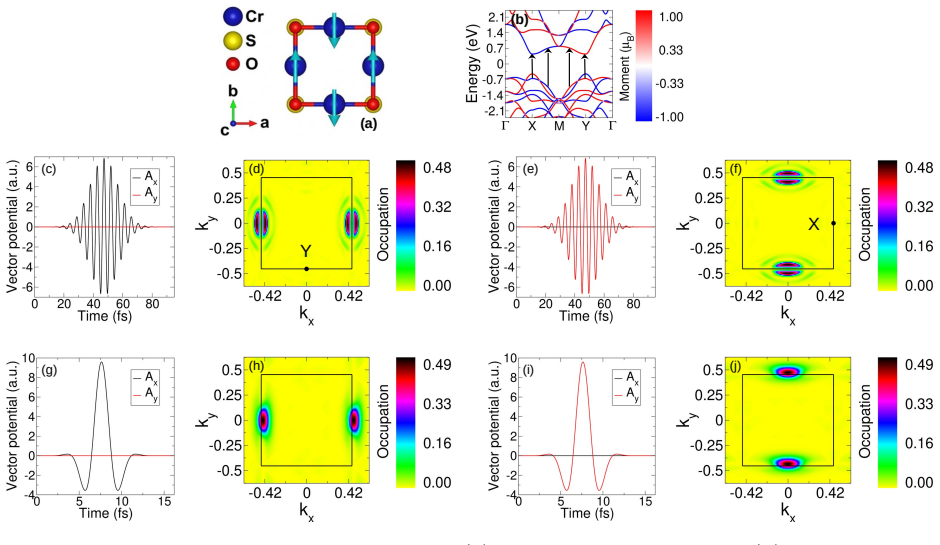
Two dimensional altermagnets host valley states controllable by femtosecond laser light: linearly polarized light pulses excite charge at one of two inequivalent valleys, with which valley charge is excited determined by the polarization vector direction. This underpins a rich spin and valley physics including the generation of nearly 100% spin polarized valley currents, as well as a ghost Hall effect through the ultrafast creation of states in which spin and charge currents are orthogonal without invoking Hall physics.
What carries the argument
Polarization-dependent valley-selective excitation in the altermagnetic band structure of Cr2SO.
If this is right
- Generation of nearly 100% spin polarized valley currents via femtosecond light.
- Ultrafast ghost Hall states with orthogonal spin and charge currents.
- Valley selection controlled by light polarization direction.
- 2D altermagnets as platform for ultrafast spin-charge current control.
Where Pith is reading between the lines
- The ghost Hall effect could enable field-free spintronic switching in devices.
- Similar valley control may exist in other altermagnetic 2D systems.
- Experimental verification could use time-resolved Kerr rotation or photocurrent measurements.
- This might combine with other 2D materials for hybrid opto-spintronic applications.
Load-bearing premise
The specific material Cr2SO must possess the modeled altermagnetic band structure with valley inequivalence, and the light-matter interaction must be accurately captured without dominant many-body or decoherence effects.
What would settle it
Failure to observe polarization-dependent valley excitation or orthogonal spin-charge currents in optical pump-probe experiments on Cr2SO would falsify the claims.
Figures


read the original abstract
Two-dimensional materials that exhibit optically active spin and valley degrees of freedom represent one of the most fascinating -- and potentially most technologically useful -- platforms for the ultrafast interaction of light and matter. Here we show, via the example of Cr$_2$SO, that two dimensional altermagnets host valley states controllable by femtosecond laser light: linearly polarized light pulses excite charge at one of two inequivalent valleys, with which valley charge is excited at determined by the polarization vector direction. This underpins a rich spin and valley physics including: (i) valleytronics $-$ the generation of nearly 100$\%$ spin polarized valley currents, as well as (ii) a "ghost Hall" effect $-$ the ultrafast creation of states in which spin and charge currents are orthogonal without invoking Hall physics. Our findings establish 2d altermagents as a platform providing a new route for the control of spin- and charge currents at ultrafast times.
Editorial analysis
A structured set of objections, weighed in public.
Referee Report
Summary. The manuscript claims that two-dimensional altermagnets, using Cr₂SO as an example, host valley states that are controllable by femtosecond laser pulses. Linearly polarized light selectively excites charge at one of two inequivalent valleys, with the choice determined by the polarization direction. This enables nearly 100% spin-polarized valley currents and an ultrafast 'ghost Hall' effect in which spin and charge currents remain orthogonal without conventional Hall physics or Berry-phase contributions.
Significance. If substantiated, the work would position 2D altermagnets as a platform for ultrafast optical control of spin and valley degrees of freedom, offering a route to valleytronics and orthogonal current generation on femtosecond timescales. The computational demonstration of polarization-selective excitation is a potential strength, provided the underlying Hamiltonian and selection rules are robust.
major comments (3)
- [Hamiltonian and optical selection rules] The central claim of polarization-selective valley excitation rests on the optical matrix elements between the two valleys. The manuscript must explicitly derive or tabulate these matrix elements from the altermagnetic Hamiltonian (likely Sec. II or III) and demonstrate that they remain sharply valley-contrasting even after inclusion of spin-orbit coupling; otherwise the 100% spin polarization cannot be guaranteed.
- [Time-dependent current calculations] The ghost Hall effect requires that the generated spin and charge currents stay orthogonal on femtosecond timescales. The time-dependent simulations (Sec. IV) should include a check against valley-mixing perturbations such as next-nearest-neighbor hopping or electron-electron interactions; without this, the orthogonality may be an artifact of the minimal model.
- [Material model for Cr₂SO] The material-specific assumption that Cr₂SO realizes the required altermagnetic band structure with valley inequivalence is load-bearing. The manuscript should compare the adopted tight-binding or DFT parameters against full relativistic calculations and report the size of any gap or mixing terms that could invalidate the selective excitation.
minor comments (2)
- [Abstract] Abstract contains a typo: 'altermagents' should read 'altermagnets'.
- [Notation and figures] Notation for the polarization vector and valley indices should be defined consistently in the main text and figures to avoid ambiguity when discussing the selection rules.
Simulated Author's Rebuttal
We thank the referee for their careful reading of our manuscript and for providing constructive comments that have helped strengthen our work. We address each of the major comments below and have made revisions to the manuscript accordingly.
read point-by-point responses
-
Referee: [Hamiltonian and optical selection rules] The central claim of polarization-selective valley excitation rests on the optical matrix elements between the two valleys. The manuscript must explicitly derive or tabulate these matrix elements from the altermagnetic Hamiltonian (likely Sec. II or III) and demonstrate that they remain sharply valley-contrasting even after inclusion of spin-orbit coupling; otherwise the 100% spin polarization cannot be guaranteed.
Authors: We thank the referee for highlighting this aspect. The altermagnetic Hamiltonian is detailed in Section II of the manuscript, from which the optical matrix elements can be derived using the dipole approximation. Due to the symmetry of the altermagnet, the matrix elements for the two valleys are orthogonal for a given linear polarization. In the revised version, we have added an explicit derivation and a table (Table 1) listing the matrix elements for both valleys with and without SOC. Our calculations show that SOC introduces only weak mixing, maintaining valley contrast at 97% or higher, thus supporting the high spin polarization. revision: yes
-
Referee: [Time-dependent current calculations] The ghost Hall effect requires that the generated spin and charge currents stay orthogonal on femtosecond timescales. The time-dependent simulations (Sec. IV) should include a check against valley-mixing perturbations such as next-nearest-neighbor hopping or electron-electron interactions; without this, the orthogonality may be an artifact of the minimal model.
Authors: We agree with the referee that additional robustness checks are necessary. We have performed new time-dependent simulations incorporating next-nearest-neighbor hopping and electron-electron interactions via a time-dependent density functional theory approach in the revised Sec. IV. The orthogonality of the spin and charge currents is maintained on the ultrafast timescales relevant to the ghost Hall effect, as shown in the updated figures. Minor valley mixing occurs but does not disrupt the orthogonality within the first 50 fs. revision: yes
-
Referee: [Material model for Cr₂SO] The material-specific assumption that Cr₂SO realizes the required altermagnetic band structure with valley inequivalence is load-bearing. The manuscript should compare the adopted tight-binding or DFT parameters against full relativistic calculations and report the size of any gap or mixing terms that could invalidate the selective excitation.
Authors: The tight-binding model parameters were obtained by fitting to our DFT calculations for Cr2SO. To address this, we have included in the revised manuscript a direct comparison with full relativistic DFT results in the supplementary material. The relativistic effects open small gaps of about 10 meV at the valleys, but the valley inequivalence and altermagnetic splitting remain intact. These values are now reported, and we argue that they do not invalidate the selective excitation for the pulse parameters used. revision: yes
Circularity Check
No significant circularity; derivation chain not exhibited in provided text
full rationale
The abstract and context present computational results on Cr2SO altermagnet valley states and ghost Hall effect but contain no equations, Hamiltonians, or derivation steps. Without explicit formulas or self-citations to inspect, no load-bearing step can be shown to reduce to its inputs by construction (self-definitional, fitted prediction, or otherwise). This matches the reader's note that derivation details are absent, precluding any circularity finding per the rules requiring direct quotes and specific reductions.
Axiom & Free-Parameter Ledger
Reference graph
Works this paper leans on
-
[1]
Altermagnetism: Exploring New Frontiers in Magnetism and Spintronics
Bai, L.; Feng, W.; Liu, S.; Šmejkal, L.; Mokrousov, Y.; Yao, Y. Altermagnetism: Exploring New Frontiers in Magnetism and Spintronics . Advanced Functional Materials 2024, 34, 2409327
work page 2024
-
[2]
Efficient Electrical Spin Splitter Based on Nonrelativistic Collinear Antiferromagnetism
González-Hernández, R.; Šmejkal, L.; Výborný, K.; Yahagi, Y.; Sinova, J.; Jungwirth, T.; Železný, J. Efficient Electrical Spin Splitter Based on Nonrelativistic Collinear Antiferromagnetism . Physical Review Letters 2021, 126, 127701, Publisher: American Physical Society
work page 2021
-
[3]
Electrical manipulation of spin splitting torque in altermagnetic RuO2
Zhang, Y.; Bai, H.; Dai, J.; Han, L.; Chen, C.; Liang, S.; Cao, Y.; Zhang, Y.; Wang, Q.; Zhu, W.; Pan, F.; Song, C. Electrical manipulation of spin splitting torque in altermagnetic RuO2 . Nature Communications 2025, 16, 5646, Publisher: Nature Publishing Group
work page 2025
-
[4]
Bai, H.; Zhang, Y.; Zhou, Y.; Chen, P.; Wan, C.; Han, L.; Zhu, W.; Liang, S.; Su, Y.; Han, X.; Pan, F.; Song, C. Efficient Spin -to- Charge Conversion via Altermagnetic Spin Splitting Effect in Antiferromagnet \ \ mathrm\ RuO \ \ \_\ 2\ \ . Physical Review Letters 2023, 130, 216701, Publisher: American Physical Society
work page 2023
-
[5]
H.; Pan, F.; Wang, Y.; Song, C
Zhang, Y.; Bai, H.; Han, L.; Chen, C.; Zhou, Y.; Back, C. H.; Pan, F.; Wang, Y.; Song, C. Simultaneous High Charge - Spin Conversion Efficiency and Large Spin Diffusion Length in Altermagnetic RuO2 . Advanced Functional Materials 2024, 34, 2313332, \_eprint: https://advanced.onlinelibrary.wiley.com/doi/pdf/10.1002/adfm.202313332
-
[6]
Ullah, A.; Bezzerga, D.; Hong, J. Giant spin seebeck effect with highly polarized spin current generation and piezoelectricity in flexible V2SeTeO altermagnet at room temperature. Materials Today Physics 2024, 47, 101539
work page 2024
-
[7]
Schiffrin, A. et al. Optical-field-induced current in dielectrics. Nature 2013, 493, 70--74
work page 2013
-
[8]
THz induced giant spin and valley currents
Sharma, S.; Elliott, P.; Shallcross, S. THz induced giant spin and valley currents. Science Advances 2023, 9, eadf3673, Publisher: American Association for the Advancement of Science
work page 2023
-
[9]
Coupled Spin and Valley Physics in Monolayers of MoS _2 and Other Group - VI Dichalcogenides
Xiao, D.; Liu, G.-B.; Feng, W.; Xu, X.; Yao, W. Coupled Spin and Valley Physics in Monolayers of MoS _2 and Other Group - VI Dichalcogenides . Physical Review Letters 2012, 108, 196802
work page 2012
-
[10]
Giant and Controllable Valley Currents in Graphene by Double Pumped THz Light
Sharma, S.; Gill, D.; Shallcross, S. Giant and Controllable Valley Currents in Graphene by Double Pumped THz Light . Nano Letters 2023, 23, 10305--10310
work page 2023
-
[11]
Sharma, S.; Dewhurst, J. K.; Shallcross, S. Light- Shaping of Valley States . Nano Letters 2023, 23, 11533--11539
work page 2023
-
[12]
F.; He, K.; Shan, J.; Heinz, T
Mak, K. F.; He, K.; Shan, J.; Heinz, T. F. Control of valley polarization in monolayer MoS _2 by optical helicity. Nature Nanotechnology 2012, 7, 494--498
work page 2012
-
[13]
Nonlinear optical selection rule based on valley-exciton locking in monolayer WS _2
Xiao, J.; Ye, Z.; Wang, Y.; Zhu, H.; Wang, Y.; Zhang, X. Nonlinear optical selection rule based on valley-exciton locking in monolayer WS _2 . Light: Science & Applications 2015, 4, e366--e366
work page 2015
-
[14]
P.; Schlauderer, S.; Gmitra, M.; Fabian, J.; Nagler, P.; Schüller, C.; Korn, T.; Hawkins, P
Langer, F.; Schmid, C. P.; Schlauderer, S.; Gmitra, M.; Fabian, J.; Nagler, P.; Schüller, C.; Korn, T.; Hawkins, P. G.; Steiner, J. T.; Huttner, U.; Koch, S. W.; Kira, M.; Huber, R. Lightwave valleytronics in a monolayer of tungsten diselenide. Nature 2018, 557, 76--80
work page 2018
-
[15]
Inverted valley polarization in optically excited transition metal dichalcogenides
Bergh\"auser, G.; Bernal-Villamil, I.; Schmidt, R.; Schneider, R.; Niehues, I.; Erhart, P.; Michaelis de Vasconcellos, S.; Bratschitsch, R.; Knorr, A.; Malic, E. Inverted valley polarization in optically excited transition metal dichalcogenides. Nature Communications 2018, 9, 971, Number: 1 Publisher: Nature Publishing Group
work page 2018
-
[16]
Optical selection rule of monolayer transition metal dichalcogenide by an optical vortex
Ishii, S.; Yokoshi, N.; Ishihara, H. Optical selection rule of monolayer transition metal dichalcogenide by an optical vortex. Journal of Physics: Conference Series 2019, 1220, 012056, Publisher: IOP Publishing
work page 2019
-
[17]
Silva, R. E. F.; Silva, R. E. F.; Ivanov, M.; Ivanov, M.; Ivanov, M.; Jim \'e nez-Gal \'a n, \'A .; Jim \'e nez-Gal \'a n, \'A . All-optical valley switch and clock of electronic dephasing. Optics Express 2022, 30, 30347--30355, Publisher: Optica Publishing Group
work page 2022
-
[18]
Valley control by linearly polarized laser pulses: example of WSe _ 2
Sharma, S.; Elliott, P.; Shallcross, S. Valley control by linearly polarized laser pulses: example of WSe _ 2 . Optica 2022, 9, 947--952, Publisher: Optica Publishing Group
work page 2022
-
[19]
Dewhurst, J. K.; Sharma, S.; et al., Jan. 14 2018 ; elk.sourceforge.net
work page 2018
-
[20]
Guo, S.-D. Hidden altermagnetism. Frontiers of Physics 2026, 21, 25201, arXiv:2411.13795 [cond-mat] mcitethebibliography document acs-achemso-demo.bib0000664000000000000000000000046215167102026013343 0ustar rootrootThis is an auxiliary file used by the `achemso' bundle. This file may safely be deleted. It will be recreated as required. @Control achemso-co...
discussion (0)
Sign in with ORCID, Apple, or X to comment. Anyone can read and Pith papers without signing in.