Impact of the formation angle on the drag of bio-inspired pmb vee-formations
Pith reviewed 2026-05-08 09:56 UTC · model grok-4.3
The pith
V-formation angle sets which members save drag, reaching 80 percent reduction for interiors at the tightest spacing.
A machine-rendered reading of the paper's core claim, the machinery that carries it, and where it could break.
Core claim
Over a range of V-formation angles, drag reduction reaches approximately 80 percent for the interior members of the tightest formation. All members experience some drag reduction for V-angles up to around 50 degrees; above that threshold only the leading member shows observable reduction. These outcomes are tied directly to the measured velocity fields, vortex shedding, circulation, and bleeding flow between members.
What carries the argument
The V-formation angle, which fixes lateral spacing and frontal overlap and thereby governs wake-body and wake-wake interactions captured by multi-illumination PIV.
If this is right
- Smaller angles increase frontal overlap so interior members sit deeper inside upstream wakes.
- Drag benefit is strongly position-dependent inside the V.
- Vortex dynamics and gap flow directly modulate the drag recorded on each member.
- Adjusting formation angle offers a direct way to tune total group drag.
- The 50-degree threshold marks the point where interior shielding becomes ineffective.
Where Pith is reading between the lines
- Real lifting bodies may shift the observed 50-degree threshold because of added downwash.
- The angle-dependent pattern could be used to program energy-optimal paths for drone swarms.
- Extending the setup to larger groups or time-varying angles would test whether adaptive formation control yields further savings.
Load-bearing premise
Axisymmetric non-lifting cylinders accurately isolate wake effects without the lift or induced velocities present on real aircraft or rotors.
What would settle it
Repeat the experiment with lifting airfoils or quadrotors at the same formation angles and check whether the 50-degree crossover in drag reduction still appears.
Figures



read the original abstract
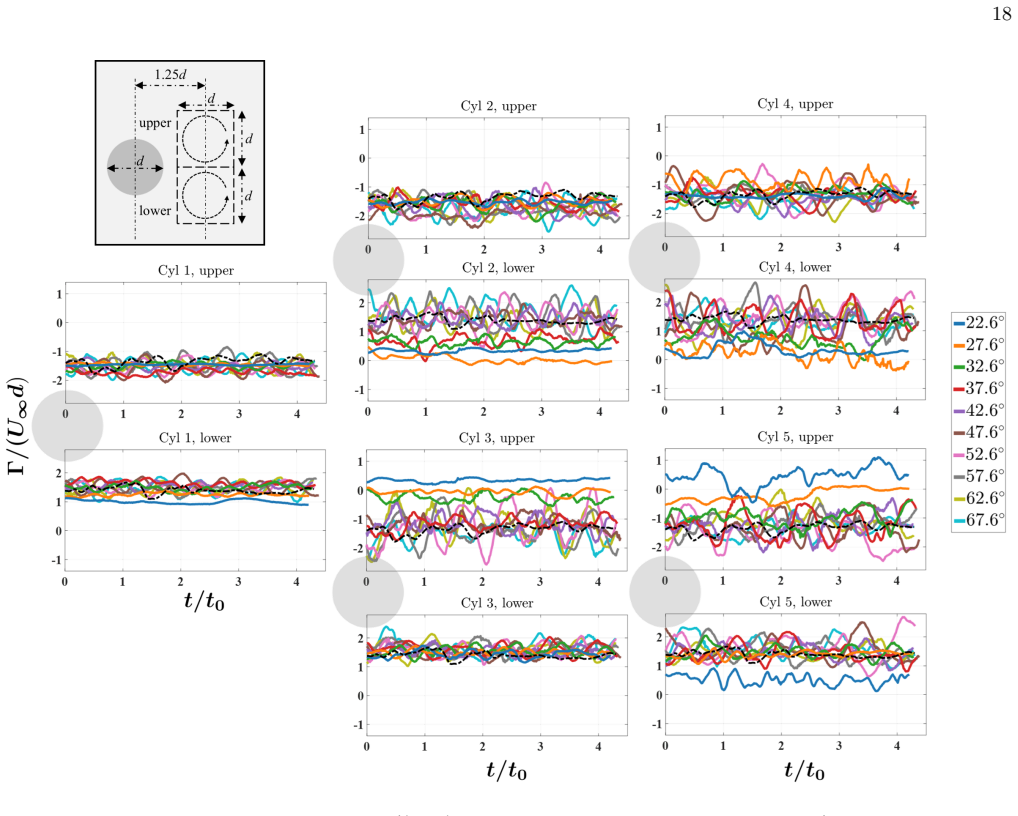
Bio-inspired $\pmb \vee$ flight formation is a well known technique for energy saving among groups of fixed-wing aircraft, and as of recently, for groups of quad-rotors. Here, we study the effect of the formation angle on the performance of each of the members of a 5-member $\pmb \vee$-formation in terms of the flow field, and drag force. We employ axisymmetric cylinders, which are non-lifting in solo condition to reduce/eliminate the effect of the lift (lateral force) on the group performance, and use time-resolved, multi-illumination, consecutive-overlapping particle image velocimetry (PIV) to capture the velocity field around and in-between the members. Over a range of $\pmb \vee$-formation angles, we see various degree of drag reduction, with the highest drag reduction ($\sim 80\%$) for the interior members of the tightest formation (formation with the smallest $\pmb \vee$-angle and the most overlap in frontal views). All formation members experience some levels of drag reduction up for $\pmb \vee$-angle of around $50^{\circ}$ and in formation with $\pmb \vee$-angle greater than $50^{\circ}$, only the leading member experiences observable drag reduction. We explore the complex flow dynamics between the formation members in terms of wake-body and wake-wake interactions, and the bleeding (gap) flow. We present the mean and fluctuating quantities, as well as the dynamics of the vortex shedding and circulation in the wakes of the members, and discuss how these flow characteristics relate to the drag of each member, both as a function of their position within the $\pmb \vee$ and the angle of the formation. This current study serves as a baseline for further explorations of wake-body and wake-wake interactions of flow past groups of bodies, and demonstrates how changing formation angle can help achieve a desired group performance (like minimum drag).
Editorial analysis
A structured set of objections, weighed in public.
Referee Report
Summary. The manuscript experimentally investigates the effect of V-formation angle on drag and flow fields for a 5-member group of non-lifting axisymmetric cylinders using time-resolved multi-illumination PIV. It reports angle-dependent drag reductions, with a maximum of ~80% for interior members in the tightest (smallest-angle) formation; all members show some reduction up to ~50° while only the leader benefits beyond that. Wake-body/wake-wake interactions and bleeding flow are analyzed via mean/fluctuating velocities, vortex shedding, and circulation to link flow features to individual-member drag.
Significance. If the quantitative trends hold, the work supplies a useful experimental baseline for wake interactions among bluff bodies in formation, with strengths in the time-resolved PIV capture of vortex dynamics and the systematic angle sweep. These data could inform models of clustered-body flows. However, the deliberate choice of non-lifting cylinders limits direct mapping to bio-inspired applications (birds, aircraft, quadrotors), where lift-induced upwash is the primary mechanism.
major comments (3)
- [Abstract] Abstract: the headline claim of ~80% drag reduction for interior members in the tightest formation is presented without error bars, uncertainty estimates, or statistical tests on the force measurements. Given that the central results are quantitative experimental trends, this omission makes it difficult to judge whether the reported magnitude is robust or within experimental scatter.
- [Abstract] Abstract and (presumed) Methods: the proxy of non-lifting axisymmetric cylinders is chosen 'to reduce/eliminate the effect of the lift', yet the title and framing invoke bio-inspired V-formations whose documented drag savings arise primarily from lift-generated trailing vortices and upwash. The reported angle thresholds (~50°) and interior-member savings therefore characterize a different physical regime (bluff-body vortex shedding and momentum deficit) whose quantitative applicability to lifting bodies requires explicit justification or additional discussion.
- [Methods] Results/Methods (flow diagnostics): Reynolds number, cylinder aspect ratio, and blockage details are not stated in the provided abstract and appear insufficiently specified for the vortex-shedding and circulation analysis. These parameters directly govern the wake dynamics that the paper links to drag reduction, so their absence undermines reproducibility and interpretation of the PIV-derived quantities.
minor comments (2)
- [Introduction] Figure captions and text should explicitly define the V-angle convention and frontal-overlap metric with a schematic, as these are central to the angle-sweep claims.
- [Results] Notation for fluctuating quantities (e.g., rms velocities) and circulation should be standardized across the text and figures to avoid ambiguity in the wake-interaction discussion.
Simulated Author's Rebuttal
We thank the referee for their constructive and detailed review, which highlights both the strengths of our time-resolved PIV approach and areas for improvement. We address each major comment below and will incorporate revisions to strengthen the manuscript.
read point-by-point responses
-
Referee: [Abstract] Abstract: the headline claim of ~80% drag reduction for interior members in the tightest formation is presented without error bars, uncertainty estimates, or statistical tests on the force measurements. Given that the central results are quantitative experimental trends, this omission makes it difficult to judge whether the reported magnitude is robust or within experimental scatter.
Authors: We agree that the abstract would benefit from explicit uncertainty information to support the quantitative claim. In the full manuscript, drag coefficients are derived from multiple independent runs (typically 5–10 per configuration) with standard deviations reported in the results figures and tables (generally 3–8% relative uncertainty). We will revise the abstract to include a concise qualifier, such as noting the ~80% reduction for interior members with an estimated uncertainty of ±5–7%, while preserving brevity. This addresses the concern without altering the headline result. revision: yes
-
Referee: [Abstract] Abstract and (presumed) Methods: the proxy of non-lifting axisymmetric cylinders is chosen 'to reduce/eliminate the effect of the lift', yet the title and framing invoke bio-inspired V-formations whose documented drag savings arise primarily from lift-generated trailing vortices and upwash. The reported angle thresholds (~50°) and interior-member savings therefore characterize a different physical regime (bluff-body vortex shedding and momentum deficit) whose quantitative applicability to lifting bodies requires explicit justification or additional discussion.
Authors: The selection of non-lifting cylinders was deliberate to isolate wake-body and wake-wake interactions and momentum-deficit effects, as stated in the abstract and introduction, thereby establishing a controlled baseline free from lift-induced upwash. We recognize that this differs from the primary mechanism in bio-inspired lifting formations (birds, aircraft). In the revised manuscript we will expand the discussion to explicitly contrast the two regimes, note that the observed ~50° threshold and interior savings are specific to the bluff-body case, and clarify the limitations on direct quantitative transferability while emphasizing the value of this wake-interaction reference for future lifting-body studies. revision: yes
-
Referee: [Methods] Results/Methods (flow diagnostics): Reynolds number, cylinder aspect ratio, and blockage details are not stated in the provided abstract and appear insufficiently specified for the vortex-shedding and circulation analysis. These parameters directly govern the wake dynamics that the paper links to drag reduction, so their absence undermines reproducibility and interpretation of the PIV-derived quantities.
Authors: These parameters are provided in the Methods section (Re_D = 5000, aspect ratio L/D = 10, blockage ratio < 6%). We apologize if their placement made them insufficiently prominent for the referee. To improve clarity and reproducibility we will add a short 'Key Experimental Parameters' sentence to the abstract and ensure the values are repeated at the start of the Results section. This will directly support interpretation of the vortex-shedding, circulation, and PIV quantities without changing any data or analysis. revision: yes
Circularity Check
No derivation or model present; results are direct experimental measurements with no fitted predictions or self-referential chains.
full rationale
The paper reports experimental drag and PIV measurements on non-lifting cylinders in V-formations. No equations, derivations, fitted parameters, or first-principles predictions are claimed. All quantitative results (drag reductions up to ~80%, angle thresholds around 50°) are obtained directly from force sensors and velocity fields. No self-citations are used to justify core claims, and no ansatz or uniqueness theorem is invoked. The work is self-contained as an empirical study; the proxy choice (axisymmetric cylinders) is an explicit methodological assumption but does not create circularity in any derivation chain.
Axiom & Free-Parameter Ledger
axioms (1)
- standard math Incompressible flow at the experimental Reynolds number with negligible compressibility effects
Reference graph
Works this paper leans on
-
[1]
Most overlapping formations,ϕ=22.6 ○ and27.6 ○ The leading members of formations withϕ=22.6 ○, and 27.6 ○, shown in Figs. 3(a-b) and 4(a-b), experience wakes that partially encompass members 2 and 3, leading to wider wakes in the normal (y) direction compared with the solo case. These 2 cases, with the lowest angles, only allow a small amount of flow in t...
-
[2]
When there is a slight gap between members 2 and 3, as for the case ofϕ=27.6 ○ shown in Figs. 3(b) and 4(b), the equivalent bleeding flowsU b 12 and U b 13 are substantially higher (∼9%) with the two bleeding flows becomingu b
-
[3]
However, the limited space between members 2 and 3 cannot change the pattern of the flow field (compared withϕ=22.6 ○) and a single recirculating vortex remains in the separation bubble between cylinders 1-2-3 (Fig. 5(b)). Here again, we see the streamlines of Int 12 enter the separation bubble, create the recirculating region, and this time they leave th...
-
[4]
Intermediate overlaps,ϕ=32.6 ○−47.6○ For the rest of the formations with overlaps, namelyϕ=32.6 ○, 37.6○, and 42.6 ○, and the marginal case ofϕ=47.6 ○, as the space between members 2 and 3 increases, the bleeding flow into the interior of the formation also increases. Unlike the bleeding flowu b 23 ofϕ=22.6 ○ and 27.6○ which is either non-existent or very...
-
[5]
Non-overlapping formations,ϕ=52.6 ○−67.6○ For all the cases withϕ⩾52.6 ○ (no overlaps in the streamwise direction), we see the width of the wake of member 1 to be smaller than the previous two groups (see Figs. 3(g-j) and 4(g-j)), as the space between members 2 and 3 allows for larger magnitudes of bleeding flow to move between the members. Right before m...
-
[6]
The trailing members 4 and 5, with all the space available in their downstream, develop wakes with closer similarities to the wake of a solo cylinder (but with the aforementioned asymmetries). Even with the differences in the flow field and the streamlines, members 4 and 5 of these formations record similar drag values as that of the solo cylinder as seen...
-
[7]
L. L. Gould and F. Heppner, The Vee formation of Canada geese, The Auk91, 494 (1974)
work page 1974
-
[8]
R. M. May, Flight formations in geese and other birds, Nature282, 778 (1979)
work page 1979
-
[9]
C. Cutts and J. Speakman, Energy savings in formation flight of pink-footed geese, The Journal of experimental biology 189, 251 (1994)
work page 1994
-
[10]
H. Weimerskirch, J. Martin, Y. Clerquin, P. Alexandre, and S. Jiraskova, Energy saving in flight formation, Nature413, 697 (2001)
work page 2001
-
[11]
M. Nagy, Z. ´Akos, D. Biro, and T. Vicsek, Hierarchical group dynamics in pigeon flocks, Nature464, 890 (2010). 21
work page 2010
-
[12]
S. J. Portugal, T. Y. Hubel, J. Fritz, S. Heese, D. Trobe, B. Voelkl, S. Hailes, A. M. Wilson, and J. R. Usherwood, Upwash exploitation and downwash avoidance by flap phasing in ibis formation flight, Nature505, 399 (2014)
work page 2014
-
[13]
A. Attanasi, A. Cavagna, L. Del Castello, I. Giardina, S. Melillo, L. Parisi, O. Pohl, B. Rossaro, E. Shen, E. Silvestri, and M. Viale, Collective behaviour without collective order in wild swarms of midges, PLoS computational biology10, e1003697 (2014)
work page 2014
-
[14]
A. Cavagna, D. Conti, C. Creato, L. Del Castello, I. Giardina, T. S. Grigera, S. Melillo, L. Parisi, and M. Viale, Dynamic scaling in natural swarms, Nature Physics13, 914 (2017)
work page 2017
-
[15]
J. F. M´ endez-Valderrama, Y. A. Kinkhabwala, J. Silver, I. Cohen, and T. A. Arias, Density-functional fluctuation theory of crowds, Nature communications9, 3538 (2018)
work page 2018
-
[16]
J. C. Liao, D. N. Beal, G. V. Lauder, and M. S. Triantafyllou, Fish exploiting vortices decrease muscle activity, Science 302, 1566 (2003)
work page 2003
-
[17]
Y. Zhang and G. V. Lauder, Energy conservation by collective movement in schooling fish, eLife12, RP90352 (2024)
work page 2024
-
[18]
H. Ko, G. Lauder, and R. Nagpal, The role of hydrodynamics in collective motions of fish schools and bioinspired underwater robots, Journal of The Royal Society Interface20(2023)
work page 2023
- [19]
-
[20]
J. Kelly and H. Dong, Effects of body shape on hydrodyanmic interactions in a dense diamond fish school, Physics of Fluids36(2024)
work page 2024
-
[21]
R. G. Bill and W. F. Herrnkind, Drag reduction by formation movement in spiny lobsters, Science193, 1146 (1976)
work page 1976
- [22]
-
[23]
M. Gymnopoulos, A. M. Ricardo, E. Alves, and R. M. L. Ferreira, A circular cylinder in the main-channel/floodplain interface of a compound channel: effect of the shear flow on drag and lift, Journal of Hydraulic Research58, 420 (2019)
work page 2019
- [24]
-
[25]
M. Liu, W. Huai, B. Ji, and P. Han, Numerical study on the drag characteristics of rigid submerged vegetation patches, Physics of Fluids33, 1 (2021)
work page 2021
-
[26]
R. M. L. Ferreira, M. Gymnopoulos, P. Prinos, E. Alves, and A. M. Ricardo, Drag on a square-cylinder array placed in the mixing layer of a compound channel, Water13, 1 (2021)
work page 2021
-
[27]
F. He, H. An, M. Ghisalberti, S. Draper, C. Ren, P. Branson, and L. Cheng, Obstacle arrangement can control flows through porous obstructions, Journal of Fluid Mechanics992(2024)
work page 2024
-
[28]
A. T. Sayers, Flow interference between three equispaced cylinders when subjected to a cross flow, Journal of Wind Engineering and Industrial Aerodynamics26, 1 (1987)
work page 1987
-
[29]
G. Stanescu, A. J. Fowler, and A. Bejan, The optimal spacing of cylinders in free-stream cross-flow forced convection, International Journal of Heat and Mass Transfer39, 311 (1996)
work page 1996
-
[30]
R. Kumar and N. K. Singh, Three dimensional flow over elliptic cylinders arrays in octagonal arrangement, Journal of Thermal Engineering7, 2031 (2021)
work page 2031
- [31]
-
[32]
F. A. van den Brandt, S. G. Menting, F. J. Hettinga, and M. T. Elferink-Gemser, Drafting in long-track speed skating team pursuit on the ice rink, Journal of Sports Sciences41, 456 (2023)
work page 2023
-
[33]
B. Blocken, T. van Druenen, Y. Toparlar, F. Malizia, P. Mannion, T. Andrianne, T. Marchal, G.-J. Maas, and J. Diepens, Aerodynamic drag in cycling pelotons: New insights by cfd simulation and wind tunnel testing, Journal of Wind Engineering and Industrial Aerodynamics179, 319 (2018)
work page 2018
-
[34]
P. B. S. Lissaman and C. A. Shollenberger, Formation flight of birds, Science168, 1003 (1970)
work page 1970
-
[35]
D. Hummel, Aerodynamic aspects of formation flight in birds, Journal of Theoretical Biology104, 321 (1983)
work page 1983
-
[36]
Hummel, The use of aircraft wakes to achieve power reductions in formation flight (1996)
D. Hummel, The use of aircraft wakes to achieve power reductions in formation flight (1996)
work page 1996
-
[37]
W. Blake and D. Multhopp, Design, performance and modeling considerations for close formation flight (1998)
work page 1998
-
[38]
D. Jacques, M. Pachter, G. Wagner, and B. Blake, An analytical study of drag reduction in tight formation flight (2001)
work page 2001
-
[39]
Kawabe, A study on optimal pattern and leader shift of formation flight, Trans
H. Kawabe, A study on optimal pattern and leader shift of formation flight, Trans. Japan Soc. Aero. Space Sci.50, 134 (2007)
work page 2007
-
[40]
J. Xu, S. Andrew Ning, G. Bower, and I. Kroo, Aircraft route optimization for formation flight, Journal of Aircraft51, 490 (2014)
work page 2014
-
[41]
S. A. Ning, T. C. Flanzer, and I. M. Kroo, Aerodynamic performance of extended formation flight, Journal of aircraft48, 855 (2011)
work page 2011
- [42]
-
[43]
S. Guo, B. Alkouz, B. Shahzaad, A. Lakhdari, and A. Bouguettaya, Drone formation for efficient swarm energy consumption (2023), IEEE International Conference on Pervasive Computing and Communications Workshops and other Affiliated Events (PerCom Workshops): Demos
work page 2023
-
[44]
P. Suchandra and S. Raayai-Ardakani, Impact of bio-inspired v-formation on flow past arrangements of non-lifting objects, Physics of Fluids36(2024)
work page 2024
-
[45]
C. H. K. Williamson, Vortex dynamics in the cylinder wake, Annual Review of Fluid Mechanics28, 477 (1996)
work page 1996
-
[46]
C. Williamson, Evolution of a single wake behind a pair of bluff bodies, Journal of Fluid Mechanics159, 1 (1985)
work page 1985
- [47]
-
[48]
D. Sumner, Two circular cylinders in cross-flow: A review, Journal of fluids and structures26, 849 (2010)
work page 2010
-
[49]
M. Zdravkovich and D. Pridden, Interference between two circular cylinders; series of unexpected discontinuities, Journal of wind engineering and industrial aerodynamics2, 255 (1977)
work page 1977
-
[50]
M. Zdravkovich, Review of flow interference between two circular cylinders in various arrangements, Journal of fluids engineering99, 618 (1977)
work page 1977
-
[51]
M. Zdravkovich, The effects of interference between circular cylinders in cross flow, Journal of fluids and structures1, 239 (1987)
work page 1987
-
[52]
Y. Zhou and M. M. Alam, Wake of two interacting circular cylinders: A review, International Journal of Heat and Fluid Flow62, 510 (2016)
work page 2016
-
[53]
Rockwell, Vortex-body interactions, Annual review of fluid mechanics30, 199 (1998)
D. Rockwell, Vortex-body interactions, Annual review of fluid mechanics30, 199 (1998)
work page 1998
-
[54]
S. Fu, P. Suchandra, and S. Raayai-Ardakani, Multi-sheet illumination and consecutive overlapping 2D-2C PIV acquisition for enhanced access to boundary layer flows around obstructive opaque objects,https://scholarworks.calstate.edu/ concern/publications/dj52wb987(2023), proceedings of the 15th International Symposium on Particle Image Velocimetry (ISPIV 2...
work page 2023
-
[55]
A. Nair, A. Kazemi, O. Curet, and S. Verma, Porous cylinder arrays for optimal wake and drag characteristics, Journal of Fluid Mechanics961, A18 (2023)
work page 2023
-
[56]
N. Amini and Y. A. Hassan, An investigation of matched index of refraction technique and its application in optical measurements of fluid flow, Experiments in fluids53, 2011 (2012)
work page 2011
-
[57]
S. F. Wright, I. Zadrazil, and C. N. Markides, A review of solid–fluid selection options for optical-based measurements in single-phase liquid, two-phase liquid–liquid and multiphase solid–liquid flows, Experiments in Fluids58, 1 (2017)
work page 2017
- [58]
- [59]
-
[60]
P. Bearman, Investigation of the flow behind a two-dimensional model with a blunt trailing edge and fitted with splitter plates, Journal of fluid mechanics21, 241 (1965)
work page 1965
-
[61]
P. W. Bearman, On vortex shedding from a circular cylinder in the critical reynolds number regime, Journal of Fluid Mechanics37, 577 (1969)
work page 1969
-
[62]
P. W. Bearman, Vortex shedding from oscillating bluff bodies, Annual review of fluid mechanics16, 195 (1984)
work page 1984
-
[63]
M. F. Unal and D. Rockwell, On vortex formation from a cylinder. part 1. the initial instability, Journal of Fluid Mechanics 190, 491 (1988)
work page 1988
-
[64]
G. Chopra and S. Mittal, Drag coefficient and formation length at the onset of vortex shedding, Physics of Fluids31, 1 (2019)
work page 2019
- [65]
-
[66]
J. H. Lienhard, Synopsis of lift, drag, and vortex frequency data for rigid circular cylinders (1966), technical Extension Service, Washington State University
work page 1966
-
[67]
Van Dyke, An Album of Fluid Motion (The Parabolic Press, 1982)
M. Van Dyke, An Album of Fluid Motion (The Parabolic Press, 1982)
work page 1982
-
[68]
R. J. Adrian and J. Westerweel, Particle image velocimetry, 30 (Cambridge university press, New York, 2011)
work page 2011
-
[69]
R. J. Adrian, Particle-imaging techniques for experimental fluid mechanics, Annual Review of Fluid Mechanics23, 261 (1991)
work page 1991
- [70]
-
[71]
Teensy Timer Tool, Double Exposure Laser Illuminator,https://github.com/luni64/TeensyTimerTool(2023), accessed: 2023-03-20
work page 2023
-
[72]
A. Liberzon, D. Lasagna, M. Aubert, P. Bachant, T. K¨ aufer, jakirkham, A. Bauer, B. Vodenicharski, C. Dallas, J. Borg, tomerast, and ranleu, OpenPIV/openpiv-python: OpenPIV - python (v0.22.2) with a new extended search PIV grid option (0.22.2), Zenodo3930343(2020)
work page 2020
-
[73]
J. Westerweel and F. Scarano, Universal outlier detection for PIV data, Experiments in fluids39, 1096 (2005)
work page 2005
-
[74]
P. K. Kundu and I. M. Cohen, Fluid Mechanics, 4 th ed (Academic Press, 2008)
work page 2008
- [75]
-
[76]
J. J. Charonko, C. V. King, B. L. Smith, and P. P. Vlachos, Assessment of pressure field calculations from particle image velocimetry measurements, Measurement Science and Technology21, 1 (2010)
work page 2010
-
[77]
R. de Kat and B. Ganapathisubramani, Pressure from particle image velocimetry for convective flows: a taylor’s hypothesis approach, Measurement Science and Technology24, 1 (2013)
work page 2013
-
[78]
B. W. van Oudheusden, Piv-based pressure measurement, Measurement Science and Technology24, 1 (2013)
work page 2013
-
[79]
X. Liu, J. R. Moreto, and S. Siddle-Mitchell, Instantaneous pressure reconstruction from measured pressure gradient using rotating parallel ray method (2016), paper presented at the 54th AIAA SciTech Meeting, San Diego, California, USA, 4–8 January 2016
work page 2016
- [80]
discussion (0)
Sign in with ORCID, Apple, or X to comment. Anyone can read and Pith papers without signing in.