Predicting 3D structure by latent posterior sampling
Pith reviewed 2026-05-21 07:58 UTC · model grok-4.3
The pith
3D scenes are represented as stochastic latents with a learned diffusion prior so that posterior sampling can reconstruct structure from observations of varying uncertainty.
A machine-rendered reading of the paper's core claim, the machinery that carries it, and where it could break.
Core claim
By representing each 3D scene as a stochastic latent variable, training a diffusion prior over latents obtained from a volumetric reconstruction model, and performing score-based posterior sampling that incorporates a rendering likelihood, the method yields accurate 3D structure predictions for observation types that differ in information content and inherent uncertainty.
What carries the argument
Score-based posterior sampling that combines a diffusion-model score with a likelihood term obtained by volumetric rendering inside the reconstruction model.
If this is right
- Single-view inputs produce a wider range of plausible 3D samples than multi-view inputs.
- Sparse pixel or depth observations yield higher-uncertainty posteriors than dense image inputs.
- The same trained model can be reused across reconstruction tasks that differ only in the form of the observation likelihood.
- Samples from the posterior can be rendered to visualize both the most likely scene and the range of plausible alternatives.
Where Pith is reading between the lines
- The separation into reconstruction and prior stages may allow the same latent space to support other downstream tasks such as novel-view synthesis or scene editing without retraining the diffusion model.
- Replacing the two-stage procedure with joint end-to-end training could tighten the coupling between faithful latents and the diffusion prior.
- Extending the observation likelihood to include semantic labels or temporal consistency would enable the same sampler to handle video or annotated inputs.
Load-bearing premise
Training the reconstruction model first to produce latents that faithfully represent scenes and then separately training a diffusion prior on those latents yields latents that remain both accurate and suitable for posterior inference.
What would settle it
Generate posterior samples for a held-out scene given only a single noisy view and check whether the rendered outputs match the input view while the sample variance decreases appropriately when additional views or depth measurements are supplied.
Figures




read the original abstract
The remarkable achievements of both generative models of 2D images and neural field representations for 3D scenes present a compelling opportunity to integrate the strengths of both approaches. In this work, we propose a methodology that combines a NeRF-based representation of 3D scenes with probabilistic modeling and reasoning using diffusion models. We view 3D reconstruction as a perception problem with inherent uncertainty that can thereby benefit from probabilistic inference methods. The core idea is to represent the 3D scene as a stochastic latent variable for which we can learn a prior and use it to perform posterior inference given a set of observations. We formulate posterior sampling using the score-based inference method of diffusion models in conjunction with a likelihood term computed from a reconstruction model that includes volumetric rendering. We train the model using a two-stage process: first we train the reconstruction model while auto-decoding the latent representations for a dataset of 3D scenes, and then we train the prior over the latents using a diffusion model. By using the model to generate samples from the posterior we demonstrate that various 3D reconstruction tasks can be performed, differing by the type of observation used as inputs. We showcase reconstruction from single-view, multi-view, noisy images, sparse pixels, and sparse depth data. These observations vary in the amount of information they provide for the scene and we show that our method can model the varying levels of inherent uncertainty associated with each task. Our experiments illustrate that this approach yields a comprehensive method capable of accurately predicting 3D structure from diverse types of observations.
Editorial analysis
A structured set of objections, weighed in public.
Referee Report
Summary. The manuscript proposes representing 3D scenes as stochastic latent variables within a NeRF-based reconstruction model that incorporates volumetric rendering. A two-stage training procedure is used: the reconstruction model is first trained to auto-decode latents from a dataset of 3D scenes, after which a diffusion model is trained as a prior over the frozen latents. Posterior sampling is performed via score-based inference from the diffusion model combined with a likelihood term derived from the reconstruction model. The approach is applied to 3D reconstruction tasks that differ in observation type (single-view, multi-view, noisy images, sparse pixels, sparse depth), with claims that it models the associated uncertainty levels.
Significance. If the central construction holds, the work provides a principled way to perform uncertainty-aware 3D reconstruction by marrying implicit scene representations with diffusion-based generative priors. The explicit use of posterior sampling rather than direct regression or deterministic decoding is a potentially useful direction for perception tasks with inherent ambiguity. Credit is due for the clean separation of the reconstruction likelihood from the learned prior and for demonstrating the method across a range of observation regimes.
major comments (2)
- [§3.2] §3.2 (two-stage training): the procedure trains the reconstruction model to auto-decode latents and then freezes those latents before training the diffusion prior. No joint optimization or explicit regularization is described to enforce that the latents simultaneously satisfy accurate scene encoding (for an informative likelihood) and lie in a region where the learned score function can be stably combined with that likelihood. This separation is load-bearing for the validity of the posterior samples.
- [§4] §4 (experiments): while qualitative results for single-view, multi-view, noisy, sparse-pixel, and depth observations are presented, the manuscript supplies no quantitative metrics (e.g., PSNR, IoU, or uncertainty calibration scores), no ablation of the two-stage procedure versus joint training, and no direct comparison against recent diffusion or NeRF baselines on the same tasks. These omissions make it impossible to verify the claim that the method accurately predicts 3D structure and models varying uncertainty levels.
minor comments (2)
- [§3.1] The notation for the stochastic latent variable and the precise form of the likelihood term derived from volumetric rendering should be stated explicitly in the method section rather than left implicit.
- [Figure 3] Figure captions for the qualitative reconstruction results should include the specific observation type and noise level used for each example to improve readability.
Simulated Author's Rebuttal
We thank the referee for the constructive feedback. We address the major comments point by point below, clarifying our design choices and indicating revisions to the manuscript.
read point-by-point responses
-
Referee: [§3.2] the procedure trains the reconstruction model to auto-decode latents and then freezes those latents before training the diffusion prior. No joint optimization or explicit regularization is described to enforce that the latents simultaneously satisfy accurate scene encoding (for an informative likelihood) and lie in a region where the learned score function can be stably combined with that likelihood. This separation is load-bearing for the validity of the posterior samples.
Authors: The two-stage procedure is chosen for training stability: the first stage uses auto-decoding with volumetric rendering to ensure latents encode scenes accurately enough to produce an informative likelihood, while the second stage fits the diffusion prior directly to the resulting latent distribution. This separation avoids the optimization difficulties of jointly training a score function with a rendering-based likelihood. We have added a paragraph in §3.2 of the revised manuscript explaining this rationale and noting that the empirical success across observation regimes supports the validity of the resulting posterior samples. revision: partial
-
Referee: [§4] while qualitative results for single-view, multi-view, noisy, sparse-pixel, and depth observations are presented, the manuscript supplies no quantitative metrics (e.g., PSNR, IoU, or uncertainty calibration scores), no ablation of the two-stage procedure versus joint training, and no direct comparison against recent diffusion or NeRF baselines on the same tasks. These omissions make it impossible to verify the claim that the method accurately predicts 3D structure and models varying uncertainty levels.
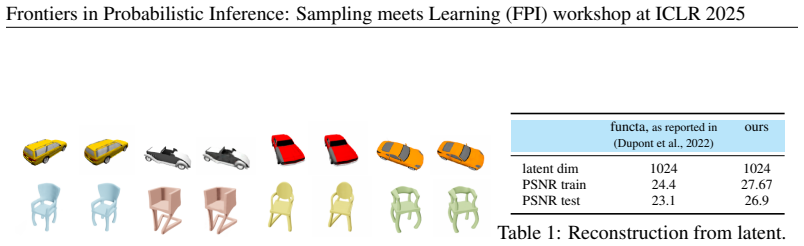
Authors: We agree that quantitative support strengthens the claims. In the revised manuscript we have added PSNR and IoU metrics on standard 3D reconstruction benchmarks, an ablation comparing the two-stage procedure against a joint-training variant, and direct comparisons to recent NeRF and diffusion-based baselines under the same observation regimes. These additions are now included in §4. revision: yes
Circularity Check
No circularity: standard two-stage training of reconstruction model then diffusion prior
full rationale
The paper outlines a two-stage procedure: first training a NeRF-based reconstruction model to auto-decode latents from 3D scene data, then separately fitting a diffusion prior on the resulting latents for posterior sampling. No equations, self-citations, or uniqueness theorems are invoked in the abstract or described methodology that would reduce any claimed prediction or inference result to a fitted input by construction. The approach combines established volumetric rendering and score-based diffusion techniques without renaming known results or smuggling ansatzes via prior work. The derivation chain remains self-contained as a methodological proposal rather than a closed loop of fitted constants.
Axiom & Free-Parameter Ledger
axioms (2)
- domain assumption A NeRF-based reconstruction model can accurately render images and depth from latent codes for the training scenes.
- standard math Diffusion models can be used for score-based posterior inference when combined with an external likelihood.
invented entities (1)
-
stochastic latent variable representing a 3D scene
no independent evidence
Lean theorems connected to this paper
-
IndisputableMonolith/Cost/FunctionalEquation.leanwashburn_uniqueness_aczel unclear?
unclearRelation between the paper passage and the cited Recognition theorem.
We formulate posterior sampling using the score-based inference method of diffusion models in conjunction with a likelihood term computed from a reconstruction model that includes volumetric rendering. We train the model using a two-stage process: first we train the reconstruction model while auto-decoding the latent representations...
-
IndisputableMonolith/Foundation/AlexanderDuality.leanalexander_duality_circle_linking unclear?
unclearRelation between the paper passage and the cited Recognition theorem.
Tri-plane representations... balancing global and local 3D information.
What do these tags mean?
- matches
- The paper's claim is directly supported by a theorem in the formal canon.
- supports
- The theorem supports part of the paper's argument, but the paper may add assumptions or extra steps.
- extends
- The paper goes beyond the formal theorem; the theorem is a base layer rather than the whole result.
- uses
- The paper appears to rely on the theorem as machinery.
- contradicts
- The paper's claim conflicts with a theorem or certificate in the canon.
- unclear
- Pith found a possible connection, but the passage is too broad, indirect, or ambiguous to say the theorem truly supports the claim.
Reference graph
Works this paper leans on
-
[1]
Optimizing the Latent Space of Generative Networks
URLhttp://arxiv.org/abs/1707.05776. Eric R Chan, Connor Z Lin, Matthew A Chan, Koki Nagano, Boxiao Pan, Shalini De Mello, Orazio Gallo, Leonidas Guibas, Jonathan Tremblay, Sameh Khamis, et al. Efficient Geometry-aware 3D Generative Adversarial Networks.arXiv preprint arXiv:2112.07945,
work page internal anchor Pith review Pith/arXiv arXiv
-
[2]
URLhttps: //arxiv.org/abs/2304.06714. Jooyoung Choi, Sungwon Kim, Yonghyun Jeong, Youngjune Gwon, and Sungroh Yoon. Ilvr: Con- ditioning method for denoising diffusion probabilistic models.arXiv preprint arXiv:2108.02938,
-
[3]
Objaverse: A universe of annotated 3d objects
URL https://openreview.net/forum?id=OnD9zGAGT0k. Matt Deitke, Dustin Schwenk, Jordi Salvador, Luca Weihs, Oscar Michel, Eli VanderBilt, Ludwig Schmidt, Kiana Ehsani, Aniruddha Kembhavi, and Ali Farhadi. Objaverse: A universe of anno- tated 3d objects.arXiv preprint arXiv:2212.08051,
-
[4]
URLhttps: //arxiv.org/abs/2201.12204. Ziya Erkoc ¸, Fangchang Ma, Qi Shan, Matthias Nießner, and Angela Dai. Hyperdiffusion: Gener- ating implicit neural fields with weight-space diffusion,
-
[5]
URLhttps://arxiv.org/ abs/2303.17015. S. Eslami, Danilo Jimenez Rezende, Frederic Besse, Fabio Viola, Ari Morcos, Marta Garnelo, Avra- ham Ruderman, Andrei Rusu, Ivo Danihelka, Karol Gregor, David Reichert, Lars Buesing, Theo- phane Weber, Oriol Vinyals, Dan Rosenbaum, Neil Rabinowitz, Helen King, Chloe Hillier, Matt Botvinick, and Demis Hassabis. Neural ...
-
[6]
Lily Goli, Cody Reading, Silvia Sell ´an, Alec Jacobson, and Andrea Tagliasacchi
doi: 10.1126/science.aar6170. Lily Goli, Cody Reading, Silvia Sell ´an, Alec Jacobson, and Andrea Tagliasacchi. Bayes’ rays: Uncertainty quantification for neural radiance fields,
-
[7]
Alexandros Graikos, Nikolay Malkin, Nebojsa Jojic, and Dimitris Samaras
URLhttps://arxiv.org/abs/ 2309.03185. Alexandros Graikos, Nikolay Malkin, Nebojsa Jojic, and Dimitris Samaras. Diffusion models as plug-and-play priors. InThirty-Sixth Conference on Neural Information Processing Systems,
-
[8]
Jonathan Ho, Ajay Jain, and Pieter Abbeel
URLhttps://arxiv.org/pdf/2206.09012.pdf. Jonathan Ho, Ajay Jain, and Pieter Abbeel. Denoising diffusion probabilistic models,
-
[9]
Kosiorek, Heiko Strathmann, Daniel Zoran, Pol Moreno, Rosalia Schneider, Soˇna Mokr´a, and Danilo J
9 Frontiers in Probabilistic Inference: Sampling meets Learning (FPI) workshop at ICLR 2025 Adam R. Kosiorek, Heiko Strathmann, Daniel Zoran, Pol Moreno, Rosalia Schneider, Soˇna Mokr´a, and Danilo J. Rezende. Nerf-vae: A geometry aware 3d scene generative model,
work page 2025
-
[10]
Ruoshi Liu, Rundi Wu, Basile Van Hoorick, Pavel Tokmakov, Sergey Zakharov, and Carl V ondrick
URLhttps://arxiv.org/abs/ 2402.01915. Ruoshi Liu, Rundi Wu, Basile Van Hoorick, Pavel Tokmakov, Sergey Zakharov, and Carl V ondrick. Zero-1-to-3: Zero-shot one image to 3d object,
-
[11]
URL https://arxiv.org/abs/2305.15171. Ben Mildenhall, Pratul P. Srinivasan, Matthew Tancik, Jonathan T. Barron, Ravi Ramamoorthi, and Ren Ng. Nerf: Representing scenes as neural radiance fields for view synthesis. InECCV,
-
[12]
DeepSDF: Learning Continuous Signed Distance Functions for Shape Representation
URL https://arxiv.org/abs/1901.05103. Ben Poole, Ajay Jain, Jonathan T. Barron, and Ben Mildenhall. Dreamfusion: Text-to-3d using 2d diffusion,
work page internal anchor Pith review Pith/arXiv arXiv 1901
-
[13]
URLhttps://arxiv. org/abs/2203.10192. J. Ryan Shue, Eric Ryan Chan, Ryan Po, Zachary Ankner, Jiajun Wu, and Gordon Wetzstein. 3d neu- ral field generation using triplane diffusion,
-
[14]
Score-Based Generative Modeling through Stochastic Differential Equations
Yang Song, Jascha Sohl-Dickstein, Diederik P Kingma, Abhishek Kumar, Stefano Ermon, and Ben Poole. Score-based generative modeling through stochastic differential equations.arXiv preprint arXiv:2011.13456,
work page internal anchor Pith review Pith/arXiv arXiv 2011
-
[15]
URLhttps://arxiv.org/abs/ 2209.08718. Qianqian Wang, Zhicheng Wang, Kyle Genova, Pratul Srinivasan, Howard Zhou, Jonathan T. Bar- ron, Ricardo Martin-Brualla, Noah Snavely, and Thomas Funkhouser. Ibrnet: Learning multi- view image-based rendering,
-
[16]
Novel view synthesis with diffusion models
URLhttps: //arxiv.org/abs/2210.04628. Guandao Yang, Abhijit Kundu, Leonidas J. Guibas, Jonathan T. Barron, and Ben Poole. Learning a diffusion prior for nerfs,
-
[17]
URLhttps://arxiv.org/abs/2304.14473. 10 Frontiers in Probabilistic Inference: Sampling meets Learning (FPI) workshop at ICLR 2025 Alex Yu, Vickie Ye, Matthew Tancik, and Angjoo Kanazawa. pixelnerf: Neural radiance fields from one or few images,
-
[18]
URLhttps://arxiv.org/abs/2403.19655. 11 Frontiers in Probabilistic Inference: Sampling meets Learning (FPI) workshop at ICLR 2025 A DATA We use two datasets in our experiments. The first dataset is SRN Cars (Sitzmann et al., 2019), which comprises 3,200 scenes with 250 images each. We randomly divide the images in each scene evenly between training images...
-
[19]
For each scenei, we randomly select 4096 rays from pixels in the training images. Along each ray, we sample 220 3D points and project them onto the tri-planes of both the RGB and density planes separately. For each (RGB and density), this projection extracts three feature vectors from the three planes for further processing. Three vectors are concatenated...
work page 2022
-
[20]
The diffusion model used is implemented by Graikos et al. (2022) with the following parameters: The noise scheduler is a linear schedule with parametersT= 1000, β 0 = 1e −4, βT = 2e −2. The U-net parameters aremodel channels= 64,num resnet blocks= 2,channel mult= (1,2,3,4), attention resolutions= [8,4],num heads=
work page 2022
-
[21]
We train the model with a minibatchBsize of 32 scenes, and with an Adam optimizer with learning rate equal to 1e-3. 12 Frontiers in Probabilistic Inference: Sampling meets Learning (FPI) workshop at ICLR 2025 The reconstruction model and the diffusion model were trained on an NVIDIA GeForce RTX 4090 for Approximately one day each. C EXPERIMENTS GENERATING...
work page 2025
-
[22]
and Zero-1-to-3 (Liu et al., 2023), trained on SRN Cars and Objaverse Chairs, respectively. Given an input image of a scene, each model generates multiple novel views, which are then used to train a TensoRF (NeRF) model. Since higher 3D consistency in the generated images facilitates NeRF training, models producing more consistent views enable NeRF to ach...
work page 2023
-
[23]
For all experiments we use the same model using the same inference process
reconstruction, using the reconstruction model to align the latent with the observed views. For all experiments we use the same model using the same inference process. We generate posterior samples using1000iterations as described in Alg. 1 with the same scale factors=5e-3 for all experiments. The only exception is the experiment with noisy data in Fig 7,...
work page 2025
discussion (0)
Sign in with ORCID, Apple, or X to comment. Anyone can read and Pith papers without signing in.