Evidence for Intermediate-Mass Black Holes From Microlensing Signatures in CHIME/FRB catalog 2
Pith reviewed 2026-05-20 04:22 UTC · model grok-4.3
The pith
Microlensing signatures in two fast radio bursts point to intermediate-mass black holes as the lenses.
A machine-rendered reading of the paper's core claim, the machinery that carries it, and where it could break.
Core claim
Two microlensing signatures have been identified in FRB 20190131D and FRB 20211115A. The lens masses derived from the characteristic time scales and frequency scalings of the dynamic spectra are approximately 539-609 solar masses and 1544-2571 solar masses. These are interpreted as evidence for intermediate-mass black holes. Under the assumption of no intervening galaxies or clusters, the objects could be isolated primordial black holes that make up roughly four percent of dark matter; if the signatures are not genuine lensing events, the abundance of intermediate-mass primordial black holes above 300 solar masses is limited to about 13 percent at 95 percent .
What carries the argument
A pipeline that identifies microlensing signatures in FRB dynamic spectra and infers lens mass from the time and frequency dependence of the observed distortion.
If this is right
- If the two lenses are isolated and primordial, intermediate-mass black holes in these mass windows would account for roughly four percent of the dark matter.
- If the signatures are not microlensing, the fraction of dark matter in primordial black holes heavier than 300 solar masses is bounded above by 13 percent at 95 percent .
- Future FRB catalogs with richer spectral and temporal information can be searched with the same pipeline to increase the sample of candidate lenses.
- A clearer separation between intrinsic burst variability and lensing requires improved models of how fast radio bursts are produced at the source.
Where Pith is reading between the lines
- Repeated application to larger FRB samples could yield a statistical census of intermediate-mass compact objects and their redshift distribution.
- Confirmed events would provide new targets for testing strong-field gravity and for coordinated multi-messenger searches.
- The same search technique might be adapted to other bright, short-duration transients to look for additional lensing events in the intermediate-mass regime.
Load-bearing premise
The dynamic-spectra features arise from gravitational microlensing by isolated intermediate-mass black holes rather than from the intrinsic emission processes of the bursts or from larger-scale structures along the lines of sight.
What would settle it
High-resolution, multi-frequency follow-up observations of the same two FRBs that fail to show the expected magnification and time-delay pattern predicted by a point-mass lens model.
Figures


read the original abstract
Intermediate-mass black holes (IMBHs) are the missing link in the cosmic hierarchy of black holes, bridging the gap between stellar-mass black holes and supermassive ones. They also serve as unique laboratories for testing strong-field gravity and are prime targets for future multi-messenger observations. However, IMBHs are a population that has remained notoriously difficult to detect. The microlensing effect of fast radio bursts (FRBs) can serve as a clean and powerful method to probe IMBHs. In this work, we develop a pipeline to search for microlensed FRBs based on their dynamic spectra and apply it to the CHIME/FRB Catalog 2. Two microlensing signatures have been identified in two separate sources, i.e. FRB~20190131D and FRB~20211115A. The inferred lens masses for these two signatures are $\sim[539-609]~M_{\odot}$ and $\sim[1544-2571]~M_{\odot}$, respectively. Here we interpret them as evidence for IMBHs. If there are no intervening structures-such as galaxies or clusters-along the line of sights for these two sources, the two identified IMBHs might be isolated and of primordial origins. In that case, we obtain primordial black holes (PBHs) within these two mass ranges would constitute $\sim4\%$ of dark matter. Moreover, if these two candidates are not genuine lensing signatures, the abundance of intermediate-mass PBHs with masses $>300,M_{\odot}$ is constrained to be $\sim13\%$ at $95\%$ confidence level. Therefore, more comprehensive observational information for FRBs, together with a deeper understanding of whether the intrinsic emission mechanisms of FRBs can produce lensing-like signals, will be crucial for establishing this effect as a powerful tool for probing (primordial) IMBHs.
Editorial analysis
A structured set of objections, weighed in public.
Referee Report
Summary. The manuscript develops a pipeline to identify microlensing signatures in the dynamic spectra of FRBs from CHIME/FRB Catalog 2. It reports two candidate events in FRB 20190131D and FRB 20211115A, with inferred point-mass lens masses in the ranges ~[539-609] M⊙ and ~[1544-2571] M⊙. These are interpreted as evidence for isolated primordial IMBHs; under that assumption the events imply that PBHs in these mass windows constitute ~4% of dark matter, while if the signatures are not lensing events the abundance of intermediate-mass PBHs above 300 M⊙ is constrained to ≲13% at 95% CL.
Significance. A robust detection of FRB microlensing by isolated IMBHs would constitute a novel and clean probe of the missing IMBH population and of primordial black hole dark matter. The work correctly identifies the scientific value of frequency-dependent time delays and magnification patterns in FRB dynamic spectra and supplies concrete mass ranges and abundance limits that can be tested with future data.
major comments (2)
- [Pipeline and model-fitting section] Pipeline and model-fitting section: the dynamic spectra of FRB 20190131D and FRB 20211115A are fitted to a point-mass microlensing model to obtain the quoted mass intervals, yet no quantitative model-selection statistics (likelihood-ratio tests, AIC/BIC, or posterior odds) are presented against plausible alternatives such as intrinsic FRB emission structure, diffractive scintillation, or plasma lensing. Because the central claim that the features constitute microlensing by isolated IMBHs rests on the uniqueness of this interpretation, the absence of such comparisons is load-bearing.
- [Interpretation and line-of-sight discussion] Interpretation and line-of-sight discussion: the ~4% dark-matter fraction and the 95% CL upper limit both assume the lenses are isolated and primordial with no intervening galaxies or clusters. The manuscript does not report explicit checks (e.g., cross-matching with galaxy catalogs, host-galaxy redshift constraints, or impact-parameter limits) for the two specific sight-lines; without these the isolated-IMBH interpretation and the derived abundance statements cannot be secured.
minor comments (2)
- [Results] The mass ranges are quoted with asymmetric or approximate brackets; explicit 1σ or 68% credible intervals and the precise likelihood function used should be stated for reproducibility.
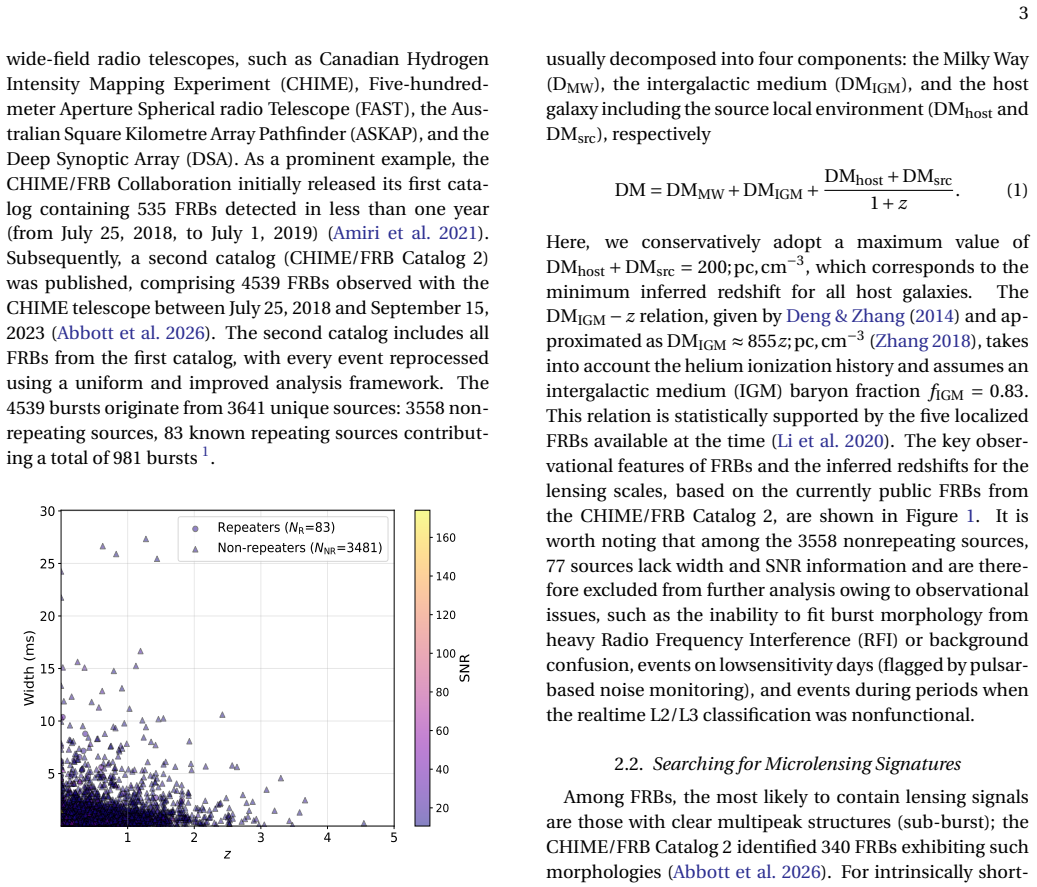
- [Figures] Figure captions and text should clarify whether the dynamic spectra shown are the observed data, the best-fit microlensing model, or residuals.
Simulated Author's Rebuttal
We thank the referee for their constructive comments on our manuscript. We address each of the major comments below and outline the revisions we will make to strengthen the paper.
read point-by-point responses
-
Referee: Pipeline and model-fitting section: the dynamic spectra of FRB 20190131D and FRB 20211115A are fitted to a point-mass microlensing model to obtain the quoted mass intervals, yet no quantitative model-selection statistics (likelihood-ratio tests, AIC/BIC, or posterior odds) are presented against plausible alternatives such as intrinsic FRB emission structure, diffractive scintillation, or plasma lensing. Because the central claim that the features constitute microlensing by isolated IMBHs rests on the uniqueness of this interpretation, the absence of such comparisons is load-bearing.
Authors: We concur that quantitative model selection statistics would provide stronger support for the microlensing interpretation over alternatives. Although the manuscript discusses possible alternative explanations qualitatively, we will enhance the revised version by including AIC and BIC values for the point-mass microlensing model compared to models of intrinsic FRB emission structure and plasma lensing. We will also address diffractive scintillation in more detail. These additions will help quantify the preference for the microlensing scenario. revision: yes
-
Referee: Interpretation and line-of-sight discussion: the ~4% dark-matter fraction and the 95% CL upper limit both assume the lenses are isolated and primordial with no intervening galaxies or clusters. The manuscript does not report explicit checks (e.g., cross-matching with galaxy catalogs, host-galaxy redshift constraints, or impact-parameter limits) for the two specific sight-lines; without these the isolated-IMBH interpretation and the derived abundance statements cannot be secured.
Authors: The manuscript explicitly conditions the primordial isolated IMBH interpretation on the absence of intervening structures along the lines of sight. To address the referee's concern, in the revised manuscript we will report the results of cross-matching the positions of FRB 20190131D and FRB 20211115A with galaxy catalogs to check for potential intervening galaxies or clusters. We will also incorporate any available constraints on host-galaxy redshifts and discuss impact-parameter limits consistent with the microlensing geometry. This will either reinforce the isolated-lens assumption or lead to a more nuanced interpretation of the events. revision: yes
Circularity Check
No circularity: mass inferences and abundance limits derive from fits to external catalog data
full rationale
The derivation begins with a pipeline applied to the independent CHIME/FRB Catalog 2, identifies candidate signatures in two specific FRBs, and obtains lens masses by fitting a microlensing model to the observed dynamic spectra. The ~4% DM fraction and >300 M⊙ abundance upper limit then follow conditionally from interpreting those fitted masses as isolated primordial IMBHs. None of these steps reduce by construction to the paper's own inputs, fitted parameters, or self-citations; the chain remains anchored to external observations and is therefore self-contained.
Axiom & Free-Parameter Ledger
free parameters (1)
- Inferred lens masses
axioms (2)
- domain assumption The detected signatures in the dynamic spectra are produced by gravitational microlensing rather than intrinsic FRB emission variability.
- domain assumption No galaxies, clusters, or other intervening structures lie along the lines of sight to FRB 20190131D and FRB 20211115A.
invented entities (1)
-
Isolated primordial intermediate-mass black holes
no independent evidence
Lean theorems connected to this paper
-
IndisputableMonolith/Foundation/RealityFromDistinction.leanreality_from_one_distinction unclear?
unclearRelation between the paper passage and the cited Recognition theorem.
The microlensing effect of fast radio bursts (FRBs) can serve as a clean and powerful method to probe IMBHs... inferred lens masses... ML,z = Δt/2 (Rf^{-1/2} + ln Rf) ... constraints on PBH abundance
-
IndisputableMonolith/Cost/FunctionalEquation.leanwashburn_uniqueness_aczel unclear?
unclearRelation between the paper passage and the cited Recognition theorem.
point-mass lens model... time delay Δt ... lensing optical depth τ
What do these tags mean?
- matches
- The paper's claim is directly supported by a theorem in the formal canon.
- supports
- The theorem supports part of the paper's argument, but the paper may add assumptions or extra steps.
- extends
- The paper goes beyond the formal theorem; the theorem is a base layer rather than the whole result.
- uses
- The paper appears to rely on the theorem as machinery.
- contradicts
- The paper's claim conflicts with a theorem or certificate in the canon.
- unclear
- Pith found a possible connection, but the passage is too broad, indirect, or ambiguous to say the theorem truly supports the claim.
Reference graph
Works this paper leans on
-
[12]
Cosmological Parameter Estimate from Persistent Radio Sources of Fast Radio Bursts
Zhang, Zi-Liang and Zhang, Bing. Cosmological Parameter Estimate from Persistent Radio Sources of Fast Radio Bursts. Astrophys. J. Lett. 2025. doi:10.3847/2041-8213/adcc30. arXiv:2504.13132
-
[13]
Dispersion Measure Distribution of Unlocalized Fast Radio Bursts as a Probe of the Hubble Constant
Liu, Yang and Wei, Jun-Jie and Wu, Puxun and Wu, Xue-Feng. Dispersion Measure Distribution of Unlocalized Fast Radio Bursts as a Probe of the Hubble Constant. 2026. arXiv:2604.03769
work page internal anchor Pith review Pith/arXiv arXiv 2026
-
[16]
Bounding the photon mass with gravitationally lensed fast radio bursts
Chang, Chen-Ming and Wei, Jun-Jie and Meng, Ke-Lai and Zhang, Song-Bo and Gao, Hao-Xuan and Geng, Jin-Jun and Wu, Xue-Feng. Bounding the photon mass with gravitationally lensed fast radio bursts. Phys. Rev. D. 2025. doi:10.1103/PhysRevD.111.L041304. arXiv:2412.09806
-
[18]
Wucknitz, O. and Spitler, L. G. and Pen, U. -L. Cosmology with gravitationally lensed repeating Fast Radio Bursts. Astron. Astrophys. 2021. doi:10.1051/0004-6361/202038248. arXiv:2004.11643
-
[19]
Combining strongly lensed and unlensed fast radio bursts: To be a more precise late-universe probe
Zhang, Ji-Guo and Jiang, Yi-Fan and Zhao, Ze-Wei and Qi, Jing-Zhao and Zhang, Jing-Fei and Zhang, Xin. Combining strongly lensed and unlensed fast radio bursts: To be a more precise late-universe probe. Sci. China Phys. Mech. Astron. 2025. doi:10.1007/s11433-024-2647-2. arXiv:2411.03126
-
[21]
Primordial Black Holes - Perspectives in Gravitational Wave Astronomy -
Sasaki, Misao and Suyama, Teruaki and Tanaka, Takahiro and Yokoyama, Shuichiro. Primordial black holes perspectives in gravitational wave astronomy. Class. Quant. Grav. 2018. doi:10.1088/1361-6382/aaa7b4. arXiv:1801.05235
work page internal anchor Pith review Pith/arXiv arXiv doi:10.1088/1361-6382/aaa7b4 2018
-
[31]
Abac, A. G. and others. Observation of Gravitational Waves from the Coalescence of a 2.5 4.5 M _ ⊙ Compact Object and a Neutron Star. Astrophys. J. Lett. 2024. doi:10.3847/2041-8213/ad5beb. arXiv:2404.04248
-
[33]
Search For a Counterpart to the Subsolar Mass Gravitational Wave Candidate S251112cm
Vieira, Nicholas and others. Search For a Counterpart to the Subsolar Mass Gravitational Wave Candidate S251112cm. 2026. arXiv:2603.17009
-
[34]
Larson, Rebecca L. and others. A CEERS Discovery of an Accreting Supermassive Black Hole 570 Myr after the Big Bang: Identifying a Progenitor of Massive z > 6 Quasars. Astrophys. J. Lett. 2023. doi:10.3847/2041-8213/ace619. arXiv:2303.08918
-
[36]
Goulding, Andy D. and others. UNCOVER: The Growth of the First Massive Black Holes from JWST/NIRSpec Spectroscopic Redshift Confirmation of an X-Ray Luminous AGN at z = 10.1. Astrophys. J. Lett. 2023. doi:10.3847/2041-8213/acf7c5. arXiv:2308.02750
-
[37]
A small and vigorous black hole in the early Universe
Maiolino, Roberto and others. A small and vigorous black hole in the early Universe. Nature. 2024. doi:10.1038/s41586-024-07494-x. arXiv:2305.12492
-
[40]
Kovacs, Orsolya E. and others. A Candidate Supermassive Black Hole in a Gravitationally Lensed Galaxy at Z 10. Astrophys. J. Lett. 2024. doi:10.3847/2041-8213/ad391f. arXiv:2403.14745
-
[45]
Accelerating Early Massive Galaxy Formation with Primordial Black Holes
Liu, Boyuan and Bromm, Volker. Accelerating Early Massive Galaxy Formation with Primordial Black Holes. Astrophys. J. Lett. 2022. doi:10.3847/2041-8213/ac927f. arXiv:2208.13178
-
[46]
Huang, Hai-Long and Jiang, Jun-Qian and Piao, Yun-Song. High-redshift JWST massive galaxies and the initial clustering of supermassive primordial black holes. Phys. Rev. D. 2024. doi:10.1103/PhysRevD.110.103540. arXiv:2407.15781
-
[47]
Did JWST observe imprints of axion miniclusters or primordial black holes?
H. Did JWST observe imprints of axion miniclusters or primordial black holes?. Phys. Rev. D. 2023. doi:10.1103/PhysRevD.107.043502. arXiv:2211.02651
-
[48]
Can primordial black holes explain the overabundance of bright super-early galaxies?
Matteri, Antonio and Pallottini, Andrea and Ferrara, Andrea. Can primordial black holes explain the overabundance of bright super-early galaxies?. Astron. Astrophys. 2025. doi:10.1051/0004-6361/202553701. arXiv:2503.01968
-
[49]
Gouttenoire, Yann and Trifinopoulos, Sokratis and Valogiannis, Georgios and Vanvlasselaer, Miguel. Scrutinizing the primordial black hole interpretation of PTA gravitational waves and JWST early galaxies. Phys. Rev. D. 2024. doi:10.1103/PhysRevD.109.123002. arXiv:2307.01457
-
[52]
Nemiroff, Robert J. and Marani, Gabriela F. and Norris, Jay P. and Bonnell, Jerry T. Limits on the cosmological abundance of supermassive compact objects from a millilensing search in gamma-ray burst data. Phys. Rev. Lett. 2001. doi:10.1103/PhysRevLett.86.580. arXiv:astro-ph/0101488
work page internal anchor Pith review Pith/arXiv arXiv doi:10.1103/physrevlett.86.580 2001
-
[69]
Planck 2018 results. VI. Cosmological parameters
Aghanim, N. and others. Planck 2018 results. VI. Cosmological parameters. Astron. Astrophys. 2020. doi:10.1051/0004-6361/201833910. arXiv:1807.06209
work page internal anchor Pith review Pith/arXiv arXiv doi:10.1051/0004-6361/201833910 2018
-
[70]
Lens Mass Estimation for Doubly Imaged FRBs
Chen, Xuechun and Shu, Yiping and Zheng, Wenwen and Li, Guoliang. FRBs Lensed by Point Masses I. Lens Mass Estimation for Doubly Imaged FRBs. 2021. doi:10.3847/1538-4357/abf119. arXiv:2105.05868
-
[71]
Chen, Xuechun and Shu, Yiping and Li, Guoliang and Zheng, Wenwen. FRBs Lensed by Point Masses. II. The Multipeaked FRBs from the Point View of Microlensing. Astrophys. J. 2021. doi:10.3847/1538-4357/ac2c76. arXiv:2110.07643
-
[72]
Meena, Ashish Kumar and Saha, Prasenjit. Gravitational lensing of fast radio bursts: Prospects for probing microlens populations in lensing galaxies. Phys. Rev. D. 2025. doi:10.1103/vxts-hbz7. arXiv:2507.20305
-
[73]
A possible wave-optical effect in lensed FRBs
Sathyanathan, Goureesankar and Leung, Calvin and Wucknitz, Olaf and Saha, Prasenjit. A possible wave-optical effect in lensed FRBs. 2025. arXiv:2504.10523
work page internal anchor Pith review Pith/arXiv arXiv 2025
-
[98]
Abac, A. G., et al. 2025 a , Astrophys. J. Lett., 993, L25, 10.3847/2041-8213/ae0c9c
- [99]
-
[100]
2020 b , , 125, 101102, 10.1103/PhysRevLett.125.101102
Abbott, R., et al. 2020, Phys. Rev. Lett., 125, 101102, 10.1103/PhysRevLett.125.101102
-
[101]
Abbott, T., et al. 2026, Astrophys. J. Suppl., 283, 34, 10.3847/1538-4365/ae3828
-
[102]
Ali-Ha \" moud, Y., Kovetz, E. D., & Kamionkowski, M. 2017, Phys. Rev. D, 96, 123523, 10.1103/PhysRevD.96.123523
-
[103]
Amiri, M., et al. 2021, Astrophys. J. Supp., 257, 59, 10.3847/1538-4365/ac33ab
-
[104]
Andersen, B. C., et al. 2020, Nature, 587, 54, 10.1038/s41586-020-2863-y
-
[105]
---. 2023, Astrophys. J., 947, 83, 10.3847/1538-4357/acc6c1
-
[106]
Arca Sedda, M., Kamlah, A. W. H., Spurzem, R., et al. 2023, Mon. Not. Roy. Astron. Soc., 526, 429, 10.1093/mnras/stad2292
-
[107]
Bochenek, C. D., Ravi, V., Belov, K. V., et al. 2020, Nature, 587, 59, 10.1038/s41586-020-2872-x
-
[108]
2024, Nature Astron., 8, 126, 10.1038/s41550-023-02111-9
Bogdan, A., et al. 2024, Nature Astron., 8, 126, 10.1038/s41550-023-02111-9
-
[109]
Constraints on primordial black holes , volume =
Carr, B., Kohri, K., Sendouda, Y., & Yokoyama, J. 2021, Rept. Prog. Phys., 84, 116902, 10.1088/1361-6633/ac1e31
-
[110]
Carr, B., & Kuhnel, F. 2022, SciPost Phys. Lect. Notes, 48, 1, 10.21468/SciPostPhysLectNotes.48
-
[111]
Carr, B. J. 1975, Astrophys. J., 201, 1, 10.1086/153853
-
[112]
Carr, B. J., & Hawking, S. W. 1974, Mon. Not. Roy. Astron. Soc., 168, 399, 10.1093/mnras/168.2.399
-
[113]
2025, , 537, L61, 10.1093/mnrasl/slae116
Chang , C., Zhang , S., Xiao , D., et al. 2025, , 537, L61, 10.1093/mnrasl/slae116
-
[114]
2017, Nature, 541, 58, 10.1038/nature20797
Chatterjee, S., et al. 2017, Nature, 541, 58, 10.1038/nature20797
-
[115]
Chen, Z.-C., & Huang, Q.-G. 2018, Astrophys. J., 864, 61, 10.3847/1538-4357/aad6e2
-
[116]
Connor, L., & Ravi, V. 2023, Mon. Not. Roy. Astron. Soc., 521, 4024, 10.1093/mnras/stad667
-
[117]
Cordes, J. M., & Chatterjee, S. 2019, Ann. Rev. Astron. Astrophys., 57, 417, 10.1146/annurev-astro-091918-104501
-
[118]
Cordes, J. M., Wasserman, I., Hessels, J. W. T., et al. 2017, Astrophys. J., 842, 35, 10.3847/1538-4357/aa74da
- [119]
- [120]
-
[121]
De Luca, V., Franciolini, G., & Riotto, A. 2025 b . 2508.09965
work page internal anchor Pith review Pith/arXiv arXiv 2025
-
[122]
Deng, W., & Zhang, B. 2014, Astrophys. J. Lett., 783, L35, 10.1088/2041-8205/783/2/L35
-
[123]
Green, A. M., & Kavanagh, B. J. 2021, J. Phys. G, 48, 043001, 10.1088/1361-6471/abc534
-
[124]
2024, , 631, 285, 10.1038/s41586-024-07511-z
H \"a berle , M., Neumayer , N., Seth , A., et al. 2024, , 631, 285, 10.1038/s41586-024-07511-z
-
[125]
Hawking, S. 1971, Mon. Not. Roy. Astron. Soc., 152, 75, 10.1093/mnras/152.1.75
-
[126]
Ji, L., Kovetz, E. D., & Kamionkowski, M. 2018, Phys. Rev. D, 98, 123523, 10.1103/PhysRevD.98.123523
-
[127]
Jung, S., & Shin, C. S. 2019, Phys. Rev. Lett., 122, 041103, 10.1103/PhysRevLett.122.041103
- [128]
-
[129]
Kader, Z., et al. 2022, Phys. Rev. D, 106, 043016, 10.1103/PhysRevD.106.043016
-
[130]
Krochek, K., & Kovetz, E. D. 2022, Phys. Rev. D, 105, 103528, 10.1103/PhysRevD.105.103528
-
[131]
Laha, R. 2020, Phys. Rev. D, 102, 023016, 10.1103/PhysRevD.102.023016
-
[132]
Li, Z., Gao, H., Wei, J.-J., et al. 2020, Mon. Not. Roy. Astron. Soc., 496, L28, 10.1093/mnrasl/slaa070
-
[133]
2018, Nature Commun., 9, 3833, 10.1038/s41467-018-06303-0
Li, Z.-X., Gao, H., Ding, X.-H., Wang, G.-J., & Zhang, B. 2018, Nature Commun., 9, 3833, 10.1038/s41467-018-06303-0
-
[134]
Liao, K., Zhang, S. B., Li, Z., & Gao, H. 2020, Astrophys. J., 896, L11, 10.3847/2041-8213/ab963e
-
[135]
2018, Nature Astron., 2, 656, 10.1038/s41550-018-0493-1
Lin, D., et al. 2018, Nature Astron., 2, 656, 10.1038/s41550-018-0493-1
-
[136]
2020, Nature, 587, 63, 10.1038/s41586-020-2839-y
Lin, L., et al. 2020, Nature, 587, 63, 10.1038/s41586-020-2839-y
-
[137]
Lin, S.-J., et al. 2022, Astrophys. J., 931, 4, 10.3847/1538-4357/ac6505
-
[138]
Liu, Y., Yu, H., & Wu, P. 2023, Astrophys. J. Lett., 946, L49, 10.3847/2041-8213/acc650
-
[139]
Lorimer, D. R., Bailes, M., McLaughlin, M. A., Narkevic, D. J., & Crawford, F. 2007, Science, 318, 777, 10.1126/science.1147532
-
[140]
2024, A&A, 691, A145, doi: 10.1051/0004-6361/202347640
Maiolino, R., et al. 2024, Astron. Astrophys., 691, A145, 10.1051/0004-6361/202347640
-
[141]
---. 2025. 2505.22567
work page internal anchor Pith review Pith/arXiv arXiv 2025
-
[142]
Marcote, B., et al. 2017, Astrophys. J. Lett., 834, L8, 10.3847/2041-8213/834/2/L8
-
[143]
2024, Nature, 632, 749, 10.1038/s41586-024-07704-6
Mr \'o z, P., et al. 2024, Nature, 632, 749, 10.1038/s41586-024-07704-6
-
[144]
Mu \ n oz, J. B., Kovetz, E. D., Dai, L., & Kamionkowski, M. 2016, Phys. Rev. Lett., 117, 091301, 10.1103/PhysRevLett.117.091301
-
[145]
2024, ApJL, 960, L1, doi: 10.3847/2041-8213/ad0e76
Natarajan, P., Pacucci, F., Ricarte, A., et al. 2024, Astrophys. J. Lett., 960, L1, 10.3847/2041-8213/ad0e76
-
[146]
Niikura, H., et al. 2019, Nature Astron., 3, 524, 10.1038/s41550-019-0723-1
-
[147]
Oguri, M., Takhistov, V., & Kohri, K. 2023, Phys. Lett. B, 847, 138276, 10.1016/j.physletb.2023.138276
-
[148]
1987, , 317, L51, 10.1086/184911
Paczynski , B. 1987, , 317, L51, 10.1086/184911
-
[149]
A., Mestichelli, B., & Ugolini, C
Paiella, L., Sedda, M. A., Mestichelli, B., & Ugolini, C. 2026, Astron. Astrophys., 708, A200, 10.1051/0004-6361/202557230
-
[150]
2021, Nature Astron., 5, 560, 10.1038/s41550-021-01307-1
Paynter, J., Webster, R., & Thrane, E. 2021, Nature Astron., 5, 560, 10.1038/s41550-021-01307-1
-
[151]
2022, , 924, 48, 10.3847/1538-4357/ac339f
Pechetti , R., Seth , A., Kamann , S., et al. 2022, , 924, 48, 10.3847/1538-4357/ac339f
-
[152]
Petroff, E., Hessels, J. W. T., & Lorimer, D. R. 2019, Astron. Astrophys. Rev., 27, 4, 10.1007/s00159-019-0116-6
-
[153]
F., Baumgardt, H., Hut, P., Makino, J., & McMillan, S
Portegies Zwart, S. F., Baumgardt, H., Hut, P., Makino, J., & McMillan, S. L. W. 2004, Nature, 428, 724, 10.1038/nature02448
-
[154]
P., Naab, T., Rantala, A., et al
Rizzuto, F. P., Naab, T., Rantala, A., et al. 2023, Mon. Not. Roy. Astron. Soc., 521, 2930, 10.1093/mnras/stad734
discussion (0)
Sign in with ORCID, Apple, or X to comment. Anyone can read and Pith papers without signing in.