Theory of distribution skewness effect on polydisperse random close packing
Pith reviewed 2026-06-29 00:15 UTC · model grok-4.3
The pith
A closed-form expression for random close packing density is derived from moments of the particle diameter distribution.
A machine-rendered reading of the paper's core claim, the machinery that carries it, and where it could break.
Core claim
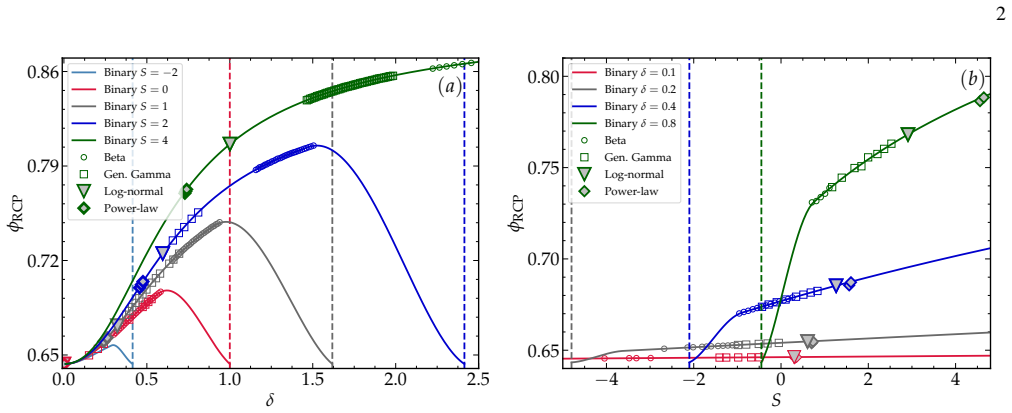
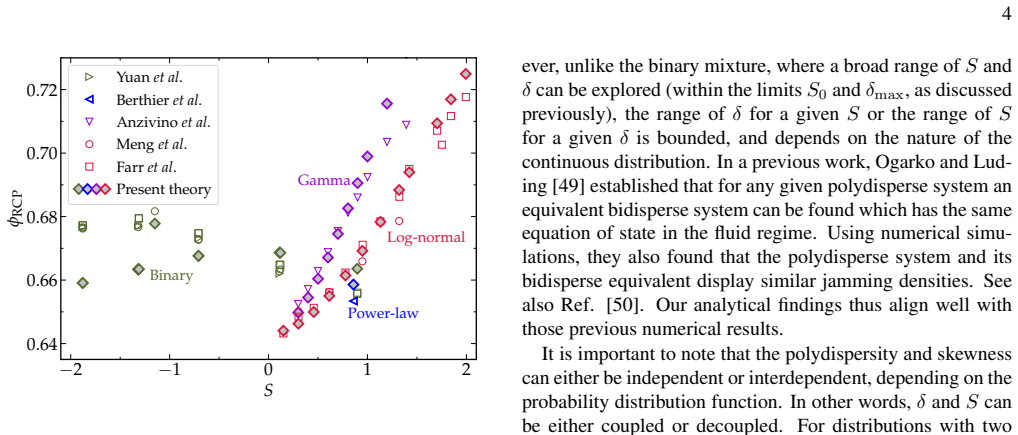
We derive a closed-form solution for φ_RCP in terms of the moments of the diameter distribution. The dependencies of φ_RCP on skewness for a variety of continuous distributions collapse onto a theoretical master curve obtained for the binary mixture case. After correcting the theory to obey exact limiting behaviors for extreme size asymmetry, the predictions agree with numerical results and extend into previously unexplored regions.
What carries the argument
Closed-form solution for φ_RCP expressed in terms of moments of the diameter distribution, derived from the equilibrium model of crowding.
If this is right
- Analytical exploration of φ_RCP dependence on polydispersity δ and skewness S becomes possible without numerical simulation.
- Skewness effects for any continuous distribution reduce to the binary mixture master curve.
- Predictions extend to regions of parameter space not previously explored numerically.
- Corrections enforce exact limits at extreme size asymmetry, improving agreement with known behaviors.
Where Pith is reading between the lines
- Material designers could use the formula to select size distributions that raise packing density in powders or suspensions.
- The moment reduction might be tested by generating distributions whose higher moments deviate strongly from binary cases.
- Similar moment-based expressions could be sought for packing under shear or in confined geometries.
Load-bearing premise
The equilibrium model of crowding supplies the starting framework for the derivation.
What would settle it
Numerical simulations of packing for a continuous diameter distribution with chosen skewness and polydispersity that fall off the predicted binary-mixture master curve would falsify the collapse result.
Figures
read the original abstract
We investigate the random close packing density, $\phi_\textrm{RCP}$, of polydisperse hard sphere systems using a theoretical framework based on the equilibrium model of crowding. We derive a closed-form solution for $\phi_\textrm{RCP}$ in terms of the moments of the diameter distribution, enabling an analytical exploration of the effects of polydispersity ($\delta$) and skewness ($S$) on packing density. For a binary mixture, it is possible to explore a broader range of dependence of $\phi_\textrm{RCP}$ on $\delta$ for a given $S$ or on $S$ for a given $\delta$. We show that the dependencies of $\phi_\textrm{RCP}$ on skewness for a variety of continuous distributions collapse onto a theoretical master curve obtained for the binary mixture case. By correcting the theory so that it obeys known exact limiting behaviours for extreme size asymmetry, our analytical predictions not only agree with previously obtained numerical results, but also predict previously unexplored regions of the $\phi_\textrm{RCP}$ parameter space.
Editorial analysis
A structured set of objections, weighed in public.
Referee Report
Summary. The manuscript derives a closed-form expression for the random close packing fraction φ_RCP of polydisperse hard-sphere systems as a function of the moments of the particle diameter distribution, using an equilibrium crowding model. It demonstrates that the dependence of φ_RCP on skewness S for various continuous distributions collapses onto a master curve derived from the binary mixture case. Post-derivation corrections are applied to ensure the expression recovers known exact limits for extreme size asymmetry, resulting in agreement with numerical simulations and predictions for unexplored parameter regions.
Significance. If the closed-form expression and the collapse hold without relying on phenomenological adjustments, the work would offer a valuable analytical framework for understanding polydispersity and skewness effects on packing density, extending beyond binary mixtures. The ability to explore broader ranges of δ and S analytically is a strength. However, the reliance on corrections to match limiting behaviors suggests the base model may not fully capture the physics, potentially limiting the generality of the predictions.
major comments (2)
- [Abstract] Abstract: the central claim of a closed-form φ_RCP(moments) that enables analytical exploration and collapse onto the binary master curve is qualified by the statement that the theory must be corrected after derivation to recover exact limiting behaviors at extreme size asymmetry. This post-hoc correction is load-bearing for both the reported agreement with numerics and the claimed universality of the master curve; the manuscript must show explicitly (in the derivation section and the final expression) whether the correction is derived from the equilibrium crowding model or imposed externally, and quantify its impact on the moment-based formula.
- [Theory] The weakest assumption identified is that the equilibrium model of crowding can be corrected post-derivation to enforce known exact limits. If this correction is phenomenological rather than emergent, the predictive power for unexplored regions of the φ_RCP(δ,S) space rests on an assumption whose validity is not independently demonstrated within the model; a concrete test (e.g., comparison of the uncorrected vs. corrected expressions against an independent limit) is required.
minor comments (2)
- Notation for polydispersity δ and skewness S should be defined explicitly at first use, and the precise definition of the moments entering the closed-form expression should be stated in an equation.
- [Abstract] The abstract refers to 'previously obtained numerical results' without citing the specific studies; these references should be added.
Simulated Author's Rebuttal
We thank the referee for the careful reading and the specific concerns raised regarding the post-derivation corrections. We address each major comment below and will revise the manuscript to provide the requested clarifications and tests.
read point-by-point responses
-
Referee: [Abstract] Abstract: the central claim of a closed-form φ_RCP(moments) that enables analytical exploration and collapse onto the binary master curve is qualified by the statement that the theory must be corrected after derivation to recover exact limiting behaviors at extreme size asymmetry. This post-hoc correction is load-bearing for both the reported agreement with numerics and the claimed universality of the master curve; the manuscript must show explicitly (in the derivation section and the final expression) whether the correction is derived from the equilibrium crowding model or imposed externally, and quantify its impact on the moment-based formula.
Authors: We agree that the abstract and derivation must make the status of the correction fully explicit. The base equilibrium crowding model yields a closed-form expression in terms of the diameter moments, but this expression does not automatically recover the known exact limits at extreme size asymmetry. The correction is therefore imposed after derivation to enforce those limits. In the revised manuscript we will (i) state this explicitly in the Theory section, (ii) write the final expression with the correction shown as an additive term, and (iii) quantify its numerical impact by tabulating the difference between uncorrected and corrected φ_RCP for representative moment sets. The moment dependence and the collapse onto the binary master curve are properties of the uncorrected model; the correction preserves the collapse while restoring the correct limits. revision: yes
-
Referee: [Theory] The weakest assumption identified is that the equilibrium model of crowding can be corrected post-derivation to enforce known exact limits. If this correction is phenomenological rather than emergent, the predictive power for unexplored regions of the φ_RCP(δ,S) space rests on an assumption whose validity is not independently demonstrated within the model; a concrete test (e.g., comparison of the uncorrected vs. corrected expressions against an independent limit) is required.
Authors: We accept that the correction is phenomenological. To demonstrate its validity for unexplored regions we will add, in the revised Theory section, a direct comparison of both the uncorrected and corrected expressions against an independent limiting case (a continuous distribution at moderate asymmetry whose packing fraction is known from separate simulations not used to calibrate the correction). This test will be presented alongside the existing numerical comparisons, allowing readers to assess the range over which the corrected expression remains reliable. revision: yes
Circularity Check
No circularity: closed-form derivation from equilibrium crowding model stands independently; post-derivation correction to external limits is not a reduction by construction.
full rationale
The paper derives a closed-form φ_RCP expression from the equilibrium model of crowding in terms of diameter-distribution moments, then separately notes a post-derivation correction to match known exact limits at extreme asymmetry. No quoted step shows the final formula reducing to its inputs by definition, a fitted parameter renamed as prediction, or a load-bearing self-citation chain. The collapse onto the binary-mixture master curve is presented as an observed outcome of the moment-based formula, not enforced by construction. The correction is an adjustment to external benchmarks rather than an internal redefinition, leaving the core derivation self-contained against the stated framework.
Axiom & Free-Parameter Ledger
axioms (1)
- domain assumption Equilibrium model of crowding supplies the starting framework for the derivation
Reference graph
Works this paper leans on
-
[1]
Multimech
(Menget al., open circles), and [47] (Farret al., open squares). These data correspond to a variety ofδvalues. The filled diamonds represent predictions from the present study, calculated for a given S(as indicated on the horizontal axis) and the sameδvalue as the numerical data. log-normal, and truncated power-law. Check the Supplemen- tary Information [...
-
[2]
Hansen and I
J.-P. Hansen and I. R. McDonald,Theory of simple liquids: with applications to soft matter(Academic press, 2013)
2013
-
[3]
Torquato and F
S. Torquato and F. H. Stillinger, Reviews of Modern Physics82, 2633 (2010)
2010
-
[4]
C. P. Royall, P. Charbonneau, M. Dijkstra, J. Russo, F. Smallen- burg, T. Speck, and C. Valeriani, Reviews of Modern Physics 96, 045003 (2024)
2024
-
[5]
B. J. Alder and T. E. Wainwright, The Journal of Chemical Physics27, 1208 (1957)
1957
-
[6]
W. W. Wood and J. D. Jacobson, The Journal of Chemical Physics27, 1207 (1957)
1957
-
[7]
W. G. Hoover and F. H. Ree, The Journal of Chemical Physics 49, 3609 (1968)
1968
-
[8]
J. D. Bernal and J. Mason, Nature188, 910 (1960)
1960
-
[9]
C. S. O’Hern, L. E. Silbert, A. J. Liu, and S. R. Nagel, Physical Review E68, 011306 (2003)
2003
-
[10]
E. Sanz, C. Valeriani, E. Zaccarelli, W. C. Poon, P. N. Pusey, and M. E. Cates, Physical Review Letters106, 215701 (2011)
2011
-
[11]
R. D. Kamien and A. J. Liu, Physical Review Letters99, 155501 (2007)
2007
-
[12]
Torquato, T
S. Torquato, T. M. Truskett, and P. G. Debenedetti, Physical Review Letters84, 2064 (2000)
2064
-
[13]
T. M. Truskett, S. Torquato, and P. G. Debenedetti, Phys. Rev. E62, 993 (2000)
2000
-
[14]
Zaccone, Physical Review Letters128, 028002 (2022)
A. Zaccone, Physical Review Letters128, 028002 (2022)
2022
-
[15]
Donev, F
A. Donev, F. H. Stillinger, and S. Torquato, Physical Review Letters96, 225502 (2006)
2006
-
[16]
K. W. Desmond and E. R. Weeks, Physical Review E90, 022204 (2014)
2014
-
[17]
Anzivino, M
C. Anzivino, M. Casiulis, T. Zhang, A. S. Moussa, S. Martini- ani, and A. Zaccone, The Journal of Chemical Physics158 (2023)
2023
-
[18]
D. J. Meer and E. R. Weeks, Plos one19, e0297862 (2024)
2024
-
[19]
McGeary, Journal of the American ceramic Society44, 513 (1961)
R. McGeary, Journal of the American ceramic Society44, 513 (1961)
1961
-
[20]
S.-E. Phan, W. B. Russel, J. Zhu, and P. M. Chaikin, The Jour- nal of Chemical Physics108, 9789 (1998)
1998
-
[21]
Castillo, F
I. Castillo, F. J. Kampas, and J. D. Pint ´er, European Journal of Operational Research191, 786 (2008)
2008
-
[22]
Jerkins, M
M. Jerkins, M. Schr ¨oter, H. L. Swinney, T. J. Senden, M. Saa- datfar, and T. Aste, Physical Review Letters101, 018301 (2008)
2008
-
[23]
D ¨orr, A
A. D ¨orr, A. Sadiki, and A. Mehdizadeh, Journal of Rheology 57, 743 (2013)
2013
-
[24]
Danaei, M
M. Danaei, M. Dehghankhold, S. Ataei, F. Hasan- zadeh Davarani, R. Javanmard, A. Dokhani, S. Khorasani, and M. Mozafari, Pharmaceutics10, 57 (2018)
2018
-
[25]
E. I. Corwin, M. Clusel, A. O. N. Siemens, and J. Bruji ´c, Soft Matter6, 2949 (2010)
2010
-
[26]
K. W. Desmond and E. R. Weeks, Physical Review E—Statistical, Nonlinear, and Soft Matter Physics80, 051305 (2009)
2009
-
[27]
Vaibhav, J
V . Vaibhav, J. Horbach, and P. Chaudhuri, The Journal of Chemical Physics156(2022)
2022
-
[28]
Biazzo, F
I. Biazzo, F. Caltagirone, G. Parisi, and F. Zamponi, Physical Review Letters102, 195701 (2009)
2009
-
[29]
Vaibhav, J
V . Vaibhav, J. Horbach, and P. Chaudhuri, Soft Matter18, 4427 (2022)
2022
-
[30]
Jiang, D
Y . Jiang, D. M. Sussman, and E. R. Weeks, Physical Review E 108, 054605 (2023)
2023
-
[31]
D. J. Meer, I. Galoustian, J. G. d. F. Manuel, and E. R. Weeks, Physical Review E109, 064905 (2024)
2024
-
[32]
Santos, S
A. Santos, S. B. Yuste, and M. L. de Haro, Physical Review E 89, 040302 (2014)
2014
-
[33]
Santos, S
A. Santos, S. B. Yuste, and M. L. de Haro, The Journal of Chemical Physics153, 120901 (2020)
2020
-
[34]
Santos and M
A. Santos and M. L ´opez de Haro, The Journal of Chemical Physics164(2026)
2026
-
[35]
See Supplementary Material at [URL], for details on the closed- form analytical solution for the RCP fraction of bidisperse dis- tributions, the derivation ofδ max andS 0, and the definitions of various continuous size distributions along with their corre- sponding moments, polydispersity, and skewness; also for the limiting behaviour of RCP for extreme s...
-
[36]
Mulero,Theory and simulation of hard-sphere fluids and re- lated systems, V ol
´A. Mulero,Theory and simulation of hard-sphere fluids and re- lated systems, V ol. 753 (Springer, 2008)
2008
-
[37]
Torquato, The Journal of Chemical Physics149(2018)
S. Torquato, The Journal of Chemical Physics149(2018)
2018
-
[38]
The choice of the ansatz forg ij,C should be symmetric foriand j, and in the monodisperse limit (eitherm= 1orσ i =σ,∀i) it should reduce tog 0g(σ;ϕ)
-
[39]
Lebowitz, Physical Review133, A895 (1964)
J. Lebowitz, Physical Review133, A895 (1964)
1964
-
[40]
Mansoori, N
G. Mansoori, N. F. Carnahan, K. Starling, and T. Leland Jr, The Journal of Chemical Physics54, 1523 (1971)
1971
-
[41]
Santos, S
A. Santos, S. B. Yuste, and M. L. De Haro, Molecular Physics 96, 1 (1999)
1999
-
[42]
T. C. Hales, Annals of mathematics162, 1065 (2005)
2005
-
[43]
Likos, J
C. Likos, J. Club Condens. Matter Phys. (published online, 2022)
2022
-
[44]
Smołalski, Measurement149, 106968 (2020)
G. Smołalski, Measurement149, 106968 (2020)
2020
-
[45]
Y . Yuan, L. Liu, Y . Zhuang, W. Jin, and S. Li, Physical Review E98, 042903 (2018)
2018
-
[46]
Berthier, D
L. Berthier, D. Coslovich, A. Ninarello, and M. Ozawa, Physi- 6 cal Review Letters116, 238002 (2016)
2016
-
[47]
L. Meng, P. Lu, and S. Li, Particuology16, 155 (2014)
2014
-
[48]
R. S. Farr and R. D. Groot, The Journal of Chemical Physics 131(2009)
2009
-
[49]
Sollich, Journal of Physics: Condensed Matter14, R79 (2002)
P. Sollich, Journal of Physics: Condensed Matter14, R79 (2002)
2002
-
[50]
Ogarko and S
V . Ogarko and S. Luding, The Journal of Chemical Physics136, 124508 (2012)
2012
-
[51]
H. J. H. Brouwers, Uspekhi Fizicheskikh Nauk194, 546 (2024)
2024
-
[52]
H. Yuan, Z. Zhang, W. Kob, and Y . Wang, Physical Review Letters127, 278001 (2021)
2021
-
[53]
J. C. Petit, N. Kumar, S. Luding, and M. Sperl, Physical Review Letters125, 215501 (2020)
2020
-
[54]
Y . Hara, H. Mizuno, and A. Ikeda, Physical Review Research 3, 023091 (2021)
2021
-
[55]
Kumar, V
N. Kumar, V . Magnanimo, M. Ramaioli, and S. Luding, Pow- der technology293, 94 (2016)
2016
-
[56]
Pednekar, J
S. Pednekar, J. Chun, and J. F. Morris, Journal of Rheology62, 513 (2018)
2018
-
[57]
Schramma, C
N. Schramma, C. Perugachi Isra ¨els, and M. Jalaal, Proceed- ings of the National Academy of Sciences120, e2216497120 (2023)
2023
-
[58]
B ¨urger, P
J. B ¨urger, P. O. Hayne, B. Gundlach, M. L ¨auter, T. Kramer, and J. Blum, Journal of Geophysical Research: Planets129, e2023JE008152 (2024)
2024
discussion (0)
Sign in with ORCID, Apple, or X to comment. Anyone can read and Pith papers without signing in.