Sliding contact creates universal self-affine fractal surfaces
Pith reviewed 2026-06-28 18:10 UTC · model grok-4.3
The pith
Sliding contact generates universal self-similar roughness at short wavelengths across metals, rocks, and glasses.
A machine-rendered reading of the paper's core claim, the machinery that carries it, and where it could break.
Core claim
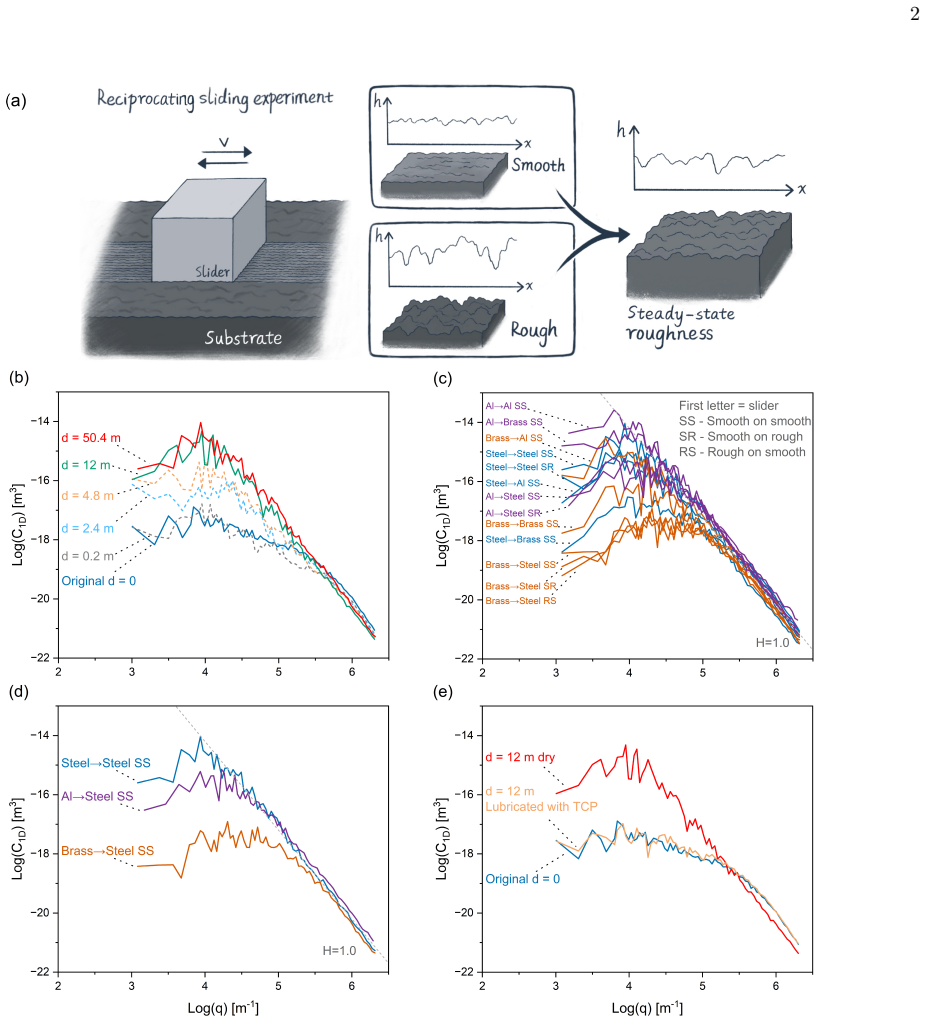
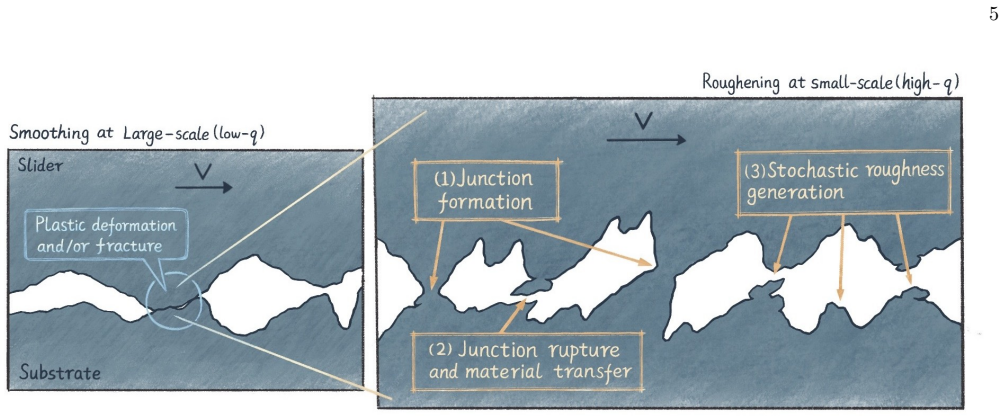
Surfaces evolve during sliding to a state of universal self-affine fractal roughness at short wavelengths for metals, rocks, and glasses, while the roll-off wavelength stays material-dependent. Junction formation and rupture drive the universal roughening at small scales, and larger-scale deformation or fracture caps its growth in a way that varies by material.
What carries the argument
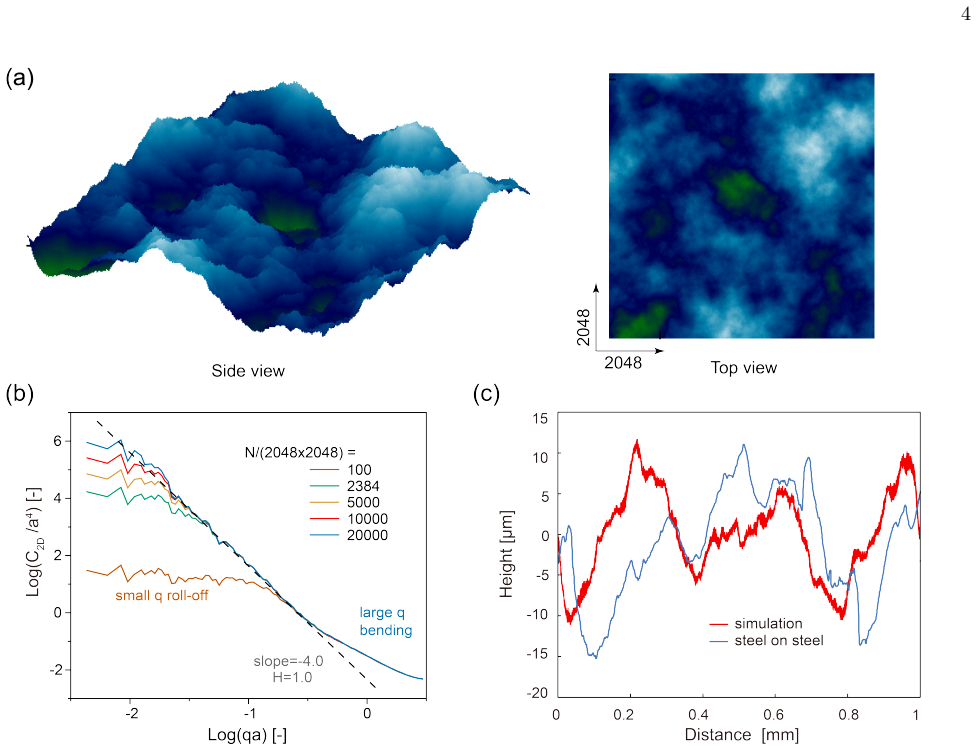
Two-process model in which junction formation and rupture produce material-independent roughening at short wavelengths while larger-scale deformation and fracture set material-dependent limits.
If this is right
- Short-wavelength roughness converges to the same statistics regardless of whether the material is metal, rock, or glass.
- The transition scale to material-dependent behavior is set by the onset of larger deformation or fracture processes.
- Friction and leakage predictions at fine scales can use a single roughness description across material classes.
- Run-in in both engineered contacts and geological faults reaches a comparable fine-scale state.
Where Pith is reading between the lines
- Contact models could treat short-scale roughness as a universal input and retain material dependence only at longer scales.
- Particle size distributions from wear might show similar power-law tails at small sizes across different materials.
- Tests on additional material families such as polymers would test whether the two-process separation holds more broadly.
Load-bearing premise
Junction formation and rupture during sliding create roughening whose statistics do not depend on the material at short wavelengths.
What would settle it
Measurements showing that the power-law exponent or amplitude of short-wavelength roughness still varies systematically with material in controlled sliding tests would falsify the universality claim.
Figures
read the original abstract
Surface roughness evolves during sliding, a process known as run-in, and the resulting topography controls friction, leakage, and failure from machines to geological faults. Yet the physical rule selecting this state remains unclear. We show that metals, rocks, and glasses develop universal self-similar roughness at short wavelengths, while retaining a material-dependent roll-off. A two-process model explains this behavior: junction formation and rupture drive universal roughening, whereas larger-scale deformation and/or fracture limit its growth.
Editorial analysis
A structured set of objections, weighed in public.
Referee Report
Summary. The manuscript claims that sliding contact during run-in produces universal self-affine roughness at short wavelengths across metals, rocks, and glasses, while the roll-off wavelength remains material-dependent. A two-process model is proposed in which junction formation and rupture generate the universal short-scale roughening, whereas larger-scale deformation and/or fracture impose the material-specific cutoff.
Significance. If substantiated with explicit derivations and cross-material validation, the result would supply a mechanistic rule for the selection of run-in topography, with direct relevance to friction, leakage, and fault mechanics. The cross-material universality would be a notable unification of tribological and geophysical observations.
major comments (1)
- [Abstract] Abstract: the central claim that junction formation and rupture alone produce a material-independent Hurst exponent at short wavelengths is stated as the explanation for universality, yet no derivation is supplied showing invariance under changes in yield stress, adhesion energy, or fracture toughness at fixed contact geometry. This assumption is load-bearing for the universality assertion.
Simulated Author's Rebuttal
We thank the referee for the constructive feedback and positive overall assessment of the work. We address the single major comment below.
read point-by-point responses
-
Referee: [Abstract] Abstract: the central claim that junction formation and rupture alone produce a material-independent Hurst exponent at short wavelengths is stated as the explanation for universality, yet no derivation is supplied showing invariance under changes in yield stress, adhesion energy, or fracture toughness at fixed contact geometry. This assumption is load-bearing for the universality assertion.
Authors: The universality claim rests on extensive cross-material simulations (metals, rocks, glasses) that vary yield stress, adhesion energy, and fracture toughness while holding contact geometry fixed; these consistently yield the same short-wavelength Hurst exponent. The two-process model is phenomenological, derived from the observed separation of scales in which small-scale junction rupture is dominated by stochastic asperity-level events whose statistics prove insensitive to the varied parameters. We acknowledge that the current manuscript does not contain an explicit analytical derivation of this invariance. In revision we will add a concise scaling argument in the methods section showing why the junction-rupture process produces parameter-independent roughness exponents at fixed geometry, together with additional simulation data confirming robustness. revision: yes
Circularity Check
No circularity: model presented as explanatory hypothesis without equations reducing to fitted inputs or self-citations
full rationale
The provided abstract and context describe a two-process model as an explanation for observed universality but contain no equations, fitting procedures, or derivation steps. No load-bearing claim reduces by construction to its own inputs, no self-citation chains are invoked for uniqueness, and no ansatz or renaming is exhibited. The central premise is stated as a physical interpretation rather than a mathematical reduction, making the derivation self-contained against external benchmarks in the visible text.
Axiom & Free-Parameter Ledger
Reference graph
Works this paper leans on
-
[1]
Pastewka, et al.,Modeling in tribology: Recent ad- vances, applications, and open questions, Tribology In- ternational,197, 111326 (2025)
L. Pastewka, et al.,Modeling in tribology: Recent ad- vances, applications, and open questions, Tribology In- ternational,197, 111326 (2025)
2025
-
[2]
T. D. B. Jacobs, L. Pastewka, and Guest Editors,Surface topography as a material parameter, MRS Bulletin47, 1205–1210 (2022)
2022
-
[3]
B. N. J. Persson,Functional properties of rough surfaces from an analytical theory of mechanical contact, MRS Bulletin47, 1211–1220 (2022)
2022
-
[4]
M. H. M¨ user, L. Nicola,Modeling the surface topography dependence of friction, adhesion, and contact compliance, MRS Bulletin47, 1221–1228 (2022)
2022
-
[5]
Weber, J
B. Weber, J. Scheibert, M. P. de Boer, A. Dhinojwala, Experimental insights into adhesion and friction between nominally dry rough surfaces, MRS Bulletin47, 1237– 1246 (2022)
2022
-
[6]
Petrova, B
D. Petrova, B. Weber, C. Allain, P. Audebert, C. H. Venner, A. M. Brouwer, and D. Bonn,Fluorescence mi- croscopy visualization of the roughness-induced transi- tion between lubrication regimes, Science Advances5, eaaw4761 (2019)
2019
-
[7]
Aghababaei, E
R. Aghababaei, E. E. Brodsky, J. F. Molinari, S. Chan- drasekar,How roughness emerges on natural and engi- neered surfaces, MRS Bulletin47, 1229–1236 (2022)
2022
-
[8]
Candela, F
T. Candela, F. Renard, Y. Klinger, K. Mair, J. Schmit- tbuhl, and E. E. Brodsky,Roughness of fault surfaces over nine decades of length scales, J. Geophys. Res.,117, B08409 (2012)
2012
-
[9]
S. Xu, E. Fukuyama, F. Yamashita, H. Kawakata, K. Mi- zoguchi, and S. Takizawa,Fault strength and rupture pro- cess controlled by fault surface topography, Nature Geo- 6 science16, 94–100 (2023)
2023
-
[10]
P. Dong, K. Xia, Y. Xu, D. Elsworth, and J.-P. Ampuero, Laboratory earthquakes decipher control and stability of rupture speeds, Nature Communications14, 2427 (2023)
2023
-
[11]
Rubino, N
V. Rubino, N. Lapusta, and A. J. Rosakis,Intermittent lab earthquakes in dynamically weakening fault gouge, Nature606, 922–929 (2022)
2022
-
[12]
et al.,A laboratory perspective on accelerating preparatory pro- cesses before earthquakes and implications for foreshock detectability, Nat Commun15, 5588 (2024)
Goebel, T.H.W., Schuster, V., Kwiatek, G. et al.,A laboratory perspective on accelerating preparatory pro- cesses before earthquakes and implications for foreshock detectability, Nat Commun15, 5588 (2024)
2024
-
[13]
I. V. Kragelsky and V. S. Kombalov,Calculation of value of stable roughness after running-in (elastic con- tact), Wear14, 137–140 (1969)
1969
-
[14]
P. J. Blau,On the nature of running-in, Tribology Inter- national38, 1007–1012 (2005)
2005
-
[15]
P. J. Blau,How common is the steady-state? The im- plications of wear transitions for materials selection and design, Wear332–333, 1120–1128 (2015)
2015
-
[16]
Milanese, T
E. Milanese, T. Brink, R. Aghababaei, and J. F. Molinari, Emergence of self-affine surfaces during adhesive wear, Nature Communications10, 1116 (2019)
2019
-
[17]
Rodriguez, L
N. Rodriguez, L. Gontard, C. Ma, R. Xu, and B.N.J. Persson,On how to determine surface roughness power spectra, Tribol. Lett.73, 18 (2025)
2025
-
[18]
Rabinowicz and D
E. Rabinowicz and D. Tabor,Metallic Transfer Between Sliding Metals: An Autoradiographic Study, Proceedings of the Royal Society of London A208, 455–475 (1951)
1951
-
[19]
J. A. Greenwood,Metal transfer and wear, Frontiers in Mechanical Engineering6, 62 (2020)
2020
-
[20]
Xu and B
R. Xu and B. N. J. Persson,Sliding Wear: Role of Plas- ticity, Tribology Letters73, 109 (2025)
2025
-
[21]
Clerc, G
A. Clerc, G. Mollon, A. Ferrieux, L. Lafarge, A. Saulot, D. Deldique, A. Schubnel, and L. Vieille,Single-asperity friction and wear in seismic faults: Part I. Experiments on marble, Journal of Geophysical Research: Solid Earth 130, e2025JB031344 (2025)
2025
-
[22]
D. E. Wolf and J. Villain,Growth with surface diffusion, Europhysics Letters13, 389–394 (1990)
1990
-
[23]
S. Pal, D. P. Landau, and K. Binder,Dynamical scaling of surface growth in simple lattice models, Physical Review E68, 021601 (2003)
2003
-
[24]
A. L. Barabasi and H. E. Stanley,Fractal Concepts in Surface Growth, Cambridge University Press, Cambridge (1995)
1995
-
[25]
Xu and B
R. Xu and B. N. J. Persson,Role of transfer films and interfacial cracking in metallic sliding wear, J. Chem. Phys., accepted
-
[26]
B. N. J. Persson,On the Fractal Dimension of Rough Surfaces, Tribology Letters54, 99–106 (2014)
2014
-
[27]
Sukhomlinov, M
S. Sukhomlinov, M. H. M¨ user, and B. N. J. Persson, Granite sliding on granite: friction, wear rates, surface topography, and the scale-dependence of rate-state effects, Reports on Progress in Physics, accepted
-
[28]
Frerot and L
L. Frerot and L. Pastewka,Elastic Shakedown and Roughness Evolution in Repeated Elastic-Plastic Contact, Tribology Letters72, 23 (2024). End Matter Minimal junction-transfer model–Consider the sliding contact between two nominally flat solids with very small initial roughness. The substrate and slider are represented as cubic lattices of blocks, and conta...
2024
discussion (0)
Sign in with ORCID, Apple, or X to comment. Anyone can read and Pith papers without signing in.