Fix the Mind, Not the Move: Interpretable AI Assistance via Knowledge-Gap Localization
Pith reviewed 2026-06-28 02:03 UTC · model grok-4.3
The pith
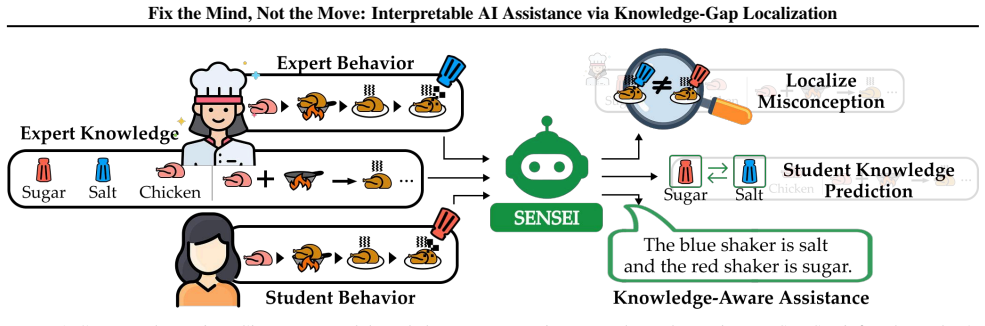
SENSEI infers and corrects user misconceptions from behavior using structured knowledge rather than intervening on actions.
A machine-rendered reading of the paper's core claim, the machinery that carries it, and where it could break.
Core claim
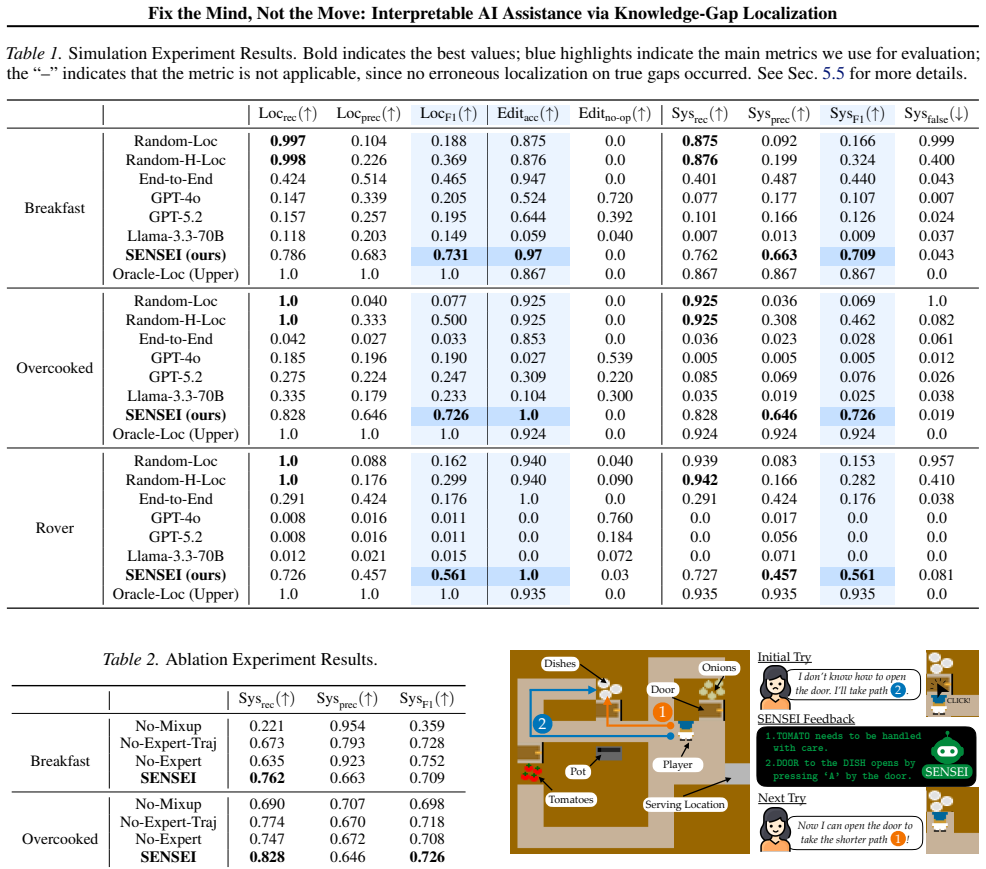
SENSEI infers user misconceptions from interaction behavior and provides targeted, minimal yet sufficient suggestions to correct them. The approach operates over a structured knowledge representation to localize and correct the sources of erroneous behavior, demonstrating zero-shot compositional generalization across three long-horizon tasks and correcting 90 percent of student misconceptions in a user study.
What carries the argument
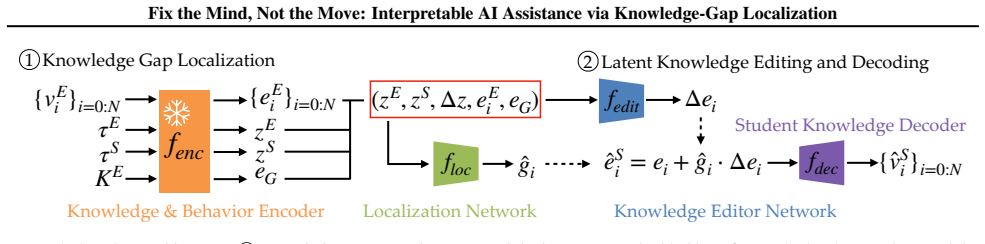
SENSEI framework that localizes knowledge gaps via structured knowledge representation derived from observed interaction behavior.
If this is right
- Long-term task performance improves because root misconceptions are removed instead of symptoms being patched repeatedly.
- The system generalizes to novel combinations of misconceptions without additional training data.
- Assistance becomes interpretable because suggestions are tied to explicit knowledge gaps rather than opaque action corrections.
- Human-AI teams achieve better outcomes on long-horizon tasks where repeated errors stem from the same underlying gaps.
Where Pith is reading between the lines
- The same localization approach could extend to domains such as driving instruction or procedural training where behavior reveals knowledge gaps.
- By reducing the need for constant corrective nudges, the method may lower cognitive load on users over repeated sessions.
- Integration with online learning updates to the knowledge representation could allow the system to adapt as users acquire new concepts.
Load-bearing premise
User misconceptions can be accurately inferred and localized from interaction behavior alone using a structured knowledge representation, and minimal targeted suggestions will correct those misconceptions.
What would settle it
An experiment in which users exhibit multiple overlapping misconceptions never seen in training and SENSEI either fails to identify them correctly or the suggested corrections produce no measurable improvement in task success rate.
Figures
read the original abstract
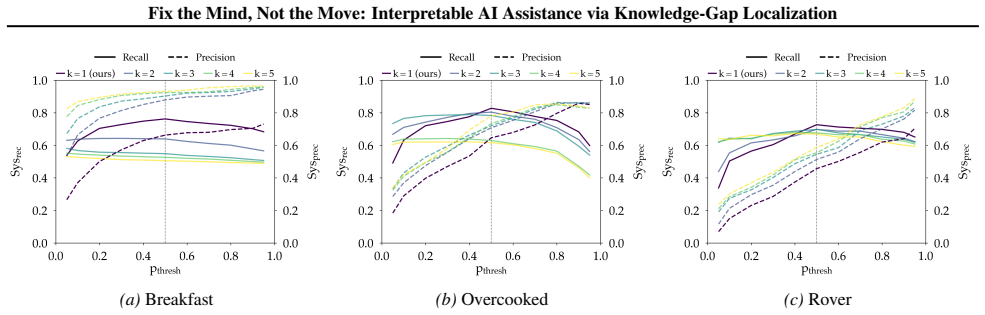
AI assistants in human-AI collaboration often correct suboptimal human actions through behavioral feedback (e.g., alerts or steering-wheel nudges in assistive driving). Such interventions can mitigate immediate errors, but long-term improvement requires addressing the underlying misconceptions that cause repeated mistakes. We introduce SENSEI, a framework that infers user misconceptions from interaction behavior and provides targeted, minimal yet sufficient suggestions to correct them. Our approach departs from action- or trajectory-level interventions by operating over a structured knowledge representation to localize and correct the sources of erroneous behavior. Across three long-horizon tasks with diverse misconceptions and corresponding behaviors, SENSEI demonstrates zero-shot compositional generalization, disentangling multiple overlapping misconceptions despite training only on single-misconception cases. A user study further shows that our method identifies real human misconceptions and provides effective guidance that improves long-horizon task performance, successfully correcting $90\%$ of student misconceptions. Code and project page are available at https://misoshiruseijin.github.io/SENSEI/.
Editorial analysis
A structured set of objections, weighed in public.
Referee Report
Summary. The paper introduces SENSEI, a framework for interpretable AI assistance that infers user misconceptions from interaction behavior via a structured knowledge representation and delivers minimal targeted suggestions to correct root knowledge gaps rather than intervening on individual actions or trajectories. It claims zero-shot compositional generalization across three long-horizon tasks, successfully disentangling multiple overlapping misconceptions after training exclusively on single-misconception cases, together with a user study demonstrating identification of real human misconceptions and 90% correction leading to improved task performance.
Significance. If the localization mechanism and generalization results are rigorously supported, the shift from behavioral correction to knowledge-gap localization could meaningfully advance human-AI collaboration in domains requiring long-horizon reasoning. The reported user study and emphasis on minimal interventions are potentially valuable contributions if the underlying representation enables unambiguous inference.
major comments (2)
- [Abstract] Abstract: the central claim of zero-shot compositional generalization and disentangling of multiple overlapping misconceptions (despite single-misconception training) is load-bearing on the assumption that the chosen structured knowledge representation permits unique, non-ambiguous localization from observable behavior traces. No explicit verification is described that the representation is injective with respect to action sequences, or that distinct misconception sets cannot produce indistinguishable traces under the task dynamics; without this, the generalization result rests on an untested uniqueness assumption.
- [Abstract] Abstract: positive empirical outcomes (90% correction rate, generalization) are reported without any description of methods, model architecture, data collection, baselines, statistical tests, or controls for confounding factors, preventing assessment of whether the experiments actually support the stated claims.
minor comments (1)
- The abstract would benefit from a concise statement of the knowledge representation used and how misconceptions are encoded.
Simulated Author's Rebuttal
We thank the referee for their constructive comments. We address each point below and indicate planned revisions.
read point-by-point responses
-
Referee: [Abstract] Abstract: the central claim of zero-shot compositional generalization and disentangling of multiple overlapping misconceptions (despite single-misconception training) is load-bearing on the assumption that the chosen structured knowledge representation permits unique, non-ambiguous localization from observable behavior traces. No explicit verification is described that the representation is injective with respect to action sequences, or that distinct misconception sets cannot produce indistinguishable traces under the task dynamics; without this, the generalization result rests on an untested uniqueness assumption.
Authors: We agree that an explicit check on uniqueness would strengthen the central claim. The knowledge representation was constructed so that distinct misconception combinations produce distinguishable action traces in the three tasks, which is implicitly supported by the zero-shot disentangling results. However, the current manuscript does not contain a dedicated injectivity analysis or proof. We will add a short formal discussion plus empirical verification (e.g., checking that no two distinct misconception sets generate identical traces under the task dynamics) in a revised appendix or methods subsection. revision: yes
-
Referee: [Abstract] Abstract: positive empirical outcomes (90% correction rate, generalization) are reported without any description of methods, model architecture, data collection, baselines, statistical tests, or controls for confounding factors, preventing assessment of whether the experiments actually support the stated claims.
Authors: Abstracts are space-constrained summaries; the full methodological details, architecture, data collection protocol, baselines, statistical tests, and controls appear in Sections 3–5 and the supplementary material. To address the concern directly, we will expand the abstract with one or two sentences that name the core experimental elements (structured knowledge representation, single-misconception training regime, user-study design, and performance metrics) while remaining within length limits. revision: partial
Circularity Check
No significant circularity; claims rest on empirical evaluation
full rationale
The paper presents an empirical framework evaluated on three long-horizon tasks and a user study, reporting zero-shot generalization from single-misconception training data and 90% correction rate. No equations, parameter fits, or derivations are described that reduce outputs to inputs by construction. The structured knowledge representation is used for localization, but success is measured via external tests rather than definitional equivalence. No load-bearing self-citations, uniqueness theorems from prior author work, or ansatzes smuggled via citation are evident in the provided text. This is the common case of a self-contained empirical contribution.
Axiom & Free-Parameter Ledger
Reference graph
Works this paper leans on
-
[1]
12 Fix the Mind, Not the Move: Interpretable AI Assistance via Knowledge-Gap Localization
Unsafe Microwaving (Hazard): Student does not know microwaving a microwave-unsafe bowl causes damage. 12 Fix the Mind, Not the Move: Interpretable AI Assistance via Knowledge-Gap Localization
-
[2]
Harmful Cleaning (Hazard): Student does not know that using a metal brush on a pan scratches the pan
-
[3]
Stubborn Sticking (Hazard): Student does not know cooking food in a non-preheated pan causes stubborn sticking
-
[4]
No Clean Skill (Skill): Student does not know how to clean tools used for cooking
-
[5]
No Crack Egg Skill (Skill): Student does not know how to crack eggs
-
[6]
No Open Can Skill (Skill): Student does not know how to open a can
-
[7]
No Egg Verify Skill (Skill): Student does not know how to check if an egg is raw or boiled without cracking it
-
[8]
No Spice Verify Skill (Skill): Student does not know how to check if a seasoning is salt or sugar
-
[9]
Fresh-Spoiled Confusion (Type): Student thinks milk1 is fresh and milk2 is spoiled
-
[10]
Salt-Sugar Confusion (Type): Student thinks salt1 item is sugar and sugar1 item is salt
-
[11]
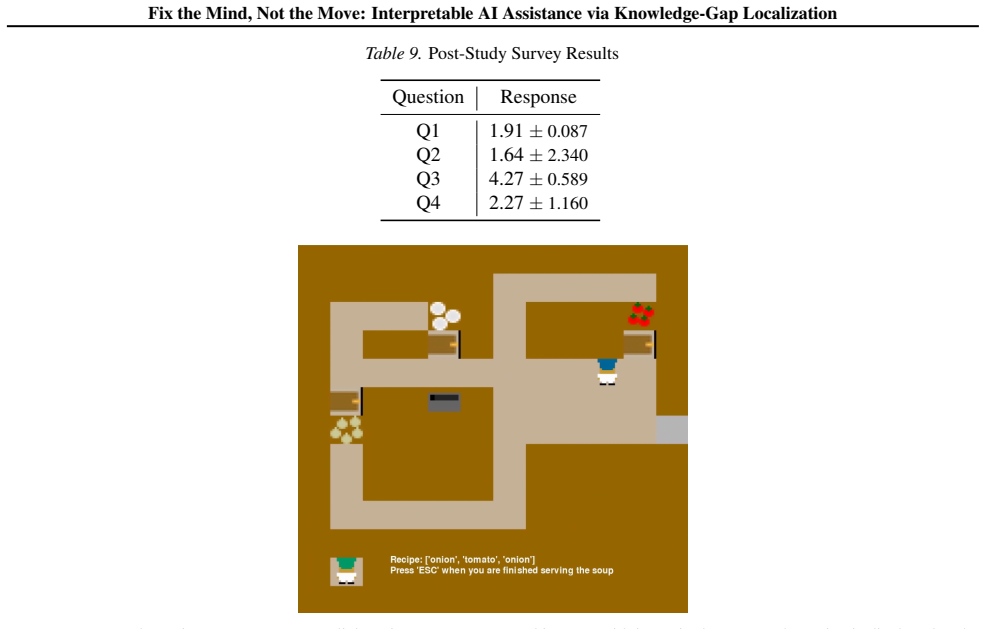
Raw-Boiled Confusion (Type): Student thinks the raw egg is boiled and the boiled egg is raw. A.1.2. OVERCOOKED The task consists of placing 2 onions and 1 tomato into a pot, cooking the soup, plating the soup, and delivering it to a serving location. Doors in the environment unlock shortcut paths to each item, and the agent must take shortcut paths whenev...
-
[12]
13 Fix the Mind, Not the Move: Interpretable AI Assistance via Knowledge-Gap Localization
Careless Dish (Hazard): Student does not know that dishes should be picked up carefully. 13 Fix the Mind, Not the Move: Interpretable AI Assistance via Knowledge-Gap Localization
-
[13]
Careless Tomato (Hazard): Student does not know that tomatoes should be picked up carefully
-
[14]
No Open Dish Door (Skill): Student does not know how to open the door to the dishes
-
[15]
No Open Onion Door (Skill): Student does not know how to open the door to the onions
-
[16]
No Open Tomato Door (Skill): Student does not know how to open the door to the tomatoes
-
[17]
Onion-Tomato Confusion (Type): Student thinks onions are tomatoes and tomatoes are onions
-
[18]
Counter Confusion (Type): Student thinks the white counter is the serving counter. A.1.3. ROVER The task is a modified IPCRoversdomain where a rover must navigate among waypoints to collect soil and rock samples, take images of scientific targets, and transmit all results back to a lander. Objects include the rover, a set of waypoints, sample targets (soi...
-
[19]
Camera Calibration (Hazard): The student is unaware that the camera must be calibrated before use, so it skips camera calibration and takes uncalibrated images
-
[20]
channel busy
Channel Busy (Hazard): The student is missing knowledge related to the “channel busy” constraint, typically causing it to ignore channel conflicts or avoid direct links in favor of relays
-
[21]
establish link
Establish Link (Hazard): The student believes “establish link” does not consume the channel (infinite capacity), so it repeatedly establishes links without releasing them
-
[22]
warmup lab
Lab Warmup (Hazard): ”The student is unaware that the lab must be warmed up before analysis, so it skips “warmup lab” and attempts raw processing
-
[23]
release channel
Clear Channel (Hazard): ”The student forgets that “release channel” clears the established link, leading to the channel being used when it is already occupied
-
[24]
Empty Storage (Hazard): The student fails to realize that it must empty the store before taking new samples, leading it to ’mix’ objects in the store rather than clearing them
-
[25]
communicate soil
Costly Soil Communicate (Skill): The student believes “communicate soil” is very costly, so it chooses to “relay soil” instead
-
[26]
relay soil
Costly Soil Relay (Skill): The student believes “relay soil” is very costly, so it forces itself to use the direct “communicate soil” action
-
[27]
release channel
Costly Release Channel (Skill): The student believes “release channel” is expensive, causing it to avoid releasing the channel whenever possible
-
[28]
Costly Rock Sample (Skill): The student believes sampling rock directly is expensive, so it uses the alternative raw sampling method
-
[29]
Costly Soil Sample (Skill): The student believes sampling soil directly is expensive, so it uses the alternative raw sampling method
-
[30]
Costly Color Image (Skill): The student believes taking standard color images is expensive, so it captures uncalibrat- ed/raw images instead
-
[31]
Costly High-Res Image (Skill): The student believes taking standard high-res images is expensive, so it captures uncalibrated/raw images instead. 15 Fix the Mind, Not the Move: Interpretable AI Assistance via Knowledge-Gap Localization A.2. Summary of Dataset The number of knowledge components (# Components), the number of components with simulated gaps (...
-
[32]
Incorrect Action Logic (e.g., wrong effects)
-
[33]
INPUTS: [EXPERT DOMAIN AND PROBLEM PDDL] {expert_pddl} [EXPERT PLAN] {expert_plan} [STUDENT PLAN] {student_plan} TASK:
Incorrect Object Definitions (e.g., they think ’onion1’ is type ’tomato’). INPUTS: [EXPERT DOMAIN AND PROBLEM PDDL] {expert_pddl} [EXPERT PLAN] {expert_plan} [STUDENT PLAN] {student_plan} TASK:
-
[34]
Trace the plan step-by-step and compare it to optimal behavior (expert plan or equally good plan)
-
[35]
Identify the FIRST step where the student’s behavior diverges from what a rational 24 Fix the Mind, Not the Move: Interpretable AI Assistance via Knowledge-Gap Localization expert would do
-
[36]
Note that a single behavioral error might imply multiple PDDL changes (e.g., adding an object AND changing a type)
INFER the specific knowledge gap(s). Note that a single behavioral error might imply multiple PDDL changes (e.g., adding an object AND changing a type)
-
[37]
identified_gaps
For EACH inferred gap, identify the specific PDDL block (e.g., Action, Objects) and REWRITE it exactly as the student believes it to be. IMPORTANT CONSTRAINTS: - For Action definitions: Output the FULL ‘(:action ...)‘ block. - For Objects blocks: Output the FULL ‘(:objects ...)‘ block containing ALL items, not just the changed ones, so it can be parsed as...
-
[38]
-> MATCH
**Synonyms/Paraphrasing:** GT uses ‘(hand-empty)‘ but Prediction uses ‘(not (holding ?x ))‘. -> MATCH
-
[39]
The intent is clearly the same
**Hallucinated Predicates: ** GT uses ‘(reachable ?x)‘ but Prediction uses ‘(can-grab ?x )‘ (which doesn’t exist). The intent is clearly the same. -> MATCH
-
[40]
MISMATCH
**Implicit vs Explicit: ** GT deletes a precondition. Prediction keeps the precondition but adds an effect that trivially satisfies it. -> MATCH. GUIDELINES for "MISMATCH" (False):
-
[41]
Student thinks they can’t fail,
**Different Logic: ** GT says "Student thinks they can’t fail," Prediction says "Student thinks they succeed instantly." (Subtle, but maybe different)
-
[42]
Prediction refers to ‘tomato1‘
**Wrong Object: ** GT refers to ‘onion1‘. Prediction refers to ‘tomato1‘. -> MISMATCH
-
[43]
inferred_belief_ground_truth
**Opposite Effect: ** GT negates a predicate. Prediction makes it positive. -> MISMATCH. OUTPUT: Return JSON: {{ "inferred_belief_ground_truth": "One sentence summary of what the GT implies (e.g., ’ Agent believes holding isn’t required’).", "inferred_belief_prediction": "One sentence summary of what the Prediction implies.", "is_conceptually_equivalent":...
discussion (0)
Sign in with ORCID, Apple, or X to comment. Anyone can read and Pith papers without signing in.