Short Gravitational-Wave Transients as Probes of Cosmic Domain Walls
Pith reviewed 2026-06-27 23:55 UTC · model grok-4.3
The pith
Two gravitational-wave events are consistent with a single cosmic domain wall.
A machine-rendered reading of the paper's core claim, the machinery that carries it, and where it could break.
Core claim
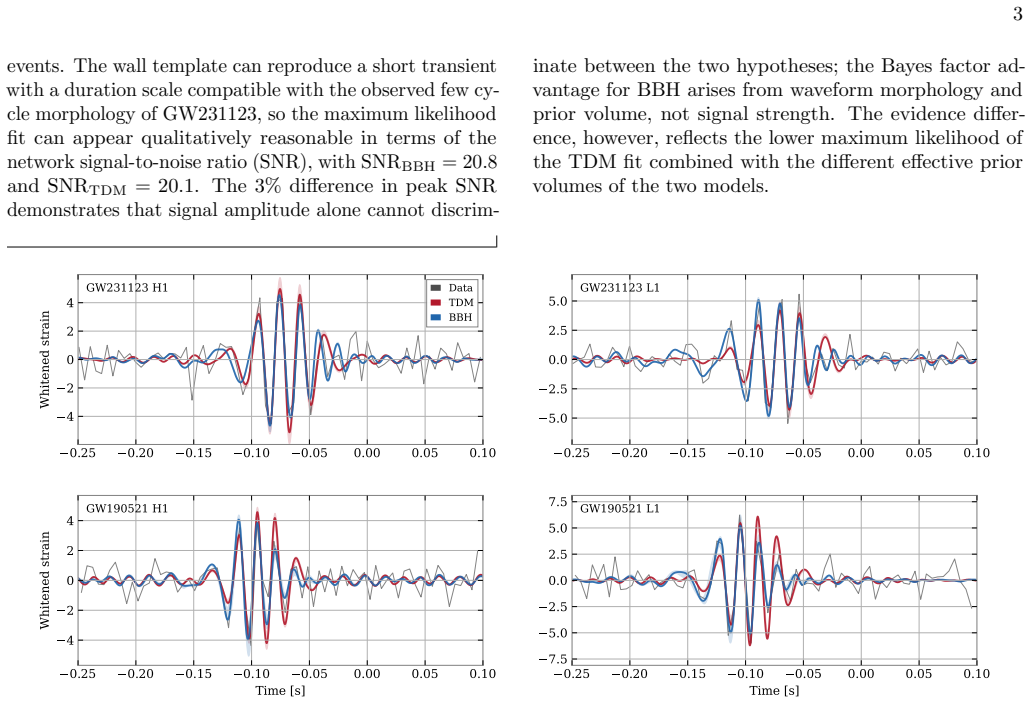
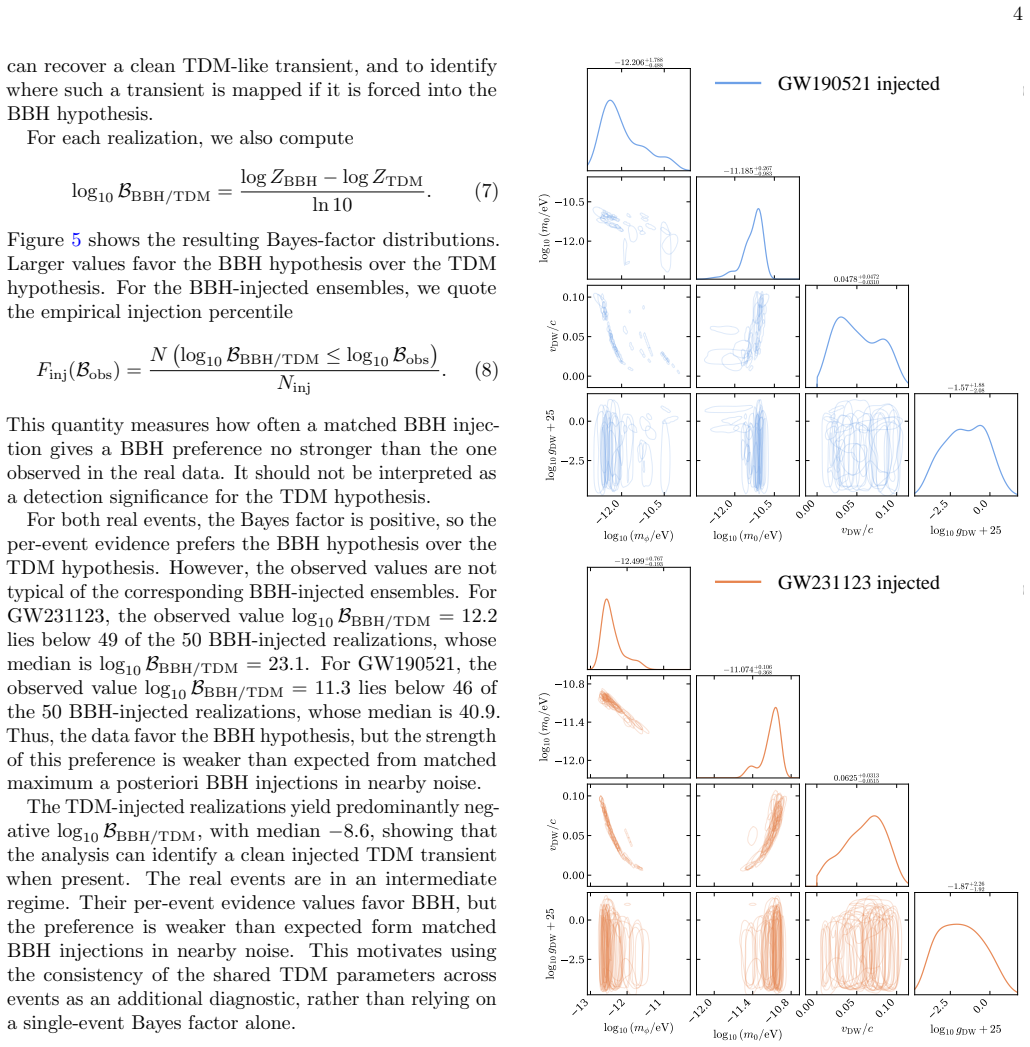
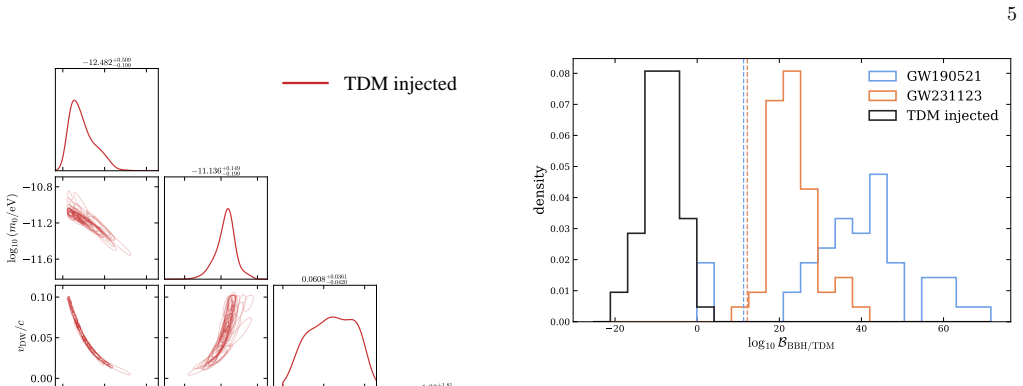
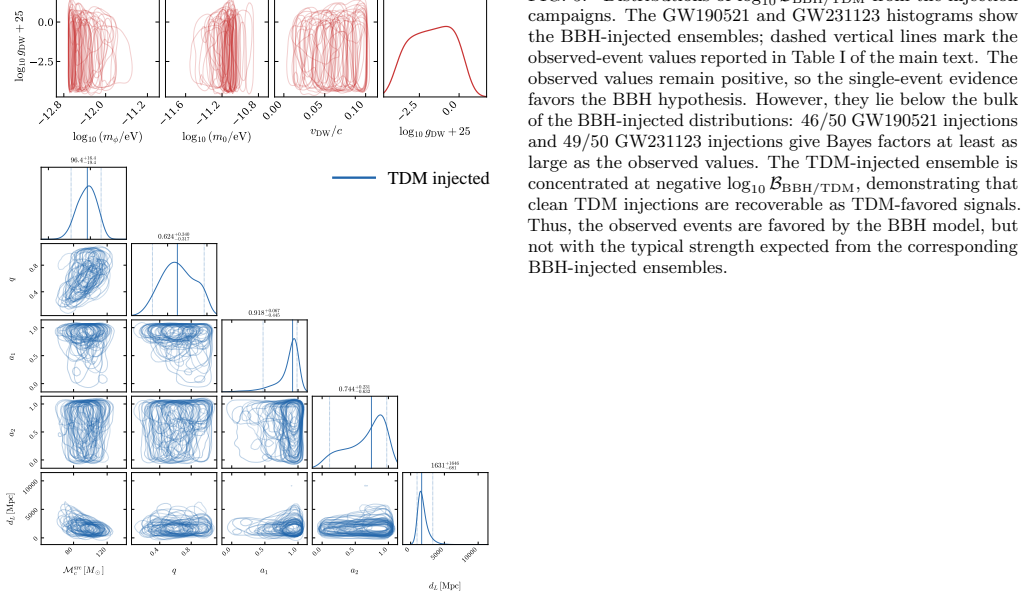
Although the binary black hole hypothesis is individually favored, with log10 Bayes factors of 12.2 for GW231123 and 11.3 for GW190521, these values are lower than those recovered from matched maximum a posteriori BBH waveforms injected into nearby noise segments. The two events are consistent with a common scalar field in a joint fit, with shared TDM parameters agreeing across independent noise realizations and sky locations. Injected TDM transients are systematically recovered under the BBH hypothesis with large spin parameters, revealing a morphological degeneracy.
What carries the argument
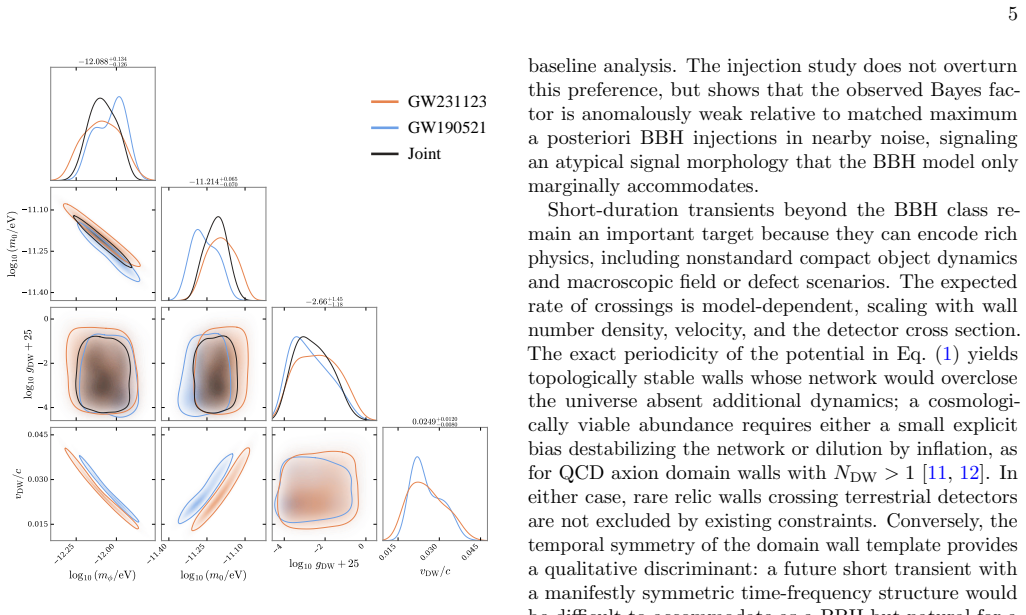
Joint fit constraining domain wall signals from a single underlying scalar field simultaneously by both events.
If this is right
- Multi-event parameter consistency tests provide a discriminant for domain wall dark matter searches in upcoming observing runs.
- Genuine domain wall signals can be misidentified as binary black hole mergers due to the degeneracy with large spin parameters.
- The lower Bayes factors leave the domain wall interpretation viable even when black hole models are preferred individually.
Where Pith is reading between the lines
- If the common scalar field interpretation holds, these events would trace back to the same early-universe phase transition.
- The degeneracy implies that some reported high-mass, high-spin black hole candidates could be reexamined for domain wall morphology.
- Applying the joint-fit test to additional short-duration candidates could either strengthen or rule out a shared origin.
Load-bearing premise
The domain wall template accurately captures the true signal morphology and the LIGO noise properties are correctly modeled for the reported Bayes factors and joint parameter constraints.
What would settle it
A third event whose best-fit domain wall parameters fall outside the range consistent with the shared scalar field values from these two events.
Figures
read the original abstract
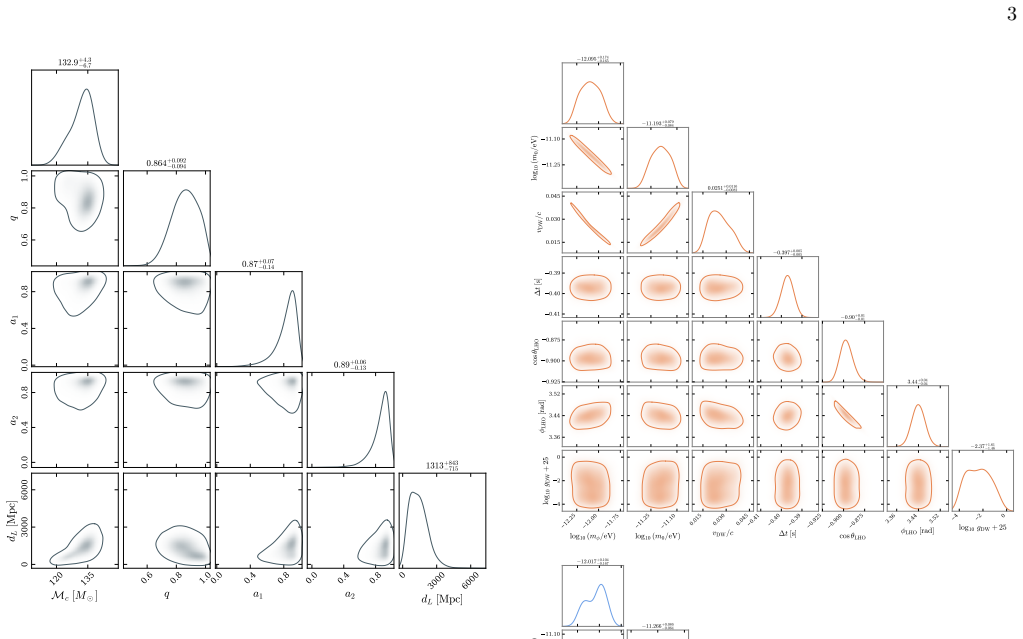
GW190521 and GW231123 have been reported as short-duration gravitational-wave transients consistent with very massive binary black hole (BBH) coalescences whose inferred parameters, i.e., exceptionally high total masses and spin magnitudes, challenge standard isolated binary stellar evolution. We test a topological dark matter (TDM) interpretation invoking cosmic domain walls by fitting a physically motivated domain wall template to the LIGO Hanford and Livingston strain data. The BBH hypothesis is individually favored, with $\log_{10}\mathcal{B}_{\rm BBH/TDM}=12.2$ and $11.3$ for GW231123 and GW190521, respectively. However, these values are lower than those typically recovered from matched maximum a posteriori BBH waveforms injected into nearby noise segments. We further perform, for the first time, a joint fit in which domain wall signals from a single underlying scalar field are constrained simultaneously by both events. Although not favored over BBH signals, we find the two events are consistent with a common scalar field, with shared TDM parameters agreeing across independent noise realizations and sky locations. We further find that injected TDM transients are systematically recovered under the BBH hypothesis with large spin parameters, revealing a morphological degeneracy that could mask genuine domain wall signals. This analysis demonstrates that multi-event parameter consistency tests provide a new discriminant for domain wall dark matter searches in upcoming observing runs.
Editorial analysis
A structured set of objections, weighed in public.
Referee Report
Summary. The manuscript tests a topological dark matter interpretation of the short GW transients GW190521 and GW231123 using a cosmic domain wall template fitted to LIGO strain data. Individual-event analyses yield log10 Bayes factors favoring BBH over TDM of 12.2 (GW231123) and 11.3 (GW190521), values lower than those from BBH injections into nearby noise. A joint fit constraining signals from a single scalar field to both events finds the shared TDM parameters consistent across independent noise realizations and sky locations. The work also reports that injected TDM signals are systematically recovered under the BBH hypothesis with large spin parameters, indicating a morphological degeneracy, and proposes multi-event consistency tests as a new discriminant for domain wall searches.
Significance. If the joint-fit consistency result holds, the manuscript introduces multi-event parameter agreement as a practical new handle for domain-wall dark-matter searches in GW catalogs, which could be applied in O4/O5 data. The explicit demonstration of the TDM-BBH morphological degeneracy is a concrete, useful cautionary result. The analysis performs the first joint constraint across two real events and uses actual LIGO data, which strengthens its relevance.
major comments (2)
- [Joint analysis] Joint-fit section: the central claim that the two events are consistent with a common scalar field rests on the reported agreement of shared TDM parameters across noise realizations and sky locations, yet no quantitative consistency metric (posterior overlap, credible-interval intersection, or KL divergence) or tabulated posterior summaries are supplied, preventing assessment of whether the agreement exceeds what is expected by chance.
- [Results on individual events] Individual Bayes-factor results: the statement that the recovered log10 B_BBH/TDM values are lower than those from matched BBH injections into nearby noise segments is used to contextualize the TDM fits, but the manuscript does not specify the number of injection trials, the distribution of recovered Bayes factors, or the precise noise-segment selection criteria, leaving the statistical significance of the comparison unclear.
minor comments (2)
- [Methods] The domain-wall template functional form and its derivation from the underlying scalar-field Lagrangian are referenced only generically; an explicit equation or citation to the template definition would improve reproducibility.
- [Parameter definitions] Notation for the shared TDM parameters (e.g., wall tension, velocity, or thickness) is introduced without a dedicated table listing priors, ranges, or units, which would aid readers in reproducing the joint constraints.
Simulated Author's Rebuttal
We thank the referee for their thorough review and valuable feedback on our manuscript. We address each major comment below and agree that additional quantitative details will strengthen the presentation. Revisions will be incorporated in the next version.
read point-by-point responses
-
Referee: [Joint analysis] Joint-fit section: the central claim that the two events are consistent with a common scalar field rests on the reported agreement of shared TDM parameters across noise realizations and sky locations, yet no quantitative consistency metric (posterior overlap, credible-interval intersection, or KL divergence) or tabulated posterior summaries are supplied, preventing assessment of whether the agreement exceeds what is expected by chance.
Authors: We agree that a quantitative consistency metric is necessary to rigorously support the claim of parameter agreement. In the revised manuscript we will add tabulated posterior summaries (medians and 90% credible intervals) for all shared TDM parameters from both the joint fit and the individual-event fits. We will also compute and report the fractional overlap of the 90% credible intervals between the two events as well as the posterior overlap integral. To assess whether the observed agreement exceeds chance, we will include a control comparison using randomized pairings of independent noise realizations drawn from the same data segments. revision: yes
-
Referee: [Results on individual events] Individual Bayes-factor results: the statement that the recovered log10 B_BBH/TDM values are lower than those from matched BBH injections into nearby noise segments is used to contextualize the TDM fits, but the manuscript does not specify the number of injection trials, the distribution of recovered Bayes factors, or the precise noise-segment selection criteria, leaving the statistical significance of the comparison unclear.
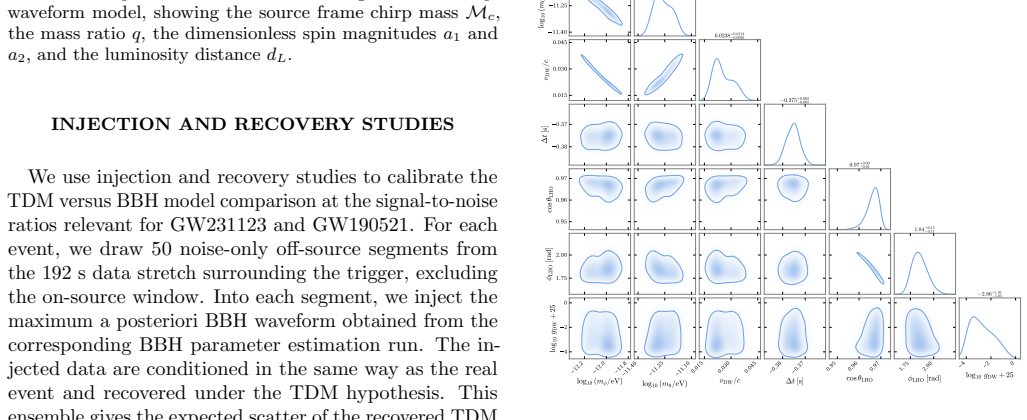
Authors: We concur that the injection study requires explicit statistical details. The revised manuscript will state that 50 independent BBH injections were performed, each using the maximum-a-posteriori BBH parameters recovered from the real data and injected into noise segments drawn from the 20-second windows immediately preceding and following each event (excluding a 4-second buffer around the trigger). We will report the full distribution of recovered log10 B_BBH/TDM values (mean, standard deviation, and range) and the fraction of injections that yield Bayes factors larger than those obtained from the actual events, thereby quantifying the significance of the comparison. revision: yes
Circularity Check
No significant circularity in derivation chain
full rationale
The central claim rests on a joint Bayesian fit constraining shared TDM parameters from two independent GW events, with consistency reported as an empirical outcome across noise realizations and sky locations. No equations or steps are shown that reduce the reported parameter agreement or Bayes factors to a fitted quantity by construction, a self-definition, or a self-citation chain. The analysis is presented as a direct multi-event consistency test without load-bearing ansatzes or renamings that collapse to the inputs. This is the normal case of a self-contained empirical result.
Axiom & Free-Parameter Ledger
free parameters (1)
- shared TDM scalar field parameters
axioms (1)
- domain assumption A physically motivated domain wall template exists that can be matched to LIGO strain data
invented entities (1)
-
cosmic domain walls as topological dark matter source for the observed transients
no independent evidence
Reference graph
Works this paper leans on
-
[1]
J. L. Feng, Ann. Rev. Astron. Astrophys.48, 495 (2010), arXiv:1003.0904 [astro-ph.CO]
work page internal anchor Pith review Pith/arXiv arXiv 2010
-
[2]
A. Arbey and F. Mahmoudi, Prog. Part. Nucl. Phys.119, 103865 (2021), arXiv:2104.11488 [hep-ph]
-
[3]
J. Khoury, in50th Rencontres de Moriond on Gravitation: 100 years after GR(2015) pp. 35–42, arXiv:1507.03013 [astro-ph.CO]
work page internal anchor Pith review Pith/arXiv arXiv 2015
- [4]
- [7]
-
[8]
How do you know if you ran through a wall?
M. Pospelov, S. Pustelny, M. P. Ledbetter, D. F. Jack- son Kimball, W. Gawlik, and D. Budker, Phys. Rev. Lett. 110, 021803 (2013), arXiv:1205.6260 [hep-ph]
work page internal anchor Pith review Pith/arXiv arXiv 2013
-
[9]
S. M. Vermeulen, P. Relton, H. Grote, V. Raymond, C. Af- feldt, F. Bergamin, A. Bisht, M. Brinkmann, K. Danz- mann, S. Doravari,et al., Nature600, 424 (2021)
2021
-
[10]
T. W. B. Kibble, J. Phys. A9, 1387 (1976)
1976
-
[11]
Vilenkin and E
A. Vilenkin and E. P. S. Shellard,Cosmic Strings and Other Topological Defects(Cambridge University Press, 2000)
2000
-
[12]
Vachaspati,Kinks and Domain Walls : An Introduc- tion to Classical and Quantum Solitons(Oxford University Press, 2007)
T. Vachaspati,Kinks and Domain Walls : An Introduc- tion to Classical and Quantum Solitons(Oxford University Press, 2007)
2007
-
[13]
Rajaraman,Solitons and Instantons: An Introduc- tion to Solitons and Instantons in Quantum Field Theory (Elsevier, New York, 1982)
R. Rajaraman,Solitons and Instantons: An Introduc- tion to Solitons and Instantons in Quantum Field Theory (Elsevier, New York, 1982)
1982
-
[14]
N. S. Manton and P. Sutcliffe,Topological solitons, Cam- bridge Monographs on Mathematical Physics (Cambridge University Press, 2004)
2004
-
[15]
Y. V. Stadnik and V. V. Flambaum, Phys. Rev. Lett. 113, 151301 (2014), arXiv:1405.5337 [hep-ph]
work page internal anchor Pith review Pith/arXiv arXiv 2014
-
[16]
Hunting for topological dark matter with atomic clocks
A. Derevianko and M. Pospelov, Nature Phys.10, 933 (2014), arXiv:1311.1244 [physics.atom-ph]
work page internal anchor Pith review Pith/arXiv arXiv 2014
-
[17]
B. M. Roberts, G. Blewitt, C. Dailey, M. Murphy, M. Pospelov, A. Rollings, J. Sherman, W. Williams, and A. Derevianko, Nature Commun.8, 1195 (2017), arXiv:1704.06844 [hep-ph]
work page internal anchor Pith review Pith/arXiv arXiv 2017
-
[19]
Searching for Dark Photon Dark Matter with Gravitational Wave Detectors
A. Pierce, K. Riles, and Y. Zhao, Phys. Rev. Lett.121, 061102 (2018), arXiv:1801.10161 [hep-ph]
work page internal anchor Pith review Pith/arXiv arXiv 2018
- [20]
-
[21]
Abbottet al.(LIGO Scientific, KAGRA, Virgo), Phys
R. Abbottet al.(LIGO Scientific, KAGRA, Virgo), Phys. Rev. D105, 063030 (2022), [Erratum: Phys.Rev.D 109, 089902 (2024)], arXiv:2105.13085 [astro-ph.CO]
-
[22]
T. L. S. Collaboration, the Virgo Collaboration, the KA- GRA Collaboration, A. G. Abac, I. Abouelfettouh, F. Ac- ernese, K. Ackley, C. Adamcewicz, S. Adhicary, D. Ad- hikari,et al., Direct multi-model dark-matter search with gravitational-wave interferometers using data from the first part of the fourth ligo-virgo-kagra observing run (2025), arXiv:2510.27...
- [23]
-
[24]
S. Bhattacharya, B. Dasgupta, R. Laha, and A. Ray, Phys. Rev. Lett.131, 091401 (2023), arXiv:2302.07898 [hep-ph]
-
[25]
B. Dasgupta, R. Laha, and A. Ray, Phys. Rev. Lett.126, 141105 (2021), arXiv:2009.01825 [astro-ph.HE]
-
[26]
Black Hole Superradiance Signatures of Ultralight Vectors
M. Baryakhtar, R. Lasenby, and M. Teo, Phys. Rev. D 96, 035019 (2017), arXiv:1704.05081 [hep-ph]
work page internal anchor Pith review Pith/arXiv arXiv 2017
-
[27]
A. Maselli, N. Franchini, L. Gualtieri, and T. P. Sotiriou, Phys. Rev. Lett.125, 141101 (2020), arXiv:2004.11895 [gr-qc]
-
[28]
A. Maselli, N. Franchini, L. Gualtieri, T. P. Sotiriou, S. Barsanti, and P. Pani, Nature Astron.6, 464 (2022), arXiv:2106.11325 [gr-qc]
-
[29]
The Primordial Black Hole Dark Matter - LISA Serendipity
N. Bartolo, V. De Luca, G. Franciolini, A. Lewis, M. Peloso, and A. Riotto, Phys. Rev. Lett.122, 211301 (2019), arXiv:1810.12218 [astro-ph.CO]
work page internal anchor Pith review Pith/arXiv arXiv 2019
-
[32]
G.-P. Li and X.-L. Fan, The Hierarchical Merger Scenario for GW231123 (2025), arXiv:2509.08298 [astro-ph.HE]
-
[33]
L. Passenger, S. Banagiri, E. Thrane, P. D. Lasky, A. Borchers, M. Fishbach, and C. S. Ye, Is GW231123 a hierarchical merger? (2025), arXiv:2510.14363 [astro- ph.HE]
-
[34]
L. Paiella, C. Ugolini, M. Spera, M. Branchesi, and M. A. Sedda, Astrophys. J. Lett.994, L54 (2025), arXiv:2509.10609 [astro-ph.GA]
- [35]
-
[37]
Varying constants, Gravitation and Cosmology
J.-P. Uzan, Living Rev. Rel.14, 2 (2011), arXiv:1009.5514 [astro-ph.CO]
work page internal anchor Pith review Pith/arXiv arXiv 2011
-
[39]
Bilby: A user-friendly Bayesian inference library for gravitational-wave astronomy
G. Ashtonet al., Astrophys. J. Suppl.241, 27 (2019), arXiv:1811.02042 [astro-ph.IM]
work page internal anchor Pith review Pith/arXiv arXiv 2019
-
[40]
J. S. Speagle, Monthly Notices of the Royal Astronomical Society493, 3132 (2020), arXiv:1904.02180 [astro-ph.IM]
work page internal anchor Pith review Pith/arXiv arXiv 2020
-
[41]
See Supplemental Material for details on detector response channels, data conditioning, prior choices, BBH analysis, robustness checks, and posterior corner plots
-
[42]
Øyvind Christiansen, J. Adamek, and M. Kunz, Cosmic strings, domain walls and environment-dependent cluster- ing (2026), arXiv:2601.15234 [astro-ph.CO]
-
[43]
K. Hinterbichler and J. Khoury, Physical Review Letters 104, 10.1103/physrevlett.104.231301 (2010)
-
[44]
K. Hinterbichler, J. Khoury, A. Levy, and A. Matas, Phys- ical Review D84, 10.1103/physrevd.84.103521 (2011)
-
[47]
Y. B. Zeldovich, I. Y. Kobzarev, and L. B. Okun, Zh. Eksp. Teor. Fiz.67, 3 (1974)
1974
-
[48]
Saikawa, Universe3, 40 (2017)
K. Saikawa, Universe3, 40 (2017)
2017
-
[49]
Burrage, A
C. Burrage, A. Kuribayashi-Coleman, J. Stevenson, and B. Thrussell, Journal of Cosmology and Astroparticle Physics2016(12), 041–041
- [50]
-
[51]
Short Gravitational-Wave Transients as Probes of Cosmic Domain Walls
G. Cronenberg, P. Brax, H. Filter, P. Geltenbort, T. Jenke, G. Pignol, M. Pitschmann, M. Thalhammer, and H. Abele, Nature Physics14, 1022–1026 (2018). Supplemental Material for “Short Gravitational-Wave Transients as Probes of Cosmic Domain Walls” T¨ ore Boybeyi,1 Do˘ ga Veske,2, 3, 4 and David Maibach 5 1School of Physics & Astronomy, University of Minne...
2018
-
[52]
L. Heisenberg, D. Maibach, and D. Veske, Phys. Rev. D 110, 055037 (2024), arXiv:2309.05093 [gr-qc]
-
[53]
J. Aasiet al.(LIGO Scientific), Class. Quant. Grav.32, 074001 (2015), arXiv:1411.4547 [gr-qc]
work page internal anchor Pith review Pith/arXiv arXiv 2015
-
[54]
H. Grote and Y. V. Stadnik, Phys. Rev. Res.1, 033187 (2019), arXiv:1906.06193 [astro-ph.IM]
-
[55]
A. G. Abacet al.(LIGO Scientific, VIRGO, KAGRA), Open Data from LIGO, Virgo, and KAGRA through the First Part of the Fourth Observing Run (2025), arXiv:2508.18079 [gr-qc]
work page internal anchor Pith review Pith/arXiv arXiv 2025
-
[56]
P. P. Avelino and L. Sousa, Universe1, 6 (2015), arXiv:1404.3419 [astro-ph.CO]
work page internal anchor Pith review Pith/arXiv arXiv 2015
-
[57]
Hearing the signals of dark sectors with gravitational wave detectors
J. Jaeckel, V. V. Khoze, and M. Spannowsky, Phys. Rev. D94, 103519 (2016), arXiv:1602.03901 [hep-ph]
work page internal anchor Pith review Pith/arXiv arXiv 2016
- [58]
-
[59]
Surrogate models for precessing binary black hole simulations with unequal masses
V. Varma, S. E. Field, M. A. Scheel, J. Blackman, D. Gerosa, L. C. Stein, L. E. Kidder, and H. P. Pfeiffer, Phys. Rev. Research.1, 033015 (2019), arXiv:1905.09300 [gr-qc]
work page internal anchor Pith review Pith/arXiv arXiv 2019
-
[60]
A. G. Abacet al.(LIGO Scientific, VIRGO, KAGRA), Astrophys. J. Lett.993, L25 (2025), arXiv:2507.08219 [astro-ph.HE]
work page internal anchor Pith review Pith/arXiv arXiv 2025
-
[61]
R. Abbottet al.(LIGO Scientific, VIRGO), Phys. Rev. D109, 022001 (2024), arXiv:2108.01045 [gr-qc]
work page internal anchor Pith review Pith/arXiv arXiv 2024
-
[62]
R. Abbottet al.(KAGRA, VIRGO, LIGO Scientific), Phys. Rev. X13, 041039 (2023), arXiv:2111.03606 [gr- qc]
work page internal anchor Pith review Pith/arXiv arXiv 2023
-
[63]
Abbottet al.(LIGO Scientific, Virgo), Phys
R. Abbottet al.(LIGO Scientific, Virgo), Phys. Rev. Lett. 125, 101102 (2020), arXiv:2009.01075 [gr-qc]
discussion (0)
Sign in with ORCID, Apple, or X to comment. Anyone can read and Pith papers without signing in.