Short-Range Correlations Between Partons in a Proton
Pith reviewed 2026-06-27 03:11 UTC · model grok-4.3
The pith
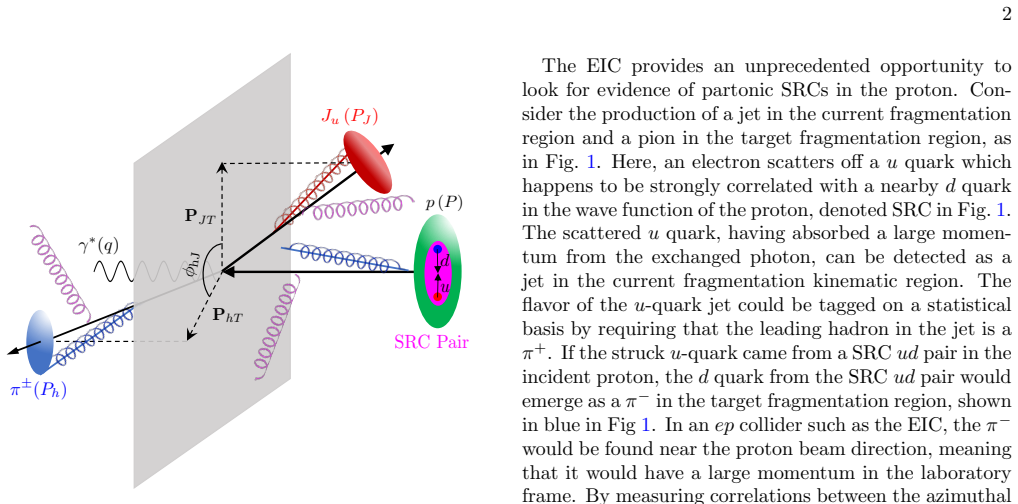
EIC measurements of a jet and a pion with the scattered electron can detect short-range correlations between quark pairs inside protons.
A machine-rendered reading of the paper's core claim, the machinery that carries it, and where it could break.
Core claim
The central claim is that EIC observables involving measurements of a jet and a pion together with the scattered electron can seek and quantify the possible existence of short-range correlations between quark pairs within a nucleon, with the QCD attraction in the ud diquark channel making ud SRCs stronger than uu or dd SRCs and thereby allowing a first observation of partonic SRCs.
What carries the argument
The proposed EIC jet-plus-pion measurement that exploits the isospin dependence arising from QCD attraction in the ud diquark channel, in direct analogy to the np dominance seen in nuclear SRCs.
If this is right
- The measurements would characterize the strongly coupled interior of the proton beyond the one-parton-at-a-time picture from generalized parton distributions.
- They would provide a key ingredient for a microscopic understanding of the liquid nature of quark-gluon plasma.
- They would enable the first observation of partonic short-range correlations.
- The isospin asymmetry in the signals would directly test the role of diquark attraction at the parton level.
Where Pith is reading between the lines
- If the signals are observed, similar jet-pion measurements could be pursued in other high-energy experiments to map parton correlations across different hadrons.
- The approach would connect nuclear SRC studies to the partonic structure of free nucleons, suggesting a unified description across length scales.
- Confirmation would motivate theoretical calculations of the expected ud enhancement using models of diquark correlations inside the proton.
Load-bearing premise
The isospin dependence and dominance pattern observed for nucleon SRCs in nuclei has a direct analog for partonic SRCs inside protons driven by the QCD attraction in the ud diquark channel.
What would settle it
Data from the proposed EIC jet-plus-pion observables showing no enhancement of ud correlations relative to uu or dd correlations would falsify the predicted partonic SRCs.
Figures
read the original abstract
A principal lesson from recreating droplets of quark-gluon plasma (QGP) in heavy ion collisions is that it is a strongly coupled liquid, not a plasma of partons. The energy density and pressure of quarks and gluons confined within a proton are comparable to those of QGP at or just above the QCD transition temperature. Given this similarity between protons and QGP, we propose that the investigation of correlations between nearby partons within a proton must be a central goal for the future Electron-Ion Collider (EIC). Here, we ask how EIC measurements can discern such short-range correlations (SRCs) of quark pairs. Doing so would characterize the strongly coupled interior of a proton, augmenting the one-parton-at-a-time understanding of protons via (generalized) parton distribution functions, and could at the same time yield a key ingredient for the microscopic understanding of the liquid nature of QGP. Motivated by the experiments that have been used to demonstrate the existence of SRCs between nucleon pairs within a nucleus, we propose using EIC observables involving measurements of a jet and a pion, together with the scattered electron, to seek and quantify the possible existence of SRCs between quark pairs within a nucleon. The pronounced isospin dependence observed in the dominance of $np$ SRCs over $pp$ or $nn$ SRCs has played a central role in establishing the importance of SRCs among nucleons in nuclei. Analogously, the QCD attraction in the $ud$ diquark channel can make the $ud$ SRC stronger than the $uu$ and $dd$ SRCs, allowing a first observation of partonic SRCs.
Editorial analysis
A structured set of objections, weighed in public.
Referee Report
Summary. The manuscript proposes that EIC triple-coincidence measurements of a jet, a pion, and the scattered electron can seek and quantify short-range correlations (SRCs) between quark pairs inside a proton. It motivates the idea from the strongly coupled liquid-like nature of both the proton interior and QGP, and argues that the isospin pattern seen in nuclear SRCs (np dominance) should have a partonic analog driven by QCD attraction in the ud diquark channel, making ud SRCs stronger than uu or dd and enabling a first observation of partonic SRCs.
Significance. If the proposed observables can isolate partonic SRCs, the work would extend the one-parton-at-a-time description provided by GPDs to correlated multi-parton structure inside the nucleon and supply a potential microscopic ingredient for understanding the liquid nature of QGP. The analogy-based proposal is novel in its direct transfer of nuclear-physics concepts to the partonic level at an upcoming collider.
major comments (2)
- [Abstract] Abstract: the claim that the jet+pion+electron observables 'can seek and quantify' SRCs between quark pairs rests on an untested assumption that the nuclear np-dominance pattern has a direct counterpart at the parton level; no calculation, toy model, or kinematic estimate is supplied to show that a ud excess would be measurable above standard PDFs, fragmentation, or other correlations.
- [Abstract] Abstract: the assertion that 'the QCD attraction in the ud diquark channel can make the ud SRC stronger' and thereby allow 'a first observation of partonic SRCs' is presented solely by analogy without any supporting argument or estimate demonstrating why the nuclear isospin pattern should translate to partons inside a single proton.
Simulated Author's Rebuttal
We thank the referee for the careful reading and constructive comments. The points raised correctly identify that the abstract's claims rely on an untested analogy without quantitative support. We address each comment below and will revise the manuscript accordingly.
read point-by-point responses
-
Referee: [Abstract] Abstract: the claim that the jet+pion+electron observables 'can seek and quantify' SRCs between quark pairs rests on an untested assumption that the nuclear np-dominance pattern has a direct counterpart at the parton level; no calculation, toy model, or kinematic estimate is supplied to show that a ud excess would be measurable above standard PDFs, fragmentation, or other correlations.
Authors: We agree that the abstract phrasing implies a stronger claim than is supported by explicit calculations in the manuscript. The work is a conceptual proposal to motivate EIC measurements based on the nuclear SRC analogy. We will revise the abstract to state that the observables 'could be used to search for and potentially quantify' such correlations, and add a brief discussion of how one might estimate the expected ud excess using simple scaling from nuclear data and known diquark properties. revision: yes
-
Referee: [Abstract] Abstract: the assertion that 'the QCD attraction in the ud diquark channel can make the ud SRC stronger' and thereby allow 'a first observation of partonic SRCs' is presented solely by analogy without any supporting argument or estimate demonstrating why the nuclear isospin pattern should translate to partons inside a single proton.
Authors: The manuscript presents the ud dominance as a hypothesis motivated by the parallel between the attractive np channel in nuclei and the attractive ud diquark channel in QCD, together with the comparable energy densities in the proton and near-Tc QGP. We acknowledge that no quantitative estimate or detailed mapping is provided. We will revise the abstract and introduction to clarify this as a motivated conjecture to be tested experimentally, and add references to existing theoretical work on diquark correlations inside nucleons. revision: yes
Circularity Check
No circularity; proposal paper with no derivations or fitted quantities
full rationale
The manuscript is a conceptual proposal for EIC measurements of partonic SRCs, motivated by nuclear SRC analogies and QCD diquark attraction. No equations, normalizations, parameter fits, or self-citation chains appear in the provided text. The central claim is an unverified conjecture resting on analogy, not a derivation that reduces to its inputs by construction. This matches the default expectation of no circularity for non-derivational papers.
Axiom & Free-Parameter Ledger
axioms (1)
- domain assumption The QCD attraction in the ud diquark channel produces stronger ud SRCs than uu or dd SRCs, mirroring the np dominance in nuclear SRCs
Reference graph
Works this paper leans on
-
[1]
K. Adcoxet al.(PHENIX), Nucl. Phys. A757, 184 (2005), arXiv:nucl-ex/0410003
Pith/arXiv arXiv 2005
-
[2]
I. Arseneet al.(BRAHMS), Nucl. Phys. A757, 1 (2005), arXiv:nucl-ex/0410020
arXiv 2005
-
[3]
B. B. Backet al.(PHOBOS), Nucl. Phys. A757, 28 (2005), arXiv:nucl-ex/0410022
Pith/arXiv arXiv 2005
-
[4]
J. Adamset al.(STAR), Nucl. Phys. A757, 102 (2005), arXiv:nucl-ex/0501009
Pith/arXiv arXiv 2005
-
[5]
M. Gyulassy and L. McLerran, Nucl. Phys. A750, 30 (2005), arXiv:nucl-th/0405013
Pith/arXiv arXiv 2005
-
[6]
B. Muller and J. L. Nagle, Ann. Rev. Nucl. Part. Sci.56, 93 (2006), arXiv:nucl-th/0602029
Pith/arXiv arXiv 2006
-
[7]
B. V. Jacak and B. Muller, Science337, 310 (2012)
2012
-
[8]
B. Muller, J. Schukraft, and B. Wyslouch, Ann. Rev. Nucl. Part. Sci.62, 361 (2012), arXiv:1202.3233 [hep-ex]
Pith/arXiv arXiv 2012
-
[9]
U. Heinz and R. Snellings, Ann. Rev. Nucl. Part. Sci.63, 123 (2013), arXiv:1301.2826 [nucl-th]
Pith/arXiv arXiv 2013
-
[10]
E. Shuryak, Rev. Mod. Phys.89, 035001 (2017), arXiv:1412.8393 [hep-ph]
Pith/arXiv arXiv 2017
-
[11]
Akibaet al., arXiv:1502.02730 (2015), arXiv:1502.02730 [nucl-ex]
Y. Akibaet al., arXiv:1502.02730 (2015), arXiv:1502.02730 [nucl-ex]
Pith/arXiv arXiv 2015
-
[12]
W. Busza, K. Rajagopal, and W. van der Schee, Ann. Rev. Nucl. Part. Sci.68, 339 (2018), arXiv:1802.04801 [hep-ph]
Pith/arXiv arXiv 2018
-
[13]
R. Abdul Khaleket al., Nucl. Phys. A1026, 122447 (2022), arXiv:2103.05419 [physics.ins-det]
Pith/arXiv arXiv 2022
-
[14]
S. Borsanyi, Z. Fodor, C. Hoelbling, S. D. Katz, S. Krieg, and K. K. Szabo, Phys. Lett. B730, 99 (2014), arXiv:1309.5258 [hep-lat]
Pith/arXiv arXiv 2014
-
[15]
A. Bazavovet al.(HotQCD), Phys. Rev. D90, 094503 (2014), arXiv:1407.6387 [hep-lat]
Pith/arXiv arXiv 2014
-
[16]
D. E. Kharzeev and K. Rajagopal, arXiv:2605.19058 (2026), arXiv:2605.19058 [hep-ph]
Pith/arXiv arXiv 2026
-
[17]
D. E. Kharzeev, Phys. Rev. D104, 054015 (2021), arXiv:2102.00110 [hep-ph]
arXiv 2021
-
[18]
Duranet al., Nature615, 813 (2023), arXiv:2207.05212 [nucl-ex]
B. Duranet al., Nature615, 813 (2023), arXiv:2207.05212 [nucl-ex]
arXiv 2023
-
[19]
P. E. Shanahan and W. Detmold, Phys. Rev. D99, 014511 (2019), arXiv:1810.04626 [hep-lat]
Pith/arXiv arXiv 2019
-
[20]
P. E. Shanahan and W. Detmold, Phys. Rev. Lett.122, 072003 (2019), arXiv:1810.07589 [nucl-th]
arXiv 2019
-
[21]
D. C. Hackett, D. A. Pefkou, and P. E. Shanahan, Phys. Rev. Lett.132, 251904 (2024), arXiv:2310.08484 [hep- lat]
arXiv 2024
-
[22]
M. V. Polyakov, Phys. Lett. B555, 57 (2003), arXiv:hep- ph/0210165
arXiv 2003
-
[23]
V. D. Burkert, L. Elouadrhiri, and F. X. Girod, Nature 557, 396 (2018)
2018
-
[24]
C. Lorc´ e, H. Moutarde, and A. P. Trawi´ nski, Eur. Phys. J. C79, 89 (2019), arXiv:1810.09837 [hep-ph]
Pith/arXiv arXiv 2019
-
[25]
M. V. Polyakov and P. Schweitzer, Int. J. Mod. Phys. A 33, 1830025 (2018), arXiv:1805.06596 [hep-ph]
Pith/arXiv arXiv 2018
-
[26]
O. Hen, G. A. Miller, E. Piasetzky, and L. B. Weinstein, Rev. Mod. Phys.89, 045002 (2017), arXiv:1611.09748 [nucl-ex]
Pith/arXiv arXiv 2017
-
[27]
Ciofi degli Atti, Phys
C. Ciofi degli Atti, Phys. Rept.590, 1 (2015)
2015
-
[28]
A. Tanget al., Phys. Rev. Lett.90, 042301 (2003), arXiv:nucl-ex/0206003
Pith/arXiv arXiv 2003
-
[29]
Koroveret al.(Lab Hall A), Phys
I. Koroveret al.(Lab Hall A), Phys. Rev. Lett.113, 022501 (2014), arXiv:1401.6138 [nucl-ex]
Pith/arXiv arXiv 2014
-
[30]
E. Piasetzky, M. Sargsian, L. Frankfurt, M. Strikman, and J. W. Watson, Phys. Rev. Lett.97, 162504 (2006), arXiv:nucl-th/0604012
Pith/arXiv arXiv 2006
-
[31]
F. E. Close, Phys. Lett. B43, 422 (1973)
1973
-
[32]
G. R. Farrar and D. R. Jackson, Phys. Rev. Lett.35, 1416 (1975)
1975
-
[33]
D. B. Lichtenberg, W. Namgung, E. Predazzi, and J. G. Wills, Phys. Rev. Lett.48, 1653 (1982)
1982
-
[34]
Anselmino, E
M. Anselmino, E. Predazzi, S. Ekelin, S. Fredriksson, and D. B. Lichtenberg, Rev. Mod. Phys.65, 1199 (1993)
1993
- [35]
-
[36]
R. L. Jaffe and F. Wilczek, Phys. Rev. Lett.91, 232003 (2003), arXiv:hep-ph/0307341
Pith/arXiv arXiv 2003
-
[37]
E. Santopinto, Phys. Rev. C72, 022201 (2005), arXiv:hep-ph/0412319
Pith/arXiv arXiv 2005
-
[38]
I. C. Cloet, G. Eichmann, B. El-Bennich, T. Klahn, and C. D. Roberts, Few Body Syst.46, 1 (2009), arXiv:0812.0416 [nucl-th]
Pith/arXiv arXiv 2009
-
[39]
M. Y. Barabanovet al., Prog. Part. Nucl. Phys.116, 103835 (2021), arXiv:2008.07630 [hep-ph]
arXiv 2021
-
[40]
C. Alexandrou, P. de Forcrand, and B. Lucini, Phys. Rev. Lett.97, 222002 (2006), arXiv:hep-lat/0609004
Pith/arXiv arXiv 2006
-
[41]
A. Francis, P. de Forcrand, R. Lewis, and K. Maltman, JHEP05, 062, arXiv:2106.09080 [hep-lat]
-
[42]
A. Francis, P. de Forcrand, R. Lewis, and K. Malt- man, Rev. Mex. Fis. Suppl.3, 0308082 (2022), arXiv:2201.03332 [hep-lat]
arXiv 2022
-
[43]
Francis, P
A. Francis, P. de Forcrand, R. Lewis, and K. Maltman, PoSICHEP2022, 795 (2022)
2022
-
[44]
M. G. Alford, K. Rajagopal, and F. Wilczek, Phys. Lett. B422, 247 (1998), arXiv:hep-ph/9711395
Pith/arXiv arXiv 1998
-
[45]
R. Rapp, T. Sch¨ afer, E. V. Shuryak, and M. Velkovsky, Phys. Rev. Lett.81, 53 (1998), arXiv:hep-ph/9711396
Pith/arXiv arXiv 1998
-
[46]
M. G. Alford, K. Rajagopal, and F. Wilczek, Nucl. Phys. 7 B537, 443 (1999), arXiv:hep-ph/9804403
Pith/arXiv arXiv 1999
-
[47]
M. G. Alford, A. Schmitt, K. Rajagopal, and T. Sch¨ afer, Rev. Mod. Phys.80, 1455 (2008), arXiv:0709.4635 [hep- ph]
Pith/arXiv arXiv 2008
-
[48]
T. Sj¨ ostrand, S. Ask, J. R. Christiansen, R. Corke, N. De- sai, P. Ilten, S. Mrenna, S. Prestel, C. O. Rasmussen, and P. Z. Skands, Comput. Phys. Commun.191, 159 (2015), arXiv:1410.3012 [hep-ph]
Pith/arXiv arXiv 2015
-
[49]
H. Avakianet al.(CLAS), Phys. Rev. Lett.130, 022501 (2023), arXiv:2208.05086 [hep-ex]
arXiv 2023
-
[50]
A. G. Acaret al.(CLAS), arXiv:2602.14271 (2026), arXiv:2602.14271 [hep-ex]
arXiv 2026
-
[51]
Trentadue and G
L. Trentadue and G. Veneziano, Phys. Lett. B323, 201 (1994)
1994
-
[52]
M. Anselmino, V. Barone, and A. Kotzinian, Phys. Lett. B699, 108 (2011), arXiv:1102.4214 [hep-ph]. SUPPLEMENT AL MA TERIALS F racture F unction and F actorization In these Supplemental Materials, we relate the observable that we have introduced in this paper and partonic SRCs in the nucleon to a two-quark fracture function that we shall define. This lays ...
Pith/arXiv arXiv 2011
discussion (0)
Sign in with ORCID, Apple, or X to comment. Anyone can read and Pith papers without signing in.