OpenGadget3 GPU solver tests
Pith reviewed 2026-06-27 02:45 UTC · model grok-4.3
The pith
The GPU port of OpenGadget3 matches CPU results across gravity-only, hydro, and full-physics cosmological tests.
A machine-rendered reading of the paper's core claim, the machinery that carries it, and where it could break.
Core claim
Comparing the results obtained with the GPU implementation to those from the classical CPU version, we find excellent agreement across all tests, with small differences on very small scales.
What carries the argument
The GPU port of the short-range gravity integrator, hydrodynamic solver components, and conjugate gradient solver for thermal conduction.
If this is right
- The GPU code can replace the CPU version for the tested physics without changing scientific conclusions.
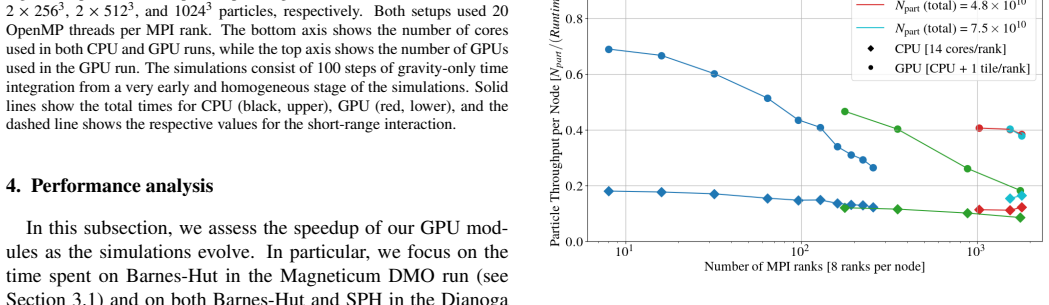
- Individual modules run 3-5 times faster on a GPU chip than on a CPU chip.
- Full cosmological setups with many processes and overheads still achieve 2-3 times overall speedup on the same hardware.
- The port is ready for use on the four tested supercomputer architectures.
Where Pith is reading between the lines
- Similar GPU ports of other mesh or particle codes could be validated with the same staged test progression.
- The small-scale differences are unlikely to affect statistics measured on halo or galaxy scales.
- Future work could add radiation or magnetic modules and repeat the same comparison sequence.
Load-bearing premise
The chosen tests exercise every ported module under conditions that represent production cosmological runs.
What would settle it
A new test that includes all the ported modules and shows statistically significant differences between GPU and CPU results at resolved scales would falsify the agreement claim.
Figures
read the original abstract
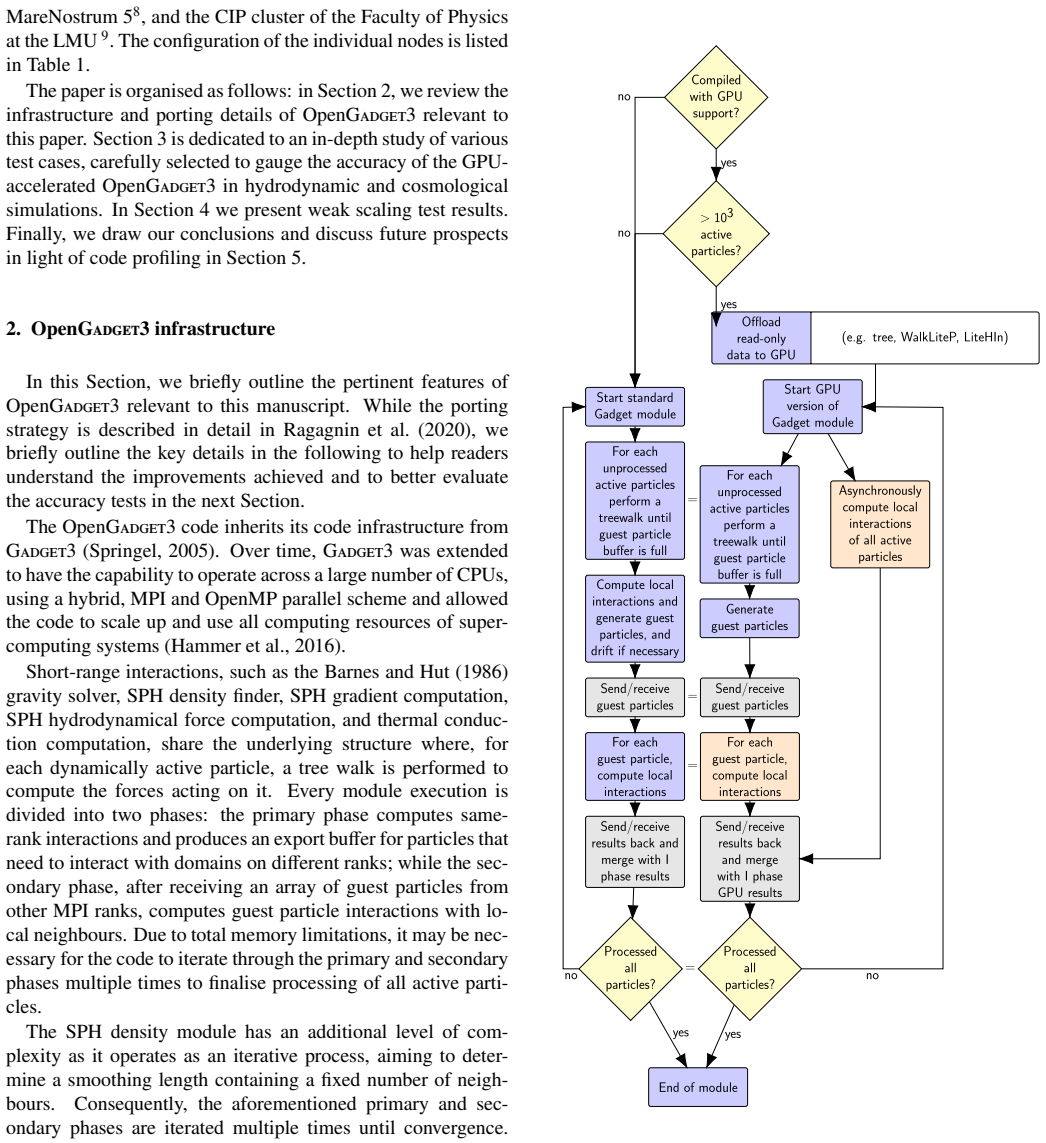
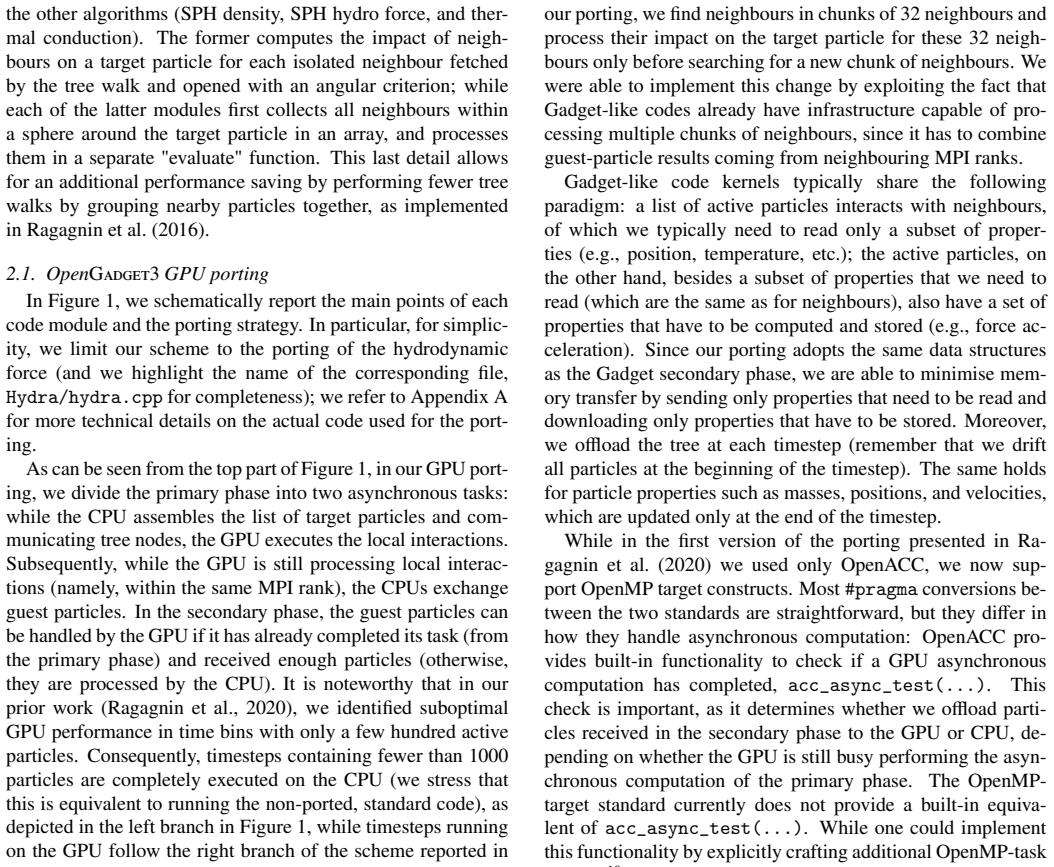
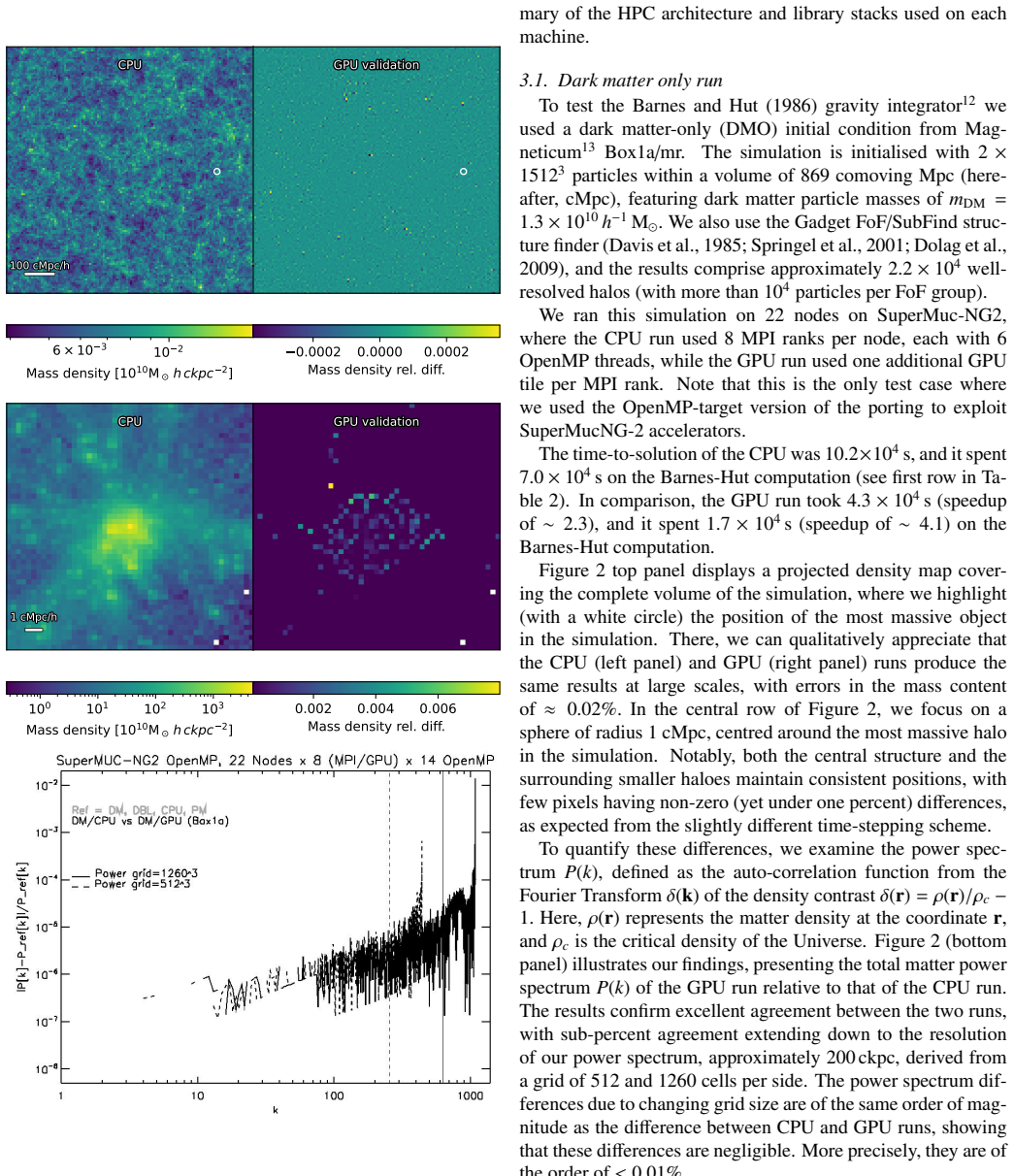
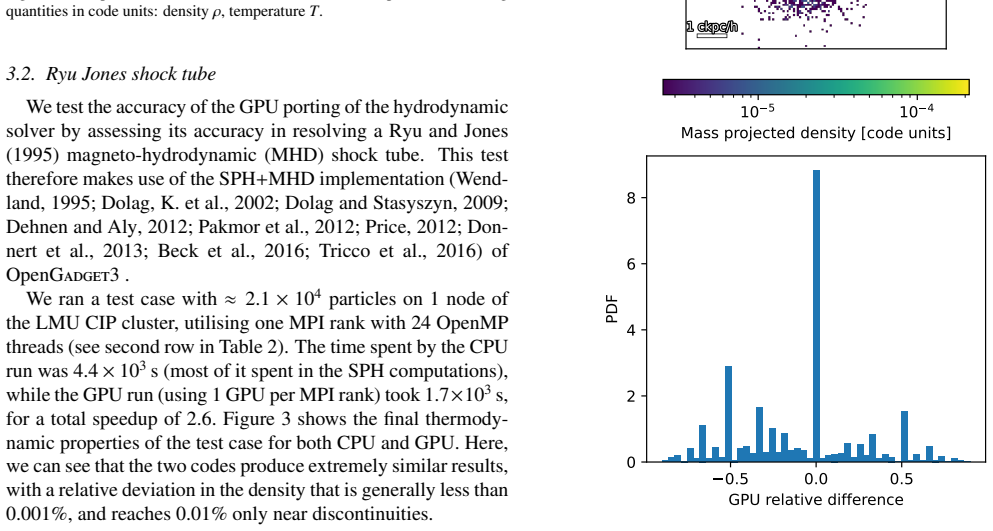
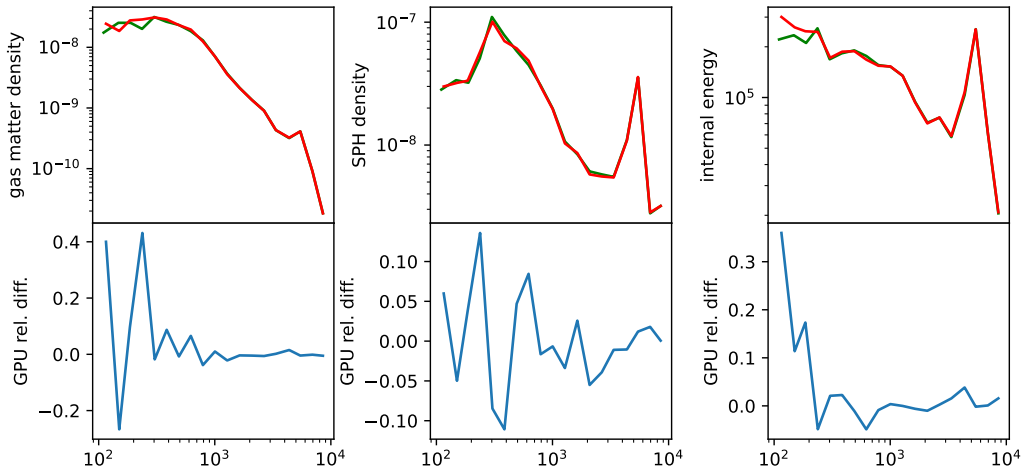
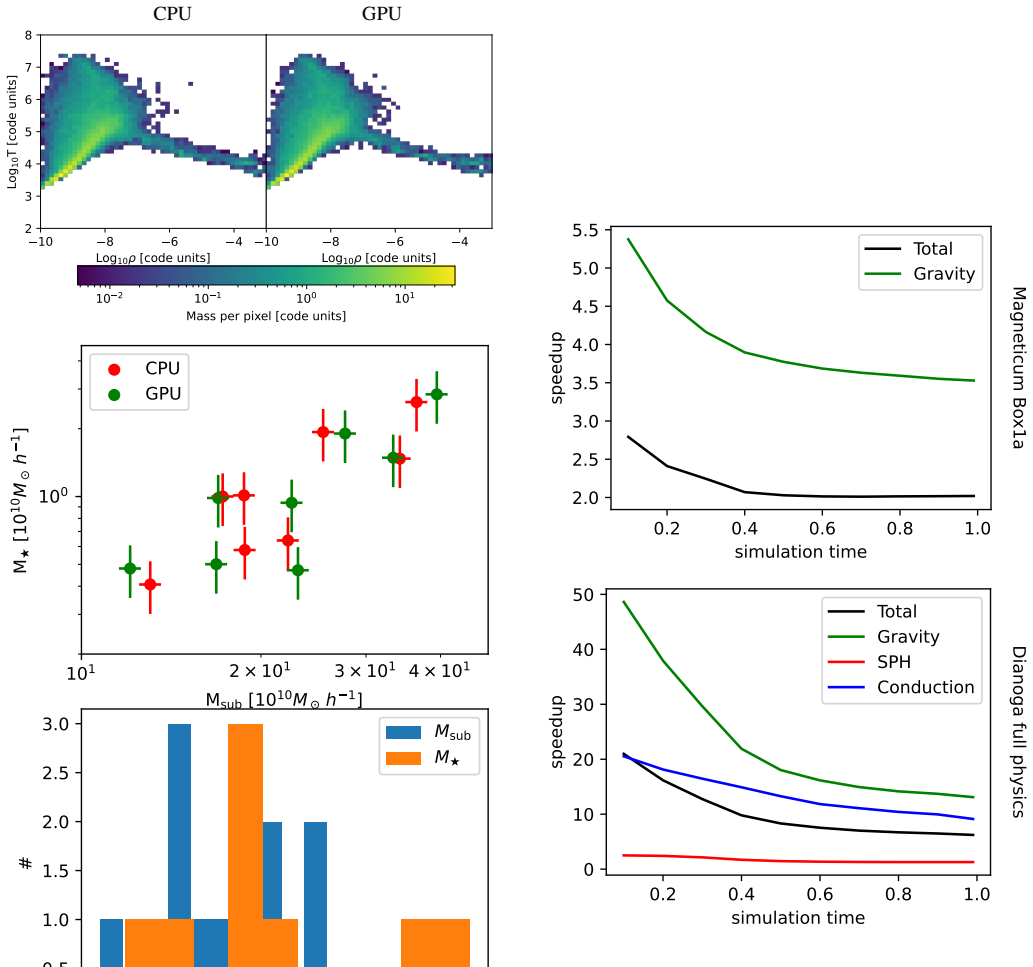
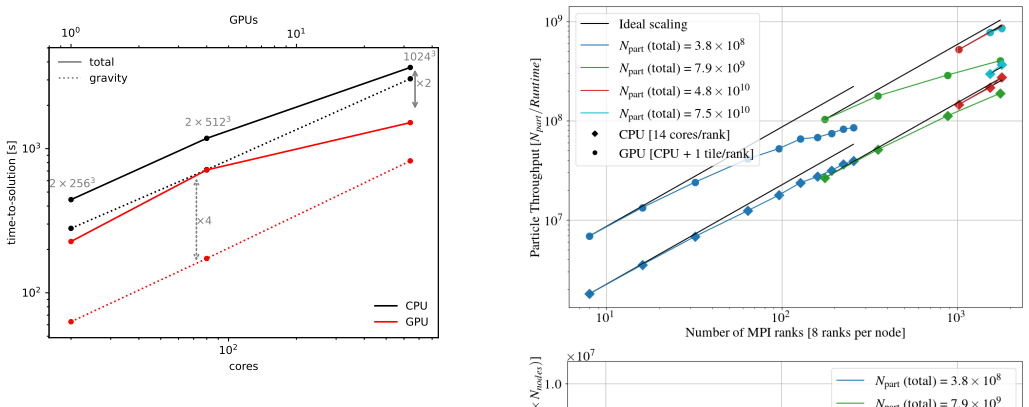
We present an in-depth evaluation of the scalability and accuracy of the GPU porting of the N-body code for hydrodynamic cosmological simulations \og. While technical details of our GPU porting were presented in Ragagnin et al. (2020), in this work we focus on assessing the accuracy of the ported modules: the short range gravity integrator, the different components of the hydrodynamic solver, and the conjugate gradient solver for thermal conduction. We ran several tests that gradually increase the number of physical modules included: a gravity-only cosmological simulation; a hydrodynamical shock tube test; a non-radiative zoom-in simulation of a galaxy cluster in a cosmological box; and a full-physics zoom-in simulation of a galaxy in a cosmological box. Comparing the results obtained with the GPU implementation to those from the classical CPU version, we find excellent agreement across all tests, with small differences on very small scales. For the individual physical modules, we find a GPU chip-to-chip speedup ranging from $\approx3-5$. For more complex cosmological and hydrodynamical setups, where a large number of physical processes and overheads contribute to the total workload, the observed total chip-to-chip speedup (with the same number of nodes and CPUs per node) is $\approx2-3$. We ran our tests on four different supercomputers: Leonardo Booster (CINECA), MareNostrum-V (BSC), SuperMUC-NG2 (LRZ), and the CIP cluster of the Faculty of Physics at the Ludwig-Maximilians-Universit\"at (LMU).
Editorial analysis
A structured set of objections, weighed in public.
Referee Report
Summary. The paper evaluates the GPU port of OpenGadget3 for accuracy in the short-range gravity integrator, hydrodynamic solver components, and conjugate gradient conduction solver. It performs side-by-side CPU/GPU comparisons on four tests of increasing complexity (gravity-only cosmological run, shock tube, non-radiative cluster zoom-in, full-physics galaxy zoom-in) and reports excellent agreement with only small differences on very small scales, plus module speedups of ~3-5x and overall ~2-3x on four supercomputers.
Significance. If the quantitative agreement holds, the work supplies needed validation for GPU-accelerated cosmological hydro codes, directly supporting production use on current supercomputers. The multi-machine testing and progressive inclusion of modules are positive features.
major comments (2)
- [Abstract] Abstract: the central claim of 'excellent agreement' rests on a purely qualitative statement; no quantitative error metrics (relative L2 norms, power-spectrum deviations, or convergence tests) are supplied to demonstrate that the noted 'small differences on very small scales' lie inside expected round-off or truncation error.
- [Abstract] Abstract: the test suite is described as 'gradually increas[ing] the number of physical modules,' yet no explicit confirmation is given that the conjugate-gradient conduction solver is exercised either in isolation or in combination with full physics over timescales representative of production runs.
minor comments (1)
- The abstract lists four supercomputers but supplies no node counts, CPU/GPU configurations, or wall-time tables that would allow readers to reproduce the reported speedups.
Simulated Author's Rebuttal
We thank the referee for their positive assessment of the work's significance and for the constructive comments. We address each major comment below.
read point-by-point responses
-
Referee: [Abstract] Abstract: the central claim of 'excellent agreement' rests on a purely qualitative statement; no quantitative error metrics (relative L2 norms, power-spectrum deviations, or convergence tests) are supplied to demonstrate that the noted 'small differences on very small scales' lie inside expected round-off or truncation error.
Authors: We agree that the abstract's claim would be strengthened by quantitative metrics. The full manuscript presents detailed visual and profile comparisons (density fields, velocity profiles, power spectra) across the test suite, but does not include explicit L2 norms or similar error measures. We will revise the abstract and add a short quantitative summary in the results sections, reporting e.g. relative L2 differences at the 10^{-4} level or below for integrated quantities, consistent with expected floating-point and truncation errors. revision: yes
-
Referee: [Abstract] Abstract: the test suite is described as 'gradually increas[ing] the number of physical modules,' yet no explicit confirmation is given that the conjugate-gradient conduction solver is exercised either in isolation or in combination with full physics over timescales representative of production runs.
Authors: The full-physics galaxy zoom-in run incorporates thermal conduction (via the conjugate-gradient solver) as one of the active modules, and the simulation duration is representative of production galaxy-formation timescales. We did not include an isolated conduction test in this manuscript, as the emphasis was on end-to-end accuracy and performance; module-level validation appeared in the earlier porting paper. To address the comment we will add an explicit statement clarifying the inclusion of the conduction solver in the full-physics test. revision: partial
Circularity Check
No circularity: direct CPU-GPU numerical comparison
full rationale
The paper's core claim rests on running identical test suites (gravity-only cosmology, shock tube, non-radiative cluster zoom, full-physics galaxy zoom) on both the GPU-ported and classical CPU versions of OpenGadget3 and reporting side-by-side agreement. No derivation chain, fitted parameters renamed as predictions, or self-referential definitions appear; the single self-citation (Ragagnin et al. 2020) supplies only porting implementation details while the accuracy assessment is performed afresh in the present work. The result is therefore externally falsifiable by re-running the same tests and is not forced by construction.
Axiom & Free-Parameter Ledger
axioms (1)
- domain assumption The original CPU version of OpenGadget3 is treated as the ground-truth reference for accuracy.
Reference graph
Works this paper leans on
-
[3]
GAMER-2: a GPU-accelerated adaptive mesh refinement code -- accuracy, performance, and scalability
Schive, Hsi-Yu and ZuHone, John A and Goldbaum, Nathan J and Turk, Matthew J and Gaspari, Massimo and Cheng, Chin-Yu , journal=. GAMER-2: a GPU-accelerated adaptive mesh refinement code -- accuracy, performance, and scalability. 2018 , publisher=
2018
-
[4]
PKDGRAV3: Beyond Trillion Particle Cosmological Simulations for the Next Era of Galaxy Surveys
PKDGRAV3: beyond trillion particle cosmological simulations for the next era of galaxy surveys. Computational Astrophysics and Cosmology , keywords =. doi:10.1186/s40668-017-0021-1 , archivePrefix =. 1609.08621 , primaryClass =
work page internal anchor Pith review Pith/arXiv arXiv doi:10.1186/s40668-017-0021-1
-
[5]
DISCO-DJ: differentiable particle-mesh simulation software
Florian List and Oliver Hahn and Thomas Fl \"o ss and Lukas Winkler. DISCO-DJ: differentiable particle-mesh simulation software. 2025
2025
-
[7]
The First Star-by-star N -body/Hydrodynamics Simulation of Our Galaxy Coupling with a Surrogate Model. arXiv e-prints , keywords =. doi:10.48550/arXiv.2510.23330 , archivePrefix =. 2510.23330 , primaryClass =
-
[26]
Advances in computational Mathematics , volume=
Piecewise polynomial, positive definite and compactly supported radial functions of minimal degree , author=. Advances in computational Mathematics , volume=. 1995 , publisher=
1995
-
[30]
Monthly Notices of the Royal Astronomical Society , volume =
Berlok, Thomas , title =. Monthly Notices of the Royal Astronomical Society , volume =. 2022 , month =. doi:10.1093/mnras/stac1882 , url =
-
[32]
A Survey of Several Finite Difference Methods for Systems of Nonlinear Hyperbolic Conservation Laws
Review. A Survey of Several Finite Difference Methods for Systems of Nonlinear Hyperbolic Conservation Laws. Journal of Computational Physics , keywords =. doi:10.1016/0021-9991(78)90023-2 , adsurl =
-
[33]
OpenACC --- First Experiences with Real-World Applications
Wienke, Sandra and Springer, Paul and Terboven, Christian and an Mey, Dieter. OpenACC --- First Experiences with Real-World Applications. Euro-Par 2012 Parallel Processing. 2012
2012
-
[43]
2016 , publisher=
Parallel programming with OpenACC , author=. 2016 , publisher=
2016
-
[44]
nIFTy galaxy cluster simulations I: dark matter & non-radiative models
nIFTy galaxy cluster simulations - I. Dark matter and non-radiative models. , keywords =. doi:10.1093/mnras/stw250 , archivePrefix =. 1503.06065 , primaryClass =
work page internal anchor Pith review Pith/arXiv arXiv doi:10.1093/mnras/stw250
-
[47]
Cosmology dependence of galaxy cluster scaling relations. , keywords =. doi:10.1093/mnras/staa1004 , archivePrefix =. 1911.05751 , primaryClass =
-
[49]
Cosmology dependence of halo masses and concentrations in hydrodynamic simulations. , keywords =. doi:10.1093/mnras/staa3523 , archivePrefix =. 2011.05345 , primaryClass =
-
[50]
Pylians: Python libraries for the analysis of numerical simulations
-
[51]
Seven-Year Wilkinson Microwave Anisotropy Probe (WMAP) Observations: Cosmological Interpretation
Seven-year Wilkinson Microwave Anisotropy Probe (WMAP) Observations: Cosmological Interpretation. , keywords =. doi:10.1088/0067-0049/192/2/18 , archivePrefix =. 1001.4538 , primaryClass =
work page internal anchor Pith review Pith/arXiv arXiv doi:10.1088/0067-0049/192/2/18
-
[60]
Supermassive black hole spin evolution in cosmological simulations with OPENGADGET3. , keywords =. doi:10.1051/0004-6361/202348925 , archivePrefix =. 2312.07657 , primaryClass =
-
[63]
, title =
Frigo, Matteo and Johnson, Steven G. , title =. Proceedings of the IEEE , year = 2005, volume = 93, number = 2, pages =
2005
-
[65]
Simulating cosmic structure formation with the GADGET-4 code. , keywords =. doi:10.1093/mnras/stab1855 , archivePrefix =. 2010.03567 , primaryClass =
-
[67]
Euclid: modelling massive neutrinos in cosmology - a code comparison. , keywords =. doi:10.1088/1475-7516/2023/06/035 , archivePrefix =. 2211.12457 , primaryClass =
-
[69]
2020, ApJS, 248, 32, doi: 10.3847/1538-4365/ab908c
The AREPO Public Code Release. , keywords =. doi:10.3847/1538-4365/ab908c , archivePrefix =. 1909.04667 , primaryClass =
-
[75]
1986, Nature, 324, 446, doi: 10.1038/324446a0 Ba˜ nados, E., Venemans, B
Josh Barnes and Piet Hut . A hierarchical O(N log N) force-calculation algorithm . , 324 0 (6096): 0 446--449, December 1986. doi:10.1038/324446a0
-
[76]
A. M. Beck , G. Murante , A. Arth , R.-S. Remus , A. F. Teklu , J. M. F. Donnert , S. Planelles , M. C. Beck , P. F \"o rster , M. Imgrund , K. Dolag , and S. Borgani . An improved SPH scheme for cosmological simulations . , 455 0 (2): 0 2110--2130, January 2016. doi:10.1093/mnras/stv2443
-
[77]
A sparse octree gravitational N-body code that runs entirely on the GPU processor
Jeroen B \'e dorf , Evghenii Gaburov , and Simon Portegies Zwart . A sparse octree gravitational N-body code that runs entirely on the GPU processor . Journal of Computational Physics, 231 0 (7): 0 2825--2839, April 2012. doi:10.1016/j.jcp.2011.12.024
-
[78]
A. Bonafede , K. Dolag , F. Stasyszyn , G. Murante , and S. Borgani . A non-ideal magnetohydrodynamic GADGET: simulating massive galaxy clusters . , 418 0 (4): 0 2234--2250, December 2011. doi:10.1111/j.1365-2966.2011.19523.x
-
[79]
B \"o ss , Klaus Dolag , Ulrich P
Ludwig M. B \"o ss , Klaus Dolag , Ulrich P. Steinwandel , Elena Hern \'a ndez-Mart \' nez , Ildar Khabibullin , Benjamin Seidel , and Jenny G. Sorce . Simulating the LOcal Web (SLOW): III. Synchrotron emission from the local cosmic web . , 692: 0 A232, December 2024. doi:10.1051/0004-6361/202348339
-
[80]
Cabez\' o n, Michal Grabarczyk, and Florina M
Aur\' e lien Cavelan, Rub\' e n M. Cabez\' o n, Michal Grabarczyk, and Florina M. Ciorba. A smoothed particle hydrodynamics mini-app for exascale. In Proceedings of the Platform for Advanced Scientific Computing Conference, PASC '20, New York, NY, USA, 2020. Association for Computing Machinery. ISBN 9781450379939. doi:10.1145/3394277.3401855. URL https://...
-
[81]
Chaitra, Antonio Ragagnin, Milena Valentini, Giuseppe Murante, Stefano Borgani, and Giuliano Taffoni. Variability in cosmological hydrodynamical simulations: How stochastic processes, numerical effects, and reproducibility limits impact predictability. Astronomy and Computing, page 101127, 2026. ISSN 2213-1337. doi:https://doi.org/10.1016/j.ascom.2026.101...
-
[82]
Alice Damiano , Milena Valentini , Stefano Borgani , Luca Tornatore , Giuseppe Murante , Antonio Ragagnin , Cinthia Ragone-Figueroa , and Klaus Dolag . Dynamical friction and the evolution of black holes in cosmological simulations: A new implementation in OpenGadget3 . , 692: 0 A81, December 2024. doi:10.1051/0004-6361/202450021
-
[83]
Numerical solutions for black hole feeding and feedback in cosmological simulations with opengadget3
Alice Damiano, Stefano Borgani, Giuseppe Murante, Milena Valentini, Luca Tornatore, and Giuliano Taffoni. Numerical solutions for black hole feeding and feedback in cosmological simulations with opengadget3. Astronomy and Computing, 56: 0 101117, 2026. ISSN 2213-1337. doi:https://doi.org/10.1016/j.ascom.2026.101117. URL https://www.sciencedirect.com/scien...
-
[84]
M. Davis , G. Efstathiou , C. S. Frenk , and S. D. M. White . The evolution of large-scale structure in a universe dominated by cold dark matter . , 292: 0 371--394, May 1985. doi:10.1086/163168
-
[85]
Walter Dehnen and Hossam Aly. Improving convergence in smoothed particle hydrodynamics simulations without pairing instability. Monthly Notices of the Royal Astronomical Society, 425 0 (2): 0 1068--1082, 09 2012. ISSN 0035-8711. doi:10.1111/j.1365-2966.2012.21439.x. URL https://doi.org/10.1111/j.1365-2966.2012.21439.x
-
[86]
K. Dolag and F. Stasyszyn . An MHD GADGET for cosmological simulations . , 398 0 (4): 0 1678--1697, October 2009. doi:10.1111/j.1365-2966.2009.15181.x
-
[87]
K. Dolag , M. Jubelgas , V. Springel , S. Borgani , and E. Rasia . Thermal Conduction in Simulated Galaxy Clusters . , 606 0 (2): 0 L97--L100, May 2004. doi:10.1086/420966
-
[88]
K. Dolag , S. Borgani , G. Murante , and V. Springel . Substructures in hydrodynamical cluster simulations . , 399 0 (2): 0 497--514, October 2009. doi:10.1111/j.1365-2966.2009.15034.x
-
[89]
Klaus Dolag , Ludwig M. B \"o ss , B \"a rbel S. Koribalski , Ulrich P. Steinwandel , and Milena Valentini . Insights on the Origin of Odd Radio Circles from Cosmological Simulations . , 945 0 (1): 0 74, March 2023. doi:10.3847/1538-4357/acb5f5
-
[90]
Dolag, K. , Bartelmann, M. , and Lesch, H. Evolution and structure of magnetic fields in simulated galaxy clusters. A&A, 387 0 (2): 0 383--395, 2002. doi:10.1051/0004-6361:20020241. URL https://doi.org/10.1051/0004-6361:20020241
-
[91]
J. Donnert , K. Dolag , G. Brunetti , and R. Cassano . Rise and fall of radio haloes in simulated merging galaxy clusters . , 429 0 (4): 0 3564--3569, March 2013. doi:10.1093/mnras/sts628
-
[92]
D. Fabjan , S. Borgani , L. Tornatore , A. Saro , G. Murante , and K. Dolag . Simulating the effect of active galactic nuclei feedback on the metal enrichment of galaxy clusters . , 401 0 (3): 0 1670--1690, January 2010. doi:10.1111/j.1365-2966.2009.15794.x
-
[93]
Yu Feng , Tiziana Di Matteo , Rupert Croft , Ananth Tenneti , Simeon Bird , Nicholas Battaglia , and Stephen Wilkins . The Formation of Milky Way-mass Disk Galaxies in the First 500 Million Years of a Cold Dark Matter Universe . , 808 0 (1): 0 L17, July 2015. doi:10.1088/2041-8205/808/1/L17
-
[94]
Mp-gadget/mp-gadget: A tag for getting a doi, October 2018
Yu Feng, Simeon Bird, Lauren Anderson, Andreu Font-Ribera, and Chris Pedersen. Mp-gadget/mp-gadget: A tag for getting a doi, October 2018. URL https://doi.org/10.5281/zenodo.1451799
-
[95]
Moritz S Fischer, Lenard Kasselmann, Marcus Brüggen, Klaus Dolag, Felix Kahlhoefer, Antonio Ragagnin, Andrew Robertson, and Kai Schmidt-Hoberg. Cosmological and idealized simulations of dark matter haloes with velocity-dependent, rare and frequent self-interactions, 04 2024. ISSN 0035-8711. URL https://doi.org/10.1093/mnras/stae699
-
[96]
Matteo Frigo and Steven G. Johnson. The design and implementation of FFTW3 . Proceedings of the IEEE, 93 0 (2): 0 216--231, 2005. Special issue on ``Program Generation, Optimization, and Platform Adaptation''
2005
-
[97]
Nicholas Frontiere , J. D. Emberson , Michael Buehlmann , Joseph Adamo , Salman Habib , Katrin Heitmann , and Claude-Andr \'e Faucher-Gigu \`e re . Simulating Hydrodynamics in Cosmology with CRK-HACC . , 264 0 (2): 0 34, February 2023. doi:10.3847/1538-4365/aca58d
-
[98]
R. A. Gingold and J. J. Monaghan . Smoothed particle hydrodynamics: theory and application to non-spherical stars. , 181: 0 375--389, November 1977. doi:10.1093/mnras/181.3.375
-
[99]
Monthly Notices of the Royal Astronomical Society 526(1), 616–644 (2023)
Frederick Groth , Ulrich P. Steinwandel , Milena Valentini , and Klaus Dolag . The cosmological simulation code OPENGADGET3 - implementation of meshless finite mass . , 526 0 (1): 0 616--644, November 2023. doi:10.1093/mnras/stad2717
-
[100]
Nicolay Hammer, Ferdinand Jamitzky, Helmut Satzger, Momme Allalen, Alexander Block, Anupam Karmakar, Matthias Brehm, Reinhold Bader, Luigi Iapichino, Antonio Ragagnin, Vasilios Karakasis, Dieter Kranzlmueller, Arndt Bode, Herbert Huber, Martin Kuehn, Rui Machado, Daniel Gruenewald, Philipp V. F. Edelmann, Friedrich K. Roepke, Markus Wittmann, Thomas Zeise...
-
[101]
Cosmological simulations of black hole growth: AGN luminosities and downsizing
Michaela Hirschmann , Klaus Dolag , Alexandro Saro , Lisa Bachmann , Stefano Borgani , and Andreas Burkert . Cosmological simulations of black hole growth: AGN luminosities and downsizing . , 442 0 (3): 0 2304--2324, August 2014. doi:10.1093/mnras/stu1023
-
[102]
Monthly Notices of the Royal Astronomical Society , author =
Martin Jubelgas , Volker Springel , and Klaus Dolag . Thermal conduction in cosmological SPH simulations . , 351 0 (2): 0 423--435, June 2004. doi:10.1111/j.1365-2966.2004.07801.x
-
[103]
Space-timers — a stack-based hierarchical timing system for c++
Geray Karademir and Klaus Dolag. Space-timers — a stack-based hierarchical timing system for c++. March 2026. doi:10.2139/ssrn.6321185. URL http://dx.doi.org/10.2139/ssrn.6321185
-
[104]
Cornerstone: Octree construction algorithms for scalable particle simulations
Sebastian Keller, Aur\' e lien Cavelan, Rub\' e n Cabezon, Lucio Mayer, and Florina Ciorba. Cornerstone: Octree construction algorithms for scalable particle simulations. In Proceedings of the Platform for Advanced Scientific Computing Conference, PASC '23, New York, NY, USA, 2023. Association for Computing Machinery. ISBN 9798400701900. doi:10.1145/35929...
-
[105]
Disco-dj: differentiable particle-mesh simulation software, October 2025
Florian List, Oliver Hahn, Thomas Fl \"o ss, and Lukas Winkler. Disco-dj: differentiable particle-mesh simulation software, October 2025
2025
-
[106]
Tirso Marin-Gilabert , Milena Valentini , Ulrich P. Steinwandel , and Klaus Dolag . The role of physical and numerical viscosity in hydrodynamical instabilities . , 517 0 (4): 0 5971--5991, December 2022. doi:10.1093/mnras/stac3042
-
[107]
V. Marra , T. Castro , D. Camarena , S. Borgani , and A. Ragagnin . The BEHOMO project: Lema \^ tre-Tolman-Bondi N-body simulations . , 664: 0 A179, August 2022. doi:10.1051/0004-6361/202243539
-
[108]
Smoothed Particle Hydrodynamics in pkdgrav3 for Shock Physics Simulations
Thomas Meier , Douglas Potter , Christian Reinhardt , and Joachim Stadel . Smoothed Particle Hydrodynamics in pkdgrav3 for Shock Physics Simulations. I. Hydrodynamics . , 1000 0 (2): 0 266, April 2026. doi:10.3847/1538-4357/ae4e29
-
[109]
A. Mignone , C. Zanni , P. Tzeferacos , B. van Straalen , P. Colella , and G. Bodo . The PLUTO Code for Adaptive Mesh Computations in Astrophysical Fluid Dynamics . , 198 0 (1): 0 7, January 2012. doi:10.1088/0067-0049/198/1/7
-
[110]
OpenMP application program interface version 3.0, May 2008
OpenMP Architecture Review Board . OpenMP application program interface version 3.0, May 2008. URL http://www.openmp.org/mp-documents/spec30.pdf
2008
-
[111]
R. Pakmor , P. Edelmann , F. K. R \"o pke , and W. Hillebrandt . Stellar GADGET: a smoothed particle hydrodynamics code for stellar astrophysics and its application to Type Ia supernovae from white dwarf mergers . , 424 0 (3): 0 2222--2231, August 2012. doi:10.1111/j.1365-2966.2012.21383.x
-
[112]
Margarita Petkova and Volker Springel . An implementation of radiative transfer in the cosmological simulation code GADGET . , 396 0 (3): 0 1383--1403, July 2009. doi:10.1111/j.1365-2966.2009.14843.x
-
[113]
Daniel J. Price . Resolving high Reynolds numbers in smoothed particle hydrodynamics simulations of subsonic turbulence . , 420 0 (1): 0 L33--L37, February 2012. doi:10.1111/j.1745-3933.2011.01187.x
-
[114]
Antonio Ragagnin , Nikola Tchipev , Michael Bader , Klaus Dolag , and Nicolay J. Hammer . Exploiting the Space Filling Curve Ordering of Particles in the Neighbour Search of Gadget3 . In Advances in Parallel Computing, pages 411--420, May 2016. doi:10.3233/978-1-61499-621-7-411
-
[115]
Gadget3 on gpus with openacc, 2020
Antonio Ragagnin, Klaus Dolag, Mathias Wagner, Claudio Gheller, Conradin Roffler, David Goz, David Hubber, and Alexander Arth. Gadget3 on gpus with openacc, 2020. URL https://ebooks.iospress.nl/doi/10.3233/APC200043
-
[116]
Dongsu Ryu and T. W. Jones . Numerical Magnetohydrodynamics in Astrophysics: Algorithm and Tests for One-dimensional Flow . , 442: 0 228, March 1995. doi:10.1086/175437
-
[117]
GAMER-2: a GPU-accelerated adaptive mesh refinement code -- accuracy, performance, and scalability
Hsi-Yu Schive, John A ZuHone, Nathan J Goldbaum, Matthew J Turk, Massimo Gaspari, and Chin-Yu Cheng. GAMER-2: a GPU-accelerated adaptive mesh refinement code -- accuracy, performance, and scalability . Monthly Notices of the Royal Astronomical Society, 481 0 (4): 0 4815--4840, 2018
2018
-
[119]
Nitin Shukla, Alessandro Romeo, Caterina Caravita, Lubomir Riha, Ondrej Vysocky, Petr Strakos, Milan Jaros, Jo\ a o Barbosa, Radim Vavrik, Andrea Mignone, Marco Rossazza, Stefano Truzzi, Vittoria Berta, Iacopo Colonnelli, Doriana Medi\' c , Elisabetta Boella, Daniele Gregori, Eva Sciacca, Luca Tornatore, Giuliano Taffoni, Pranab J. Deka, Fabio Bacchini, R...
-
[120]
Monthly Notices of the Royal Astronomical Society , volume =
Volker Springel . The cosmological simulation code GADGET-2 . , 364 0 (4): 0 1105--1134, December 2005. doi:10.1111/j.1365-2966.2005.09655.x
-
[121]
Volker Springel . E pur si muove: Galilean-invariant cosmological hydrodynamical simulations on a moving mesh . , 401 0 (2): 0 791--851, January 2010. doi:10.1111/j.1365-2966.2009.15715.x
-
[122]
Volker Springel and Lars Hernquist . Cosmological smoothed particle hydrodynamics simulations: a hybrid multiphase model for star formation . , 339 0 (2): 0 289--311, February 2003. doi:10.1046/j.1365-8711.2003.06206.x
-
[123]
Volker Springel , Naoki Yoshida , and Simon D. M. White . GADGET: a code for collisionless and gasdynamical cosmological simulations . , 6 0 (2): 0 79--117, April 2001. doi:10.1016/S1384-1076(01)00042-2
-
[124]
Black Holes in Galaxy Mergers: The Formation of Red Elliptical Galaxies
Volker Springel , Tiziana Di Matteo , and Lars Hernquist . Black Holes in Galaxy Mergers: The Formation of Red Elliptical Galaxies . , 620 0 (2): 0 L79--L82, February 2005. doi:10.1086/428772
-
[125]
Steinborn , Klaus Dolag , Michaela Hirschmann , M
Lisa K. Steinborn , Klaus Dolag , Michaela Hirschmann , M. Almudena Prieto , and Rhea-Silvia Remus . A refined sub-grid model for black hole accretion and AGN feedback in large cosmological simulations . , 448 0 (2): 0 1504--1525, April 2015. doi:10.1093/mnras/stv072
-
[126]
James M. Stone, Patrick D. Mullen, Drummond Fielding, Philipp Grete, Minghao Guo, Philipp Kempski, Elias R. Most, Christopher J. White, and George N. Wong. Athenak: A performance-portable version of the athena++ adaptive mesh refinement framework, feb 2026. URL https://doi.org/10.3847/1538-4365/ae3717
-
[127]
Hierarchical Data Format, version 5
The HDF Group . Hierarchical Data Format, version 5 . URL https://github.com/HDFGroup/hdf5
-
[128]
Monthly Notices of the Royal Astronomical Society , author =
L. Tornatore , S. Borgani , F. Matteucci , S. Recchi , and P. Tozzi . Simulating the metal enrichment of the intracluster medium . , 349 0 (1): 0 L19--L24, March 2004. doi:10.1111/j.1365-2966.2004.07689.x
-
[129]
L. Tornatore , S. Borgani , K. Dolag , and F. Matteucci . Chemical enrichment of galaxy clusters from hydrodynamical simulations . , 382 0 (3): 0 1050--1072, December 2007. doi:10.1111/j.1365-2966.2007.12070.x
-
[130]
L. Tornatore , S. Borgani , M. Viel , and V. Springel . The impact of feedback on the low-redshift intergalactic medium . , 402 0 (3): 0 1911--1926, March 2010. doi:10.1111/j.1365-2966.2009.16025.x
-
[131]
Terrence S. Tricco, Daniel J. Price, and Matthew R. Bate. Constrained hyperbolic divergence cleaning in smoothed particle magnetohydrodynamics with variable cleaning speeds. Journal of Computational Physics, 322: 0 326--344, 2016. ISSN 0021-9991. doi:https://doi.org/10.1016/j.jcp.2016.06.053. URL https://www.sciencedirect.com/science/article/pii/S0021999116302789
-
[132]
Piecewise polynomial, positive definite and compactly supported radial functions of minimal degree
Holger Wendland. Piecewise polynomial, positive definite and compactly supported radial functions of minimal degree. Advances in computational Mathematics, 4 0 (1): 0 389--396, 1995
1995
-
[133]
Openacc --- first experiences with real-world applications
Sandra Wienke, Paul Springer, Christian Terboven, and Dieter an Mey. Openacc --- first experiences with real-world applications. In Christos Kaklamanis, Theodore Papatheodorou, and Paul G. Spirakis, editors, Euro-Par 2012 Parallel Processing, pages 859--870, Berlin, Heidelberg, 2012. Springer Berlin Heidelberg. ISBN 978-3-642-32820-6
2012
-
[134]
Robert P. C. Wiersma , Joop Schaye , Tom Theuns , Claudio Dalla Vecchia , and Luca Tornatore . Chemical enrichment in cosmological, smoothed particle hydrodynamics simulations . , 399 0 (2): 0 574--600, October 2009. doi:10.1111/j.1365-2966.2009.15331.x
-
[135]
Adapting AREPO-RT for exascale computing: GPU acceleration and efficient communication
Oliver Zier , Rahul Kannan , Aaron Smith , Mark Vogelsberger , and Erkin Verbeek . Adapting AREPO-RT for exascale computing: GPU acceleration and efficient communication . , 533 0 (1): 0 268--286, September 2024. doi:10.1093/mnras/stae1837
discussion (0)
Sign in with ORCID, Apple, or X to comment. Anyone can read and Pith papers without signing in.