The Lumina Project: Intergalactic Clumping and Recombination Sinks
Pith reviewed 2026-06-26 23:34 UTC · model grok-4.3
The pith
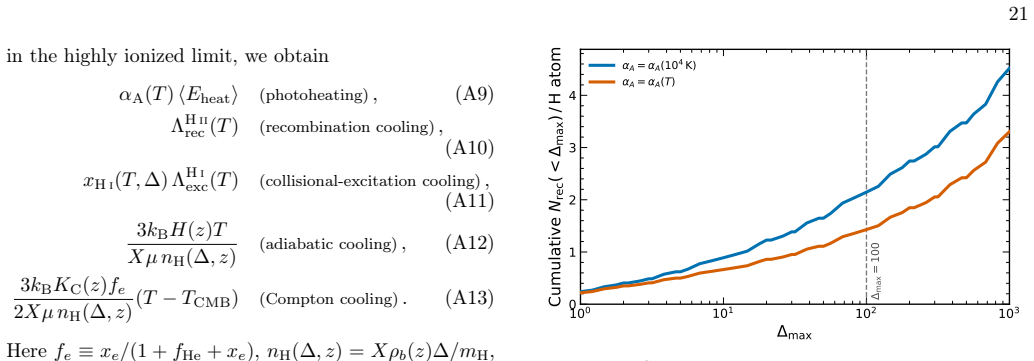
Density-only prescriptions overestimate recombination rates during reionization by a factor of 1.84 at z≈5 because they ignore photoheating suppression.
A machine-rendered reading of the paper's core claim, the machinery that carries it, and where it could break.
Core claim
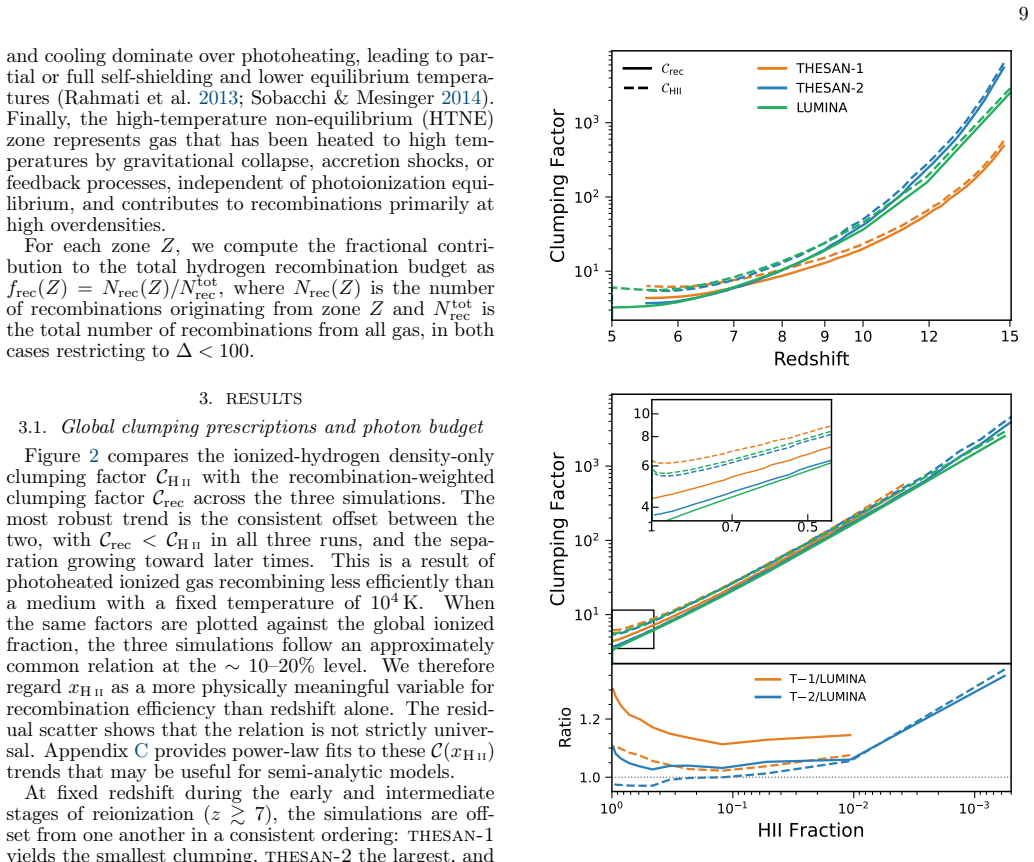
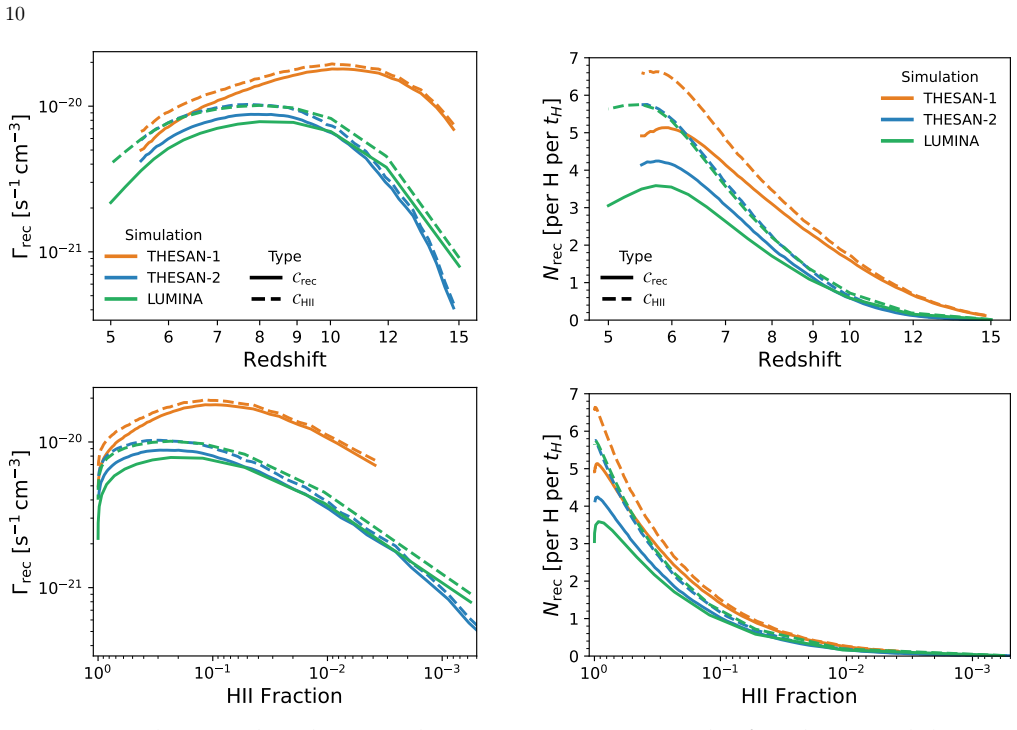
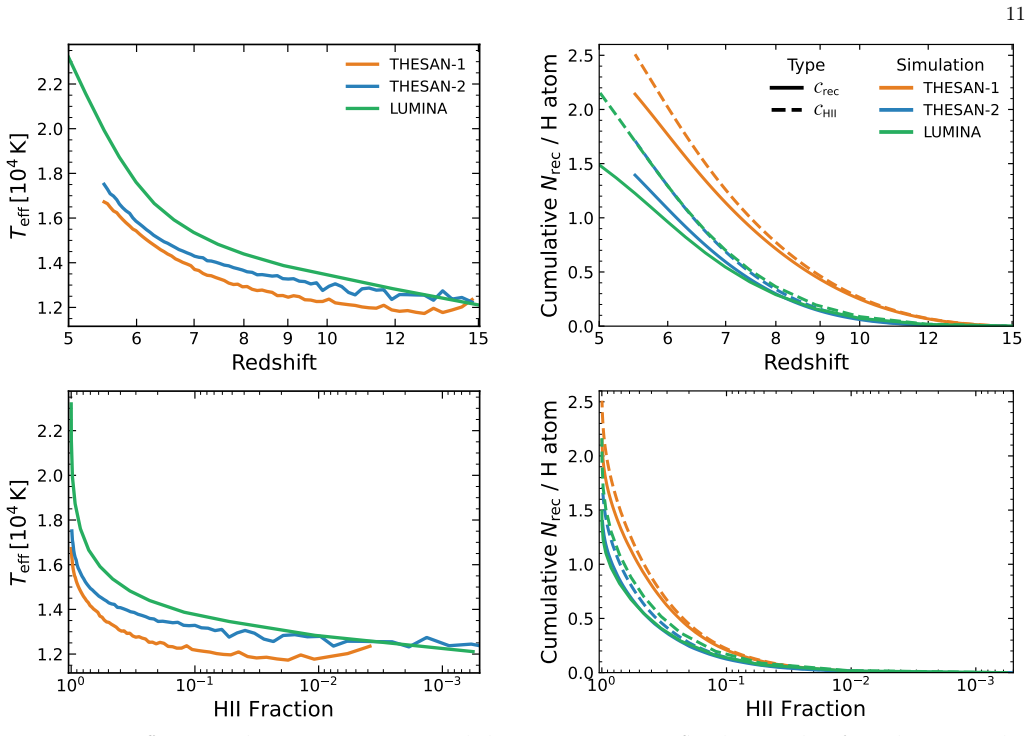
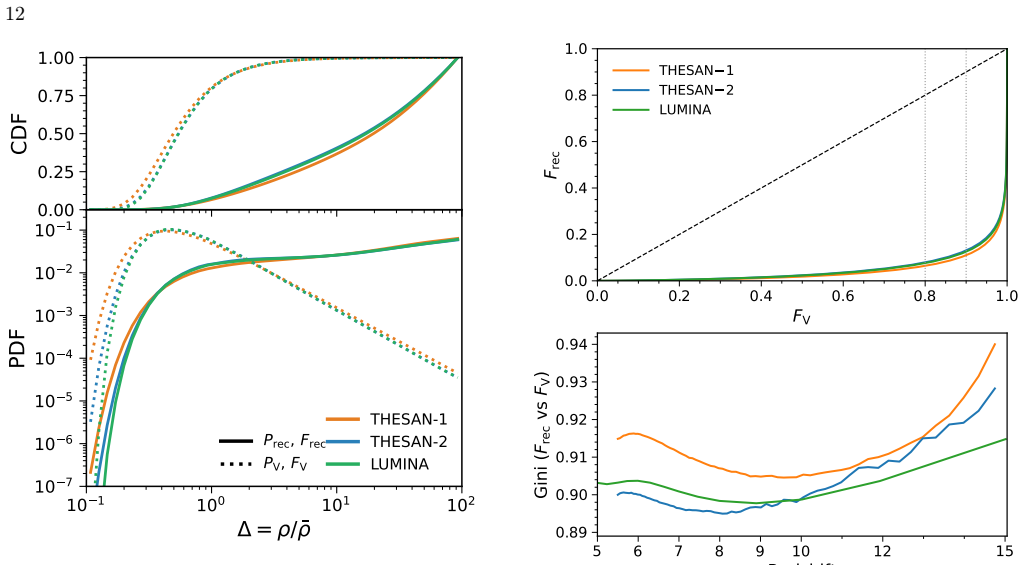
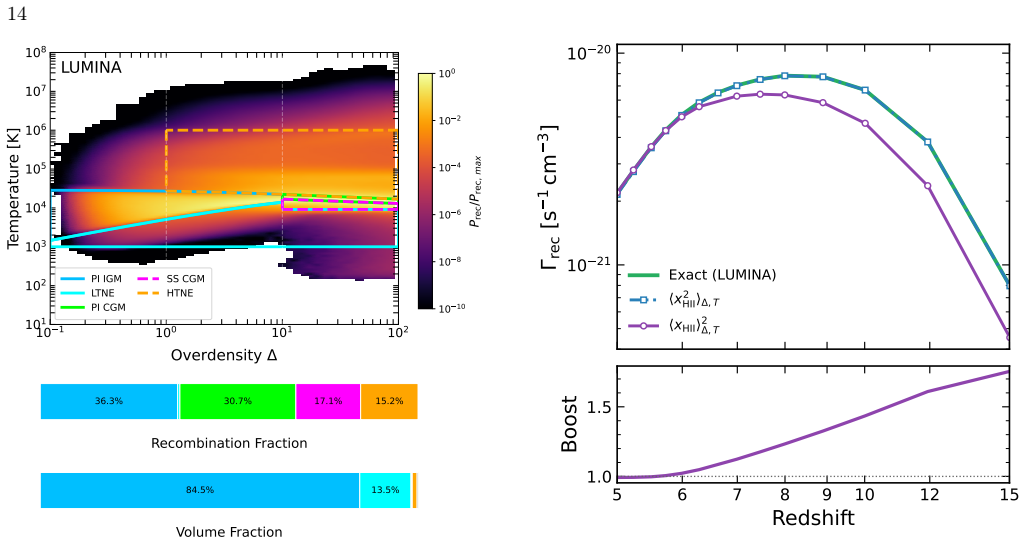
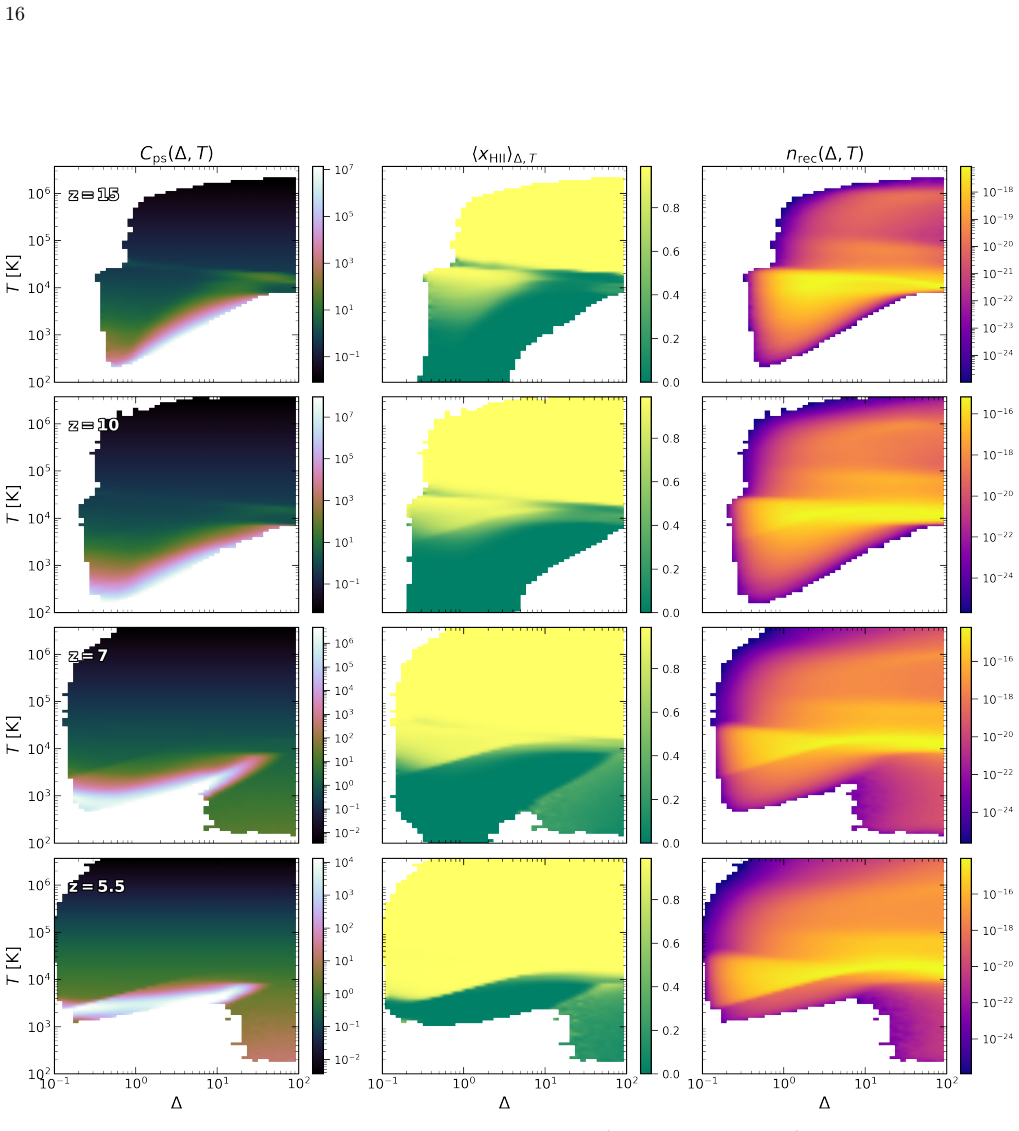
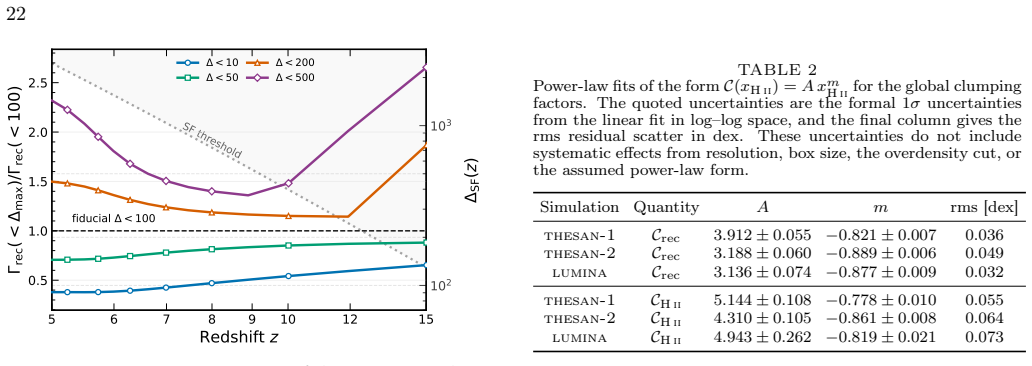
The central claim is that the recombination-weighted clumping factor C_rec remains systematically below the ionized-hydrogen clumping factor C_HII across all simulations, with the discrepancy increasing toward lower redshift as photoheating suppresses recombinations. In the Lumina run the density-only prescription overpredicts the instantaneous recombination rate by factors of 1.29 at z≈8 and 1.84 at z≈5, and the cumulative recombination count by a factor of 1.45 by z≈5. The dominant recombination ridges in the joint overdensity-temperature plane follow simple analytic thermal equilibrium bands. A phase-space recombination integral and phase-space clumping factor C_ps(Δ,T) are introduced to
What carries the argument
The recombination-weighted clumping factor C_rec, which incorporates temperature and ionization state rather than density alone, together with the phase-space clumping factor C_ps(Δ,T) that fixes overdensity and temperature to isolate structural effects.
If this is right
- Clumping factors can be parametrized by ionized fraction with only 10-20 percent scatter across different reionization histories.
- Photoheating causes the recombination suppression to strengthen at lower redshifts.
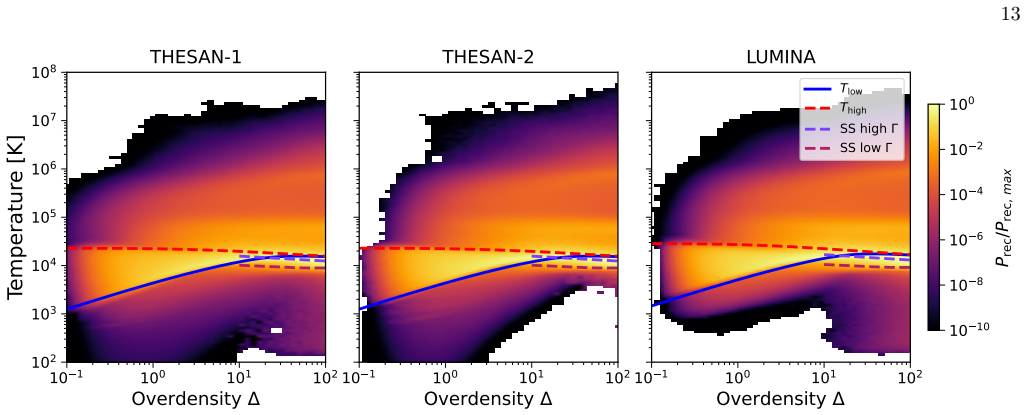
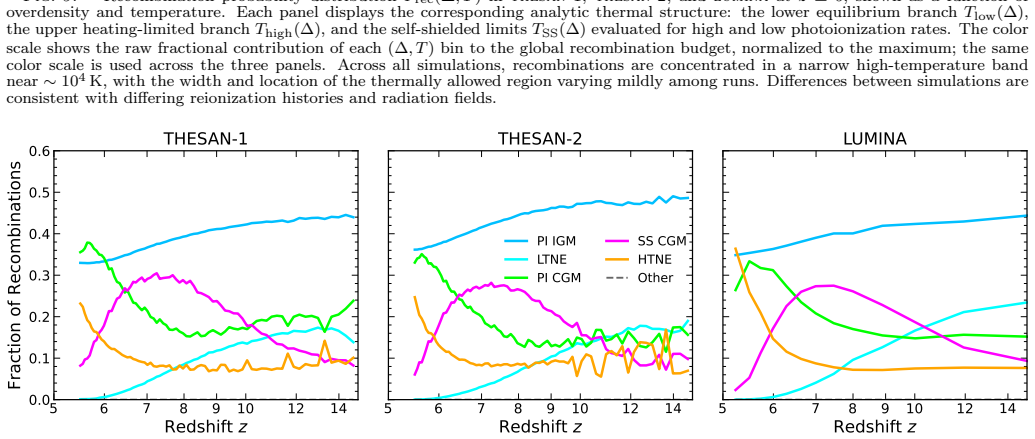
- The bulk of recombinations occur along thermal equilibrium bands in the overdensity-temperature plane.
- The phase-space clumping factor isolates the contribution from ionization patchiness at fixed density and temperature.
Where Pith is reading between the lines
- Reionization photon-budget calculations that rely on density clumping alone may require downward revision of the total photons needed to complete reionization.
- The phase-space formulation could be adapted into sub-grid prescriptions for larger-volume simulations that cannot resolve small-scale structure directly.
- If the thermal-equilibrium bands hold in other reionization models, they offer a simple way to estimate the recombination budget without full radiative-transfer runs.
Load-bearing premise
Clumping evolution is approximately universal at the 10-20 percent level when parametrized by the global ionized fraction x_HII rather than by redshift, across simulations that differ in resolution, volume, and reionization history.
What would settle it
A new simulation or observational constraint that finds the ratio of density-only to full recombination rates at z≈5 closer to 1.0 than the reported 1.84, or that shows C_rec and C_HII differing by less than the reported gap at the same x_HII.
Figures
read the original abstract
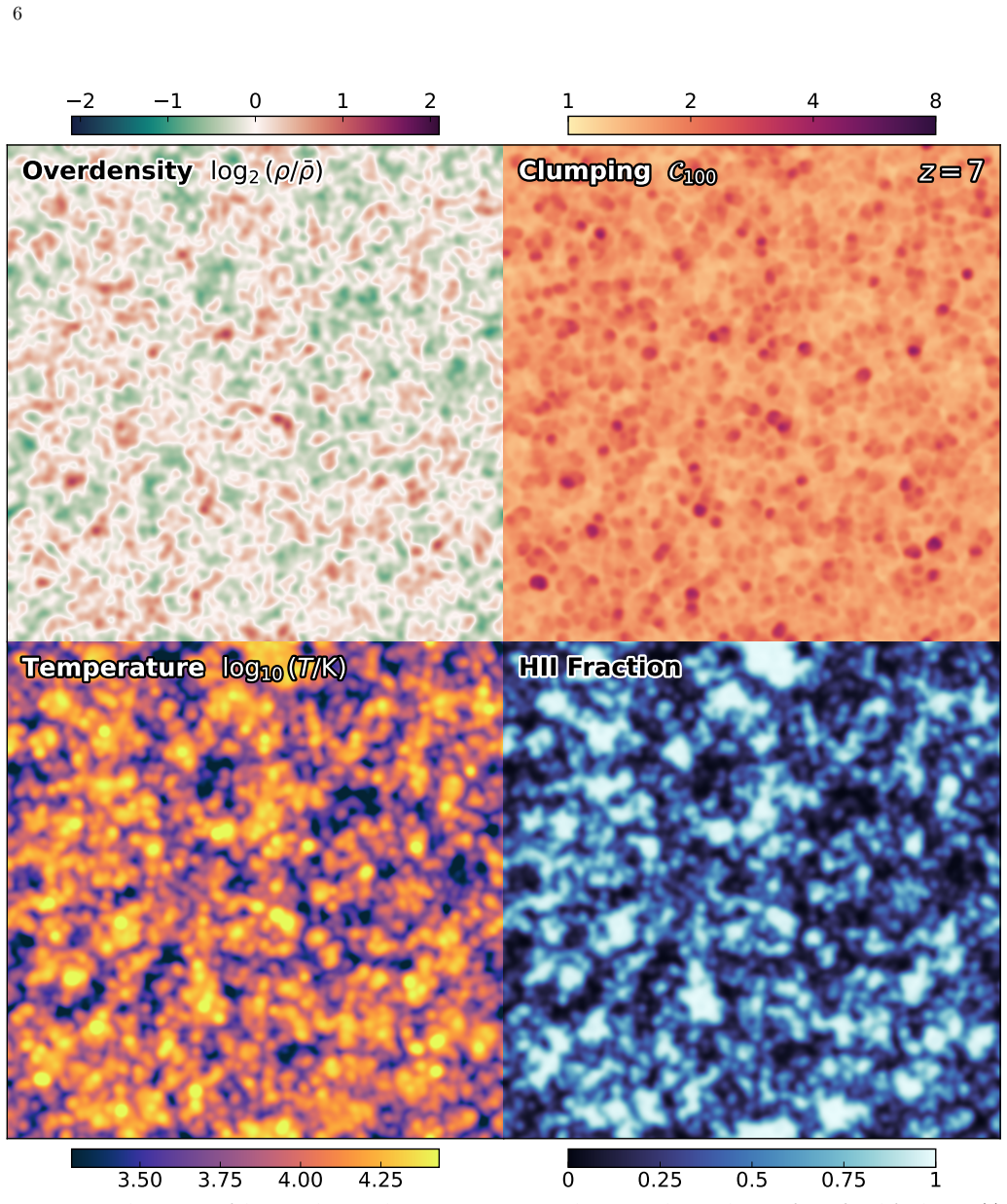
Recombinations during the Epoch of Reionization are intrinsically inhomogeneous, with different regions of the intergalactic medium contributing unevenly depending on their density, temperature, ionization state, and spatial patchiness. We combine the high- and medium-resolution 95.5 cMpc Thesan-1 andh Thesan-2 runs with the significantly larger 500 cMpc Lumina simulation to measure clumping factors and recombination rates consistently across different resolutions and box sizes. We consider the standard ionized hydrogen clumping factor, $C_{\rm HII} \equiv \langle n_{\rm HII}^2\rangle/\langle n_{\rm HII}\rangle^2$, and a recombination-weighted clumping factor, $C_{\rm rec}$. Despite differences in resolution, volume, and reionization history, the simulations show an approximately universal clumping evolution at the 10-20% level when parametrized by the global ionized fraction $x_{\rm HII}$ rather than by redshift. Across all simulations, $C_{\rm rec}$ remains systematically below $C_{\rm HII}$, with the discrepancy increasing toward lower redshift as photoheating suppresses recombinations. In \lumina, the density-only prescription overpredicts the instantaneous recombination rate by factors of 1.29 at $z\approx8$ and 1.84 at $z\approx5$, and the cumulative recombination count by a factor of 1.45 by $z\approx5$. Mapping the recombination budget in the joint overdensity-temperature plane reveals that the dominant recombination ridges closely follow simple analytic thermal equilibrium bands. Finally, we introduce a phase-space recombination integral and define a phase-space clumping factor, $C_{\rm ps}(\Delta,T)$, which isolates the intrinsic recombination enhancement associated with ionization structure and thermal state at fixed overdensity and temperature.
Editorial analysis
A structured set of objections, weighed in public.
Referee Report
Summary. The paper combines Thesan-1, Thesan-2, and Lumina simulations to measure intergalactic clumping factors during the Epoch of Reionization. It defines the standard C_HII and a new recombination-weighted C_rec, reports that clumping evolution is approximately universal (at the 10-20% level) when parametrized by global ionized fraction x_HII rather than redshift across simulations differing in resolution, volume, and reionization history, finds C_rec systematically below C_HII with the gap widening at lower redshift due to photoheating, and states that in Lumina the density-only prescription overpredicts instantaneous recombination rates by factors of 1.29 at z≈8 and 1.84 at z≈5 and cumulative recombinations by 1.45 by z≈5. It maps recombinations in the overdensity-temperature plane, shows dominant ridges follow analytic thermal equilibrium bands, and introduces a phase-space clumping factor C_ps(Δ,T) to isolate intrinsic enhancement at fixed density and temperature.
Significance. If the quantitative results and universality claim hold, the work would provide useful constraints on recombination sinks in inhomogeneous IGM, potentially improving sub-grid modeling in reionization simulations. The distinction between C_rec and C_HII and the phase-space approach highlight thermal suppression effects and could inform more accurate recombination budgets. The reported overprediction factors offer concrete numbers for model corrections, and the x_HII parametrization, if robust, simplifies application across different reionization histories.
Simulated Author's Rebuttal
We thank the referee for their detailed summary of the manuscript and for highlighting its potential significance for sub-grid modeling of recombination sinks. No specific major comments were provided in the report.
Circularity Check
No significant circularity; results are direct simulation outputs
full rationale
The paper reports empirical measurements of clumping factors (C_HII, C_rec) and recombination rates extracted directly from the Thesan-1/2 and Lumina simulation outputs. Quantities such as the overprediction factors (1.29 at z≈8, 1.84 at z≈5) and the systematic offset between C_rec and C_HII are computed from the simulation density, temperature, and ionization fields rather than derived via equations that reduce to fitted inputs or self-citations. The claimed approximate universality when parametrized by x_HII is an observed pattern across independent runs, not a self-referential definition. No load-bearing step matches any of the enumerated circularity patterns.
Axiom & Free-Parameter Ledger
axioms (1)
- domain assumption The Thesan-1, Thesan-2, and Lumina simulations accurately capture the density, temperature, ionization state, and spatial patchiness of the intergalactic medium
invented entities (2)
-
recombination-weighted clumping factor C_rec
no independent evidence
-
phase-space clumping factor C_ps(Δ,T)
no independent evidence
Reference graph
Works this paper leans on
-
[1]
doi:10.1093/mnras/stab3710 , archiveprefix =
Introducing the THESAN project: radiation-magnetohydrodynamic simulations of the epoch of reionization. , keywords =. doi:10.1093/mnras/stab3710 , archivePrefix =. 2110.00584 , primaryClass =
-
[2]
The Open Journal of Astrophysics , keywords =
Introducing the THESAN-ZOOM project: radiation-hydrodynamic simulations of high-redshift galaxies with a multi-phase interstellar medium. The Open Journal of Astrophysics , keywords =. doi:10.33232/001c.145804 , archivePrefix =. 2502.20437 , primaryClass =
-
[3]
The THESAN project: predictions for multitracer line intensity mapping in the epoch of reionization. , keywords =. doi:10.1093/mnras/stac1557 , archivePrefix =. 2111.02411 , primaryClass =
-
[4]
The THESAN project: properties of the intergalactic medium and its connection to reionization-era galaxies. , keywords =. doi:10.1093/mnras/stac257 , archivePrefix =. 2110.01628 , primaryClass =
-
[5]
The THESAN project: Lyman- emission and transmission during the Epoch of Reionization. , keywords =. doi:10.1093/mnras/stac713 , archivePrefix =. 2110.02966 , primaryClass =
-
[6]
doi:10.1093/mnras/stae839 , archiveprefix =
The THESAN project: public data release of radiation-hydrodynamic simulations matching reionization-era JWST observations , journal =. doi:10.1093/mnras/stae839 , archivePrefix =. 2309.06475 , primaryClass =
-
[7]
The THESAN project: ionizing escape fractions of reionization-era galaxies. , keywords =. doi:10.1093/mnras/stad210 , archivePrefix =. 2205.02238 , primaryClass =
-
[8]
Madau, Piero and Haardt, Francesco and Rees, Martin J. , title =. The Astrophysical Journal , year =. doi:10.1086/306975 , adsurl =
-
[9]
Reionization of the Inhomogeneous Universe , journal =
Miralda-Escud. Reionization of the Inhomogeneous Universe , journal =. 2000 , volume =. doi:10.1086/308330 , adsurl =
-
[10]
Finlator, Kristian and Oh, S. Peng and. Gas clumping in self-consistent reionization models , journal =. 2012 , volume =. doi:10.1111/j.1365-2966.2012.22114.x , adsurl =
-
[11]
Monthly Notices of the Royal Astronomical Society , year =
Sobacchi, Emanuele and Mesinger, Andrei , title =. Monthly Notices of the Royal Astronomical Society , year =. doi:10.1093/mnras/stu377 , eprint =
-
[12]
Kaurov, Alexander A. and Gnedin, Nickolay Y. , title =. The Astrophysical Journal , year =. doi:10.1088/0004-637X/810/2/154 , adsurl =
-
[13]
Davies, Frederick B. and Furlanetto, Steven R. , title =. Monthly Notices of the Royal Astronomical Society , year =. doi:10.1093/mnras/stw931 , adsurl =
-
[14]
Rahmati, Alireza and Pawlik, Andreas H. and Rai. On the evolution of the H\,. Monthly Notices of the Royal Astronomical Society , year =. doi:10.1093/mnras/stt066 , eprint =
-
[15]
Hui, Lam and Gnedin, Nickolay Y. , title =. Monthly Notices of the Royal Astronomical Society , year =. doi:10.1093/mnras/292.1.27 , eprint =
-
[16]
A Hydrodynamic Approach to Cosmology: Methodology. , keywords =. doi:10.1086/191630 , adsurl =
-
[17]
Atomic Data for Astrophysics. I. Radiative Recombination Rates for H-like, He-like, Li-like, and Na-like Ions over a Broad Range of Temperature. , keywords =. doi:10.1086/192284 , archivePrefix =. astro-ph/9509083 , primaryClass =
work page internal anchor Pith review Pith/arXiv arXiv doi:10.1086/192284
-
[18]
The Aurora radiation-hydrodynamical simulations of reionization: calibration and first results
The Aurora radiation-hydrodynamical simulations of reionization: calibration and first results. , keywords =. doi:10.1093/mnras/stw2869 , archivePrefix =. 1603.00034 , primaryClass =
work page internal anchor Pith review Pith/arXiv arXiv doi:10.1093/mnras/stw2869
-
[19]
Cosmic Reionization on Computers: Physical Origin of Long Dark Gaps in Quasar Absorption Spectra. , keywords =. doi:10.3847/1538-4357/ac8d0a , archivePrefix =. 2204.05338 , primaryClass =
-
[20]
LyC escape from SPHINX galaxies in the Epoch of Reionization. , keywords =. doi:10.1093/mnras/stac1942 , archivePrefix =. 2207.03232 , primaryClass =
-
[21]
The SPHINX cosmological simulations of the first billion years: the impact of binary stars on reionization. , keywords =. doi:10.1093/mnras/sty1655 , archivePrefix =. 1801.07259 , primaryClass =
work page internal anchor Pith review Pith/arXiv arXiv doi:10.1093/mnras/sty1655
-
[22]
SPICE: the connection between cosmic reionization and stellar feedback in the first galaxies. , keywords =. doi:10.1093/mnras/stae1125 , archivePrefix =. 2310.16895 , primaryClass =
-
[23]
Cosmic Dawn (CoDa): the First Radiation-Hydrodynamics Simulation of Reionization and Galaxy Formation in the Local Universe. , keywords =. doi:10.1093/mnras/stw2036 , archivePrefix =. 1511.00011 , primaryClass =
work page internal anchor Pith review Pith/arXiv arXiv doi:10.1093/mnras/stw2036
-
[24]
doi:10.1093/mnras/staa1266 , archiveprefix =
Cosmic Dawn II (CoDa II): a new radiation-hydrodynamics simulation of the self-consistent coupling of galaxy formation and reionization. , keywords =. doi:10.1093/mnras/staa1266 , archivePrefix =. 1811.11192 , primaryClass =
-
[25]
The short ionizing photon mean free path at z = 6 in Cosmic Dawn III, a new fully coupled radiation-hydrodynamical simulation of the Epoch of Reionization. , keywords =. doi:10.1093/mnras/stac2383 , archivePrefix =. 2202.05869 , primaryClass =
-
[26]
Cosmic Reionization on Computers. I. Design and Calibration of Simulations. , keywords =. doi:10.1088/0004-637X/793/1/29 , archivePrefix =. 1403.4245 , primaryClass =
work page internal anchor Pith review Pith/arXiv arXiv doi:10.1088/0004-637x/793/1/29
-
[27]
, year = 2024, month = mar, volume =
Emergence of the temperature--density relation in the low-density intergalactic medium. , year = 2024, month = mar, volume =. doi:10.1093/mnras/stae401 , archivePrefix =. 2310.15226 , primaryClass =
-
[28]
The thermal history of the intergalactic medium ^ *. , keywords =. doi:10.1046/j.1365-8711.2000.03815.x , archivePrefix =. astro-ph/9912432 , primaryClass =
-
[29]
, year = 2000, month = may, volume =
The Evolution of the Effective Equation of State of the Intergalactic Medium. , year = 2000, month = may, volume =
2000
-
[30]
Monthly Notices of the Royal Astronomical Society , author =
Simulating cosmic structure formation with the GADGET-4 code. , keywords =. doi:10.1093/mnras/stab1855 , archivePrefix =. 2010.03567 , primaryClass =
-
[31]
Cosmological smoothed particle hydrodynamics simulations: a hybrid multiphase model for star formation. , keywords =. doi:10.1046/j.1365-8711.2003.06206.x , archivePrefix =. astro-ph/0206393 , primaryClass =
-
[32]
Introducing the Lumina project: large-volume radiation-hydrodynamic simulations of the epochs of hydrogen and helium reionization. arXiv e-prints , keywords =. doi:10.48550/arXiv.2605.15310 , archivePrefix =. 2605.15310 , primaryClass =
work page internal anchor Pith review Pith/arXiv arXiv doi:10.48550/arxiv.2605.15310
-
[33]
, year = 2009, volume =
Keeping the Universe ionized: photoheating and the clumping factor of the high-redshift intergalactic medium. , year = 2009, volume =
2009
-
[34]
The Growth of H II Regions During Reionization. , year = 2004, volume =. doi:10.1086/423025 , archivePrefix =
-
[35]
On Lyman-limit Systems and the Evolution of the Intergalactic Ionizing Background
On Lyman-limit Systems and the Evolution of the Intergalactic Ionizing Background. , year = 2011, volume =. doi:10.1088/0004-637X/743/1/82 , archivePrefix =. 1101.1964 , primaryClass =
work page internal anchor Pith review Pith/arXiv arXiv doi:10.1088/0004-637x/743/1/82 2011
-
[36]
The Evolution of the Intergalactic Medium
The Evolution of the Intergalactic Medium. , year = 2016, volume =. doi:10.1146/annurev-astro-082214-122355 , archivePrefix =. 1512.00086 , primaryClass =
work page internal anchor Pith review Pith/arXiv arXiv doi:10.1146/annurev-astro-082214-122355 2016
-
[37]
On the intergalactic temperature-density relation
On the intergalactic temperature-density relation. , year = 2016, month = jan, volume =. doi:10.1093/mnras/stv2675 , archivePrefix =. 1505.07875 , primaryClass =
work page internal anchor Pith review Pith/arXiv arXiv doi:10.1093/mnras/stv2675 2016
-
[38]
Trac, Hy and Chen, Nianyi and Holst, Ian and Alvarez, Marcelo A. and Cen, Renyue , title =. The Astrophysical Journal , abstract =. 2022 , month =. doi:10.3847/1538-4357/ac5116 , url =
-
[39]
, year = 2009, volume =
A New Calculation of the Ionizing Background Spectrum and the Effects of He II Reionization. , year = 2009, volume =
2009
-
[40]
Radiative Transfer in a Clumpy Universe. IV. New Synthesis Models of the Cosmic UV/X-Ray Background. , year = 2012, volume =
2012
-
[41]
, year = 2019, volume =
Consistent modelling of the meta-galactic UV background and the thermal/ionization history of the intergalactic medium. , year = 2019, volume =
2019
-
[42]
A cosmic UV/X-ray background model update. , keywords =. doi:10.1093/mnras/staa302 , archivePrefix =. 1903.08657 , primaryClass =
-
[43]
The impact of inhomogeneous subgrid clumping on cosmic reionization. , year = 2020, volume =. doi:10.1093/mnras/stz2986 , archivePrefix =. 1906.02476 , primaryClass =
-
[44]
The impact of inhomogeneous subgrid clumping on cosmic reionization -- II. Modelling stochasticity. , year = 2021, volume =. doi:10.1093/mnras/stab787 , primaryClass =
-
[45]
and Hernquist, Lars , title =
Katz, Neal and Weinberg, David H. and Hernquist, Lars , title =. The Astrophysical Journal Supplement Series , volume =. 1996 , doi =
1996
-
[46]
Dust-UV offsets in high-redshift galaxies in the Cosmic Dawn III simulation. , keywords =. doi:10.1051/0004-6361/202452098 , archivePrefix =. 2409.05946 , primaryClass =
-
[47]
Taxing the Rich: Recombinations and Bubble Growth during Reionization. , keywords =. doi:10.1111/j.1365-2966.2005.09505.x , archivePrefix =. astro-ph/0505065 , adsurl =
-
[48]
Heating of the Intergalactic Medium by Hydrogen Reionization
Heating of the Intergalactic Medium by Hydrogen Reionization. , keywords =. doi:10.3847/1538-4357/ab0d83 , archivePrefix =. 1807.09282 , primaryClass =
work page internal anchor Pith review Pith/arXiv arXiv doi:10.3847/1538-4357/ab0d83
-
[49]
SCORCH. III. Analytical Models of Reionization with Varying Clumping Factors. , keywords =. doi:10.3847/1538-4357/abc890 , adsurl =
-
[50]
In the Beginning: The First Sources of Light and the Reionization of the Universe
In the beginning: the first sources of light and the reionization of the Universe. Physics Reports , year = 2001, month = jul, volume =. doi:10.1016/S0370-1573(01)00019-9 , archivePrefix =. astro-ph/0010468 , adsurl =
work page internal anchor Pith review Pith/arXiv arXiv doi:10.1016/s0370-1573(01)00019-9 2001
-
[51]
Cosmic Reionization and Early Star-forming Galaxies: A Joint Analysis of New Constraints from Planck and the Hubble Space Telescope. , year = 2015, month = apr, volume =. doi:10.1088/2041-8205/802/2/L19 , archivePrefix =. 1502.02024 , primaryClass =
work page internal anchor Pith review Pith/arXiv arXiv doi:10.1088/2041-8205/802/2/l19 2015
-
[52]
, year = 2012, month = mar, volume =
Critical Star Formation Rates for Reionization: Full Reionization Occurs at Redshift z 7. , year = 2012, month = mar, volume =. doi:10.1088/0004-637X/747/2/100 , primaryClass =
-
[53]
The observed ionization rate of the intergalactic medium and the ionizing emissivity at z >= 5: evidence for a photon-starved and extended epoch of reionization. , year = 2007, month = nov, volume =. doi:10.1111/j.1365-2966.2007.12372.x , archivePrefix =. astro-ph/0703306 , adsurl =
-
[54]
New measurements of the ionizing ultraviolet background over 2 < z < 5 and implications for hydrogen reionization. , year = 2013, month = dec, volume =. doi:10.1093/mnras/stt1610 , archivePrefix =. 1307.2259 , primaryClass =
work page internal anchor Pith review Pith/arXiv arXiv doi:10.1093/mnras/stt1610 2013
-
[55]
Simulating cosmic reionization at large scales - I. The geometry of reionization. , year = 2006, month = jul, volume =. doi:10.1111/j.1365-2966.2006.10502.x , archivePrefix =. astro-ph/0512187 , adsurl =
-
[56]
Reionization Simulations Powered by Graphics Processing Units. I. The Structure of the Ultraviolet Radiation Field. , year = 2010, month = nov, volume =. doi:10.1088/0004-637X/724/1/244 , archivePrefix =. 1004.2503 , primaryClass =
work page internal anchor Pith review Pith/arXiv arXiv doi:10.1088/0004-637x/724/1/244 2010
-
[57]
Imprint of Inhomogeneous Hydrogen Reionization on the Temperature Distribution of the Intergalactic Medium. , year = 2008, month = dec, volume =. doi:10.1086/595678 , archivePrefix =. 0807.4530 , primaryClass =
work page internal anchor Pith review Pith/arXiv arXiv doi:10.1086/595678 2008
-
[58]
21cmFAST: a fast, seminumerical simulation of the high-redshift 21-cm signal. , year = 2011, month = feb, volume =. doi:10.1111/j.1365-2966.2010.17731.x , archivePrefix =. 1003.3878 , primaryClass =
-
[59]
P3M-SPH simulations of the Lyalpha forest. , year = 1998, month = dec, volume =. doi:10.1046/j.1365-8711.1998.02040.x , archivePrefix =. astro-ph/9805119 , adsurl =
-
[60]
AREPO-RT: Radiation hydrodynamics on a moving mesh
AREPO-RT: radiation hydrodynamics on a moving mesh. , year = 2019, month = may, volume =. doi:10.1093/mnras/stz287 , archivePrefix =. 1804.01987 , primaryClass =
work page internal anchor Pith review Pith/arXiv arXiv doi:10.1093/mnras/stz287 2019
-
[61]
Simulating galaxy formation with black hole driven thermal and kinetic feedback. , year = 2017, month = mar, volume =. doi:10.1093/mnras/stw2944 , archivePrefix =. 1607.03486 , primaryClass =
work page internal anchor Pith review Pith/arXiv arXiv doi:10.1093/mnras/stw2944 2017
-
[62]
Simulating Galaxy Formation with the IllustrisTNG Model
Simulating galaxy formation with the IllustrisTNG model. , year = 2018, month = jan, volume =. doi:10.1093/mnras/stx2656 , archivePrefix =. 1703.02970 , primaryClass =
work page internal anchor Pith review Pith/arXiv arXiv doi:10.1093/mnras/stx2656 2018
-
[63]
Mon Not R Astron Soc , author =
The MillenniumTNG Project: the hydrodynamical full physics simulation and a first look at its galaxy clusters. , year = 2023, month = sep, volume =. doi:10.1093/mnras/stac3620 , archivePrefix =. 2210.10060 , primaryClass =
-
[64]
, year = 2011, month = mar, volume =
Modelling recombinations during cosmological reionization. , year = 2011, month = mar, volume =. doi:10.1111/j.1745-3933.2010.00993.x , primaryClass =
-
[65]
Clumping factors of HII, HeII and HeIII
Clumping factors of H II, He II and He III. , year = 2014, month = sep, volume =. doi:10.1093/mnras/stu1365 , archivePrefix =. 1407.5996 , primaryClass =
work page internal anchor Pith review Pith/arXiv arXiv doi:10.1093/mnras/stu1365 2014
-
[66]
The morphology of H II regions during reionization. , year = 2007, month = may, volume =. doi:10.1111/j.1365-2966.2007.11489.x , archivePrefix =. astro-ph/0610094 , adsurl =
-
[67]
Living Reviews in Computational Astrophysics , year = 2022, month = dec, volume =
Modeling Cosmic Reionization. Living Reviews in Computational Astrophysics , year = 2022, month = dec, volume =. doi:10.1007/s41115-022-00015-5 , archivePrefix =. 2208.02260 , primaryClass =
-
[68]
The LUMINA Project: LyC Escape Fractions
-
[69]
The THESAN project: Lyman- emitter luminosity function calibration. , keywords =. doi:10.1093/mnras/stad789 , archivePrefix =. 2210.16275 , primaryClass =
-
[70]
The THESAN project: connecting ionized bubble sizes to their local environments during the Epoch of Reionization. , keywords =. doi:10.1093/mnras/stae1325 , archivePrefix =. 2310.03783 , primaryClass =
-
[71]
The THESAN project: Lyman-alpha emitters as probes of ionized bubble sizes
The THESAN project: Lyman-alpha emitters as probes of ionized bubble sizes. The Open Journal of Astrophysics , keywords =. doi:10.33232/001c.160756 , archivePrefix =. 2510.18946 , primaryClass =
work page internal anchor Pith review Pith/arXiv arXiv doi:10.33232/001c.160756
-
[72]
The THESAN project: tracking the expansion and merger histories of ionized bubbles during the Epoch of Reionization. , keywords =. doi:10.1093/mnras/staf996 , archivePrefix =. 2411.08943 , primaryClass =
-
[73]
The THESAN project: Lyman-alpha intensity mapping of cosmic reionization. arXiv e-prints , keywords =. doi:10.48550/arXiv.2512.06085 , archivePrefix =. 2512.06085 , primaryClass =
-
[74]
The THESAN project: environmental drivers of Local Group reionization. , keywords =. doi:10.1093/mnras/stag500 , archivePrefix =. 2507.16245 , primaryClass =
-
[75]
Planck 2015 results. XIII. Cosmological parameters. , year = 2016, month = sep, volume =. doi:10.1051/0004-6361/201525830 , archivePrefix =. 1502.01589 , primaryClass =
work page internal anchor Pith review Pith/arXiv arXiv doi:10.1051/0004-6361/201525830 2015
-
[76]
Planck 2018 results. VI. Cosmological parameters. , keywords =. doi:10.1051/0004-6361/201833910 , archivePrefix =. 1807.06209 , primaryClass =
work page internal anchor Pith review Pith/arXiv arXiv doi:10.1051/0004-6361/201833910 2018
-
[77]
Improving the convergence properties of the moving-mesh code AREPO
Improving the convergence properties of the moving-mesh code AREPO. , keywords =. doi:10.1093/mnras/stv2380 , archivePrefix =. 1503.00562 , primaryClass =
work page internal anchor Pith review Pith/arXiv arXiv doi:10.1093/mnras/stv2380
-
[78]
E pur si muove: Galilean-invariant cosmological hydrodynamical simulations on a moving mesh. , keywords =. doi:10.1111/j.1365-2966.2009.15715.x , archivePrefix =. 0901.4107 , primaryClass =
-
[79]
The AREPO Public Code Release. , keywords =. doi:10.3847/1538-4365/ab908c , archivePrefix =. 1909.04667 , primaryClass =
-
[80]
Relating Eddington factors to flux limiters. , keywords =. doi:10.1016/0022-4073(84)90112-2 , adsurl =
discussion (0)
Sign in with ORCID, Apple, or X to comment. Anyone can read and Pith papers without signing in.