The Contribution of Disrupted Dense Star Clusters to Gaia's Compact Object Binaries
Pith reviewed 2026-06-26 23:27 UTC · model grok-4.3
The pith
Disrupted dense star clusters release roughly 450,000 compact-object binaries into the Milky Way over its history.
A machine-rendered reading of the paper's core claim, the machinery that carries it, and where it could break.
Core claim
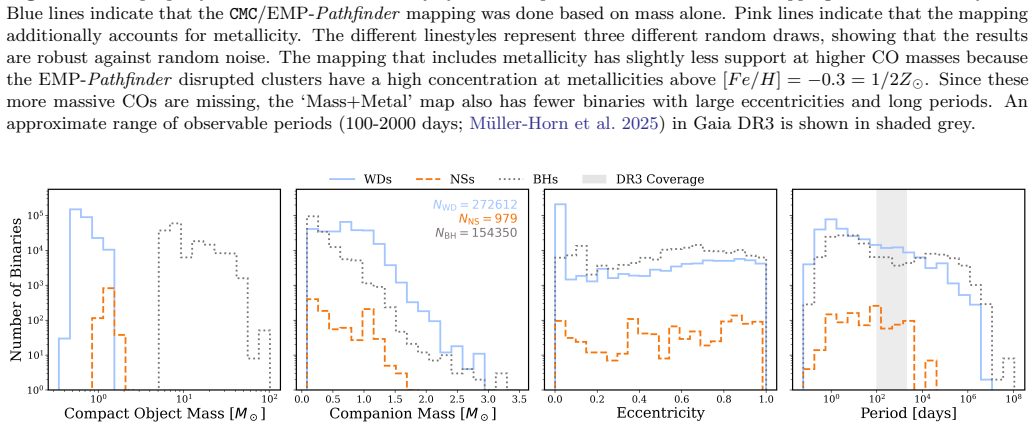
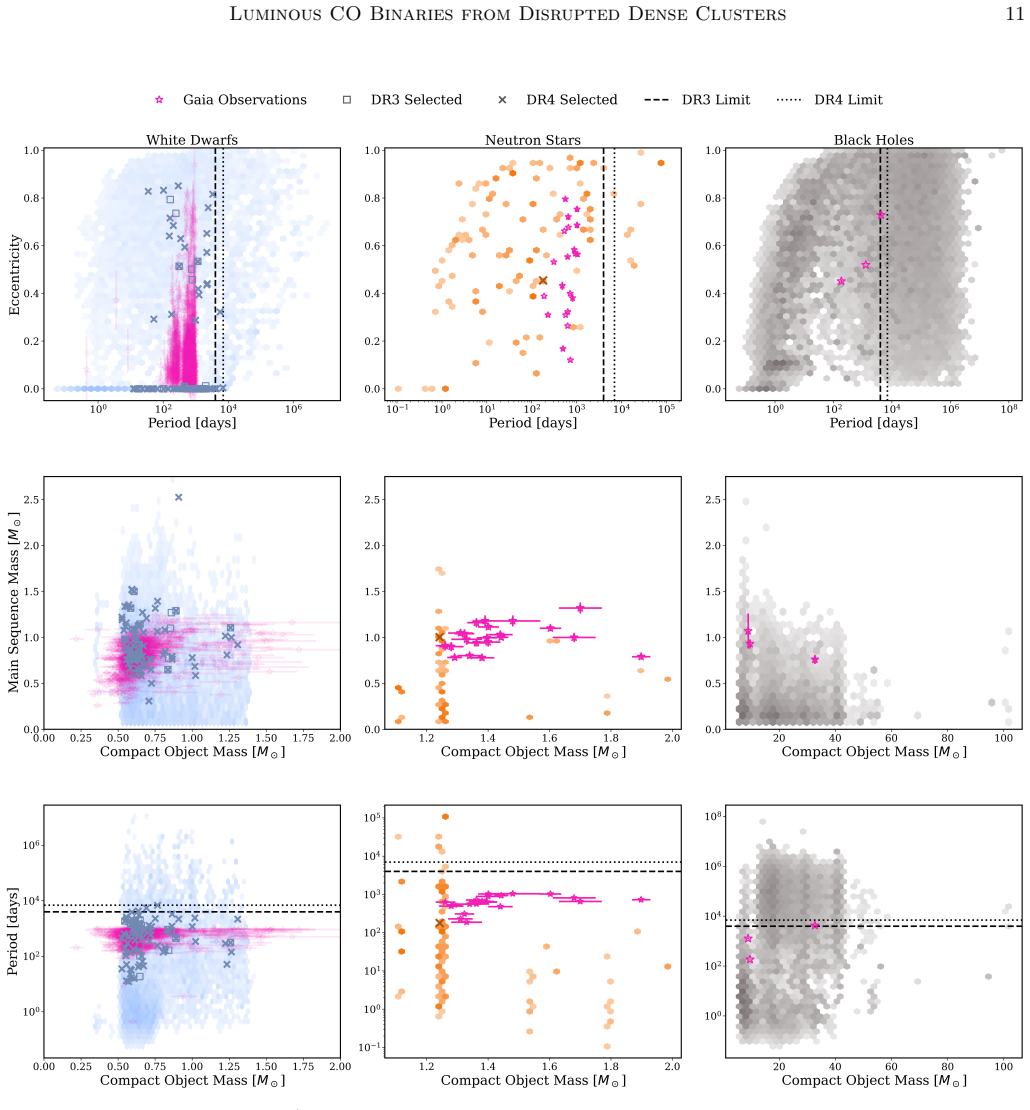
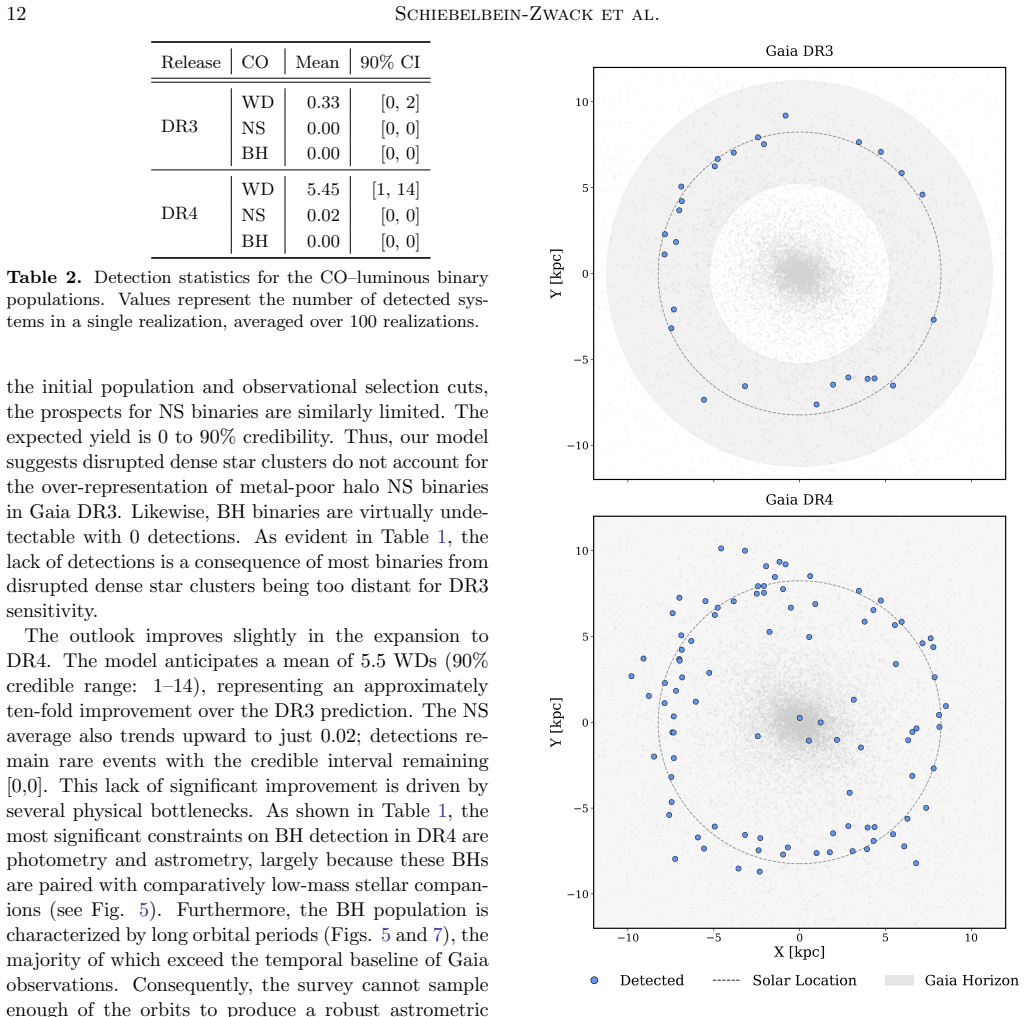
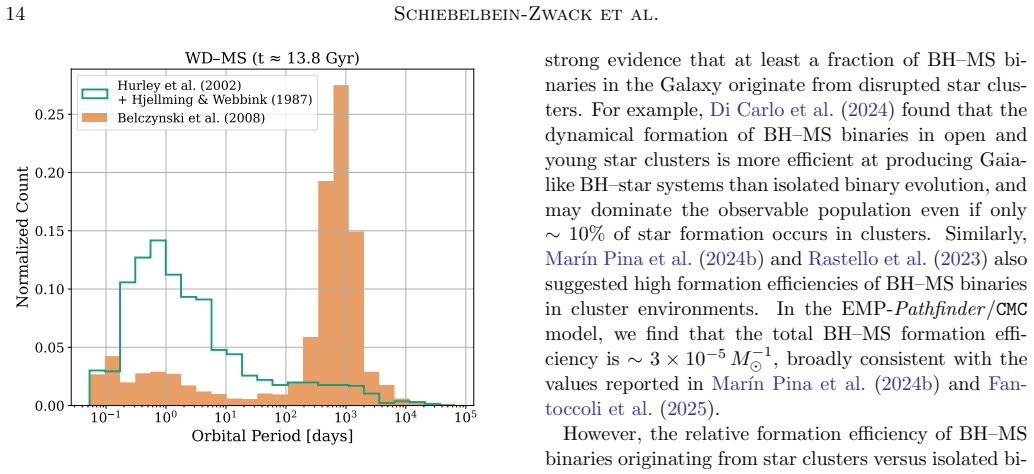
By mapping predicted star clusters from cosmological simulations onto high-resolution dynamical models, the work finds that approximately 3×10^5 white dwarfs, 1.5×10^5 black holes, and 1×10^3 neutron stars in binaries with luminous companions are released to the Galaxy from now-disrupted dense star clusters throughout the history of the Milky Way. Synthetic Gaia observations show sparse yields of about 2 white dwarfs at 90 percent credibility in DR3 and about 14 in DR4, with no neutron-star or black-hole detections expected. Black-hole systems are detected even less efficiently than white-dwarf systems because they tend to have lower-mass companions and longer orbital periods.
What carries the argument
The mapping of cosmological predictions of star cluster populations onto high-resolution dynamical models of internal evolution and binary interactions, followed by a pipeline that generates synthetic Gaia observations of the resulting field population.
If this is right
- Most compact-object binaries released by disrupted clusters lie beyond Gaia's reliable detection horizon even after the search volume expands in later data releases.
- Black-hole binaries are observed far less often than white-dwarf binaries because they pair with dimmer companions and have longer orbital periods.
- The metal-poor neutron-star binaries already catalogued by Gaia are inconsistent with an origin in disrupted dense clusters.
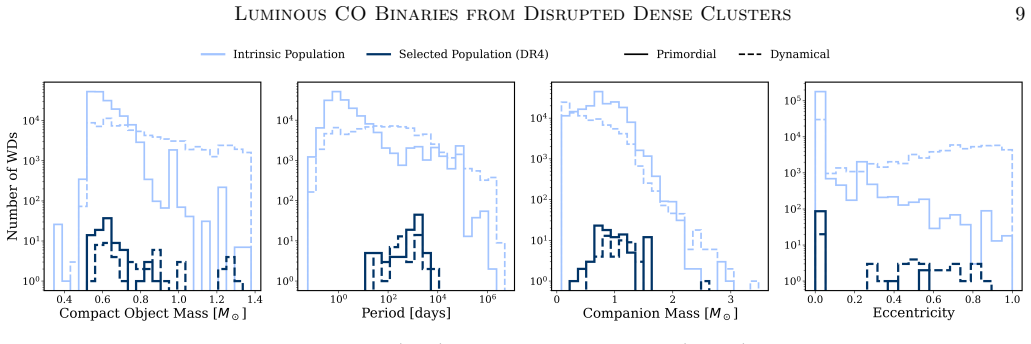
- White-dwarf binaries dominate the predicted released population yet still produce only marginal Gaia yields.
Where Pith is reading between the lines
- The observed halo neutron-star binaries more likely trace isolated binary evolution, supernova kicks, or the accretion of metal-poor dwarf galaxies.
- A lower overall cluster disruption rate would reduce the total numbers of released binaries in direct proportion.
- Surveys that reach fainter magnitudes at larger distances could provide a direct test of the predicted field population.
Load-bearing premise
The cosmological predictions of cluster formation can be accurately mapped onto detailed dynamical models that capture binary hardening and cluster disruption over time.
What would settle it
A direct count, in actual Gaia data releases, of compact-object binaries with luminous companions that either matches or deviates sharply from the predicted yields of roughly 2 white dwarfs in DR3 and 14 in DR4.
Figures
read the original abstract
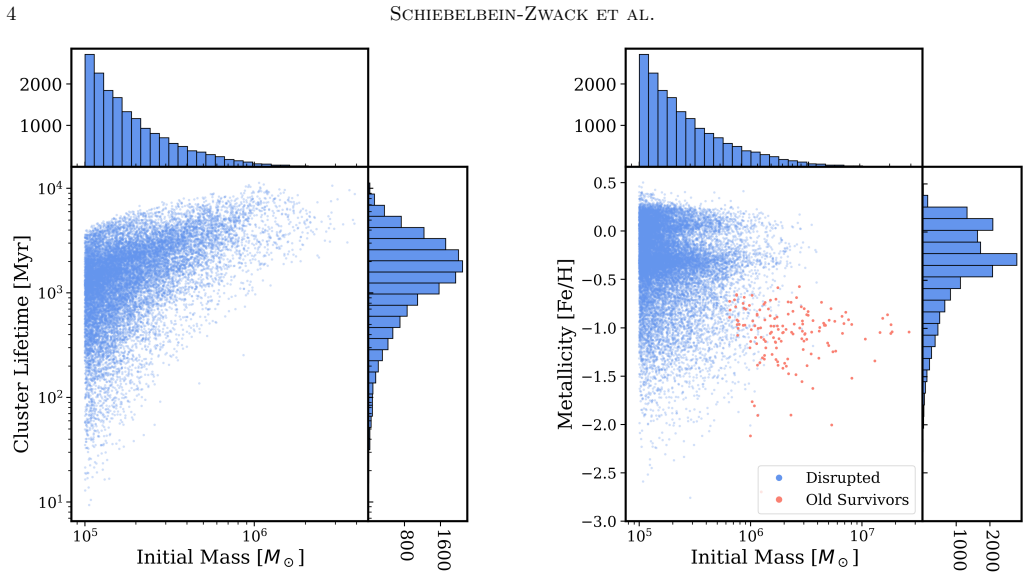
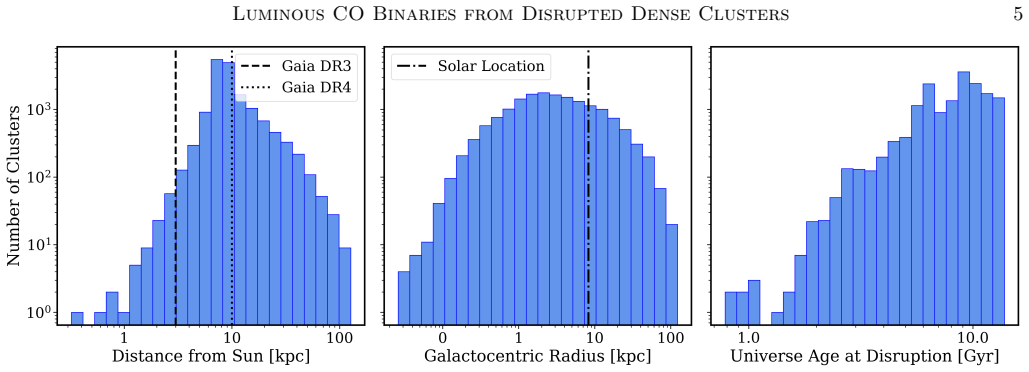
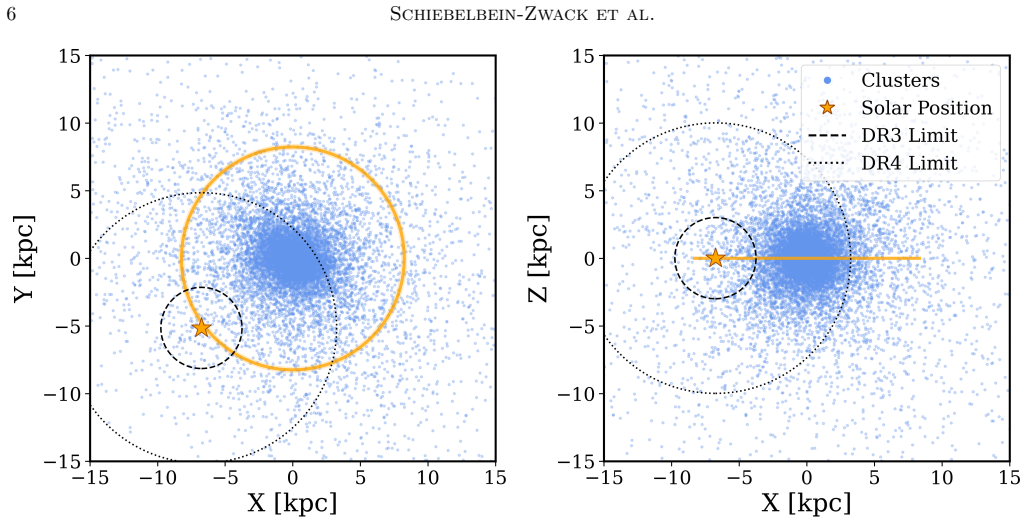
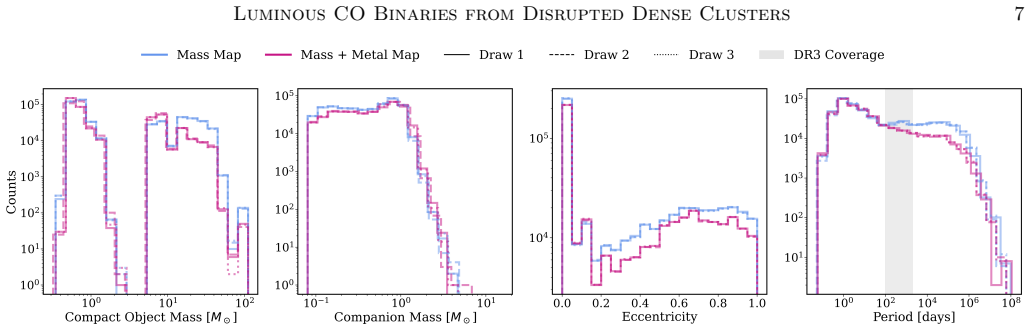
We present the first model of the Milky Way's detectable compact object--luminous star binary population from disrupted dense star clusters. We bridge large-scale cosmological star cluster formation with high-resolution dynamical evolution of compact object binaries by mapping the predicted star clusters from the EMP-Pathfinder simulations to $N$-body Cluster Monte Carlo models. We predict that approximately $3\times10^5$ white dwarfs (WDs), $1.5\times10^5$ black holes (BHs), and $1\times10^3$ neutron stars (NSs) in binaries with luminous companions are released to the Galaxy from now-disrupted dense star clusters throughout the history of the Milky Way. Synthetic observations modeled with the gaiamock pipeline reveal that the modeled Gaia DR3 yields are sparse ($\approx 2$ WDs, 0 NS, 0 BHs at 90% credibility), with the majority lying beyond the detection horizon. Gaia DR4 is expected to increase the observational yield of these systems only marginally, as the benefits of an expanded search volume are largely offset by the diminished astrometric and photometric precision of more distant sources ($\approx 14$ WDs, 0 NS, 0 BHs). While the underlying BH binary population is similar to that of WDs, they are detected far less frequently; they tend to pair with lower-mass, dimmer companions and have less temporal coverage of their long orbital periods. For NSs, we suggest that the observed over-representation of metal-poor, halo systems is inconsistent with an origin in disrupted dense star clusters. Instead, the observed Gaia NS population could reflect the accretion history of metal-poor, dwarf galaxies into the Milky Way, isolated binary star evolution, or supernova physics.
Editorial analysis
A structured set of objections, weighed in public.
Referee Report
Summary. The paper presents the first model bridging EMP-Pathfinder cosmological star cluster catalogs with Cluster Monte Carlo (CMC) N-body simulations to predict the population of compact-object binaries released by disrupted dense clusters over Milky Way history. It reports headline yields of ~3×10^5 WDs, 1.5×10^5 BHs and 1×10^3 NSs in binaries with luminous companions, then uses the gaiamock pipeline to forecast Gaia DR3/DR4 detections (sparse yields of ~2 WDs for DR3 and ~14 for DR4 at 90% credibility, with zero NS/BH detections) and argues that the observed metal-poor NS population is inconsistent with a disrupted-cluster origin.
Significance. If the mapping and disruption statistics hold, the work supplies a novel, simulation-based estimate of the contribution of dense-cluster disruption to the Galactic compact-object binary population and demonstrates that most such systems lie beyond Gaia’s current horizon. The use of a synthetic observation pipeline (gaiamock) to translate population predictions into observable yields is a clear methodological strength.
major comments (1)
- [Abstract] Abstract (mapping description): the central population numbers are obtained by assigning EMP-Pathfinder cluster masses, radii, metallicities and formation redshifts to CMC initial conditions, evolving the binaries, and summing systems released at disruption. No quantitative validation is supplied (e.g., comparison of disruption timescales, retained binary fractions, or density evolution against direct N-body benchmarks), so any systematic bias in the radius/density assignment or tidal-field representation propagates directly into the reported 3×10^5 / 1.5×10^5 / 1×10^3 counts.
minor comments (2)
- [Abstract] The 90% credibility intervals on the synthetic Gaia yields are stated but the underlying parameter ranges or exclusion rules used to generate them are not summarized, making it difficult to assess robustness.
- [Abstract] The statement that Gaia DR4 yields increase only marginally would benefit from an explicit statement of the trade-off between search volume and astrometric precision as a function of distance.
Simulated Author's Rebuttal
We thank the referee for their constructive review and the opportunity to address concerns regarding the mapping procedure. We respond to the single major comment below.
read point-by-point responses
-
Referee: [Abstract] Abstract (mapping description): the central population numbers are obtained by assigning EMP-Pathfinder cluster masses, radii, metallicities and formation redshifts to CMC initial conditions, evolving the binaries, and summing systems released at disruption. No quantitative validation is supplied (e.g., comparison of disruption timescales, retained binary fractions, or density evolution against direct N-body benchmarks), so any systematic bias in the radius/density assignment or tidal-field representation propagates directly into the reported 3×10^5 / 1.5×10^5 / 1×10^3 counts.
Authors: We agree that the abstract provides no quantitative validation of the mapping. The manuscript (Section 2) details the parameter-matching approach and relies on prior extensive benchmarks of the CMC code against direct N-body simulations for disruption timescales, binary retention, and density evolution in individual clusters. A full end-to-end N-body validation across the cosmological sample is computationally prohibitive. We will revise the abstract to note the dependence on validated CMC models and add a brief methods discussion of mapping approximations and potential systematics. revision: partial
- Direct quantitative validation of disruption timescales, retained binary fractions, and density evolution against direct N-body benchmarks for the full cosmological cluster population, which exceeds available computational resources.
Circularity Check
No circularity: predictions derive from external simulations and models
full rationale
The paper obtains its headline counts (3e5 WDs, 1.5e5 BHs, 1e3 NSs) by taking cluster catalogs from the external EMP-Pathfinder cosmological simulations, mapping them to initial conditions for separate Cluster Monte Carlo (CMC) N-body runs, evolving the binaries, and summing the released systems upon disruption, then feeding the output into the gaiamock pipeline. No equation or step inside the paper defines a target quantity in terms of itself, fits a parameter to a subset of the Gaia-related data and renames the fit as a prediction, or relies on a self-citation chain for a uniqueness claim. The mapping step is methodological and external; the derivation therefore remains self-contained against independent inputs.
Axiom & Free-Parameter Ledger
axioms (1)
- domain assumption Standard assumptions of stellar evolution, binary dynamics, and cluster disruption in N-body simulations hold for the mapped populations.
Reference graph
Works this paper leans on
-
[1]
Ambartsumian, V. A. 1938, TsAGI Uchenye Zapiski, 22, 19 Astropy Collaboration, Robitaille, T. P., Tollerud, E. J., et al. 2013, Astronomy & Astrophysics, 558, A33, doi: 10.1051/0004-6361/201322068 Astropy Collaboration, Price-Whelan, A. M., Sip˝ ocz, B. M., et al. 2018, The Astronomical Journal, 156, 123, doi: 10.3847/1538-3881/aabc4f Astropy Collaboratio...
-
[2]
2024, Astronomy and Astrophysics, 687, L3, doi: 10.1051/0004-6361/202450425
Balbinot, E., Dodd, E., Matsuno, T., et al. 2024, A&A, 687, L3, doi: 10.1051/0004-6361/202450425
-
[3]
2024, MNRAS, 535, 949, doi: 10.1093/mnras/stae2385
Bashi, D., Belokurov, V., & Hodgkin, S. 2024, MNRAS, 535, 949, doi: 10.1093/mnras/stae2385
-
[4]
doi:10.1046/j.1365-8711.2003.06432.x , archivePrefix =
Baumgardt, H., & Makino, J. 2003, MNRAS, 340, 227, doi: 10.1046/j.1365-8711.2003.06286.x
-
[5]
Belczynski, K., Kalogera, V., Rasio, F. A., et al. 2008, ApJS, 174, 223, doi: 10.1086/521026
work page internal anchor Pith review doi:10.1086/521026 2008
-
[6]
Vertical waves in the solar neighbourhood in Gaia DR2
Bennett, M., & Bovy, J. 2019, MNRAS, 482, 1417, doi: 10.1093/mnras/sty2813
work page internal anchor Pith review doi:10.1093/mnras/sty2813 2019
-
[7]
Bobylev, V. V. 2023, Astronomy Letters, 49, 493, doi: 10.1134/S1063773723090025
-
[8]
Finkbeiner, D. P. 2016, ApJ, 818, 130, doi: 10.3847/0004-637X/818/2/130
-
[9]
2020, ApJ, 898, 71, doi: 10.3847/1538-4357/ab9d85
Breivik, K., Coughlin, S., Zevin, M., et al. 2020, ApJ, 898, 71, doi: 10.3847/1538-4357/ab9d85
-
[10]
Burrows, A., Wang, T., Vartanyan, D., & Coleman, M. S. B. 2023, arXiv e-prints, arXiv:2311.12109, doi: 10.48550/arXiv.2311.12109
-
[11]
2022, ApJ, 931, 107, doi: 10.3847/1538-4357/ac60a5
Chawla, C., Chatterjee, S., Breivik, K., et al. 2022, ApJ, 931, 107, doi: 10.3847/1538-4357/ac60a5
-
[12]
2016, ApJ, 823, 102, doi: 10.3847/0004-637X/823/2/102
Choi, J., Dotter, A., Conroy, C., et al. 2016, ApJ, 823, 102, doi: 10.3847/0004-637X/823/2/102
work page internal anchor Pith review doi:10.3847/0004-637x/823/2/102 2016
-
[13]
Cournoyer-Cloutier, C., Sills, A., Harris, W. E., et al. 2024, ApJ, 977, 203, doi: 10.3847/1538-4357/ad90b3 Di Carlo, U. N., Agrawal, P., Rodriguez, C. L., & Breivik, K. 2024, ApJ, 965, 22, doi: 10.3847/1538-4357/ad2f2c
-
[14]
2025, ApJL, 989, L8, doi: 10.3847/2041-8213/adf286
Disberg, P., & Mandel, I. 2025, ApJL, 989, L8, doi: 10.3847/2041-8213/adf286
-
[15]
2003, A&A, 409, 205, doi: 10.1051/0004-6361:20031070
Drimmel, R., Cabrera-Lavers, A., & L´ opez-Corredoira, M. 2003, A&A, 409, 205, doi: 10.1051/0004-6361:20031070
-
[16]
1991, A&A, 248, 485
Duquennoy, A., & Mayor, M. 1991, A&A, 248, 485
1991
-
[17]
Applied and Computational Harmonic Analysis , volume =
El-Badry, K. 2024a, NewAR, 98, 101694, doi: 10.1016/j.newar.2024.101694 Luminous CO Binaries from Disrupted Dense Clusters17 —. 2024b, The Open Journal of Astrophysics, 7, 38, doi: 10.33232/001c.117652
-
[18]
2024a, The Open Journal of Astrophysics, 7, 100, doi: 10.33232/001c.125461 —
El-Badry, K., Lam, C., Holl, B., et al. 2024a, The Open Journal of Astrophysics, 7, 100, doi: 10.33232/001c.125461 —. 2024b, The Open Journal of Astrophysics, 7, 100, doi: 10.33232/001c.125461
-
[19]
2019, MNRAS, 482, L139, doi: 10.1093/mnrasl/sly206
El-Badry, K., & Rix, H.-W. 2019, MNRAS, 482, L139, doi: 10.1093/mnrasl/sly206
-
[20]
El-Badry, K., Rix, H.-W., & Heintz, T. M. 2021, MNRAS, 506, 2269, doi: 10.1093/mnras/stab323
-
[21]
2023a, MNRAS, 518, 1057, doi: 10.1093/mnras/stac3140
El-Badry, K., Rix, H.-W., Quataert, E., et al. 2023a, MNRAS, 518, 1057, doi: 10.1093/mnras/stac3140
-
[22]
2023b, MNRAS, 521, 4323, doi: 10.1093/mnras/stad799
El-Badry, K., Rix, H.-W., Cendes, Y., et al. 2023b, MNRAS, 521, 4323, doi: 10.1093/mnras/stad799
-
[23]
El-Badry, K., Rix, H.-W., Latham, D. W., et al. 2024c, The Open Journal of Astrophysics, 7, 58, doi: 10.33232/001c.121261
-
[24]
El-Badry, K., Simon, J. D., Reggiani, H., et al. 2024d, The Open Journal of Astrophysics, 7, 27, doi: 10.33232/001c.116675
-
[25]
Elmegreen, B. G. 2010, ApJL, 712, L184, doi: 10.1088/2041-8205/712/2/L184
-
[26]
Elmegreen, B. G., & Hunter, D. A. 2010, ApJ, 712, 604, doi: 10.1088/0004-637X/712/1/604
-
[27]
2025, MNRAS, 538, 243, doi: 10.1093/mnras/staf303
Fantoccoli, F., Barber, J., Dosopoulou, F., Chattopadhyay, D., & Antonini, F. 2025, MNRAS, 538, 243, doi: 10.1093/mnras/staf303
-
[28]
L., Belczynski, K., Wiktorowicz, G., et al
Fryer, C. L., Belczynski, K., Wiktorowicz, G., et al. 2012, ApJ, 749, 91, doi: 10.1088/0004-637X/749/1/91 Gaia Collaboration, Prusti, T., de Bruijne, J. H. J., et al. 2016, A&A, 595, A1, doi: 10.1051/0004-6361/201629272 Gaia Collaboration, Brown, A. G. A., Vallenari, A., et al. 2021, A&A, 649, A1, doi: 10.1051/0004-6361/202039657 Gaia Collaboration, Panuz...
-
[29]
Gieles, M., Portegies Zwart, S. F., Baumgardt, H., et al. 2006, MNRAS, 371, 793, doi: 10.1111/j.1365-2966.2006.10711.x
-
[30]
A 3D Dust Map Based on Gaia, Pan-STARRS 1 and 2MASS
Finkbeiner, D. 2019, ApJ, 887, 93, doi: 10.3847/1538-4357/ab5362
work page internal anchor Pith review doi:10.3847/1538-4357/ab5362 2019
-
[31]
2023, A&A, 674, A9, doi: 10.1051/0004-6361/202243969
Halbwachs, J.-L., Pourbaix, D., Arenou, F., et al. 2023, A&A, 674, A9, doi: 10.1051/0004-6361/202243969
-
[32]
Harris, C. R., Millman, K. J., van der Walt, S. J., et al. 2020, Nature, 585, 357, doi: 10.1038/s41586-020-2649-2
-
[33]
2023, arXiv e-prints, arXiv:2304.09350, doi: 10.48550/arXiv.2304.09350
Heger, A., M¨ uller, B., & Mandel, I. 2023, arXiv e-prints, arXiv:2304.09350, doi: 10.48550/arXiv.2304.09350
-
[34]
Heggie, D. C. 1975, MNRAS, 173, 729, doi: 10.1093/mnras/173.3.729 H´ enon, M. 1961, Annales d’Astrophysique, 24, 369
-
[35]
Hjellming, M. S., & Webbink, R. F. 1987, ApJ, 318, 794, doi: 10.1086/165412
-
[36]
Hobbs, G., Lorimer, D. R., Lyne, A. G., & Kramer, M. 2005, MNRAS, 360, 974, doi: 10.1111/j.1365-2966.2005.09087.x
-
[37]
Hunter, J. D. 2007, Computing in Science & Engineering, 9, 90, doi: 10.1109/MCSE.2007.55
-
[38]
Hurley, J. R., Tout, C. A., & Pols, O. R. 2002, MNRAS, 329, 897, doi: 10.1046/j.1365-8711.2002.05038.x
-
[39]
Kaib, N. A., & Raymond, S. N. 2014, ApJ, 782, 60, doi: 10.1088/0004-637X/782/2/60
-
[40]
Kiel, P. D., Hurley, J. R., Bailes, M., & Murray, J. R. 2008, MNRAS, 388, 393, doi: 10.1111/j.1365-2966.2008.13402.x
-
[41]
2024, MNRAS, 535, 3577, doi: 10.1093/mnras/stae2591
Kotko, I., Banerjee, S., & Belczynski, K. 2024, MNRAS, 535, 3577, doi: 10.1093/mnras/stae2591
-
[42]
Kremer, K., Ye, C. S., Rui, N. Z., et al. 2020, ApJS, 247, 48, doi: 10.3847/1538-4365/ab7919
-
[43]
Kroupa, P. 2001, MNRAS, 322, 231, doi: 10.1046/j.1365-8711.2001.04022.x
-
[44]
Kruijssen, J. M. D. 2012, MNRAS, 426, 3008, doi: 10.1111/j.1365-2966.2012.21923.x
-
[45]
Kruijssen, J. M. D., Pelupessy, F. I., Lamers, H. J. G. L. M., et al. 2012, MNRAS, 421, 1927, doi: 10.1111/j.1365-2966.2012.20322.x
-
[46]
Kruijssen, J. M. D., Pelupessy, F. I., Lamers, H. J. G. L. M., Portegies Zwart, S. F., & Icke, V. 2011, MNRAS, 414, 1339, doi: 10.1111/j.1365-2966.2011.18467.x
-
[47]
Kruijssen, J. M. D., Pfeffer, J. L., Crain, R. A., & Bastian, N. 2019, MNRAS, 486, 3134, doi: 10.1093/mnras/stz968
-
[48]
Lamers, H. J. G. L. M., Gieles, M., & Portegies Zwart, S. F. 2005, A&A, 429, 173, doi: 10.1051/0004-6361:20041476 Mar´ ın Pina, D., Rastello, S., Gieles, M., et al. 2024a, A&A, 688, L2, doi: 10.1051/0004-6361/202450460 —. 2024b, A&A, 688, L2, doi: 10.1051/0004-6361/202450460
-
[49]
2006, A&A, 453, 635, doi: 10.1051/0004-6361:20053842
Picaud, S. 2006, A&A, 453, 635, doi: 10.1051/0004-6361:20053842
-
[50]
2010, in Proceedings of the 9th Python in Science Conference, ed
McKinney, W. 2010, in Proceedings of the 9th Python in Science Conference, ed. S. van der Walt & J. Millman, 51–56
2010
-
[51]
Miholics, M., Kruijssen, J. M. D., & Sills, A. 2017, MNRAS, 470, 1421, doi: 10.1093/mnras/stx1312
-
[52]
1980, PASJ, 32, 303, doi: 10.1093/pasj/32.2.303
Miyaji, S., Nomoto, K., Yokoi, K., & Sugimoto, D. 1980, PASJ, 32, 303, doi: 10.1093/pasj/32.2.303
-
[53]
Montet, B. T., Morton, T. D., Foreman-Mackey, D., et al. 2015, ApJ, 809, 25, doi: 10.1088/0004-637X/809/1/25 18Schiebelbein-Zwack et al
-
[54]
Morton, T. D. 2015, isochrones: Stellar model grid package, Astrophysics Source Code Library, record ascl:1503.010 M¨ uller-Horn, J., Rix, H.-W., El-Badry, K., et al. 2025, arXiv e-prints, arXiv:2510.05982, doi: 10.48550/arXiv.2510.05982
work page internal anchor Pith review Pith/arXiv arXiv doi:10.48550/arxiv.2510.05982 2015
-
[55]
2025, PASP, 137, 044202, doi: 10.1088/1538-3873/adc839
Nagarajan, P., El-Badry, K., Chawla, C., et al. 2025, PASP, 137, 044202, doi: 10.1088/1538-3873/adc839
-
[56]
1984, ApJ, 277, 791, doi: 10.1086/161749 —
Nomoto, K. 1984, ApJ, 277, 791, doi: 10.1086/161749 —. 1987, ApJ, 322, 206, doi: 10.1086/165716 O’Doherty, T. N., Bahramian, A., Miller-Jones, J. C. A., et al. 2023, MNRAS, 521, 2504, doi: 10.1093/mnras/stad680
-
[57]
Pfeffer, J., Kruijssen, J. M. D., Crain, R. A., & Bastian, N. 2018, MNRAS, 475, 4309, doi: 10.1093/mnras/stx3124
-
[58]
2023, MNRAS, 526, 740, doi: 10.1093/mnras/stad2757
Rastello, S., Iorio, G., Mapelli, M., et al. 2023, MNRAS, 526, 740, doi: 10.1093/mnras/stad2757
-
[59]
Reina-Campos, M., Keller, B. W., Kruijssen, J. M. D., et al. 2022, MNRAS, 517, 3144, doi: 10.1093/mnras/stac1934
-
[60]
Rodriguez, C. L., Weatherford, N. C., Coughlin, S. C., et al. 2022, ApJS, 258, 22, doi: 10.3847/1538-4365/ac2edf
-
[61]
C., Breivik, K., Badenes, C., et al
Rubio, A. C., Breivik, K., Badenes, C., et al. 2025a, A&A, 704, A6, doi: 10.1051/0004-6361/202555600 —. 2025b, A&A, 704, A6, doi: 10.1051/0004-6361/202555600
-
[62]
doi:10.1126/science.1223344 , eprint =
Sana, H., de Mink, S. E., de Koter, A., et al. 2012, Science, 337, 444, doi: 10.1126/science.1223344
-
[63]
2023, MNRAS, 518, 2991, doi: 10.1093/mnras/stac3290
Shahaf, S., Bashi, D., Mazeh, T., et al. 2023, MNRAS, 518, 2991, doi: 10.1093/mnras/stac3290
-
[64]
2024, MNRAS, 529, 3729, doi: 10.1093/mnras/stae773
Shahaf, S., Hallakoun, N., Mazeh, T., et al. 2024, MNRAS, 529, 3729, doi: 10.1093/mnras/stae773
-
[65]
Smith, B. D., Bryan, G. L., Glover, S. C. O., et al. 2017, MNRAS, 466, 2217, doi: 10.1093/mnras/stw3291
-
[66]
Stability Criteria for Mass Transfer in Binary Stellar Evolution
Soberman, G. E., Phinney, E. S., & van den Heuvel, E. P. J. 1997, A&A, 327, 620, doi: 10.48550/arXiv.astro-ph/9703016
work page internal anchor Pith review Pith/arXiv arXiv doi:10.48550/arxiv.astro-ph/9703016 1997
-
[67]
1940, MNRAS, 100, 396, doi: 10.1093/mnras/100.5.396
Spitzer, Jr., L. 1940, MNRAS, 100, 396, doi: 10.1093/mnras/100.5.396
-
[68]
Springel, V. 2010, MNRAS, 401, 791, doi: 10.1111/j.1365-2966.2009.15715.x
-
[69]
Tanikawa, A., Wang, L., & Fujii, M. S. 2024, The Open Journal of Astrophysics, 7, 39, doi: 10.33232/001c.117684 The pandas development team. 2020, pandas-dev/pandas:
-
[70]
Pandas, Zenodo, doi: 10.5281/zenodo.3509134
-
[71]
2020, ApJS, 246, 4, doi: 10.3847/1538-4365/ab54c4
Tian, H.-J., El-Badry, K., Rix, H.-W., & Gould, A. 2020, ApJS, 246, 4, doi: 10.3847/1538-4365/ab54c4
-
[72]
Trujillo-Gomez, S., Reina-Campos, M., & Kruijssen, J. M. D. 2019, MNRAS, 488, 3972, doi: 10.1093/mnras/stz1932 van Son, L. A. C., Roy, S. K., Mandel, I., et al. 2025, ApJ, 979, 209, doi: 10.3847/1538-4357/ada14a
-
[73]
Yamaguchi, N., El-Badry, K., Rees, N. R., et al. 2024, PASP, 136, 084202, doi: 10.1088/1538-3873/ad6809
-
[74]
2025a, PASP, 137, 104205, doi: 10.1088/1538-3873/ae0d30 —
Yamaguchi, N., El-Badry, K., & Shahaf, S. 2025a, PASP, 137, 104205, doi: 10.1088/1538-3873/ae0d30 —. 2025b, PASP, 137, 104205, doi: 10.1088/1538-3873/ae0d30
-
[75]
Rasio, F. A. 2019, ApJ, 877, 122, doi: 10.3847/1538-4357/ab1b21
discussion (0)
Sign in with ORCID, Apple, or X to comment. Anyone can read and Pith papers without signing in.