REVIEW 1 major objections 18 references
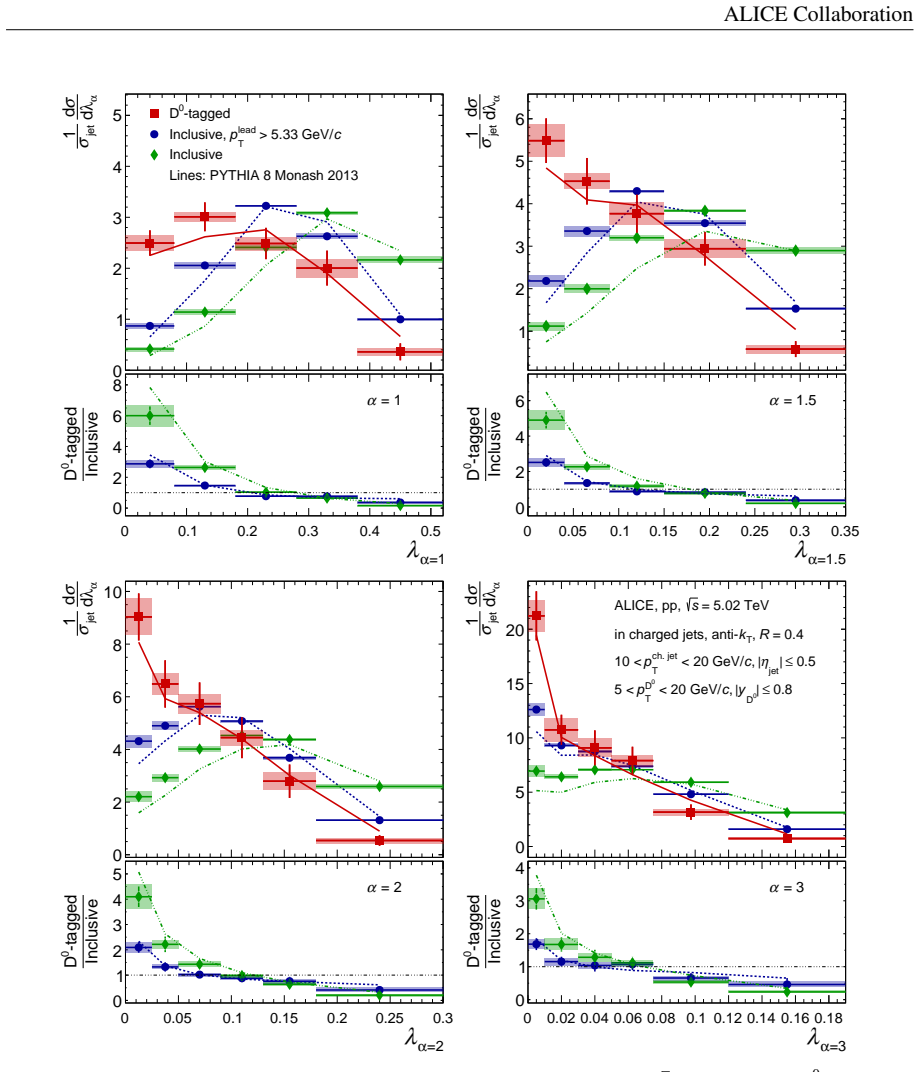
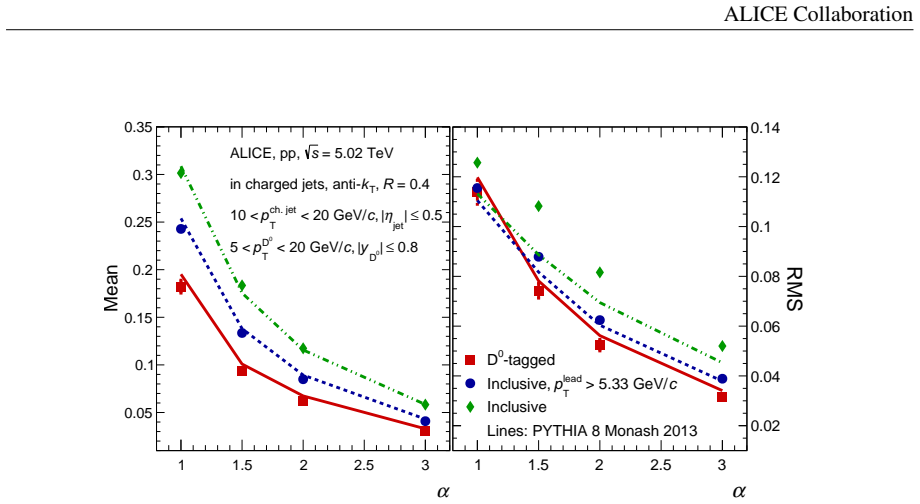
D0-tagged jets exhibit smaller angularity values than inclusive jets at low angular weights, indicating charm-quark radiation suppression.
Reviewed by Pith at T0; open to challenge. T0 means a machine referee read the full paper against a public rubric. the ladder, T0–T4 →
T0 review · grok-4.3
2026-06-26 15:14 UTC pith:3E6TRTPR
load-bearing objection ALICE delivers the first D0-tagged jet angularity data in pp collisions, with the expected smaller values at low weight, but tagging selection effects still need explicit isolation from the dead-cone claim. the 1 major comments →
Probing flavor effects in the QCD parton shower using mathbf{{rm D}⁰}-tagged jet angularities in proton-proton collisions at mathbf{ sqrt{s} = 5.02} TeV
The pith
A machine-rendered reading of the paper's core claim, the machinery that carries it, and where it could break.
Core claim
The central claim is that the reduction in angularity for D0-tagged jets at low angular weights demonstrates the QCD dead-cone effect caused by the mass of the charm quark, with the modification localized to the jet core rather than its periphery.
What carries the argument
Jet angularity, a substructure observable with a tunable angular exponent that controls sensitivity to collinear versus wide-angle radiation.
Load-bearing premise
The observed difference between D0-tagged and inclusive jet angularities is driven primarily by the charm-quark mass rather than by jet reconstruction efficiency, background subtraction, or the choice of the inclusive reference sample.
What would settle it
A measurement showing that the angularity distributions of D0-tagged and inclusive jets become statistically identical once all non-mass differences in reconstruction and selection are corrected would falsify the dead-cone interpretation.
Editorial analysis
A structured set of objections, weighed in public.
Referee Report
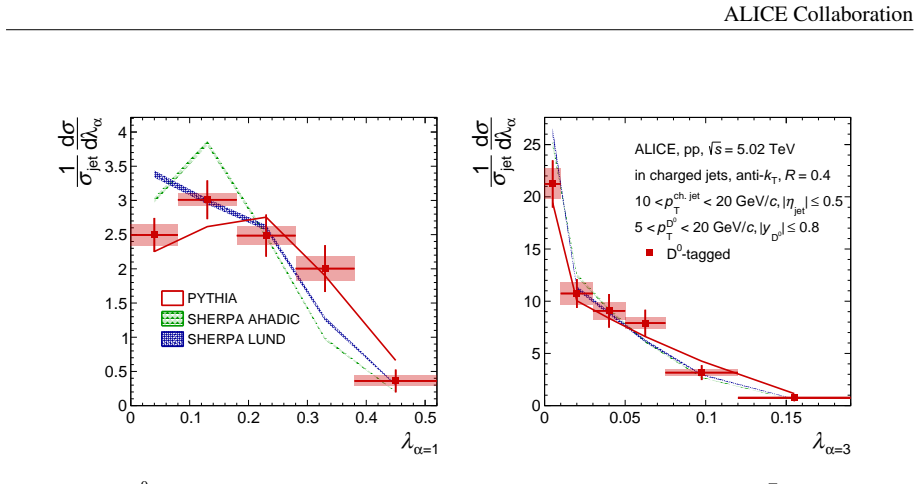
Summary. The ALICE Collaboration reports the first measurements of D0-tagged charged-particle jet angularities (R=0.4) in pp collisions at 5.02 TeV for 10 < pT^ch jet < 20 GeV/c. At low angular weight (emphasizing collinear radiation), D0-tagged jets show smaller angularity values than inclusive jets, interpreted as evidence for the QCD dead-cone effect due to charm-quark mass suppression. The difference decreases at higher angular weights. PYTHIA 8 qualitatively reproduces both distributions, with better agreement for D0-tagged jets than inclusive jets.
Significance. If the central interpretation holds, this provides the first experimental probe of flavor-dependent jet substructure via tunable angularities in the low-pT regime where mass effects are prominent, serving as an essential baseline for heavy-ion studies of jet quenching. The qualitative PYTHIA comparison offers a new constraint on fragmentation models, though the lack of quantitative distributions and uncertainties in the presented results limits immediate impact.
major comments (1)
- [Abstract and results section] Abstract and results section: The claim that smaller angularity values provide evidence for the dead-cone effect assumes the D0-tagged vs. inclusive difference is driven by charm mass rather than D0 reconstruction biases (vertex reconstruction, pT/PID cuts on daughters). The manuscript notes qualitative PYTHIA agreement but does not isolate or quantify the contribution of tagging-induced selection effects on fragmentation or efficiency, which could suppress wide-angle radiation independently of mass.
Simulated Author's Rebuttal
We thank the referee for their careful reading and constructive feedback on our manuscript. We address the major comment below and will make targeted revisions to strengthen the discussion of potential biases.
read point-by-point responses
-
Referee: [Abstract and results section] Abstract and results section: The claim that smaller angularity values provide evidence for the dead-cone effect assumes the D0-tagged vs. inclusive difference is driven by charm mass rather than D0 reconstruction biases (vertex reconstruction, pT/PID cuts on daughters). The manuscript notes qualitative PYTHIA agreement but does not isolate or quantify the contribution of tagging-induced selection effects on fragmentation or efficiency, which could suppress wide-angle radiation independently of mass.
Authors: We agree that isolating the charm-mass contribution from tagging-induced selection effects is important for a robust interpretation. The D0-tagged sample applies the same reconstruction (vertexing, pT and PID requirements on daughters) to both data and PYTHIA 8, which includes the full detector response and charm-quark mass. The observed difference between D0-tagged and inclusive jets is therefore compared to a simulation that already incorporates tagging biases; the qualitative agreement with PYTHIA supports that the mass-dependent suppression (dead-cone) is the primary driver. Nevertheless, the manuscript does not provide an explicit decomposition (e.g., PYTHIA runs with massless charm or with tagging cuts removed). We will add a dedicated paragraph in the results section and a supplementary figure quantifying the tagging bias contribution by comparing massive vs. massless charm simulations under identical reconstruction, thereby addressing the referee’s concern directly. revision: partial
Circularity Check
No circularity: direct experimental measurement
full rationale
The paper reports first measurements of D0-tagged jet angularities compared to inclusive jets in pp collisions. No derivation, ansatz, or parameter fitting is present that reduces to its own inputs. The central result is the observed difference in angularity distributions at low angular weight, interpreted as possible dead-cone evidence, but this follows from the data collection and reconstruction rather than any self-referential equation or self-citation chain. PYTHIA comparisons are external model checks, not load-bearing for the measurement itself. The paper is self-contained against external benchmarks with no self-definitional or fitted-input reductions.
Axiom & Free-Parameter Ledger
axioms (1)
- domain assumption Standard QCD parton shower and hadronization models (PYTHIA 8) provide a valid reference for vacuum fragmentation
read the original abstract
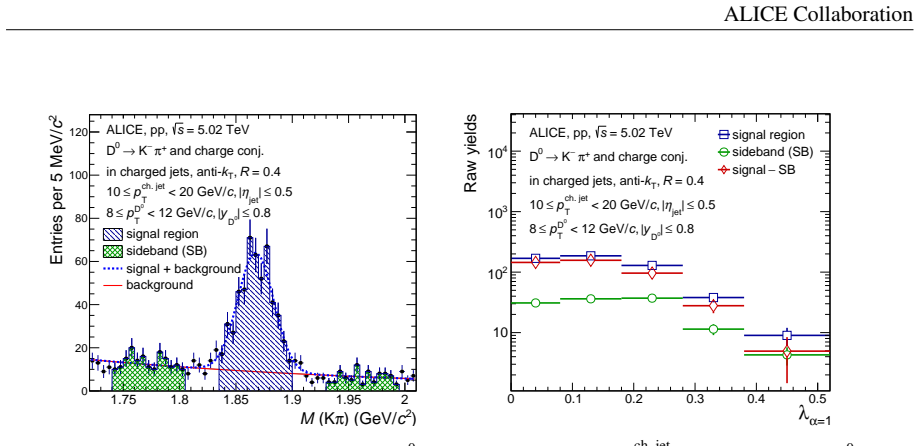
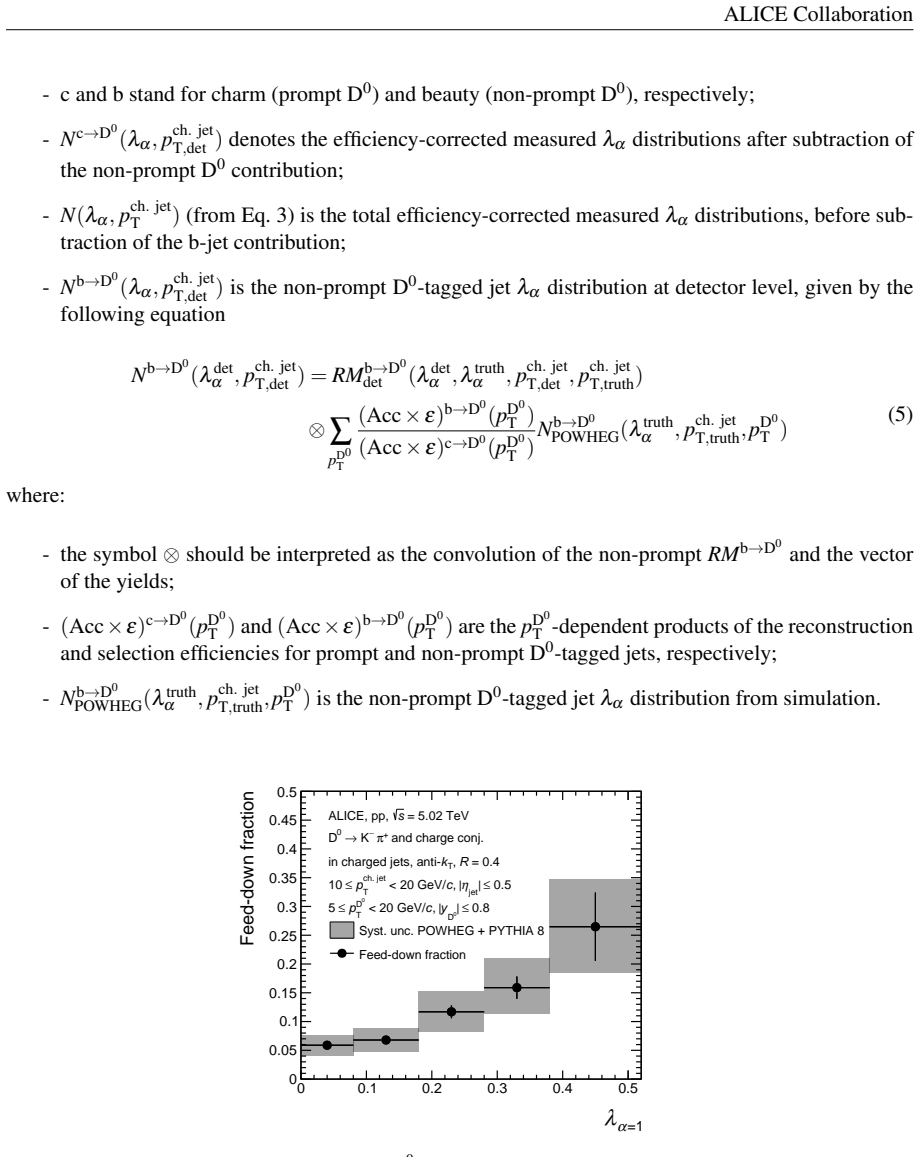
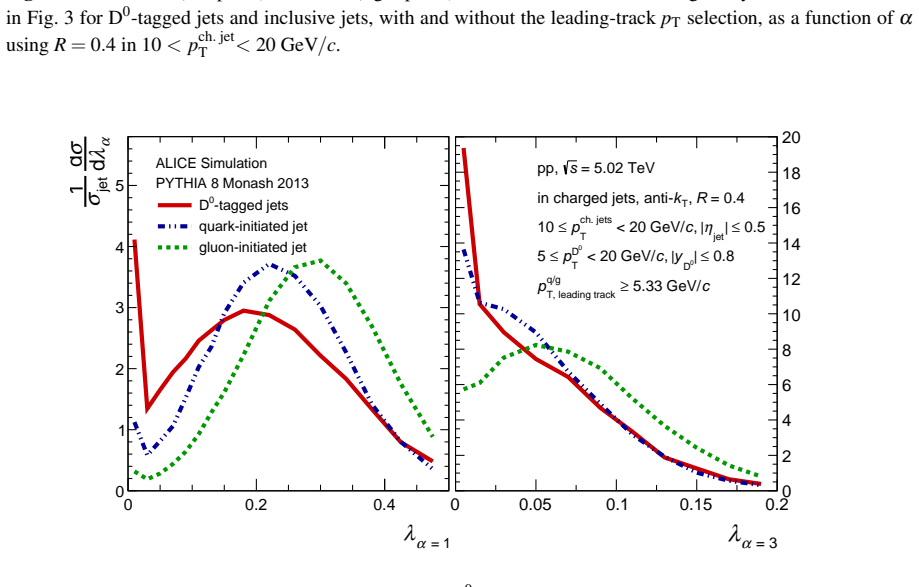
The ALICE Collaboration presents the first measurements of ${\rm D}^0$-tagged jet angularities in proton$-$proton (pp) collisions at $\sqrt{s} = 5.02$ TeV. Jet angularities are powerful substructure observables that characterize the angular and momentum distributions of particles within jets via tunable weighting parameters. Varying the angular parameter in jet angularities allows for a systematic probe of the sensitivity to collinear and soft radiation, enabling the study of flavor-dependent fragmentation and hadronization through comparisons of jets initiated by different partons. This paper reports ${\rm D}^0$-tagged and inclusive (gluon-dominated) charged-particle jet angularities with a resolution parameter $R=0.4$ in the low jet transverse momentum range ($10 < p_{\rm T}^{\rm ch. \, jet} < 20$ GeV/$c$), where charm-quark mass effects are most significant. At low angular weight, which emphasizes collinear radiation, ${\rm D}^0$-tagged jets exhibit smaller angularity values than inclusive jets. This provides evidence for the radiation suppression from massive quarks -- a phenomenon known as the QCD dead-cone effect. As the angular weight increases, giving more emphasis to wide-angle radiation, the difference between ${\rm D}^0$-tagged and inclusive jet distributions decreases. This indicates that the modification is concentrated within the jet core rather than its edge. PYTHIA 8 simulations qualitatively reproduce both the angularity of ${\rm D}^0$-tagged and inclusive charged-particle jets, but reproduce the ${\rm D}^0$-tagged jet distributions better than those of inclusive jets, offering a powerful new constraint for models. These results provide insight into flavor-dependent fragmentation and establish an essential baseline for future studies of jet modifications in the quark-gluon plasma produced in heavy-ion collisions.
Figures
Reference graph
Works this paper leans on
-
[1]
Asymptotic freedom in parton language
G. Altarelli and G. Parisi, “Asymptotic freedom in parton language”,Nucl. Phys. B126(1977) 298–318
1977
-
[2]
Basics of perturbative QCD
Y . L. Dokshitzer, V . A. Khoze, A. H. Mueller, and S. I. Troyan, “Basics of perturbative QCD”, Editions Frontieres(1991) .https://www.lpthe.jussieu.fr/~yuri/BPQCD/BPQCD.pdf
1991
-
[3]
On specific QCD properties of heavy quark fragmentation (’dead cone’)
Y . L. Dokshitzer, V . A. Khoze, and S. I. Troian, “On specific QCD properties of heavy quark fragmentation (’dead cone’)”,J. Phys. G17(1991) 1602–1604. [4]ALICECollaboration, S. Acharyaet al., “Measurement of the production of charm jets tagged with D0 mesons in pp collisions at √s=5.02 and 13 TeV”,JHEP06(2023) 133, arXiv:2204.10167 [nucl-ex]. [5]CMSColl...
-
[4]
Gaining (Mutual) Information about Quark/Gluon Discrimination
A. J. Larkoski, J. Thaler, and W. J. Waalewijn, “Gaining (mutual) information about quark/gluon discrimination”,JHEP2014(Nov, 2014) 129,arXiv:1408.3122 [hep-ph]
work page internal anchor Pith review Pith/arXiv arXiv 2014
-
[5]
Substructure of high-p_T Jets at the LHC
L. G. Almeida, S. J. Lee, G. Perez, G. F. Sterman, I. Sung, and J. Virzi, “Substructure of high-p T Jets at the LHC”,Phys. Rev. D79(2009) 074017,arXiv:0807.0234 [hep-ph]
work page internal anchor Pith review Pith/arXiv arXiv 2009
-
[6]
Phenomenology of jet angularities at the LHC
D. Reichelt, S. Caletti, O. Fedkevych, S. Marzani, S. Schumann, and G. Soyez, “Phenomenology of jet angularities at the LHC”,JHEP03(2022) 131,arXiv:2112.09545 [hep-ph]. [33]ALICECollaboration, S. Acharyaet al., “Measurements of the groomed and ungroomed jet angularities in pp collisions at √s=5.02 TeV”,JHEP05(2022) 061,arXiv:2107.11303 [nucl-ex]
-
[7]
Scaling Rule for Nonperturbative Radiation in a Class of Event Shapes
C. F. Berger and G. Sterman, “Scaling rule for nonperturbative radiation in a class of event shapes”,JHEP2003(Sep, 2003) 058–058,arXiv:hep-ph/0307394
work page internal anchor Pith review Pith/arXiv arXiv 2003
-
[8]
Jet angularity measurements for single inclusive jet production
Z.-B. Kang, K. Lee, and F. Ringer, “Jet angularity measurements for single inclusive jet production”,JHEP2018(Apr, 2018) 110,arXiv:1801.00790 [hep-ph]. [36]ALICECollaboration, G. Dellacasaet al., “ALICE technical design report of the inner tracking system (ITS)”, CERN-LHCC-99-12. [37]ALICECollaboration, G. Dellacasaet al., “ALICE: Technical design report ...
work page internal anchor Pith review Pith/arXiv arXiv 2018
-
[9]
T. Sjöstrand, S. Mrenna, and P. Z. Skands, “PYTHIA 6.4 Physics and Manual”,JHEP05(2006) 026,arXiv:hep-ph/0603175
work page internal anchor Pith review Pith/arXiv arXiv 2006
-
[10]
Tuning Monte Carlo Generators: The Perugia Tunes
P. Z. Skands, “Tuning Monte Carlo Generators: The Perugia Tunes”,Phys. Rev. D82(2010) 074018,arXiv:1005.3457 [hep-ph]
work page internal anchor Pith review Pith/arXiv arXiv 2010
-
[11]
Simulation program for particle physics experiments, GEANT: user guide and reference manual
R. Brun, R. Hagelberg, M. Hansroul, and J. C. Lassalle, “Simulation program for particle physics experiments, GEANT: user guide and reference manual”, CERN-DD-78-2. [47]Particle Data GroupCollaboration, S. Navaset al., “Review of Particle Physics”,Phys. Rev. D 110(2024) 030001. 17 ALICE Collaboration
2024
-
[12]
The anti-k_t jet clustering algorithm
M. Cacciari, G. P. Salam, and G. Soyez, “The anti-kt jet clustering algorithm”,JHEP04(2008) 063,arXiv:0802.1189 [hep-ph]
work page internal anchor Pith review Pith/arXiv arXiv 2008
-
[13]
M. Cacciari, G. P. Salam, and G. Soyez, “FastJet user manual”,Eur . Phys. J. C72(2012) 1896, arXiv:1111.6097 [hep-ph]
work page internal anchor Pith review Pith/arXiv arXiv 2012
-
[14]
A general framework for implementing NLO calculations in shower Monte Carlo programs: the POWHEG BOX
S. Alioli, P. Nason, C. Oleari, and E. Re, “A general framework for implementing NLO calculations in shower Monte Carlo programs: the POWHEG BOX”,JHEP06(2010) 043, arXiv:1002.2581 [hep-ph]
work page internal anchor Pith review Pith/arXiv arXiv 2010
-
[15]
Tuning PYTHIA 8.1: the Monash 2013 Tune
P. Skands, S. Carrazza, and J. Rojo, “Tuning PYTHIA 8.1: the Monash 2013 Tune”,Eur . Phys. J. C74(2014) 3024,arXiv:1404.5630 [hep-ph]
work page internal anchor Pith review Pith/arXiv arXiv 2013
-
[16]
Improved iterative Bayesian unfolding
G. D’Agostini, “Improved iterative Bayesian unfolding”,arXiv:1010.0632 [physics.data-an]
work page internal anchor Pith review Pith/arXiv arXiv
-
[17]
RooUnfold: an unfolding framework for ROOT
T. Adye, R. Claridge, K. Tackmann, and F. Wilson, “RooUnfold: an unfolding framework for ROOT”,https://gitlab.cern.ch/RooUnfold/RooUnfold
-
[18]
Theoretical predictions for charm and bottom production at the LHC
M. Cacciari, S. Frixione, N. Houdeau, M. L. Mangano, P. Nason, and G. Ridolfi, “Theoretical predictions for charm and bottom production at the LHC”,JHEP10(2012) 137, arXiv:1205.6344 [hep-ph]. [55]SherpaCollaboration, E. Bothmannet al., “Event Generation with Sherpa 2.2”,SciPost Phys.7 (2019) 034,arXiv:1905.09127 [hep-ph]. 18 ALICE Collaboration A The ALIC...
work page internal anchor Pith review Pith/arXiv arXiv 2012
discussion (0)
Sign in with ORCID, Apple, or X to comment. Anyone can read and Pith papers without signing in.