Accurate identification and measurement of the precipitate area by two-stage deep neural networks in novel chromium-based alloys
Pith reviewed 2026-06-26 12:24 UTC · model grok-4.3
The pith
DT-SegNet uses YOLOv5 detection followed by SegFormer segmentation to measure precipitate areas in chromium-based alloy electron microscopy images more accurately than prior tools.
A machine-rendered reading of the paper's core claim, the machinery that carries it, and where it could break.
Core claim
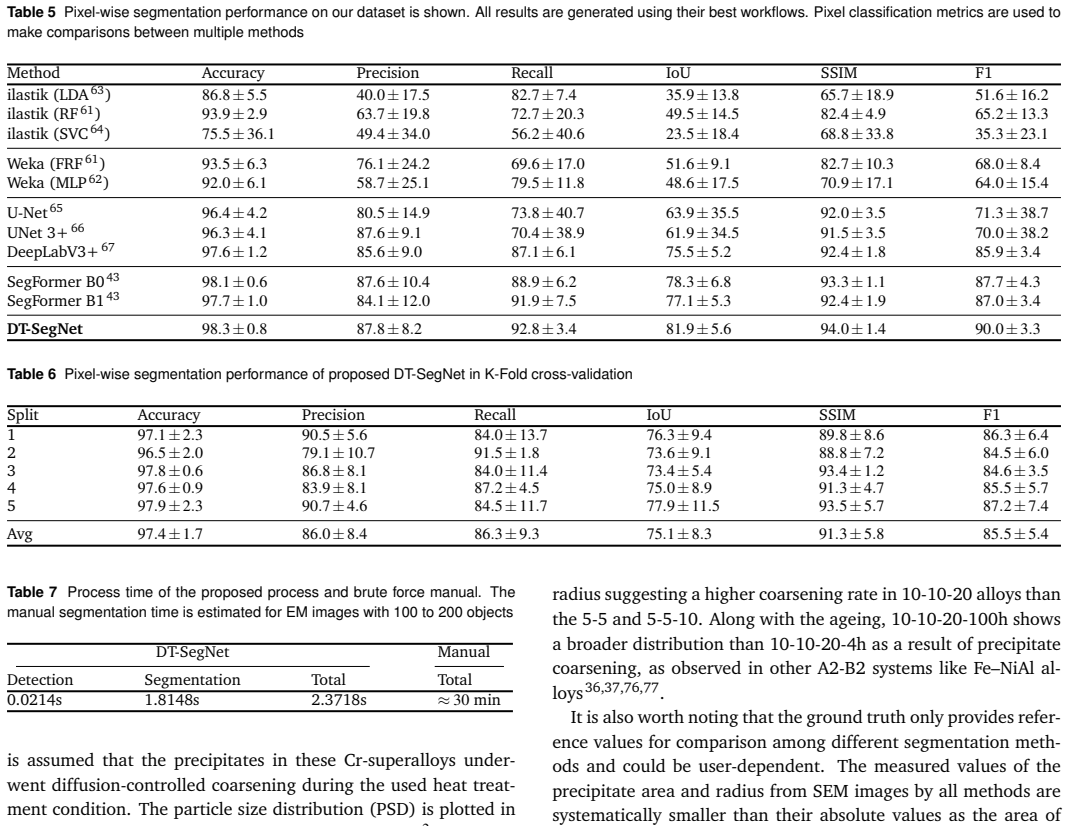
DT-SegNet is an end-to-end two-stage deep learning scheme based on YOLOv5 and SegFormer for object detection and segmentation in electron microscopy images. Numerical experiments show that DT-SegNet substantially outperforms state-of-the-art segmentation tools offered by Weka and ilastik across metrics including accuracy, precision, recall, and F1-score. The model provides a useful tool for alloy-development microstructure examinations and helps address the large datasets associated with high-throughput alloy development.
What carries the argument
DT-SegNet, the two-stage network that applies YOLOv5 for precipitate detection and SegFormer for subsequent segmentation to extract area measurements from electron microscopy images.
Load-bearing premise
The electron microscopy images used for training and testing are representative of the full range of imaging conditions and alloy variants encountered in practice, and the two-stage model requires no substantial per-material manual tuning.
What would settle it
Running DT-SegNet on a fresh collection of electron microscopy images from chromium-based alloys imaged under microscope settings or compositions absent from the training set, and checking whether its accuracy, precision, recall, and F1-score remain higher than those of Weka and ilastik.
Figures

read the original abstract
The performance of advanced materials for extreme environments is underpinned by their microstructure, including the size and distribution of reinforcing phases. Chromium-based superalloys are a recently proposed alternative to conventional face-centred-cubic superalloys for high-temperature applications, such as Concentrated Solar Power, and their development requires efficient measurement of precipitate volume fraction and size distribution from electron microscopy images. Traditional fixed-threshold image processing is sensitive to background noise, generalises poorly across materials, and requires substantial manual measurement effort. To address these bottlenecks, this study proposes DT-SegNet, an end-to-end two-stage deep learning scheme based on YOLOv5 and SegFormer for object detection and segmentation in electron microscopy images. The approach combines the training efficiency of convolutional neural networks at the detection stage with the segmentation accuracy of a Vision Transformer. Numerical experiments show that DT-SegNet substantially outperforms state-of-the-art segmentation tools offered by Weka and ilastik across metrics including accuracy, precision, recall, and F1-score. The model provides a useful tool for alloy-development microstructure examinations and helps address the large datasets associated with high-throughput alloy development.
Editorial analysis
A structured set of objections, weighed in public.
Referee Report
Summary. The manuscript proposes DT-SegNet, a two-stage deep neural network combining YOLOv5 for detection and SegFormer for segmentation, to accurately identify and measure precipitate areas in electron microscopy images of chromium-based alloys. It reports that this model substantially outperforms the segmentation tools in Weka and ilastik on standard metrics including accuracy, precision, recall, and F1-score, positioning it as a tool for high-throughput microstructure analysis in alloy development.
Significance. If the reported performance gains are supported by rigorous validation on representative datasets, the approach could significantly reduce manual effort in quantifying microstructures for novel high-temperature alloys, facilitating faster iteration in materials design for extreme environments. The two-stage architecture leverages the strengths of both convolutional and transformer-based models, which is a sensible choice for handling object detection followed by precise segmentation in noisy EM images.
major comments (2)
- Abstract: the claim that DT-SegNet substantially outperforms Weka and ilastik on accuracy, precision, recall, and F1-score is presented without any information on dataset size, number of images or alloys, train-test splits, cross-validation procedure, or statistical testing. These details are load-bearing for the central empirical claim of general utility in high-throughput alloy development.
- Methods/Results (as implied by the experimental claims): the representativeness of the electron microscopy images across varying imaging conditions and alloy variants is not demonstrated, nor is it shown whether the two-stage pipeline requires substantial per-material manual tuning or retraining. This directly undermines the assertion that the model serves as a general tool without the limitations of traditional methods.
Simulated Author's Rebuttal
We thank the referee for their constructive comments on our manuscript. We have revised the manuscript to address the concerns raised regarding the abstract and the demonstration of generalizability. Below we respond to each major comment.
read point-by-point responses
-
Referee: Abstract: the claim that DT-SegNet substantially outperforms Weka and ilastik on accuracy, precision, recall, and F1-score is presented without any information on dataset size, number of images or alloys, train-test splits, cross-validation procedure, or statistical testing. These details are load-bearing for the central empirical claim of general utility in high-throughput alloy development.
Authors: We agree that the abstract should include these supporting details to make the central empirical claim more robust. We have revised the abstract to incorporate information on the dataset size, number of images and alloys, train-test splits, cross-validation procedure, and statistical testing. The full experimental protocol remains described in the Methods section. revision: yes
-
Referee: Methods/Results (as implied by the experimental claims): the representativeness of the electron microscopy images across varying imaging conditions and alloy variants is not demonstrated, nor is it shown whether the two-stage pipeline requires substantial per-material manual tuning or retraining. This directly undermines the assertion that the model serves as a general tool without the limitations of traditional methods.
Authors: We appreciate the referee highlighting this point. We have revised the Methods and Results sections to include additional discussion and analysis demonstrating the representativeness of the images across varying imaging conditions and alloy variants. We have also clarified that the two-stage pipeline does not require substantial per-material manual tuning or retraining. revision: yes
Circularity Check
No circularity: empirical comparison of segmentation models
full rationale
The paper contains no equations, derivations, fitted parameters, or self-citation chains. Its central claim is an empirical performance comparison of DT-SegNet against Weka and ilastik on standard metrics, which does not reduce to any input by construction. No load-bearing step matches any of the enumerated circularity patterns.
Axiom & Free-Parameter Ledger
axioms (1)
- domain assumption Electron microscopy images of precipitates can be effectively processed by standard object detection and segmentation models without domain-specific modifications beyond training.
Reference graph
Works this paper leans on
-
[1]
1 S. Berg, D. Kutra, T. Kroeger, C. N. Straehle, B. X. Kausler, C. Haubold, M. Schiegg, J. Ales, T. Beier, M. Rudy , K. Eren, J. I. Cervantes, B. Xu, F. Beuttenmueller, A. Wolny , C. Zhang, U. Koethe, F. A. Hamprecht and A. Kreshuk,Nat. Methods, 2019,16, 1226–1232. 2 S. Curtarolo, G. L. W. Hart, M. B. Nardelli, N. Mingo, S. San- vito and O. Levy ,Nat. Mat...
2019
-
[2]
11 X. Lu, W. Quan, S. Gao, G. Zhang, K. Feng, G. Lin and J. X. Chen,IEEE Transactions on Intelligent Transportation Systems, 2022,23, 15922–15939. 12 Q. Zhou, Z. Feng, Q. Gu, J. Pang, G. Cheng, X. Lu, J. Shi and L. Ma,Context-Aware Mixup for Domain Adaptive Seman- tic Segmentation,
2022
-
[3]
13 W. Wang, X. Tan, P. Zhang and X. Wang,IEEE Journal of Se- lected Topics in Applied Earth Observations and Remote Sensing, 2022,15, 6817–6825. 14 S. Cheng, I. C. Prentice, Y. Huang, Y. Jin, Y.-K. Guo and R. Ar- cucci,Journal of Computational Physics, 2022, 111302. 15 S. Cheng, Y. Jin, S. P. Harrison, C. Quilodrán-Casas, I. C. Pren- tice, Y.-K. Guo and R...
2022
-
[4]
16 E. A. Holm, R. Cohn, N. Gao, A. R. Kitahara, T. P. Matson, B. Lei and S. R. Yarasi,Metall. Mater. Trans. A, 2020,51, 5985–5999. 17 B. L. DeCost and E. A. Holm,Comput. Mater. Sci., 2015,110, 126–133. 18 S. M. Azimi, D. Britz, M. Engstler, M. Fritz and F. Mücklich, Sci. Rep., 2018,8,
2020
-
[5]
19 B. L. DeCost, B. Lei, T. Francis and E. A. Holm,Microsc. Mi- croanal., 2019,25, 21–29. 20 B. Ma, X. Ban, H. Huang, Y. Chen, W. Liu and Y. Zhi,Symme- try, 2018,10,
2019
-
[6]
Roberts, S
21 G. Roberts, S. Y. Haile, R. Sainju, D. J. Edwards, B. Hutchinson and Y. Zhu,Sci. Rep., 2019,9, 12744. 22 R. Cohn, I. Anderson, T. Prost, J. Tiarks, E. White and E. Holm,JOM, 2021,73, 2159–2172. 23 P. Liu, H. Huang, X. Jiang, Y. Zhang, T. Omori, T. Lookman and Y. Su,Acta Mater., 2022,235, 118101. 24 Y. Wang, M. Lu, Z. Wang, J. Liu, L. Xu, Z. Qin, Z. Wan...
2019
-
[7]
30 A. M. Ges, O. Fornaro and H. A. Palacio,Mater. Sci. Eng., A, 2007,458, 96–100. 31 S. Zhao, X. Xie, G. D. Smith and S. J. Patel,Mater. Lett., 2004, 58, 1784–1787. 32 S. Meher, S. Nag, J. Tiley , A. Goel and R. Banerjee,Acta Mater., 2013,61, 4266–4276. 33 D. J. Sauza, D. C. Dunand and D. N. Seidman,Acta Mater., 2019,174, 427–438. 34 Ö. Do ˘gan, X. Song, ...
2007
-
[8]
37 Z. Sun, G. Song, J. Ilavsky , G. Ghosh and P. K. Liaw,Sci. Rep., 2015,5, 16081. 38 Ö. Do ˘gan, X. Song, S. Chen and M. Gao,Intermetallics, 2013, 35, 33–40. 39 S.-I. Baik, M. J. S. Rawlings and D. C. Dunand,Acta Mater., 2018,153, 126–135. 40 G. Song, Z. Sun, L. Li, X. Xu, M. Rawlings, C. H. Liebscher, B. Clausen, J. Poplawsky , D. N. Leonard, S. Huang, ...
arXiv 2015
-
[9]
56 Y. Liu, L. Chu, G. Chen, Z. Wu, Z. Chen, B. Lai and Y. Hao, PaddleSeg: A High-Efficient Development Toolkit for Image Seg- mentation, 2021,http://arxiv.org/abs/2101.06175. 57 D. Tzutalin,Labelimg, 2015,https://github.com/ tzutalin/labelImg. 58 T.-Y. Lin, M. Maire, S. Belongie, J. Hays, P. Perona, D. Ra- manan, P. Dollár and C. L. Zitnick, European Conf...
arXiv 2021
-
[10]
Breiman,Machine Learning, 2001,45, 5–32
61 L. Breiman,Machine Learning, 2001,45, 5–32. 62 M. Kubat,The Knowledge Engineering Review, 1999,13, 409–
2001
-
[11]
Hastie, R
63 T. Hastie, R. Tibshirani and J. H. Friedman,The Elements of Statistical Learning: Data Mining, Inference, and Prediction, Springer, 2009, vol
2009
-
[12]
Platt,Advances in large margin classifiers, 1999,10, 61–74
64 J. Platt,Advances in large margin classifiers, 1999,10, 61–74. 65 O. Ronneberger, P. Fischer and T. Brox, Medical Image Com- puting and Computer-Assisted Intervention (MICCAI), Cham, 2015, pp. 234–241. 66 H. Huang, L. Lin, R. Tong, H. Hu, Q. Zhang, Y. Iwamoto, X. Han, Y.-W. Chen and J. Wu, IEEE International Conference on Acoustics, Speech and Signal P...
1999
-
[13]
Wang and A
69 Z. Wang and A. C. Bovik,IEEE Signal Processing Magazine, 2009,26, 98–117. 70 W. Luo, Y. Li, R. Urtasun and R. Zemel, Advances in Neural Information Processing Systems (NIPS),
2009
-
[14]
71 R. B. Schwarz and R. Labusch,J. Appl. Phys. (Melville, NY, U. S.), 1978,49, 5174–5187. 72 B. Reppich,Acta Mater., 1998,46, 61–67. 73 L. M. Brown and W. M. Stobbs,Philos. Mag. (1798-1977), 1971,23, 1201–1233. 74 E. Nembach,Scr. Metall., 1984,18, 105–110. 75 U. F. Kocks,Mater. Sci. Eng., 1977,27, 291–298. 76 N. Cayetano-Castro, M. L. Saucedo-Muñoz, H. J....
1978
discussion (0)
Sign in with ORCID, Apple, or X to comment. Anyone can read and Pith papers without signing in.