On the assessment of the disk truncation and detection of type-II bursts from the accreting millisecond X-ray Pulsar IGR J17062-6143
Pith reviewed 2026-06-26 07:45 UTC · model grok-4.3
The pith
Relativistic reflection models place the inner edge of the accretion disk in IGR J17062-6143 at 7-17 gravitational radii from the neutron star at low inclination.
A machine-rendered reading of the paper's core claim, the machinery that carries it, and where it could break.
Core claim
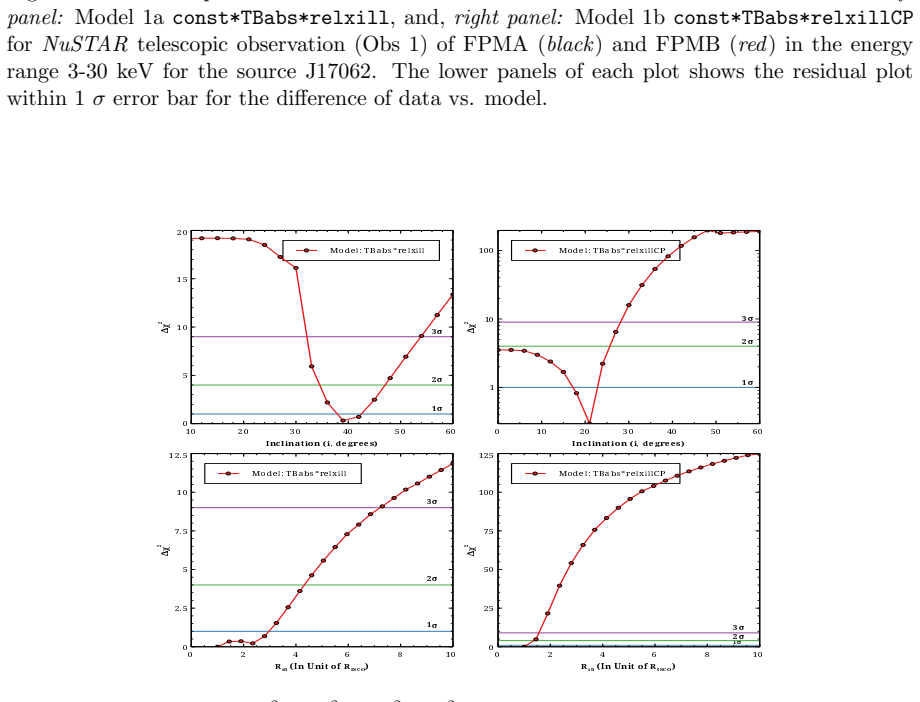
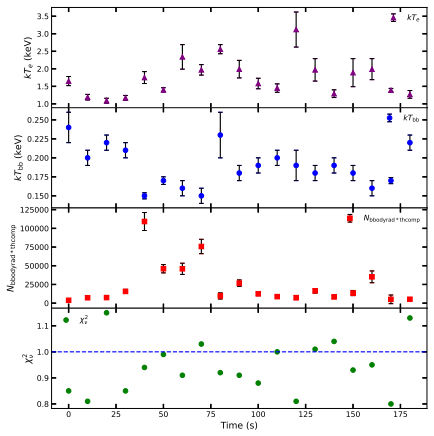
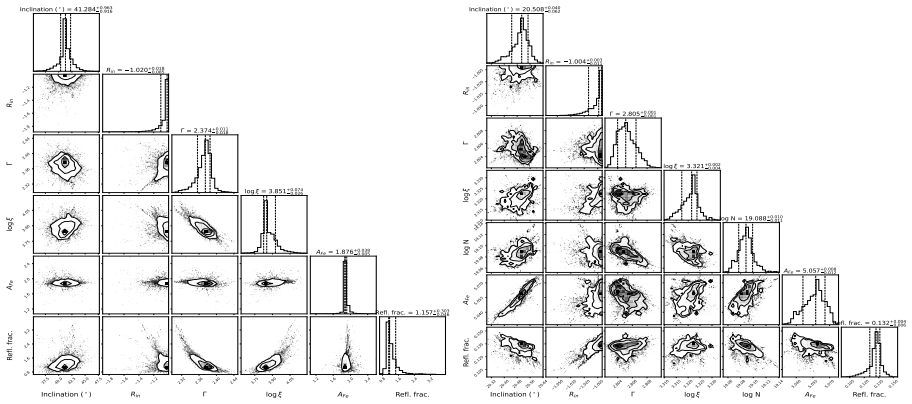
The spectral analysis reveals that the accretion disk extends close to the neutron star surface at approximately 7-17 R_g with an inclination of 20-40 degrees, as determined by fitting the NuSTAR spectrum with the relativistic reflection models relxill and relxillCP. The continuum is modeled as a power law or Comptonized disk photons by plasma with electron temperature above 100 keV. Type-II bursts are detected for the first time in the NICER observation, showing varying light-curve patterns and spectra well described by an absorbed Comptonization component acting on diskbb and blackbody photons with a corona temperature of 1-3 keV, consistent with magnetospheric gating of the accretion flow
What carries the argument
Self-consistent relativistic reflection models relxill and relxillCP that simultaneously fit the broad Fe K line, Compton hump, and continuum to derive inner disk radius and system inclination.
If this is right
- The magnetospheric radius remains smaller than 17 R_g even at luminosities down to 0.2 percent Eddington, implying limited truncation by the neutron star magnetic field.
- The derived low inclination constrains the viewing geometry and affects estimates of intrinsic luminosities and accretion rates.
- Type-II bursts occur in this accreting millisecond pulsar and are linked to magnetospheric gating, with distinct mode-0 and mode-1 light-curve patterns.
- Both persistent and burst emission are described by Comptonization, differing only in the seed photon distributions from the disk and blackbody components.
Where Pith is reading between the lines
- Similar reflection modeling applied to other accreting pulsars at comparable luminosities could test whether inner disks commonly reach close to the neutron star surface in the hard state.
- Confirmation of small inner radii would require revisions to models that assume strong magnetic truncation at low accretion rates for millisecond pulsars.
- The NICER detection of type-II bursts suggests that sensitive soft X-ray timing can reveal such events in additional sources, allowing studies of recurrence times and gating physics.
Load-bearing premise
The relativistic reflection models relxill and relxillCP provide an unbiased description of the spectrum such that the inferred inner radius and inclination do not depend strongly on the choice of continuum model or missing spectral components.
What would settle it
Re-analysis of the NuSTAR spectrum with an alternative continuum model or added components that yields a statistically acceptable fit only when the inner disk radius exceeds 20 R_g or the inclination exceeds 40 degrees would falsify the central claim.
Figures
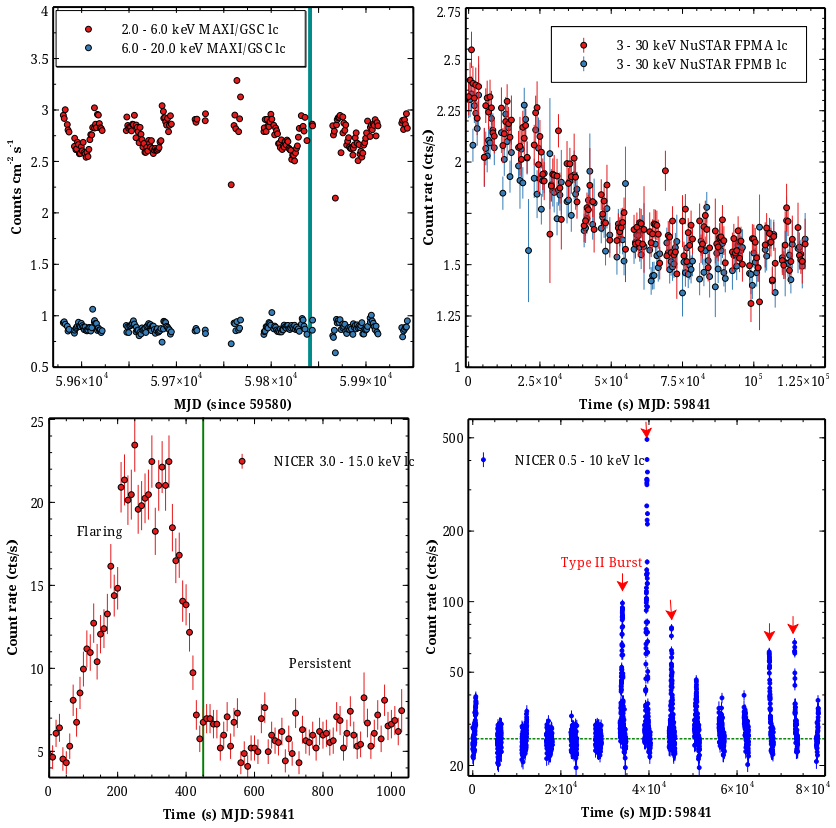
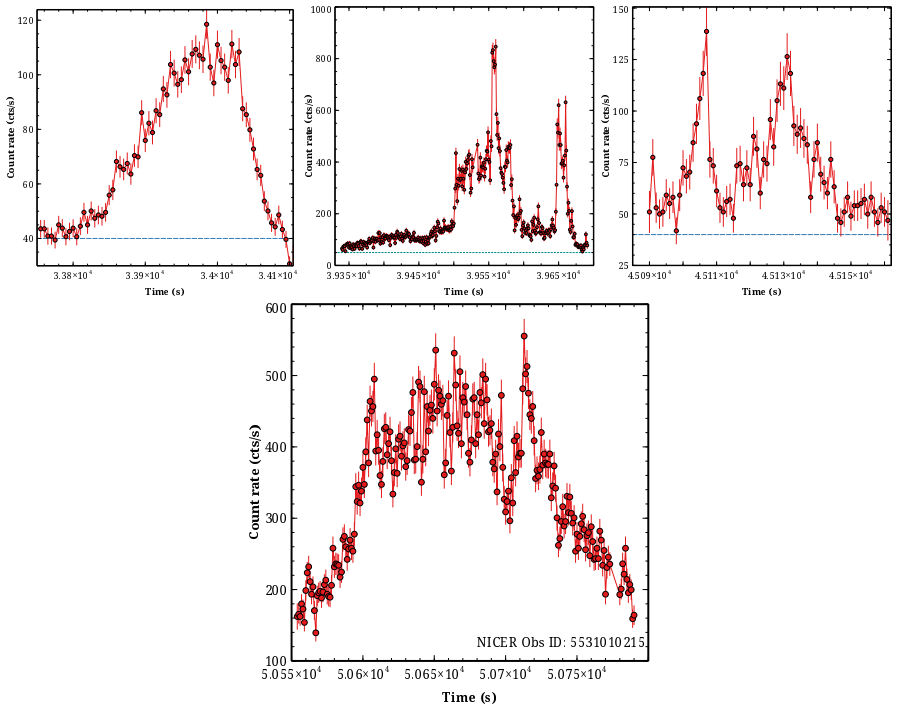
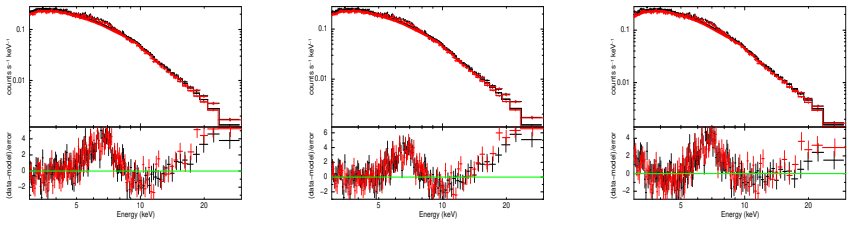
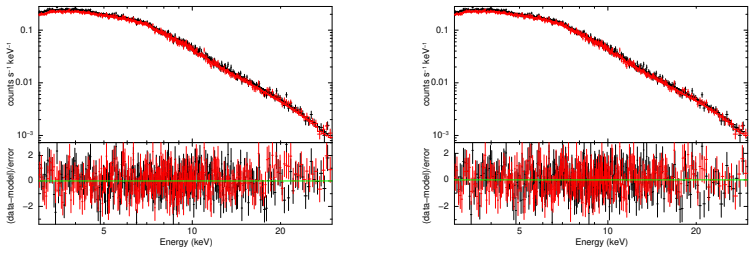
read the original abstract
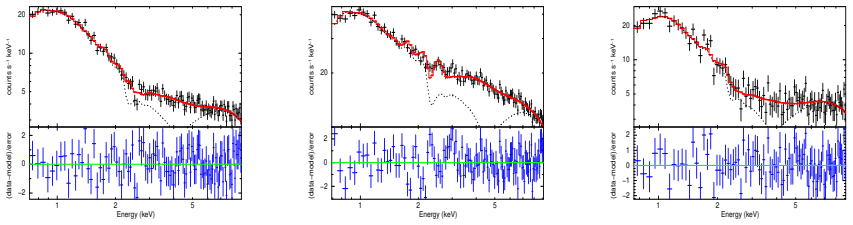
We present a spectral analysis of the NuSTAR and NICER observations of the accreting millisecond X-ray pulsar IGR J17062-6143, performed in 2022. The source remained in the hard spectral state during the observations, with a luminosity of about 0.2-1.3$\%$ of the Eddington luminosity. The continuum emission of the NuSTAR spectrum is entirely dominated by a power-law component or by Comptonized emission of disk photons by a plasma with a high electron temperature ($\gtrsim100$ keV). The NuSTAR spectrum also reveals clear evidence of disk reflection, a broad Fe K line around 6-8 keV, and a Compton hump peaking at 20 keV, irrespective of the choice of the continuum models. Our spectral studies suggest a disk extending close to the neutron star surface ($\sim$7-17 $R_{\rm g}$) at low inclination angles ($\sim$20$^\circ$-40$^\circ$), as revealed by a couple of self-consistent relativistic reflection models, relxill and relxillCP. In addition, we detected type-II bursts for the first time in the NICER observation of this source. Light curve profiles of type-II bursts exhibit different patterns, mostly associated with the so-called mode-0 and mode-1 type-II bursts. The energy spectra of the persistent (pre-burst) and burst emission are well described by an absorbed Comptonization component, scattering diskbb- and blackbody-distributed photons, respectively, by a corona with a temperature of 1-3 keV. Although the origin of the type-II burst is not very clear, it has been substantially linked to magnetospheric gating of the accretion flow.
Editorial analysis
A structured set of objections, weighed in public.
Referee Report
Summary. The manuscript reports spectral analysis of 2022 NuSTAR and NICER observations of the accreting millisecond X-ray pulsar IGR J17062-6143 while in the hard state at 0.2–1.3% Eddington luminosity. The NuSTAR spectrum shows a power-law or high-temperature Comptonized continuum plus clear disk reflection (broad Fe K line and Compton hump). Fits with the relativistic reflection models relxill and relxillCP yield an inner-disk radius of ~7–17 R_g at low inclination (~20°–40°), stated to hold irrespective of continuum choice. The NICER data additionally reveal type-II bursts (mode-0 and mode-1 profiles) whose persistent and burst spectra are modeled as Comptonization of diskbb and blackbody seed photons, respectively; the bursts are linked to possible magnetospheric gating.
Significance. If the reported inner radius and inclination are shown to be insensitive to plausible continuum variations and unmodeled components, the work supplies useful constraints on disk truncation in the hard state of an AMXP at low accretion rate. The type-II burst detection expands the observational sample and its connection to magnetospheric effects. The application of self-consistent reflection models is appropriate for the observed features.
major comments (2)
- [Spectral analysis / Results] Spectral fitting section: The central claim that the inner radius (~7–17 R_g) and inclination (~20°–40°) are robust “irrespective of the choice of the continuum models” is load-bearing for the main result. The manuscript must demonstrate this by presenting explicit fits (with χ^{2}/dof, parameter errors, and reflection fraction) for at least two additional continuum variants—e.g., varying Comptonization optical depth or seed-photon temperature, or adding an unmodeled diskbb component—because modest changes in the hard-state continuum can trade off against reflection parameters and shift R_in.
- [Results / Reflection modeling] Table of best-fit parameters (reflection modeling subsection): No quantitative comparison is provided between the two reflection models (relxill vs. relxillCP) for the same continuum; the reported radius range (7–17 R_g) therefore lacks an explicit statement of whether the values are statistically consistent or whether one model systematically returns a larger truncation radius.
minor comments (2)
- [Abstract] Abstract: Fit statistics (χ^{2}, null-hypothesis probability) and 1σ uncertainties on R_in and inclination are omitted, making it impossible for a reader to judge the precision of the quoted 7–17 R_g range from the summary alone.
- [Introduction] Notation: The symbol R_g is used without an explicit definition (GM/c^{2}) on first appearance; this should be added in the introduction or methods.
Simulated Author's Rebuttal
We thank the referee for the constructive review and for highlighting areas where the robustness of our results can be more clearly demonstrated. We address each major comment below and will revise the manuscript accordingly.
read point-by-point responses
-
Referee: [Spectral analysis / Results] Spectral fitting section: The central claim that the inner radius (~7–17 R_g) and inclination (~20°–40°) are robust “irrespective of the choice of the continuum models” is load-bearing for the main result. The manuscript must demonstrate this by presenting explicit fits (with χ²/dof, parameter errors, and reflection fraction) for at least two additional continuum variants—e.g., varying Comptonization optical depth or seed-photon temperature, or adding an unmodeled diskbb component—because modest changes in the hard-state continuum can trade off against reflection parameters and shift R_in.
Authors: We agree that the robustness claim requires explicit demonstration via additional fits. In the revised manuscript we will add fits for at least two further continuum variants (varying Comptonization optical depth/seed-photon temperature and testing an added diskbb component). Each will report χ²/dof, parameter errors, and reflection fraction so that the stability of R_in and inclination can be directly assessed. revision: yes
-
Referee: [Results / Reflection modeling] Table of best-fit parameters (reflection modeling subsection): No quantitative comparison is provided between the two reflection models (relxill vs. relxillCP) for the same continuum; the reported radius range (7–17 R_g) therefore lacks an explicit statement of whether the values are statistically consistent or whether one model systematically returns a larger truncation radius.
Authors: We acknowledge that an explicit quantitative comparison between relxill and relxillCP on identical continua was not provided. In the revision we will add a direct side-by-side comparison of the best-fit parameters (including R_in values with uncertainties) and a statement on their statistical consistency and any systematic trends. revision: yes
Circularity Check
No circularity: results from external model fits to data
full rationale
The paper reports spectral fits of NuSTAR/NICER data to the external public models relxill and relxillCP (plus standard Comptonization and blackbody components) to obtain inner-disk radius and inclination, plus direct detection of type-II bursts in the light curve. These outputs are not algebraically or statistically forced by any quantity defined inside the paper; the models pre-exist the present work and are applied to independent observations. No self-citation, ansatz, or renaming step is load-bearing for the central claims. The derivation chain is therefore self-contained against external benchmarks.
Axiom & Free-Parameter Ledger
free parameters (2)
- inner disk radius =
7-17 R_g
- inclination =
20-40 degrees
axioms (2)
- domain assumption relxill and relxillCP models correctly capture relativistic reflection physics for this source and luminosity range.
- domain assumption Observed flares are type-II bursts produced by magnetospheric gating.
Reference graph
Works this paper leans on
-
[1]
Handbook of X-ray and Gamma-ray Astrophysics , year = 2023, publisher=
Bahramian, Arash and Degenaar, Nathalie. Low-Mass X-ray Binaries. 2022. doi:10.1007/978-981-16-4544-0_94-1. arXiv:2206.10053
-
[2]
Accretion Disks - New Aspects , year = 1997, editor =
X-ray spectrum of low-mass X-ray binaries. Accretion Disks - New Aspects , year = 1997, editor =. doi:10.1007/BFb0105817 , adsurl =
-
[3]
Research in Astronomy and Astrophysics , volume=
Formation of accreting millisecond X-ray pulsars , author=. Research in Astronomy and Astrophysics , volume=. 2019 , publisher=
2019
-
[4]
van den Eijnden, J. and Bagnoli, T. and Degenaar, N. and Lohfink, A. M. and Parker, M. L. and in ‘t Zand, J. J. M and Fabian, A. C. , title =. Monthly Notices of the Royal Astronomical Society: Letters , volume =. 2016 , month =. doi:10.1093/mnrasl/slw244 , url =
-
[5]
The MAXI Mission on the ISS: Science and Instruments for Monitoring All Sky X-Ray Images
The MAXI Mission on the ISS: Science and Instruments for Monitoring All-Sky X-Ray Images. , keywords =. doi:10.1093/pasj/61.5.999 , archivePrefix =. 0906.0631 , primaryClass =
work page internal anchor Pith review Pith/arXiv arXiv doi:10.1093/pasj/61.5.999
-
[6]
IGR J17062-6143 is an Accreting Millisecond X-ray Pulsar
IGR J17062-6143 Is an Accreting Millisecond X-Ray Pulsar. , keywords =. doi:10.3847/2041-8213/aa5e51 , archivePrefix =. 1702.05449 , primaryClass =
work page internal anchor Pith review Pith/arXiv arXiv doi:10.3847/2041-8213/aa5e51 2041
-
[7]
INTEGRAL observations of the cosmic X-ray background in the 5-100 keV range via occultation by the Earth. , keywords =. doi:10.1051/0004-6361:20066230 , archivePrefix =. astro-ph/0608250 , primaryClass =
work page internal anchor Pith review Pith/arXiv arXiv doi:10.1051/0004-6361:20066230
-
[8]
The very-faint X-ray binary IGR J17062-6143: a truncated disk, no pulsations and a possible outflow
van den Eijnden, J. and others. The very faint X-ray binary IGR J17062-6143: a truncated disc, no pulsations, and a possible outflow. Mon. Not. Roy. Astron. Soc. 2018. doi:10.1093/mnras/stx3224. arXiv:1712.03949
work page internal anchor Pith review Pith/arXiv arXiv doi:10.1093/mnras/stx3224 2018
-
[9]
and Pinto, C
Degenaar, N. and Pinto, C. and Miller, J. M. and Wijnands, R. and Altamirano, D. and Paerels, F. and Fabian, A. C. and Chakrabarty, D. , title =. Monthly Notices of the Royal Astronomical Society , volume =
-
[10]
Normalizing a relativistic model of X-ray reflection - Definition of the reflection fraction and its implementation in relxill , DOI= "10.1051/0004-6361/201628135", url= "https://doi.org/10.1051/0004-6361/201628135", journal =
-
[11]
The Astrophysical Journal , volume=
The nuclear spectroscopic telescope array (NuSTAR) high-energy X-ray mission , author=. The Astrophysical Journal , volume=. 2013 , publisher=
2013
-
[12]
Space Telescopes and Instrumentation 2016: Ultraviolet to Gamma Ray , year = 2016, editor =
The Neutron star Interior Composition Explorer (NICER): design and development. Space Telescopes and Instrumentation 2016: Ultraviolet to Gamma Ray , year = 2016, editor =. doi:10.1117/12.2231304 , adsurl =
-
[13]
HE-UHE Behaviour of Accreting X-ray Sources , year = 1987, editor =
Basic physics of accretion onto compact objects. HE-UHE Behaviour of Accreting X-ray Sources , year = 1987, editor =
1987
-
[14]
Timing Neutron Stars: Pulsations, Oscillations and Explosions , year = 2021, editor =
Accreting Millisecond X-ray Pulsars. Timing Neutron Stars: Pulsations, Oscillations and Explosions , year = 2021, editor =. doi:10.1007/978-3-662-62110-3_4 , archivePrefix =. 1206.2727 , primaryClass =
-
[15]
2020 , eprint=
Accretion powered X-ray millisecond pulsars , author=. 2020 , eprint=
2020
-
[16]
The Astrophysical Journal , volume=
The spin parameter of uniformly rotating compact stars , author=. The Astrophysical Journal , volume=. 2011 , publisher=
2011
-
[17]
Monthly Notices of the Royal Astronomical Society , volume =
Mukherjee, Dipanjan and Bult, Peter and van der Klis, Michiel and Bhattacharya, Dipankar , title =. Monthly Notices of the Royal Astronomical Society , volume =. 2015 , month =. doi:10.1093/mnras/stv1542 , url =
-
[18]
Statistical properties of type-II bursts in Rapid Burster observed with Insight-HXMT
Statistical properties of type-II bursts in Rapid Burster observed with Insight-HXMT. arXiv e-prints , keywords =. doi:10.48550/arXiv.2606.02190 , archivePrefix =. 2606.02190 , primaryClass =
work page internal anchor Pith review Pith/arXiv arXiv doi:10.48550/arxiv.2606.02190
-
[19]
The Astrophysical Journal Supplement Series , volume=
Thermonuclear (Type I) X-ray bursts observed by the Rossi X-ray timing explorer , author=. The Astrophysical Journal Supplement Series , volume=. 2008 , publisher=
2008
-
[20]
X-Ray Emission and Absorption Features during an Energetic Thermonuclear X-Ray Burst from IGR J17062-6143. , keywords =. doi:10.1088/2041-8205/767/2/L37 , archivePrefix =. 1212.4869 , primaryClass =
work page internal anchor Pith review Pith/arXiv arXiv doi:10.1088/2041-8205/767/2/l37 2041
-
[21]
Astronomical Data Analysis Software and Systems V , year = 1996, editor =
XSPEC: The First Ten Years. Astronomical Data Analysis Software and Systems V , year = 1996, editor =
1996
-
[22]
First Detection of an X-Ray Burst and a One-Hour Intensity Dip in 4U1323-62. , keywords =. doi:10.1007/BF00212900 , adsurl =
-
[23]
H I in the galaxy. , keywords =. doi:10.1146/annurev.aa.28.090190.001243 , adsurl =
-
[24]
Broad-band -ray and X-ray spectra of NGC 4151 and their implications for physical processes and geometry. , keywords =. doi:10.1093/mnras/283.1.193 , archivePrefix =. astro-ph/9607015 , primaryClass =
work page internal anchor Pith review Pith/arXiv arXiv doi:10.1093/mnras/283.1.193
-
[25]
and Done, Chris and Smith, David A
Życki, Piotr T. and Done, Chris and Smith, David A. , title =. Monthly Notices of the Royal Astronomical Society , volume =. 1999 , month =
1999
-
[26]
Improved spectral models for relativistic reflection
Improved spectral models for relativistic reflection. , keywords =. doi:10.1093/mnras/stz487 , archivePrefix =. 1805.06065 , primaryClass =
work page internal anchor Pith review Pith/arXiv arXiv doi:10.1093/mnras/stz487
-
[27]
Spectral and temporal properties of Compton scattering by mildly relativistic thermal electrons. , keywords =. doi:10.1093/mnras/staa159 , archivePrefix =. 1910.04535 , primaryClass =
-
[28]
The Astronomical Journal , volume=
An empirical background model for the NICER X-ray timing instrument , author=. The Astronomical Journal , volume=. 2022 , publisher=
2022
-
[29]
Astronomy & Astrophysics , volume=
The transient hard X-ray tail of GX 17+ 2: New BeppoSAX results , author=. Astronomy & Astrophysics , volume=. 2005 , publisher=
2005
-
[30]
Physica Scripta , volume=
Unification of spectral states of accreting black holes , author=. Physica Scripta , volume=
-
[31]
Publications of the Astronomical Society of the Pacific , volume=
emcee: the MCMC hammer , author=. Publications of the Astronomical Society of the Pacific , volume=. 2013 , publisher=
2013
-
[32]
, year = 1975, month = feb, volume =
Why the Number of Galactic X-ray Stars Is so Small?. , year = 1975, month = feb, volume =
1975
-
[33]
Journal of High Energy Astrophysics , pages=
NuSTAR discovers a long type-I X-ray burst from the clocked burster GS 1826-24 , author=. Journal of High Energy Astrophysics , pages=. 2025 , publisher=
2025
-
[34]
Spectra of the spreading layers on the neutron star surface and constraints on the neutron star equation of state. , keywords =. doi:10.1111/j.1365-2966.2006.10454.x , archivePrefix =. astro-ph/0601689 , primaryClass =
-
[35]
Timing Neutron Stars: Pulsations, Oscillations and Explosions , pages=
Thermonuclear X-ray bursts , author=. Timing Neutron Stars: Pulsations, Oscillations and Explosions , pages=. 2020 , publisher=
2020
-
[36]
II-Radial and vertical structure of the transition zone in disk accretion , author=
Accretion by rotating magnetic neutron stars. II-Radial and vertical structure of the transition zone in disk accretion , author=. Astrophysical Journal, Part 1, vol. 232, Aug. 15, 1979, p. 259-276. , volume=
1979
-
[37]
III-Accretion torques and period changes in pulsating X-ray sources , author=
Accretion by rotating magnetic neutron stars. III-Accretion torques and period changes in pulsating X-ray sources , author=. Astrophysical Journal, Part 1, vol. 234, Nov. 15, 1979, p. 296-316. , volume=
1979
-
[38]
, author=
ACCRETION BY ROTATING MAGNETIC NEUTRON STARS. , author=. 1978 , publisher=
1978
-
[39]
Observational appearance
Black holes in binary systems. Observational appearance. , author=. Astronomy and Astrophysics, Vol. 24, p. 337-355 , volume=
-
[40]
Chen, Y. P. and Zhang, S. and Zhang, S. N. and Ji, L. and Kong, L. D. and Wang, P. J. and Tao, L. and Ge, M. Y. and Liu, C. Z. and Lu, F. J. and Qu, J. L. and Li, T. P. and Xu, Y. P. and Cao, X. L. and Chen, Y. and Bu, Q. C. and Cai, C. and Chang, Z. and Chen, L. and Chen, T. X. and Chen, Y. B. and Cui, W. W. and Du, Y. Y. and Gao, G. H. and Gao, H. and G...
-
[41]
Astrophysical Journal, vol
On the infall of matter into clusters of galaxies and some effects on their evolution , author=. Astrophysical Journal, vol. 176, p. 1 , volume=
-
[42]
A model for compact X-ray sources: accretion by rotating magnetic stars , author=
-
[43]
I-Flow of matter inside the magnetosphere and its implications for spin-up and spin-down of the star , author=
Accretion by rotating magnetic neutron stars. I-Flow of matter inside the magnetosphere and its implications for spin-up and spin-down of the star , author=. Astrophysical Journal, Part 1, vol. 217, Oct. 15, 1977, p. 578-596. , volume=
1977
-
[44]
Astronomy & Astrophysics , volume=
Magnetically driven outflows from Jovian circum-planetary accretion disks , author=. Astronomy & Astrophysics , volume=. 2003 , publisher=
2003
-
[45]
Monthly Notices of the Royal Astronomical Society , volume =
Mönkkönen, Juhani and Tsygankov, Sergey S and Mushtukov, Alexander A and Doroshenko, Victor and Suleimanov, Valery F and Poutanen, Juri , title =. Monthly Notices of the Royal Astronomical Society , volume =. 2022 , month =. doi:10.1093/mnras/stac1828 , url =
-
[46]
Monthly Notices of the Royal Astronomical Society , volume =
Zhu, Zhaohuan , title =. Monthly Notices of the Royal Astronomical Society , volume =. 2025 , month =. doi:10.1093/mnras/staf250 , url =
-
[47]
Low-Magnetic-Field Neutron Stars in X-ray Binaries
Salvo, Tiziana Di and Papitto, Alessandro and Marino, Alessio and Iaria, Rosario and Burderi, Luciano. Low-Magnetic-Field Neutron Stars in X-ray Binaries. Handbook of X-ray and Gamma-ray Astrophysics. 2024. doi:10.1007/978-981-19-6960-7_103
-
[48]
The Astrophysical Journal , volume=
X-Ray Reflection and an Exceptionally Long Thermonuclear Helium Burst from IGR J17062-6143 , author=. The Astrophysical Journal , volume=. 2017 , publisher=
2017
-
[49]
Bagnoli, T. and in 't Zand, J. J. M. and D'Angelo, C. R. and Galloway, D. K. , title =. Monthly Notices of the Royal Astronomical Society , volume =. 2015 , month =. doi:10.1093/mnras/stv330 , url =
-
[50]
Astrophysical Journal, Part 1 (ISSN 0004-637X), vol
An interpretation of X-ray spectra of type II bursts from the'rapid burster'-Comptonization due to accretion flow , author=. Astrophysical Journal, Part 1 (ISSN 0004-637X), vol. 355, June 1, 1990, p. 577-584. , volume=
1990
-
[51]
Note on regression and inheritance in the case of two parents , author=
VII. Note on regression and inheritance in the case of two parents , author=. proceedings of the royal society of London , volume=. 1895 , publisher=
-
[52]
Biometrika , pages=
The probable error of a mean , author=. Biometrika , pages=. 1908 , publisher=
1908
-
[53]
Counting for Something: Statistical Principles and Personalities , pages=
Pearson to Gosset to Fisher , author=. Counting for Something: Statistical Principles and Personalities , pages=. 1987 , publisher=
1987
-
[54]
Accreting millisecond pulsar SAX J1808.4-3658 during its 2002 outburst: evidence for a receding disc. , keywords =. doi:10.1111/j.1365-2966.2009.15477.x , archivePrefix =. 0901.0073 , primaryClass =
-
[55]
Relativistic Lines and Reflection from the Inner Accretion Disks Around Neutron Stars
Relativistic Lines and Reflection from the Inner Accretion Disks Around Neutron Stars. , keywords =. doi:10.1088/0004-637X/720/1/205 , archivePrefix =. 0908.1098 , primaryClass =
work page internal anchor Pith review Pith/arXiv arXiv doi:10.1088/0004-637x/720/1/205
-
[56]
Effects of Rapid Stellar Rotation on Equation-of-State Constraints Derived from Quasi-periodic Brightness Oscillations. , keywords =. doi:10.1086/306533 , archivePrefix =. astro-ph/9805007 , primaryClass =
work page internal anchor Pith review Pith/arXiv arXiv doi:10.1086/306533
-
[57]
2002 , publisher=
Accretion Power in Astrophysics , author=. 2002 , publisher=
2002
-
[58]
1983 , publisher=
Black Holes, White Dwarfs, and Neutron Stars: The Physics of Compact Objects , author=. 1983 , publisher=
1983
-
[59]
Publications of the Astronomical Society of Japan , volume=
New Results from ASCA on the Type II Bursts of the Rapid Burster (MXB 1730 335) , author=. Publications of the Astronomical Society of Japan , volume=. 2003 , publisher=
2003
-
[60]
Monthly Notices of the Royal Astronomical Society , volume=
The evolution of viscous discs and the origin of the nebular variables , author=. Monthly Notices of the Royal Astronomical Society , volume=. 1974 , publisher=
1974
-
[61]
Roche,. M. 1849 , publisher=
-
[62]
Dynamics of Close Binary Systems , pages=
The Roche Model , author=. Dynamics of Close Binary Systems , pages=. 1989 , publisher=
1989
-
[63]
, keywords =
Accretion by neutron stars - Accretion disk and rotating magnetic field. , keywords =
-
[64]
Observational appearance
Black holes in binary systems. Observational appearance. , year = 1973, month = jan, volume =
1973
-
[65]
Astronomy and Astrophysics, Vol
Accretion disc models for compact X-ray sources , author=. Astronomy and Astrophysics, Vol. 21, p. 1 (1972) , volume=
1972
-
[66]
Astrophysical Journal, Part 2-Letters to the Editor, vol
Disk accretion by magnetic neutron stars , author=. Astrophysical Journal, Part 2-Letters to the Editor, vol. 223, July 15, 1978, p. L83-L87. , volume=
1978
-
[67]
Neutron Star Dynamos and the Origins of Pulsar Magnetism. , keywords =. doi:10.1086/172580 , adsurl =
-
[68]
Astrophysical Journal, vol
The discovery of X-ray bursts from a region in the constellation Norma , author=. Astrophysical Journal, vol. 206, June 15, 1976, pt. 2, p. L135-L138. DOD-ERDA-sponsored research. , volume=
1976
-
[69]
X-Ray Bursts , journal =. 1993 , volume =. doi:10.1007/BF00196124 , adsurl =
-
[70]
The Astrophysical Journal , volume=
A Comprehensive Study of Thermonuclear X-Ray Bursts from 4U 1820--30 with NICER: Accretion Disk Interactions and a Candidate Burst Oscillation , author=. The Astrophysical Journal , volume=. 2024 , publisher=
2024
-
[71]
Strohmayer, T. E. and Arzoumanian, Z. and Bogdanov, S. and Bult, P. M. and Chakrabarty, D. and Enoto, T. and Gendreau, K. C. and Guillot, S. and Harding, A. K. and Ho, W. C. G. and Homan, J. and Jaisawal, G. K. and Keek, L. and Kerr, M. and Mahmoodifar, S. and Markwardt, C. B. and Ransom, S. M. and Ray, P. S. and Remillard, R. and Wolff, M. T. , title =. ...
-
[72]
2021, , 920, 59, 10.3847/1538-4357/ac18c4
Bult, Peter and Altamirano, Diego and Arzoumanian, Zaven and Ballantyne, David R. and Chenevez, Jerome and Fabian, Andrew C. and Gendreau, Keith C. and Homan, Jeroen and Jaisawal, Gaurava K. and Malacaria, Christian and Miller, Jon M. and Parker, Michael L. and Strohmayer, Tod E. , title =. The Astrophysical Journal , abstract =. 2021 , month =. doi:10.38...
-
[73]
Nature , volume=
A new type of transient high-energy source in the direction of the Galactic Centre , author=. Nature , volume=. 1996 , publisher=
1996
-
[74]
Astrophysical Journal, vol
The discovery of rapidly repetitive X-ray bursts from a new source in Scorpius , author=. Astrophysical Journal, vol. 207, July 15, 1976, pt. 2, p. L95-L99. , volume=
1976
-
[75]
Jiang, Yan-Fei and Stone, James M. and Davis, Shane W. , title =. The Astrophysical Journal , abstract =. 2014 , month =. doi:10.1088/0004-637X/796/2/106 , url =
-
[76]
title An XMM-Newton spectral survey of 12 m selected galaxies - I
D’Angelo, Caroline R. and Spruit, Hendrik C. , title =. Monthly Notices of the Royal Astronomical Society , volume =. 2012 , month =. doi:10.1111/j.1365-2966.2011.20046.x , url =
-
[77]
, year = 1974, month = jan, volume =
Black Holes in Binary Systems: Instability of Disk Accretion. , year = 1974, month = jan, volume =. doi:10.1086/181377 , adsurl =
-
[78]
A theory of the instability of disk accretion on to black holes and the variability of binary X-ray sources, galactic nuclei and quasars. , keywords =. doi:10.1093/mnras/175.3.613 , adsurl =
discussion (0)
Sign in with ORCID, Apple, or X to comment. Anyone can read and Pith papers without signing in.