From Magnetic to Inverse Magnetic Catalysis: The Interplay of Quark and Gluon Mass Generation in Magnetic Fields
Pith reviewed 2026-06-26 10:43 UTC · model grok-4.3
The pith
The increase in gluon screening mass induced by a magnetic field competes with and can dominate quark mass enhancement, producing inverse magnetic catalysis near the chiral phase transition.
A machine-rendered reading of the paper's core claim, the machinery that carries it, and where it could break.
Core claim
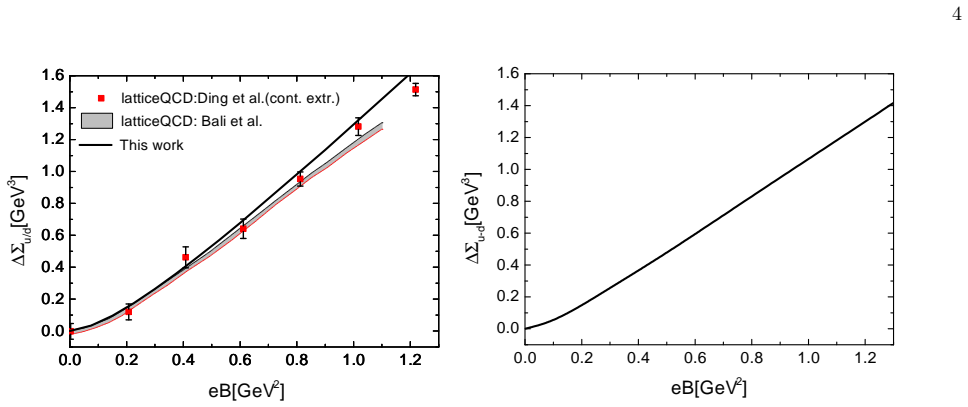
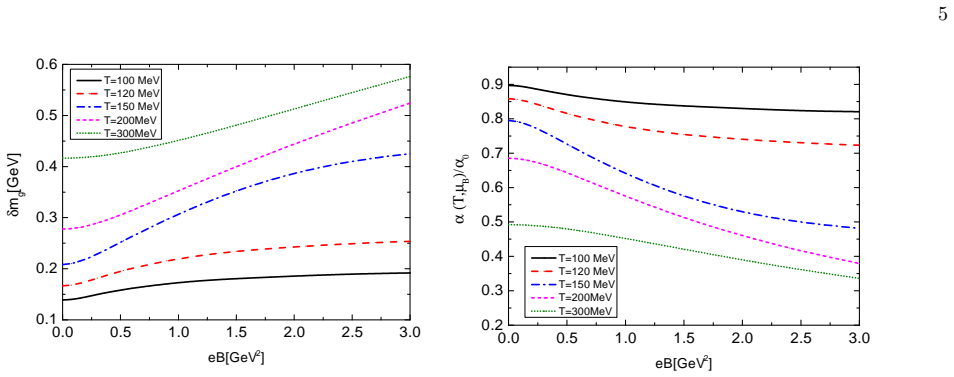
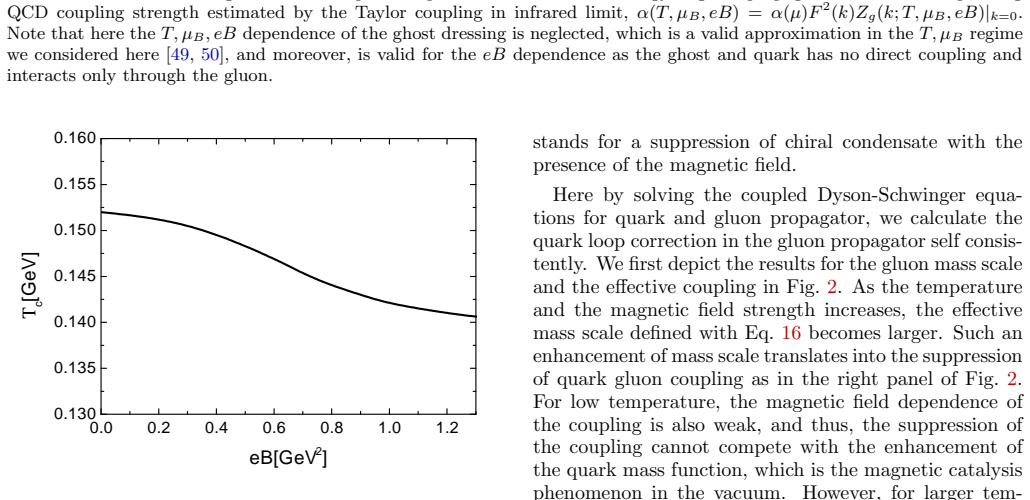
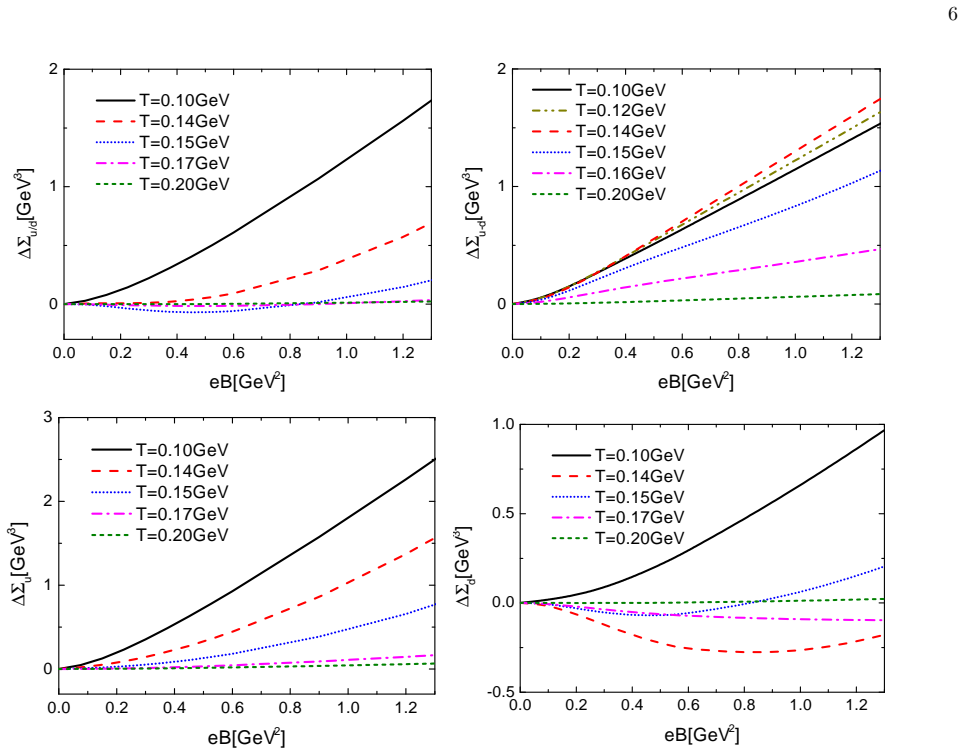
By solving the coupled Dyson-Schwinger equations for the quark and gluon propagators, we find that the quark mass is generally enhanced in the presence of a magnetic field, leading to magnetic catalysis of the chiral condensate. Meanwhile, the magnetic field also induces an increase in the gluon screening mass. The enhancement of the gluon screening mass suppresses the quark-gluon interaction and thereby weakens the strength of dynamical chiral symmetry breaking, establishing a competing mechanism against magnetic catalysis. In particular, this enhancement of the gluon screening mass becomes dominant near the chiral phase transition, which in turn gives rise to inverse magnetic catalysis.
What carries the argument
The coupled Dyson-Schwinger equations for the quark and gluon propagators, which encode the simultaneous generation of quark mass and gluon screening mass and their opposing effects on the chiral condensate in a magnetic field.
If this is right
- Magnetic catalysis of the chiral condensate occurs at lower temperatures while inverse catalysis sets in closer to the transition because the gluon screening mass grows faster there.
- The rise in gluon screening mass directly reduces the strength of the quark-gluon interaction that sustains dynamical chiral symmetry breaking.
- Inverse magnetic catalysis is therefore a consequence of gluon dynamics competing with quark dynamics rather than an isolated quark-sector phenomenon.
- The location of the transition between catalysis and inverse catalysis is set by the relative temperature dependence of the two mass enhancements.
Where Pith is reading between the lines
- The same competition could be tested by extending the equations to finite temperature and density to map the full QCD phase diagram in a magnetic field.
- If the gluon screening mass increase is the dominant driver, then inverse catalysis should weaken or disappear in models where gluons are treated as static backgrounds.
- The mechanism suggests that other external fields capable of raising gluon screening mass might also produce inverse effects on chiral symmetry breaking.
Load-bearing premise
The truncation and numerical solution of the coupled Dyson-Schwinger equations capture the dominant non-perturbative effects of the magnetic field without additional parameters or uncontrolled approximations.
What would settle it
A lattice or functional calculation that finds the gluon screening mass remains unchanged or decreases in a magnetic field near the chiral transition temperature would remove the competing mechanism required for inverse magnetic catalysis.
Figures
read the original abstract
We analyze the effects of the magnetic field on the quark and gluon propagators within the functional QCD framework. By solving the coupled Dyson-Schwinger equations for the quark and gluon propagators, we find that the quark mass is generally enhanced in the presence of a magnetic field, leading to magnetic catalysis of the chiral condensate. Meanwhile, the magnetic field also induces an increase in the gluon screening mass. The enhancement of the gluon screening mass suppresses the quark-gluon interaction and thereby weakens the strength of dynamical chiral symmetry breaking, establishing a competing mechanism against magnetic catalysis. In particular, this enhancement of the gluon screening mass becomes dominant near the chiral phase transition, which in turn gives rise to inverse magnetic catalysis.
Editorial analysis
A structured set of objections, weighed in public.
Referee Report
Summary. The manuscript analyzes the effects of an external magnetic field on the quark and gluon propagators by solving their coupled Dyson-Schwinger equations in the functional QCD framework. It reports that the quark mass function is enhanced (magnetic catalysis of the chiral condensate) while the gluon screening mass also increases; the latter suppresses the quark-gluon interaction strength and, near the chiral phase transition, becomes dominant, thereby producing inverse magnetic catalysis.
Significance. If the reported dominance of the gluon screening-mass enhancement is robust, the work supplies a concrete dynamical mechanism, arising from the interplay of quark and gluon mass generation, that can account for the observed switch from magnetic to inverse magnetic catalysis. This is of direct relevance to the phase structure of QCD in strong magnetic fields, as encountered in heavy-ion collisions and magnetars.
major comments (1)
- The truncation scheme for the gluon Dyson-Schwinger equation (including the treatment of the magnetic field via Landau-level sums, regularization procedure, and the ansatz adopted for the three-gluon vertex) is not specified. Because the central claim—that the gluon screening-mass increase overcomes magnetic catalysis near the transition—depends on this truncation accurately capturing the dominant non-perturbative effects without hidden parameters or uncontrolled approximations, the absence of these details prevents verification that the reported dominance follows from the equations rather than from modeling choices.
Simulated Author's Rebuttal
We thank the referee for the careful reading of our manuscript and for highlighting the need for greater clarity on the truncation. We address the single major comment below.
read point-by-point responses
-
Referee: The truncation scheme for the gluon Dyson-Schwinger equation (including the treatment of the magnetic field via Landau-level sums, regularization procedure, and the ansatz adopted for the three-gluon vertex) is not specified. Because the central claim—that the gluon screening-mass increase overcomes magnetic catalysis near the transition—depends on this truncation accurately capturing the dominant non-perturbative effects without hidden parameters or uncontrolled approximations, the absence of these details prevents verification that the reported dominance follows from the equations rather than from modeling choices.
Authors: We agree that the truncation details were insufficiently specified in the original submission, which is required to substantiate the central claim. In the revised manuscript we will add a dedicated subsection that fully specifies the gluon DSE truncation: the precise Landau-level summation procedure for the magnetic field, the regularization scheme, and the explicit ansatz employed for the three-gluon vertex. These additions will allow readers to confirm that the reported dominance of gluon screening-mass enhancement follows directly from the coupled equations within the stated truncation. revision: yes
Circularity Check
No significant circularity; derivation follows from numerical DSE solutions
full rationale
The paper obtains its central result—the dominance of gluon screening-mass enhancement near the chiral transition producing inverse magnetic catalysis—by numerically solving the coupled Dyson-Schwinger equations for the quark and gluon propagators in an external magnetic field. No step reduces by construction to a fitted parameter, a self-citation chain, or a renamed input; the competing mechanisms are outputs of the self-consistent truncation and solution procedure. The derivation therefore remains independent of the target phenomenology.
Axiom & Free-Parameter Ledger
Reference graph
Works this paper leans on
-
[1]
Rafelski and B
J. Rafelski and B. Muller, Phys. Rev. Lett.36, 517 (1976)
1976
-
[2]
V. Skokov, A. Y. Illarionov, and V. Toneev, Int. J. Mod. Phys. A24, 5925 (2009), arXiv:0907.1396 [nucl-th]
Pith/arXiv arXiv 2009
-
[3]
V. Voronyuk, V. D. Toneev, W. Cassing, E. L. Bratkovskaya, V. P. Konchakovski, and S. A. Voloshin, Phys. Rev. C83, 054911 (2011), arXiv:1103.4239 [nucl- th]
Pith/arXiv arXiv 2011
-
[4]
V. P. Gusynin, V. A. Miransky, and I. A. Shovkovy, Nucl. Phys. B563, 361 (1999), arXiv:hep-ph/9908320
Pith/arXiv arXiv 1999
-
[5]
C. N. Leung and S.-Y. Wang, Annals Phys.322, 701 (2007), arXiv:hep-ph/0503298
Pith/arXiv arXiv 2007
-
[6]
T. D. Cohen, D. A. McGady, and E. S. Werbos, Phys. Rev. C76, 055201 (2007), arXiv:0706.3208 [hep-ph]
Pith/arXiv arXiv 2007
-
[7]
J. K. Boomsma and D. Boer, Phys. Rev. D81, 074005 (2010), arXiv:0911.2164 [hep-ph]
Pith/arXiv arXiv 2010
-
[8]
M. D’Elia and F. Negro, Phys. Rev. D83, 114028 (2011), arXiv:1103.2080 [hep-lat]
Pith/arXiv arXiv 2011
-
[9]
K. Fukushima and J. M. Pawlowski, Phys. Rev. D86, 076013 (2012), arXiv:1203.4330 [hep-ph]
Pith/arXiv arXiv 2012
-
[10]
R. Gatto and M. Ruggieri, Lect. Notes Phys.871, 87 (2013), arXiv:1207.3190 [hep-ph]
Pith/arXiv arXiv 2013
-
[11]
E. V. Gorbar, V. A. Miransky, I. A. Shovkovy, and X. Wang, Phys. Rev. D88, 025043 (2013), arXiv:1306.3245 [hep-ph]
Pith/arXiv arXiv 2013
-
[12]
V. A. Miransky and I. A. Shovkovy, Phys. Rept.576, 1 (2015), arXiv:1503.00732 [hep-ph]
Pith/arXiv arXiv 2015
-
[13]
H.-T. Ding and D. Zhang, Phys. Rev. D113, 094503 8 (2026), arXiv:2601.18354 [hep-lat]
Pith/arXiv arXiv 2026
-
[14]
G. Endrodi, Prog. Part. Nucl. Phys.141, 104153 (2025), arXiv:2406.19780 [hep-lat]
arXiv 2025
-
[15]
G. S. Bali, F. Bruckmann, G. Endrodi, Z. Fodor, S. D. Katz, S. Krieg, A. Schafer, and K. K. Szabo, JHEP02, 044 (2012), arXiv:1111.4956 [hep-lat]
Pith/arXiv arXiv 2012
-
[16]
G. S. Bali, F. Bruckmann, M. Constantinou, M. Costa, G. Endrodi, S. D. Katz, H. Panagopou- los, and A. Schafer, Phys. Rev. D86, 094512 (2012), arXiv:1209.6015 [hep-lat]
Pith/arXiv arXiv 2012
-
[17]
G. S. Bali, F. Bruckmann, G. Endr¨ odi, S. D. Katz, and A. Sch¨ afer, JHEP08, 177 (2014), arXiv:1406.0269 [hep- lat]
Pith/arXiv arXiv 2014
-
[18]
F. Bruckmann, G. Endrodi, and T. G. Kovacs, JHEP 04, 112 (2013), arXiv:1303.3972 [hep-lat]
Pith/arXiv arXiv 2013
-
[19]
H.-T. Ding, C. Schmidt, A. Tomiya, and X.-D. Wang, Phys. Rev. D102, 054505 (2020), arXiv:2006.13422 [hep- lat]
arXiv 2020
- [20]
-
[21]
H. T. Ding, S. T. Li, J. H. Liu, and X. D. Wang, Phys. Rev. D105, 034514 (2022), arXiv:2201.02349 [hep-lat]
arXiv 2022
-
[22]
H.-T. Ding, J.-B. Gu, S.-T. Li, and R. Thakkar, Phys. Rev. D111, 074513 (2025), arXiv:2501.11262 [hep-lat]
arXiv 2025
-
[23]
J. O. Andersen, W. R. Naylor, and A. Tranberg, Rev. Mod. Phys.88, 025001 (2016), arXiv:1411.7176 [hep-ph]
Pith/arXiv arXiv 2016
-
[24]
K. Hattori, K. Itakura, and S. Ozaki, Prog. Part. Nucl. Phys.133, 104068 (2023), arXiv:2305.03865 [hep-ph]
arXiv 2023
-
[25]
K. Fukushima and Y. Hidaka, Phys. Rev. Lett.110, 031601 (2013), arXiv:1209.1319 [hep-ph]
Pith/arXiv arXiv 2013
-
[26]
M. Ferreira, P. Costa, D. P. Menezes, C. Providˆ encia, and N. Scoccola, Phys. Rev. D89, 016002 (2014), [Addendum: Phys.Rev.D 89, 019902 (2014)], arXiv:1305.4751 [hep-ph]
Pith/arXiv arXiv 2014
-
[27]
M. Ferreira, P. Costa, O. Louren¸ co, T. Frederico, and C. Providˆ encia, Phys. Rev. D89, 116011 (2014), arXiv:1404.5577 [hep-ph]
Pith/arXiv arXiv 2014
-
[28]
J. O. Andersen, W. R. Naylor, and A. Tranberg, JHEP 02, 042 (2015), arXiv:1410.5247 [hep-ph]
Pith/arXiv arXiv 2015
-
[29]
A. Ayala, C. A. Dominguez, L. A. Hernandez, M. Loewe, and R. Zamora, Phys. Lett. B759, 99 (2016), arXiv:1510.09134 [hep-ph]
Pith/arXiv arXiv 2016
-
[30]
L. Yu, J. Van Doorsselaere, and M. Huang, Phys. Rev. D91, 074011 (2015), arXiv:1411.7552 [hep-ph]
Pith/arXiv arXiv 2015
-
[31]
L. Yu, H. Liu, and M. Huang, Phys. Rev. D90, 074009 (2014), arXiv:1404.6969 [hep-ph]
Pith/arXiv arXiv 2014
-
[32]
D. Li, M. Huang, Y. Yang, and P.-H. Yuan, JHEP02, 030 (2017), arXiv:1610.04618 [hep-th]
Pith/arXiv arXiv 2017
- [33]
-
[34]
Z. ZHU, Y. ZHAO, and D. HOU, Nucl. Tech.46, 040007 (2024)
2024
- [35]
- [36]
-
[37]
P. Watson and H. Reinhardt, Phys. Rev. D89, 045008 (2014), arXiv:1310.6050 [hep-ph]
Pith/arXiv arXiv 2014
-
[38]
N. Mueller, J. A. Bonnet, and C. S. Fischer, Phys. Rev. D89, 094023 (2014), arXiv:1401.1647 [hep-ph]
Pith/arXiv arXiv 2014
-
[39]
N. Mueller and J. M. Pawlowski, Phys. Rev. D91, 116010 (2015), arXiv:1502.08011 [hep-ph]
Pith/arXiv arXiv 2015
-
[40]
M. Ding, F. Gao, and S. M. Schmidt, (2025), arXiv:2504.14504 [hep-ph]
arXiv 2025
-
[41]
V. I. Ritus, Annals Phys.69, 555 (1972)
1972
-
[42]
V. I. Ritus, Sov. Phys. JETP48, 788 (1978)
1978
-
[43]
J. S. Schwinger, Phys. Rev.82, 664 (1951)
1951
-
[44]
Chodos, K
A. Chodos, K. Everding, and D. A. Owen, Phys. Rev. D42, 2881 (1990)
1990
-
[45]
E. J. Ferrer, V. de la Incera, D. Manreza Paret, A. P´ erez Mart´ ınez, and A. Sanchez, Phys. Rev. D91, 085041 (2015), arXiv:1501.06616 [hep-ph]
Pith/arXiv arXiv 2015
-
[46]
E. J. Ferrer and V. de la Incera, Phys. Rev. Lett.102, 050402 (2009), arXiv:0807.4744 [hep-ph]
Pith/arXiv arXiv 2009
-
[47]
F. Gao, Y. Lu, M. Ding, X. Wang, and Y. Liu, (2026), arXiv:2604.24410 [hep-th]
Pith/arXiv arXiv 2026
-
[48]
G. S. Bali, F. Bruckmann, G. Endrodi, Z. Fodor, S. D. Katz, and A. Schafer, Phys. Rev. D86, 071502 (2012), arXiv:1206.4205 [hep-lat]
Pith/arXiv arXiv 2012
- [49]
-
[50]
Y. Lu, F. Gao, Y.-X. Liu, and J. M. Pawlowski, Phys. Rev. D110, 014036 (2024), arXiv:2310.18383 [hep-ph]
arXiv 2024
-
[51]
F. Gao, Y. Guan, and S. Matsuzaki, (2026), arXiv:2603.04728 [hep-ph]
arXiv 2026
-
[52]
Y.-h. Chen, Y. Lu, Z.-w. Wang, Y.-x. Liu, and F. Gao, (2026), arXiv:2602.14489 [hep-ph]
arXiv 2026
- [53]
- [54]
-
[55]
B. Blossier, P. Boucaud, M. Brinet, F. De Soto, X. Du, M. Gravina, V. Morenas, O. Pene, K. Petrov, and J. Rodriguez-Quintero, Phys. Rev. D85, 034503 (2012), arXiv:1110.5829 [hep-lat]
Pith/arXiv arXiv 2012
-
[56]
B. Blossier, P. Boucaud, M. Brinet, F. De Soto, X. Du, V. Morenas, O. Pene, K. Petrov, and J. Rodriguez-Quintero, Phys. Rev. Lett.108, 262002 (2012), arXiv:1201.5770 [hep-ph]
Pith/arXiv arXiv 2012
-
[57]
D. Binosi, C. Mezrag, J. Papavassiliou, C. D. Roberts, and J. Rodriguez-Quintero, Phys. Rev. D96, 054026 (2017), arXiv:1612.04835 [nucl-th]
Pith/arXiv arXiv 2017
discussion (0)
Sign in with ORCID, Apple, or X to comment. Anyone can read and Pith papers without signing in.