Holographic light-quark energy loss in a spinning plasma
Pith reviewed 2026-06-26 04:42 UTC · model grok-4.3
The pith
In a holographic model of spinning plasma, light quarks lose energy faster and stop sooner when moving perpendicular to the rotation axis.
A machine-rendered reading of the paper's core claim, the machinery that carries it, and where it could break.
Core claim
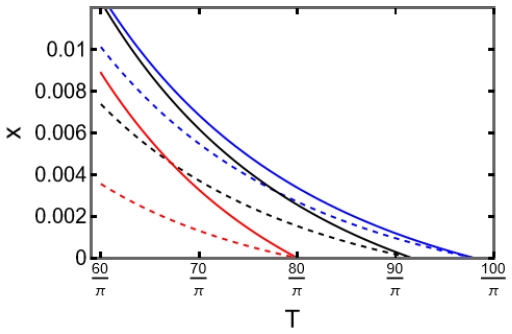
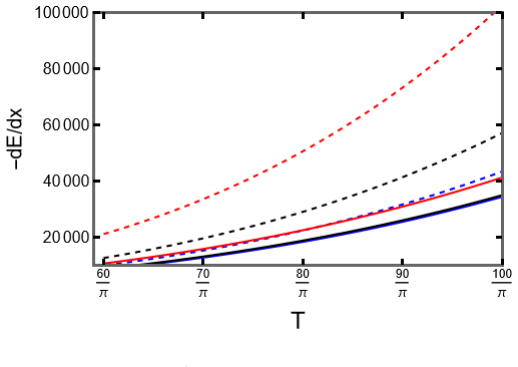
In the large-black-hole limit of the Myers-Perry geometry, which supplies the holographic dual of a spinning or boosted strongly coupled fluid, both the falling-string and shooting-string prescriptions show that increasing temperature or the parameter a shortens the stopping distance of a light quark and increases its instantaneous energy loss. The reduction in stopping distance is larger for motion transverse to the rotation axis than for motion parallel to it, yielding an anisotropic energy-loss pattern. The same trends appear for both string probes and match earlier holographic results on jet quenching and heavy-quark motion in rotating plasmas.
What carries the argument
Spinning black-brane background from the large-black-hole limit of Myers-Perry geometry, probed by falling-string and shooting-string configurations.
If this is right
- Energy loss becomes direction-dependent, stronger transverse to the rotation axis than along it.
- Both stopping distance and instantaneous loss rate decrease with rising temperature at fixed rotation.
- The anisotropy grows with the rotation parameter a, producing a measurable directional preference in quenching.
- The pattern is reproduced by two independent string probes, increasing in the anisotropy result.
Where Pith is reading between the lines
- The directional preference could alter the shape of jets produced in non-central heavy-ion collisions where the plasma carries angular momentum.
- Similar calculations could be repeated for other probes such as heavy quarks or gluons to map the full anisotropy of the rotating medium.
- If the anisotropy survives in more realistic holographic models, hydrodynamic simulations of rotating quark-gluon plasma would need to incorporate direction-dependent energy-loss terms.
Load-bearing premise
The large-black-hole limit of the Myers-Perry geometry supplies a reliable dual description of a spinning strongly coupled fluid and the chosen string configurations correctly capture light-quark dynamics inside it.
What would settle it
A direct computation in the same background that shows the stopping distance increasing or staying constant with rising a, or experimental data from a rotating plasma showing equal energy loss in all directions, would falsify the central claim.
Figures
read the original abstract
In this work, we investigate light-quark energy loss in a strongly coupled plasma described by a spinning black-brane background obtained from the large-black-hole limit of the Myers--Perry geometry. The parameter $a$ characterizes the boost/rotation of the dual fluid in this holographic setup and is related to the angular velocity in the corresponding limit. We employ two complementary probes, the falling-string and shooting-string descriptions, to compute the stopping distance and the instantaneous energy loss of a light quark moving either transverse or parallel to the rotation axis. We find that increasing the temperature or the parameter $a$ reduces the stopping distance and enhances the instantaneous energy loss. The effect of $a$ is more pronounced for transverse motion than for motion along the rotation axis, indicating an anisotropic energy-loss pattern induced by the spinning/boosted background. These results are consistent with earlier holographic studies of jet quenching and heavy-quark dynamics in rotating plasmas.
Editorial analysis
A structured set of objections, weighed in public.
Referee Report
Summary. The manuscript investigates light-quark energy loss in a strongly coupled spinning plasma using the large-black-hole limit of the Myers-Perry geometry as the holographic dual. It applies the falling-string and shooting-string prescriptions to compute stopping distances and instantaneous energy loss for light quarks moving parallel or transverse to the rotation axis, parameterized by the boost/rotation parameter a. The central results are that increasing temperature or a reduces the stopping distance and increases instantaneous energy loss, with the effect of a being stronger for transverse motion, producing an anisotropic pattern; these findings are stated to be consistent with prior holographic jet-quenching studies.
Significance. If the calculations are correct, the work provides a concrete holographic prediction for anisotropic light-quark energy loss in rotating plasmas, extending standard string-probe methods to the spinning Myers-Perry background. This could be relevant for modeling jet quenching in heavy-ion collisions carrying angular momentum. The approach relies on established techniques in the field without introducing new free parameters beyond a and temperature.
minor comments (1)
- [Abstract] Abstract: the relation between the parameter a and the angular velocity of the dual fluid is mentioned but not quantified; a brief statement of the coordinate frame or the explicit form of the metric in the large-black-hole limit would improve readability for readers unfamiliar with the Myers-Perry reduction.
Simulated Author's Rebuttal
We thank the referee for their positive assessment of the manuscript and for recommending acceptance.
Circularity Check
No significant circularity detected
full rationale
The derivation applies the standard falling-string and shooting-string equations to the large-black-hole limit of the Myers-Perry metric. Stopping distance and instantaneous energy loss are obtained by integrating the Nambu-Goto action and solving the resulting differential equations in the given background; these quantities are not defined in terms of themselves or fitted to the target observables. The anisotropy is a direct geometric consequence of the boosted/rotating metric components and does not rely on self-citation for its justification. The abstract's consistency statement with earlier holographic studies is observational and not used as a load-bearing premise. No self-definitional, fitted-input, or ansatz-smuggling steps appear in the reported chain.
Axiom & Free-Parameter Ledger
free parameters (2)
- a
- temperature
axioms (2)
- domain assumption Holographic duality maps the strongly coupled spinning plasma to the large-black-hole limit of the Myers-Perry geometry.
- domain assumption Falling-string and shooting-string prescriptions correctly model light-quark energy loss.
Reference graph
Works this paper leans on
-
[1]
Arseneet al.[BRAHMS Collaboration], Nucl
I. Arseneet al.[BRAHMS Collaboration], Nucl. Phys. A757, 1 (2005) doi:10.1016/j.nuclphysa.2005.02.130 [nucl-ex/0410020]
-
[2]
K. Adcoxet al.[PHENIX Collaboration], Nucl. Phys. A757, 184 (2005) doi:10.1016/j.nuclphysa.2005.03.086 [nucl-ex/0410003]
work page internal anchor Pith review Pith/arXiv arXiv doi:10.1016/j.nuclphysa.2005.03.086 2005
-
[3]
B. B. Backet al., Nucl. Phys. A757, 28 (2005) doi:10.1016/j.nuclphysa.2005.03.084 [nucl- ex/0410022]
-
[4]
J. Adamset al.[STAR Collaboration], Nucl. Phys. A757, 102 (2005) doi:10.1016/j.nuclphysa.2005.03.085 [nucl-ex/0501009]
work page internal anchor Pith review Pith/arXiv arXiv doi:10.1016/j.nuclphysa.2005.03.085 2005
-
[5]
X. N. Wang and M. Gyulassy, Phys. Rev. Lett.68(1992), 1480-1483 doi:10.1103/PhysRevLett.68.1480
-
[6]
Radiative energy loss of high energy quarks and gluons in a finite volume quark-gluon plasma
R. Baier, Y. L. Dokshitzer, A. H. Mueller, S. Peigne and D. Schiff, Nucl. Phys. B483(1997), 291-320 doi:10.1016/S0550-3213(96)00553-6 [arXiv:hep-ph/9607355 [hep-ph]]
work page internal anchor Pith review Pith/arXiv arXiv doi:10.1016/s0550-3213(96)00553-6 1997
-
[7]
The theory and phenomenology of perturbative QCD based jet quenching
A. Majumder and M. Van Leeuwen, Prog. Part. Nucl. Phys.66(2011), 41-92 doi:10.1016/j.ppnp.2010.09.001 [arXiv:1002.2206 [hep-ph]]
work page internal anchor Pith review Pith/arXiv arXiv doi:10.1016/j.ppnp.2010.09.001 2011
-
[8]
G. Y. Qin and X. N. Wang, Int. J. Mod. Phys. E24(2015) no.11, 1530014 doi:10.1142/S0218301315300143 [arXiv:1511.00790 [hep-ph]]
work page internal anchor Pith review Pith/arXiv arXiv doi:10.1142/s0218301315300143 2015
-
[9]
E. V. Shuryak, Nucl. Phys. A750(2005), 64-83 doi:10.1016/j.nuclphysa.2004.10.022 [arXiv:hep-ph/0405066 [hep-ph]]. 11
work page internal anchor Pith review Pith/arXiv arXiv doi:10.1016/j.nuclphysa.2004.10.022 2005
-
[10]
Viscosity in Strongly Interacting Quantum Field Theories from Black Hole Physics
P. Kovtun, D. T. Son and A. O. Starinets, Phys. Rev. Lett.94(2005), 111601 doi:10.1103/PhysRevLett.94.111601 [arXiv:hep-th/0405231 [hep-th]]
work page internal anchor Pith review Pith/arXiv arXiv doi:10.1103/physrevlett.94.111601 2005
-
[11]
J. M. Maldacena, Adv. Theor. Math. Phys.2, 231-252 (1998) doi:10.1023/A:1026654312961 [arXiv:hep-th/9711200 [hep-th]]
work page internal anchor Pith review Pith/arXiv arXiv doi:10.1023/a:1026654312961 1998
-
[12]
Anti De Sitter Space And Holography
E. Witten, Adv. Theor. Math. Phys.2, 253-291 (1998) doi:10.4310/ATMP.1998.v2.n2.a2 [arXiv:hep-th/9802150 [hep-th]]
work page internal anchor Pith review Pith/arXiv arXiv doi:10.4310/atmp.1998.v2.n2.a2 1998
-
[13]
S. S. Gubser, I. R. Klebanov and A. M. Polyakov, Phys. Lett. B428, 105-114 (1998) doi:10.1016/S0370-2693(98)00377-3 [arXiv:hep-th/9802109 [hep-th]]
work page internal anchor Pith review Pith/arXiv arXiv doi:10.1016/s0370-2693(98)00377-3 1998
-
[14]
Gauge/String Duality, Hot QCD and Heavy Ion Collisions
J. Casalderrey-Solana, H. Liu, D. Mateos, K. Rajagopal and U. Achim Wiedemann, Cambridge University Press, 2014, ISBN 978-1-009-40350-4, 978-1-009-40349-8, 978-1-009-40352-8, 978- 1-139-13674-7 doi:10.1017/9781009403504 [arXiv:1101.0618 [hep-th]]
work page internal anchor Pith review Pith/arXiv arXiv doi:10.1017/9781009403504 2014
-
[15]
O. DeWolfe, S. S. Gubser, C. Rosen and D. Teaney, Prog. Part. Nucl. Phys.75(2014), 86-132 doi:10.1016/j.ppnp.2013.11.001 [arXiv:1304.7794 [hep-th]]
work page internal anchor Pith review Pith/arXiv arXiv doi:10.1016/j.ppnp.2013.11.001 2014
-
[16]
H. Liu, K. Rajagopal and U. A. Wiedemann, Phys. Rev. Lett.97(2006), 182301 doi:10.1103/PhysRevLett.97.182301 [arXiv:hep-ph/0605178 [hep-ph]]
work page internal anchor Pith review Pith/arXiv arXiv doi:10.1103/physrevlett.97.182301 2006
-
[17]
H. Liu, K. Rajagopal and U. A. Wiedemann, JHEP03(2007), 066 doi:10.1088/1126- 6708/2007/03/066 [arXiv:hep-ph/0612168 [hep-ph]]
work page internal anchor Pith review Pith/arXiv arXiv doi:10.1088/1126- 2007
-
[18]
P. M. Chesler, K. Jensen, A. Karch and L. G. Yaffe, Phys. Rev. D79(2009), 125015 doi:10.1103/PhysRevD.79.125015 [arXiv:0810.1985 [hep-th]]
work page internal anchor Pith review Pith/arXiv arXiv doi:10.1103/physrevd.79.125015 2009
-
[19]
P. Arnold and D. Vaman, JHEP10(2010), 099 doi:10.1007/JHEP10(2010)099 [arXiv:1008.4023 [hep-th]]
work page internal anchor Pith review Pith/arXiv arXiv doi:10.1007/jhep10(2010)099 2010
-
[20]
Jet quenching in hot strongly coupled gauge theories simplified
P. Arnold and D. Vaman, JHEP04(2011), 027 doi:10.1007/JHEP04(2011)027 [arXiv:1101.2689 [hep-th]]
work page internal anchor Pith review Pith/arXiv arXiv doi:10.1007/jhep04(2011)027 2011
-
[21]
P. M. Chesler, K. Jensen and A. Karch, Phys. Rev. D79(2009), 025021 doi:10.1103/PhysRevD.79.025021 [arXiv:0804.3110 [hep-th]]
work page internal anchor Pith review Pith/arXiv arXiv doi:10.1103/physrevd.79.025021 2009
-
[22]
Finite momentum at string endpoints
A. Ficnar and S. S. Gubser, Phys. Rev. D89(2014) no.2, 026002 doi:10.1103/PhysRevD.89.026002 [arXiv:1306.6648 [hep-th]]
work page internal anchor Pith review Pith/arXiv arXiv doi:10.1103/physrevd.89.026002 2014
-
[23]
Shooting String Holography of Jet Quenching at RHIC and LHC
A. Ficnar, S. S. Gubser and M. Gyulassy, Phys. Lett. B738(2014), 464-471 doi:10.1016/j.physletb.2014.10.016 [arXiv:1311.6160 [hep-ph]]
work page internal anchor Pith review Pith/arXiv arXiv doi:10.1016/j.physletb.2014.10.016 2014
-
[24]
Z. R. Zhu, S. Q. Feng, Y. F. Shi and Y. Zhong, Phys. Rev. D99(2019) no.12, 126001 doi:10.1103/PhysRevD.99.126001 [arXiv:1901.09304 [hep-ph]]. 12
work page internal anchor Pith review Pith/arXiv arXiv doi:10.1103/physrevd.99.126001 2019
-
[25]
Z. q. Zhang, X. Zhu and D. f. Hou, Eur. Phys. J. C83(2023) no.5, 389 doi:10.1140/epjc/s10052-023-11428-8
-
[26]
Z. q. Zhang, Eur. Phys. J. C79(2019) no.12, 992 doi:10.1140/epjc/s10052-019-7503-z
-
[27]
Z. q. Zhang, Phys. Lett. B793(2019), 308-312 doi:10.1016/j.physletb.2019.04.064
-
[28]
L. Zhang, L. Yin, G. D. Zhou, C. J. Fan and X. Chen, Phys. Rev. D111(2025) no.12, 126001 doi:10.1103/m6rx-vy32 [arXiv:2504.04979 [hep-ph]]
-
[29]
Z. T. Liang and X. N. Wang, Phys. Rev. Lett.94(2005), 102301 [erratum: Phys. Rev. Lett. 96(2006), 039901] doi:10.1103/PhysRevLett.94.102301 [arXiv:nucl-th/0410079 [nucl-th]]
work page internal anchor Pith review Pith/arXiv arXiv doi:10.1103/physrevlett.94.102301 2005
-
[30]
Angular momentum conservation in heavy ion collisions at very high energy
F. Becattini, F. Piccinini and J. Rizzo, Phys. Rev. C77(2008), 024906 doi:10.1103/PhysRevC.77.024906 [arXiv:0711.1253 [nucl-th]]
work page internal anchor Pith review Pith/arXiv arXiv doi:10.1103/physrevc.77.024906 2008
-
[31]
Helicity separation in Heavy-Ion Collisions
M. Baznat, K. Gudima, A. Sorin and O. Teryaev, Phys. Rev. C88(2013) no.6, 061901 doi:10.1103/PhysRevC.88.061901 [arXiv:1301.7003 [nucl-th]]
work page internal anchor Pith review Pith/arXiv arXiv doi:10.1103/physrevc.88.061901 2013
-
[32]
Global $\Lambda$ hyperon polarization in nuclear collisions: evidence for the most vortical fluid
L. Adamczyket al.[STAR], Nature548(2017), 62-65 doi:10.1038/nature23004 [arXiv:1701.06657 [nucl-ex]]
work page internal anchor Pith review Pith/arXiv arXiv doi:10.1038/nature23004 2017
-
[33]
Rotating quark-gluon plasma in relativistic heavy ion collisions
Y. Jiang, Z. W. Lin and J. Liao, Phys. Rev. C94(2016) no.4, 044910 [erratum: Phys. Rev. C95(2017) no.4, 049904] doi:10.1103/PhysRevC.94.044910 [arXiv:1602.06580 [hep-ph]]
work page internal anchor Pith review Pith/arXiv arXiv doi:10.1103/physrevc.94.044910 2016
-
[34]
X. Chen, L. Zhang, D. Li, D. Hou and M. Huang, JHEP07(2021), 132 doi:10.1007/JHEP07(2021)132 [arXiv:2010.14478 [hep-ph]]
-
[35]
Y. Q. Zhao, S. He, D. Hou, L. Li and Z. Li, JHEP04(2023), 115 doi:10.1007/JHEP04(2023)115 [arXiv:2212.14662 [hep-ph]]
-
[36]
A. A. Golubtsova, E. Gourgoulhon and M. K. Usova, Nucl. Phys. B979(2022), 115786 doi:10.1016/j.nuclphysb.2022.115786 [arXiv:2107.11672 [hep-th]]
-
[37]
I. Y. Aref’eva, A. A. Golubtsova and E. Gourgoulhon, JHEP04, 169 (2021) doi:10.1007/JHEP04(2021)169 [arXiv:2004.12984 [hep-th]]
-
[38]
A. A. Golubtsova and N. S. Tsegelnik, Phys. Rev. D107(2023) no.10, 106017 doi:10.1103/PhysRevD.107.106017 [arXiv:2211.11722 [hep-th]]
-
[39]
S. W. Hawking, C. J. Hunter and M. Taylor, Phys. Rev. D59, 064005 (1999) doi:10.1103/PhysRevD.59.064005 [arXiv:hep-th/9811056 [hep-th]]
work page internal anchor Pith review Pith/arXiv arXiv doi:10.1103/physrevd.59.064005 1999
-
[40]
G. W. Gibbons, M. J. Perry and C. N. Pope, Class. Quant. Grav.22, 1503-1526 (2005) doi:10.1088/0264-9381/22/9/002 [arXiv:hep-th/0408217 [hep-th]]. 13
work page internal anchor Pith review Pith/arXiv arXiv doi:10.1088/0264-9381/22/9/002 2005
-
[41]
G. W. Gibbons, H. Lu, D. N. Page and C. N. Pope, Phys. Rev. Lett.93, 171102 (2004) doi:10.1103/PhysRevLett.93.171102 [arXiv:hep-th/0409155 [hep-th]]
work page internal anchor Pith review Pith/arXiv arXiv doi:10.1103/physrevlett.93.171102 2004
-
[42]
M. Garbiso and M. Kaminski, JHEP12, 112 (2020) doi:10.1007/JHEP12(2020)112 [arXiv:2007.04345 [hep-th]]
-
[43]
M. A. G. Amano, C. Cartwright, M. Kaminski and J. Wu, Prog. Part. Nucl. Phys.139(2024), 104135 doi:10.1016/j.ppnp.2024.104135 [arXiv:2308.11686 [hep-th]]
-
[44]
Z. R. Zhu, S. Wang, X. Chen, J. X. Chen and D. Hou, Phys. Rev. D110, no.12, 126008 (2024) doi:10.1103/PhysRevD.110.126008 [arXiv:2407.03633 [hep-ph]]
-
[45]
Z. R. Zhu, M. Sun, R. Zhou, Z. Ma and J. Han, Eur. Phys. J. C84, no.12, 1252 (2024) doi:10.1140/epjc/s10052-024-13628-2 [arXiv:2406.19661 [hep-ph]]
-
[46]
Z. R. Zhu, S. Wang, Y. K. Liu and D. Hou, Phys. Rev. D112, no.2, 026012 (2025) doi:10.1103/rwrh-z742 [arXiv:2501.04318 [hep-ph]]
-
[47]
Z. R. Zhu, S. Wang, M. L. Tian and D. Hou, Phys. Rev. D113(2026) no.6, 066014 doi:10.1103/s8dq-486v [arXiv:2512.13076 [hep-ph]]
-
[48]
Instabilities of Kerr-AdS_5 x S^5 Spacetime
K. Murata, Prog. Theor. Phys.121, 1099-1124 (2009) doi:10.1143/PTP.121.1099 [arXiv:0812.0718 [hep-th]]
work page internal anchor Pith review Pith/arXiv arXiv doi:10.1143/ptp.121.1099 2009
-
[49]
Non-universal shear viscosity from Einstein gravity
J. Erdmenger, P. Kerner and H. Zeller, Phys. Lett. B699, 301-304 (2011) doi:10.1016/j.physletb.2011.04.009 [arXiv:1011.5912 [hep-th]]
work page internal anchor Pith review Pith/arXiv arXiv doi:10.1016/j.physletb.2011.04.009 2011
-
[50]
Anisotropic shear viscosity of a strongly coupled non-Abelian plasma from magnetic branes
R. Critelli, S. I. Finazzo, M. Zaniboni and J. Noronha, Phys. Rev. D90, no.6, 066006 (2014) doi:10.1103/PhysRevD.90.066006 [arXiv:1406.6019 [hep-th]]
work page internal anchor Pith review Pith/arXiv arXiv doi:10.1103/physrevd.90.066006 2014
-
[51]
Violation of the Holographic Viscosity Bound in a Strongly Coupled Anisotropic Plasma
A. Rebhan and D. Steineder, Phys. Rev. Lett.108, 021601 (2012) doi:10.1103/PhysRevLett.108.021601 [arXiv:1110.6825 [hep-th]]
work page internal anchor Pith review Pith/arXiv arXiv doi:10.1103/physrevlett.108.021601 2012
-
[52]
J. X. Chen, D. F. Hou and H. C. Ren, JHEP03, 171 (2024) doi:10.1007/JHEP03(2024)171 [arXiv:2308.08126 [hep-ph]]
-
[53]
Charged Kerr-de Sitter Black Holes in Five Dimensions
M. Cvetic, H. Lu and C. N. Pope, Phys. Lett. B598, 273-278 (2004) doi:10.1016/j.physletb.2004.08.011 [arXiv:hep-th/0406196 [hep-th]]. 14
work page internal anchor Pith review Pith/arXiv arXiv doi:10.1016/j.physletb.2004.08.011 2004
discussion (0)
Sign in with ORCID, Apple, or X to comment. Anyone can read and Pith papers without signing in.