The ESO SupJup Survey XI. Atmospheric properties of six isolated M- and L-type dwarfs with CRIRES+
Pith reviewed 2026-06-26 02:58 UTC · model grok-4.3
The pith
Six isolated brown dwarfs show near-solar C/O ratios and carbon isotope ratios at or above the local ISM value.
A machine-rendered reading of the paper's core claim, the machinery that carries it, and where it could break.
Core claim
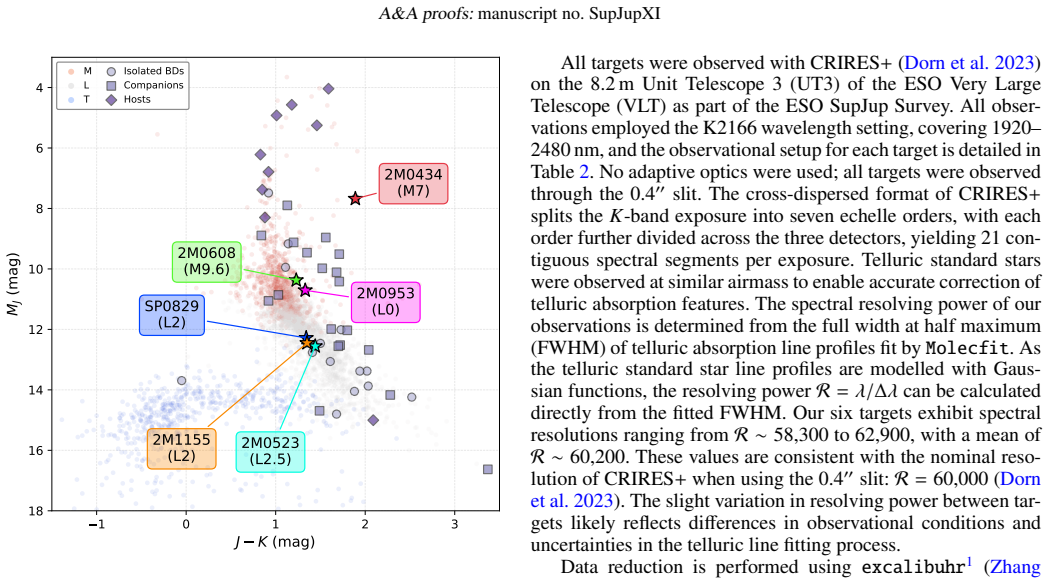
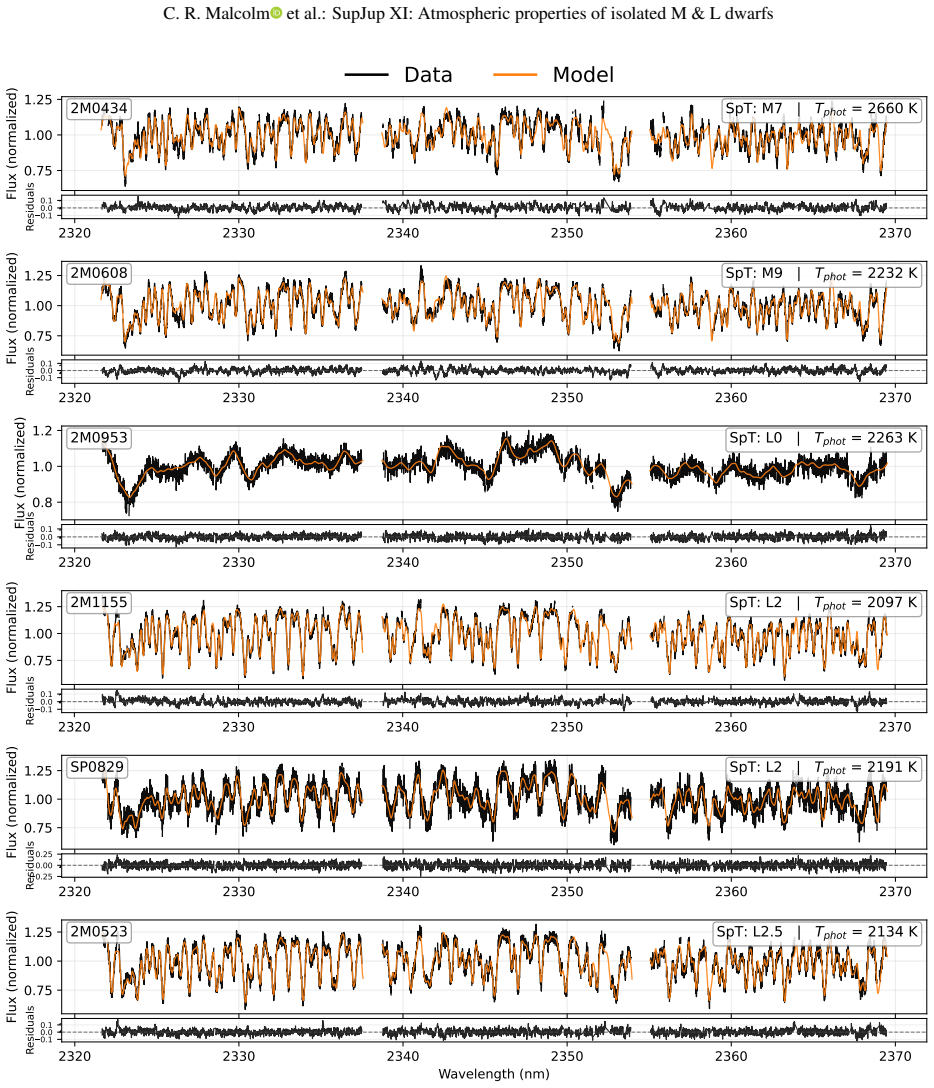
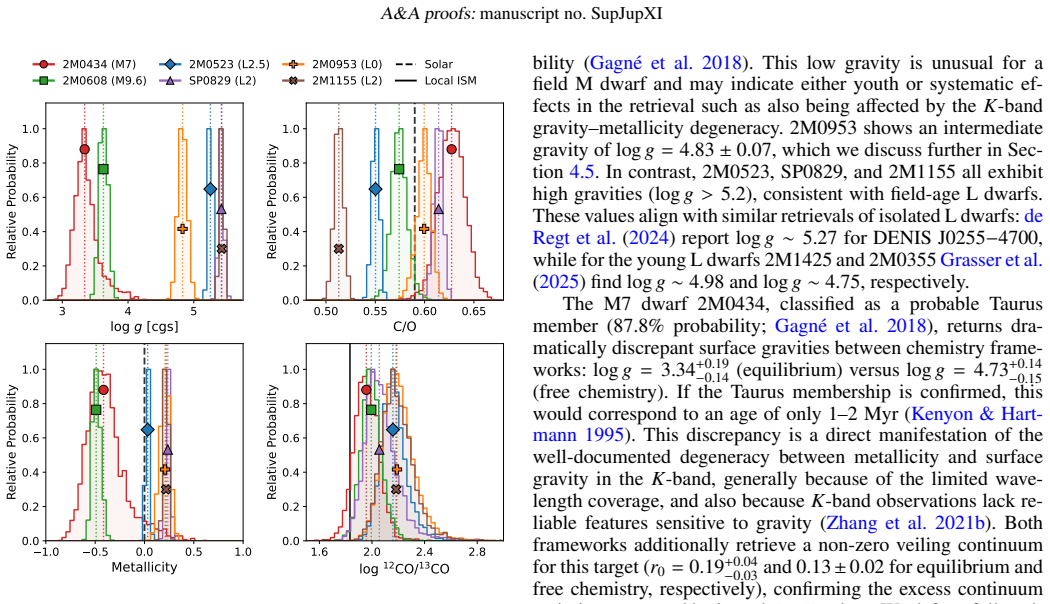
The six targets display near-solar C/O ratios (0.51-0.63), mostly near-solar metallicities, and 12C/13C ratios of ~91-155 that lie at or above the local ISM value. H2O is strongly detected in all objects and 12CO in five, while 13CO is significantly detected in one target and tentatively in three others. The M7 dwarf shows discrepant gravity and metallicity between chemistry frameworks, and apparent H2^18O signals in two targets are shown to be spurious. The overall composition pattern, together with the agreement of isotope ratios between retrieval frameworks, is presented as evidence that the dwarfs formed by molecular cloud fragmentation.
What carries the argument
Atmospheric retrievals that couple the petitRADTRANS radiative-transfer code with PyMultiNest nested sampling, applied to high-resolution CRIRES+ spectra to extract thermal structure, molecular abundances, and isotope ratios under free and equilibrium chemistry assumptions.
If this is right
- The sample formed through molecular cloud fragmentation rather than giant-planet-like pathways.
- The 12C/13C ratios are robust across chemistry frameworks even for objects with severe rotational broadening.
- Apparent H2^18O detections must be validated by cross-correlation before being treated as real.
- Isolated M- and L-type dwarfs share chemical fingerprints with field stars rather than with objects formed in disks.
Where Pith is reading between the lines
- Extending the same retrieval pipeline to a larger sample of isolated ultracool dwarfs could test whether the fragmentation signature is universal.
- Higher spectral resolution or longer exposures may be needed to obtain independent 13CO detections in the fastest rotators.
- The same observational and retrieval approach could be applied to directly imaged exoplanets to search for contrasting formation signatures.
Load-bearing premise
The carbon isotope ratios retrieved for the two fastest rotators remain reliable even though they rest only on the spectral fit and lack independent confirmation from a 13CO cross-correlation peak.
What would settle it
An independent measurement, such as a clear 13CO cross-correlation detection, that yields a 12C/13C ratio well below the local ISM value for either of the two fastest-rotating targets.
Figures
read the original abstract
The distinct formation pathways of brown dwarfs and giant exoplanets may be encoded in their atmospheric composition. We present atmospheric retrievals for six isolated brown dwarfs of spectral types M7-L2.5 from the ESO SupJup Survey, aiming to constrain their thermal structures, chemical compositions, and isotope ratios. We analyse CRIRES+ K-band spectra, coupling the radiative transfer code petitRADTRANS with the nested sampling algorithm PyMultiNest under both free and equilibrium chemistry frameworks. The L0 dwarf 2MASS J09532126-1014205 emerges as one of the fastest-rotating ultracool dwarfs known, with $v\sin i = 85.9\pm0.5$ km s$^{-1}$. H$_2$O is strongly detected in all six targets and $^{12}$CO in five, with a marginal $^{12}$CO detection in the ultra-fast L0 rotator consistent with severe rotational broadening. $^{13}$CO is significantly detected in DENIS J060852.8-275358 and tentatively in three further targets. Retrieved compositions are consistent with isolated brown dwarfs: near-solar C/O ratios ($0.51$-$0.63$), predominantly near-solar metallicities, and $^{12}$C/$^{13}$C ratios of ~91-155, at or above the local ISM value, with constraints for the two fastest rotators resting on the spectral fit but not corroborated by a $^{13}$CO cross-correlation peak. The M7 dwarf 2MASS J04341527+2250309 shows discrepant gravity and metallicity values between chemistry frameworks. Apparent H$_2^{18}$O constraints for two targets are found to be spurious, and their H$_2^{(16)}$O/H$_2^{18}$O ratios are presented as lower limits, demonstrating the importance of cross-correlation validation for minor species detections. The near-solar C/O ratios and metallicities, with $^{12}$C/$^{13}$C ratios at or above the ISM value, support a molecular cloud fragmentation origin for the sample. The agreement of $^{12}$C/$^{13}$C between chemistry frameworks supports the robustness of these ratios.
Editorial analysis
A structured set of objections, weighed in public.
Referee Report
Summary. This paper presents atmospheric retrieval analyses of CRIRES+ K-band spectra for six isolated M7 to L2.5 brown dwarfs from the ESO SupJup Survey. Using petitRADTRANS coupled with PyMultiNest under both free and equilibrium chemistry assumptions, the authors retrieve thermal structures, chemical abundances including C/O ratios, metallicities, and carbon isotope ratios. Key findings include strong detections of H2O in all targets and 12CO in five, tentative 13CO in four, near-solar C/O (0.51-0.63) and metallicities, and 12C/13C ratios of approximately 91-155. The results are interpreted as supporting a molecular cloud fragmentation origin for these objects, with the L0 target noted for its extreme rotation rate of v sin i = 85.9 km/s. Limitations such as marginal detections, spurious H2^18O signals, and reliance on spectral fits for fast rotators are acknowledged.
Significance. Should the reported isotope ratios prove robust, this study contributes to distinguishing formation pathways between brown dwarfs and giant exoplanets through atmospheric composition, particularly using 12C/13C as a diagnostic. The consistency between free and equilibrium chemistry frameworks for the isotope ratios adds credibility. The explicit validation via cross-correlation for minor species and identification of spurious detections provide a useful methodological example for the field.
major comments (2)
- [Abstract (and corresponding results/discussion on isotope ratios)] Abstract and results on 12C/13C ratios: The central claim that the full sample's 12C/13C ratios (~91-155, at or above local ISM value) support a molecular cloud fragmentation origin is load-bearing on all six targets being reliable. However, the manuscript states that constraints for the two fastest rotators (including the L0 with v sin i = 85.9 km/s) rest only on the spectral fit without 13CO cross-correlation corroboration. Severe rotational broadening can induce degeneracies in the petitRADTRANS + PyMultiNest retrievals, so these two values require additional validation or explicit down-weighting in the sample conclusion.
- [Results section on the M7 dwarf] Results for M7 dwarf 2MASS J04341527+2250309: The discrepant gravity and metallicity between free and equilibrium chemistry frameworks is noted but left unresolved; this discrepancy directly affects the reliability of the retrieved parameters for this target and should be investigated as it may signal model limitations affecting the overall sample interpretation.
minor comments (2)
- [Abstract] The abstract states 'tentatively in three further targets' for 13CO but earlier notes 'significantly detected in DENIS J060852.8-275358'; clarify the exact breakdown of significant vs. tentative detections for precision.
- Ensure figure captions explicitly label which chemistry framework (free or equilibrium) corresponds to each retrieval result shown.
Simulated Author's Rebuttal
We thank the referee for their thorough and constructive report. We address the two major comments point-by-point below. Where appropriate, we propose revisions to strengthen the presentation of limitations while preserving the manuscript's core findings.
read point-by-point responses
-
Referee: Abstract and results on 12C/13C ratios: The central claim that the full sample's 12C/13C ratios (~91-155, at or above local ISM value) support a molecular cloud fragmentation origin is load-bearing on all six targets being reliable. However, the manuscript states that constraints for the two fastest rotators (including the L0 with v sin i = 85.9 km/s) rest only on the spectral fit without 13CO cross-correlation corroboration. Severe rotational broadening can induce degeneracies in the petitRADTRANS + PyMultiNest retrievals, so these two values require additional validation or explicit down-weighting in the sample conclusion.
Authors: We agree that the two fastest rotators have less secure 13CO constraints. The manuscript already states explicitly that these rest on the spectral fit alone. In revision we will (i) modify the abstract to state that the molecular-cloud-fragmentation interpretation is supported by the four targets with cross-correlation detections and is consistent with (but not driven by) the two fast rotators, and (ii) add a short paragraph in the discussion quantifying the impact of rotational broadening on retrieval degeneracies and noting that the retrieved 12C/13C values for the fast rotators remain within the range of the better-constrained objects. This is a partial revision because the limitation is already flagged in the text. revision: partial
-
Referee: Results for M7 dwarf 2MASS J04341527+2250309: The discrepant gravity and metallicity between free and equilibrium chemistry frameworks is noted but left unresolved; this discrepancy directly affects the reliability of the retrieved parameters for this target and should be investigated as it may signal model limitations affecting the overall sample interpretation.
Authors: We concur that the log g and [M/H] discrepancy for this M7 target between the two chemistry assumptions merits explicit investigation. In the revised manuscript we will expand the relevant results subsection to discuss possible origins (differences in temperature-structure coupling, line-list sensitivities, or prior volume effects) and will report the outcome of additional retrieval tests in which key parameters are fixed or the temperature profile is parameterised differently. We will also confirm that the 12C/13C ratio remains consistent across both frameworks for this object. This change will be implemented as a full revision. revision: yes
Circularity Check
No circularity: compositions and isotope ratios obtained via direct spectral retrievals
full rationale
The paper's central results are obtained by coupling petitRADTRANS radiative transfer with PyMultiNest nested sampling to fit CRIRES+ K-band spectra under free and equilibrium chemistry assumptions, directly retrieving C/O, metallicities, and 12C/13C ratios as model parameters. The formation-origin interpretation follows from comparing these retrieved values (near-solar C/O 0.51-0.63, 12C/13C ~91-155 at/above ISM) to external benchmarks, without any reduction of the reported ratios to quantities already fitted in prior self-citations or by construction. The manuscript explicitly flags that constraints for the two fastest rotators rest solely on the spectral fit without 13CO cross-correlation corroboration, but this is a noted limitation on data quality rather than a circular step. No self-definitional relations, fitted-input predictions, load-bearing self-citations, or smuggled ansatzes appear in the derivation chain.
Axiom & Free-Parameter Ledger
free parameters (1)
- atmospheric parameters (T-P profile, abundances, v sin i)
axioms (2)
- domain assumption petitRADTRANS radiative transfer and PyMultiNest nested sampling produce unbiased posterior distributions for the observed K-band spectra
- domain assumption cross-correlation validation is required to confirm minor-species detections against rotational broadening
Reference graph
Works this paper leans on
-
[1]
Research Notes of the American Astronomical Society , keywords =
VLT/CRIRES Science Verification Observations: A hint of C ^ 18 O in the Young Brown Dwarf 2M0355. Research Notes of the American Astronomical Society , keywords =. doi:10.3847/2515-5172/ac9309 , adsurl =
-
[2]
Possibly distinct formation pathways of super-Jupiters and brown dwarfs
The ^ 12 CO/ ^ 13 CO isotopologue ratio of a young, isolated brown dwarf. Possibly distinct formation pathways of super-Jupiters and brown dwarfs. , keywords =. doi:10.1051/0004-6361/202141502 , archivePrefix =. 2109.11569 , primaryClass =
-
[3]
The ^ 13 CO-rich atmosphere of a young accreting super-Jupiter. , keywords =. doi:10.1038/s41586-021-03616-x , archivePrefix =. 2107.06297 , primaryClass =
-
[4]
Retrieving Temperatures and Abundances of Exoplanet Atmospheres with High-resolution Cross-correlation Spectroscopy. , keywords =. doi:10.3847/1538-3881/aaffd3 , archivePrefix =. 1811.01681 , primaryClass =
work page internal anchor Pith review Pith/arXiv arXiv doi:10.3847/1538-3881/aaffd3
-
[5]
A solar C/O and sub-solar metallicity in a hot Jupiter atmosphere. , keywords =. doi:10.1038/s41586-021-03912-6 , archivePrefix =. 2110.14821 , primaryClass =
-
[6]
, year = 2014, month = may, volume =
Fast spin of the young extrasolar planet Pictoris b. , year = 2014, month = may, volume =. doi:10.1038/nature13253 , adsurl =
-
[7]
Characterizing Young Brown Dwarfs using Low Resolution Near-IR Spectra
Characterizing Young Brown Dwarfs Using Low-Resolution Near-Infrared Spectra. , keywords =. doi:10.1086/510845 , archivePrefix =. astro-ph/0611408 , primaryClass =
work page internal anchor Pith review Pith/arXiv arXiv doi:10.1086/510845
-
[8]
Evolutionary models for low-mass stars and brown dwarfs: Uncertainties and limits at very young ages , DOI= "10.1051/0004-6361:20011638", url= "https://doi.org/10.1051/0004-6361:20011638", journal =
-
[9]
New Grids of ATLAS9 Model Atmospheres
New Grids of ATLAS9 Model Atmospheres. Modelling of Stellar Atmospheres , year = 2003, editor =. doi:10.48550/arXiv.astro-ph/0405087 , archivePrefix =. astro-ph/0405087 , primaryClass =
work page internal anchor Pith review Pith/arXiv arXiv doi:10.48550/arxiv.astro-ph/0405087 2003
-
[10]
Workshop on Astrophysical Opacities , year = 2018, series =
Including All the Lines: Data Releases for Spectra and Opacities through 2017. Workshop on Astrophysical Opacities , year = 2018, series =
2017
-
[11]
Line Intensities and Molecular Opacities of the FeH $F^4\Delta_i-X^4\Delta_i$ Transition
Line Intensities and Molecular Opacities of the FeH F ^ 4 _ i -X ^ 4 _ i Transition. , keywords =. doi:10.1086/376791 , archivePrefix =. astro-ph/0305162 , primaryClass =
work page internal anchor Pith review Pith/arXiv arXiv doi:10.1086/376791
-
[12]
MoLLIST: Molecular Line Lists, Intensities and Spectra. , keywords =. doi:10.1016/j.jqsrt.2019.106687 , adsurl =
-
[13]
Barton, Emma J. and Yurchenko, Sergei N. and Tennyson, Jonathan , title =. Monthly Notices of the Royal Astronomical Society , volume =. 2013 , month =. doi:10.1093/mnras/stt1105 , url =
-
[14]
New study of the line profiles of sodium perturbed by H _ 2. , keywords =. doi:10.1051/0004-6361/201935593 , archivePrefix =. 1908.01989 , primaryClass =
-
[15]
A library of near-infrared integral field spectra of young M–L dwarfs⋆⋆⋆ , DOI= "10.1051/0004-6361/201118270", url= "https://doi.org/10.1051/0004-6361/201118270", journal =
-
[16]
Spitzer Variability Properties of Low-gravity L Dwarfs. , keywords =. doi:10.3847/1538-3881/ab9642 , archivePrefix =. 2005.12854 , primaryClass =
-
[17]
Burgasser, Adam J. and Logsdon, Sarah E. and Gagné, Jonathan and Bochanski, John J. and Faherty, Jaqueline K. and West, Andrew A. and Mamajek, Eric E. and Schmidt, Sarah J. and Cruz, Kelle L. , year=. THE BROWN DWARF KINEMATICS PROJECT (BDKP). IV. RADIAL VELOCITIES OF 85 LATE-M AND L DWARFS WITH MagE , volume=. The Astrophysical Journal Supplement Series ...
-
[18]
Young L Dwarfs Identified in the Field: A Preliminary Low-Gravity, Optical Spectral Sequence from L0 to L5. , keywords =. doi:10.1088/0004-6256/137/2/3345 , archivePrefix =. 0812.0364 , primaryClass =
work page internal anchor Pith review Pith/arXiv arXiv doi:10.1088/0004-6256/137/2/3345
-
[19]
Meeting the Cool Neighbors. V. A 2MASS-Selected Sample of Ultracool Dwarfs. , keywords =. doi:10.1086/378607 , archivePrefix =. astro-ph/0307429 , primaryClass =
work page internal anchor Pith review Pith/arXiv arXiv doi:10.1086/378607
-
[20]
VizieR Online Data Catalog , keywords =
VizieR Online Data Catalog: Gaia EDR3 (Gaia Collaboration, 2020). VizieR Online Data Catalog , keywords =. doi:10.26093/cds/vizier.1350 , adsurl =
-
[21]
Monthly Notices of the Royal Astronomical Society , volume =
Cooper, W J and Jones, H R A and Smart, R L and Folkes, S L and Caballero, J A and Marocco, F and Ortiz, M C Gálvez and Burgasser, A J and Kirkpatrick, J D and Sarro, L M and Burningham, B and Cabrera-Lavers, A and Tremblay, P E and Reylé, C and Lodieu, N and Zhang, Z H and Cook, N J and Faherty, J F and García-Álvarez, D and Montes, D and Pinfield, D J a...
-
[22]
BANYAN. VII. A New Population of Young Substellar Candidate Members of Nearby Moving Groups from the BASS Survey. , keywords =. doi:10.1088/0067-0049/219/2/33 , archivePrefix =. 1506.07712 , primaryClass =
work page internal anchor Pith review Pith/arXiv arXiv doi:10.1088/0067-0049/219/2/33
-
[23]
A search for binary systems among the nearest L dwarfs
A Search for Binary Systems among the Nearest L Dwarfs. , keywords =. doi:10.1086/505626 , archivePrefix =. astro-ph/0606331 , primaryClass =
work page internal anchor Pith review Pith/arXiv arXiv doi:10.1086/505626
-
[24]
Meeting the Cool Neighbors. X. Ultracool Dwarfs from the 2MASS All-Sky Data Release. , keywords =. doi:10.1088/0004-6256/136/3/1290 , adsurl =
-
[25]
Discovery of very nearby ultracool dwarfs from DENIS
Discovery of very nearby ultracool dwarfs from DENIS. , keywords =. doi:10.1051/0004-6361:20040046 , archivePrefix =. astro-ph/0402171 , primaryClass =
work page internal anchor Pith review Pith/arXiv arXiv doi:10.1051/0004-6361:20040046
-
[26]
SDSS J111010.01+011613.1: A New Planetary-Mass T Dwarf Member of the AB Doradus Moving Group
SDSS J111010.01+011613.1: A New Planetary-mass T Dwarf Member of the AB Doradus Moving Group. , keywords =. doi:10.1088/2041-8205/808/1/L20 , archivePrefix =. 1506.04195 , primaryClass =
work page internal anchor Pith review Pith/arXiv arXiv doi:10.1088/2041-8205/808/1/l20 2041
-
[27]
2MASSJ035523.51+113337.4: A Young, Dusty, Nearby, Isolated Brown Dwarf Resembling A Giant Exoplanet
2MASS J035523.37+113343.7: A Young, Dusty, Nearby, Isolated Brown Dwarf Resembling a Giant Exoplanet. , keywords =. doi:10.1088/0004-6256/145/1/2 , archivePrefix =. 1206.5519 , primaryClass =
work page internal anchor Pith review Pith/arXiv arXiv doi:10.1088/0004-6256/145/1/2
-
[28]
The Extremely Red, Young L Dwarf PSO J318.5338-22.8603: A Free-floating Planetary-mass Analog to Directly Imaged Young Gas-giant Planets. , keywords =. doi:10.1088/2041-8205/777/2/L20 , archivePrefix =. 1310.0457 , primaryClass =
work page internal anchor Pith review Pith/arXiv arXiv doi:10.1088/2041-8205/777/2/l20 2041
-
[29]
Infrared parallaxes of young field brown dwarfs and connections to directly imaged gas-giant exoplanets. Astronomische Nachrichten , keywords =. doi:10.1002/asna.201211783 , archivePrefix =. 1305.3270 , primaryClass =
work page internal anchor Pith review Pith/arXiv arXiv doi:10.1002/asna.201211783
-
[30]
The NIRSPEC Ultracool Dwarf Radial Velocity Survey
The NIRSPEC Ultracool Dwarf Radial Velocity Survey. , keywords =. doi:10.1088/0004-637X/723/1/684 , archivePrefix =. 1008.3874 , primaryClass =
work page internal anchor Pith review Pith/arXiv arXiv doi:10.1088/0004-637x/723/1/684
-
[31]
Constraints on the Spin Evolution of Young Planetary-Mass Companions
Constraints on the spin evolution of young planetary-mass companions. Nature Astronomy , keywords =. doi:10.1038/s41550-017-0325-8 , archivePrefix =. 1712.00457 , primaryClass =
work page internal anchor Pith review Pith/arXiv arXiv doi:10.1038/s41550-017-0325-8
-
[32]
Rotational studies in the Orion Nebula Cluster: from solar mass stars to brown dwarfs
Rotational studies in the Orion Nebula Cluster: from solar mass stars to brown dwarfs. , keywords =. doi:10.1051/0004-6361/200811427 , archivePrefix =. 0906.2419 , primaryClass =
work page internal anchor Pith review Pith/arXiv arXiv doi:10.1051/0004-6361/200811427
-
[33]
Rotation Periods of Young Brown Dwarfs: K2 Survey in Upper Scorpius
Rotation Periods of Young Brown Dwarfs: K2 Survey in Upper Scorpius. , keywords =. doi:10.1088/2041-8205/809/2/L29 , archivePrefix =. 1506.06771 , primaryClass =
work page internal anchor Pith review Pith/arXiv arXiv doi:10.1088/2041-8205/809/2/l29 2041
-
[34]
The evolution of CNO elements in galaxies. , keywords =. doi:10.1007/s00159-022-00144-z , archivePrefix =. 2210.04350 , primaryClass =
-
[35]
Brown Dwarfs in Young Moving Groups from Pan-STARRS1. I. AB Doradus. , keywords =. doi:10.3847/0004-637X/821/2/120 , archivePrefix =. 1604.04284 , primaryClass =
work page internal anchor Pith review Pith/arXiv arXiv doi:10.3847/0004-637x/821/2/120
-
[36]
Ultracool Dwarfs Observed with the Spitzer Infrared Spectrograph: Equatorial Latitudes in L Dwarf Atmospheres Are Cloudier. , keywords =. doi:10.3847/2041-8213/acec4b , archivePrefix =. 2308.02093 , primaryClass =
-
[37]
Brown Dwarfs and the TW Hya Association
Brown Dwarfs and the TW Hydrae Association. , keywords =. doi:10.1086/341259 , archivePrefix =. astro-ph/0204342 , primaryClass =
work page internal anchor Pith review Pith/arXiv arXiv doi:10.1086/341259
-
[38]
APOGEE Data and Spectral Analysis from SDSS Data Release 16: Seven Years of Observations Including First Results from APOGEE-South. , keywords =. doi:10.3847/1538-3881/aba592 , archivePrefix =. 2007.05537 , primaryClass =
-
[39]
SpeX Spectroscopy of Unresolved Very Low Mass Binaries. II. Identification of 14 Candidate Binaries with Late-M/Early-L and T Dwarf Components. , keywords =. doi:10.1088/0004-637X/794/2/143 , archivePrefix =. 1408.3089 , primaryClass =
work page internal anchor Pith review Pith/arXiv arXiv doi:10.1088/0004-637x/794/2/143
-
[40]
The Ultracool SpeXtroscopic Survey. I. Volume-limited Spectroscopic Sample and Luminosity Function of M7-L5 Ultracool Dwarfs. , keywords =. doi:10.3847/1538-4357/ab253d , archivePrefix =. 1906.04166 , primaryClass =
-
[41]
VizieR Online Data Catalog , keywords =
VizieR Online Data Catalog: 2MASS All-Sky Catalog of Point Sources (Cutri+ 2003). VizieR Online Data Catalog , keywords =
2003
-
[42]
Importance Nested Sampling and the MultiNest Algorithm
Importance Nested Sampling and the MultiNest Algorithm. The Open Journal of Astrophysics , keywords =. doi:10.21105/astro.1306.2144 , archivePrefix =. 1306.2144 , primaryClass =
work page internal anchor Pith review Pith/arXiv arXiv doi:10.21105/astro.1306.2144
-
[43]
The ESO SupJup Survey. I. Chemical and isotopic characterisation of the late L-dwarf DENIS J0255-4700 with CRIRES ^ +. , keywords =. doi:10.1051/0004-6361/202348508 , archivePrefix =. 2405.10841 , primaryClass =
-
[44]
A First Look at CRIRES+: Performance Assessment and Exoplanet Spectroscopy. , keywords =. doi:10.3847/1538-3881/ac77eb , archivePrefix =. 2206.10621 , primaryClass =
-
[45]
pycrires: Data reduction pipeline for VLT/CRIRES+
-
[46]
ELemental abundances of Planets and brown dwarfs Imaged around Stars (ELPIS). I. Potential Metal Enrichment of the Exoplanet AF Lep b and a Novel Retrieval Approach for Cloudy Self-luminous Atmospheres. , keywords =. doi:10.3847/1538-3881/acf768 , archivePrefix =. 2309.02488 , primaryClass =
-
[47]
Molecfit: A general tool for telluric absorption correction. I. Method and application to ESO instruments. , keywords =. doi:10.1051/0004-6361/201423932 , archivePrefix =. 1501.07239 , primaryClass =
work page internal anchor Pith review Pith/arXiv arXiv doi:10.1051/0004-6361/201423932
-
[48]
X-ray spectral modelling of the AGN obscuring region in the CDFS: Bayesian model selection and catalogue. , keywords =. doi:10.1051/0004-6361/201322971 , archivePrefix =. 1402.0004 , primaryClass =
work page internal anchor Pith review Pith/arXiv arXiv doi:10.1051/0004-6361/201322971
-
[49]
MULTINEST: an efficient and robust Bayesian inference tool for cosmology and particle physics. , keywords =. doi:10.1111/j.1365-2966.2009.14548.x , archivePrefix =. 0809.3437 , primaryClass =
-
[50]
petitRADTRANS: a Python radiative transfer package for exoplanet characterization and retrieval
petitRADTRANS. A Python radiative transfer package for exoplanet characterization and retrieval. , keywords =. doi:10.1051/0004-6361/201935470 , archivePrefix =. 1904.11504 , primaryClass =
work page internal anchor Pith review Pith/arXiv arXiv doi:10.1051/0004-6361/201935470 1904
-
[51]
The Observation and Analysis of Stellar Photospheres
-
[52]
PyA: Python astronomy-related packages
-
[53]
An Accurate, Extensive, and Practical Line List of Methane for the HITEMP Database. , keywords =. doi:10.3847/1538-4365/ab7a1a , archivePrefix =. 2001.05037 , primaryClass =
-
[54]
Rovibrational Line Lists for Nine Isotopologues of the CO Molecule in the X ^ 1 ^ + Ground Electronic State. , keywords =. doi:10.1088/0067-0049/216/1/15 , adsurl =
-
[55]
A rotation-vibration line list for hot ammonia
ExoMol molecular line lists - XXXV. A rotation-vibration line list for hot ammonia. , keywords =. doi:10.1093/mnras/stz2778 , archivePrefix =. 1911.10369 , primaryClass =
-
[56]
Improved HCN/HNC linelist, model atmospheres and synthetic spectra for WZ Cas. , keywords =. doi:10.1111/j.1365-2966.2005.09960.x , archivePrefix =. astro-ph/0512363 , primaryClass =
-
[57]
HITEMP, the high-temperature molecular spectroscopic database
HITEMP, the high-temperature molecular spectroscopic database. , year = 2010, month = oct, volume =. doi:10.1016/j.jqsrt.2010.05.001 , adsurl =
-
[58]
ExoMol molecular line lists XXX: a complete high-accuracy line list for water
ExoMol molecular line lists XXX: a complete high-accuracy line list for water. , keywords =. doi:10.1093/mnras/sty1877 , archivePrefix =. 1807.04529 , primaryClass =
work page internal anchor Pith review Pith/arXiv arXiv doi:10.1093/mnras/sty1877
-
[59]
ExoMol line lists III: An improved hot rotation-vibration line list for HCN and HNC
ExoMol line lists - III. An improved hot rotation-vibration line list for HCN and HNC. , keywords =. doi:10.1093/mnras/stt2011 , archivePrefix =. 1311.1328 , primaryClass =
work page internal anchor Pith review Pith/arXiv arXiv doi:10.1093/mnras/stt2011
-
[60]
The HITRAN2012 molecular spectroscopic database
L.S. Rothman and I.E. Gordon and Y. Babikov and A. Barbe and D. The HITRAN2012 molecular spectroscopic database , journal =. 2013 , note =. doi:https://doi.org/10.1016/j.jqsrt.2013.07.002 , url =
-
[61]
Improved direct potential fit analyses for the ground electronic states of the hydrogen halides: HF/DF/TF, HCl/DCl/TCl, HBr/DBr/TBr and HI/DI/TI. , keywords =. doi:10.1016/j.jqsrt.2014.08.028 , adsurl =
-
[62]
Calculation of electric quadrupole linestrengths for diatomic molecules: Application to the H _ 2 , CO, HF, and O _ 2 molecules. , keywords =. doi:10.1063/5.0063256 , archivePrefix =. 2111.05840 , primaryClass =
-
[63]
Methane, Carbon Monoxide, and Ammonia in Brown Dwarfs and Self-Luminous Giant Planets
Methane, Carbon Monoxide, and Ammonia in Brown Dwarfs and Self-Luminous Giant Planets. , keywords =. doi:10.1088/0004-637X/797/1/41 , archivePrefix =. 1408.6283 , primaryClass =
work page internal anchor Pith review Pith/arXiv arXiv doi:10.1088/0004-637x/797/1/41
-
[64]
ExoMol molecular line lists - XVI: The rotation-vibration spectrum of hot H$_2$S
ExoMol molecular line lists - XVI. The rotation-vibration spectrum of hot H _ 2 S. , keywords =. doi:10.1093/mnras/stw1133 , archivePrefix =. 1607.00499 , primaryClass =
work page internal anchor Pith review Pith/arXiv arXiv doi:10.1093/mnras/stw1133
-
[65]
Marvel analysis of the measured high-resolution rovibrational spectra of H2S
MARVEL analysis of the measured high-resolution rovibrational spectra of H _ 2 ^ 32 S. , keywords =. doi:10.1016/j.jqsrt.2018.07.012 , archivePrefix =. 1812.10503 , primaryClass =
work page internal anchor Pith review Pith/arXiv arXiv doi:10.1016/j.jqsrt.2018.07.012 2018
-
[66]
ExoMol molecular line lists XIX: high-accuracy computed hot line lists for H _ 2 ^ 18 O and H _ 2 ^ 17 O. , keywords =. doi:10.1093/mnras/stw3125 , archivePrefix =. 1702.03570 , primaryClass =
work page internal anchor Pith review Pith/arXiv arXiv doi:10.1093/mnras/stw3125
-
[67]
BANYAN. XI. The BANYAN Multivariate Bayesian Algorithm to Identify Members of Young Associations with 150 pc. , keywords =. doi:10.3847/1538-4357/aaae09 , archivePrefix =. 1801.09051 , primaryClass =
work page internal anchor Pith review Pith/arXiv arXiv doi:10.3847/1538-4357/aaae09
-
[68]
Chemical Evolution in a Protoplanetary Disk within Planet Carved Gaps and Dust Rings. , keywords =. doi:10.3847/1538-4357/abc1d6 , archivePrefix =. 2010.08000 , primaryClass =
-
[69]
Tracing the Formation History of Giant Planets in Protoplanetary Disks with Carbon, Oxygen, Nitrogen, and Sulfur. , keywords =. doi:10.3847/1538-4357/abd6e5 , archivePrefix =. 2012.14315 , primaryClass =
-
[70]
Chemical Diversity in Protoplanetary Disks and Its Impact on the Formation History of Giant Planets. , keywords =. doi:10.3847/1538-4357/ac8b11 , archivePrefix =. 2206.14685 , primaryClass =
-
[71]
Interpreting the Atmospheric Composition of Exoplanets: Sensitivity to Planet Formation Assumptions. , keywords =. doi:10.3847/1538-4357/ac6a56 , archivePrefix =. 2204.13714 , primaryClass =
-
[72]
Spectroscopy across the brown dwarf/planetary mass boundary. I. Near-infrared JHK spectra. , keywords =. doi:10.1051/0004-6361/201118058 , archivePrefix =. 1201.3921 , primaryClass =
work page internal anchor Pith review Pith/arXiv arXiv doi:10.1051/0004-6361/201118058
-
[73]
Population Properties of Brown Dwarf Analogs to Exoplanets
Population Properties of Brown Dwarf Analogs to Exoplanets. , keywords =. doi:10.3847/0067-0049/225/1/10 , archivePrefix =. 1605.07927 , primaryClass =
work page internal anchor Pith review Pith/arXiv arXiv doi:10.3847/0067-0049/225/1/10
-
[74]
, year = 1996, month = nov, volume =
Formation of the Giant Planets by Concurrent Accretion of Solids and Gas. , year = 1996, month = nov, volume =. doi:10.1006/icar.1996.0190 , adsurl =
-
[75]
Formation of giant planets by fragmentation of protoplanetary disks
Formation of Giant Planets by Fragmentation of Protoplanetary Disks. Science , keywords =. doi:10.1126/science.1077635 , archivePrefix =. astro-ph/0301088 , primaryClass =
work page internal anchor Pith review Pith/arXiv arXiv doi:10.1126/science.1077635
-
[76]
Giant planet formation by gravitational instability. Science , keywords =. doi:10.1126/science.276.5320.1836 , adsurl =
-
[77]
The formation mechanism of brown dwarfs. , keywords =. doi:10.1046/j.1365-8711.2002.05539.x , archivePrefix =. astro-ph/0206365 , primaryClass =
-
[78]
Ground-based Instrumentation for Astronomy , year = 2004, editor =
CRIRES: a high-resolution infrared spectrograph for ESO's VLT. Ground-based Instrumentation for Astronomy , year = 2004, editor =. doi:10.1117/12.551480 , adsurl =
-
[79]
The Messenger , year = 2014, month = jun, volume =
CRIRES+: Exploring the Cold Universe at High Spectral Resolution. The Messenger , year = 2014, month = jun, volume =
2014
-
[80]
Trade-offs in high-contrast integral field spectroscopy for exoplanet detection and characterisation. Young gas giants in emission. , keywords =. doi:10.1051/0004-6361/202245169 , archivePrefix =. 2305.19355 , primaryClass =
discussion (0)
Sign in with ORCID, Apple, or X to comment. Anyone can read and Pith papers without signing in.