REVIEW 4 major objections 3 minor 95 references
A geometric rule on the Borel plane — the South-East rule — determines which saddles contribute to multidimensional oscillatory integrals, without solving downward-flow differential equations.
Reviewed by Pith at T0; open to challenge. T0 means a machine referee read the full paper against a public rubric. the ladder, T0–T4 →
A proposed "South-East rule" reads the directions of edges in a Borel-plane adjacency graph of critical values to decide, without steepest-descent flow computations, which complex and real saddles contribute to multidimensional oscillatory integrals.
T0 review reviewed 2026-08-02 challenge →
load-bearing objection A genuinely new geometric shortcut for identifying relevant saddles in multidimensional oscillatory integrals, but it is a demonstrated proposal rather than a theorem and the algorithm's initialization has a real gap. the 4 major comments →
Which Saddles Contribute? The South-East Rule for Multidimensional Integrals
The pith
A machine-rendered reading of the paper's core claim, the machinery that carries it, and where it could break.
The reading
Core claim
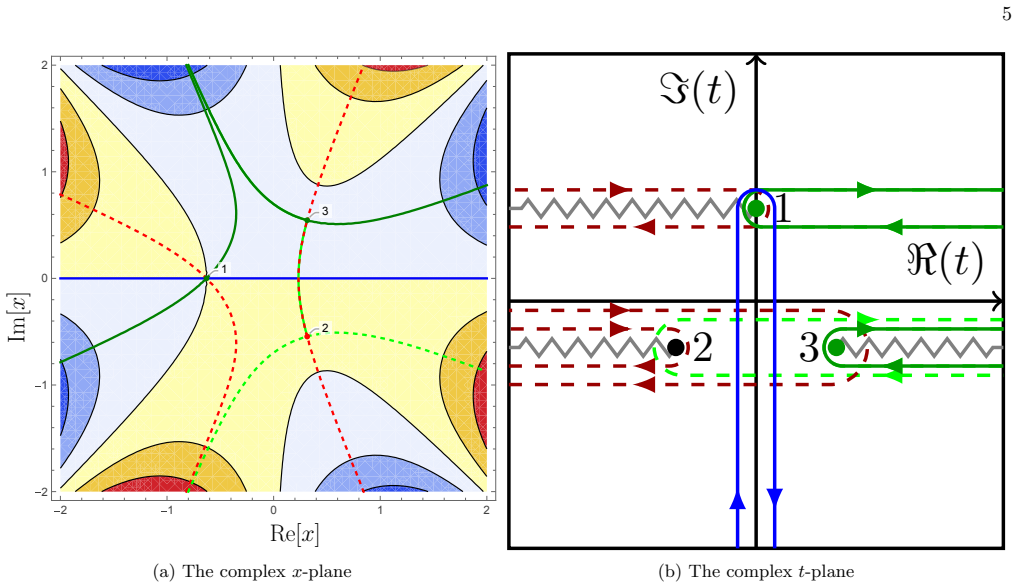
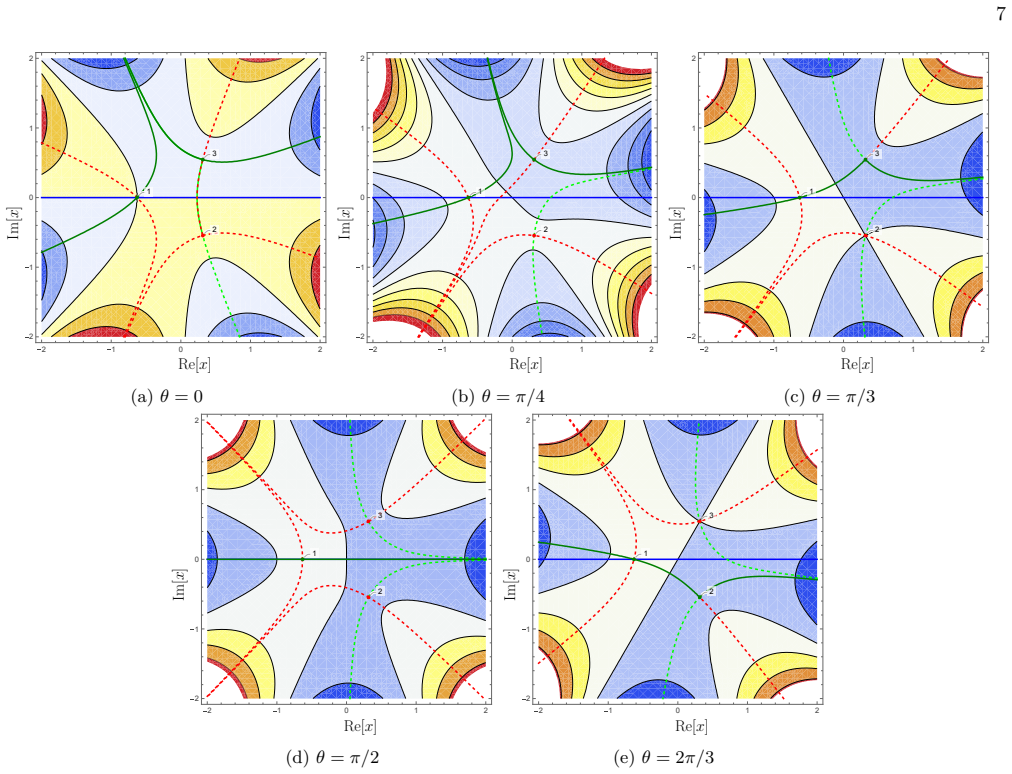
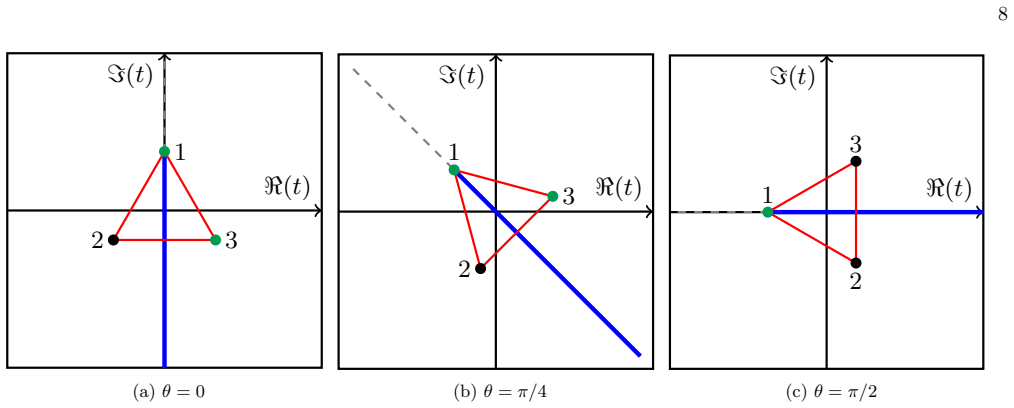
The authors claim that the intersection numbers n_j in the Picard-Lefschetz representation of the integral can be computed as follows. Start from the rotated integral at θ=π/2, where (for f bounded below) only real critical points are relevant and set their weights to 1. Then rotate back to θ=0; every adjacency-graph edge pointing from north-west to south-east, ordered by decreasing slope, corresponds to a Stokes transition that occurs exactly when that edge becomes horizontal. If the north-west endpoint is currently relevant, the south-east endpoint's weight is updated by n_k ← n_k + n_j K_jk. After all edges are processed, the saddles with non-zero weight are exactly the relevant ones. The
What carries the argument
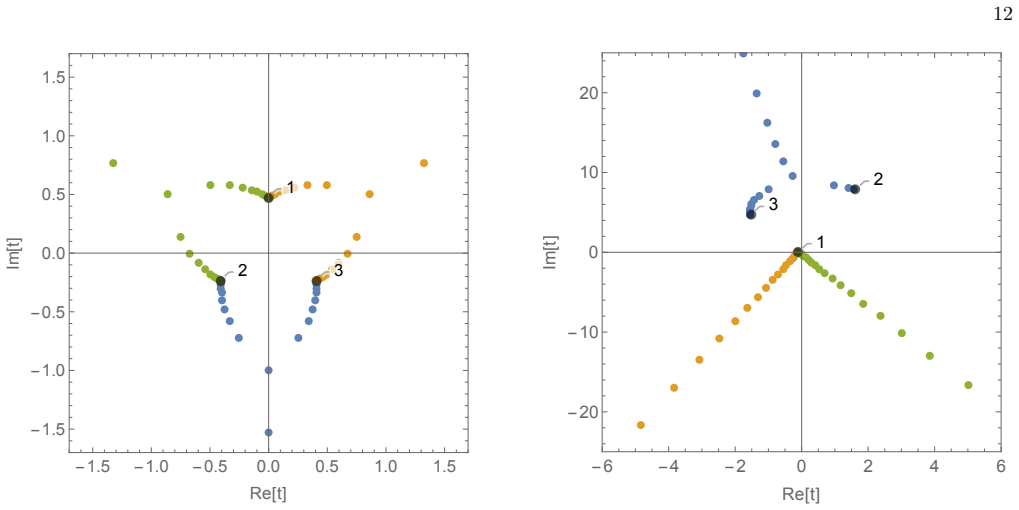
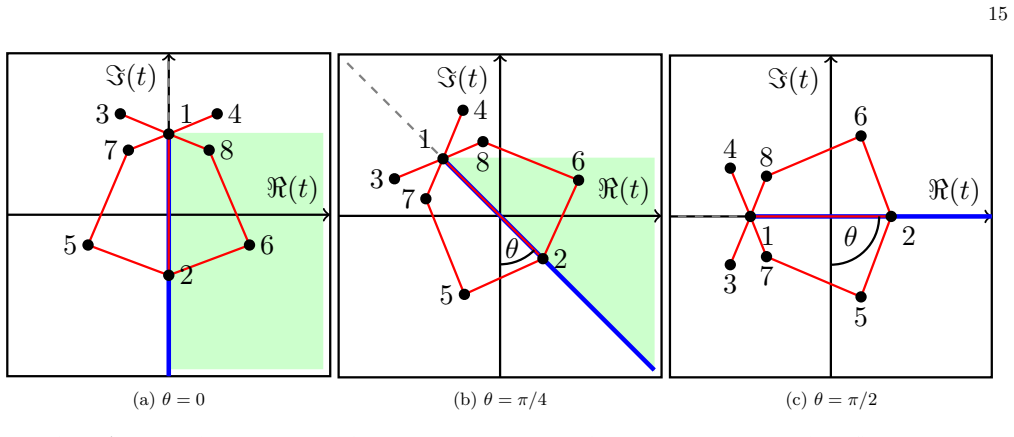
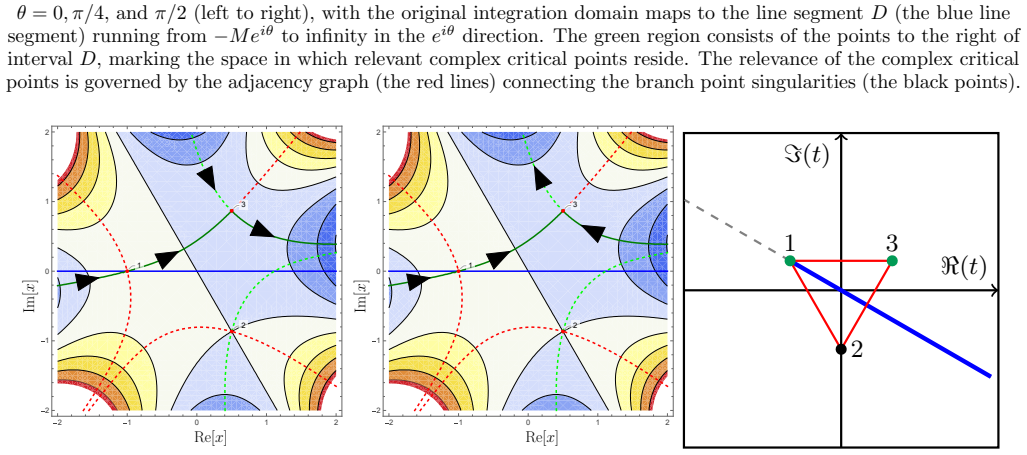
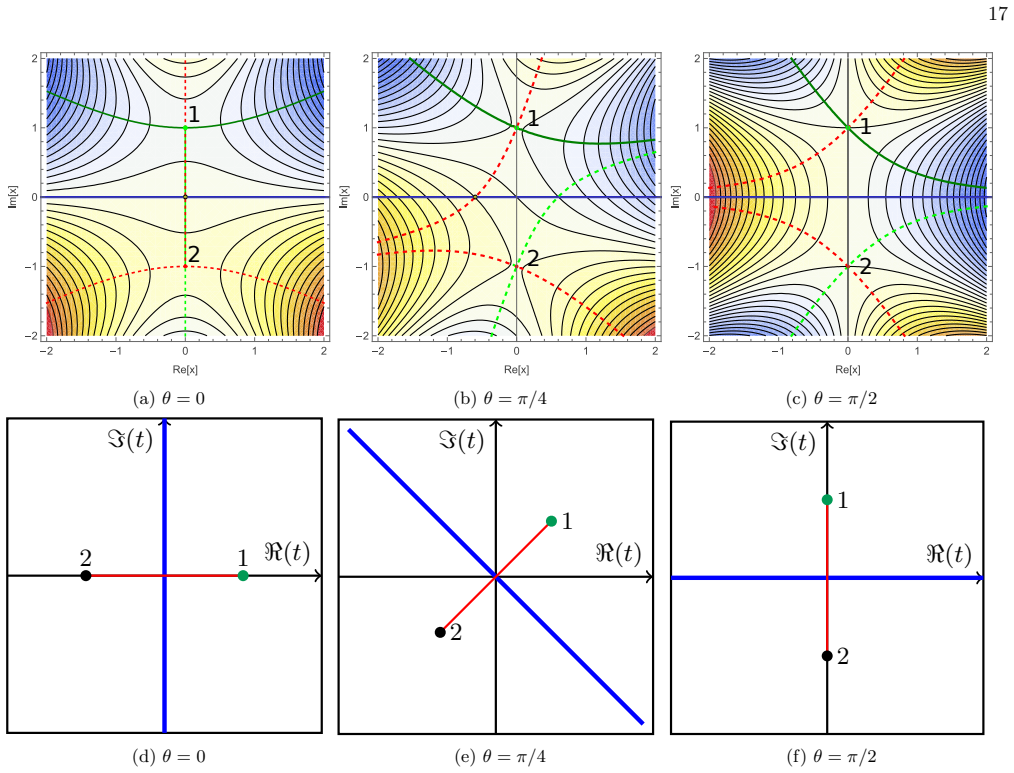
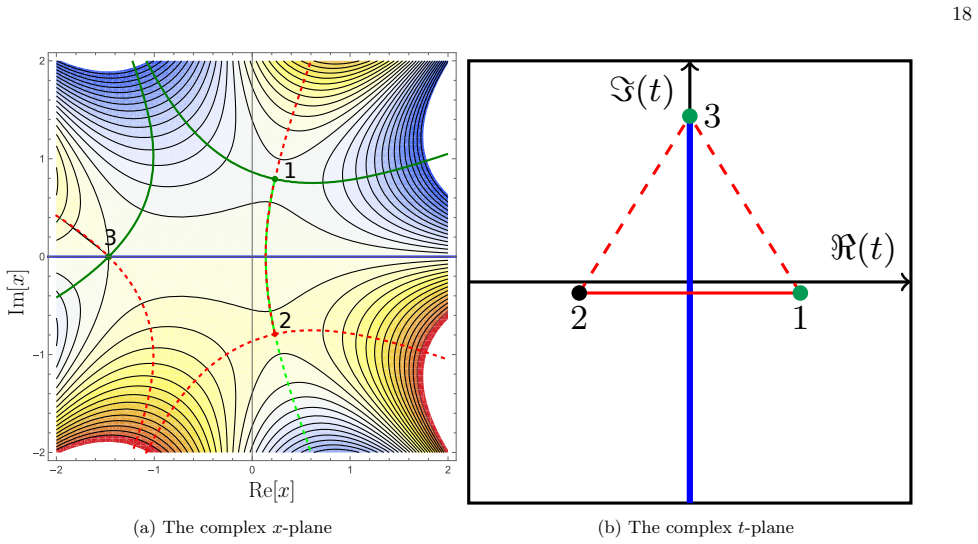
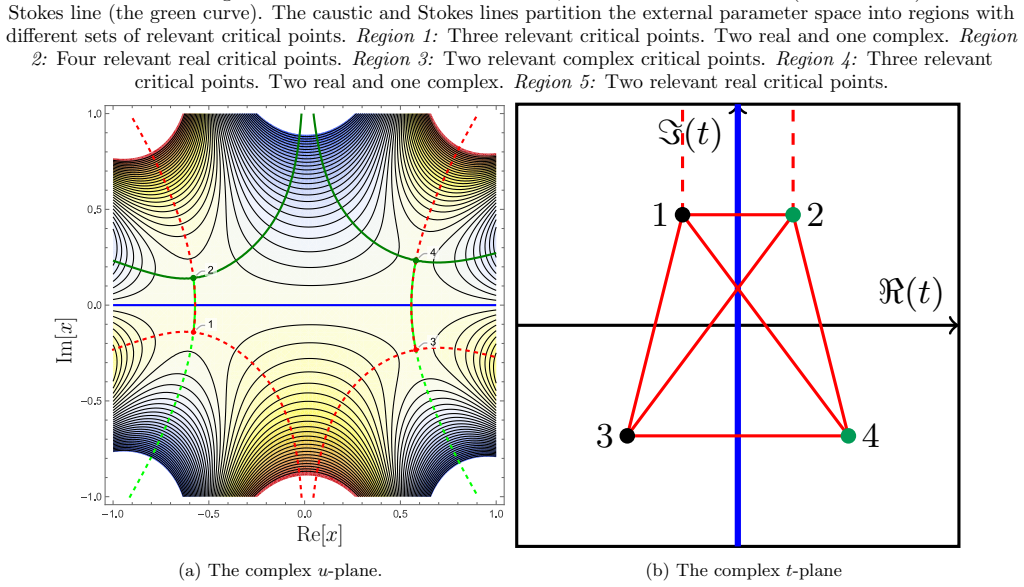
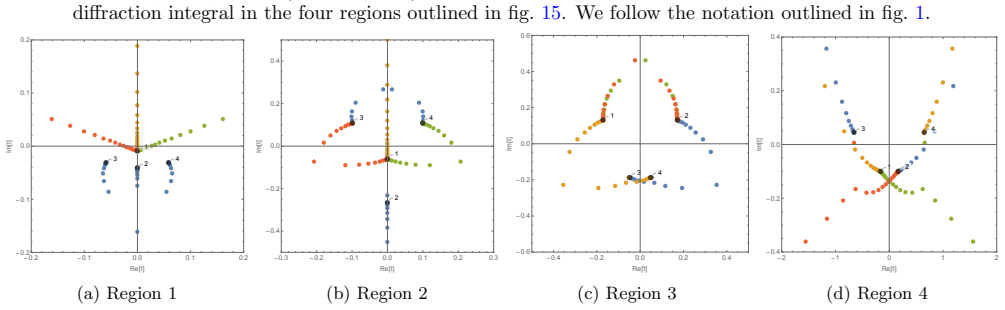
The machinery has three ingredients: (1) the critical values t_j = -i f(x_j) plotted as branch-point singularities in the complex Borel plane; (2) the adjacency graph whose vertices are these images and whose edges, labelled by Stokes constants K_jk, record which branch points are visible to each other on the same Riemann sheet; and (3) the South-East rule, which processes only edges whose direction lies in the south-east quadrant, in order of decreasing slope, updating weights at the moment the edge becomes horizontal during a rotation of the integration contour. This converts the analytic data of the asymptotic series into a finite directed bookkeeping problem.
Load-bearing premise
The load-bearing premise is that, during the rotation back from θ=π/2 to θ=0, relevance changes occur exactly when a south-east edge of the fixed adjacency graph becomes horizontal, in slope order, and that the adjacency graph does not change through higher-order Stokes phenomena — a premise the paper illustrates but does not prove.
What would settle it
Construct a two-dimensional integral whose adjacency graph contains a chain t1 → t2 → t3 where t2 is a complex saddle that becomes relevant only because t1 turns it on, and t3 relevant only because t2 turns it on; compute the exact Picard-Lefschetz weights by numerically solving the downward-flow PDE for d=2 or by direct deformation, and compare with the South-East rule output. A discrepancy in any weight would show the rule misses or overcounts in the chain case.
If this is right
- Provides a dimension-independent method to identify relevant saddles, avoiding integration of the downward-flow PDE, which becomes intractable for d>2.
- Gives a finite algorithm to compute Picard-Lefschetz intersection numbers n_j from adjacency alone, completing the earlier hyperasymptotic framework that assumed relevance known a priori.
- For real-time path integrals, it offers a systematic way to find instanton contributions and a consistent smooth Wick-rotation prescription when the potential is bounded below.
- For unbounded potentials, the regulated Airy example shows analytic continuation requires deforming the integration contour as well as the integrand, clarifying why naive Euclidean path integrals can diverge.
- Combined with Borel-Padé resummation, it yields accurate numerical values of high-dimensional oscillatory integrals without direct numerical integration.
Where Pith is reading between the lines
- The present worked examples all have the property that a complex saddle never turns on another complex saddle; the update rule allows such chains, so a natural stress test is a configuration where relevance propagates through an intermediate complex saddle — if the rule fails there, its bookkeeping premise needs an additional clause.
- The algorithm assumes the adjacency graph itself is fixed during the rotation; the paper notes adjacency can change through higher-order Stokes phenomena, so a robust implementation may need to recompute the graph at intermediate angles.
- The geometric picture suggests the rule could be reinterpreted as counting directed paths in the south-east subgraph of the adjacency graph; such a reformulation would make the algorithm transparently algebraic and may suggest topological proofs.
- For unbounded f, the regulator introduces auxiliary saddles at infinity; the order of limits (regulator removed vs. rotation) is an assumption that could be tested on a family of integrals with known exact answers.
Editorial analysis
A structured set of objections, weighed in public.
Referee Report
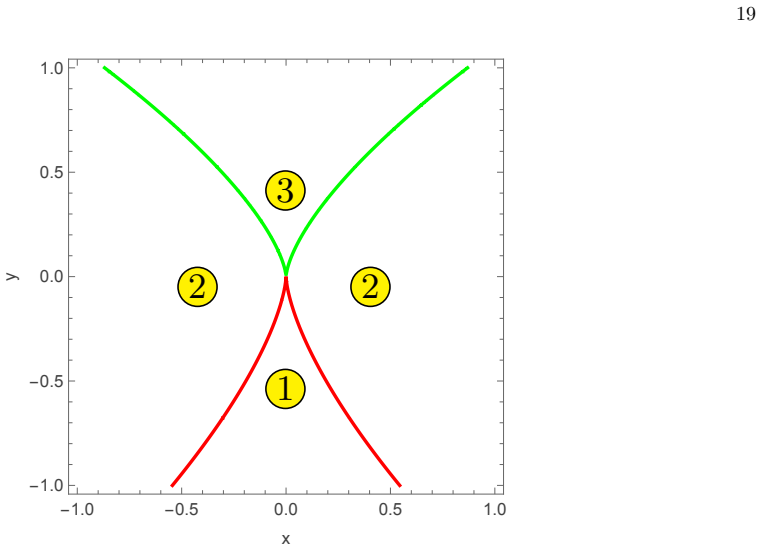
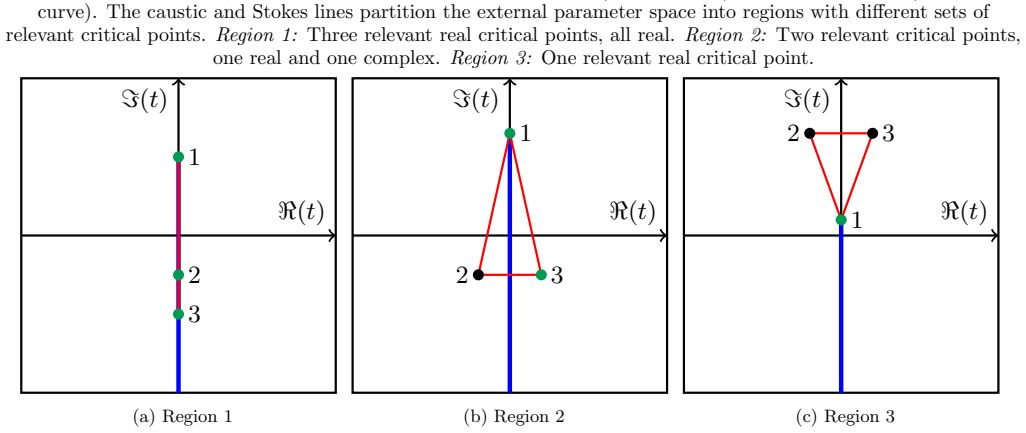
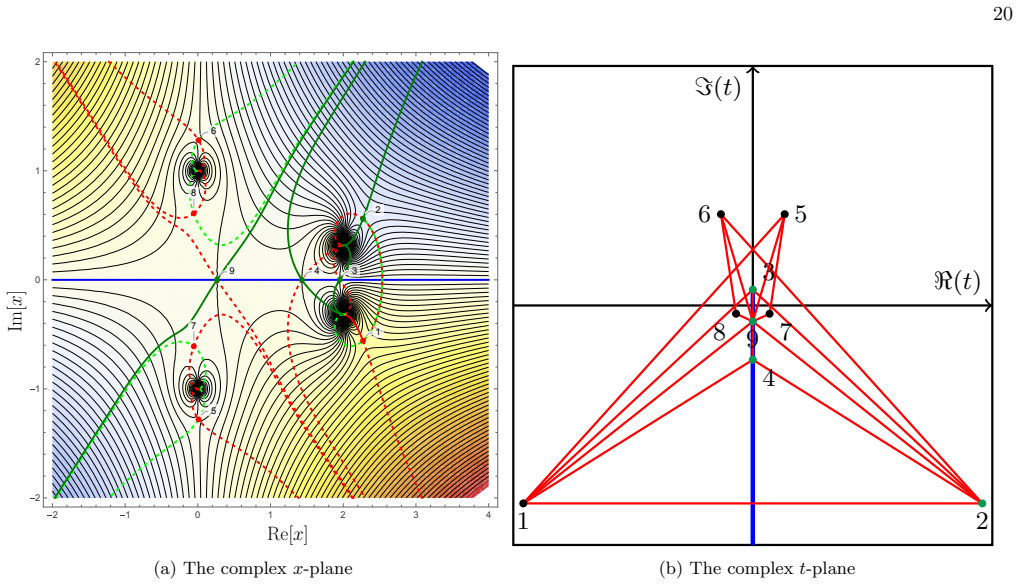
Summary. The paper proposes an algorithm ('South-East rule') to identify which critical points of a multidimensional oscillatory integral ∫ e^{ik f(x)} dx contribute to its asymptotic expansion without solving the downward-flow PDE (2). The idea is to map critical points to branch points in the Borel plane t = -i f(x), encode their Riemann-sheet connections in an adjacency graph with Stokes constants K_jk, and rotate the phase θ from π/2 back to 0, updating relevance weights n_k ← n_k + n_j K_jk whenever a South-East edge becomes horizontal. The algorithm is demonstrated on the Pearcey, lens, swallowtail, and hyperbolic umbilic integrals, and used to produce resummed asymptotic approximations of the hyperbolic integral. The paper also discusses implications for Wick rotations and path integrals.
Significance. If correct, the rule would provide a genuinely dimension-independent alternative to Picard-Lefschetz flow computations and would be useful in asymptotics and path-integral applications. The paper has clear strengths: the Borel-plane adjacency formalism is explained carefully; Stokes constants are computed independently via Borel-Padé rather than fitted; and Fig. 18 is a predictive check in which the relevant complex saddle is identified before comparison. However, the central algorithm as stated has a logical gap concerning real-real adjacencies, and the general bookkeeping principle is not proven. The evidence is mostly one-dimensional plus one reduced d=2 example, so the strong claims in the abstract are not yet fully supported.
major comments (4)
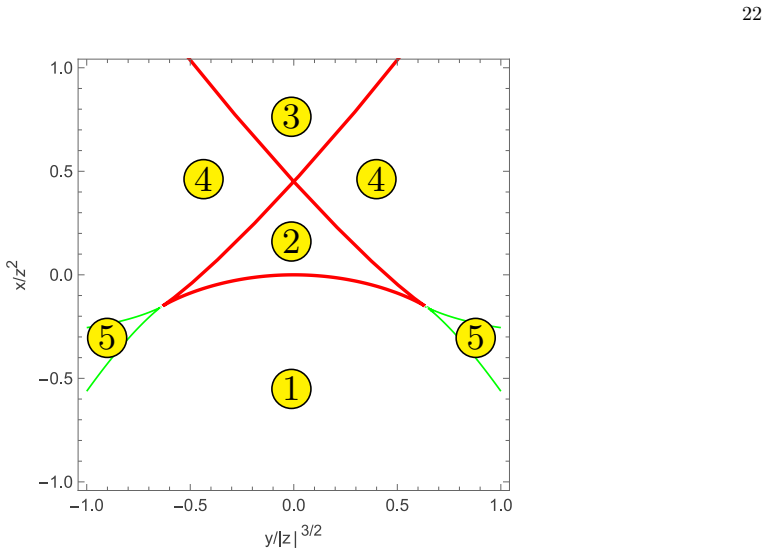
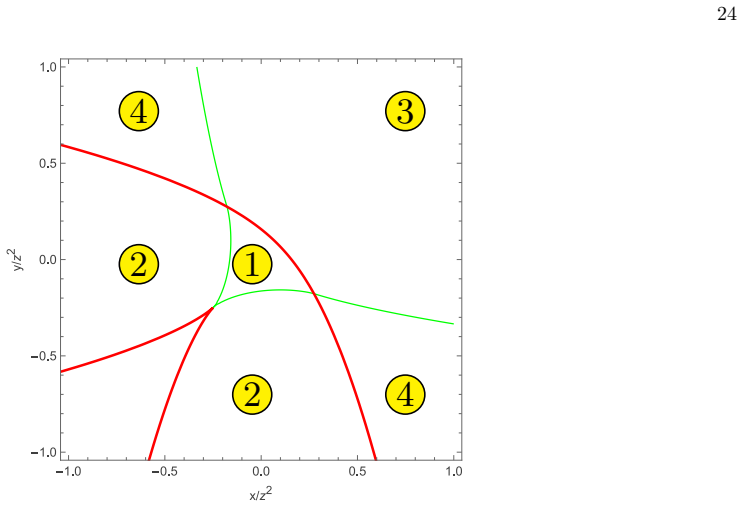
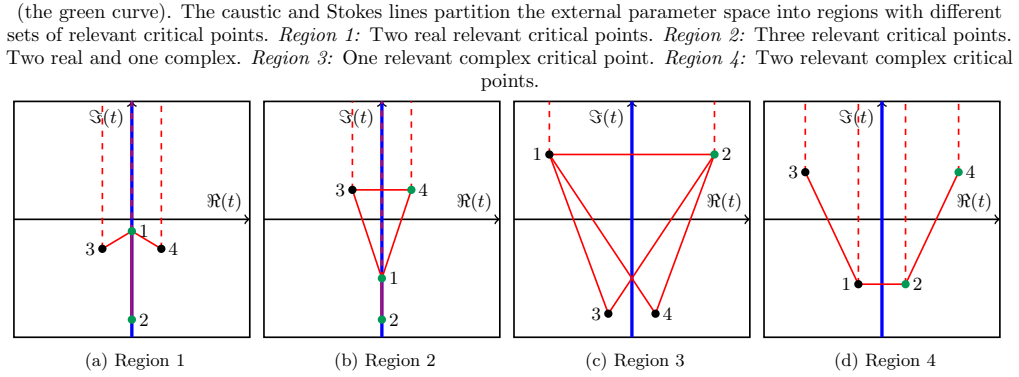
- [Algorithm 1, Steps 2-3; §VI.C] The algorithm is not well-defined for multiple real critical points. Step 2 sets n_j = 1 for every real critical point and n_j = 0 for complex points, claiming this corresponds to Ψ_{θ=π/2}. Step 3 then processes every South-East edge with slope in [-π/2,0] (Eq. 45), including vertical edges between two real critical points. A vertical edge between real critical points has slope -π/2 and is horizontal exactly at the initial angle θ=π/2; since both endpoints are initialized as relevant, Step 3 immediately gives n_k ← n_k + n_j K_jk. The paper's own region 1 of the hyperbolic umbilic (§VI.C, Fig. 16) has two adjacent real critical points 1 and 2, so K_12 ≠ 0; applying Step 3 would change the weights away from (1,1). No example runs Algorithm 1 on such a configuration, and no alternative prescription for vertical real-real edges or for the correct θ=π/2 initial weights is given. This affect
- [§V.A, §III.C, §VII] The derivation assumes that (i) the Riemann sheet structure of the Borel-plane Jacobian is completely captured by the adjacency graph, and (ii) during rotation from θ=π/2 to θ=0, relevance changes occur exactly when a South-East edge becomes horizontal, in slope order, with only the lower-right endpoint updated. No proof or precise statement of hypotheses is provided. The paper itself concedes in Section VII that adjacency relations may change as a function of ϑ via higher-order Stokes phenomena, while Algorithm 1 uses a fixed graph. Without conditions excluding such phenomena, or a proof that they do not affect the update order, the claimed dimension-independent criterion is not established. The authors should state a precise theorem and prove it for a general class, or at least for d=1 and d=2 under explicit assumptions.
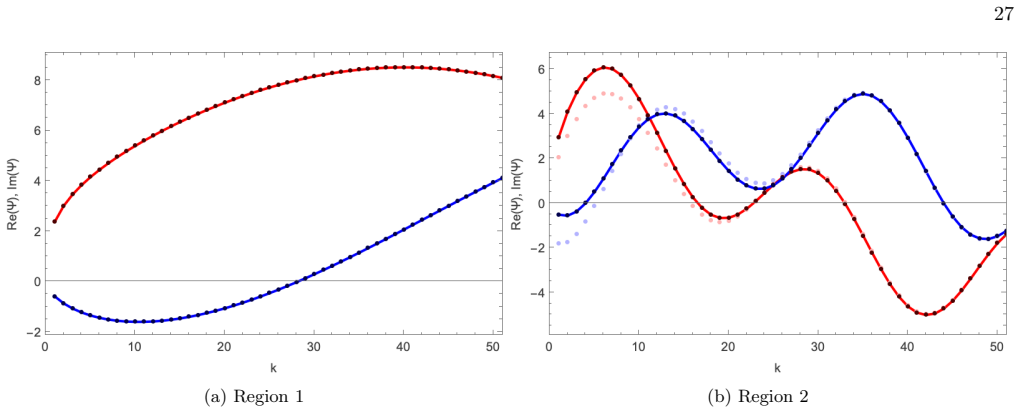
- [§VI.C, Eq. (64), Fig. 18] The demonstration does not exercise the full d-dimensional rule. The only d=2 example, the hyperbolic umbilic, is reduced to a one-dimensional integral representation (Eq. 64) for the adjacency analysis, and the numerical validation in Fig. 18 is a single visual comparison without error bars or a quantitative discrepancy measure. The paper also states at the opening of §VI that in all examples a complex critical point that becomes relevant does not turn on further complex critical points, so the general update rule (44) is never tested in the chain case. Thus the key bookkeeping assumption remains untested in exactly the situation where the algorithm is most nontrivial.
- [§V.B, Eq. (48)] The extension to unbounded f replaces f by f + r_L and defines Ψ_θ as the L→∞ limit, with the claim that dominated convergence and the vanishing of auxiliary critical points justify the procedure. The original integral is only conditionally convergent, so dominated convergence does not apply as stated, and the L→∞ limit does not trivially commute with the Picard-Lefschetz decomposition. The auxiliary critical points may turn on or off Stokes constants before moving to infinity. This is load-bearing for the claimed inclusion of unbounded f, as in the swallowtail example (59). A precise limiting argument, or at least an explicit check that the algorithm's output stabilizes as L→∞, is required.
minor comments (3)
- [§IV, Eq. (41); Algorithm 1] The sign conventions for the Stokes constants K_jk and for the initial real-saddle weights n_j are not specified. Step 2 says 'often set to 1', but the algorithm is supposed to output signed intersection numbers; an orientation rule is needed.
- [Fig. 18] The numerical comparison would be more convincing with error bars or a quantitative residual, especially since the claim is that including the complex saddle gives 'excellent improvement' for small |k|.
- [Throughout] There are several minor typographical issues, for example 'evalaution' in the caption of Fig. 3 and inconsistent accents in 'Borel-Pad´e'. These do not affect the mathematics.
Circularity Check
No significant circularity; the South-East rule is an independent geometric algorithm. Its unproven edge cases and real-real initialization are correctness/rigor risks, not circular reductions.
full rationale
The central derivation chain is: (i) Picard–Lefschetz representation with intersection numbers n_j; (ii) reduction to the Borel plane where adjacency is determined by Riemann-sheet visibility; (iii) independent extraction of Stokes constants K_jk from Borel–Padé residues of transseries coefficients (Section IV); (iv) rotation from θ=π/2 back to θ=0 with updates n_k ← n_k + n_j K_jk when a South-East edge becomes horizontal. None of these steps defines the target relevance vector n_j(0) in terms of itself. The θ=π/2 initialization n_j=1 for real critical points is not a fitted input: it is justified by Picard–Lefschetz theory (Section II: 'It follows that the real critical points are always relevant') and is not obtained from the adjacency data used to update complex points. The Stokes constants entering Step 3 are computed from large-order/Borel–Padé data independent of the unknown n_j, and the examples in Section VI are checked against known Picard–Lefschetz deformations and direct numerical comparison (Section VI.C, fig. 18, 'excellent improvement in agreement' when the predicted complex saddle is included). Thus the central claim does not reduce to its inputs. The paper's own warnings — 'the adjacency relations may change as a function of ϑ via higher-order Stokes phenomena' (Section VII) and 'our present methods are inconclusive' (Section V.B) — as well as the unaddressed real-real vertical-edge case in Algorithm 1, are correctness/rigor limitations rather than circular reductions. Self-citations to [23,26,27] provide background machinery, but adjacency is recomputed here via Borel–Padé methods and supported by independent numerical checks, so the self-citations are not load-bearing in a circular sense.
Axiom & Free-Parameter Ledger
free parameters (3)
- Initial real-saddle weights n_j =
±1 ("often set to 1")
- Regulator r_L(x) for unbounded f =
e.g. x^4/L for the Airy example
- Padé order M and conformal map in Stokes-constant extraction =
M = 30 shown in Fig. 4
axioms (6)
- domain assumption Oscillatory integrals are defined by analyticity (smooth analytic regulators), making the Picard-Lefschetz deformation exact.
- domain assumption All critical points are isolated and non-degenerate (∇f = 0, det Hf ≠ 0); critical points at infinite f are excluded.
- domain assumption The resurgence relation (15) with integer Stokes constants holds for multidimensional integrals, and adjacency is extractable from sector series.
- ad hoc to paper The Riemann sheet structure of the Borel-plane Jacobian is fully captured by the adjacency graph.
- ad hoc to paper For bounded-below f, at θ=π/2 the relevant points are exactly the real critical points with weights ±1, and rotating back to θ=0, only slope-ordered South-East edges transfer weight n_k ← n_k + n_j K_jk.
- ad hoc to paper The regulator limit L→∞ commutes with the thimble deformation; auxiliary critical points vanish in the limit.
Cite this review
Pith. "Pith review of Which Saddles Contribute? The South-East Rule for Multidimensional Integrals." pith.science (2026). https://pith.science/paper/SJO57Z6E
@misc{pith2026260628271,
  author       = {Pith},
  title        = {Pith review of: Which Saddles Contribute? The South-East Rule for Multidimensional Integrals},
  year         = {2026},
  howpublished = {\url{https://pith.science/paper/SJO57Z6E}},
  note         = {Machine review of arXiv:2606.28271}
}
read the original abstract
In this paper, we introduce and demonstrate a simple geometric algorithm to determine which critical points, both complex as well as real, contribute to the asymptotic evaluation of multiple integrals with exponential integrands of the form $e^{ikf(\boldsymbol{x})}$ over $\mathbb R^d$, for finite $d\ge 1$ and $f$ is analytic. In so doing, the algorithm removes the need to compute the flows of $-\text{Re} (i\nabla f)$ in $\mathbb C^d$ that is required to identify such relevant critical points in Picard-Lefschetz approaches to the derivation of such asymptotic expansions. By contrast, our algorithm relies on the combination of three simple features: the values of $f$ at all the critical points plotted in the complex Borel plane, the concept of adjacency between such points derived from algebraic resurgence/hyperasymptotic approaches and the new result here of a geometric "South-East" rule. The algorithm incorporates functions $f$ that remain bounded or unbounded on $\mathbb R^d$. We illustrate this new approach with both pedagogical and advanced examples, and draw conclusions as to its importance for resolving issues associated with Wick rotations and its implications for path integrals. This is a significant step towards a systematic way of identifying instanton contributions in real-time path integrals.
Figures
Reference graph
Works this paper leans on
-
[1]
Schneider, J
P. Schneider, J. Ehlers, and E. E. Falco,Gravitational Lenses(1992)
1992
-
[2]
Feldbrugge, U.-L
J. Feldbrugge, U.-L. Pen, and N. Turok, Annals of Physics451, 169255 (2023)
2023
-
[3]
B. Bonga, J. Feldbrugge, and A. R. Metidieri, Phys. Rev. D111, 063061 (2025), arXiv:2410.03828 [gr-qc]
Pith/arXiv arXiv 2025
-
[4]
J. Feldbrugge and N. Turok, arXiv e-prints , arXiv:2008.01154 (2020), arXiv:2008.01154 [gr-qc]
Pith/arXiv arXiv 2008
-
[5]
Balian, G
R. Balian, G. Parisi, and A. Voros, Phys. Rev. Lett.41, 1141 (1978)
1978
-
[6]
P. Sali` eres, B. Carr´ e, L. L. D´ eroff, F. Grasbon, G. G. Paulus, H. Walther, R. Kopold, W. Becker, D. B. Miloˇ sevi´ c, A. Sanpera, and M. Lewenstein, Science292, 902 (2001), https://www.science.org/doi/pdf/10.1126/science.108836
-
[7]
E. Pisanty, M. F. Ciappina, and M. Lewenstein, Journal of Physics: Photonics2, 034013 (2020), arXiv:2003.00277 [quant-ph]
Pith/arXiv arXiv 2020
-
[8]
D. B. Miloˇ sevi´ c, A. S. Jaˇ sarevi´ c, D. Habibovi´ c, E. Hasovi´ c, A.ˇCerki´ c, and W. Becker, J. Phys. A Math. Theor.57, 393001 (2024)
2024
-
[9]
R. P. Feynman, Reviews of Modern Physics20, 367 (1948)
1948
-
[10]
R. P. Feynman and A. R. Hibbs,Quantum mechanics and path integrals, International series in pure and applied physics (McGraw-Hill, New York, NY, 1965)
1965
-
[11]
Jones and K
D. Jones and K. M, Journal of Mathematics and Physics37, 1 (1958)
1958
-
[12]
Bleistein N., Handlesman, Journal of Mathematical Analysis and Applications27, 434 (1969)
R. Bleistein N., Handlesman, Journal of Mathematical Analysis and Applications27, 434 (1969)
1969
-
[13]
Ursell, Math
F. Ursell, Math. Proc. Camb. Phil. Soc.87, 249 (1980)
1980
-
[14]
M. V. Fedoryuk,Metod perevala(Nauka, Moscow, 1977)
1977
-
[15]
V. A. Vasiliev,Ramified Integrals(Birkh¨ auser, Boston, 1995). 28
1995
-
[16]
V. I. Arnold, A. N. Varchenko, and S. M. Gusein-Zade,Singularities of Differentiable Maps, Volume I(Birkh¨ auser, 1985)
1985
-
[17]
V. I. Arnold, A. N. Varchenko, and S. M. Gusein-Zade,Singularities of Differentiable Maps, Volume II(Birkh¨ auser, 1988)
1988
-
[18]
Wong,Asymptotic Approximations of Integrals(Academic Press, Boston, 1989)
R. Wong,Asymptotic Approximations of Integrals(Academic Press, Boston, 1989)
1989
-
[19]
Benaissa and C
A. Benaissa and C. Roger, Compte Rendus de l’Acad ’emie des Sci´ ences333, 17 (2001)
2001
-
[20]
A. Benaissa and C. Roger, Proc. Roy. Soc. Lond. A469(2013), 10.1098/rspa.2013.0109
arXiv 2013
-
[21]
N. G. de Bruijn,Asymptotic Methods in Analysis(North-Holland, Amsterdam, 1958)
1958
-
[22]
E. T. Copson,Asymptotic Expansions, Cambridge Tracts in Mathematics, Vol. 55 (Cambridge University Press, Cambridge, 1965)
1965
-
[23]
M. V. Berry and C. J. Howls, Proceedings of the Royal Society of London Series A434, 657 (1991)
1991
-
[24]
Bennett, C
T. Bennett, C. J. Howls, G. Nemes, and A. B. Olde Daalhuis, SIAM Journal on Mathematical Analysis50, 2144 (2018)
2018
-
[25]
Pham, Bulletin de la Soci´ et´ e Math´ ematique de France93, 333 (1965)
F. Pham, Bulletin de la Soci´ et´ e Math´ ematique de France93, 333 (1965)
1965
-
[26]
C. J. Howls, Proceedings of the Royal Society A: Mathematical, Physical and Engineering Sciences453, 2271 (1997), https://royalsocietypublishing.org/rspa/article-pdf/453/1966/2271/633855/rspa.1997.0122.pdf
arXiv 1997
-
[27]
Delabaere and C
E. Delabaere and C. J. Howls, Duke Mathematical Journal112, 199 (2002)
2002
-
[28]
J. Feldbrugge, J.-L. Lehners, and N. Turok, Phys. Rev. D95, 103508 (2017), arXiv:1703.02076 [hep-th]
Pith/arXiv arXiv 2017
-
[29]
F. J. Dyson, Physical Review85, 631 (1952)
1952
-
[30]
Dingle,Asymptotic Expansions: Their Derivation and Interpretation(Academic Press, 1973)
R. Dingle,Asymptotic Expansions: Their Derivation and Interpretation(Academic Press, 1973)
1973
-
[31]
´Ecalle,Les Fonctions R´ esurgentes(Publications Math´ ematiques d’Orsay, 1981) vol
J. ´Ecalle,Les Fonctions R´ esurgentes(Publications Math´ ematiques d’Orsay, 1981) vol. 1: 81-05, Vol. 2: 81-06, Vol. 3: 85-05 (published in 1981 and 1985)
1981
-
[32]
M. V. Berry and C. J. Howls, Proceedings of the Royal Society of London Series A430, 653 (1990)
1990
-
[33]
´Ecalle, inBifurcations and periodic orbits of vector fields(Springer, 1993) pp
J. ´Ecalle, inBifurcations and periodic orbits of vector fields(Springer, 1993) pp. 75–184
1993
-
[34]
A. O. Daalhuis, Journal of Computational and Applied Mathematics76, 255 (1996)
1996
-
[35]
A. O. Daalhuis, Journal of Computational and Applied Mathematics89, 87 (1998)
1998
-
[36]
Daalhuis, Research Institute for Mathematical Sciences, Kyoto University1088, 68 (1999)
A. Daalhuis, Research Institute for Mathematical Sciences, Kyoto University1088, 68 (1999)
1999
-
[37]
C. J. Howls, Proceedings of the Royal Society of London. Series A: Mathematical and Physical Sciences439, 373 (1992)
1992
-
[38]
Kaminski, Methods and Applications of Analysis1, 44 (1994)
D. Kaminski, Methods and Applications of Analysis1, 44 (1994)
1994
- [39]
-
[40]
Y. Shoji and K. Trailovi´ c, Physics Letters B873, 140198 (2026), arXiv:2510.06334 [hep-th]
arXiv 2026
-
[41]
A. B. O. Daalhuis, Proceedings: Mathematical, Physical and Engineering Sciences454, 1 (1998)
1998
-
[42]
A. B. O. Daalhuis, Proceedings of the Royal Society A: Mathematical, Physical and Engineering Sciences454, 1 (1998), https://royalsocietypublishing.org/rspa/article-pdf/454/1968/1/633921/rspa.1998.0145.pdf
arXiv 1998
-
[43]
I. Aniceto, B. Meiring, J. Jankowski, and M. Spali´ nski, JHEP02, 073 (2019), arXiv:1810.07130 [hep-th]
Pith/arXiv arXiv 2019
-
[44]
C. J. Lustri, I. Aniceto, and P. G. Kevrekidis, “Borel-pad´ e exponential asymptotics for the discrete nonlinear schr¨ odinger model with next-to-nearest neighbour interactions,” (2025), arXiv:2506.21120 [nlin.PS]
Pith/arXiv arXiv 2025
-
[45]
O. Costin and G. V. Dunne, J. Phys. A52, 445205 (2019), arXiv:1904.11593 [hep-th]
Pith/arXiv arXiv 2019
-
[46]
Costin and G
O. Costin and G. V. Dunne, The European Physical Journal Special Topics230, 2679 (2021)
2021
-
[47]
M. Serone, G. Spada, and G. Villadoro, Journal of High Energy Physics2017, 56 (2017), arXiv:1702.04148 [hep-th]
Pith/arXiv arXiv 2017
-
[48]
R. C. Assier, A. V. Shanin, and A. I. Korolkov, arXiv e-prints , arXiv:2204.02729 (2022), arXiv:2204.02729 [math.AP]
Pith/arXiv arXiv 2022
-
[49]
A. V. Shanin, A. I. Korolkov, N. M. Artemov, and R. C. Assier, arXiv e-prints , arXiv:2412.02481 (2024), arXiv:2412.02481 [math-ph]
arXiv 2024
-
[50]
Kaminski and R
D. Kaminski and R. B. Paris, SIAM Review39, 503 (1997)
1997
-
[51]
Kaminski and R
D. Kaminski and R. B. Paris, Proceedings of the Royal Society of London. Series A: Mathematical, Physical and Engineering Sciences453, 2695 (1997)
1997
-
[52]
J. Feldbrugge and N. Turok, Annals of Physics454, 169315 (2023), arXiv:2207.12798 [hep-th]
Pith/arXiv arXiv 2023
-
[53]
Pham,Singularities of integrals: Homology, hyperfunctions and microlocal analysis, Universitext (Springer Science & Business Media, 2011)
F. Pham,Singularities of integrals: Homology, hyperfunctions and microlocal analysis, Universitext (Springer Science & Business Media, 2011)
2011
-
[54]
Howls, P
C. Howls, P. Langman, and A. Olde Daalhuis, Proceedings of the Royal Society of London. Series A: Mathematical, Physical and Engineering Sciences460, 2285 (2004)
2004
-
[55]
§36.2 definitions and basic properties,
NIST Digital Library of Mathematical Functions, “§36.2 definitions and basic properties,”https://dlmf.nist.gov/36.2 (2025), equation 36.2.10, Release 1.2.4 of 2025-03-15
2025
-
[56]
I. Aniceto, G. Basar, and R. Schiappa, Phys. Rept.809, 1 (2019), arXiv:1802.10441 [hep-th]
Pith/arXiv arXiv 2019
-
[57]
Nemes, Constr
G. Nemes, Constr. Approx.38, 471–487 (2013)
2013
-
[58]
J. Feldbrugge, S. Crew, and U.-L. Pen, arXiv e-prints , arXiv:2602.21493 (2026), arXiv:2602.21493 [astro-ph.CO]
arXiv 2026
-
[59]
D. S. Gaunt and A. J. Gutmann, Physics Reports3, 181 (1974)
1974
-
[60]
Henrici,Applied and Computational Complex Analysis, Vol
P. Henrici,Applied and Computational Complex Analysis, Vol. 1 (Wiley, New York, 1977)
1977
-
[61]
A. B. Olde Daalhuis and F. W. J. Olver, Methods and Applications of Analysis2, 173 (1995)
1995
-
[62]
Introduction to 1-summability and resurgence,
D. Sauzin, “Introduction to 1-summability and resurgence,” (2014), arXiv:1405.0356 [math.DS]
Pith/arXiv arXiv 2014
-
[63]
Voros, Annales de l’I.H.P
A. Voros, Annales de l’I.H.P. Physique th´ eorique39, 211 (1983)
1983
-
[64]
U. D. Jentschura and G. Soff, J. Phys. A: Math. Gen.34, 1451 (2001)
2001
-
[65]
Caliceti, M
E. Caliceti, M. Meyer-Hermann, P. Ribeca, A. Surzhykov, and U. D. Jentschura, Phys. Rep.446, 1 (2007)
2007
-
[66]
Pad´ e approximants, encyclopedia of mathematics,
P. Graves-Morris and G. Baker, “Pad´ e approximants, encyclopedia of mathematics,” (1981)
1981
-
[67]
G. W. Gibbons, S. W. Hawking, and M. J. Perry, Nuclear Physics B138, 141 (1978). 29
1978
-
[68]
S. W. Hawking, inGeneral Relativity: An Einstein centenary survey, edited by S. W. Hawking and W. Israel (1979) pp. 746–789
1979
-
[69]
P. O. Mazur and E. Mottola, Nuclear Physics B341, 187 (1990)
1990
-
[70]
E. Y. Loh, Jr., J. E. Gubernatis, R. T. Scalettar, S. R. White, D. J. Scalapino, and R. L. Sugar, Phys. Rev. B41, 9301 (1990)
1990
-
[71]
T. D. Kieu and C. J. Griffin, Phys. Rev. E49, 3855 (1994), arXiv:hep-lat/9311072 [hep-lat]
Pith/arXiv arXiv 1994
-
[72]
G. Pan and Z. Y. Meng, arXiv e-prints , arXiv:2204.08777 (2022), arXiv:2204.08777 [cond-mat.str-el]
Pith/arXiv arXiv 2022
-
[73]
NIST Digital Library of Mathematical Functions,
DLMF, “NIST Digital Library of Mathematical Functions,”https://dlmf.nist.gov/, Release 1.2.6 of 2026-03-15, f. W. J. Olver, A. B. Olde Daalhuis, D. W. Lozier, B. I. Schneider, R. F. Boisvert, C. W. Clark, B. R. Miller, B. V. Saunders, H. S. Cohl, and M. A. McClain, eds
2026
-
[74]
M. V. Berry and C. J. Howls, Nonlinearity3, 281 (1990)
1990
-
[75]
G. V. Dunne and M. ¨Unsal, Journal of High Energy Physics2012, 170 (2012), arXiv:1210.2423 [hep-th]
Pith/arXiv arXiv 2012
-
[76]
G. Basar, G. V. Dunne, and M. ¨Unsal, Journal of High Energy Physics2017, 87 (2017), arXiv:1701.06572 [hep-th]
Pith/arXiv arXiv 2017
-
[77]
M. Mari˜ no and T. Reis, (2019), 10.1088/1742-5468/ab4802, arXiv:1905.09569 [hep-th]
Pith/arXiv arXiv 2019
-
[78]
T. Fujimori, M. Honda, S. Kamata, T. Misumi, N. Sakai, and T. Yoda, PTEP2021, 103B04 (2021), arXiv:2103.13654 [hep-th]
Pith/arXiv arXiv 2021
-
[79]
Z. Bajnok, J. Balog, A. Hegedus, and I. Vona, JHEP09, 001 (2022), arXiv:2204.13365 [hep-th]
Pith/arXiv arXiv 2022
-
[80]
R. Schiappa, M. Schwick, and N. Tamarin, SciPost Phys.20, 135 (2026), arXiv:2301.05214 [hep-th]
Pith/arXiv arXiv 2026
This paper was first reviewed by deepseek-v4-flash on August 2, 2026.
discussion (0)
Sign in with ORCID, Apple, or X to comment. Anyone can read and Pith papers without signing in.