Isospin-Driven Splitting of Chemical Potentials in Isobar Collisions from Lattice QCD
Pith reviewed 2026-06-30 03:39 UTC · model grok-4.3
The pith
Lattice QCD maps isospin differences between Ru and Zr nuclei to chemical potential splittings dominated by the electric charge sector.
A machine-rendered reading of the paper's core claim, the machinery that carries it, and where it could break.
Core claim
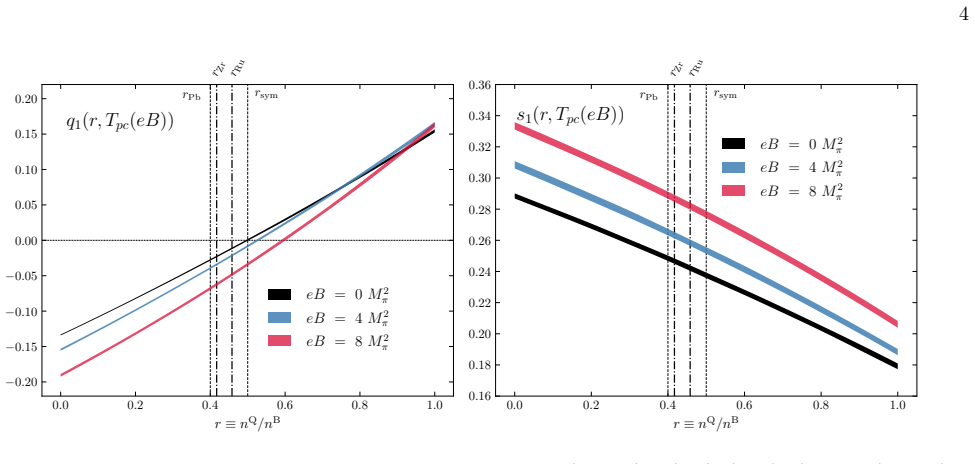
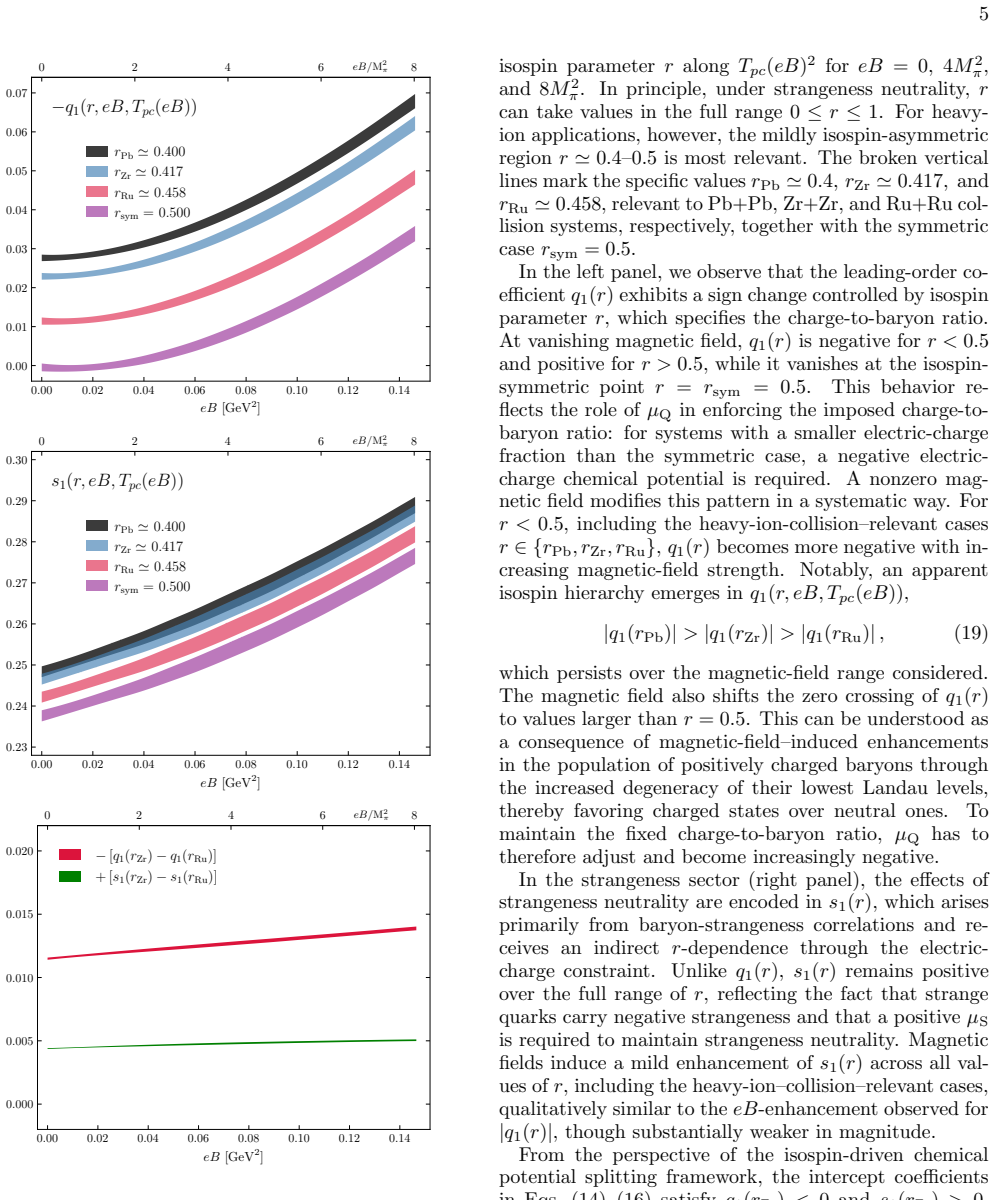
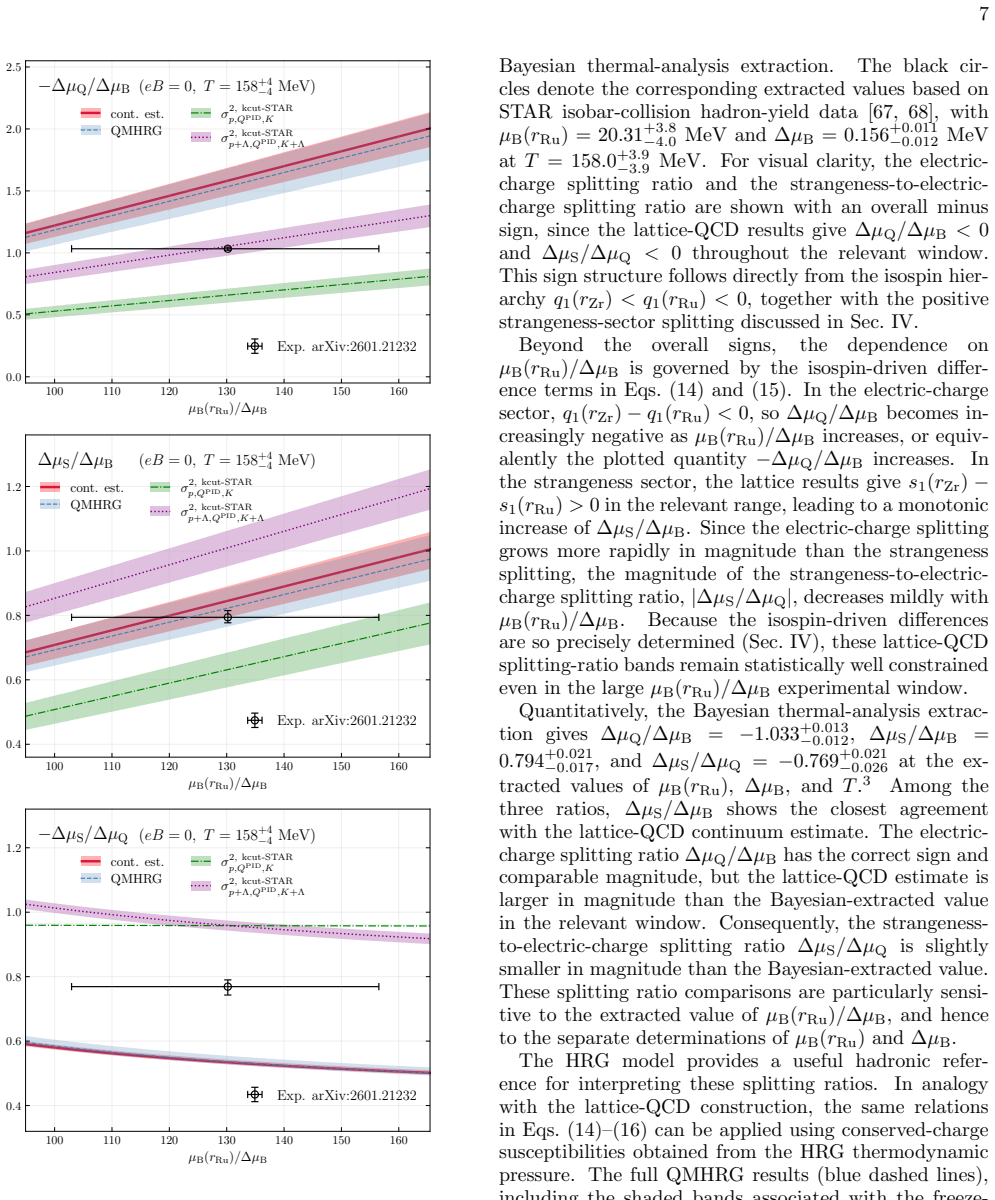
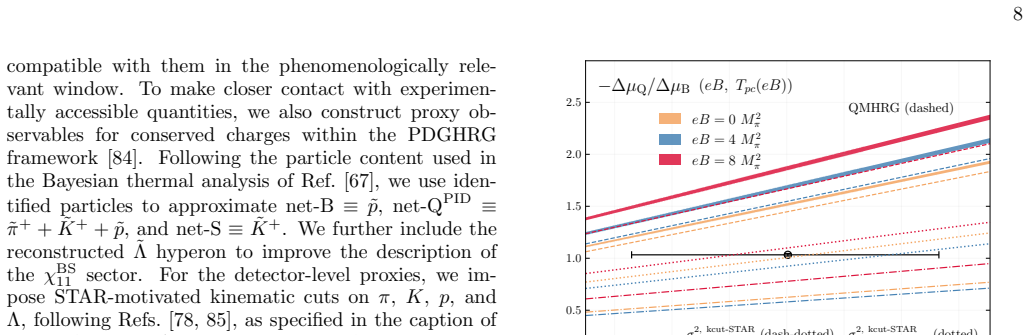
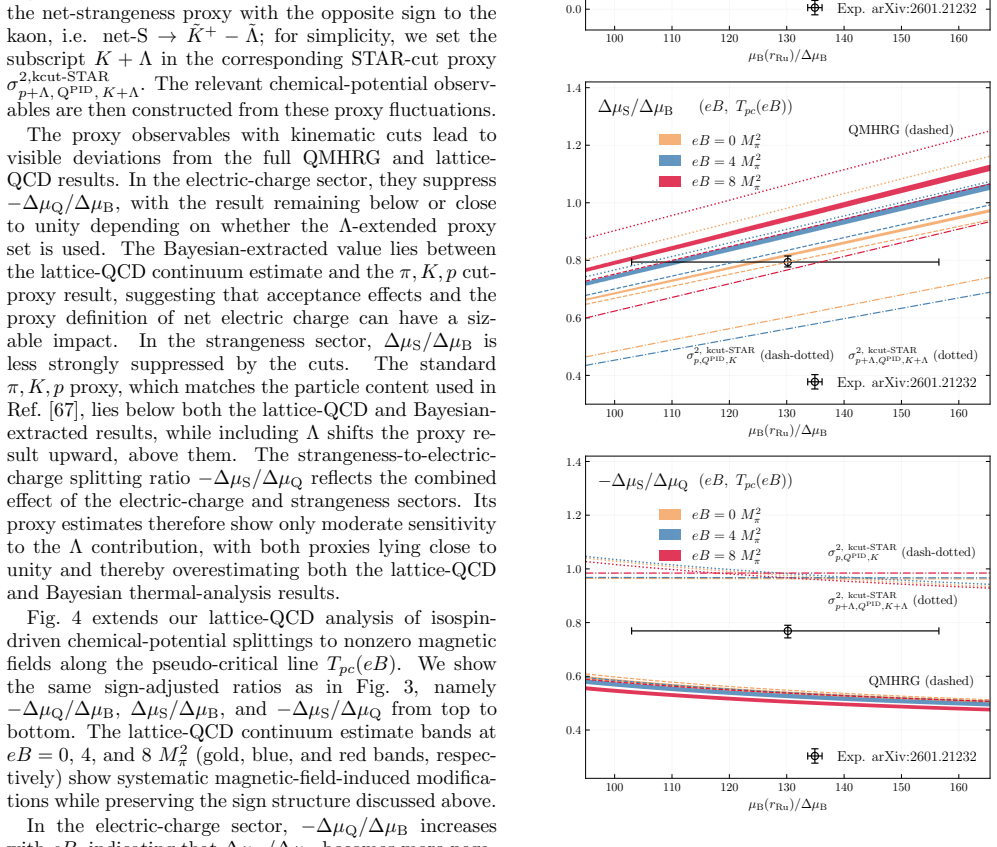
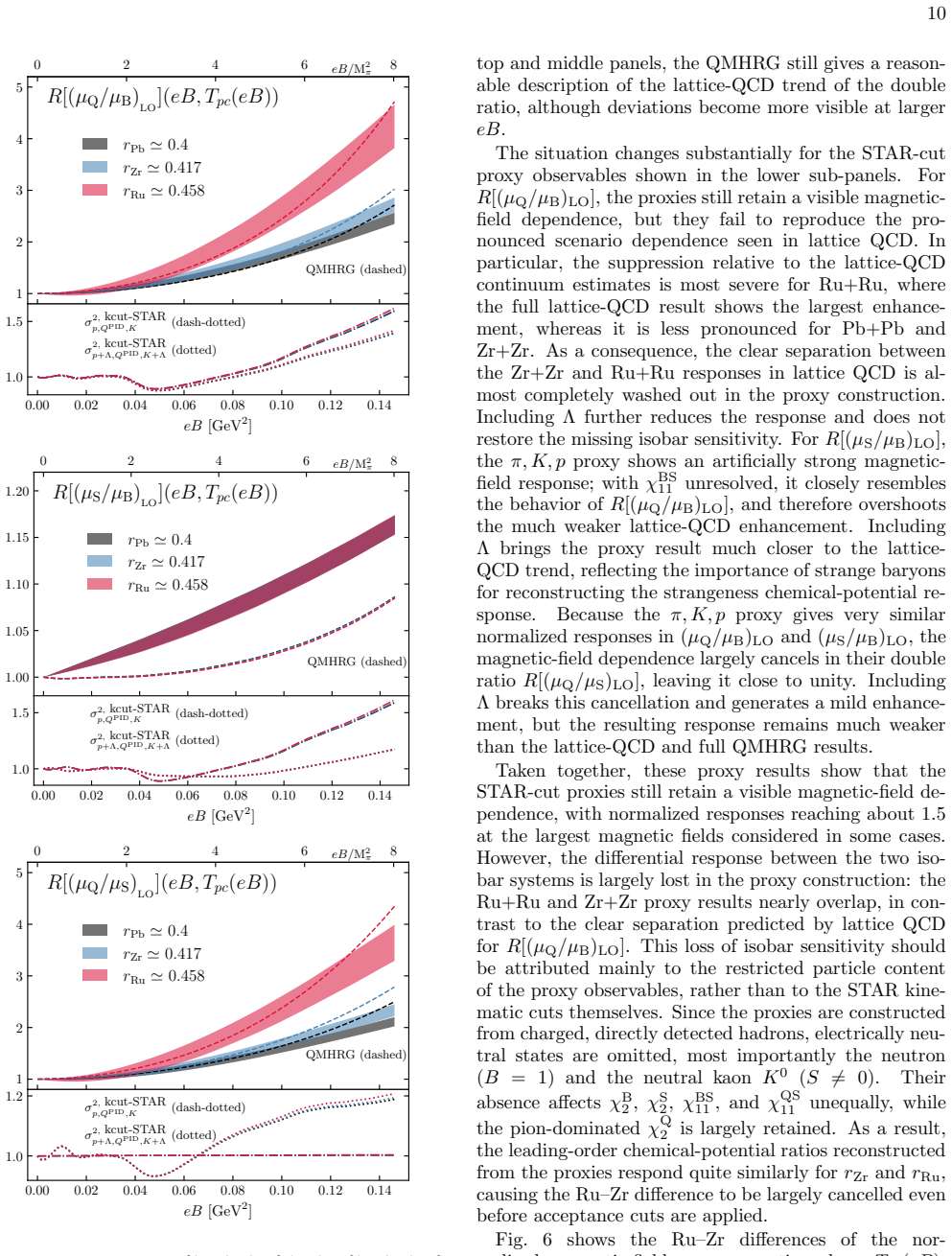
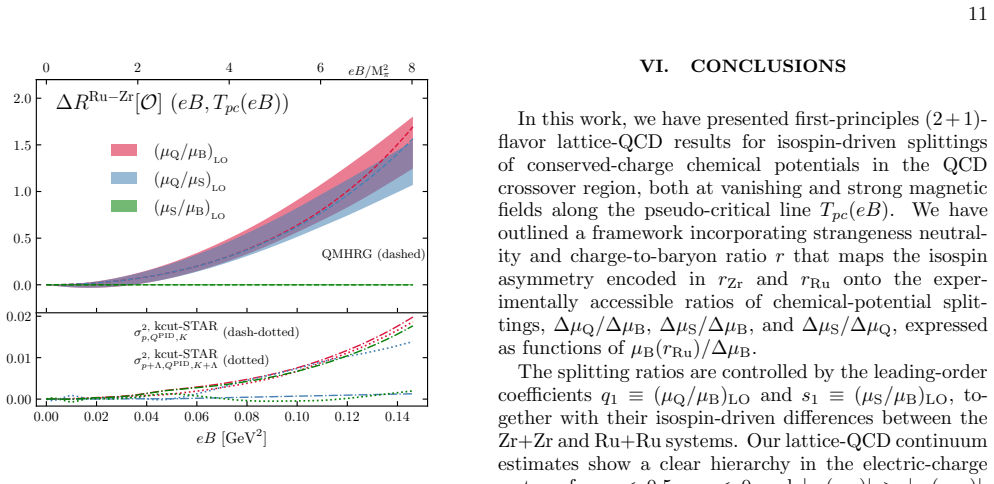
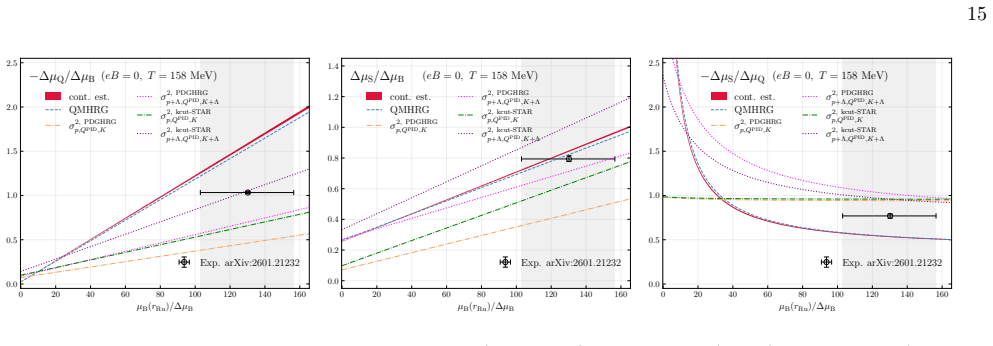
Using continuum-estimated lattice results for the leading-order coefficients q1 ≡ (μ_Q/μ_B)_LO and s1 ≡ (μ_S/μ_B)_LO, the splitting ratios at vanishing magnetic field are of similar magnitude to recent Bayesian extractions from STAR isobar data and yield Δμ_Q < 0 and Δμ_S > 0, with the electric-charge sector dominating; at nonzero magnetic fields the splitting ratios show only moderate eB dependence while Ru-Zr differences in the normalized magnetic-field response of chemical-potential ratios display a pronounced enhancement.
What carries the argument
The mapping framework that, under strangeness neutrality and charge-to-baryon ratio r ≡ n_Q/n_B, converts the isospin difference between the nuclei (encoded in r_Zr and r_Ru) into the splitting ratios Δμ_Q/Δμ_B, Δμ_S/Δμ_B and Δμ_S/Δμ_Q as functions of μ_B(r_Ru)/Δμ_B, using the lattice coefficients q1 and s1.
If this is right
- The electric-charge sector dominates the isospin-driven chemical-potential splitting between the two isobar systems.
- Δμ_Q is negative while Δμ_S is positive at vanishing magnetic field.
- The splitting ratios exhibit only moderate dependence on magnetic-field strength along the pseudo-critical line.
- Ru-Zr differences in the normalized magnetic-field response of ratios involving μ_Q/μ_B are pronouncedly enhanced.
Where Pith is reading between the lines
- The lattice baseline can be used to test or refine Bayesian extractions of chemical potentials from existing or future isobar data.
- Extension of the calculation to next-to-leading order in the chemical-potential expansion would test whether the reported ratios remain stable.
- The enhanced magnetic response may produce measurable effects in fluctuation observables once strong fields are included in hydrodynamic modeling.
Load-bearing premise
The leading-order lattice coefficients together with the mapping under strangeness neutrality and fixed charge-to-baryon ratio capture the full isospin-driven splittings without sizable higher-order corrections in the chemical potentials.
What would settle it
An extraction from isobar collision data that finds splitting ratios with the opposite sign for Δμ_Q or magnitudes differing by more than roughly a factor of two from the lattice values at zero magnetic field would falsify the central result.
Figures
read the original abstract
Strong magnetic fields produced in relativistic heavy-ion collisions can modify fluctuations of conserved charges and, consequently, their associated chemical potentials. We present first-principles $(2+1)$-flavor lattice-QCD results for isospin-driven splittings of conserved-charge chemical potentials between the isobar systems $^{96}_{44}\mathrm{Ru}+^{96}_{44}\mathrm{Ru}$ and $^{96}_{40}\mathrm{Zr}+^{96}_{40}\mathrm{Zr}$ in the QCD crossover region, both at vanishing and nonzero magnetic fields along the pseudo-critical line $T_{pc}(eB)$. We outline a framework that, under strangeness neutrality and charge-to-baryon ratio $r\equiv n_{\rm Q}/n_{\rm B}$, maps the isospin difference between two nuclei, as encoded in $r_{\rm Zr}$ and $r_{\rm Ru}$, onto splitting ratios $\Delta\mu_{\rm Q}/\Delta\mu_{\rm B}$, $\Delta\mu_{\rm S}/\Delta\mu_{\rm B}$, and $\Delta\mu_{\rm S}/\Delta\mu_{\rm Q}$ as functions of $\mu_{\rm B}(r_{\rm Ru})/\Delta\mu_{\rm B}$. Using continuum-estimated lattice results for the leading-order coefficients $q_1\equiv(\mu_{\rm Q}/\mu_{\rm B})_{\rm LO}$ and $s_1\equiv(\mu_{\rm S}/\mu_{\rm B})_{\rm LO}$, we find that, at vanishing magnetic field, the splitting ratios are of similar magnitude to recent Bayesian extractions from STAR isobar data and yield $\Delta\mu_{\rm Q}<0$ and $\Delta\mu_{\rm S}>0$, with the electric-charge sector dominating. At nonzero magnetic fields, the splitting ratios show only moderate $eB$ dependence. We therefore further examine Ru--Zr differences in the normalized magnetic-field response of chemical-potential ratios, particularly those involving $\mu_{\rm Q}/\mu_{\rm B}$, which display a pronounced enhancement in lattice QCD. We also present hadron resonance gas (HRG) results and experimentally motivated proxy observables with kinematic cuts to facilitate contact with experiment.
Editorial analysis
A structured set of objections, weighed in public.
Referee Report
Summary. The manuscript computes (2+1)-flavor lattice QCD results for isospin-driven splittings of conserved-charge chemical potentials between ^{96}Ru+^{96}Ru and ^{96}Zr+^{96}Zr collisions in the crossover region. It outlines a framework under strangeness neutrality and fixed charge-to-baryon ratio r that maps the nuclear isospin difference (via r_Zr and r_Ru) onto the splitting ratios Δμ_Q/Δμ_B, Δμ_S/Δμ_B, and Δμ_S/Δμ_Q expressed as functions of μ_B(r_Ru)/Δμ_B. Using continuum-estimated leading-order coefficients q1 ≡ (μ_Q/μ_B)_LO and s1 ≡ (μ_S/μ_B)_LO, the work reports that at vanishing magnetic field the ratios have magnitudes similar to STAR Bayesian extractions, with Δμ_Q < 0, Δμ_S > 0 and the electric-charge sector dominating; moderate eB dependence is found along T_pc(eB), together with an enhanced magnetic response in certain normalized ratios. HRG results and kinematic-cut proxy observables are also presented.
Significance. If the central results hold, the paper supplies first-principles lattice input that directly connects isospin asymmetry in isobar systems to observable chemical-potential splittings, enabling quantitative comparison with STAR data and offering a controlled way to assess magnetic-field effects. The continuum estimation of the LO coefficients, the explicit inclusion of nonzero eB along the pseudo-critical line, and the provision of HRG benchmarks for experimental contact are concrete strengths that increase the utility of the work for the heavy-ion community.
major comments (2)
- [Abstract (framework paragraph)] Abstract, paragraph beginning 'We outline a framework': the splitting ratios are presented as functions of μ_B(r_Ru)/Δμ_B, yet they are obtained from the μ_B-independent LO coefficients q1 and s1 solved at μ=0. At the finite μ_B/T ≳ 1 values probed by the collisions, NLO terms involving fourth-order susceptibilities (χ_4^B, χ_3^{BQ}, χ_2^{BQS}) enter the full solution for μ_Q and μ_S; because r_Ru ≠ r_Zr these corrections need not cancel in Δμ_Q and Δμ_S, so the reported signs, the claimed similarity to STAR values, and the dominance of the electric-charge sector could shift. This approximation is load-bearing for the headline comparison and requires either an explicit NLO calculation or a quantitative justification that the corrections remain negligible.
- [Abstract] Abstract, sentence on vanishing-B results: the statement that the splitting ratios 'are of similar magnitude to recent Bayesian extractions from STAR isobar data' is made without reference to the specific μ_B range or to any error budget on the lattice side. Because the LO coefficients are external inputs and the framework does not reduce the splittings to quantities obtained from the authors' own fits, it is unclear whether the similarity survives once the μ_B dependence implicit in the STAR extraction is folded in.
minor comments (2)
- [Abstract] The notation r_Zr and r_Ru is introduced without an explicit definition or numerical values; adding a short table or sentence giving the charge-to-baryon ratios for the two nuclei would improve readability.
- [Abstract] The phrase 'continuum-estimated lattice results' for q1 and s1 appears without a citation to the underlying lattice ensembles or to the reference that performed the continuum extrapolation; a pointer to that work is needed for reproducibility.
Simulated Author's Rebuttal
We thank the referee for the careful reading and constructive comments. We address each major point below and agree that revisions will strengthen the presentation of the LO framework and the comparison to STAR data.
read point-by-point responses
-
Referee: [Abstract (framework paragraph)] Abstract, paragraph beginning 'We outline a framework': the splitting ratios are presented as functions of μ_B(r_Ru)/Δμ_B, yet they are obtained from the μ_B-independent LO coefficients q1 and s1 solved at μ=0. At the finite μ_B/T ≳ 1 values probed by the collisions, NLO terms involving fourth-order susceptibilities (χ_4^B, χ_3^{BQ}, χ_2^{BQS}) enter the full solution for μ_Q and μ_S; because r_Ru ≠ r_Zr these corrections need not cancel in Δμ_Q and Δμ_S, so the reported signs, the claimed similarity to STAR values, and the dominance of the electric-charge sector could shift. This approximation is load-bearing for the headline comparison and requires either an explicit NLO calculation or a quantitative justification that the corrections remain negligible.
Authors: We agree that the framework relies on LO coefficients and that NLO contributions from fourth-order susceptibilities could in principle modify the splitting ratios at finite μ_B. However, the isospin-driven splittings Δμ_Q and Δμ_S are generated at leading order by the difference in r between the two nuclei; higher-order terms enter as corrections whose relative size can be estimated from existing lattice results on χ_4^B, χ_3^{BQ} and χ_2^{BQS}. Published values indicate that these corrections remain below ~15% for μ_B/T ≲ 2 in the crossover region. We will add a dedicated paragraph in the revised manuscript that (i) recalls the NLO expansion, (ii) quotes the relevant lattice susceptibilities, and (iii) shows that the signs, the dominance of the electric-charge sector, and the order-of-magnitude agreement with STAR survive after inclusion of these estimates. This supplies the quantitative justification requested without requiring a full NLO re-calculation of the entire isobar mapping. revision: yes
-
Referee: [Abstract] Abstract, sentence on vanishing-B results: the statement that the splitting ratios 'are of similar magnitude to recent Bayesian extractions from STAR isobar data' is made without reference to the specific μ_B range or to any error budget on the lattice side. Because the LO coefficients are external inputs and the framework does not reduce the splittings to quantities obtained from the authors' own fits, it is unclear whether the similarity survives once the μ_B dependence implicit in the STAR extraction is folded in.
Authors: We will revise the abstract and the main text to (i) state the μ_B range corresponding to the QCD crossover region explored (μ_B/T ≲ 2–3), (ii) quote the numerical values and uncertainties of the continuum-estimated q1 and s1, and (iii) compare the resulting splitting ratios directly with the μ_B-dependent STAR Bayesian bands. The similarity in magnitude is preserved within these ranges; the revised wording will make the comparison transparent and will clarify that the lattice coefficients carry their own (small) systematic errors. revision: yes
Circularity Check
No significant circularity; lattice inputs independent of target ratios
full rationale
The paper computes leading-order coefficients q1 ≡ (μ_Q/μ_B)_LO and s1 ≡ (μ_S/μ_B)_LO from second-order susceptibilities on the lattice at vanishing chemical potential under strangeness neutrality and fixed r. These serve as external first-principles inputs to map isospin differences (r_Zr vs r_Ru) onto splitting ratios. The framework and resulting Δμ_Q < 0, Δμ_S > 0 are not obtained by fitting to the target splittings or to STAR data; the comparison to Bayesian extractions is external. No self-definitional reduction, fitted-input-as-prediction, or load-bearing self-citation chain is present. The derivation remains self-contained against external benchmarks.
Axiom & Free-Parameter Ledger
free parameters (1)
- charge-to-baryon ratio r
axioms (2)
- domain assumption strangeness neutrality
- domain assumption leading-order truncation in chemical potentials
Reference graph
Works this paper leans on
-
[1]
D.E. Kharzeev, L.D. McLerran and H.J. Warringa,The Effects of topological charge change in heavy ion collisions: ’Event by event P and CP violation’,Nucl. Phys.A803(2008) 227 [0711.0950]
Pith/arXiv arXiv 2008
-
[2]
V. Skokov, A.Y. Illarionov and V. Toneev,Estimate of the magnetic field strength in heavy-ion collisions,Int. J. Mod. Phys.A24(2009) 5925 [0907.1396]
Pith/arXiv arXiv 2009
-
[3]
W.-T. Deng and X.-G. Huang,Event-by-event generation of electromagnetic fields in heavy-ion collisions,Phys. Rev.C85(2012) 044907 [1201.5108]
Pith/arXiv arXiv 2012
-
[4]
N. Astrakhantsev, V.V. Braguta, M. D’Elia, A.Y. Kotov, A.A. Nikolaev and F. Sanfilippo,Lattice study of the electromagnetic conductivity of the quark-gluon plasma in an external magnetic field,Phys. Rev. D102(2020) 054516 [1910.08516]
arXiv 2020
-
[5]
G.S. Bali, G. Endr˝ odi and S. Piemonte,Magnetic susceptibility of QCD matter and its decomposition from the lattice,JHEP07(2020) 183 [2004.08778]
arXiv 2020
-
[6]
H.-T. Ding, O. Kaczmarek and F. Meyer,Thermal dilepton rates and electrical conductivity of the QGP from the lattice,Phys. Rev. D94(2016) 034504 [1604.06712]
Pith/arXiv arXiv 2016
- [7]
-
[8]
K. Fukushima, D.E. Kharzeev and H.J. Warringa,The Chiral Magnetic Effect,Phys. Rev. D78(2008) 074033 [0808.3382]
Pith/arXiv arXiv 2008
-
[9]
D.E. Kharzeev, K. Landsteiner, A. Schmitt and H.-U. Yee,’Strongly interacting matter in magnetic fields’: an overview,Lect. Notes Phys.871(2013) 1 [1211.6245]
Pith/arXiv arXiv 2013
-
[10]
D.E. Kharzeev and J. Liao,Chiral magnetic effect reveals the topology of gauge fields in heavy-ion collisions,Nature Rev. Phys.3(2021) 55 [2102.06623]
arXiv 2021
-
[11]
K. Fukushima, D.E. Kharzeev and H.J. Warringa, Electric-current Susceptibility and the Chiral Magnetic Effect,Nucl. Phys. A836(2010) 311 [0912.2961]
Pith/arXiv arXiv 2010
-
[12]
Fu,Fluctuations and correlations of hot QCD matter in an external magnetic field,Phys
W.-j. Fu,Fluctuations and correlations of hot QCD matter in an external magnetic field,Phys. Rev. D88 (2013) 014009 [1306.5804]
Pith/arXiv arXiv 2013
-
[13]
K. Fukushima and Y. Hidaka,Magnetic Shift of the Chemical Freeze-out and Electric Charge Fluctuations, Phys. Rev. Lett.117(2016) 102301 [1605.01912]. [14]STARcollaboration,Search for the chiral magnetic effect with isobar collisions at √sN N=200 GeV by the STAR Collaboration at the BNL Relativistic Heavy Ion Collider,Phys. Rev. C105(2022) 014901 [2109.00131]
Pith/arXiv arXiv 2016
-
[14]
D.E. Kharzeev, J. Liao and S. Shi,Implications of the isobar-run results for the chiral magnetic effect in heavy-ion collisions,Phys. Rev. C106(2022) L051903 [2205.00120]
arXiv 2022
-
[15]
H.-T. Ding, J.-B. Gu, A. Kumar, S.-T. Li and J.-H. Liu, Baryon Electric Charge Correlation as a Magnetometer of QCD,Phys. Rev. Lett.132(2024) 201903 [2312.08860]
arXiv 2024
-
[16]
B.B. Brandt, G. Endr˝ odi, E. Garnacho-Velasco, G. Mark´ o and A.D.M. Valois,Localized chiral magnetic effect in equilibrium QCD,Phys. Rev. D112(2025) 034508 [2409.17616]. [18]ALICEcollaboration,Measurement of correlations among net-charge, net-proton, and net-kaon multiplicity distributions in Pb-Pb collisions at √sN N = 5.02 TeV, JHEP08(2025) 210 [2503....
arXiv 2025
-
[17]
Endrodi,QCD with background electromagnetic fields on the lattice: A review,Prog
G. Endrodi,QCD with background electromagnetic fields on the lattice: A review,Prog. Part. Nucl. Phys.141 (2025) 104153 [2406.19780]
arXiv 2025
-
[18]
Adhikari et al.,Strongly interacting matter in extreme magnetic fields,Prog
P. Adhikari et al.,Strongly interacting matter in extreme magnetic fields,Prog. Part. Nucl. Phys.146 (2026) 104199 [2412.18632]
Pith/arXiv arXiv 2026
-
[19]
H.-T. Ding,Lattice QCD at finite temperature and density, in42th International Symposium on Lattice Field Theory, 3, 2026 [2603.16230]
Pith/arXiv arXiv 2026
-
[20]
B.B. Brandt and G. Endrodi,Thermodynamics of magnetized matter in hot and dense QCD,2604.26715
-
[21]
G.S. Bali, F. Bruckmann, G. Endrodi, Z. Fodor, S.D. Katz, S. Krieg et al.,The QCD phase diagram for external magnetic fields,JHEP02(2012) 044 [1111.4956]
Pith/arXiv arXiv 2012
-
[22]
G.S. Bali, F. Bruckmann, G. Endrodi, Z. Fodor, S.D. Katz and A. Schafer,QCD quark condensate in external magnetic fields,Phys. Rev.D86(2012) 071502 [1206.4205]
Pith/arXiv arXiv 2012
-
[23]
M. D’Elia and F. Negro,Chiral Properties of Strong Interactions in a Magnetic Background,Phys. Rev. D 83(2011) 114028 [1103.2080]
Pith/arXiv arXiv 2011
- [24]
-
[25]
G.S. Bali, F. Bruckmann, G. Endr¨ odi, S.D. Katz and A. Sch¨ afer,The QCD equation of state in background magnetic fields,JHEP08(2014) 177 [1406.0269]
Pith/arXiv arXiv 2014
- [26]
-
[27]
G. Endrodi, M. Giordano, S.D. Katz, T.G. Kov´ acs and F. Pittler,Magnetic catalysis and inverse catalysis for heavy pions,JHEP07(2019) 007 [1904.10296]
arXiv 2019
- [28]
-
[29]
H.-T. Ding, J.-B. Gu, S.-T. Li and R. Thakkar,Chiral condensates and screening masses of neutral pseudoscalar mesons from lattice QCD at physical quark masses,Phys. Rev. D111(2025) 074513 [2501.11262]. [32]HotQCDcollaboration,Fluctuations and Correlations of net baryon number, electric charge, and strangeness: A comparison of lattice QCD results with the ...
arXiv 2025
-
[30]
S. Borsanyi, Z. Fodor, S.D. Katz, S. Krieg, C. Ratti and K. Szabo,Fluctuations of conserved charges at finite temperature from lattice QCD,JHEP01(2012) 138 [1112.4416]
Pith/arXiv arXiv 2012
-
[31]
H.-T. Ding, F. Karsch and S. Mukherjee, Thermodynamics of strong-interaction matter from Lattice QCD,Int. J. Mod. Phys.E24(2015) 1530007 [1504.05274]
Pith/arXiv arXiv 2015
-
[32]
A. Bazavov, H.-T. Ding, P. Hegde et al.,The QCD Equation of State toO(µ 6 B)from Lattice QCD,Phys. Rev.D95(2017) 054504 [1701.04325]
Pith/arXiv arXiv 2017
-
[33]
D. Bollweg, H.T. Ding, J. Goswami, F. Karsch, S. Mukherjee, P. Petreczky et al., Strangeness-correlations on the pseudocritical line in (2+1)-flavor QCD,Phys. Rev. D110(2024) 054519 [2407.09335]
arXiv 2024
- [34]
-
[35]
S. Bors´ anyi, Z. Fodor, J.N. Guenther, P. Kumar, P. Parotto, A. P´ asztor et al.,Finite density QCD phase structure from strangeness fluctuations,Phys. Rev. D 113(2026) 054507 [2510.26455]
arXiv 2026
-
[36]
A. Adam, S. Bors´ anyi, Z. Fodor, J.N. Guenther, L. Pirelli, P. Parotto et al.,Finite density lattice QCD without extrapolation: Bulk thermodynamics with physical quark masses from the canonical ensemble, 2604.14117
-
[37]
D.A. Clarke, J. Goswami, F. Karsch and P. Petreczky, Generalized definition of the isothermal compressibility in (2+1)-flavor QCD,Phys. Rev. D113(2026) 034502 [2506.22816]. [41]JLQCDcollaboration,Quark Number Susceptibilities and Conserved Charge Fluctuations in(2 + 1)-flavor QCD with M¨ obius domain-wall fermions (MDWF), 2604.22514
arXiv 2026
-
[38]
F. Karsch and K. Redlich,Probing freeze-out conditions in heavy ion collisions with moments of charge fluctuations,Phys. Lett. B695(2011) 136 [1007.2581]
Pith/arXiv arXiv 2011
-
[39]
X. Luo and N. Xu,Search for the QCD Critical Point with Fluctuations of Conserved Quantities in Relativistic Heavy-Ion Collisions at RHIC : An Overview,Nucl. Sci. Tech.28(2017) 112 [1701.02105]
Pith/arXiv arXiv 2017
-
[40]
A. Rustamov,Deciphering the phases of QCD matter with fluctuations and correlations of conserved charges, EPJ Web Conf.276(2023) 01007 [2210.14810]
arXiv 2023
-
[41]
A. Pandav, D. Mallick and B. Mohanty,Search for the QCD critical point in high energy nuclear collisions, Prog. Part. Nucl. Phys.125(2022) 103960 [2203.07817]. [46]STARcollaboration,Recent Results and Methods on Higher Order and Off-diagonal Cumulants of Identified Net-particle Multiplicity Distributions in Au+Au Collisions at STAR,Nucl. Phys. A982(2019) 863
arXiv 2022
-
[42]
Nonaka,Experimental Overview on Fluctuations of Conserved Charges,Acta Phys
T. Nonaka,Experimental Overview on Fluctuations of Conserved Charges,Acta Phys. Polon. Supp.16(2023) 1
2023
- [43]
-
[44]
H.-T. Ding, J.-B. Gu, A. Kumar and S.-T. Li,Second order fluctuations of conserved charges in external magnetic fields,Phys. Rev. D111(2025) 114522 [2503.18467]
arXiv 2025
- [45]
- [46]
-
[47]
S. Mao,Correlations and fluctuations in a magnetized PNJL model with and without the inverse magnetic catalysis effect*,Chin. Phys. C49(2025) 063106 [2410.10217]
arXiv 2025
- [48]
-
[49]
S. Mao, S. Yang, S. Lin, X. Yang, G. Shao and W.-C. Zhang,Fourth order correlation of baryon number and electric charge as a better magnetometer of QCD,2605.14674
-
[50]
R. Samanta and W. Broniowski,Magnetic properties of the hadron resonance gas with physical magnetic moments,Phys. Rev. C112(2025) 045202 [2505.14484]
arXiv 2025
-
[51]
V. Vovchenko,Magnetic field effect on hadron yield ratios and fluctuations in a hadron resonance gas,Phys. Rev. C110(2024) 034914 [2405.16306]
arXiv 2024
-
[52]
H.-T. Ding, J.-B. Gu, A. Kumar and S.-T. Li, Leading-order QCD equation of state in strong magnetic fields at nonzero baryon chemical potential,Phys. Rev. D112(2025) 094508 [2508.07532]
arXiv 2025
-
[53]
Voloshin,Testing the Chiral Magnetic Effect with Central U+U collisions,Phys
S.A. Voloshin,Testing the Chiral Magnetic Effect with Central U+U collisions,Phys. Rev. Lett.105(2010) 172301 [1006.1020]
Pith/arXiv arXiv 2010
-
[54]
X.-G. Huang, W.-T. Deng, G.-L. Ma and G. Wang, Chiral magnetic effect in isobaric collisions,Nucl. Phys. A967(2017) 736 [1704.04382]
Pith/arXiv arXiv 2017
-
[55]
W.-T. Deng, X.-G. Huang, G.-L. Ma and G. Wang, Predictions for isobaric collisions at √sNN = 200 GeV from a multiphase transport model,Phys. Rev. C97 (2018) 044901 [1802.02292]. [61]STARcollaboration,Methods for a blind analysis of isobar data collected by the STAR collaboration,Nucl. Sci. Tech.32(2021) 48 [1911.00596]
Pith/arXiv arXiv 2018
- [56]
-
[57]
H.-j. Xu, H. Li, X. Wang, C. Shen and F. Wang, Determine the neutron skin type by relativistic isobaric collisions,Phys. Lett. B819(2021) 136453 [2103.05595]
arXiv 2021
- [58]
-
[59]
Y. Sun and C.M. Ko,Chiral kinetic approach to the chiral magnetic effect in isobaric collisions,Phys. Rev. C98(2018) 014911 [1803.06043]
Pith/arXiv arXiv 2018
-
[60]
Z. Yuan, A. Huang, G. Xie, W.-H. Zhou, G.-L. Ma and M. Huang,Exploring the chiral magnetic effect in isobar collisions through chiral anomaly transport,Phys. Rev. C111(2025) 044913 [2412.09130]
arXiv 2025
-
[61]
J. Grefa, C.Y. Tsang, R. Kumar, V. Dexheimer, C. Ratti and Z. Xu,Chemical potential differentials in the QCD phase diagram from heavy-ion isobar collisions,2601.21232. [68]STARcollaboration,Tracking the baryon number with nuclear collisions,2408.15441
-
[62]
M. D’Elia, S. Mukherjee and F. Sanfilippo,QCD Phase Transition in a Strong Magnetic Background,Phys. Rev.D82(2010) 051501 [1005.5365]
Pith/arXiv arXiv 2010
-
[63]
Petreczky,Lattice QCD at non-zero temperature,J
P. Petreczky,Lattice QCD at non-zero temperature,J. Phys. G39(2012) 093002 [1203.5320]
Pith/arXiv arXiv 2012
-
[64]
A. Bazavov, H.-T. Ding, P. Hegde, O. Kaczmarek, F. Karsch et al.,Freeze-out Conditions in Heavy Ion Collisions from QCD Thermodynamics,Phys.Rev.Lett. 109(2012) 192302 [1208.1220]
Pith/arXiv arXiv 2012
-
[65]
A. Bazavov, H.T. Ding, P. Hegde, O. Kaczmarek, F. Karsch et al.,Additional Strange Hadrons from QCD Thermodynamics and Strangeness Freezeout in Heavy Ion Collisions,Phys.Rev.Lett.113(2014) 072001 [1404.6511]. [73]HotQCDcollaboration,Second order cumulants of conserved charge fluctuations revisited: Vanishing chemical potentials,Phys. Rev. D104(2021) [2107.10011]
Pith/arXiv arXiv 2014
-
[66]
H.-T. Ding, J.-B. Gu, A. Kumar and S.-T. Li,QCD in strong magnetic fields: Fluctuations of conserved charges and EoS,J. Subatomic Part. Cosmol.5(2026) 100277 [2510.21731]
arXiv 2026
-
[67]
A. Andronic, P. Braun-Munzinger and J. Stachel, Hadron production in central nucleus-nucleus collisions at chemical freeze-out,Nucl. Phys. A772(2006) 167 [nucl-th/0511071]
Pith/arXiv arXiv 2006
-
[68]
J. Cleymans, H. Oeschler, K. Redlich and S. Wheaton, Comparison of chemical freeze-out criteria in heavy-ion collisions,Phys. Rev. C73(2006) 034905 [hep-ph/0511094]
Pith/arXiv arXiv 2006
-
[69]
A. Andronic, P. Braun-Munzinger, K. Redlich and J. Stachel,Decoding the phase structure of QCD via particle production at high energy,Nature561(2018) 321 [1710.09425]
Pith/arXiv arXiv 2018
-
[70]
F. Karsch, K. Morita and K. Redlich,Effects of kinematic cuts on net-electric charge fluctuations,Phys. Rev. C93(2016) 034907 [1508.02614]. [79]HPQCD, UKQCDcollaboration,Highly improved staggered quarks on the lattice, with applications to charm physics,Phys. Rev.D75(2007) 054502 [hep-lat/0610092]
Pith/arXiv arXiv 2016
-
[71]
A. Bazavov, S. Dentinger, H.-T. Ding et al.,Meson screening masses in (2+1)-flavor QCD,Phys. Rev. D100(2019) 094510 [1908.09552]. [81]HotQCDcollaboration,Taylor expansions and Pad´ e approximants for cumulants of conserved charge fluctuations at nonvanishing chemical potentials,Phys. Rev. D105(2022) 074511 [2202.09184]
arXiv 2019
-
[72]
M.H. Al-Hashimi and U.J. Wiese,Discrete Accidental Symmetry for a Particle in a Constant Magnetic Field on a Torus,Annals Phys.324(2009) 343 [0807.0630]
Pith/arXiv arXiv 2009
- [73]
-
[74]
R. Bellwied, S. Borsanyi, Z. Fodor, J.N. Guenther, J. Noronha-Hostler, P. Parotto et al.,Off-diagonal correlators of conserved charges from lattice QCD and how to relate them to experiment,Phys. Rev. D101 (2020) 034506 [1910.14592]. Appendix A: Next-to-leading-order correction to chemical potential splitting ratios The isospin-driven chemical-potential sp...
arXiv 2020
discussion (0)
Sign in with ORCID, Apple, or X to comment. Anyone can read and Pith papers without signing in.