Recognition: no theorem link
Lattice QCD at finite temperature and density
Pith reviewed 2026-05-15 10:09 UTC · model grok-4.3
The pith
Lattice QCD calculations constrain the phase boundary and possible critical endpoint of strongly interacting matter at finite baryon density.
A machine-rendered reading of the paper's core claim, the machinery that carries it, and where it could break.
Core claim
Lattice simulations indicate that the finite-temperature QCD transition at vanishing baryon chemical potential remains a crossover that sharpens in the chiral limit while the U_A(1) anomaly stays broken. At finite chemical potential the phase boundary is constrained and current calculations show no clear signals of a critical endpoint within the range of chemical potentials that can be reliably accessed.
What carries the argument
Lattice QCD simulations at finite temperature and density that employ Taylor expansions or imaginary chemical potential to circumvent the sign problem and control discretization and volume errors.
If this is right
- The transition temperature decreases steadily with rising baryon chemical potential.
- The chiral and deconfinement transitions coincide within uncertainties.
- Thermodynamic observables such as pressure and energy density remain computable with controlled errors for small densities.
- No critical endpoint appears in the range of chemical potentials reached by current heavy-ion collision energies.
Where Pith is reading between the lines
- If the critical endpoint lies at higher chemical potentials than current bounds allow, it may remain inaccessible to near-term heavy-ion experiments.
- The lattice constraints can be used to interpret fluctuation measurements in collision data without assuming a critical point exists at accessible energies.
- Similar methods could be extended to study the effects of rotation or strong magnetic fields on the phase structure in astrophysical settings.
Load-bearing premise
The review assumes that the systematic uncertainties in the selected lattice calculations have been sufficiently controlled and that those calculations accurately represent the current state of knowledge.
What would settle it
A future lattice simulation that finds a first-order phase transition or a diverging susceptibility peak indicating criticality at a baryon chemical potential below roughly 300 MeV would contradict the constraints summarized in the review.
Figures


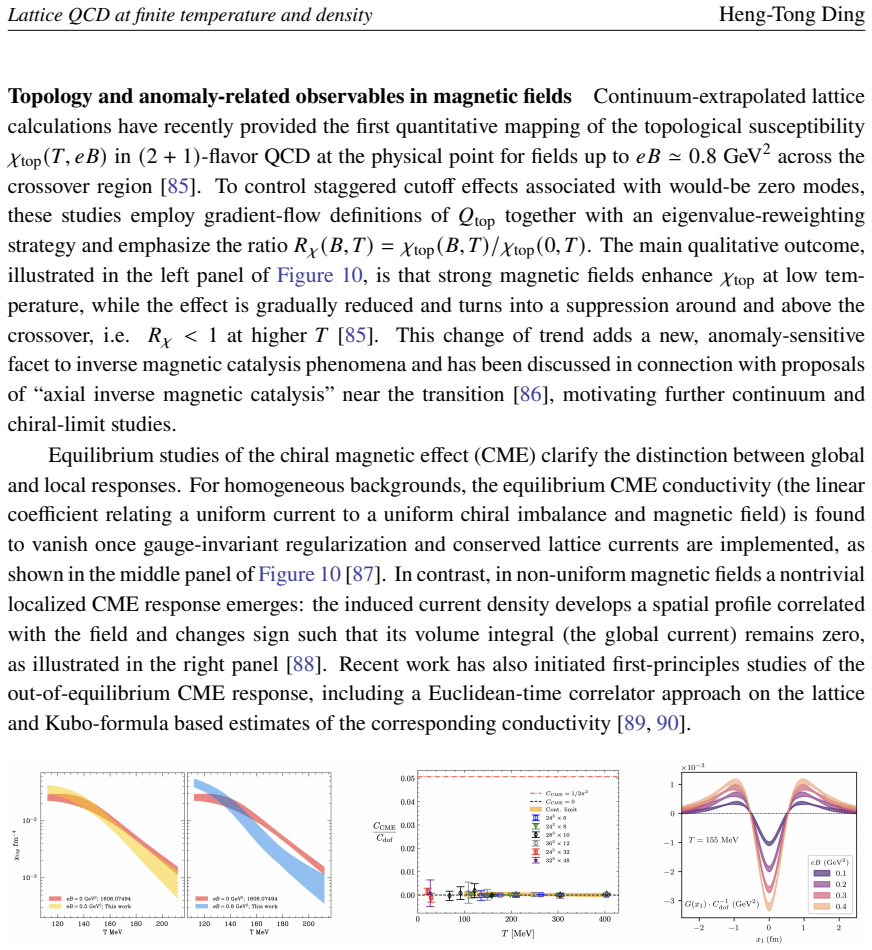
read the original abstract
I review recent lattice results on strongly interacting matter under extreme conditions, with emphasis on the finite-temperature QCD transition at $\mu_B=0$, its approach toward the chiral limit and the fate of the $U_A(1)$ anomaly, as well as recent constraints on the QCD phase boundary and the possible critical endpoint at $\mu_B>0$. I also discuss selected advances in lattice methods and in QCD thermodynamics under external conditions, in particular strong magnetic fields, isospin chemical potential, rotation, acceleration, and quark spin polarization.
Editorial analysis
A structured set of objections, weighed in public.
Referee Report
Summary. The manuscript reviews recent lattice QCD results on strongly interacting matter under extreme conditions. It focuses on the finite-temperature QCD transition at vanishing baryon chemical potential, its dependence on quark masses and approach to the chiral limit, the fate of the U_A(1) anomaly, constraints on the phase boundary and possible critical endpoint at finite baryon chemical potential, and selected methodological advances for QCD thermodynamics in external conditions such as strong magnetic fields, isospin chemical potential, rotation, acceleration, and quark spin polarization.
Significance. If the synthesis faithfully represents the cited literature, the review would provide a useful consolidation of current lattice constraints on the QCD phase diagram. This is relevant for heavy-ion phenomenology and early-universe cosmology, particularly through its emphasis on the location of any critical endpoint and the restoration pattern of chiral and axial symmetries.
minor comments (1)
- [Abstract] Abstract: the phrase 'recent lattice results' would benefit from an explicit time window (e.g., results published after 2018) to allow readers to assess how up-to-date the compilation is.
Simulated Author's Rebuttal
We thank the referee for the careful reading and positive assessment of our manuscript. The provided summary accurately reflects the scope and emphasis of the review. No specific major comments were raised in the report, so we have no point-by-point responses to address at this stage. We remain available to incorporate any minor suggestions or clarifications that may be provided.
Circularity Check
Review paper with no internal derivations or fits
full rationale
The manuscript is a review synthesizing published lattice results on the QCD transition at μ_B=0, the U_A(1) anomaly, and the phase boundary at finite density. No new calculations, equations, or derivations are introduced whose correctness must be established internally. All content reports on independent external works, so no load-bearing step reduces by construction to self-citation chains, fitted inputs renamed as predictions, or self-definitional relations within this paper.
Axiom & Free-Parameter Ledger
axioms (2)
- standard math Standard lattice regularization of QCD
- domain assumption Reliability of lattice results for thermodynamic quantities at finite T and mu
Forward citations
Cited by 3 Pith papers
-
On the effective restoration of $U(1)_A$ symmetry at finite temperature
Lattice QCD finds evidence for effective U(1)_A symmetry restoration at 319(22) MeV, well above the chiral crossover.
-
Lattice field theories with a sign problem
A review of holomorphic extensions, dual variables, tensor renormalization group, and machine learning approaches for controlling the sign problem in lattice field theories.
-
Lattice field theories with a sign problem
Reviews approaches such as Lefschetz thimbles, complex Langevin dynamics, dual variables, tensor renormalization group, and machine learning to control the sign problem in lattice field theories.
Reference graph
Works this paper leans on
-
[1]
H.-T. Ding, F. Karsch and S. Mukherjee,Thermodynamics of strong-interaction matter from Lattice QCD,Int. J. Mod. Phys. E24(2015) 1530007 [1504.05274]
work page internal anchor Pith review Pith/arXiv arXiv 2015
-
[2]
D. Bala,Spectral Properties of the Quark-Gluon Plasma from Lattice QCD, in42nd International Symposium on Lattice Field TheoryLattice 2025 talk slides. 16 Lattice QCD at finite temperature and densityHeng-Tong Ding
work page 2025
- [3]
-
[4]
Y. Aoki, G. Endrodi, Z. Fodor, S.D. Katz and K.K. Szabo,The Order of the quantum chromodynamics transition predicted by the standard model of particle physics,Nature443 (2006) 675 [hep-lat/0611014]. [5]HotQCDcollaboration,Chiral crossover in QCD at zero and non-zero chemical potentials, Phys. Lett. B795(2019) 15 [1812.08235]
work page internal anchor Pith review Pith/arXiv arXiv 2006
-
[5]
S. Borsanyi, Z. Fodor, J.N. Guenther, R. Kara, S.D. Katz, P. Parotto et al.,QCD Crossover at Finite Chemical Potential from Lattice Simulations,Phys. Rev. Lett.125(2020) 052001 [2002.02821]
-
[6]
R.V. Gavai, M.E. Jaensch, O. Kaczmarek, F. Karsch, M. Sarkar, R. Shanker et al.,Aspects of the chiral crossover transition in (2+1)-flavor QCD with Möbius domain-wall fermions, Phys. Rev. D111(2025) 034507 [2411.10217]
-
[7]
The QCD phase transition with physical-mass, chiral quarks
T. Bhattacharya et al.,QCD Phase Transition with Chiral Quarks and Physical Quark Masses,Phys. Rev. Lett.113(2014) 082001 [1402.5175]
work page internal anchor Pith review Pith/arXiv arXiv 2014
-
[8]
I. Kanamori,Topological susceptibility with 2+1 flavor Möbius domain wall fermion at finite temperature, in42nd International Symposium on Lattice Field TheoryLattice 2025 talk slides
work page 2025
-
[9]
A. Kotov,QCD thermal transition with overlap fermions, in42nd International Symposium on Lattice Field TheoryLattice 2025 talk slides. [11]JLQCDcollaboration,Quark number susceptibility and conserved charge fluctuation for (2+1)-flavor QCD with Möbius domain wall fermions,PoSLATTICE2024(2025) 168 [2501.03509]
-
[10]
J. Goswami,Towards continuum estimate of cumulants of conserved charges for (2+1)-flavor QCD with Mobius Domain Wall fermions, in42nd International Symposium on Lattice Field Theory. [13]HotQCDcollaboration,Second order cumulants of conserved charge fluctuations revisited: Vanishing chemical potentials,Phys. Rev. D104(2021) [2107.10011]
-
[11]
A.Y. Kotov, M.P. Lombardo and A. Trunin,Topological observables and𝜃dependence in high temperature QCD from lattice simulations,JHEP09(2025) 045 [2502.15407]. [15]JLQCDcollaboration,Symmetry of screening masses of mesons in two-flavor lattice QCD at high temperatures,Phys. Rev. D111(2025) 114506 [2501.12675]. [16]JLQCDcollaboration,Chiral susceptibility a...
-
[12]
A.Y. Kotov, M.P. Lombardo and A. Trunin,QCD transition at the physical point, and its scaling window from twisted mass Wilson fermions,Phys. Lett. B823(2021) 136749 [2105.09842]
-
[13]
R. Bignell, G. Aarts, C. Allton, B. Jäger, S. Kim, J.-I. Skullerud et al.,𝑈(1)𝐴 symmetry restoration at finite temperature with mesonic correlators, in42nd International Symposium on Lattice Field Theory, 1, 2026 [2601.21178]
-
[14]
T.-W. Chiu,Symmetries of spatial correlators of light and heavy mesons in high temperature lattice QCD,Phys. Rev. D110(2024) 014502 [2404.15932]
-
[15]
T.-W. Chiu,Symmetries in High-Temperature Lattice QCD with (u, d, s, c, b) Optimal Domain-Wall Quarks,Symmetry17(2025) 700 [2411.16705]
- [16]
-
[17]
J.P. Klinger,On the lattice phase structure of massless many-flavour QCD, in42nd International Symposium on Lattice Field Theory,Lattice 2025 talk slides
work page 2025
-
[18]
Y. Aoki,Investigating Phase Structure of three-flavor QCD with Domain Wall Fermions at Finite Temperature, in42nd International Symposium on Lattice Field TheoryLattice 2025 talk slides
work page 2025
-
[19]
The Spectral Density of the Dirac Operator above T_c
T.D. Cohen,The Spectral density of the Dirac operator above T(c) rep, inAPCTP Workshop on Astro-Hadron Physics: Properties of Hadrons in Matter, pp. 100–114, 10, 1997 [nucl-th/9801061]
work page internal anchor Pith review Pith/arXiv arXiv 1997
-
[20]
S. Aoki, H. Fukaya and Y. Taniguchi,Chiral symmetry restoration, eigenvalue density of Dirac operator and axial U(1) anomaly at finite temperature,Phys. Rev. D86(2012) 114512 [1209.2061]
work page internal anchor Pith review Pith/arXiv arXiv 2012
-
[21]
O. Kaczmarek, L. Mazur and S. Sharma,Eigenvalue spectra of QCD and the fate of UA(1) breaking towards the chiral limit,Phys. Rev. D104(2021) 094518 [2102.06136]. [28]HotQCDcollaboration,The chiral transition and𝑈(1) 𝐴 symmetry restoration from lattice QCD using Domain Wall Fermions,Phys. Rev. D86(2012) 094503 [1205.3535]
-
[22]
The QCD chiral transition, $\ua$ symmetry and the Dirac spectrum using domain wall fermions
M.I. Buchoff et al.,QCD chiral transition, U(1)A symmetry and the dirac spectrum using domain wall fermions,Phys. Rev. D89(2014) 054514 [1309.4149]
work page internal anchor Pith review Pith/arXiv arXiv 2014
-
[23]
H.-T. Ding, W.-P. Huang and S.-T. Li,A brief review of the QCD phase structure toward the chiral limit through lattice QCD,Sci. Sin. Phys. Mech. Astro.53(2023) 290004. 18 Lattice QCD at finite temperature and densityHeng-Tong Ding
work page 2023
- [24]
-
[25]
A. Alexandru, C. Bonanno, M. D’Elia and I. Horváth,Dirac spectral density in Nf=2+1 QCD at T=230 MeV,Phys. Rev. D110(2024) 074515 [2404.12298]
- [26]
- [27]
- [28]
-
[29]
S. Mitra and F. Karsch,Towards a Parameter-Free Analysis of the QCD Chiral Phase Transition and Its Universal Critical behavior,Springer Proc. Phys.432(2026) 781 [2501.13653]
- [30]
- [31]
- [32]
-
[33]
S. Mitra and F. Karsch,Finite-volume analysis and universal scaling signatures near the chiral phase transition in (2+1)-flavor QCD, in31st International Conference on Ultra-relativistic Nucleus-Nucleus Collisions, 8, 2025 [2508.19337]
-
[34]
H.-T. Ding, W.-P. Huang, S. Mukherjee and P. Petreczky,Microscopic Encoding of Macroscopic Universality: Scaling Properties of Dirac Eigenspectra near QCD Chiral Phase Transition,Phys. Rev. Lett.131(2023) 161903 [2305.10916]
-
[35]
C. Schmidt,Selected topics on the QCD phase diagram at finite temperature and density, PoSLATTICE2024(2025) 005 [2504.00629]
-
[36]
A. Lysenko, M.I. Gorenstein, R. Poberezhniuk and V. Vovchenko,Chemical freeze-out curve in heavy-ion collisions and the QCD critical point,Phys. Rev. C111(2025) 054903 [2408.06473]
- [37]
-
[38]
Basar,QCD critical point, Lee-Yang edge singularities, and Padé resummations,Phys
G. Basar,QCD critical point, Lee-Yang edge singularities, and Padé resummations,Phys. Rev. C110(2024) 015203 [2312.06952]
- [39]
-
[40]
C.S. Fischer and J.M. Pawlowski,Phase structure and observables at high densities from first principles QCD,2603.11135
-
[41]
S. Borsanyi, Z. Fodor, J.N. Guenther, P. Parotto, A. Pasztor, C. Ratti et al.,Lattice QCD constraints on the critical point from an improved precision equation of state,2502.10267
- [42]
-
[43]
S. Borsányi, Z. Fodor, J.N. Guenther, P. Kumar, P. Parotto, A. Pásztor et al.,Finite density QCD phase structure from strangeness fluctuations,2510.26455
- [44]
-
[45]
K. Nagata, J. Nishimura and S. Shimasaki,Argument for justification of the complex Langevin method and the condition for correct convergence,Phys. Rev. D94(2016) 114515 [1606.07627]
work page internal anchor Pith review Pith/arXiv arXiv 2016
- [46]
- [47]
-
[48]
A. Joseph and A. Kumar,Thermodynamic Diagnostics for Complex Langevin Simulations: The Role of Configurational Temperature,2509.08287
-
[49]
A. Joseph and A. Kumar,Configurational Temperature as a Diagnostic for Complex Langevin Dynamics in the 3D XY Model,2509.13314
-
[50]
A. Joseph and A. Kumar,Thermodynamic Consistency as a Reliability Test for Complex Langevin Simulations, in42nd International Symposium on Lattice Field Theory, 1, 2026 [2601.20527]
-
[51]
V. Longia, N.S. Dhindsa and A. Joseph,Configurational Thermometer for Lattice Gauge Theories, in42nd International Symposium on Lattice Field Theory, 1, 2026 [2601.17436]. 20 Lattice QCD at finite temperature and densityHeng-Tong Ding
-
[52]
S. Tsutsui, Y. Asano, Y. Ito, H. Matsufuru, Y. Namekawa, J. Nishimura et al.,On the validity of the complex Langevin method near the deconfining phase transition in QCD at finite density,JHEP10(2025) 108 [2505.06551]
- [53]
-
[54]
G. Aarts, D.E. Habibi, A. Ipp, D.I. Müller, T.R. Ranner, L. Wang et al.,Generalizable Equivariant Diffusion Models for Non-Abelian Lattice Gauge Theory,2601.19552
-
[55]
H. Alharazin, J.Y. Panteleeva and B.D. Sun,Diffusion Models for SU(2) Lattice Gauge Theory in Two Dimensions,2602.09045
-
[56]
M. Fukuma and N. Matsumoto,Worldvolume approach to the tempered Lefschetz thimble method,PTEP2021(2021) 023B08 [2012.08468]
-
[57]
Fukuma,Worldvolume Hybrid Monte Carlo algorithm for group manifolds,2506.12002
M. Fukuma,Worldvolume Hybrid Monte Carlo algorithm for group manifolds,2506.12002
-
[58]
D. Bollweg, H.T. Ding, J. Goswami, F. Karsch, S. Mukherjee, P. Petreczky et al., Strangeness-correlations on the pseudocritical line in (2+1)-flavor QCD,Phys. Rev. D110 (2024) 054519 [2407.09335]
-
[59]
D.A.Clarke,J.Goswami,F.KarschandP.Petreczky,Generalizeddefinitionoftheisothermal compressibility in (2+1)-flavor QCD,Phys. Rev. D113(2026) 034502 [2506.22816]. [67]HotQCDcollaboration,Generalized susceptibilities and the properties of charm degrees of freedom across the QCD crossover temperature,Phys. Rev. D112(2025) 034509 [2505.01734]
-
[60]
Chiral Properties of (2+1)- Flavor QCD in Magnetic Fields at Zero Temperature,
H.-T. Ding and D. Zhang,Chiral Properties of(2+1)-Flavor QCD in Magnetic Fields at Zero Temperature,2601.18354
-
[61]
H.-T. Ding, J.-B. Gu, S.-T. Li and R. Thakkar,Chiral condensates and screening masses of neutral pseudoscalar mesons from lattice QCD at physical quark masses,Phys. Rev. D111 (2025) 074513 [2501.11262]
- [62]
- [63]
-
[64]
R. Thakkar, H.-T. Ding, J.-B. Gu and S.-T. Li,Pseudoscalar Screening Mass at Finite Temperature and Magnetic Field from Lattice QCD with Physical Quark Masses,PoS LATTICE2024(2025) 185 [2502.06216]. 21 Lattice QCD at finite temperature and densityHeng-Tong Ding
-
[65]
H.-T. Ding, J.-B. Gu, A. Kumar, S.-T. Li and J.-H. Liu,Baryon Electric Charge Correlation as a Magnetometer of QCD,Phys. Rev. Lett.132(2024) 201903 [2312.08860]
-
[66]
H.-T. Ding, J.-B. Gu, A. Kumar and S.-T. Li,Second order fluctuations of conserved charges in external magnetic fields,Phys. Rev. D111(2025) 114522 [2503.18467]
-
[67]
H.-T. Ding, J.-B. Gu, A. Kumar and S.-T. Li,QCD in strong magnetic fields: Fluctuations of conserved charges and EoS,J. Subatomic Part. Cosmol.5(2026) 100277 [2510.21731]
-
[68]
H.-T. Ding, J.-B. Gu, A. Kumar and S.-T. Li,Baryon Electric Charge Correlation as QCD Magnetometer, in31st International Conference on Ultra-relativistic Nucleus-Nucleus Collisions, 8, 2025 [2508.17021]
-
[69]
R. Thakkar,Deconfinement and chiral aspects of the QCD crossover under magnetic fields: static-quark entropy and chiral susceptibility, in42nd International Symposium on Lattice Field TheoryLattice 2025 talk slides. [78]ALICEcollaboration,Measurement of correlations among net-charge, net-proton, and net-kaon multiplicity distributions in Pb-Pb collisions ...
-
[70]
J. Grefa, C.Y. Tsang, R. Kumar, V. Dexheimer, C. Ratti and Z. Xu,Chemical potential differentials in the QCD phase diagram from heavy-ion isobar collisions,2601.21232
-
[71]
N. Astrakhantsev, V.V. Braguta, A.Y. Kotov and A.A. Roenko,QCD equation of state at nonzero baryon density in an external magnetic field,Phys. Rev. D109(2024) 094511 [2403.07783]
-
[72]
H.-T. Ding, J.-B. Gu, A. Kumar and S.-T. Li,Leading-order QCD equation of state in strong magnetic fields at nonzero baryon chemical potential,Phys. Rev. D112(2025) 094508 [2508.07532]
-
[73]
A. Kumar, H.-T. Ding, J.-B. Gu and S.-T. Li,QCD Equation of State with Strong Magnetic Fields and Nonzero Baryon Density,PoSLATTICE2024(2025) 175 [2502.03152]
-
[74]
S. Borsanyi, B. Brandt, G. Endrodi, J. N. Guenther, R. Kara and A.D. Marques Valois,QCD equation of state in the presence of magnetic fields at low density,PoSLATTICE2023 (2024) 164 [2312.15118]
-
[75]
A.D. Marques Valois, S. Borsanyi, B. Brandt, G. Endrodi, J.N. Guenther, M.-A. Petri et al., Dense and magnetized QCD from imaginary chemical potential,PoSLATTICE2024(2025) 177 [2502.01132]
- [76]
-
[77]
Y. Wang and S. Matsuzaki,Axial inverse magnetic catalysis,Phys. Rev. D105(2022) 074015 [2110.10432]. 22 Lattice QCD at finite temperature and densityHeng-Tong Ding
- [78]
- [79]
-
[80]
Buividovich,Out-of-equilibrium chiral magnetic effect from simulations on Euclidean lattices,Phys
P.V. Buividovich,Out-of-equilibrium chiral magnetic effect from simulations on Euclidean lattices,Phys. Rev. D110(2024) 094508 [2404.14263]
discussion (0)
Sign in with ORCID, Apple, or X to comment. Anyone can read and Pith papers without signing in.