Blueprint for a fault-tolerant compound photon-atom quantum architecture
Pith reviewed 2026-06-30 06:27 UTC · model grok-4.3
The pith
A photon-atom hybrid architecture reaches a 2.6% photon-loss threshold for fault-tolerant MBQC on the RHG lattice.
A machine-rendered reading of the paper's core claim, the machinery that carries it, and where it could break.
Core claim
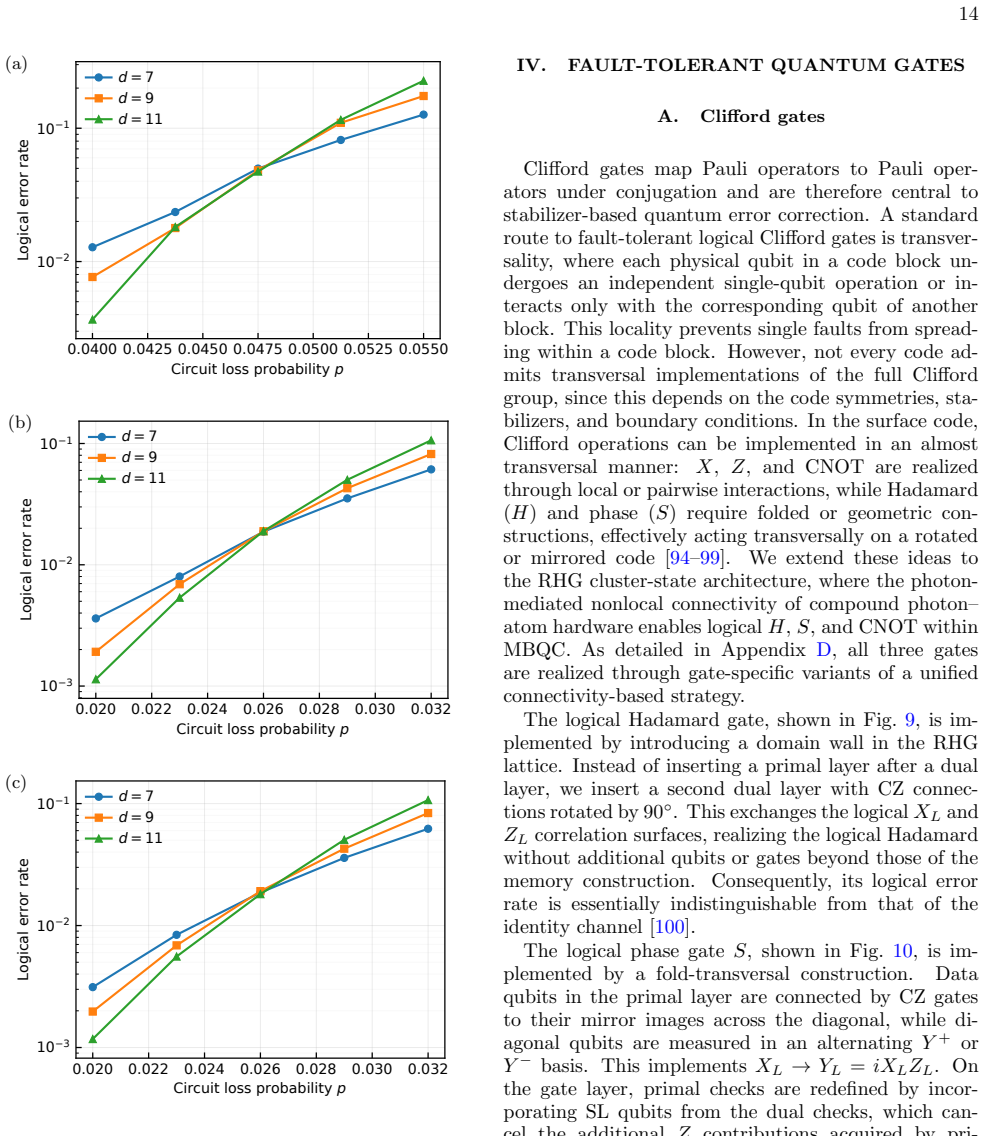
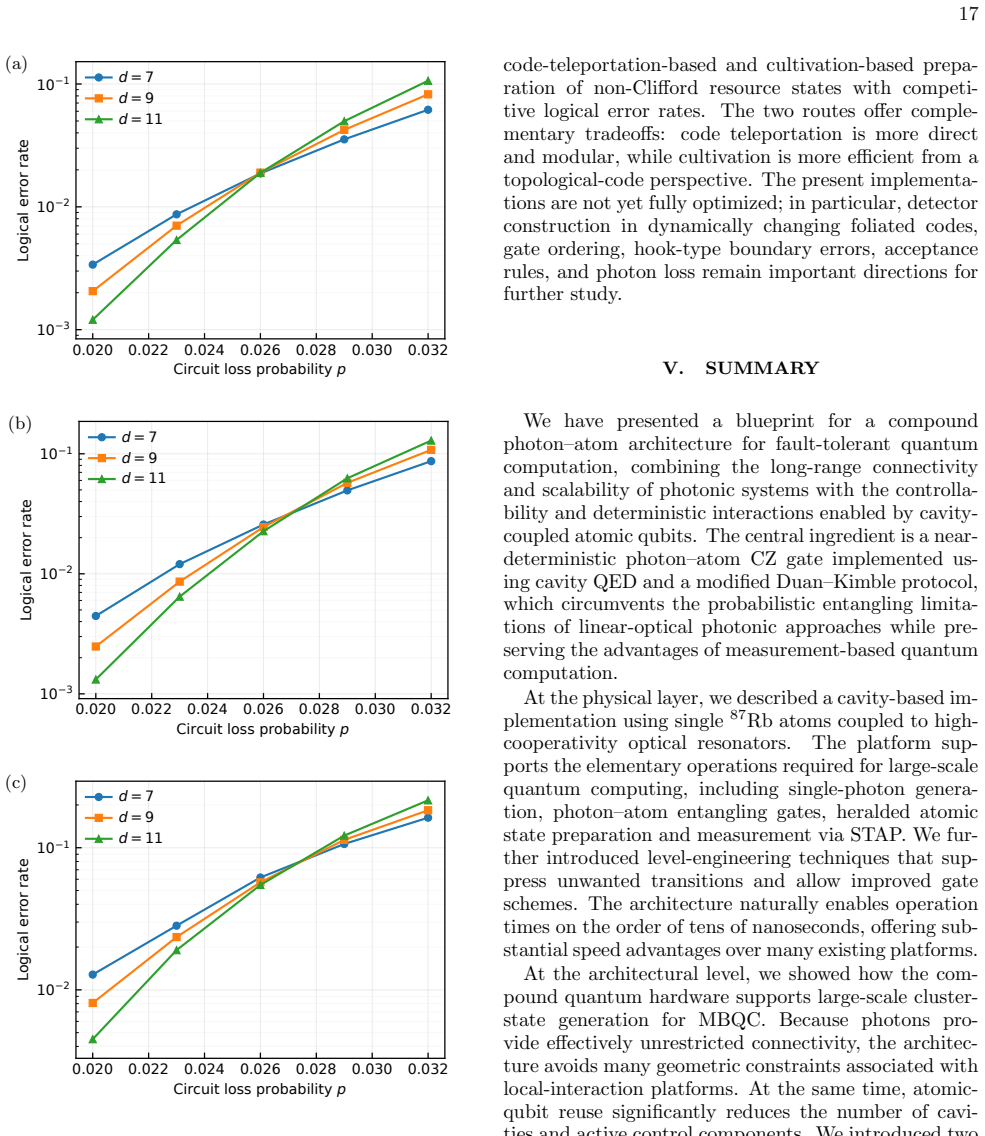
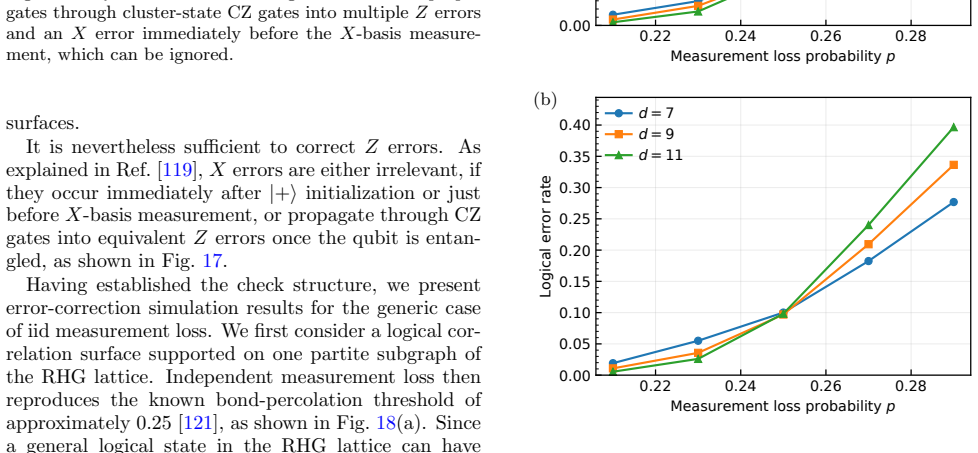
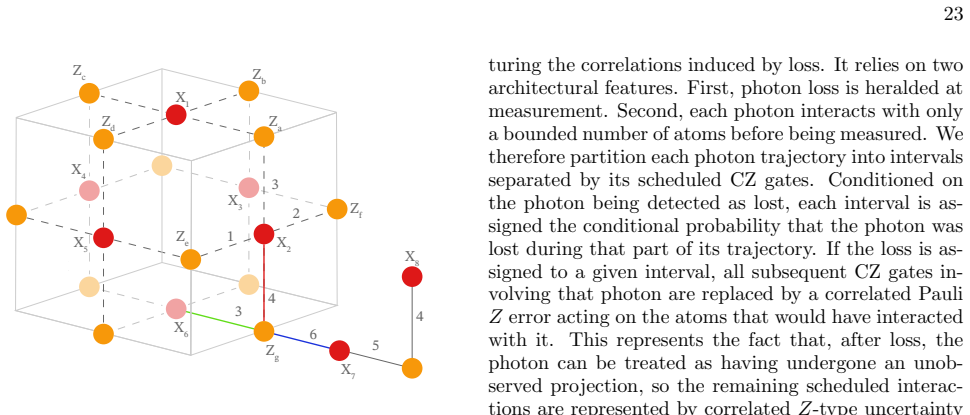
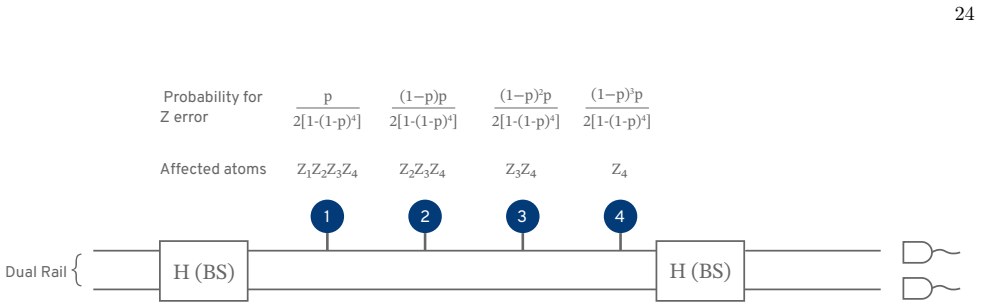
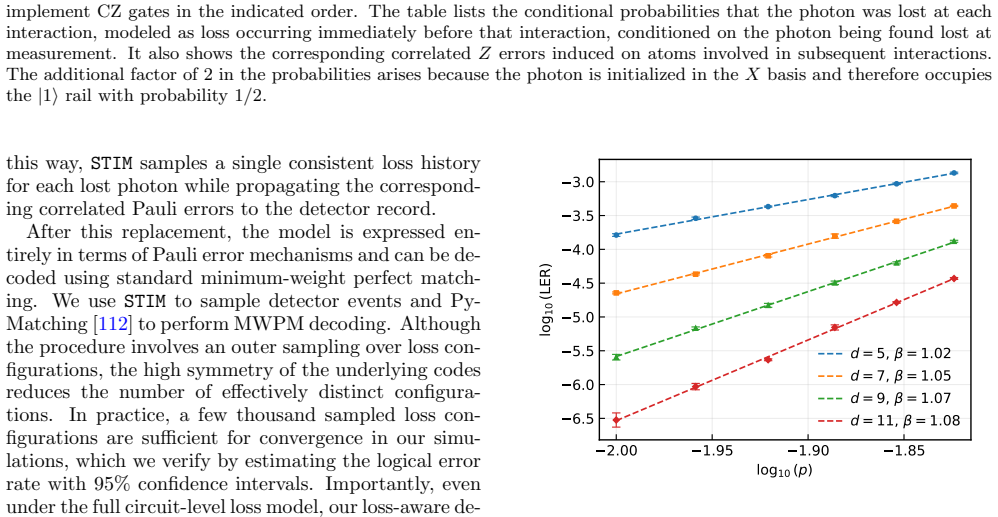
The symmetrized Duan-Kimble photon-atom controlled-phase gate enables a hybrid architecture in which photons supply scalable connectivity through measurement-based quantum computing on the Raussendorf-Harrington-Goyal lattice while atoms provide reusable, high-fidelity resources. Logical-memory simulations under the specified asymmetric-loss and correlated-error model yield a photon-loss threshold of 2.6% per physical gate. The Hadamard, phase, and CNOT gates are implemented transversally or fold-transversally at thresholds identical to the identity operation, and non-Clifford operations are addressed through code teleportation and magic-state cultivation within the foliated cluster-state ar
What carries the argument
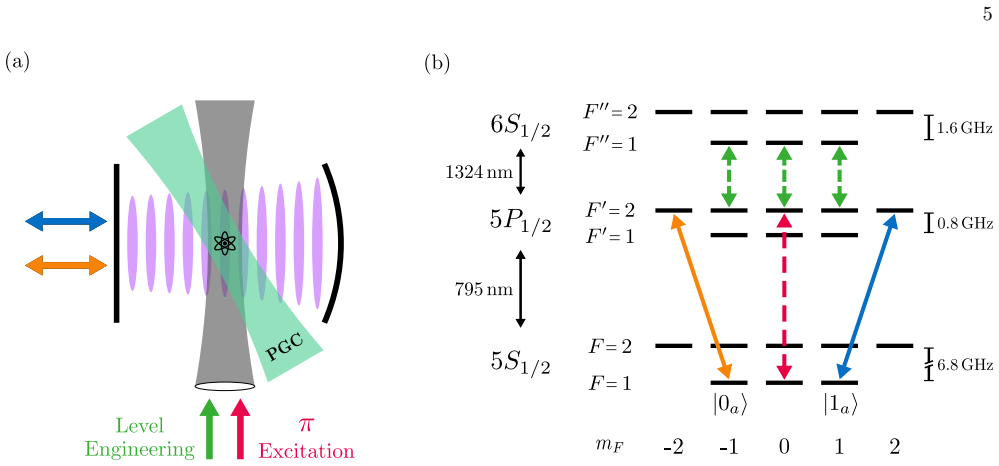
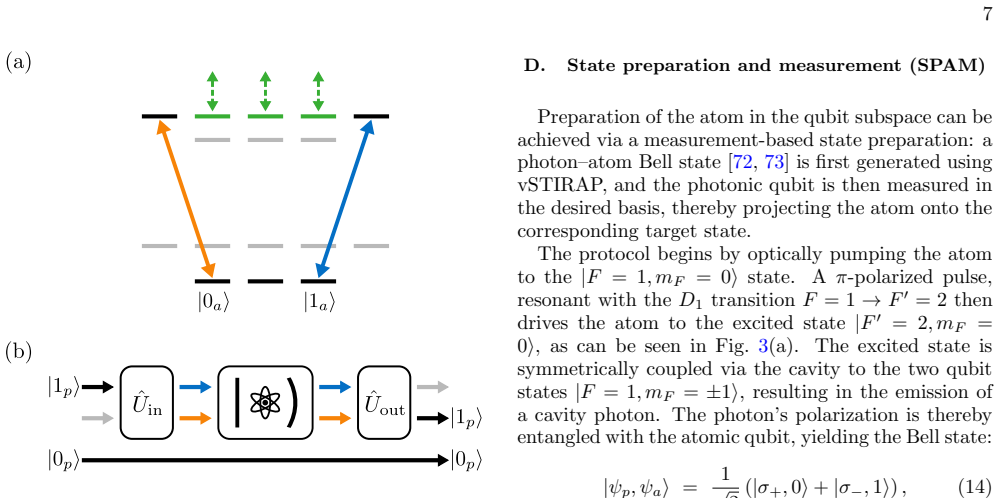
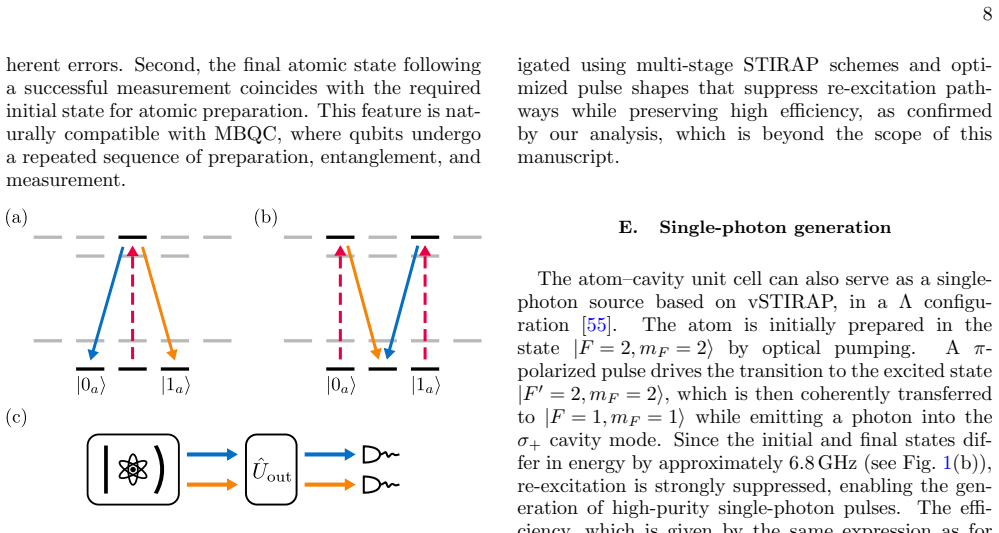
The symmetrized Duan-Kimble photon-atom controlled-phase gate, which supplies near-deterministic, robust entanglement between flying photonic qubits and stationary atomic qubits.
If this is right
- Logical memory tolerates approximately 15% total photon loss per trajectory while remaining below threshold.
- Hadamard, phase, and CNOT operations are available transversally or fold-transversally without lowering the error threshold below that of the identity channel.
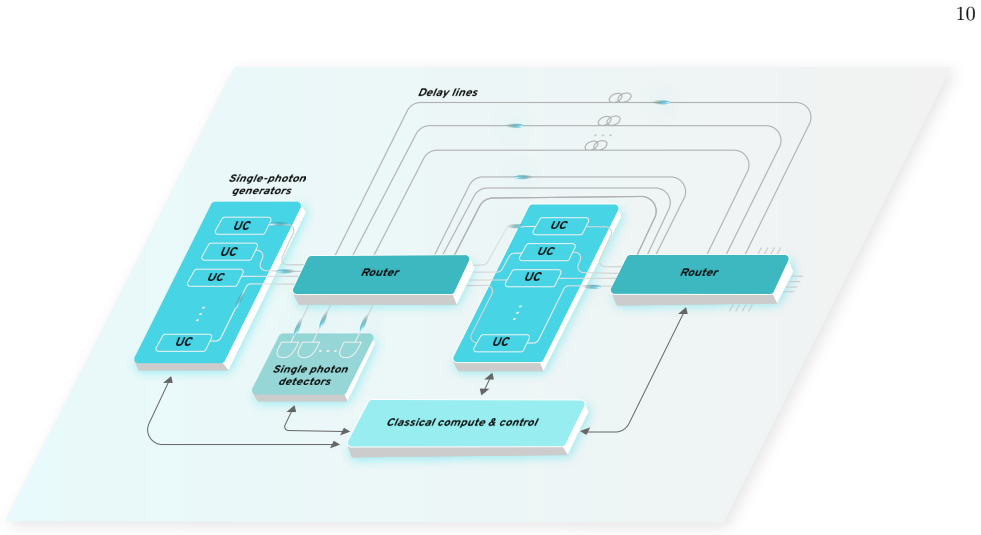
- Atomic reuse produces large-scale cluster states with effectively unrestricted connectivity and reduced overhead relative to purely photonic platforms.
- Non-Clifford resources become accessible inside the same foliated cluster-state architecture via code teleportation or magic-state cultivation.
Where Pith is reading between the lines
- The architecture could support modular quantum networks in which atomic nodes serve as stable interfaces to photonic communication channels.
- If the modeled gate performance holds, the hybrid approach may reduce the total number of physical resources needed for photonic error correction compared with all-photonic schemes.
- Direct characterization of the gate under the precise asymmetric-loss conditions assumed in the RHG simulations would provide a clear experimental test of the entire blueprint.
Load-bearing premise
The symmetrized Duan-Kimble photon-atom controlled-phase gate maintains high fidelity and near-determinism under realistic cavity imperfections together with the asymmetric loss and correlated-error model used in the simulations.
What would settle it
An experimental measurement showing that the symmetrized Duan-Kimble gate fidelity drops below the value required to sustain the reported 2.6% per-gate loss threshold under the modeled cavity-QED imperfections and loss statistics would falsify the fault-tolerance claims.
Figures

read the original abstract
Fault-tolerant quantum computing requires architectures that simultaneously address scalability, connectivity, and error correction under realistic noise constraints. We present a compound photonic-atomic quantum computing platform that uses cavity QED to realize near-deterministic entangling operations between flying photonic qubits and stationary atomic qubits. Photons provide long-range connectivity and scalability via measurement-based quantum computing (MBQC), while atoms supply reusable, near-deterministic resources for photon generation and entanglement, overcoming the inefficiency of purely photonic platforms. The core primitive is a symmetrized Duan-Kimble photon-atom controlled-phase (CZ) gate, robust to experimental imperfections and high-fidelity. Using single $^{87}$Rb atoms coupled to optical cavities, we give protocols for state preparation, measurement, photon generation, and entangling gates on tens-of-nanosecond timescales, and show how large-scale cluster states with effectively unrestricted connectivity and reduced overhead can be generated through atomic reuse. We analyze fault tolerance on the Raussendorf-Harrington-Goyal (RHG) lattice with a hardware-aware noise model capturing asymmetric loss and correlated photonic-atomic errors. Logical memory simulations yield a photon-loss threshold near $2.6\%$ per physical gate ($\sim$15\% total per trajectory). The full Clifford set -- Hadamard, phase, CNOT -- is implementable transversally or fold-transversally at thresholds matching the identity channel, and we propose two non-Clifford resource-state routes (code teleportation and magic state cultivation) within the foliated cluster-state architecture.
Editorial analysis
A structured set of objections, weighed in public.
Referee Report
Summary. The paper proposes a compound photonic-atomic quantum architecture using cavity QED to implement near-deterministic photon-atom entangling gates via a symmetrized Duan-Kimble CZ protocol. It provides explicit protocols for state preparation, photon generation, measurement, and entangling operations on nanosecond timescales with 87Rb atoms, then analyzes fault tolerance of the full Clifford set on the RHG lattice under a hardware-aware noise model of asymmetric photon loss plus correlated errors, reporting a logical-memory threshold of ~2.6% photon loss per physical gate (~15% total per trajectory) with transversal or fold-transversal implementations.
Significance. If the noise-model mapping holds, the work supplies a concrete hybrid blueprint that combines photonic long-range connectivity with reusable atomic resources, yielding competitive thresholds and reduced overhead relative to purely photonic MBQC. The explicit gate protocols, the demonstration that all Clifford gates meet the identity threshold, and the two outlined routes to non-Clifford resources are concrete contributions that could guide near-term cavity-QED experiments.
major comments (2)
- [Abstract and protocols section] Abstract and protocols section: the 2.6% per-gate photon-loss threshold (and the matching Clifford thresholds) is obtained from RHG-lattice Monte Carlo simulations that inject a specific asymmetric-loss plus correlated-error model; however, the manuscript supplies no master-equation derivation, cooperativity-dependent fidelity bound, or explicit propagation of cavity decay, spontaneous emission, and timing jitter that maps the symmetrized Duan-Kimble gate onto the precise loss and correlation rates used in the simulator. This unverified mapping is load-bearing for the central fault-tolerance claim.
- [Abstract] Abstract: no error bars, sensitivity analysis, or robustness checks are reported for the 2.6% threshold figure despite the dependence on the unverified noise-model parameters.
minor comments (1)
- [protocols section] The manuscript states that the symmetrized gate is 'robust to experimental imperfections' but does not quantify the required cooperativity or cavity parameters needed to stay below the simulated loss rates.
Simulated Author's Rebuttal
We thank the referee for the careful reading and constructive feedback. We address the two major comments below, agreeing where the manuscript is incomplete and outlining concrete revisions.
read point-by-point responses
-
Referee: [Abstract and protocols section] Abstract and protocols section: the 2.6% per-gate photon-loss threshold (and the matching Clifford thresholds) is obtained from RHG-lattice Monte Carlo simulations that inject a specific asymmetric-loss plus correlated-error model; however, the manuscript supplies no master-equation derivation, cooperativity-dependent fidelity bound, or explicit propagation of cavity decay, spontaneous emission, and timing jitter that maps the symmetrized Duan-Kimble gate onto the precise loss and correlation rates used in the simulator. This unverified mapping is load-bearing for the central fault-tolerance claim.
Authors: We agree that the mapping from the symmetrized Duan-Kimble gate to the precise loss and correlation rates requires an explicit derivation to support the fault-tolerance claim. The current manuscript uses a hardware-aware phenomenological model informed by standard cavity-QED treatments but does not provide the requested master-equation analysis or cooperativity bounds. In the revised manuscript we will add a new appendix that derives the effective asymmetric photon-loss and correlated-error rates from the underlying parameters (cavity decay, spontaneous emission, timing jitter, and cooperativity) for the symmetrized protocol, thereby making the noise-model mapping fully traceable. revision: yes
-
Referee: [Abstract] Abstract: no error bars, sensitivity analysis, or robustness checks are reported for the 2.6% threshold figure despite the dependence on the unverified noise-model parameters.
Authors: We acknowledge that the reported 2.6% threshold lacks error bars and sensitivity analysis. In the revision we will rerun the RHG-lattice Monte Carlo simulations while varying the key noise parameters (loss asymmetry, correlation strength) over physically plausible ranges, report statistical uncertainties on the threshold, and include a sensitivity plot demonstrating robustness of the Clifford thresholds to these variations. revision: yes
Circularity Check
Threshold from direct simulation of stated noise model; minor self-citation on gate protocol not load-bearing
full rationale
The paper's central result—the 2.6% photon-loss threshold—is obtained by running Monte Carlo simulations on the RHG lattice that directly inject the described hardware-aware noise model of asymmetric loss and correlated errors. No equation or protocol in the provided text reduces this threshold to a fitted parameter or self-defined quantity; the simulation uses the model as an external input rather than deriving the threshold by construction. Self-citation to prior cavity-QED work on the symmetrized Duan-Kimble gate supplies the protocol description but is not invoked as a uniqueness theorem or to close the derivation loop. The fault-tolerance claims therefore remain independently falsifiable against the stated noise parameters and external benchmarks.
Axiom & Free-Parameter Ledger
axioms (2)
- domain assumption Cavity QED interactions can be modeled with the standard Jaynes-Cummings Hamiltonian under the stated experimental imperfections
- domain assumption The RHG lattice error-correction thresholds remain valid under the asymmetric loss and correlated photonic-atomic error model
Reference graph
Works this paper leans on
-
[1]
Construction The RHG lattice, introduced by Raussendorf, Har- rington, and Goyal, was the first three-dimensional fault-tolerant topological quantum code supporting a universal gate set [27]. Fig. 5 shows an example with d= 3 andt= 3. The parameterdis the spatial linear size of the lattice and sets the error-correction distance, defined as the minimum wei...
-
[2]
Single-qubit teleportation A key feature of MBQC is that quantum informa- tion can be teleported using only single-qubit measure- ments [77]
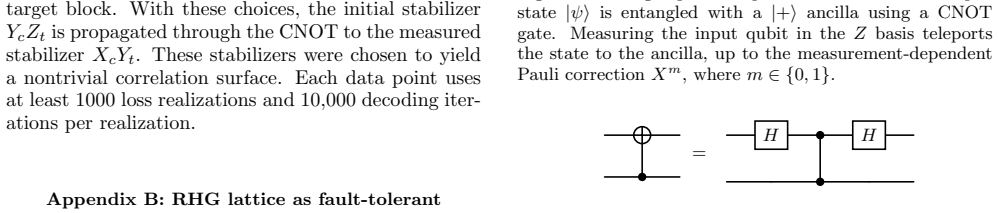
Foliation a. Single-qubit teleportation A key feature of MBQC is that quantum informa- tion can be teleported using only single-qubit measure- ments [77]. The basic circuit is shown in Fig. 13: a state|ψ⟩is teleported to an ancilla prepared in|+⟩by entangling the two qubits with a CNOT gate and then |ψ⟩ |+⟩ X m |ψ⟩ Figure 13. Single-qubit teleportation ci...
-
[3]
We now describe the same ob- ject directly as a three-dimensional topological cluster state [119]
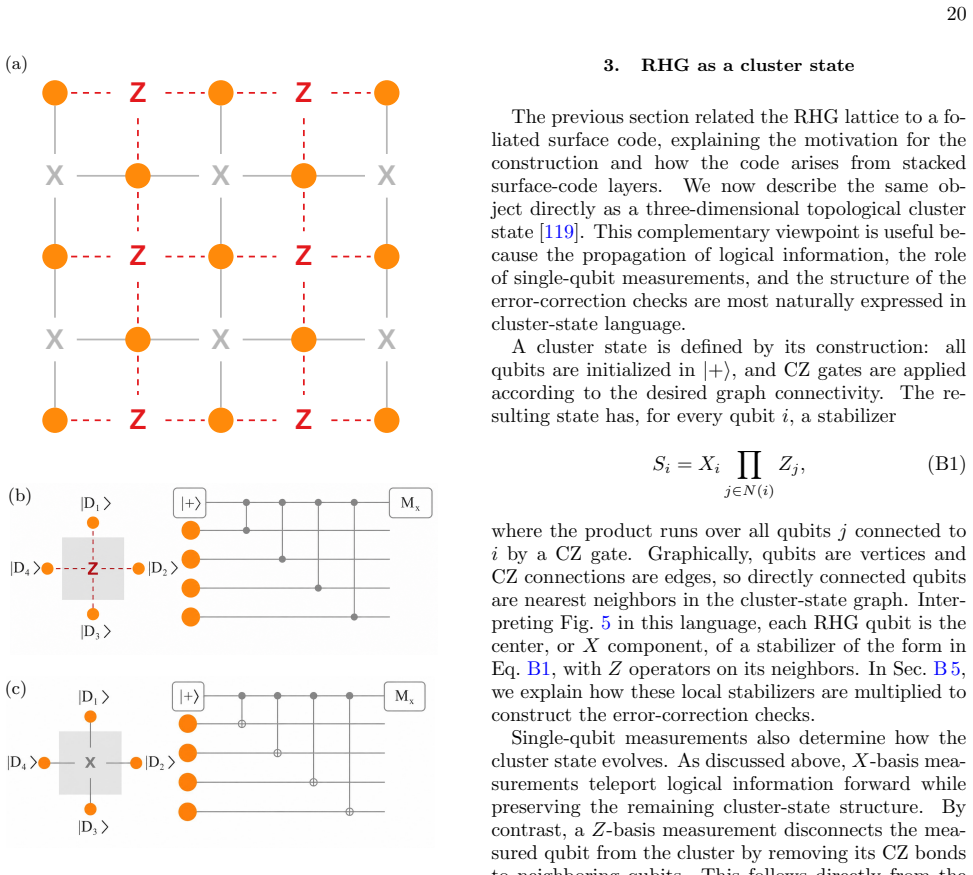
RHG as a cluster state The previous section related the RHG lattice to a fo- liated surface code, explaining the motivation for the construction and how the code arises from stacked surface-code layers. We now describe the same ob- ject directly as a three-dimensional topological cluster state [119]. This complementary viewpoint is useful be- cause the pr...
-
[4]
A logical operator is a one-dimensional prod- uct of single-qubit Pauli operators defined on a given layer
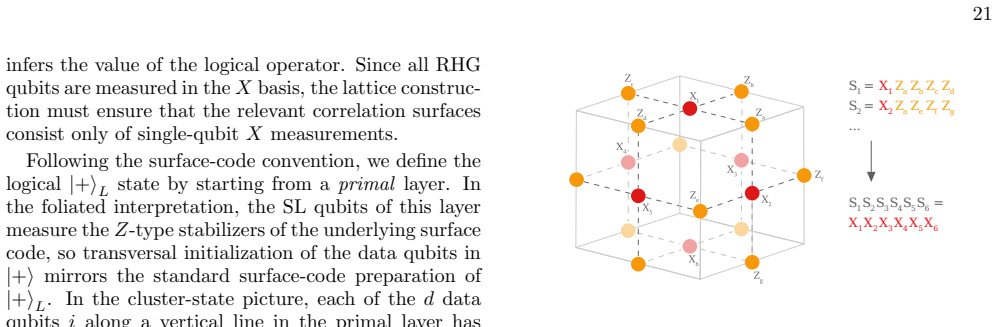
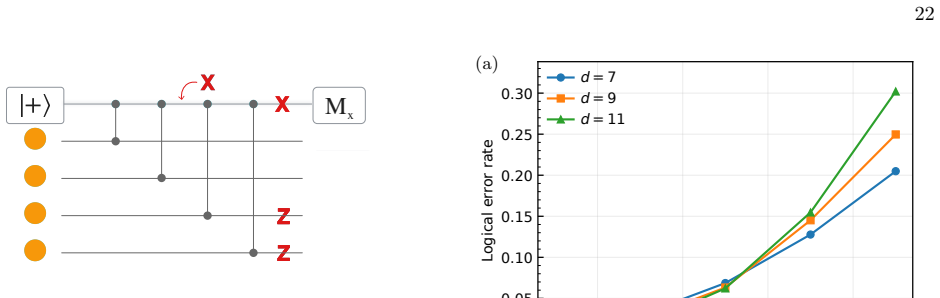
Logical state To understand how logical information is stored and propagated in the RHG lattice, we distinguish between two objects: thelogical operatorand thecorrelation surface. A logical operator is a one-dimensional prod- uct of single-qubit Pauli operators defined on a given layer. A correlation surface is a two-dimensional prod- uct over single-qubi...
-
[5]
Error correction The error-correction procedure in the RHG lattice is a three-dimensional generalization of the surface-code procedure. See Ref. [119] for a review. The main differ- ence is that RHG error correction uses only single-qubit measurements, all performed in theXbasis, rather than explicit ancilla-based stabilizer measurements. As a result, ins...
-
[6]
Under conjugation, it mapsXtoY=iXZ
S gate The phase gate is aπ/2 rotation about theZaxis, 1 0 0i . Under conjugation, it mapsXtoY=iXZ. A logical Sgate must therefore implementX L →Y L =iX LZL while preserving the stabilizer structure. A simple approach is to inject a logicalY L ∝ |0⟩ L + i|1⟩ L resource state and use gate teleportation. In the RHG lattice, such a state can be initialized b...
-
[7]
It is defined by 1 0 0 0 0 1 0 0 0 0 0 1 0 0 1 0
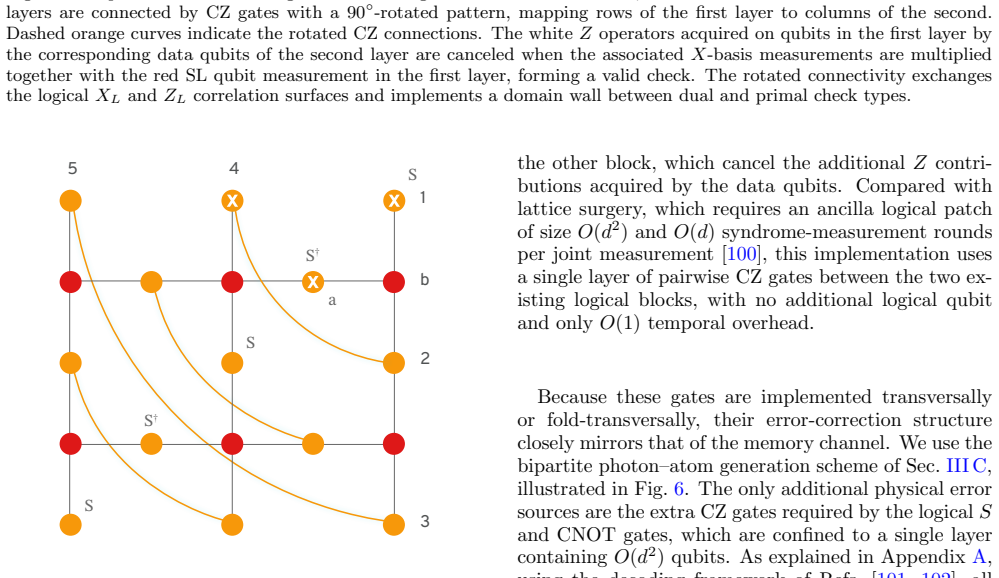
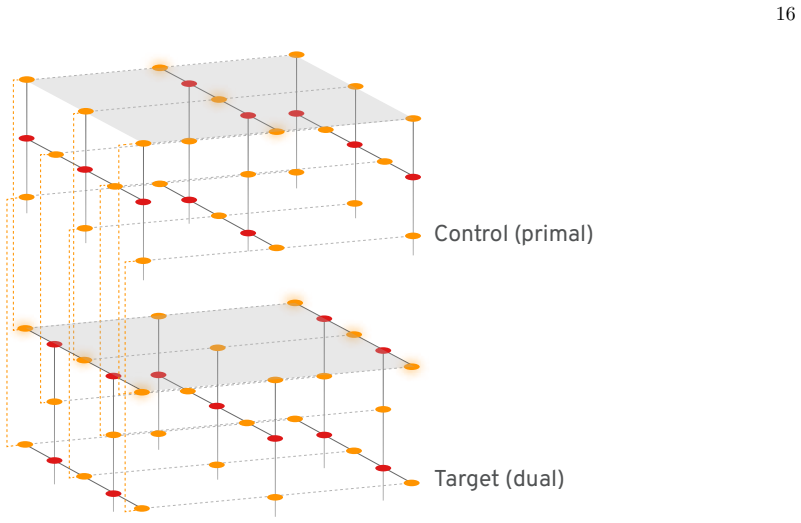
CNOT gate The only two-qubit gate required to complete the Clifford set is CNOT. It is defined by 1 0 0 0 0 1 0 0 0 0 0 1 0 0 1 0 . In surface-code and RHG architectures, the two stan- dard fault-tolerant implementations are lattice surgery, which uses merge-and-split operations through joint stabilizer measurements [94, 115, 128], and transver-...
-
[8]
Preskill, Crossing the quantum chasm: From NISQ to fault tolerance (2023)
J. Preskill, Crossing the quantum chasm: From NISQ to fault tolerance (2023)
2023
-
[9]
Mind the gaps: The fraught road to quantum advantage
J. Eisert and J. Preskill, Mind the gaps: The fraught road to quantum advantage, arXiv preprint arXiv:2510.19928 (2026)
work page internal anchor Pith review Pith/arXiv arXiv 2026
-
[10]
How to factor 2048 bit RSA integers with less than a million noisy qubits
C. Gidney, How to factor 2048 bit RSA integers with less than a million noisy qubits, arXiv preprint arXiv:2505.15917 (2025)
work page internal anchor Pith review Pith/arXiv arXiv 2048
-
[11]
L. Z. Cohen, I. H. Kim, S. D. Bartlett, and B. J. Brown, Low-overhead fault-tolerant quantum com- puting using long-range connectivity, Science Ad- vances8(2022)
2022
-
[12]
Baspin and A
N. Baspin and A. Krishna, Connectivity constrains quantum codes, Quantum6, 711 (2022)
2022
-
[13]
Architecting Distributed Quantum Computers: Design Insights from Resource Estimation
D. Filippov, P. Yang, and P. Murali, Architecting dis- tributed quantum computers: Design insights from resource estimation, arXiv preprint arXiv:2508.19160 (2026)
work page internal anchor Pith review Pith/arXiv arXiv 2026
-
[14]
How to Build a Quantum Supercomputer: Scaling from Hundreds to Millions of Qubits
M. Mohseni, A. Scherer, K. G. Johnson, O. Wertheim, M. Otten, N. Anand, N. A. Aadit, Y. Alexeev, G. Ben-Shach, K. M. Bresniker,et al., How to build a quantum supercomputer: Scaling from hundreds to millions of qubits, arXiv preprint arXiv:2411.10406 (2024)
work page internal anchor Pith review Pith/arXiv arXiv 2024
-
[15]
Megrant and Y
A. Megrant and Y. Chen, Scaling up superconducting quantum computers, Nature Electronics8, 549 (2025)
2025
-
[16]
K. Wang, Z. Lu, C. Zhang, G. Liu, J. Chen, Y. Wang, Y. Wu, S. Xu, X. Zhu, F. Jin, Y. Gao, Z. Tan, Z. Cui, N. Wang, Y. Zou, A. Zhang, T. Li, F. Shen, J. Zhong, Z. Bao, Z. Zhu, Y. Han, Y. He, J. Shen, H. Wang, J.-N. Yang, Z. Song, J. Deng, H. Dong, Z.-Z. Sun, W. Li, Q. Ye, S. Jiang, Y. Ma, P.-X. Shen, P. Zhang, H. Li, Q. Guo, Z. Wang, C. Song, H. Wang, and ...
2026
-
[17]
Bravyi, A
S. Bravyi, A. W. Cross, J. M. Gambetta, D. Maslov, P. Rall, and T. J. Yoder, High-threshold and low- overhead fault-tolerant quantum memory, Nature 627, 778 (2024)
2024
-
[18]
Mathews, L
M. Mathews, L. Pahl, D. Pahl, V. L. Addala, C. Tang, W. D. Oliver, and J. A. Grover, Placing and routing quantum LDPC codes in multilayer superconducting hardware, npj Quantum Information (2026)
2026
-
[19]
K. A. Landsman, Y. Wu, P. H. Leung, D. Zhu, N. M. Linke, K. R. Brown, L. Duan, and C. Monroe, Two- qubit entangling gates within arbitrarily long chains of trapped ions, Phys. Rev. A100, 022332 (2019)
2019
-
[20]
Nonlinear Coupling between Motional Modes in Trapped Ion Quantum Processors
W. Johnson and B. Ruzic, Nonlinear coupling between motional modes in trapped ion quantum processors, arXiv preprint arXiv:2510.07590 (2025)
work page internal anchor Pith review Pith/arXiv arXiv 2025
-
[21]
S. J. Evered, D. Bluvstein, M. Kalinowski, S. Ebadi, T. Manovitz, H. Zhou, S. H. Li, A. A. Geim, T. T. 27 Wang, N. Maskara,et al., High-fidelity parallel en- tangling gates on a neutral-atom quantum computer, Nature622, 268 (2023)
2023
-
[22]
B. W. Reichardt, A. Paetznick, D. Aasen, I. Basov, J. M. Bello-Rivas, P. Bonderson, R. Chao, W. van Dam, M. B. Hastings, R. V. Mishmash,et al., Fault- tolerant quantum computation with a neutral atom processor, arXiv preprint arXiv:2411.11822 (2024)
work page internal anchor Pith review Pith/arXiv arXiv 2024
-
[23]
S. Khan, S. Sethi, K. Sahay, Y. Lin, J. Alnas, S. Kurapati, A. Anand, J. M. Baker, and K. R. Brown, Architecting early fault-tolerant neutral atoms systems with quantum advantage, arXiv preprint arXiv:2604.19735 (2026)
work page internal anchor Pith review Pith/arXiv arXiv 2026
-
[24]
J. Kn¨ orzer, X. Liu, B. F. Schiffer, and J. Tura, Dis- tributed quantum information processing: A review of recent progress, arXiv preprint arXiv:2510.15630 (2025)
-
[25]
AbuGhanem, Toward scalable fault-tolerant pho- tonic quantum computers, The Journal of Supercom- puting82, 51 (2026)
M. AbuGhanem, Toward scalable fault-tolerant pho- tonic quantum computers, The Journal of Supercom- puting82, 51 (2026)
2026
-
[26]
H. Zhu, T. Chen, H. Ma, Z. Zhao, J. Guo, Q. Liang, Y. Tu, T. He, W. Luo, B. Wang,et al., Recent progress towards large-scale integrated photonic quantum com- putation, npj Nanophotonics3, 20 (2026)
2026
-
[27]
J. E. Bourassa, R. N. Alexander, M. Vasmer, A. Patil, I. Tzitrin, T. Matsuura, D. Su, B. Q. Baragiola, S. Guha, G. Dauphinais,et al., Blueprint for a scalable photonic fault-tolerant quantum computer, Quantum 5, 392 (2021)
2021
-
[28]
P. Kok, W. J. Munro, K. Nemoto, T. C. Ralph, J. P. Dowling, and G. J. Milburn, Linear optical quantum computing with photonic qubits, Rev. Mod. Phys.79, 135 (2007)
2007
-
[29]
Rudolph, Why I am optimistic about the silicon- photonic route to quantum computing, APL photonics 2(2017)
T. Rudolph, Why I am optimistic about the silicon- photonic route to quantum computing, APL photonics 2(2017)
2017
-
[30]
J. Romero and G. Milburn, Photonic quantum com- puting, arXiv preprint arXiv:2404.03367 (2024)
- [31]
-
[32]
Raussendorf and H
R. Raussendorf and H. J. Briegel, A one-way quantum computer, Phys. Rev. Lett.86, 5188 (2001)
2001
-
[33]
Raussendorf, J
R. Raussendorf, J. Harrington, and K. Goyal, A fault- tolerant one-way quantum computer, Ann. Phys.321, 2242 (2006)
2006
-
[34]
Raussendorf, J
R. Raussendorf, J. Harrington, and K. Goyal, Topo- logical fault-tolerance in cluster state quantum com- putation, New J. Phys.9, 199 (2007)
2007
-
[35]
Bartolucci, P
S. Bartolucci, P. Birchall, H. Bombin, H. Cable, C. Dawson, M. Gimeno-Segovia, E. Johnston, K. Kiel- ing, N. Nickerson, M. Pant,et al., Fusion-based quan- tum computation, Nat. Commun.14, 912 (2023)
2023
-
[36]
H. J. Briegel, D. E. Browne, W. D¨ ur, R. Raussendorf, and M. Van den Nest, Measurement-based quantum computation, Nat. Phys.5, 19 (2009)
2009
-
[37]
H. J. Briegel and R. Raussendorf, Persistent entan- glement in arrays of interacting particles, Phys. Rev. Lett.86, 910 (2001)
2001
-
[38]
M. Hein, J. Eisert, and H. J. Briegel, Multiparty en- tanglement in graph states, Phys. Rev. A69, 062311 (2004)
2004
-
[39]
J. H. Shapiro, Single-photon kerr nonlinearities do not help quantum computation, Phys. Rev. A73, 062305 (2006)
2006
-
[40]
A. N. Poddubny, S. Rosenblum, and B. Dayan, How single-photon switching is quenched with multiple Λ– level atoms, Phys. Rev. Lett.133, 113601 (2024)
2024
-
[41]
D. C. Burnham and D. L. Weinberg, Observation of simultaneity in parametric production of optical pho- ton pairs, Phys. Rev. Lett.25, 84 (1970)
1970
-
[42]
P. G. Kwiat, E. Waks, A. G. White, I. Appel- baum, and P. H. Eberhard, Ultrabright source of polarization-entangled photons, Physical Review A 60, R773 (1999)
1999
-
[43]
T. B. Pittman, B. C. Jacobs, and J. D. Franson, Sin- gle photons on pseudodemand from stored paramet- ric down-conversion, Physical Review A66, 042303 (2002)
2002
-
[44]
J. E. Sharping, K. F. Lee, M. A. Foster, A. C. Turner, B. S. Schmidt, M. Lipson, A. L. Gaeta, and P. Kumar, Generation of correlated photons in nanoscale silicon waveguides, Optics Express14, 12388 (2006)
2006
-
[45]
Reimer, L
C. Reimer, L. Caspani, M. Clerici, M. Ferrera, M. Kues, M. Peccianti, A. Pasquazi, L. Razzari, B. E. Little, S. T. Chu, D. J. Moss, and R. Morandotti, Integrated frequency comb source of heralded single photons, Optics Express22, 6535 (2014)
2014
-
[46]
J. W. Silverstone, D. Bonneau, K. Ohira, N. Suzuki, H. Yoshida, N. Iizuka, M. Ezaki, C. M. Natarajan, M. G. Tanner, R. H. Hadfield, V. Zwiller, G. D. Mar- shall, J. G. Rarity, J. L. O’Brien, and M. G. Thomp- son, On-chip quantum interference between silicon photon-pair sources, Nature Photonics8, 104 (2014)
2014
-
[47]
D. E. Browne and T. Rudolph, Resource-efficient lin- ear optical quantum computation, Phys. Rev. Lett. 95, 010501 (2005)
2005
-
[48]
Varnava, D
M. Varnava, D. E. Browne, and T. Rudolph, How good must single photon sources and detectors be for efficient linear optical quantum computation?, Phys. Rev. Lett.100, 060502 (2008)
2008
-
[49]
Y. Li, P. C. Humphreys, G. J. Mendoza, and S. C. Benjamin, Resource costs for fault-tolerant linear op- tical quantum computing, Phys. Rev. X5, 041007 (2015)
2015
-
[50]
S. Bartolucci, P. M. Birchall, M. Gimeno-Segovia, E. Johnston, K. Kieling, M. Pant, T. Rudolph, J. Smith, C. Sparrow, and M. D. Vidrighin, Creation of entangled photonic states using linear optics, arXiv preprint arXiv:2106.13825 (2021)
-
[51]
M. L. Chan, A. A. Capatos, P. Lodahl, A. S. Sørensen, and S. Paesani, Practical blueprint for low-depth pho- tonic quantum computing with quantum dots, arXiv preprint arXiv:2507.16152 (2025)
work page internal anchor Pith review Pith/arXiv arXiv 2025
-
[52]
Near-identical photons from distant quantum dot-cavity devices
T. Pollet, V. Guilloux, D.-D. Tran, A. Pishchagin, S. Wein, J. A. Sulpizio, W. Hease, P. Stepanov, P. Steindl, N. Margaria,et al., Near-identical pho- tons from distant quantum dot-cavity devices, arXiv preprint arXiv:2604.25615 (2026)
work page internal anchor Pith review Pith/arXiv arXiv 2026
-
[53]
S. Bartolucci, T. Bell, H. Bombin, P. Birchall, J. Bulmer, C. Dawson, T. Farrelly, S. Gartenstein, M. Gimeno-Segovia, D. Litinski, Y. Liu, R. Knegjens, N. Nickerson, A. Olivo, M. Pant, A. Patil, S. Roberts, T. Rudolph, C. Sparrow, D. Tuckett, and A. Veitia, Comparison of schemes for highly loss tolerant pho- tonic fusion based quantum computing, arXiv pre...
-
[54]
Aqua and B
Z. Aqua and B. Dayan, Atom-mediated determinis- tic generation and stitching of photonic graph states, PRX Quantum6, 010340 (2025)
2025
-
[55]
R. J. Thompson, G. Rempe, and H. J. Kimble, Ob- servation of normal-mode splitting for an atom in an optical cavity, Phys. Rev. Lett.68, 1132 (1992)
1992
-
[56]
Haroche and J.-M
S. Haroche and J.-M. Raimond,Exploring the Quan- tum: Atoms, Cavities, and Photons, Oxford Graduate Texts (Oxford University Press, New York, 2013). 28
2013
-
[57]
Duan and H
L.-M. Duan and H. J. Kimble, Scalable photonic quan- tum computation through cavity-assisted interactions, Phys. Rev. Lett.92, 127902 (2004)
2004
-
[58]
Reiserer, N
A. Reiserer, N. Kalb, G. Rempe, and S. Ritter, A quantum gate between a flying optical photon and a single trapped atom, Nature508, 237 (2014)
2014
-
[59]
N. V. Vitanov, A. A. Rangelov, B. W. Shore, and K. Bergmann, Stimulated Raman adiabatic passage in physics, chemistry, and beyond, Rev. Mod. Phys. 89, 015006 (2017)
2017
-
[60]
Hennrich, T
M. Hennrich, T. Legero, A. Kuhn, and G. Rempe, Vacuum-stimulated Raman scattering based on adi- abatic passage in a high-finesse optical cavity, Phys. Rev. Lett.85, 4872 (2000)
2000
-
[61]
A. Kuhn, M. Hennrich, and G. Rempe, Determinis- tic single-photon source for distributed quantum net- working, Phys. Rev. Lett.89, 067901 (2002)
2002
-
[62]
Kuhn and D
A. Kuhn and D. Ljunggren, Cavity-based single- photon sources, Contemporary Physics51, 289 (2010)
2010
- [64]
-
[65]
Panteleev and G
P. Panteleev and G. Kalachev, Asymptotically good quantum and locally testable classical LDPC codes, in Proceedings of the 54th annual ACM SIGACT sympo- sium on theory of computing(2022) pp. 375–388
2022
-
[66]
Leverrier and G
A. Leverrier and G. Z´ emor, Quantum tanner codes, in 2022 IEEE 63rd Annual Symposium on Foundations of Computer Science (FOCS)(IEEE, 2022) pp. 872– 883
2022
-
[67]
T.-C. Lin and M.-H. Hsieh, Good quantum LDPC codes with linear time decoder from lossless ex- panders, arXiv preprint arXiv:2203.03581 (2022)
-
[68]
Jiang, C
Y.-Y. Jiang, C. Deng, H. Fan, B.-Y. Li, L. Sun, X.-S. Tan, W. Wang, G.-M. Xue, F. Yan, H.-F. Yu, Y.- S. Zhang, Y.-R. Zhang, and C.-L. Zou, Advancements in superconducting quantum computing, National Sci- ence Review12, nwaf246 (2025)
2025
-
[69]
Hunger, T
D. Hunger, T. Steinmetz, Y. Colombe, C. Deutsch, T. W. H¨ ansch, and J. Reichel, A fiber Fabry–P´ erot cavity with high finesse, New Journal of Physics12, 065038 (2010)
2010
-
[70]
Pfeifer, L
H. Pfeifer, L. Ratschbacher, J. Gallego, C. Saavedra, A. Faßbender, A. Von Haaren, W. Alt, S. Hofferberth, M. K¨ ohl, S. Linden, and D. Meschede, Achievements and perspectives of optical fiber Fabry–P´ erot cavities, Applied Physics B128, 29 (2022)
2022
-
[71]
Gallego, S
J. Gallego, S. Ghosh, S. K. Alavi, W. Alt, M. Martinez-Dorantes, D. Meschede, and L. Ratschbacher, High-finesse fiber Fabry–P´ erot cavities: stabilization and mode matching analysis, Applied Physics B122, 47 (2016)
2016
-
[72]
Kikura, R
S. Kikura, R. Inoue, H. Yamasaki, A. Goban, and S. Sunami, Taming the recoil effect in cavity-assisted quantum interconnects, PRX Quantum6, 040351 (2025)
2025
-
[73]
Y. Yu, S. Saha, M. Shalaev, G. Toh, J. O’reilly, I. Goetting, A. Kalakuntla, and C. Monroe, Entanglement-fidelity limits of photonically net- worked atomic qubits from recoil and timing, Physical Review A113, 012620 (2026)
2026
-
[74]
Apol´ ın and D
J. Apol´ ın and D. P. Nadlinger, Recoil-induced er- rors and their correction in photon-mediated entan- glement between atomic qubits, PRX Quantum7, 010326 (2026)
2026
-
[75]
C. W. Gardiner and M. J. Collett, Input and out- put in damped quantum systems: Quantum stochastic differential equations and the master equation, Phys. Rev. A31, 3761 (1985)
1985
-
[76]
H. J. Carmichael, Quantum trajectory theory for cas- caded open systems, Phys. Rev. Lett.70, 2273 (1993)
1993
-
[77]
Reiserer and G
A. Reiserer and G. Rempe, Cavity-based quantum networks with single atoms and optical photons, Rev. Mod. Phys.87, 1379 (2015)
2015
-
[78]
Nagib, P
O. Nagib, P. Huft, A. Safari, and M. Saffman, Robust atom-photon gate for quantum information process- ing, Phys. Rev. A109, 032602 (2024)
2024
-
[79]
J. Volz, M. Weber, D. Schlenk, W. Rosenfeld, J. Vrana, K. Saucke, C. Kurtsiefer, and H. Weinfurter, Observation of entanglement of a single photon with a trapped atom, Phys. Rev. Lett.96, 030404 (2006)
2006
-
[80]
T. Wilk, S. C. Webster, A. Kuhn, and G. Rempe, Single-atom single-photon quantum interface, Science 317, 488 (2007)
2007
-
[81]
Finkelstein, S
R. Finkelstein, S. Bali, O. Firstenberg, and I. Novikova, A practical guide to electromagnetically induced transparency in atomic vapor, New J. Phys. 25, 035001 (2023)
2023
discussion (0)
Sign in with ORCID, Apple, or X to comment. Anyone can read and Pith papers without signing in.