JWST spectroscopy of galaxies at z>10: Damped Lyα absorbers reveal efficient star formation and hidden redshift biases
Pith reviewed 2026-07-01 01:59 UTC · model grok-4.3
The pith
Damped Lyα absorbers in z>10 galaxies track efficient star formation while biasing photometric redshifts by 0.39 on average.
A machine-rendered reading of the paper's core claim, the machinery that carries it, and where it could break.
Core claim
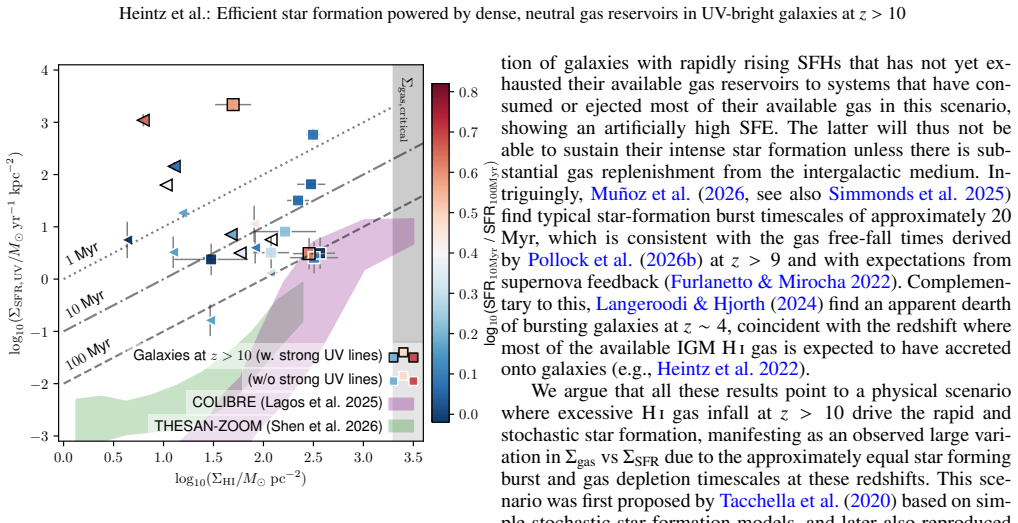
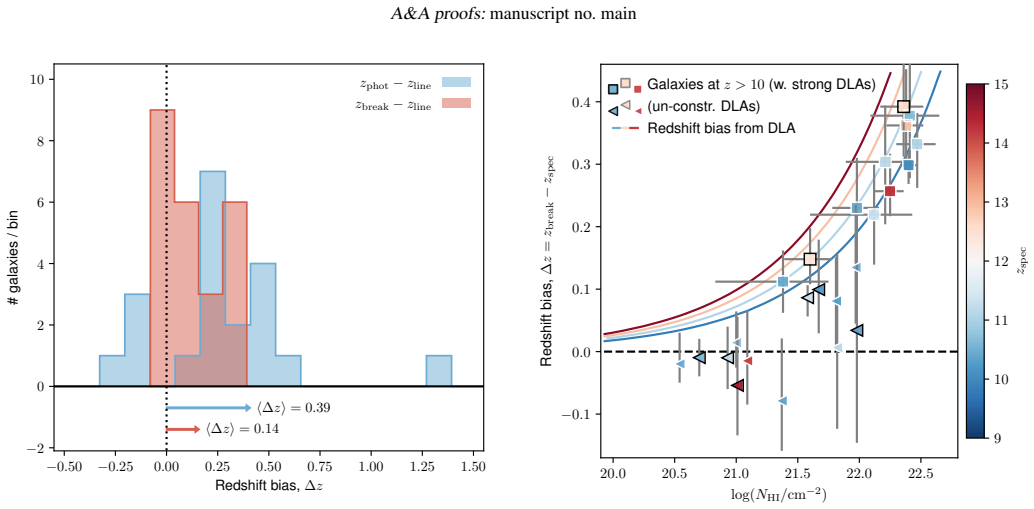
In galaxies at z_spec >= 10, the prominence of strong rest-UV lines correlates with burstiness (SFR_10Myr / SFR_100Myr), whereas HI column density from DLAs shows no strong links to M_UV, burstiness, or line prominence. The burstiest galaxies display large variations in efficiency and HI surface density but typically very short depletion times t_dep ≲ 20 Myr. DLAs on the spectra produce average redshift biases of 0.39 (photometric) and 0.14 (Lyα-break) when not modeled, with only marginal impact on the UV luminosity function.
What carries the argument
Damped Lyα absorption (DLA) features in NIRSpec Prism spectra that yield local HI gas column densities and alter the shape of the emergent spectrum used for redshift fitting.
If this is right
- Rest-UV line prominence can be used as a proxy for recent bursty star formation in high-redshift galaxies.
- Bursty systems require external pristine gas infall on timescales comparable to the depletion time to sustain their activity.
- Photometric and Lyα-break redshift estimates that omit DLAs systematically overestimate galaxy redshifts.
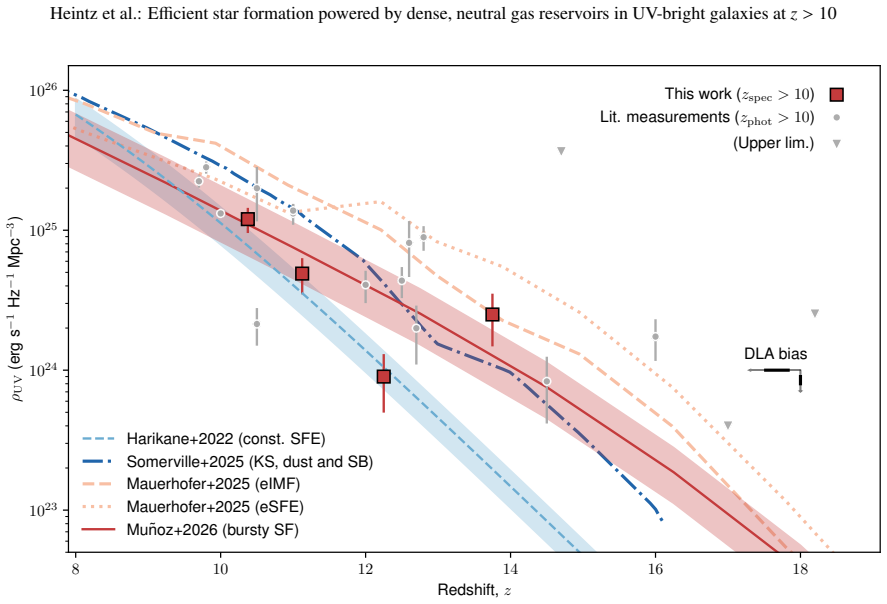
- The measured cosmic UV luminosity density at z>10 changes only slightly after correcting for the DLA-induced bias.
Where Pith is reading between the lines
- Star formation at these redshifts appears regulated by rapid external gas supply rather than the size of the local HI reservoir.
- Similar DLA-induced redshift biases may affect other JWST or ground-based surveys of the earliest galaxies.
- Models of early galaxy growth must incorporate short-timescale gas accretion to match the observed abundance of luminous objects.
Load-bearing premise
The damped Lyα absorption features arise from neutral hydrogen gas physically associated with the target galaxies rather than unrelated foreground systems.
What would settle it
A larger sample of z>10 galaxies in which DLA strength shows no correlation with burstiness or in which independent redshift methods confirm zero average bias when DLAs are ignored.
Figures
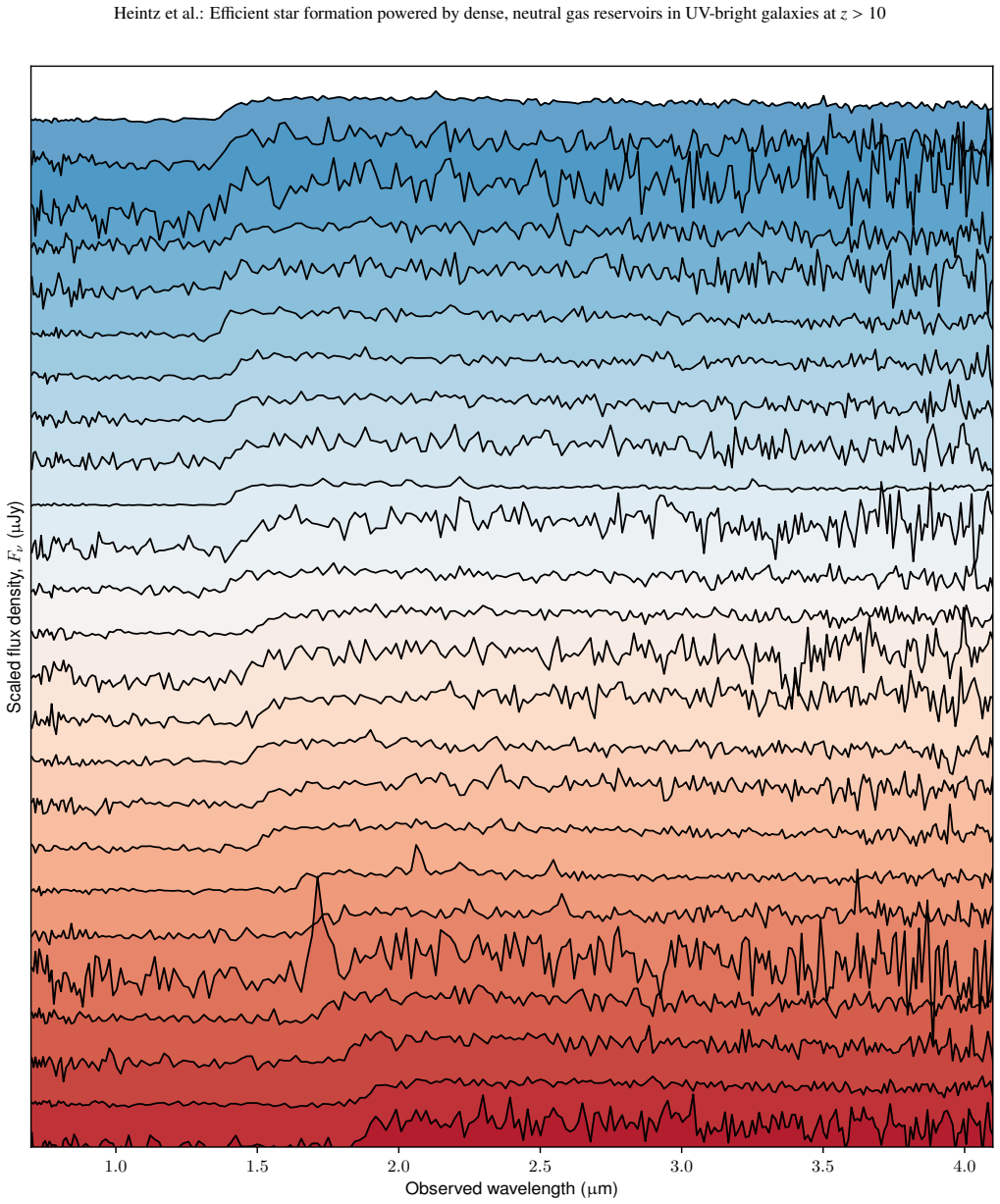
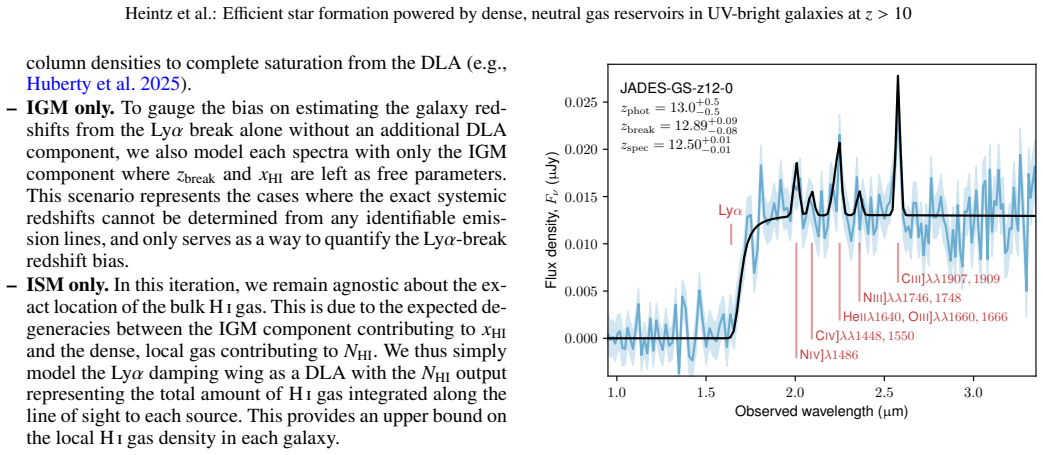
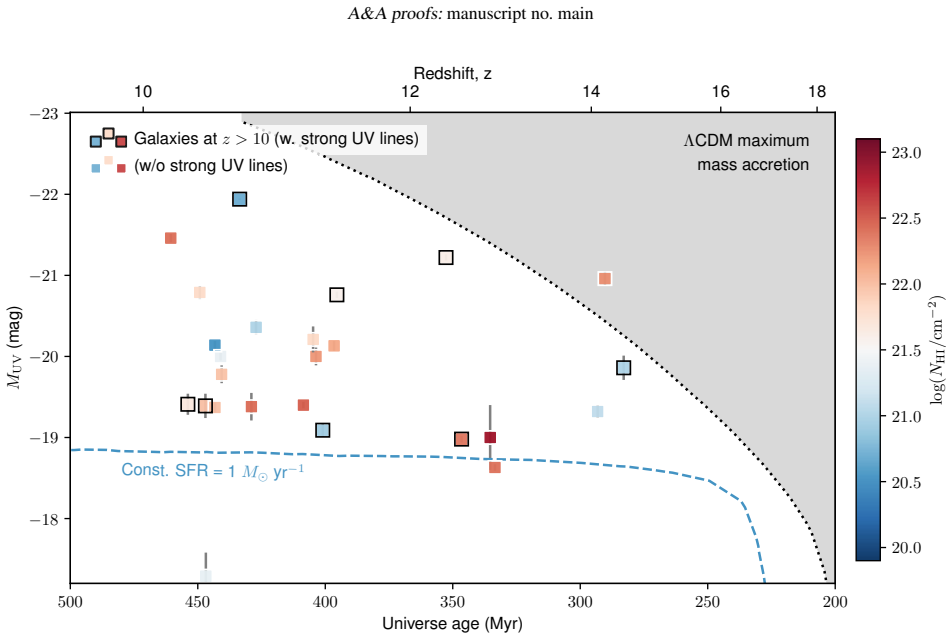
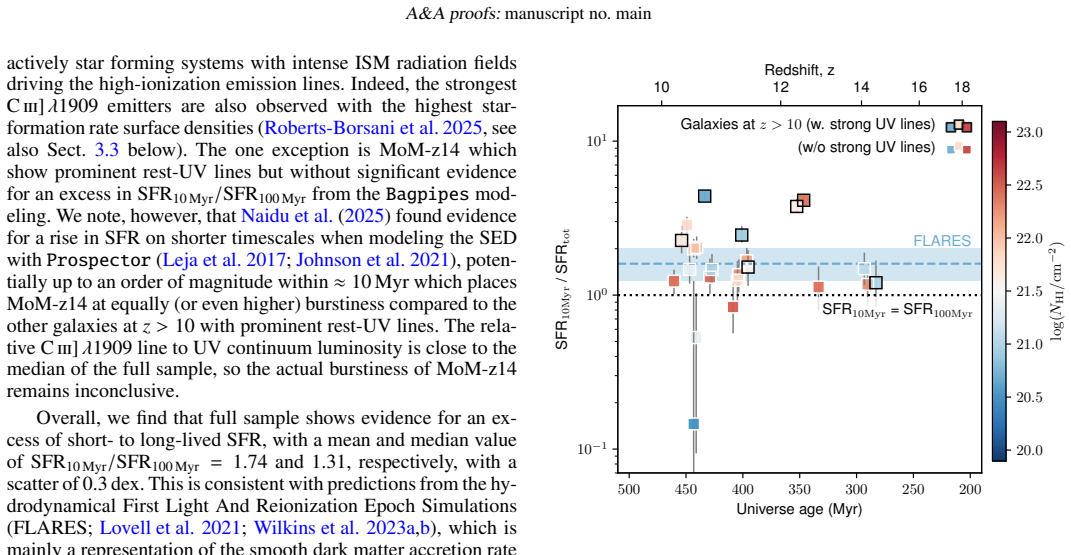
read the original abstract
Recent observations with JWST have revealed a remarkable population of surprisingly luminous galaxies at redshifts $z>10$. Their abundance exceed predictions from simulations and empirical extrapolations from lower redshifts, suggesting a transition in the physical conditions under which the first stars formed. Here we investigate the physical conditions of a select sample of 25 galaxies with robust redshift measurements at $z_{\rm spec}\geq 10$ observed with JWST/NIRSpec Prism. We characterize their star-formation efficiency, `burstiness', and presence of strong rest-frame UV nebular lines in relation to the density of the local neutral atomic hydrogen (HI) gas reservoirs they are embedded in. We find that the prominence of strong rest-UV lines are correlated with the burstiness of the galaxies, defined as ${\rm SFR_{10\,Myr} / SFR_{100\,Myr}}$. In contrast, there are no strong connections between the HI gas column density derived from the damped Ly$\alpha$ absorption (DLA) and the $M_{\rm UV}$ brightness, ${\rm SFR_{10\,Myr} / SFR_{100\,Myr}}$, and prominence of rest-UV lines. The most bursty galaxies show a large variation in star-formation efficiencies and HI gas surface densities, though typically with very short depletion timescales, $t_{\rm dep} \lesssim 20$\,Myr. This necessites rapid gas depletion times and external replenishment from infalling, pristine gas, powering starburst episodes on equally short timescales. We further quantify the impact of strong DLAs in galaxy spectra on photometric and Ly$\alpha$-break redshift-inferences, finding average redshift biases of $\langle z \rangle =0.39$ and $0.14$, respectively, when not incorporating DLAs on the emergent spectra. We show the effect of this bias on new measurements of the cosmic UV luminosity density, $\rho_{\rm UV}$, derived here at $z>10$, finding that this has a marginal impact on the UV luminosity function.
Editorial analysis
A structured set of objections, weighed in public.
Referee Report
Summary. The paper analyzes JWST/NIRSpec Prism spectra for a sample of 25 galaxies with robust z_spec >=10. It reports that prominence of strong rest-UV nebular lines correlates with burstiness (defined as SFR_10Myr / SFR_100Myr), while HI column density from damped Lyα absorption shows no strong connections to M_UV, burstiness, or line prominence. The most bursty systems exhibit short depletion timescales t_dep ≲ 20 Myr, implying rapid gas depletion and external replenishment. Not incorporating DLAs produces average redshift biases of ⟨z⟩=0.39 (photometric) and 0.14 (Lyα-break), with only marginal impact on the derived UV luminosity function at z>10.
Significance. If the DLAs are confirmed to trace gas physically associated with the targets, the results would constrain star-formation efficiency and burstiness in the earliest galaxies while flagging a systematic in high-z redshift and luminosity-function measurements. The direct use of NIRSpec Prism spectra to link nebular-line strength, burstiness, and depletion time is a strength of the observational approach.
major comments (2)
- [Abstract] Abstract: the central claims on N_HI correlations, t_dep ≲ 20 Myr, and quantified redshift biases all require that the damped Lyα features trace neutral gas physically associated with the z>=10 targets rather than intervening systems. No velocity alignment with systemic redshift from emission lines, coincident low-ionization metal absorption, or other association diagnostics are reported, leaving the interpretation load-bearing and unverified.
- [Abstract] Abstract: reported correlations and bias values are stated without error bars, statistical significance tests, explicit sample selection criteria for the 25 galaxies, or details on how DLA column densities and SFR_10Myr/SFR_100Myr ratios were derived from the Prism spectra, preventing full evaluation of robustness.
minor comments (1)
- Notation for the burstiness ratio and depletion timescale should be defined explicitly with units and time baselines in the main text for clarity.
Simulated Author's Rebuttal
We thank the referee for their constructive comments on our manuscript. We address each major comment point-by-point below, providing the strongest honest response based on the content and limitations of the current analysis. Revisions have been made where they strengthen the paper without misrepresenting the data.
read point-by-point responses
-
Referee: [Abstract] Abstract: the central claims on N_HI correlations, t_dep ≲ 20 Myr, and quantified redshift biases all require that the damped Lyα features trace neutral gas physically associated with the z>=10 targets rather than intervening systems. No velocity alignment with systemic redshift from emission lines, coincident low-ionization metal absorption, or other association diagnostics are reported, leaving the interpretation load-bearing and unverified.
Authors: The association is supported by the DLA feature appearing at the systemic redshift independently measured from multiple rest-UV emission lines in the same Prism spectrum. We agree, however, that the low spectral resolution of Prism precludes precise velocity offsets or detection of weak low-ionization metal lines. We have added a new paragraph in Section 4.3 discussing this assumption, including a statistical estimate of the low probability of chance alignment with an intervening DLA at z>10 based on known incidence rates. Claims are now qualified to reflect that physical association is the favored but not definitively proven interpretation with current data. revision: partial
-
Referee: [Abstract] Abstract: reported correlations and bias values are stated without error bars, statistical significance tests, explicit sample selection criteria for the 25 galaxies, or details on how DLA column densities and SFR_10Myr/SFR_100Myr ratios were derived from the Prism spectra, preventing full evaluation of robustness.
Authors: We accept that the abstract omitted these elements for brevity. The main text already details the sample (25 galaxies with robust z_spec >=10 confirmed by multiple emission lines), N_HI derivation via Voigt-profile fitting, and burstiness from SED modeling with Prospector. We have revised the abstract to include sample criteria, error bars on the bias values (e.g., 0.39 ± 0.11), and a brief methods summary. Statistical tests (Spearman rank and p-values) for the reported correlations have been added to Section 3.2. revision: yes
Circularity Check
No circularity: direct observational measurements from spectra
full rationale
The paper reports measured quantities (N_HI from DLA fits, SFR ratios, line strengths, photometric redshift shifts) directly from JWST/NIRSpec Prism spectra of 25 galaxies. No load-bearing step reduces by the paper's own equations to a fitted parameter renamed as a prediction, a self-citation chain, or a self-definitional loop. The reported null correlations, depletion times, and average redshift biases are computed from the observed spectra and standard conversions; the association of DLAs with the targets is an interpretive assumption but does not create a circular derivation within the presented chain. The study is self-contained as an observational report.
Axiom & Free-Parameter Ledger
axioms (1)
- domain assumption Damped Lyα absorption features observed in the spectra accurately trace local neutral hydrogen column densities associated with the galaxies.
Reference graph
Works this paper leans on
-
[1]
Abundance scaling in stars, nebulae and galaxies
Abundance scaling in stars, nebulae and galaxies. , keywords =. doi:10.1093/mnras/stw3235 , archivePrefix =. 1612.03546 , primaryClass =
work page internal anchor Pith review Pith/arXiv arXiv doi:10.1093/mnras/stw3235
-
[2]
The statistical properties of stars at redshift, z = 5, compared with the present epoch. , keywords =. doi:10.1093/mnras/stac3481 , archivePrefix =. 2211.15727 , primaryClass =
-
[3]
The COLIBRE project: cosmological hydrodynamical simulations of galaxy formation and evolution
The COLIBRE project: cosmological hydrodynamical simulations of galaxy formation and evolution. , keywords =. doi:10.1093/mnras/stag375 , archivePrefix =. 2508.21126 , primaryClass =
work page internal anchor Pith review Pith/arXiv arXiv doi:10.1093/mnras/stag375
-
[4]
Feedback-free starbursts at cosmic dawn: Observable predictions for JWST. , keywords =. doi:10.1051/0004-6361/202348727 , archivePrefix =. 2311.14662 , primaryClass =
-
[5]
Synergising semi-analytical models and hydrodynamical simulations to interpret JWST data from the first billion years. , keywords =. doi:10.1051/0004-6361/202554042 , archivePrefix =. 2502.02647 , primaryClass =
-
[6]
Predictions for deep galaxy surveys with JWST from $\Lambda$CDM
Predictions for deep galaxy surveys with JWST from CDM. , keywords =. doi:10.1093/mnras/stx2897 , archivePrefix =. 1702.02146 , primaryClass =
work page internal anchor Pith review Pith/arXiv arXiv doi:10.1093/mnras/stx2897
-
[7]
A comparison of pre-existing CDM predictions with the abundance of JWST galaxies at high redshift. , keywords =. doi:10.1093/mnras/stae2646 , archivePrefix =. 2406.02672 , primaryClass =
-
[8]
A hidden population of active galactic nuclei can explain the overabundance of luminous z > 10 objects observed by JWST. , keywords =. doi:10.1088/1475-7516/2024/08/025 , archivePrefix =. 2405.01629 , primaryClass =
-
[9]
Dust Attenuation Curves in the Local Universe: Demographics and New Laws for Star-forming Galaxies and High-redshift Analogs. , keywords =. doi:10.3847/1538-4357/aabf3c , archivePrefix =. 1804.05850 , primaryClass =
work page internal anchor Pith review Pith/arXiv arXiv doi:10.3847/1538-4357/aabf3c
-
[10]
Ionizing properties of galaxies in JADES for a stellar mass complete sample: resolving the cosmic ionizing photon budget crisis at the Epoch of Reionization. , keywords =. doi:10.1093/mnras/stae2537 , archivePrefix =. 2409.01286 , primaryClass =
-
[11]
Bursting at the seams: the star-forming main sequence and its scatter at z = 3─9 using NIRCam photometry from JADES. , keywords =. doi:10.1093/mnras/staf1950 , archivePrefix =. 2508.04410 , primaryClass =
-
[12]
21 Balmer Jump Street: The Nebular Continuum at High Redshift and Implications for the Bright Galaxy Problem, UV Continuum Slopes, and Early Stellar Populations. arXiv e-prints , keywords =. doi:10.48550/arXiv.2408.03189 , archivePrefix =. 2408.03189 , primaryClass =
-
[13]
Variation of the low-mass end of the stellar initial mass function with redshift and metallicity. , keywords =. doi:10.1093/mnras/staf059 , archivePrefix =. 2501.06082 , primaryClass =
-
[14]
High Energy, Optical, and Infrared Detectors for Astronomy IV , year = 2010, editor =
Reducing the read noise of H2RG detector arrays: eliminating correlated noise with efficient use of reference signals. High Energy, Optical, and Infrared Detectors for Astronomy IV , year = 2010, editor =. doi:10.1117/12.866773 , adsurl =
-
[15]
Improved Reference Sampling and Subtraction: A Technique for Reducing the Read Noise of Near-infrared Detector Systems. , keywords =. doi:10.1088/1538-3873/aa83fd , archivePrefix =. 1707.09387 , primaryClass =
work page internal anchor Pith review Pith/arXiv arXiv doi:10.1088/1538-3873/aa83fd
-
[16]
The JWST FRESCO survey: legacy NIRCam/grism spectroscopy and imaging in the two GOODS fields. , keywords =. doi:10.1093/mnras/stad2411 , archivePrefix =. 2304.02026 , primaryClass =
-
[17]
Reionization Era Bright Emission Line Survey: Selection and Characterization of Luminous Interstellar Medium Reservoirs in the z > 6.5 Universe. , keywords =. doi:10.3847/1538-4357/ac5a4a , archivePrefix =. 2106.13719 , primaryClass =
-
[18]
The nature of high [O III] _ 88 m /[C II] _ 158 m galaxies in the epoch of reionization: Low carbon abundance and a top-heavy IMF?. , keywords =. doi:10.1093/mnras/stac028 , archivePrefix =. 2108.01074 , primaryClass =
-
[19]
UNCOVERing the contribution of black holes to reionization in the JWST era. arXiv e-prints , keywords =. doi:10.48550/arXiv.2401.11242 , archivePrefix =. 2401.11242 , primaryClass =
-
[20]
Are the newly-discovered z 13 drop-out sources starburst galaxies or quasars?. , keywords =. doi:10.1093/mnrasl/slac035 , archivePrefix =. 2201.00823 , primaryClass =
-
[21]
A fundamental plane for field star-forming galaxies
A fundamental plane for field star-forming galaxies. , keywords =. doi:10.1051/0004-6361/201014803 , archivePrefix =. 1005.0509 , primaryClass =
work page internal anchor Pith review Pith/arXiv arXiv doi:10.1051/0004-6361/201014803
-
[22]
Strong damped Lyman- absorption in young star-forming galaxies at redshifts 9 to 11. Science , keywords =. doi:10.1126/science.adj0343 , archivePrefix =. 2306.00647 , primaryClass =
-
[23]
Identifying Ly emitter candidates with Random Forest: Learning from galaxies in the CANDELS survey. , keywords =. doi:10.1051/0004-6361/202347026 , archivePrefix =. 2307.11818 , primaryClass =
-
[24]
The onset of star formation 250 million years after the Big Bang. , keywords =. doi:10.1038/s41586-018-0117-z , archivePrefix =. 1805.05966 , primaryClass =
-
[25]
Galaxy Formation and Reionization: Key Unknowns and Expected Breakthroughs by the James Webb Space Telescope. , keywords =. doi:10.1146/annurev-astro-120221-044656 , archivePrefix =. 2110.13160 , primaryClass =
-
[26]
, year = 2016, month = sep, volume =
Galaxies in the First Billion Years After the Big Bang. , year = 2016, month = sep, volume =. doi:10.1146/annurev-astro-081915-023417 , adsurl =
-
[27]
Core condensation in heavy halos: a two-stage theory for galaxy formation and clustering. , keywords =. doi:10.1093/mnras/183.3.341 , adsurl =
-
[28]
Galaxy Formation through Hierarchical Clustering. , keywords =. doi:10.1086/170483 , adsurl =
-
[29]
Formation of galaxies and large-scale structure with cold dark matter. , keywords =. doi:10.1038/311517a0 , adsurl =
-
[30]
How do galaxies get their gas?. , keywords =. doi:10.1111/j.1365-2966.2005.09451.x , archivePrefix =. astro-ph/0407095 , primaryClass =
-
[31]
The physics driving the cosmic star formation history. , keywords =. doi:10.1111/j.1365-2966.2009.16029.x , archivePrefix =. 0909.5196 , primaryClass =
-
[32]
Early galaxy formation and its large-scale effects. , keywords =. doi:10.1016/j.physrep.2018.10.002 , archivePrefix =. 1809.09136 , primaryClass =
-
[33]
The Circumgalactic Medium. , keywords =. doi:10.1146/annurev-astro-091916-055240 , archivePrefix =. 1709.09180 , primaryClass =
work page internal anchor Pith review Pith/arXiv arXiv doi:10.1146/annurev-astro-091916-055240
-
[34]
Quasars and the Intergalactic Medium at Cosmic Dawn. , keywords =. doi:10.1146/annurev-astro-052920-102455 , archivePrefix =. 2212.06907 , primaryClass =
-
[35]
The Evolution and Explosion of Massive Stars. II. Explosive Hydrodynamics and Nucleosynthesis. , keywords =. doi:10.1086/192237 , adsurl =
-
[36]
, year = 1957, month = jun, volume =
Nuclear Reactions in Stars and Nucleogenesis. , year = 1957, month = jun, volume =. doi:10.1086/127051 , adsurl =
-
[37]
the Synthesis of Elements from Carbon to Nickel
On Nuclear Reactions Occuring in Very Hot STARS.I. the Synthesis of Elements from Carbon to Nickel. , year = 1954, month = sep, volume =. doi:10.1086/190005 , adsurl =
-
[38]
Reviews of Modern Physics , year = 1957, month = jan, volume =
Synthesis of the Elements in Stars. Reviews of Modern Physics , year = 1957, month = jan, volume =. doi:10.1103/RevModPhys.29.547 , adsurl =
-
[39]
Cool Gas in High Redshift Galaxies
Cool Gas in High-Redshift Galaxies. , keywords =. doi:10.1146/annurev-astro-082812-140953 , archivePrefix =. 1301.0371 , primaryClass =
work page internal anchor Pith review Pith/arXiv arXiv doi:10.1146/annurev-astro-082812-140953
-
[40]
Royal Society Open Science , keywords =
High-redshift star formation in the Atacama large millimetre/submillimetre array era. Royal Society Open Science , keywords =. doi:10.1098/rsos.200556 , archivePrefix =. 2004.00934 , primaryClass =
-
[41]
The Cosmic Baryon and Metal Cycles. , keywords =. doi:10.1146/annurev-astro-021820-120014 , archivePrefix =. 2011.01935 , primaryClass =
-
[42]
UV Luminosity Functions at redshifts z~4 to z~10: 10000 Galaxies from HST Legacy Fields
UV Luminosity Functions at Redshifts z 4 to z 10: 10,000 Galaxies from HST Legacy Fields. , keywords =. doi:10.1088/0004-637X/803/1/34 , archivePrefix =. 1403.4295 , primaryClass =
work page internal anchor Pith review Pith/arXiv arXiv doi:10.1088/0004-637x/803/1/34
-
[43]
Cosmic Star-Formation History. , keywords =. doi:10.1146/annurev-astro-081811-125615 , archivePrefix =. 1403.0007 , primaryClass =
work page internal anchor Pith review Pith/arXiv arXiv doi:10.1146/annurev-astro-081811-125615
-
[44]
COSMOS2020: The galaxy stellar mass function. The assembly and star formation cessation of galaxies at 0.2< z 7.5. , keywords =. doi:10.1051/0004-6361/202245581 , archivePrefix =. 2212.02512 , primaryClass =
-
[45]
Evolution of the UV LF from z 15 to z 8 using new JWST NIRCam medium-band observations over the HUDF/XDF. , keywords =. doi:10.1093/mnras/stad1145 , archivePrefix =. 2211.02607 , primaryClass =
-
[46]
Galaxy Stellar Mass Functions from z 10 to z 6 using the Deepest Spitzer/Infrared Array Camera Data: No Significant Evolution in the Stellar-to-halo Mass Ratio of Galaxies in the First Gigayear of Cosmic Time. , keywords =. doi:10.3847/1538-4357/ac1bb6 , archivePrefix =. 2103.16571 , primaryClass =
-
[47]
A Comprehensive Study of Galaxies at z 9-16 Found in the Early JWST Data: Ultraviolet Luminosity Functions and Cosmic Star Formation History at the Pre-reionization Epoch. , keywords =. doi:10.3847/1538-4365/acaaa9 , archivePrefix =. 2208.01612 , primaryClass =
-
[48]
Pure Spectroscopic Constraints on UV Luminosity Functions and Cosmic Star Formation History from 25 Galaxies at z _ spec = 8.61-13.20 Confirmed with JWST/NIRSpec. , keywords =. doi:10.3847/1538-4357/ad0b7e , archivePrefix =. 2304.06658 , primaryClass =
-
[49]
A population of red candidate massive galaxies 600 Myr after the Big Bang. , keywords =. doi:10.1038/s41586-023-05786-2 , archivePrefix =. 2207.12446 , primaryClass =
-
[50]
The UNCOVER Survey: A First-Look HST+JWST Catalog of Galaxy Redshifts and Stellar Populations Properties Spanning 0.2 z 15. arXiv e-prints , keywords =. doi:10.48550/arXiv.2310.01276 , archivePrefix =. 2310.01276 , primaryClass =
-
[51]
A Large Population of Faint 8 < z < 16 Galaxies Found in the First JWST NIRCam Observations of the NGDEEP Survey. , keywords =. doi:10.3847/2041-8213/ace18d , archivePrefix =. 2302.04270 , primaryClass =
-
[52]
EPOCHS III: Unbiased UV continuum slopes at 6.5<z<13 from combined PEARLS GTO and public JWST NIRCam imaging. arXiv e-prints , keywords =. doi:10.48550/arXiv.2404.10751 , archivePrefix =. 2404.10751 , primaryClass =
-
[53]
Schrodinger's Galaxy Candidate: Puzzlingly Luminous at z 17 , or Dusty/Quenched at z 5 ?. arXiv e-prints , keywords =. doi:10.48550/arXiv.2208.02794 , archivePrefix =. 2208.02794 , primaryClass =
-
[54]
JWST UNCOVER: discovery of z > 9 galaxy candidates behind the lensing cluster Abell 2744. , keywords =. doi:10.1093/mnras/stad1998 , archivePrefix =. 2305.01793 , primaryClass =
-
[55]
Revealing galaxy candidates out to z 16 with JWST observations of the lensing cluster SMACS0723. , keywords =. doi:10.1093/mnras/stac3144 , archivePrefix =. 2207.12338 , primaryClass =
-
[56]
ALMA FIR View of Ultra-high-redshift Galaxy Candidates at z 11-17: Blue Monsters or Low-z Red Interlopers?. , keywords =. doi:10.3847/1538-4357/aceb67 , archivePrefix =. 2211.03896 , primaryClass =
-
[57]
Early Results from GLASS-JWST. III. Galaxy Candidates at z 9-15. , keywords =. doi:10.3847/2041-8213/ac94d0 , archivePrefix =. 2207.09436 , primaryClass =
-
[58]
The evolution of the galaxy UV luminosity function at redshifts z ≃ 8 - 15 from deep JWST and ground-based near-infrared imaging. , keywords =. doi:10.1093/mnras/stac3472 , archivePrefix =. 2207.12356 , primaryClass =
-
[59]
The Near-Infrared Spectrograph (NIRSpec) on the James Webb Space Telescope. I. Overview of the instrument and its capabilities. , keywords =. doi:10.1051/0004-6361/202142663 , archivePrefix =. 2202.03305 , primaryClass =
work page internal anchor Pith review Pith/arXiv arXiv doi:10.1051/0004-6361/202142663
-
[60]
UNCOVER: Illuminating the Early Universe -- JWST/NIRSpec Confirmation of z > 12 Galaxies. arXiv e-prints , keywords =. doi:10.48550/arXiv.2308.03745 , archivePrefix =. 2308.03745 , primaryClass =
-
[61]
UNCOVER: A NIRSpec Census of Lensed Galaxies at z=8.50-13.08 Probing a High AGN Fraction and Ionized Bubbles in the Shadow. arXiv e-prints , keywords =. doi:10.48550/arXiv.2308.11609 , archivePrefix =. 2308.11609 , primaryClass =
-
[62]
CEERS Spectroscopic Confirmation of NIRCam-selected z 8 Galaxy Candidates with JWST/NIRSpec: Initial Characterization of Their Properties. , keywords =. doi:10.3847/2041-8213/acd2d9 , archivePrefix =. 2301.09482 , primaryClass =
-
[63]
The Evolution of the Baryons Associated with Galaxies Averaged over Cosmic Time and Space. , keywords =. doi:10.3847/1538-4357/abb82e , archivePrefix =. 2009.11126 , primaryClass =
-
[64]
Discovery of a new N-emitter in the epoch of reionization. , keywords =. doi:10.1051/0004-6361/202450721 , archivePrefix =. 2406.08408 , primaryClass =
-
[65]
On the Estimation of Confidence Intervals for Binomial Population Proportions in Astronomy: The Simplicity and Superiority of the Bayesian Approach. , keywords =. doi:10.1071/AS10046 , archivePrefix =. 1012.0566 , primaryClass =
work page internal anchor Pith review Pith/arXiv arXiv doi:10.1071/as10046
-
[66]
Spectroscopic confirmation of four metal-poor galaxies at z = 10.3-13.2. Nature Astronomy , keywords =. doi:10.1038/s41550-023-01918-w , archivePrefix =. 2212.04568 , primaryClass =
-
[67]
JADES NIRSpec Spectroscopy of GN-z11: Lyman- emission and possible enhanced nitrogen abundance in a z = 10.60 luminous galaxy. , keywords =. doi:10.1051/0004-6361/202346159 , archivePrefix =. 2302.07256 , primaryClass =
-
[68]
JADES NIRSpec Initial Data Release for the Hubble Ultra Deep Field: Redshifts and Line Fluxes of Distant Galaxies from the Deepest JWST Cycle 1 NIRSpec Multi-Object Spectroscopy. arXiv e-prints , keywords =. doi:10.48550/arXiv.2306.02467 , archivePrefix =. 2306.02467 , primaryClass =
-
[69]
A small and vigorous black hole in the early Universe. arXiv e-prints , keywords =. doi:10.48550/arXiv.2305.12492 , archivePrefix =. 2305.12492 , primaryClass =
-
[70]
A Remarkably Luminous Galaxy at z=11.1 Measured with Hubble Space Telescope Grism Spectroscopy
A Remarkably Luminous Galaxy at z=11.1 Measured with Hubble Space Telescope Grism Spectroscopy. , keywords =. doi:10.3847/0004-637X/819/2/129 , archivePrefix =. 1603.00461 , primaryClass =
work page internal anchor Pith review Pith/arXiv arXiv doi:10.3847/0004-637x/819/2/129
-
[71]
The Dearth of z 10 Galaxies in All HST Legacy Fields The Rapid Evolution of the Galaxy Population in the First 500 Myr. , keywords =. doi:10.3847/1538-4357/aab03f , archivePrefix =. 1710.11131 , primaryClass =
work page internal anchor Pith review Pith/arXiv arXiv doi:10.3847/1538-4357/aab03f
-
[72]
Planck 2018 results. VI. Cosmological parameters. , keywords =. doi:10.1051/0004-6361/201833910 , archivePrefix =. 1807.06209 , primaryClass =
work page internal anchor Pith review Pith/arXiv arXiv doi:10.1051/0004-6361/201833910 2018
-
[73]
The Characteristic Shape of Damping Wings During Reionization. arXiv e-prints , keywords =. doi:10.48550/arXiv.2307.04797 , archivePrefix =. 2307.04797 , primaryClass =
-
[74]
The JWST UNCOVER Treasury survey: Ultradeep NIRSpec and NIRCam ObserVations before the Epoch of Reionization. arXiv e-prints , keywords =. doi:10.48550/arXiv.2212.04026 , archivePrefix =. 2212.04026 , primaryClass =
-
[75]
CEERS Key Paper. I. An Early Look into the First 500 Myr of Galaxy Formation with JWST. , keywords =. doi:10.3847/2041-8213/acade4 , archivePrefix =. 2211.05792 , primaryClass =
-
[76]
JADES: Probing interstellar medium conditions at z 5.5-9.5 with ultra-deep JWST/NIRSpec spectroscopy. , keywords =. doi:10.1051/0004-6361/202346107 , archivePrefix =. 2302.04298 , primaryClass =
-
[77]
Direct T _ e -based Metallicities of z = 2 9 Galaxies with JWST/NIRSpec: Empirical Metallicity Calibrations Applicable from Reionization to Cosmic Noon. , keywords =. doi:10.3847/1538-4357/ad15fc , archivePrefix =. 2303.08149 , primaryClass =
work page internal anchor Pith review Pith/arXiv arXiv doi:10.3847/1538-4357/ad15fc
-
[78]
Lyman-alpha opacities at z = 4-6 require low mass, radiatively-suppressed galaxies to drive cosmic reionization. , keywords =. doi:10.1093/mnras/stab2502 , archivePrefix =. 2105.01663 , primaryClass =
-
[79]
JWST Census for the Mass-Metallicity Star-Formation Relations at z=4-10 with the Self-Consistent Flux Calibration and the Proper Metallicity Calibrators. arXiv e-prints , keywords =. doi:10.48550/arXiv.2301.12825 , archivePrefix =. 2301.12825 , primaryClass =
-
[80]
Most of the photons that reionized the Universe came from dwarf galaxies. , keywords =. doi:10.1038/s41586-024-07043-6 , archivePrefix =. 2308.08540 , primaryClass =
discussion (0)
Sign in with ORCID, Apple, or X to comment. Anyone can read and Pith papers without signing in.