Deep Extragalactic VIsible Legacy Survey (DEVILS): Morphologically-selected galaxy merger fractions and their direct comparison to close-pair samples
Pith reviewed 2026-07-01 05:09 UTC · model grok-4.3
The pith
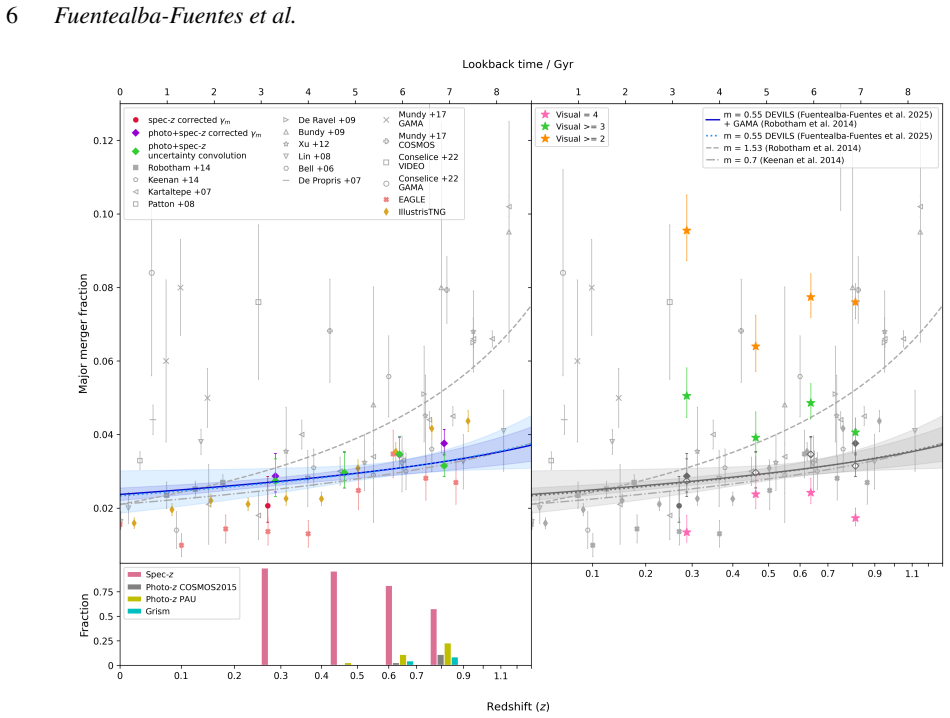
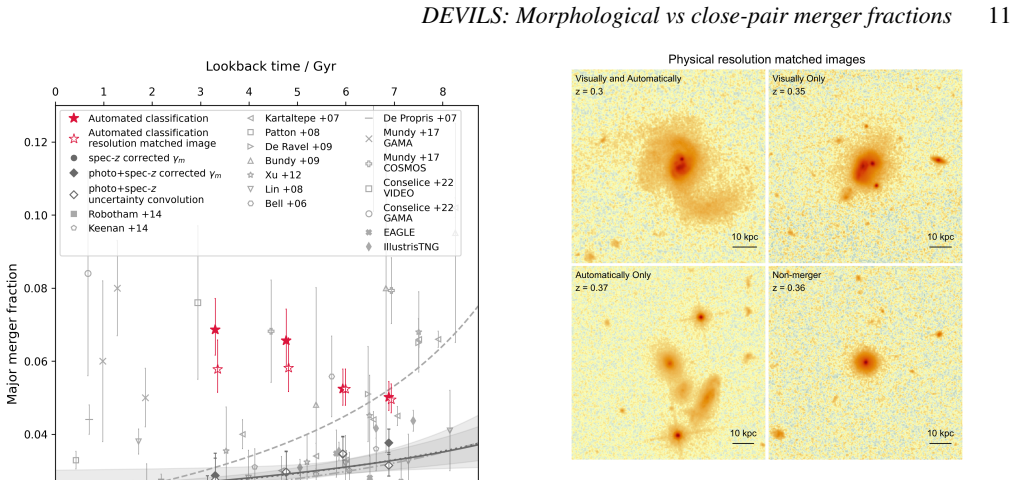
Morphological identification yields consistently higher galaxy merger fractions than close-pair counting from redshift 0.2 to 0.9.
A machine-rendered reading of the paper's core claim, the machinery that carries it, and where it could break.
Core claim
Galaxy merger fractions derived from morphological disturbances are consistently higher than those from close-pair counts at all redshifts. This potentially reflects how each method probes different stages of the merger process, with distinct observability timescales, as well as the fact that morphologically disturbed galaxies, at a given redshift, are typically the later-stage descendants of close-pairs from earlier epochs.
What carries the argument
Direct comparison of merger fractions from visual and CAS/Gini-M20 morphological classification (including unsharp-masked asymmetry) versus close-pair samples in the same DEVILS volume.
If this is right
- Morphologically selected merger fractions exceed close-pair fractions at every redshift from 0.2 to 0.9.
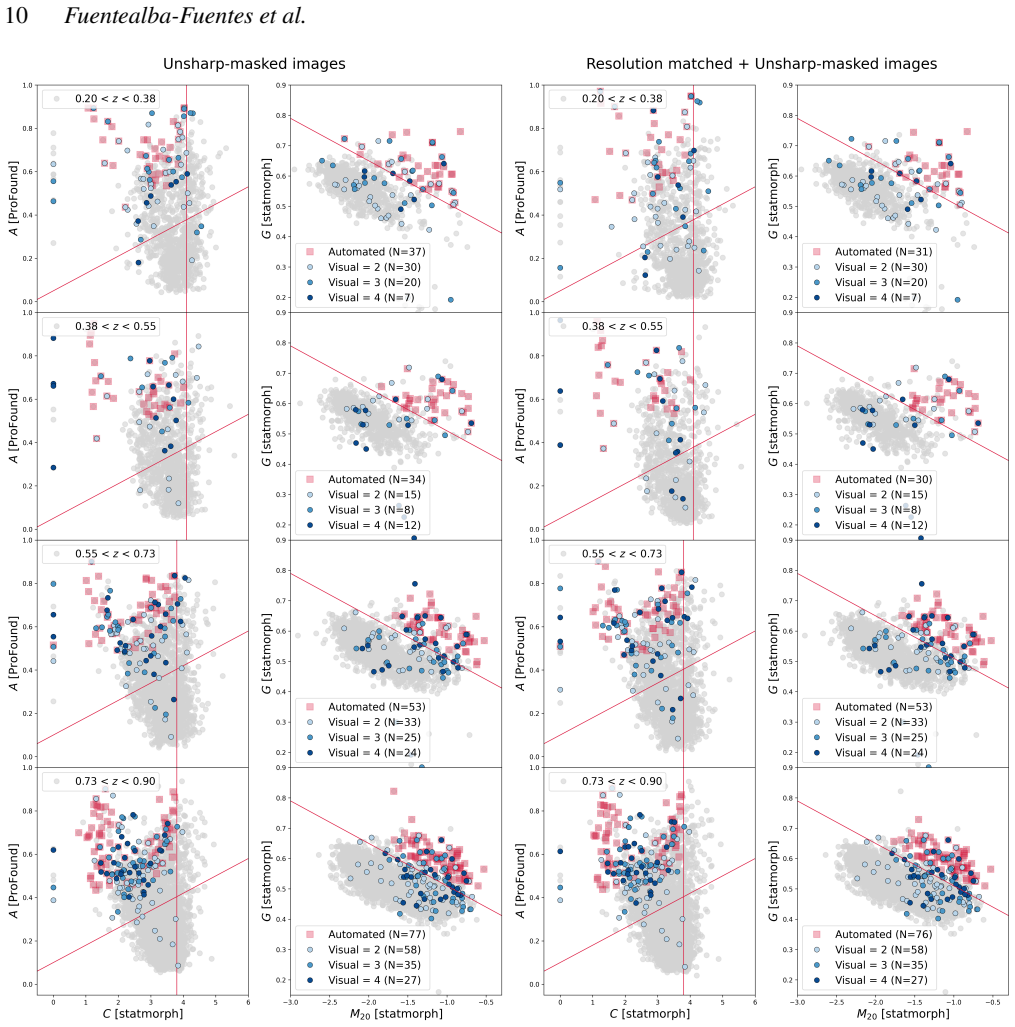
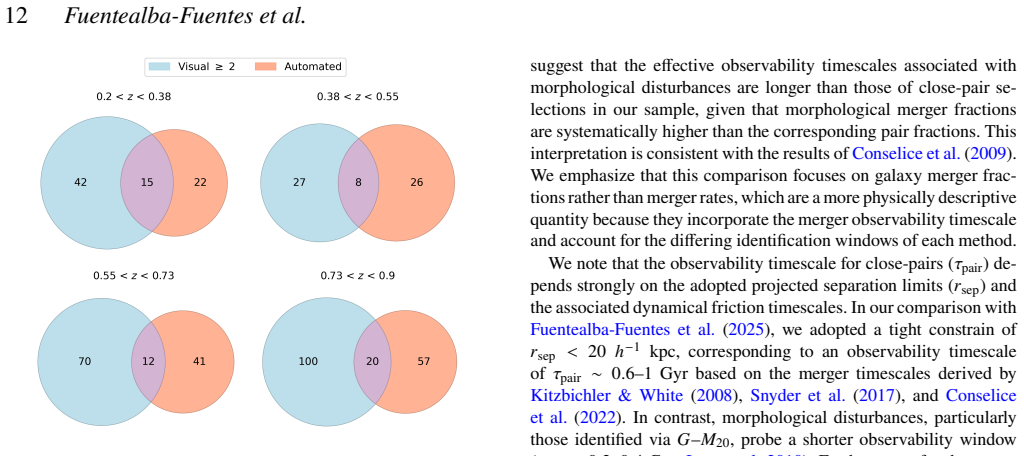
- Visually and automatically identified morphological samples show relatively little overlap.
- Morphologically disturbed galaxies at a given redshift are later-stage descendants of close-pairs observed at earlier epochs.
- Different identification techniques carry distinct sensitivities that must be accounted for when tracing merger evolution.
Where Pith is reading between the lines
- Merger rate calculations that rely on a single technique may systematically under- or over-estimate the true frequency depending on the redshift range.
- Combining morphological and close-pair indicators could provide a more complete census by covering both early and late merger phases.
- Future surveys with higher-resolution imaging might reduce contamination in morphological samples and tighten the comparison.
Load-bearing premise
That the observed morphological disturbances are produced by galaxy mergers rather than other processes and that the two samples can be compared without large corrections for selection or completeness.
What would settle it
A measurement demonstrating that the average observability timescale for morphological disturbances is equal to or shorter than the timescale for close-pair visibility would remove the proposed explanation for the higher morphological fractions.
Figures
read the original abstract
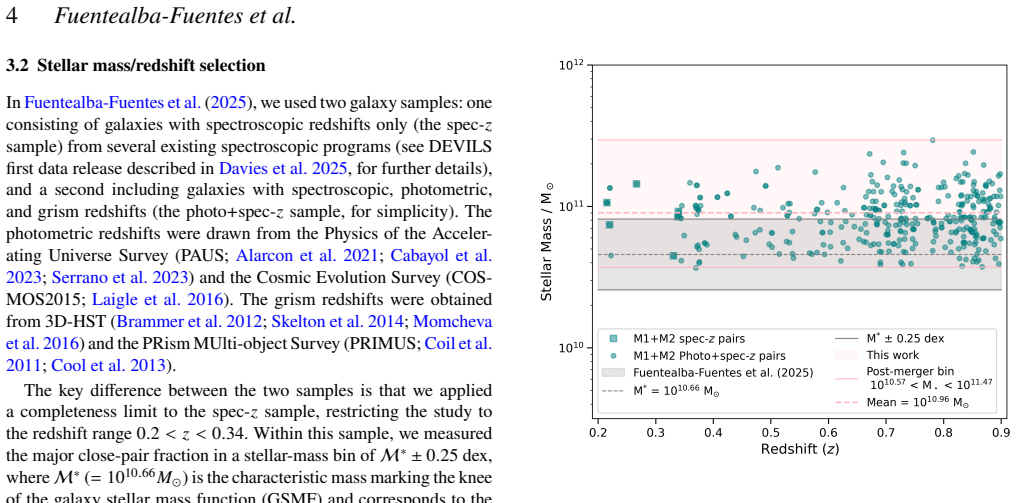
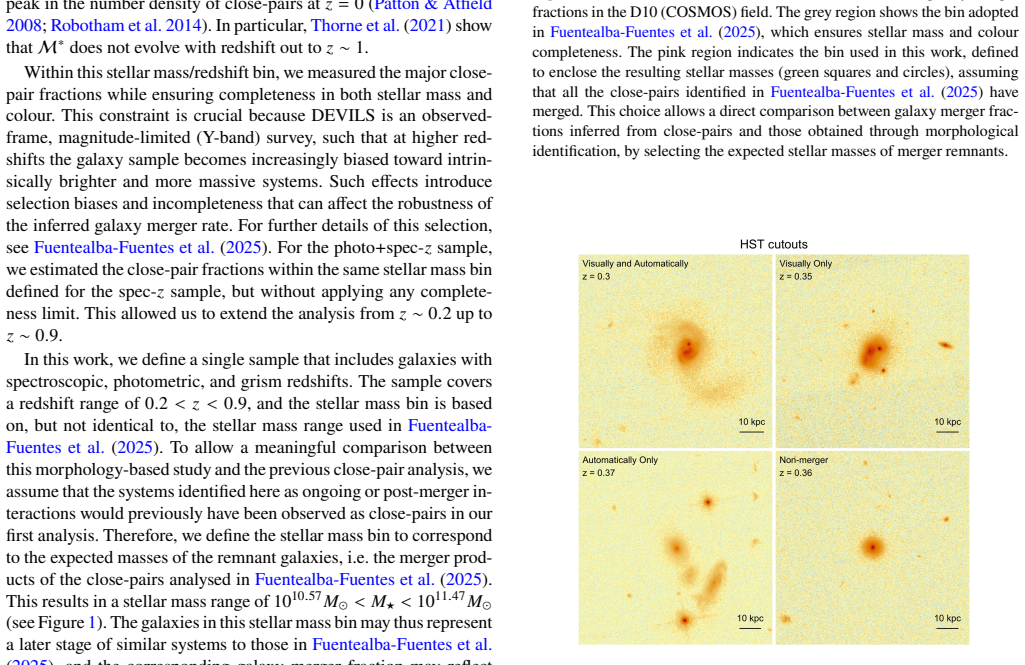
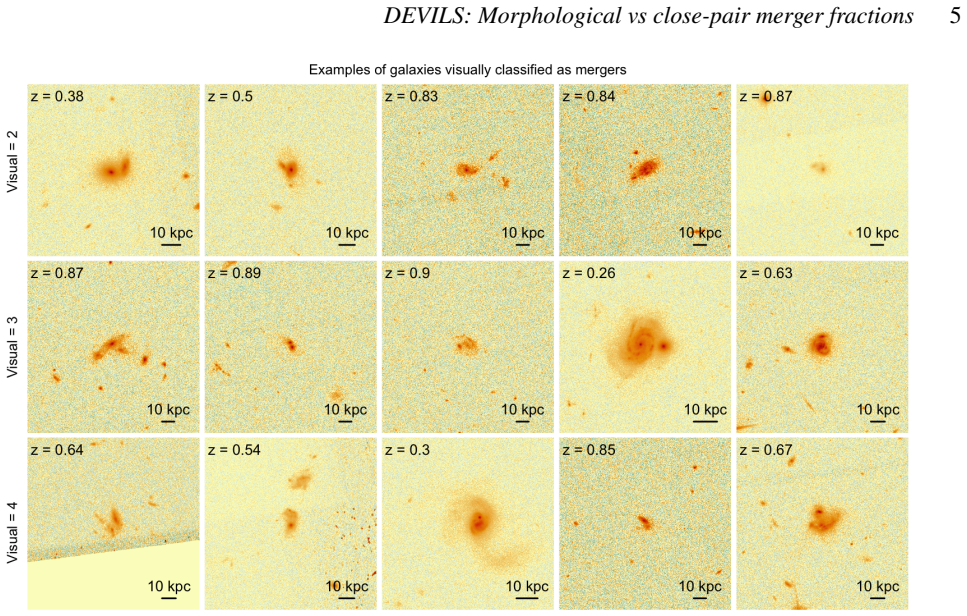
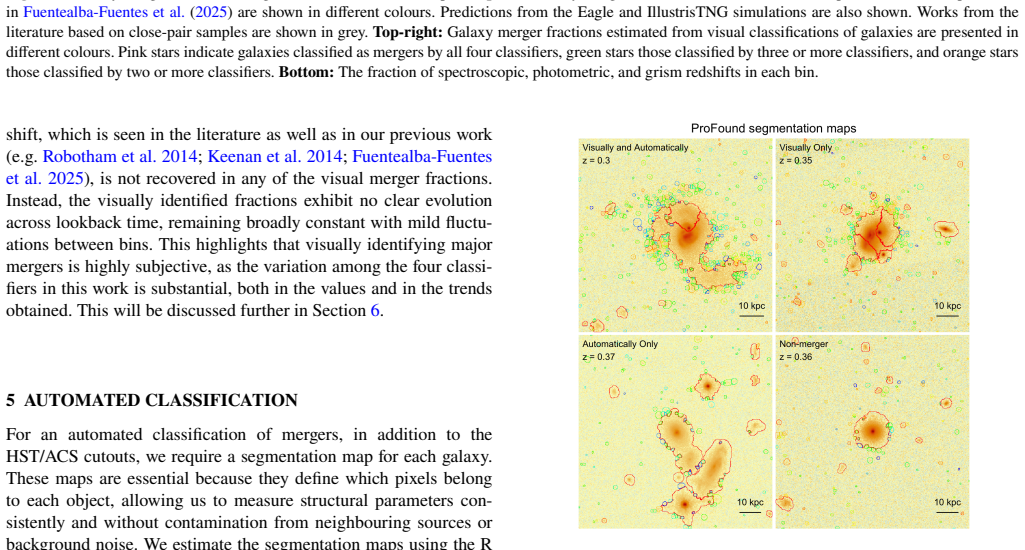
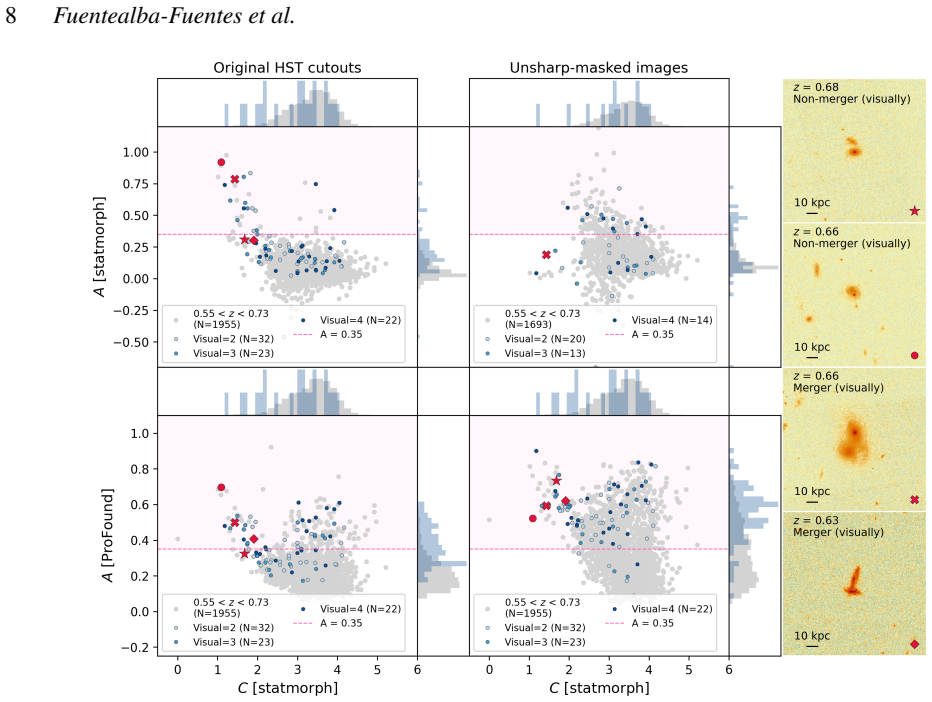
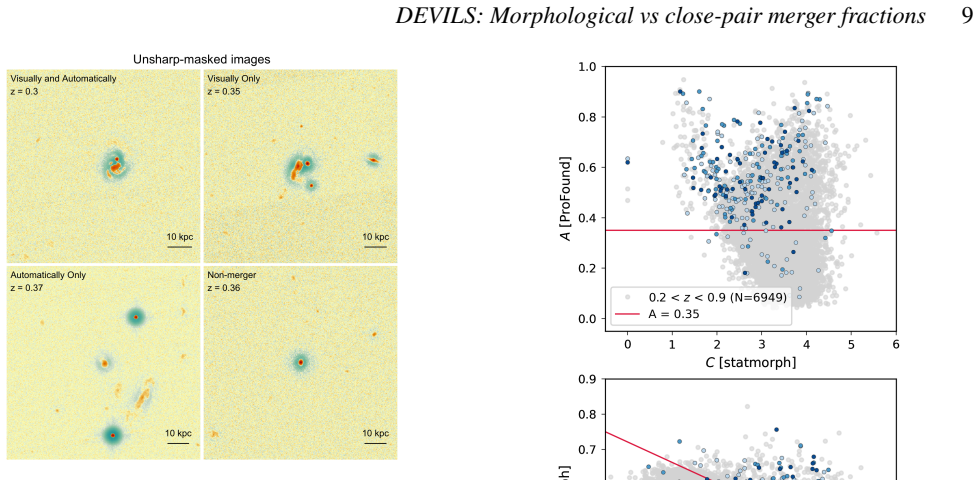
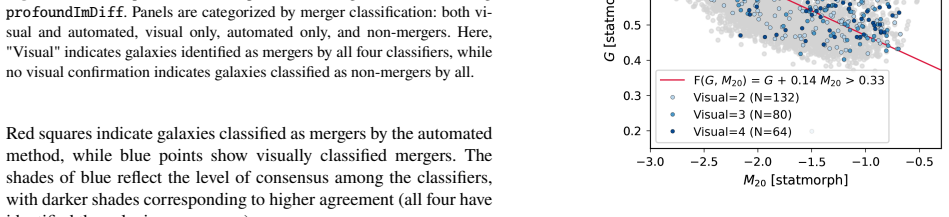
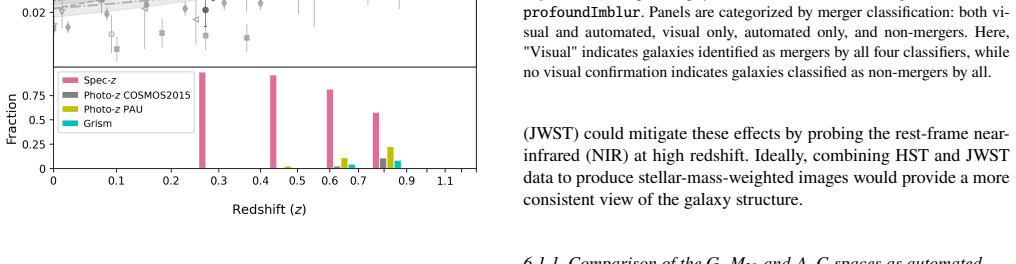
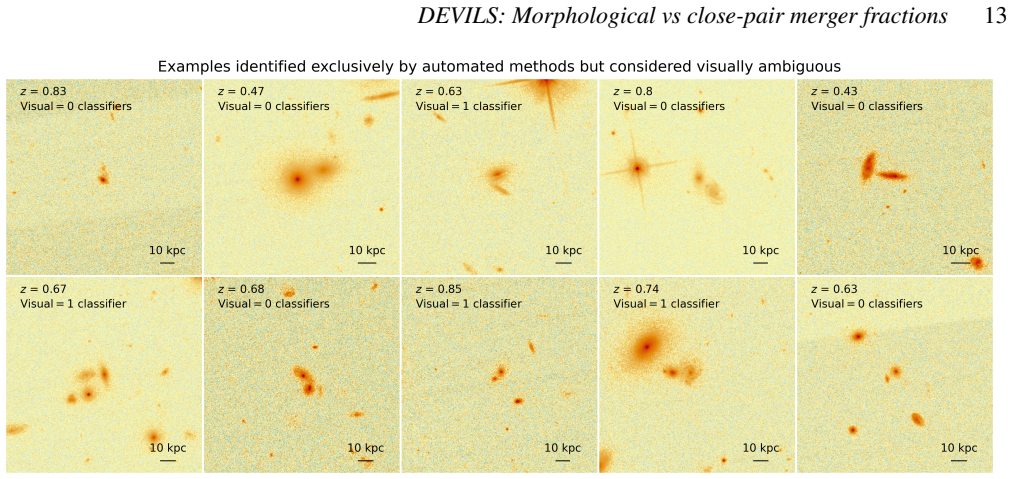
Galaxy mergers are a central driver of galaxy evolution across cosmic time, and thus, quantifying their frequency is critical for constraining hierarchical models of galaxy formation. Motivated by the need to robustly quantify these fractions and their evolution, we build on our previous close-pair analysis by exploring morphological identification techniques within the Deep Extragalactic VIsible Legacy Survey (DEVILS), using the D10 (COSMOS) field, which covers an area of $1.47$ deg$^2$. While close-pairs trace the early stages of galaxy interactions, morphological methods probe more advanced phases of the merging process, including systems with disturbed structures and post-merger remnants. We present galaxy merger fractions over the redshift range $0.2 < z < 0.9$ using visual classification and automated identification based on non-parametric statistics: concentration ($C$), asymmetry ($A$), smoothness ($S$), Gini ($G$), and $M_{20}$, applied to HST/ACS imaging. To enhance the detection of subtle structural perturbations, we measure asymmetry on unsharp-masked images. We find relatively little overlap between visually and automatically identified samples, which highlights their distinct sensitivities and limitations. Moreover, galaxy merger fractions derived from morphological disturbances are consistently higher than those from close-pair counts at all redshifts. This potentially reflects how each method probes different stages of the merger process, with distinct observability timescales, as well as the fact that morphologically disturbed galaxies, at a given redshift, are typically the later-stage descendants of close-pairs from earlier epochs. This comparison allows us to examine systematic differences between identification techniques and assess how they impact the observed evolution of the galaxy merger fraction.
Editorial analysis
A structured set of objections, weighed in public.
Referee Report
Summary. The paper analyzes galaxy merger fractions in the DEVILS D10 (COSMOS) 1.47 deg² field over 0.2 < z < 0.9 using visual classification and automated non-parametric statistics (C, A, S, G, M20 with unsharp-masked asymmetry) on HST/ACS imaging. It reports consistently higher merger fractions from morphological disturbances than from prior close-pair counts at all redshifts, with little overlap between visual and automated morphological samples, and interprets this as evidence that the methods probe different merger stages with distinct observability timescales.
Significance. If the central comparison holds after accounting for selection effects, the result would clarify systematic differences between merger identification techniques and their impact on inferred merger evolution, aiding constraints on hierarchical galaxy formation models. The multi-technique approach within a single large-area field is a positive aspect for internal consistency checks.
major comments (2)
- [Results (comparison to close-pairs)] Results section (comparison to close-pairs): The claim that morphological fractions exceed close-pair fractions at all redshifts is load-bearing on the assumption that both samples have been corrected for their respective selection functions and completeness within the identical 1.47 deg² volume; this correction and its impact on the numerical comparison are not demonstrated.
- [Methods (sample identification)] Methods (sample identification): The interpretation that elevated morphological fractions reflect later-stage mergers requires quantitative estimates of contamination from non-merger processes (internal instabilities, minor interactions, projection); the reported low overlap between visual and automated (CAS + unsharp-masked) samples indicates differing sensitivities that could admit such contaminants, directly affecting the central claim.
minor comments (2)
- [Abstract] Abstract and results: Provide quantitative overlap fractions (e.g., percentages or Venn diagram statistics) between visual and automated samples rather than the qualitative statement 'relatively little overlap'.
- [Figures and results text] Figure captions and text: Ensure error bars, sample sizes, and statistical significance of the reported difference in fractions are explicitly stated when comparing morphological and close-pair results.
Simulated Author's Rebuttal
We thank the referee for their thorough review and valuable comments on our manuscript. We address each of the major comments in turn below, providing clarifications and indicating where revisions will be made to strengthen the paper.
read point-by-point responses
-
Referee: Results section (comparison to close-pairs): The claim that morphological fractions exceed close-pair fractions at all redshifts is load-bearing on the assumption that both samples have been corrected for their respective selection functions and completeness within the identical 1.47 deg² volume; this correction and its impact on the numerical comparison are not demonstrated.
Authors: The referee correctly identifies that the direct numerical comparison relies on consistent application of selection corrections. The close-pair sample from our prior work was selected and corrected within the same D10 field and redshift range, and the morphological sample uses identical volume limits. However, the manuscript does not include an explicit side-by-side demonstration of the corrected values. We will revise the results section to include a table presenting the merger fractions before and after corrections for both methods, ensuring the comparison is transparent and the impact is quantified. revision: yes
-
Referee: Methods (sample identification): The interpretation that elevated morphological fractions reflect later-stage mergers requires quantitative estimates of contamination from non-merger processes (internal instabilities, minor interactions, projection); the reported low overlap between visual and automated (CAS + unsharp-masked) samples indicates differing sensitivities that could admit such contaminants, directly affecting the central claim.
Authors: We agree that quantitative estimates of contamination would provide a more robust foundation for the interpretation. The low overlap is discussed in the paper as indicating complementary sensitivities to different merger phases rather than a source of contamination. While we cannot provide new quantitative contamination fractions without additional simulations or data, we will expand the methods and discussion sections to include a more detailed assessment of potential non-merger contaminants based on the criteria used (e.g., visual inspection thresholds and CAS parameter cuts), and reference relevant literature on contamination rates in similar studies. This will be a partial revision as full quantification is beyond the scope of the current analysis. revision: partial
Circularity Check
Minor self-citation to prior close-pair analysis; purely observational comparison with no derivation reducing to inputs
full rationale
The paper reports direct observational measurements of merger fractions via visual classification and non-parametric CAS/GM20 statistics on HST imaging, then compares the resulting fractions to close-pair counts from earlier work by overlapping authors. No equations, fitted parameters, or derivations are presented that reduce by construction to the inputs; the central result is a numerical contrast between two independent selection techniques. The reference to 'our previous close-pair analysis' constitutes a self-citation but is not load-bearing for any claimed derivation or uniqueness result. The study remains self-contained against external benchmarks as an empirical comparison.
Axiom & Free-Parameter Ledger
axioms (2)
- domain assumption Morphological disturbances (asymmetry, low smoothness, high M20) are produced by galaxy mergers rather than other dynamical processes.
- domain assumption The DEVILS D10 field is representative for merger statistics at 0.2 < z < 0.9.
Reference graph
Works this paper leans on
-
[1]
Rodriguez-Gomez, Vicente and Snyder, Gregory F and Lotz, Jennifer M and Nelson, Dylan and Pillepich, Annalisa and Springel, Volker and Genel, Shy and Weinberger, Rainer and Tacchella, Sandro and Pakmor, Rüdiger and Torrey, Paul and Marinacci, Federico and Vogelsberger, Mark and Hernquist, Lars and Thilker, David A , title =. Monthly Notices of the Royal A...
work page internal anchor Pith review doi:10.1093/mnras/sty3345 2019
-
[2]
ProFound: Source Extraction and Application to Modern Survey Data
ProFound: Source Extraction and Application to Modern Survey Data. , keywords =. doi:10.1093/mnras/sty440 , archivePrefix =. 1802.00937 , primaryClass =
work page internal anchor Pith review Pith/arXiv arXiv doi:10.1093/mnras/sty440
-
[3]
and Primack, Joel and Madau, Piero , title =
Lotz, Jennifer M. and Primack, Joel and Madau, Piero , title =. The Astronomical Journal , abstract =. 2004 , month =. doi:10.1086/421849 , url =
work page internal anchor Pith review doi:10.1086/421849 2004
-
[4]
and Jangren, Anna and Conselice, Christopher J
Bershady, Matthew A. and Jangren, Anna and Conselice, Christopher J. , title =. The Astronomical Journal , abstract =. 2000 , month =. doi:10.1086/301386 , url =
-
[5]
Conselice, Christopher J. , title =. The Astrophysical Journal Supplement Series , abstract =. 2003 , month =. doi:10.1086/375001 , url =
-
[6]
Deep Extragalactic VIsible Legacy Survey (DEVILS): new robust merger rates at intermediate redshifts. , keywords =. doi:10.1093/mnras/staf596 , archivePrefix =. 2504.06613 , primaryClass =
-
[7]
doi:10.1093/mnras/sty1553 , url =
L J M Davies and A S G Robotham and S P Driver and C P Lagos and L Cortese and E Mannering and C Foster and C Lidman and A Hashemizadeh and S Koushan and S O'Toole and I K Baldry and M Bilicki and J Bland-Hawthorn and M N Bremer and M J I Brown and J J Bryant and B Catinella and S M Croom and M W Grootes and B W Holwerda and M J Jarvis and N Maddox and M ...
-
[9]
The PAU Survey: an improved photo-z sample in the COSMOS field. , keywords =. doi:10.1093/mnras/staa3659 , archivePrefix =. 2007.11132 , primaryClass =
-
[10]
The PAU Survey and Euclid: Improving broadband photometric redshifts with multi-task learning. , keywords =. doi:10.1051/0004-6361/202245027 , archivePrefix =. 2209.10161 , primaryClass =
-
[11]
The Physics of the Accelerating Universe Survey: narrow-band image photometry. , keywords =. doi:10.1093/mnras/stad1399 , archivePrefix =. 2206.14022 , primaryClass =
-
[12]
C. Laigle and H. J. McCracken and O. Ilbert and B. C. Hsieh and I. Davidzon and P. Capak and G. Hasinger and J. D. Silverman and C. Pichon and J. Coupon and H. Aussel and D. Le Borgne and K. Caputi and P. Cassata and Y.-Y. Chang and F. Civano and J. Dunlop and J. Fynbo and J. S. Kartaltepe and A. Koekemoer and O. Le Fèvre and E. Le Floc’h and A. Leauthaud...
-
[13]
Abraham and Sidney van den Bergh and Preethi Nair , title =
Roberto G. Abraham and Sidney van den Bergh and Preethi Nair , title =. The Astrophysical Journal , abstract =. 2003 , month =. doi:10.1086/373919 , url =
-
[14]
D. R. Patton and J. E. Atfield , title =. The Astrophysical Journal , abstract =. 2008 , month =. doi:10.1086/590542 , url =
-
[15]
Galaxy And Mass Assembly (GAMA): Galaxy close-pairs, mergers, and the future fate of stellar mass
Galaxy And Mass Assembly (GAMA): galaxy close pairs, mergers and the future fate of stellar mass. , keywords =. doi:10.1093/mnras/stu1604 , archivePrefix =. 1408.1476 , primaryClass =
work page internal anchor Pith review Pith/arXiv arXiv doi:10.1093/mnras/stu1604
-
[16]
Deep Extragalactic VIsible Legacy Survey (DEVILS): SED fitting in the D10-COSMOS field and the evolution of the stellar mass function and SFR-M _ relation. , keywords =. doi:10.1093/mnras/stab1294 , archivePrefix =. 2011.13605 , primaryClass =
-
[17]
Tidal triggering of starbursts and nuclear activity in galaxies. , keywords =. doi:10.1038/340687a0 , adsurl =
-
[18]
Galaxy Pairs in the Sloan Digital Sky Survey. I. Star Formation, Active Galactic Nucleus Fraction, and the Mass-Metallicity Relation. , keywords =. doi:10.1088/0004-6256/135/5/1877 , archivePrefix =. 0803.0161 , primaryClass =
work page internal anchor Pith review Pith/arXiv arXiv doi:10.1088/0004-6256/135/5/1877
-
[19]
Galaxy And Mass Assembly (GAMA): the effect of close interactions on star formation in galaxies
Galaxy And Mass Assembly (GAMA): the effect of close interactions on star formation in galaxies. , keywords =. doi:10.1093/mnras/stv1241 , archivePrefix =. 1507.04447 , primaryClass =
work page internal anchor Pith review Pith/arXiv arXiv doi:10.1093/mnras/stv1241
-
[20]
Jennifer M. Lotz and M. Davis and S. M. Faber and P. Guhathakurta and S. Gwyn and J. Huang and D. C. Koo and E. Le Floc’h and Lihwai Lin and J. Newman and K. Noeske and C. Papovich and C. N. A. Willmer and A. Coil and C. J. Conselice and M. Cooper and A. M. Hopkins and A. Metevier and J. Primack and G. Rieke and B. J. Weiner , title =. The Astrophysical J...
-
[21]
Lotz, Jennifer M. and. Galaxy merger morphologies and time-scales from simulations of equal-mass gas-rich disc mergers. , keywords =. 2008 , key =. doi:10.1111/j.1365-2966.2008.14004.x , archivePrefix =. 0805.1246 , primaryClass =
-
[22]
Cameron, Ewan , year=. On the Estimation of Confidence Intervals for Binomial Population Proportions in Astronomy: The Simplicity and Superiority of the Bayesian Approach , volume=. Publications of the Astronomical Society of Australia , publisher=. doi:10.1071/as10046 , number=
-
[23]
Frédéric Bournaud and Damien Chapon and Romain Teyssier and Leila C. Powell and Bruce G. Elmegreen and Debra Meloy Elmegreen and Pierre-Alain Duc and Thierry Contini and Benoit Epinat and Kristen L. Shapiro , title =. The Astrophysical Journal , abstract =. 2011 , month =. doi:10.1088/0004-637X/730/1/4 , url =
-
[24]
G. Martin and S. Kaviraj and Devriendt, J. E. G. and Y. Dubois and C. Pichon. The role of mergers in driving morphological transformation over cosmic time. Monthly Notices of the Royal Astronomical Society. 2018. doi:10.1093/mnras/sty1936
-
[25]
Di Matteo, Tiziana and Springel, Volker and Hernquist, Lars , year=. Energy input from quasars regulates the growth and activity of black holes and their host galaxies , volume=. Nature , publisher=. doi:10.1038/nature03335 , number=
work page internal anchor Pith review doi:10.1038/nature03335
-
[26]
A Cosmological Framework for the Co-Evolution of Quasars, Supermassive Black Holes, and Elliptical Galaxies. I. Galaxy Mergers and Quasar Activity. , keywords =. doi:10.1086/524362 , archivePrefix =. 0706.1243 , primaryClass =
work page internal anchor Pith review Pith/arXiv arXiv doi:10.1086/524362
-
[27]
Wet Disc Contraction to Galactic Blue Nuggets and Quenching to Red Nuggets
Wet disc contraction to galactic blue nuggets and quenching to red nuggets. , keywords =. doi:10.1093/mnras/stt2331 , archivePrefix =. 1310.1074 , primaryClass =
work page internal anchor Pith review Pith/arXiv arXiv doi:10.1093/mnras/stt2331
-
[28]
A definitive merger-AGN connection at z 0 with CFIS: mergers have an excess of AGN and AGN hosts are more frequently disturbed. , keywords =. doi:10.1093/mnras/stz1431 , archivePrefix =. 1905.08830 , primaryClass =
work page internal anchor Pith review Pith/arXiv arXiv doi:10.1093/mnras/stz1431 1905
-
[29]
D. R. Patton and C. J. Pritchet and R. G. Carlberg and R. O. Marzke and H. K. C. Yee and P. B. Hall and H. Lin and S. L. Morris and M. Sawicki and C. W. Shepherd and G. D. Wirth , title =. The Astrophysical Journal , abstract =. 2002 , month =. doi:10.1086/324543 , url =
-
[30]
Galaxy and Mass Assembly (GAMA): survey diagnostics and core data release. , keywords =. doi:10.1111/j.1365-2966.2010.18188.x , archivePrefix =. 1009.0614 , primaryClass =
-
[31]
New Techniques for Relating Dynamically Close Galaxy Pairs to Merger and Accretion Rates: Application to the Second Southern Sky Redshift Survey. , keywords =. doi:10.1086/308907 , archivePrefix =. astro-ph/0001364 , primaryClass =
work page internal anchor Pith review Pith/arXiv arXiv doi:10.1086/308907
-
[32]
Evolution of the Frequency of Luminous (\geq L_V*) Close Galaxy Pairs at z < 1.2 in the COSMOS Field
Evolution of the Frequency of Luminous (>=L ^ * _ V ) Close Galaxy Pairs at z < 1.2 in the COSMOS Field. , keywords =. doi:10.1086/519953 , archivePrefix =. 0705.2266 , primaryClass =
work page internal anchor Pith review Pith/arXiv arXiv doi:10.1086/519953
-
[33]
Kenneth Duncan and Christopher J. Conselice and Carl Mundy and Eric Bell and Jennifer Donley and Audrey Galametz and Yicheng Guo and Norman A. Grogin and Nimish Hathi and Jeyhan Kartaltepe and Dale Kocevski and Anton M. Koekemoer and Pablo G. Pérez-González and Kameswara B. Mantha and Gregory F. Snyder and Mauro Stefanon , title =. The Astrophysical Journ...
-
[34]
CANDELS Visual Classifications: Scheme, Data Release, and First Results
CANDELS Visual Classifications: Scheme, Data Release, and First Results. , keywords =. doi:10.1088/0067-0049/221/1/11 , archivePrefix =. 1401.2455 , primaryClass =
work page internal anchor Pith review Pith/arXiv arXiv doi:10.1088/0067-0049/221/1/11
-
[35]
The Major and Minor Galaxy Merger Rates at z < 1.5
The Major and Minor Galaxy Merger Rates at z < 1.5. , keywords =. doi:10.1088/0004-637X/742/2/103 , archivePrefix =. 1108.2508 , primaryClass =
work page internal anchor Pith review Pith/arXiv arXiv doi:10.1088/0004-637x/742/2/103
-
[36]
The effect of mass ratio on the morphology and time-scales of disc galaxy mergers. , keywords =. doi:10.1111/j.1365-2966.2010.16268.x , archivePrefix =. 0912.1590 , primaryClass =
-
[37]
Astronomical Data Analysis Software and Systems XI , year = 2002, editor =
The TERAPIX Pipeline. Astronomical Data Analysis Software and Systems XI , year = 2002, editor =
2002
-
[38]
Deep Extragalactic VIsible Legacy Survey (DEVILS): consistent multiwavelength photometry for the DEVILS regions (COSMOS, XMMLSS, and ECDFS). , keywords =. doi:10.1093/mnras/stab1601 , archivePrefix =. 2106.06241 , primaryClass =
-
[39]
Deep Extragalactic VIsible Legacy Survey (DEVILS): first data release covering the D10 (COSMOS) region. , keywords =. doi:10.1093/mnras/staf1763 , archivePrefix =. 2511.20999 , primaryClass =
-
[40]
Deep Extragalactic VIsible Legacy Survey (DEVILS): the size mass relation of galaxies and their components in HST-COSMOS over the last 8 billion years. , keywords =. doi:10.1093/mnras/staf575 , adsurl =
-
[41]
Deep extragalactic visible legacy survey (DEVILS): stellar mass growth by morphological type since z = 1. , keywords =. doi:10.1093/mnras/stab600 , archivePrefix =. 2102.13377 , primaryClass =
-
[42]
Deep extragalactic visible legacy survey (DEVILS): the emergence of bulges and decline of disc growth since z = 1. , keywords =. doi:10.1093/mnras/stac1195 , archivePrefix =. 2203.00185 , primaryClass =
-
[43]
The limitations (and potential) of non-parametric morphology statistics for post-merger identification. , keywords =. doi:10.1093/mnras/stae287 , archivePrefix =. 2401.13654 , primaryClass =
-
[44]
Morphological signatures of mergers in the TNG50 simulation and the Kilo-Degree Survey: the merger fraction from dwarfs to Milky Way-like galaxies. , keywords =. doi:10.1093/mnras/stac3334 , archivePrefix =. 2211.05785 , primaryClass =
-
[45]
The Effect of Surface Brightness Dimming in the Selection of High-z Galaxies
The Effect of Surface Brightness Dimming in the Selection of High-z Galaxies. , keywords =. doi:10.1088/0004-637X/796/2/102 , archivePrefix =. 1410.2281 , primaryClass =
work page internal anchor Pith review Pith/arXiv arXiv doi:10.1088/0004-637x/796/2/102
-
[46]
Proceedings of the National Academy of Science , year = 1930, month = jul, volume =
On the Estimation of Distances in a Curved Universe with a Non-Static Line Element. Proceedings of the National Academy of Science , year = 1930, month = jul, volume =. doi:10.1073/pnas.16.7.511 , adsurl =
-
[47]
Relativity, Thermodynamics, and Cosmology
-
[48]
Galaxy morphology to I=25 mag in the Hubble Deep Field
Galaxy morphology to I=25 mag in the Hubble Deep Field. , keywords =. doi:10.1093/mnras/279.3.L47 , archivePrefix =. astro-ph/9602044 , primaryClass =
work page internal anchor Pith review Pith/arXiv arXiv doi:10.1093/mnras/279.3.l47
-
[49]
The Asymmetry of Galaxies: Physical Morphology for Nearby and High Redshift Galaxies
The Asymmetry of Galaxies: Physical Morphology for Nearby and High-Redshift Galaxies. , keywords =. doi:10.1086/308300 , archivePrefix =. astro-ph/9907399 , primaryClass =
work page internal anchor Pith review Pith/arXiv arXiv doi:10.1086/308300
-
[50]
Bell and Stefanie Phleps and Rachel S
Eric F. Bell and Stefanie Phleps and Rachel S. Somerville and Christian Wolf and Andrea Borch and Klaus Meisenheimer , title =. The Astrophysical Journal , abstract =. 2006 , month =. doi:10.1086/508408 , url =
-
[51]
Kevin Bundy and Masataka Fukugita and Richard S. Ellis and Thomas A. Targett and Sirio Belli and Tadayuki Kodama , title =. The Astrophysical Journal , abstract =. 2009 , month =. doi:10.1088/0004-637X/697/2/1369 , url =
-
[52]
A Direct Measurement of Galaxy Major and Minor Merger Rates and Stellar Mass Accretion Histories at Z < 3 Using Galaxy Pairs in the REFINE Survey. , keywords =. doi:10.3847/1538-4357/ac9b1a , archivePrefix =. 2207.03984 , primaryClass =
-
[53]
Evolution of the Major Merger Galaxy Pair Fraction at z < 1
Evolution of the Major Merger Galaxy Pair Fraction at z < 1. , keywords =. doi:10.1088/0004-637X/795/2/157 , archivePrefix =. 1408.3468 , primaryClass =
work page internal anchor Pith review Pith/arXiv arXiv doi:10.1088/0004-637x/795/2/157
-
[54]
Angular momentum evolution of galaxies in EAGLE
Angular momentum evolution of galaxies in EAGLE. , keywords =. doi:10.1093/mnras/stw2610 , archivePrefix =. 1609.01739 , primaryClass =
work page internal anchor Pith review Pith/arXiv arXiv doi:10.1093/mnras/stw2610
-
[55]
Quantifying the impact of mergers on the angular momentum of simulated galaxies
Quantifying the impact of mergers on the angular momentum of simulated galaxies. , keywords =. doi:10.1093/mnras/stx2667 , archivePrefix =. 1701.04407 , primaryClass =
work page internal anchor Pith review Pith/arXiv arXiv doi:10.1093/mnras/stx2667
-
[56]
The diverse nature and formation paths of slow rotator galaxies in the EAGLE simulations. , keywords =. doi:10.1093/mnras/stab3128 , archivePrefix =. 2012.08060 , primaryClass =
-
[57]
IllustrisTNG in the HSC-SSP: image data release and the major role of mini mergers as drivers of asymmetry and star formation. , keywords =. doi:10.1093/mnras/stad2971 , archivePrefix =. 2308.14793 , primaryClass =
-
[58]
A consistent measure of the merger histories of massive galaxies using close-pair statistics - I. Major mergers at z < 3.5. , keywords =. doi:10.1093/mnras/stx1238 , archivePrefix =. 1705.07986 , primaryClass =
work page internal anchor Pith review Pith/arXiv arXiv doi:10.1093/mnras/stx1238
-
[59]
The role of mergers and environment in active galactic nucleus activity in dwarf galaxies
MaNGA AGN dwarf galaxies (MAD): III. The role of mergers and environment in active galactic nucleus activity in dwarf galaxies. , keywords =. doi:10.1051/0004-6361/202554387 , archivePrefix =. 2503.03742 , primaryClass =
-
[60]
Brammer, Gabriel B. and Van Dokkum , Pieter G. and Marijn Franx and Mattia Fumagalli and Shannon Patel and Rix, Hans Walter and Skelton, Rosalind E. and Mariska Kriek and Erica Nelson and Schmidt, Kasper B. and Rachel Bezanson and Da Cunha , Elisabete and Erb, Dawn K. and Xiaohui Fan and F \"o rster Schreiber , Natascha and Illingworth, Garth D. and Ivo L...
-
[61]
Rosalind E. Skelton and Katherine E. Whitaker and Ivelina G. Momcheva and Gabriel B. Brammer and Pieter G. van Dokkum and Ivo Labbé and Marijn Franx and Arjen van der Wel and Rachel Bezanson and Elisabete Da Cunha and Mattia Fumagalli and Natascha Förster Schreiber and Mariska Kriek and Joel Leja and Britt F. Lundgren and Daniel Magee and Danilo Marchesin...
-
[62]
The PRIsm MUlti-object Survey (PRIMUS). I. Survey Overview and Characteristics. , keywords =. doi:10.1088/0004-637X/741/1/8 , archivePrefix =. 1011.4307 , primaryClass =
work page internal anchor Pith review Pith/arXiv arXiv doi:10.1088/0004-637x/741/1/8
-
[63]
The PRIsm MUlti-object Survey (PRIMUS). II. Data Reduction and Redshift Fitting. , keywords =. doi:10.1088/0004-637X/767/2/118 , archivePrefix =. 1303.2672 , primaryClass =
work page internal anchor Pith review Pith/arXiv arXiv doi:10.1088/0004-637x/767/2/118
-
[64]
The 3D-HST Survey: Hubble Space Telescope WFC3/G141 Grism Spectra, Redshifts, and Emission Line Measurements for -0.5ex 100,000 Galaxies. , keywords =. doi:10.3847/0067-0049/225/2/27 , archivePrefix =. 1510.02106 , primaryClass =
work page internal anchor Pith review Pith/arXiv arXiv doi:10.3847/0067-0049/225/2/27
-
[65]
The COSMOS Survey: Hubble Space Telescope Advanced Camera for Surveys Observations and Data Processing. , keywords =. doi:10.1086/520086 , archivePrefix =. astro-ph/0703095 , primaryClass =
work page internal anchor Pith review Pith/arXiv arXiv doi:10.1086/520086
-
[66]
Early and Rapid Merging as a Formation Mechanism of Massive Galaxies: Empirical Constraints
Early and Rapid Merging as a Formation Mechanism of Massive Galaxies: Empirical Constraints. , keywords =. doi:10.1086/499067 , archivePrefix =. astro-ph/0507146 , primaryClass =
work page internal anchor Pith review Pith/arXiv arXiv doi:10.1086/499067
-
[67]
1986, ApJ, 303, 336, doi: 10.1086/164079
Confidence Limits for Small Numbers of Events in Astrophysical Data. , keywords =. doi:10.1086/164079 , adsurl =
-
[68]
The structures of distant galaxies - III. The merger history of over 20000 massive galaxies at z < 1.2. , keywords =. doi:10.1111/j.1365-2966.2009.14396.x , archivePrefix =. 0812.3237 , primaryClass =
-
[69]
Lihwai Lin and David R. Patton and David C. Koo and Kevin Casteels and Christopher J. Conselice and S. M. Faber and Jennifer Lotz and Christopher N. A. Willmer and B. C. Hsieh and Tzihong Chiueh and Jeffrey A. Newman and Gregory S. Novak and Benjamin J. Weiner and Michael C. Cooper , title =. The Astrophysical Journal , abstract =. 2008 , month =. doi:10....
-
[70]
The VIMOS VLT Deep Survey* - Evolution of the major merger rate since z 1 from spectroscopically confirmed galaxy pairs , DOI= "10.1051/0004-6361/200810569", url= "https://doi.org/10.1051/0004-6361/200810569", journal =
-
[71]
Kevin Xu and Yinghe Zhao and N
C. Kevin Xu and Yinghe Zhao and N. Scoville and P. Capak and N. Drory and Y. Gao , title =. The Astrophysical Journal , abstract =. 2012 , month =. doi:10.1088/0004-637X/747/2/85 , url =
-
[72]
Conselice and Jochen Liske and Simon P
Roberto De Propris and Christopher J. Conselice and Jochen Liske and Simon P. Driver and David R. Patton and Alister W. Graham and Paul D. Allen , title =. The Astrophysical Journal , abstract =. 2007 , month =. doi:10.1086/520488 , url =
-
[73]
The CFHTLS-Deep Catalog of Interacting Galaxies. I. Merger Rate Evolution to z = 1.2. , keywords =. doi:10.1088/0004-637X/709/2/1067 , archivePrefix =. 1001.2772 , primaryClass =
work page internal anchor Pith review Pith/arXiv arXiv doi:10.1088/0004-637x/709/2/1067
-
[74]
A calibration of the relation between the abundance of close galaxy pairs and the rate of galaxy mergers. , keywords =. doi:10.1111/j.1365-2966.2008.13873.x , archivePrefix =. 0804.1965 , primaryClass =
-
[75]
Massive Close Pairs Measure Rapid Galaxy Assembly in Mergers at High Redshift
Massive close pairs measure rapid galaxy assembly in mergers at high redshift. , keywords =. doi:10.1093/mnras/stx487 , archivePrefix =. 1610.01156 , primaryClass =
work page internal anchor Pith review Pith/arXiv arXiv doi:10.1093/mnras/stx487
discussion (0)
Sign in with ORCID, Apple, or X to comment. Anyone can read and Pith papers without signing in.