On a new class of high-corank Kac-Moody algebras
Pith reviewed 2026-07-02 03:10 UTC · model grok-4.3
The pith
Block-doubling operations on multigraphs produce generalized Cartan matrices with exponentially growing coranks.
A machine-rendered reading of the paper's core claim, the machinery that carries it, and where it could break.
Core claim
Recursive constructions of generalized Cartan matrices are presented using block-doubling operations on those associated with connected multigraphs. The corank of 2Id minus the adjacency matrix of the graph equals the multiplicity of the adjacency eigenvalue 2. Two explicit recursive families are given along with their spectra and coranks, highlighting the distinction between absolute exponential growth and relative asymptotic density. The algebras obtained are typically indefinite and singular with corank larger than one.
What carries the argument
Block-doubling operations on symmetric generalized Cartan matrices associated with connected multigraphs, which translate corank into the multiplicity of the adjacency eigenvalue 2.
Load-bearing premise
The block-doubling operations on the symmetric generalized Cartan matrices produce valid generalized Cartan matrices whose coranks match the multiplicity of the adjacency eigenvalue 2.
What would settle it
A counterexample where applying block-doubling to the matrix of a specific connected multigraph yields either an invalid generalized Cartan matrix or a corank that differs from the multiplicity of eigenvalue 2.
Figures
read the original abstract
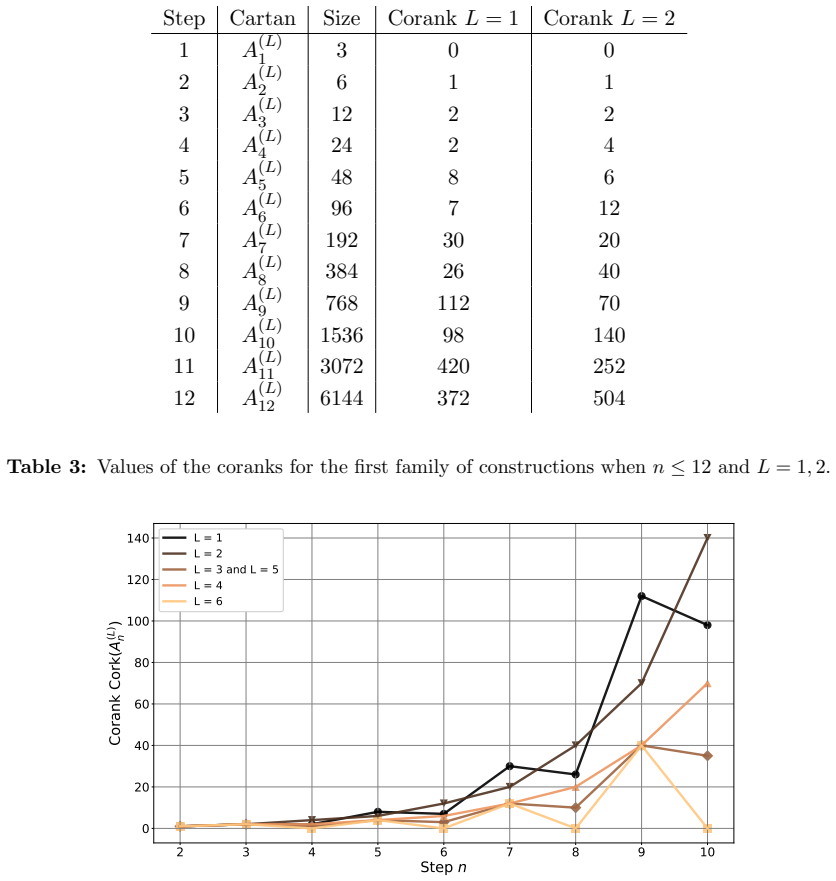
We present recursive constructions of several families of generalized Cartan matrices associated with Kac-Moody algebras, whose sizes and coranks grow exponentially. The constructions are encoded by connected multigraphs and by block-doubling operations on their associated symmetric generalized Cartan matrices. Equivalently, the corank problem is translated into a spectral graph-theoretic problem: the corank of $2\mathrm{Id}-\operatorname{Adj}(G)$ is the multiplicity of the adjacency eigenvalue $2$. We give two explicit recursive families, compute their spectra and coranks, and emphasize the difference between absolute exponential growth and relative asymptotic density. The resulting algebras are typically indefinite and singular of corank larger than one, and therefore contain several independent central directions and several isotropic radical directions in the root lattice. We also discuss alternative constructions and possible applications to the algebraic structures appearing in gravity, supergravity, string/M-theory and related generalized symmetry problems.
Editorial analysis
A structured set of objections, weighed in public.
Referee Report
Summary. The paper constructs two explicit recursive families of symmetric generalized Cartan matrices via block-doubling operations on connected multigraphs. These yield families of Kac-Moody algebras whose matrix sizes and coranks grow exponentially. The corank of 2Id − Adj(G) is identified with the algebraic multiplicity of the adjacency eigenvalue 2 (a direct linear-algebra fact). Spectra and coranks are computed for the families; the distinction between absolute exponential growth and relative asymptotic density is emphasized. The resulting algebras are typically indefinite and singular of corank >1, with possible applications to gravity, supergravity, and string/M-theory.
Significance. If the recursive rules are correctly stated and the spectral computations verified, the work supplies concrete, explicitly describable examples of high-corank indefinite Kac-Moody algebras. The graph-theoretic reformulation reduces the corank question to a standard spectral computation and is a genuine simplification. The explicit recursions and the growth-versus-density clarification are strengths that allow independent verification and further study. Such families may be useful for exploring isotropic radicals and central extensions in the root lattice.
minor comments (3)
- The abstract and introduction would benefit from a single sentence clarifying that the block-doubling rules are required to preserve the off-diagonal non-positivity and integrality conditions of a symmetric GCM; a brief check that the stated recursions satisfy these conditions would remove any ambiguity.
- Notation for the two recursive families (e.g., G_n and H_n) should be introduced once in §2 or §3 and used consistently thereafter; occasional switches between graph and matrix language can be tightened.
- A short table summarizing the computed coranks and the multiplicity of eigenvalue 2 for the first few members of each family would improve readability and allow quick verification of the exponential-growth claim.
Simulated Author's Rebuttal
We thank the referee for the positive assessment of our manuscript and the recommendation to accept. The referee's summary correctly identifies the core contributions: the recursive block-doubling constructions on multigraphs, the translation of corank to the multiplicity of the adjacency eigenvalue 2, the explicit spectral computations, and the distinction between absolute exponential growth and relative density.
Circularity Check
No significant circularity identified
full rationale
The paper presents explicit recursive constructions of symmetric generalized Cartan matrices via block-doubling operations on connected multigraphs, together with direct computation of spectra and coranks. The noted equivalence that corank(2Id − Adj(G)) equals the multiplicity of eigenvalue 2 of Adj(G) follows immediately from the definition of algebraic multiplicity for any real symmetric matrix and adds no assumption or reduction. No fitted parameters renamed as predictions, self-citation load-bearing premises, uniqueness theorems imported from the same authors, or ansatzes smuggled via citation are present. The derivations are self-contained explicit constructions whose validity rests on the stated recursion rules and standard linear algebra, not on any input-to-output equivalence by construction.
Axiom & Free-Parameter Ledger
axioms (2)
- domain assumption Standard definitions and properties of generalized Cartan matrices and Kac-Moody algebras
- standard math Basic facts of spectral graph theory relating matrix corank to eigenvalue multiplicity
Reference graph
Works this paper leans on
-
[1]
Simple graded Lie algebras of finite growth,
V. G. Kac, “Simple graded Lie algebras of finite growth,” Func. Anal. Appl.1(1967) 82–83
1967
-
[2]
R. V. Moody, “A new class of Lie algebras,” J. Algebra10(1968) 211–230. https://doi.org/10.1016/0021-8693(68)90096-3
-
[3]
V. G. Kac, Infinite Dimensional Lie Algebras. 3rd ed. Cambridge University Press: Cambridge, MA, 1990
1990
-
[4]
R. V. Moody and A. Pianzola, Lie algebras with triangular decompositions. Can. Math. Soc. Ser. Monogr. Adv. Texts. New York, NY: John Wiley & Sons, 1995
1995
-
[5]
A. E. Brouwer and W. H. Haemers, Spectra of Graphs. Springer, New York, 2012
2012
-
[6]
Cvetkovi´ c, P
D. Cvetkovi´ c, P. Rowlinson, and S. Simi´ c,An Introduction to the Theory of Graph Spectra. Cambridge University Press, Cambridge, 2010
2010
-
[7]
Godsil and G
C. Godsil and G. Royle, Algebraic Graph Theory, vol. 207 of Graduate Texts in Mathematics. Springer, New York, 2001
2001
-
[8]
Lifts, discrepancy and nearly optimal spectral gap,
Y. Bilu and N. Linial, “Lifts, discrepancy and nearly optimal spectral gap,” Combinatorica26(2006) no. 5, 495–519
2006
-
[9]
Discrete groups generated by reflections in Lobachevskii spaces,
E. B. Vinberg, “Discrete groups generated by reflections in Lobachevskii spaces,” Mathematics of the USSR-Sbornik1(1967) no. 3, 429–444
1967
-
[10]
Kac-moody symmetry of gravitation and supergravity theories,
B. L. Julia, “Kac-moody symmetry of gravitation and supergravity theories,” in Lectures in Applied Mathematics, vol. 21, pp. 355–373. American Mathematical Society, Providence, RI, 1985
1985
-
[11]
E10 and a "small tension expansion" of M Theory
T. Damour, M. Henneaux, and H. Nicolai, “E 10 and a “small tension expansion” of M theory,” Physical Review Letters89(2002) 221601,arXiv:hep-th/0207267
work page internal anchor Pith review Pith/arXiv arXiv 2002
-
[12]
T. Damour, M. Henneaux, and H. Nicolai, “Cosmological billiards,” Classical and Quantum Gravity20(2003) R145–R200,arXiv:hep-th/0212256
work page internal anchor Pith review Pith/arXiv arXiv 2003
-
[13]
P. C. West, “E 11 and M theory,” Classical and Quantum Gravity18(2001) 4443–4460, arXiv:hep-th/0104081
work page internal anchor Pith review Pith/arXiv arXiv 2001
-
[14]
E10 and SO(9,9) invariant supergravity
A. Kleinschmidt and H. Nicolai, “E 10 andSO(9,9) invariant supergravity,” Journal of High Energy Physics2004(2004) no. 07, 041,arXiv:hep-th/0407101
work page internal anchor Pith review Pith/arXiv arXiv 2004
-
[15]
A. Kleinschmidt and H. Nicolai, “IIB supergravity andE 10,” Physics Letters B606 (2005) 391–402,arXiv:hep-th/0411225
work page internal anchor Pith review Pith/arXiv arXiv 2005
-
[16]
Kac-Moody algebras
I. G. Macdonald, “Kac-Moody algebras.” Lie Algebras and Related Topics, Proc. Semin., Windsor/Ont. 1984, CMS Conf. Proc. 5, 69-109, 1986
1984
-
[17]
Carter, Lie algebras of finite and affine type, vol
R. Carter, Lie algebras of finite and affine type, vol. 96 of Camb. Stud. Adv. Math. Cambridge: Cambridge University Press, 2005
2005
-
[18]
Marquis, An introduction to Kac-Moody groups over fields
T. Marquis, An introduction to Kac-Moody groups over fields. EMS Textb. Math. Z¨ urich: European Mathematical Society (EMS), 2018
2018
-
[19]
Cartan matrices with null roots and finite Cartan matrices,
S. Berman, R. Moody, and M. Wonenburger, “Cartan matrices with null roots and finite Cartan matrices,” Indiana Univ. Math. J.21(1972) 1091–1099
1972
-
[20]
Generalized Kac-Moody algebras,
R. E. Borcherds, “Generalized Kac-Moody algebras,” Journal of Algebra115(1988) no. 2, 501–512. 26
1988
discussion (0)
Sign in with ORCID, Apple, or X to comment. Anyone can read and Pith papers without signing in.