The Milky Way Atlas for Linear Filaments III: Giant filaments and magnetic fields as evidence of a bubbly Galactic disk
Pith reviewed 2026-07-02 08:46 UTC · model grok-4.3
The pith
Giant Milky Way filaments lack strong alignment with the ambient magnetic field, favoring supernova-driven bubbles over magnetic dominance in disk structure.
A machine-rendered reading of the paper's core claim, the machinery that carries it, and where it could break.
Core claim
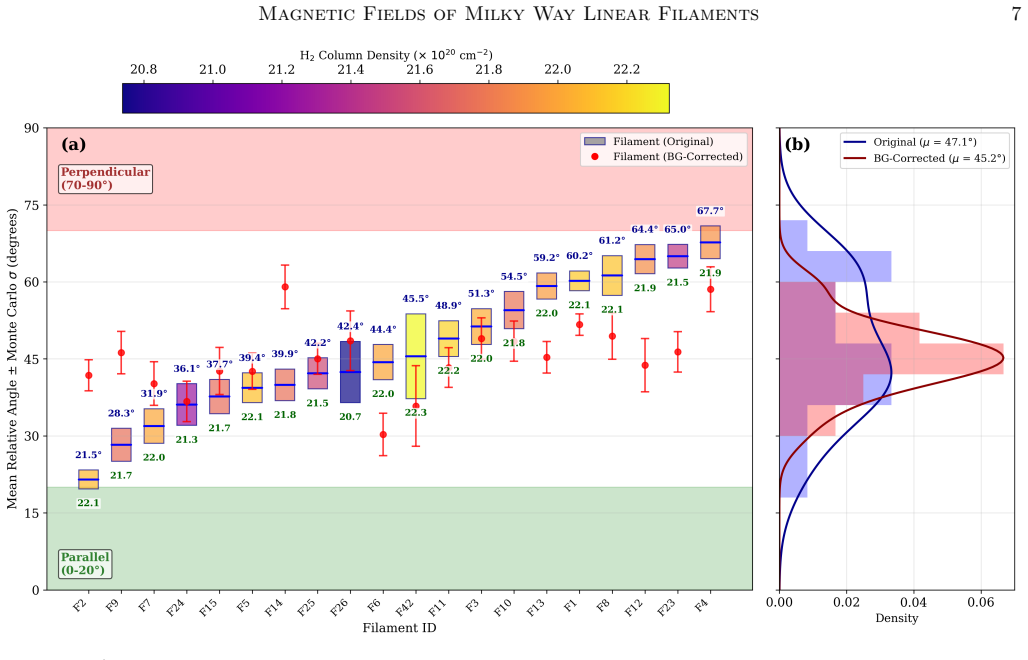
Large-scale B-fields do not dominate MWLF formation; instead the data favor a super-Alfvénic regime where magnetic forces are dynamically subdominant, as expected for filaments tied to supernova-driven shells, with the overall disk therefore structured as a network of bubbles when viewed face-on.
What carries the argument
Statistical comparison of filament and B-field position angles, with projection effects and significance quantified via Monte Carlo simulations of three-dimensional vector pairs.
If this is right
- Magnetic forces are dynamically subdominant during giant filament formation.
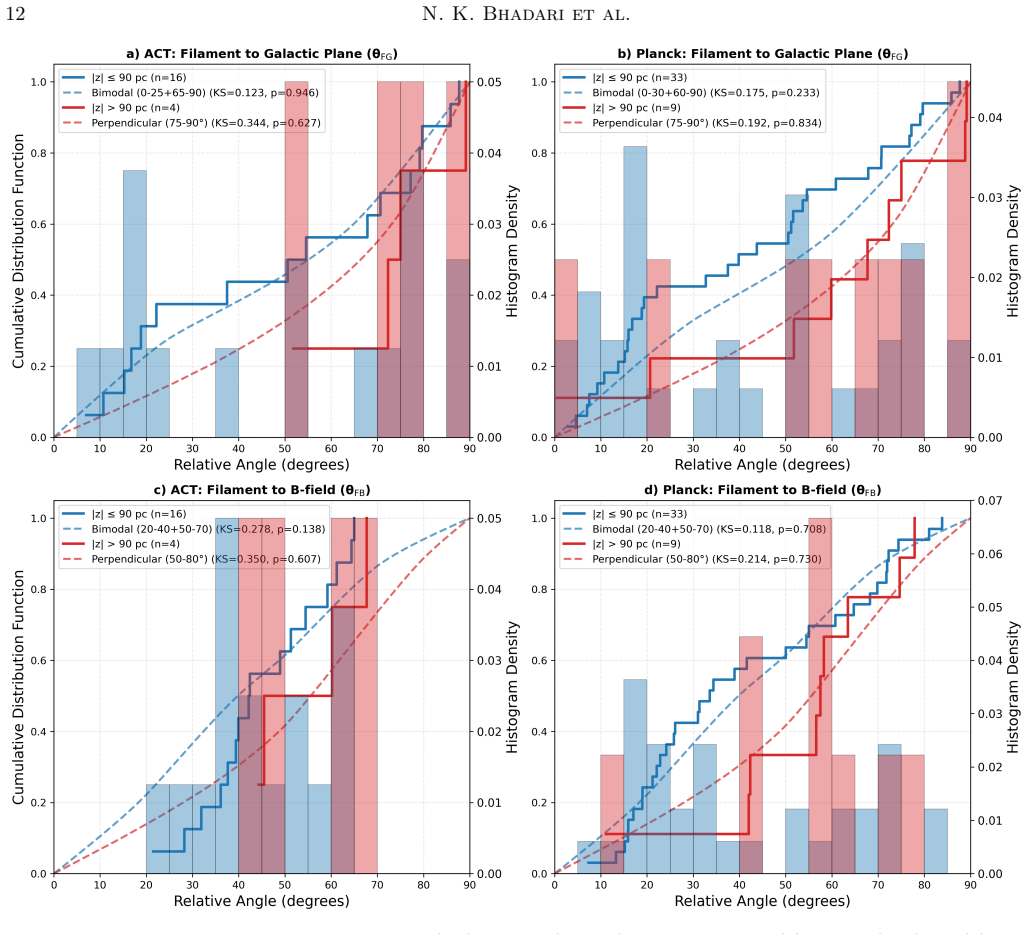
- Filaments far from the midplane align perpendicular to both the Galactic plane and the B-field.
- Filaments near the midplane show a bimodal orientation distribution.
- The Milky Way disk, viewed face-on, would appear as a network of supernova-driven bubbles.
Where Pith is reading between the lines
- Similar bubble networks should appear in face-on views of other spiral galaxies at comparable resolution.
- The height-dependent orientation shift may trace the vertical reach of supernova feedback.
- Local alignments inside individual shells could still exist even if global statistics show none.
Load-bearing premise
The Monte Carlo simulations of three-dimensional vector pairs correctly capture the true projection effects and any selection biases present in the filament catalog.
What would settle it
New polarization or kinematic data that demonstrate a statistically significant parallel alignment between the majority of filaments and the local B-field direction after identical projection corrections would falsify the no-preferential-alignment result.
Figures
read the original abstract
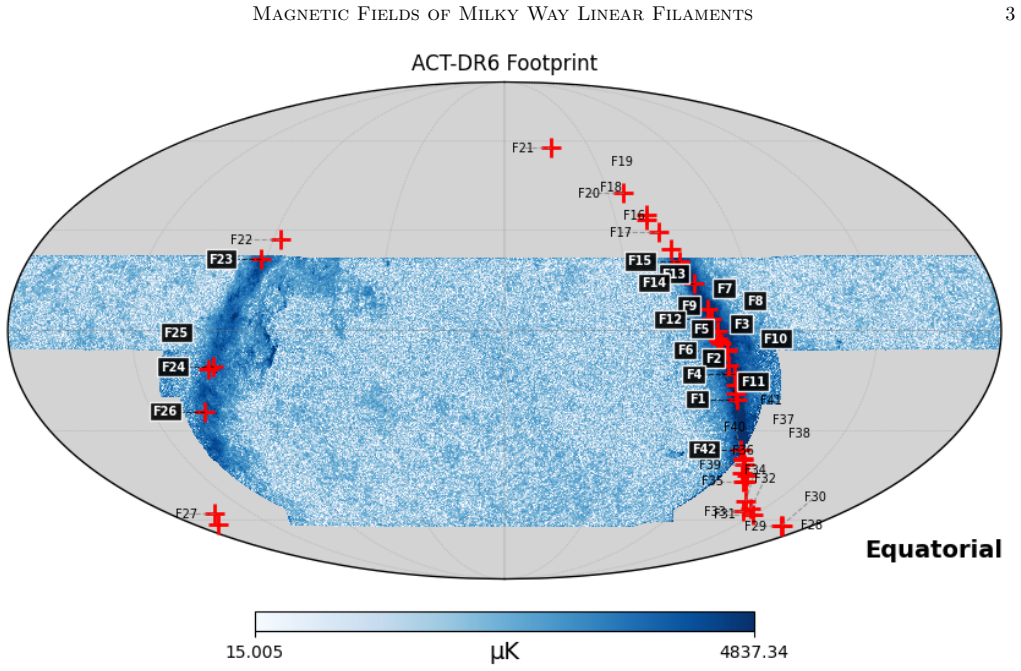
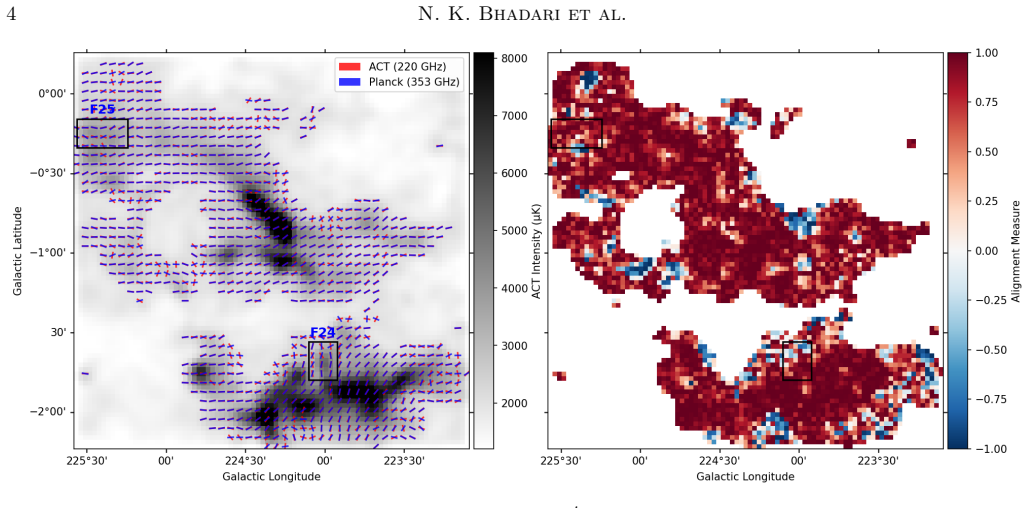
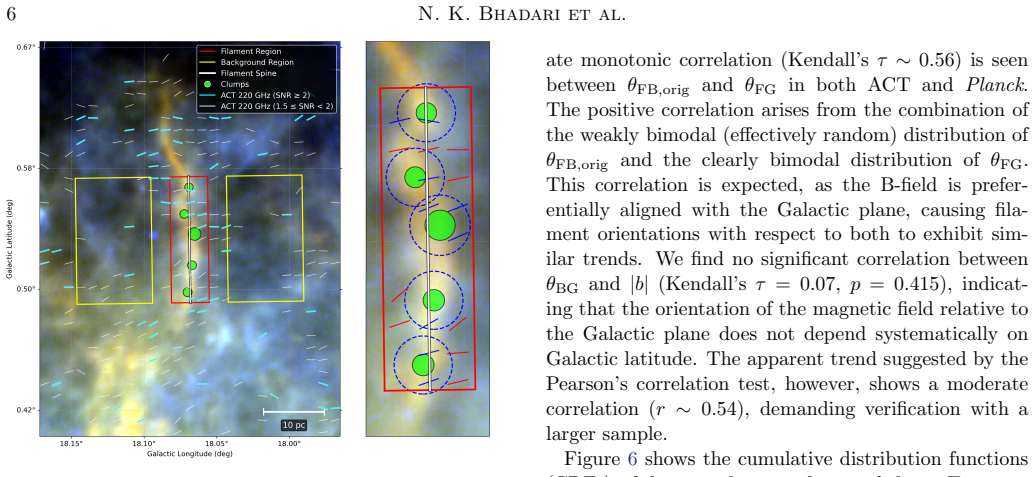
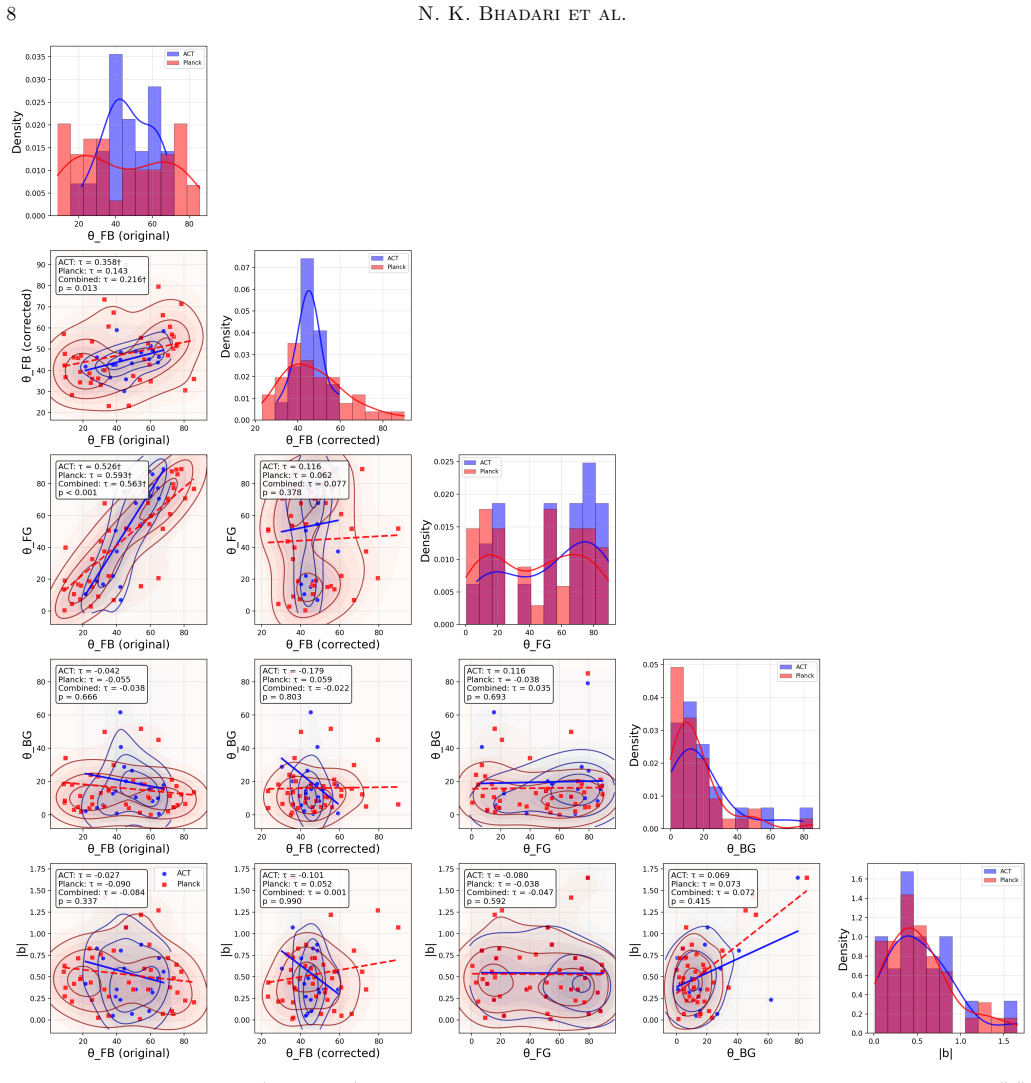
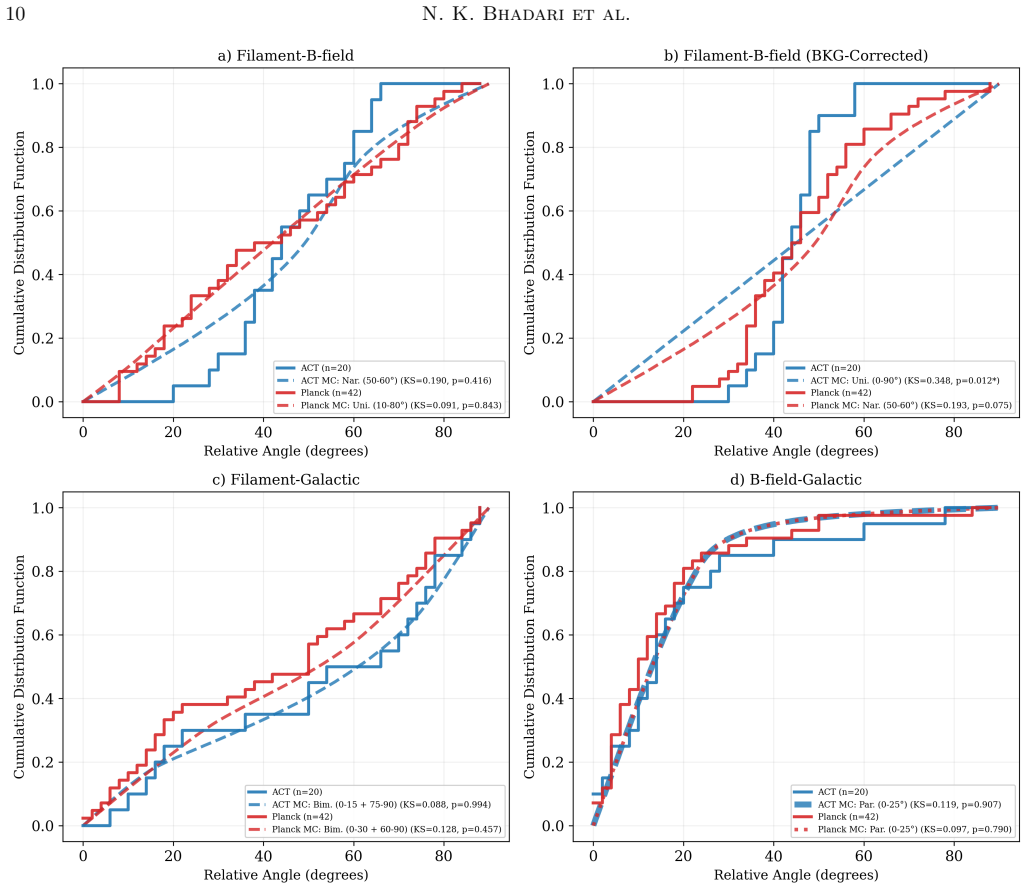
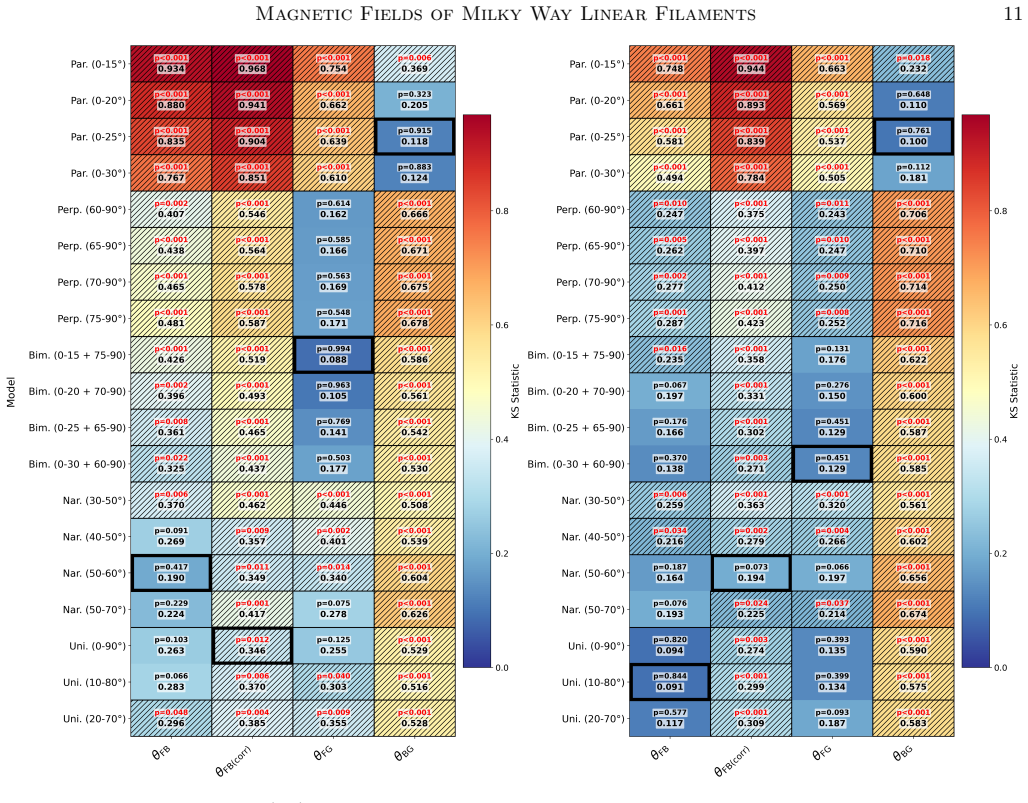
Linear filamentary structures are fundamental constituents of the interstellar medium and play a central role in star formation. Their relative orientation with respect to the ambient magnetic field (B-field) provides key constraints on filament formation mechanisms. We investigate the relative orientation between Milky Way linear filaments (MWLFs) and the plane-of-sky B-field using polarization observations from the Atacama Cosmology Telescope (ACT) DR6, complemented by Planck data. Filament orientations are compared with the local B-field and the Galactic plane, while projection effects and statistical significance are quantified using Monte Carlo simulations of vector pairs in three-dimensions. We find no strong preferential alignment between MWLFs and the ambient B-field. Although the B-field is preferentially aligned with the Galactic plane with relative angles $\theta_{\rm BG} \sim0-25\deg$, filament orientations exhibit a bimodal distribution, being either parallel or perpendicular to the plane ($\theta_{\rm FG} \sim0-15\deg$ and $\sim75-90\deg$). Filaments located far from the Galactic midplane ($|z|>90$ pc) preferentially show perpendicular alignment with both the plane and the B-field, whereas those near the midplane exhibit a bimodal orientation. These results indicate that large-scale B-fields do not dominate the formation of MWLFs and instead favor a super-Alfv\'enic regime in which magnetic forces are dynamically subdominant, as expected for filaments associated with supernova-driven shells. Overall, our findings suggest that a face-on view of the Milky Way would resemble nearby disk galaxies such as M74, as observed in JWST images, with its disk structured by a network of supernova-driven bubbles (i.e., a bubbly disk).
Editorial analysis
A structured set of objections, weighed in public.
Referee Report
Summary. The manuscript analyzes orientations of Milky Way linear filaments (MWLFs) relative to the plane-of-sky B-field using ACT DR6 and Planck polarization data. Filament angles θ_FG and θ_FB are compared to the Galactic plane and local B-field, with projection effects and significance assessed via Monte Carlo simulations of 3D vector pairs. The authors report no strong preferential alignment between MWLFs and B-fields, a bimodal θ_FG distribution (parallel or perpendicular to the plane), z-dependent trends (|z|>90 pc filaments preferentially perpendicular), and conclude this favors a super-Alfvénic regime with supernova-driven bubbles structuring a bubbly Galactic disk.
Significance. If the statistical results hold, the findings provide useful constraints on filament formation in the ISM by indicating that large-scale B-fields are dynamically subdominant. Strengths include the use of public polarization datasets and Monte Carlo tests to address projection effects, which support reproducibility and allow direct comparison to observations of nearby galaxies like M74.
major comments (2)
- [Abstract] Abstract: the Monte Carlo simulations of 3D vector pairs are load-bearing for the central claim of no strong preferential alignment and the reported z-dependent bimodality in θ_FB and θ_FG. The description does not specify whether the simulations condition on the observed |z| distribution of the MWLF catalog, the length-to-width selection function, or line-of-sight integration effects in the ACT/Planck maps; without this, the null distribution may be incorrect and the statistical significance of the no-alignment result cannot be evaluated.
- [Abstract] Abstract: filament selection criteria, error propagation for the measured angles, and potential systematics in the bimodal bins (e.g., θ_FG ~0-15° and ~75-90°) are not described. These details are required to assess whether the reported distributions and |z| trends are robust or could arise from catalog construction choices.
Simulated Author's Rebuttal
We thank the referee for their careful review and constructive comments on our manuscript. We address each major comment below and have revised the manuscript to provide the requested details and clarifications.
read point-by-point responses
-
Referee: [Abstract] Abstract: the Monte Carlo simulations of 3D vector pairs are load-bearing for the central claim of no strong preferential alignment and the reported z-dependent bimodality in θ_FB and θ_FG. The description does not specify whether the simulations condition on the observed |z| distribution of the MWLF catalog, the length-to-width selection function, or line-of-sight integration effects in the ACT/Planck maps; without this, the null distribution may be incorrect and the statistical significance of the no-alignment result cannot be evaluated.
Authors: We agree that the abstract provides only a high-level description and does not specify the conditioning details of the Monte Carlo simulations. In the revised manuscript we will update the abstract and add an explicit methods subsection describing that the simulations (i) draw random 3D vector pairs conditioned on the observed |z| distribution of the MWLF catalog, (ii) incorporate the length-to-width selection function by matching the simulated filament aspect ratios and lengths to the catalog, and (iii) account for line-of-sight integration by resampling polarization angles directly from the ACT DR6 and Planck maps at the observed filament positions. These additions will allow readers to evaluate the appropriateness of the null distribution and the reported statistical significance. revision: yes
-
Referee: [Abstract] Abstract: filament selection criteria, error propagation for the measured angles, and potential systematics in the bimodal bins (e.g., θ_FG ~0-15° and ~75-90°) are not described. These details are required to assess whether the reported distributions and |z| trends are robust or could arise from catalog construction choices.
Authors: We acknowledge that the abstract does not describe these elements. The filament selection criteria (linear structure identification with length and aspect-ratio cuts) and angle error propagation (standard propagation from filament position-angle fits and polarization uncertainties) are presented in Section 2 and Appendix A of the manuscript. To address potential systematics in the bimodal bins, we have performed additional robustness checks by varying bin edges and excluding filaments near selection boundaries; the bimodality and |z|-dependent trends persist. In the revision we will add a concise summary of the selection criteria, error treatment, and robustness tests to the abstract and expand the discussion in the main text. revision: yes
Circularity Check
No significant circularity detected
full rationale
The paper's central result—no strong preferential alignment between MWLFs and the B-field, favoring a super-Alfvénic bubbly-disk picture—is obtained by measuring observed angles θ_FB and θ_FG and comparing them directly to null distributions generated from Monte Carlo draws of random 3D vector pairs. This comparison is a standard statistical test and does not reduce any fitted parameter or self-citation to a renamed prediction. The filament catalog originates in prior papers of the series, but those works supply only the input positions and orientations; they do not furnish the alignment statistics, uniqueness theorems, or ansatzes that would make the present conclusions circular by construction. The derivation chain therefore remains self-contained against external benchmarks.
Axiom & Free-Parameter Ledger
free parameters (2)
- midplane distance threshold =
90 pc
- parallel/perpendicular angle bins =
0-15 deg and 75-90 deg
axioms (2)
- domain assumption Polarization data from ACT DR6 and Planck trace the plane-of-sky magnetic field direction without major contamination
- domain assumption Identified linear filaments have well-defined orientations that can be compared to local B-field and galactic plane
Reference graph
Works this paper leans on
-
[1]
2016, A&A, 590, A131, doi: 10.1051/0004-6361/201527674
Abreu-Vicente, J., Ragan, S., Kainulainen, J., et al. 2016, A&A, 590, A131, doi: 10.1051/0004-6361/201527674
-
[2]
2019, MNRAS, 485, 2825, doi: 10.1093/mnras/stz508 Andr´ e, P
Alina, D., Ristorcelli, I., Montier, L., et al. 2019, MNRAS, 485, 2825, doi: 10.1093/mnras/stz508 Andr´ e, P. 2017, Comptes Rendus Geoscience, 349, 187, doi: 10.1016/j.crte.2017.07.002 Andr´ e, P., Di Francesco, J., Ward-Thompson, D., et al. 2014, in Protostars and Planets VI, ed. H. Beuther, R. S
-
[4]
A&A , archivePrefix = "arXiv", eprint =
Arzoumanian, D., Andr´ e, P., Didelon, P., et al. 2011, A&A, 529, L6, doi: 10.1051/0004-6361/201116596 14N. K. Bhadari et al. T able 1.Derived Physical Parameters of Giant Filaments Traced by ACT Fil.l b d L z θFIfQfUfpfθB,fθFB,fIbQbUbpbθB,bθFB,bθFB,corrθFGθBGNH2,fσv,fMA,fMA,b ID (◦) (◦) (kpc)(pc) (pc) (◦) (µK) (µK) (µK) (◦) (◦) (µK) (µK) (µK) (◦) (◦) (◦)...
-
[5]
2022, A&A, 660, A56, doi: 10.1051/0004-6361/202141699 Astropy Collaboration, Robitaille, T
Arzoumanian, D., Russeil, D., Zavagno, A., et al. 2022, A&A, 660, A56, doi: 10.1051/0004-6361/202141699 Astropy Collaboration, Robitaille, T. P., Tollerud, E. J., et al. 2013, A&A, 558, A33, doi: 10.1051/0004-6361/201322068 Magnetic Fields of Milky W ay Linear Filaments17 Figure A4.Distribution of B-field relative angles in filament and clump regions. His...
-
[6]
2020, ApJ, 890, 44, doi: 10.3847/1538-4357/ab66b6
Baug, T., Wang, K., Liu, T., et al. 2020, ApJ, 890, 44, doi: 10.3847/1538-4357/ab66b6
-
[7]
Bhadari, N. K., Dewangan, L. K., Ojha, D. K., Pirogov, L. E., & Maity, A. K. 2022, ApJ, 930, 169, doi: 10.3847/1538-4357/ac65e9
-
[8]
Bhadari, N. K., Dewangan, L. K., Pirogov, L. E., & Ojha, D. K. 2020, ApJ, 899, 167, doi: 10.3847/1538-4357/aba2c6
-
[9]
Butterfield, N. O., Chuss, D. T., Guerra, J. A., et al. 2024, ApJ, 963, 130, doi: 10.3847/1538-4357/ad12b9
-
[10]
Chen, C.-Y., King, P. K., & Li, Z.-Y. 2016, ApJ, 829, 84, doi: 10.3847/0004-637X/829/2/84
-
[11]
Cho, J., & Vishniac, E. T. 2000, ApJ, 539, 273, doi: 10.1086/309213
-
[12]
D., S´ anchez-Monge,´A., Williams, G
Clarke, S. D., S´ anchez-Monge,´A., Williams, G. M., et al. 2023, MNRAS, 519, 3098, doi: 10.1093/mnras/stac3212
-
[13]
Hubber, D. A. 2017, MNRAS, 468, 2489, doi: 10.1093/mnras/stx637
-
[14]
Corradi, R. L. M., Aznar, R., & Mampaso, A. 1998, MNRAS, 297, 617, doi: 10.1046/j.1365-8711.1998.01532.x Coud´ e, S., Stephens, I. W., Myers, P. C., et al. 2025, arXiv e-prints, arXiv:2509.25832, doi: 10.48550/arXiv.2509.25832
-
[15]
Cox, N. L. J., Arzoumanian, D., Andr´ e, P., et al. 2016, A&A, 590, A110, doi: 10.1051/0004-6361/201527068
-
[16]
Crutcher, R. M. 2012, ARA&A, 50, 29, doi: 10.1146/annurev-astro-081811-125514
-
[17]
2015, ApJ, 799, 64, doi: 10.1088/0004-637X/799/1/64
Fierlinger, K. 2015, ApJ, 799, 64, doi: 10.1088/0004-637X/799/1/64
-
[18]
Dobbs, C. L. 2008, MNRAS, 391, 844, doi: 10.1111/j.1365-2966.2008.13939.x
-
[19]
Duarte-Cabral, A., Colombo, D., Urquhart, J. S., et al. 2021, The SEDIGISM survey: molecular clouds in the inner Galaxy, OUP, doi: 10.1093/mnras/staa2480
-
[20]
Fissel, L. M., Ade, P. A. R., Angil` e, F. E., et al. 2016, ApJ, 824, 134, doi: 10.3847/0004-637X/824/2/134
-
[21]
2024, MNRAS, 529, 3060, doi: 10.1093/mnras/stae680
Ge, W., Du, F., & Yuan, L. 2024, MNRAS, 529, 3060, doi: 10.1093/mnras/stae680
-
[22]
2022, ApJS, 259, 36, doi: 10.3847/1538-4365/ac4a76
Ge, Y., & Wang, K. 2022, ApJS, 259, 36, doi: 10.3847/1538-4365/ac4a76
-
[23]
2023, A&A, 675, A119, doi: 10.1051/0004-6361/202245784
Ge, Y., Wang, K., Duarte-Cabral, A., et al. 2023, A&A, 675, A119, doi: 10.1051/0004-6361/202245784
-
[24]
Goodman, A. A., Alves, J., Beaumont, C. N., et al. 2014, ApJ, 797, 53, doi: 10.1088/0004-637X/797/1/53 18N. K. Bhadari et al. Figure A5.Plane-of-sky magnetic-field morphology of filaments F1–F8 as traced by ACT observations at 220 GHz (white: 1.5≤P/σ P <2; cyan:P/σ P ≥2). The background image is an RGB composite constructed fromHerschel250 (Red), 160 (Gre...
-
[25]
Green, D. A. 2025, Journal of Astrophysics and Astronomy, 46, 14, doi: 10.1007/s12036-024-10038-4
-
[26]
Guan, Y., Clark, S. E., Hensley, B. S., et al. 2021, ApJ, 920, 6, doi: 10.3847/1538-4357/ac133f Magnetic Fields of Milky W ay Linear Filaments19 Figure A6.Same as Figure A5, but for filaments F9–F15 and F23
-
[27]
Hacar, A., Clark, S. E., Heitsch, F., et al. 2023, in Astronomical Society of the Pacific Conference Series, Vol. 534, Protostars and Planets VII, ed. S. Inutsuka, Y. Aikawa, T. Muto, K. Tomida, & M. Tamura, 153, doi: 10.48550/arXiv.2203.09562
-
[28]
Harper, D. A., Runyan, M. C., Dowell, C. D., et al. 2018, Journal of Astronomical Instrumentation, 7, 1840008, doi: 10.1142/S2251171718400081 20N. K. Bhadari et al. Figure A7.Same as Figure A5, but for filaments F24, F25, F26, and F42
-
[29]
Harris, C. R., Millman, K. J., van der Walt, S. J., et al. 2020, Nature, 585, 357, doi: 10.1038/s41586-020-2649-2
-
[30]
Hartmann, L., Ballesteros-Paredes, J., & Bergin, E. A. 2001, ApJ, 562, 852, doi: 10.1086/323863
-
[31]
2019, Frontiers in Astronomy and Space Sciences, 6, 5, doi: 10.3389/fspas.2019.00005
Hennebelle, P., & Inutsuka, S.-i. 2019, Frontiers in Astronomy and Space Sciences, 6, 5, doi: 10.3389/fspas.2019.00005
-
[32]
Hull, C. L. H., & Zhang, Q. 2019, Frontiers in Astronomy and Space Sciences, 6, 3, doi: 10.3389/fspas.2019.00003
-
[33]
Hunter, J. D. 2007, Computing in Science and Engineering, 9, 90, doi: 10.1109/MCSE.2007.55
-
[34]
Hwang, J., Sanhueza, P., Girart, J. M., et al. 2025, arXiv e-prints, arXiv:2510.25078, doi: 10.48550/arXiv.2510.25078
-
[35]
2015, A&A, 580, A49, doi: 10.1051/0004-6361/201425584
Inutsuka, S.-i., Inoue, T., Iwasaki, K., & Hosokawa, T. 2015, A&A, 580, A49, doi: 10.1051/0004-6361/201425584
-
[36]
Jackson, J. M., Finn, S. C., Chambers, E. T., Rathborne, J. M., & Simon, R. 2010, ApJL, 719, L185, doi: 10.1088/2041-8205/719/2/L185
-
[37]
Jackson, J. M., Rathborne, J. M., Shah, R. Y., et al. 2006, ApJS, 163, 145, doi: 10.1086/500091
-
[38]
Joung, M. K. R., & Mac Low, M.-M. 2006, ApJ, 653, 1266, doi: 10.1086/508795
-
[39]
A., & Mandel, E
Joye, W. A., & Mandel, E. 2003, in Astronomical Society of the Pacific Conference Series, Vol. 295, Astronomical Data Analysis Software and Systems XII, ed. H. E
2003
-
[40]
Gravoturbulent Star Cluster Formation
Klessen, R. S., Ballesteros-Paredes, J., Li, Y., & Mac Low, M.-M. 2004, in Astronomical Society of the Pacific Conference Series, Vol. 322, The Formation and Evolution of Massive Young Star Clusters, ed. H. J. G. L. M. Lamers, L. J. Smith, & A. Nota, 299–308, doi: 10.48550/arXiv.astro-ph/0403469
work page internal anchor Pith review Pith/arXiv arXiv doi:10.48550/arxiv.astro-ph/0403469 2004
-
[41]
2021, ApJ, 918, 39, doi: 10.3847/1538-4357/ac0cf2
Lee, D., Berthoud, M., Chen, C.-Y., et al. 2021, ApJ, 918, 39, doi: 10.3847/1538-4357/ac0cf2
-
[42]
2013, MNRAS, 436, 3707, doi: 10.1093/mnras/stt1849
Li, H.-b., Fang, M., Henning, T., & Kainulainen, J. 2013, MNRAS, 436, 3707, doi: 10.1093/mnras/stt1849
-
[43]
Li, H.-B., Goodman, A., Sridharan, T. K., et al. 2014, in Protostars and Planets VI, ed. H. Beuther, R. S. Klessen, C. P. Dullemond, & T. Henning, 101–123, doi: 10.2458/azu uapress 9780816531240-ch005
work page doi:10.2458/azu 2014
-
[44]
Li, P. S., McKee, C. F., Klein, R. I., & Fisher, R. T. 2008, ApJ, 684, 380, doi: 10.1086/589874
-
[45]
2024, ApJ, 962, 39, doi: 10.3847/1538-4357/ad1395
Lu, X., Liu, J., Pillai, T., et al. 2024, ApJ, 962, 39, doi: 10.3847/1538-4357/ad1395
-
[46]
2016, MNRAS, 460, 1934, doi: 10.1093/mnras/stw1061
Malinen, J., Montier, L., Montillaud, J., et al. 2016, MNRAS, 460, 1934, doi: 10.1093/mnras/stw1061
-
[47]
Marsh, K. A., Whitworth, A. P., & Lomax, O. 2015, MNRAS, 454, 4282, doi: 10.1093/mnras/stv2248
-
[48]
Marsh, K. A., Whitworth, A. P., Lomax, O., et al. 2017, MNRAS, 471, 2730, doi: 10.1093/mnras/stx1723
-
[49]
2010, A&A, 518, L100, doi: 10.1051/0004-6361/201014659
Molinari, S., Swinyard, B., Bally, J., et al. 2010, A&A, 518, L100, doi: 10.1051/0004-6361/201014659
-
[50]
Mouschovias, T. C. 1976, ApJ, 207, 141, doi: 10.1086/154478
-
[51]
Naess, S., Guan, Y., Duivenvoorden, A. J., et al. 2025, JCAP, 2025, 061, doi: 10.1088/1475-7516/2025/11/061
-
[52]
2008, ApJ, 687, 354, doi: 10.1086/591641
Nakamura, F., & Li, Z.-Y. 2008, ApJ, 687, 354, doi: 10.1086/591641
-
[53]
2004, ApJL, 604, L49, doi: 10.1086/383308
Padoan, P., Jimenez, R., Juvela, M., & Nordlund, ˚A. 2004, ApJL, 604, L49, doi: 10.1086/383308
-
[54]
2013, A&A, 550, A38, doi: 10.1051/0004-6361/201220500 Planck Collaboration, Ade, P
Palmeirim, P., Andr´ e, P., Kirk, J., et al. 2013, A&A, 550, A38, doi: 10.1051/0004-6361/201220500 Planck Collaboration, Ade, P. A. R., Aghanim, N., et al. 2016, A&A, 586, A138, doi: 10.1051/0004-6361/201525896
-
[55]
Sanhueza, P., Girart, J. M., Padovani, M., et al. 2021, ApJL, 915, L10, doi: 10.3847/2041-8213/ac081c
-
[56]
Schuller, F., Csengeri, T., Urquhart, J. S., et al. 2017, A&A, 601, A124, doi: 10.1051/0004-6361/201628933
-
[57]
Schuller, F., Urquhart, J. S., Csengeri, T., et al. 2021, MNRAS, 500, 3064, doi: 10.1093/mnras/staa2369
-
[58]
2015, MNRAS, 452, 2410, doi: 10.1093/mnras/stv1458
Seifried, D., & Walch, S. 2015, MNRAS, 452, 2410, doi: 10.1093/mnras/stv1458
-
[59]
Shetty, R., & Ostriker, E. C. 2006, ApJ, 647, 997, doi: 10.1086/505594
-
[60]
Soler, J. D. 2019, A&A, 629, A96, doi: 10.1051/0004-6361/201935779
-
[61]
Soler, J. D., Hennebelle, P., Martin, P. G., et al. 2013, ApJ, 774, 128, doi: 10.1088/0004-637X/774/2/128
-
[62]
Stephens, I. W., Coude, S., Myers, P. C., et al. 2025, arXiv e-prints, arXiv:2510.05933, doi: 10.48550/arXiv.2510.05933
-
[63]
Stone, J. M., Ostriker, E. C., & Gammie, C. F. 1998, ApJL, 508, L99, doi: 10.1086/311718
-
[64]
2025, A&A, 698, A119, doi: 10.1051/0004-6361/202553795
Suin, P., Arzoumanian, D., Zavagno, A., & Hennebelle, P. 2025, A&A, 698, A119, doi: 10.1051/0004-6361/202553795
-
[65]
Vestuto, J. G., Ostriker, E. C., & Stone, J. M. 2003, ApJ, 590, 858, doi: 10.1086/375021
-
[66]
Virtanen, P., Gommers, R., Oliphant, T. E., et al. 2020, Nature Medicine, 17, 261, doi: 10.1038/s41592-019-0686-2
-
[67]
Wang, K., & Ge, Y. 2021, MST: Minimum Spanning Tree algorithm for identifying large-scale filaments, Astrophysics Source Code Library, record ascl:2102.002, doi: 10.48550/arXiv.2201.01555
-
[68]
2024, A&A, 686, L11, doi: 10.1051/0004-6361/202450296
Wang, K., Ge, Y., & Baug, T. 2024, A&A, 686, L11, doi: 10.1051/0004-6361/202450296
-
[69]
2016, ApJS, 226, 9, doi: 10.3847/0067-0049/226/1/9
Wang, K., Testi, L., Burkert, A., et al. 2016, ApJS, 226, 9, doi: 10.3847/0067-0049/226/1/9
-
[70]
2015, MNRAS, 450, 4043, doi: 10.1093/mnras/stv735
Wang, K., Testi, L., Ginsburg, A., et al. 2015, MNRAS, 450, 4043, doi: 10.1093/mnras/stv735
-
[71]
2012, ApJL, 745, L30, doi: 10.1088/2041-8205/745/2/L30
Wang, K., Zhang, Q., Wu, Y., Li, H.-b., & Zhang, H. 2012, ApJL, 745, L30, doi: 10.1088/2041-8205/745/2/L30
-
[72]
2017, ApJ, 842, 66, doi: 10.3847/1538-4357/aa70a0
Ward-Thompson, D., Pattle, K., Bastien, P., et al. 2017, ApJ, 842, 66, doi: 10.3847/1538-4357/aa70a0
-
[73]
Watkins, E. J., Barnes, A. T., Henny, K., et al. 2023, ApJL, 944, L24, doi: 10.3847/2041-8213/aca6e4
-
[74]
2026, A&A, 708, A251, doi: 10.1051/0004-6361/202557480
Xu, F., Wang, K., Schneider, N., et al. 2026, A&A, 708, A251, doi: 10.1051/0004-6361/202557480
-
[75]
2024, MNRAS, 535, 940, doi: 10.1093/mnras/stae2379
Xu, X., Wang, K., Gou, Q., et al. 2024, MNRAS, 535, 940, doi: 10.1093/mnras/stae2379
-
[76]
2019, ApJ, 887, 186, doi: 10.3847/1538-4357/ab517d
Zucker, C., Smith, R., & Goodman, A. 2019, ApJ, 887, 186, doi: 10.3847/1538-4357/ab517d
discussion (0)
Sign in with ORCID, Apple, or X to comment. Anyone can read and Pith papers without signing in.