REVIEW 3 major objections 6 minor 67 references
Most stock-terminated synthesis routes fail chemical-plausibility checks; specialized planners still beat LLMs on hard targets.
Reviewed by Pith at T0; open to challenge. T0 means a machine referee read the full paper against a public rubric. the ladder, T0–T4 →
T0 review · grok-4.5
2026-07-11 15:06 UTC pith:TZI3PLJD
load-bearing objection Solid, usable Solv-2 benchmark that shows stock termination overstates chemical validity; specialized CASP still beats LLMs on hard targets and is far cheaper. the 3 major comments →
URSA: Chemistry-Aware Benchmark for Utilitarian Retrosynthesis Assessment
The pith
A machine-rendered reading of the paper's core claim, the machinery that carries it, and where it could break.
Core claim
Stock-terminated synthetic routes frequently fail stricter Solv-1 and Solv-2 chemical-plausibility checks. On the hard URSA-expert-2026 set the strongest conventional planner reaches only 32 percent Solv-2 while the best LLM reaches 21 percent; on drugs and clinical candidates specialized CASP systems remain competitive or superior to frontier LLMs while being substantially cheaper. Multistep planning is not reducible to isolated reaction-plausibility judgment.
What carries the argument
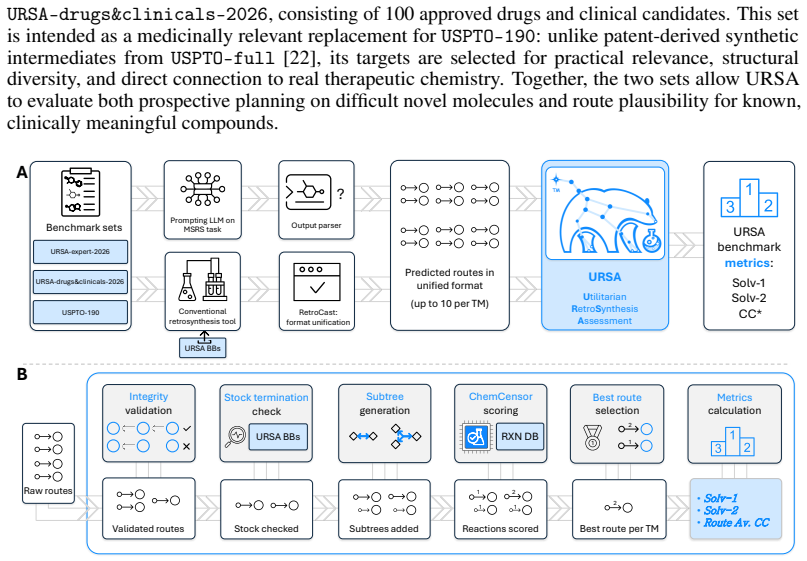
URSA: a pipeline that standardizes routes (via RetroCast or LLM parsing), enforces stock termination and structural integrity, generates alternative subtrees to match reaction granularity, scores every step with ChemCensor precedent matching, and selects a best route under a Solv-2-first priority.
Load-bearing premise
The central ranking rests on treating ChemCensor's precedent match of reaction centers and functional-group signatures as a faithful automated stand-in for expert chemical-plausibility judgment.
What would settle it
A large independent panel of expert chemists re-labels the same best routes that URSA scored; if many ChemCensor-passing routes are rejected as implausible (or many failing routes accepted), the Solv-2 ranking of planners collapses.
Editorial analysis
A structured set of objections, weighed in public.
Referee Report
Summary. The paper introduces URSA, a route-level evaluation framework that scores retrosynthetic plans under the Solv-N hierarchy (stock termination plus syntactic, topological, and chemical-plausibility validity). Routes from heterogeneous CASP systems and LLMs are standardized (via RetroCast or LLM parsers), stock-checked against a shared commercial building-block set, optionally augmented by subtree generation, and scored with ChemCensor as an automated Solv-2 judge. The authors release expert-labeled reaction data (1000 reactions), two new target sets (URSA-expert-2026 and URSA-drugs&clinicals-2026), code, and annotated best routes. Empirically, ChemCensor outperforms LLM judges on the reaction set (accuracy 0.96 vs ≤0.83); on route planning, stock-terminated Solv-0 rates substantially exceed Solv-2 rates, conventional planners (notably RetroChimera-MCTS, AZF-MCTS) remain competitive or superior to frontier LLMs on both target sets, and specialized systems are far cheaper.
Significance. If the results hold, URSA supplies a practical, chemistry-aware alternative to stock-termination and exact route-reproduction metrics at a time when both specialized CASP tools and LLMs are being compared without shared validity criteria. The released open target sets, building-block stock, ChemCensor integration, annotated CDXML routes, and cost accounting are concrete community assets. The head-to-head finding that stock termination overstates chemical validity, and that conventional planners still match or beat LLMs under Solv-2 while remaining cheaper, is actionable for both method developers and medicinal-chemistry users. Strengths include the large multi-system evaluation, bootstrap CIs on Solv-2, dual open/closed precedent corpora (U2 vs U2P2), and explicit limitations on Solv-3 and best-route-only reporting.
major comments (3)
- §5.2 and Table 1: ChemCensor is adopted as the automated Solv-2 ground truth for all route rankings on the basis of a 1000-reaction expert-labeled set (accuracy 0.96, MCC 0.92). The manuscript does not report inter-annotator agreement, number of annotators per reaction, adjudication protocol, or how borderline selectivity cases were resolved. Because binary Solv-2 pass/fail is load-bearing for the central ranking claim (stock termination ≫ chemical validity; CASP vs LLM ordering), please add agreement statistics (e.g., Cohen’s κ or majority-vote rates) and a short description of the labeling SOP; if only single-annotator labels exist, state that limitation explicitly and discuss its effect on the reported accuracy gap versus LLMs.
- §4.2 best-route selection and Eq. (1): Primary metrics (Solv-0/1/2, CC*) are computed only on the single best route per target after allowing up to 10 candidates and subtree augmentation. Systems that emit more diverse or more finely granular routes can be systematically favored by the priority order (Solv-2 first, then average CC, then length). Please report, at least in the appendix, complementary statistics that are less selection-dependent—e.g., fraction of targets with any Solv-2 route among all candidates, mean Solv-2 rate over all valid stock-terminated routes, or success@k—so that the ranking is not driven solely by best-of-N selection.
- §3–§4 and Related Work: URSA’s Solv-2 component, route standardization (RetroCast), and Solv-N formalism are drawn from closely related prior work by overlapping author groups. The new expert reaction set and open target sets mitigate circularity for the ranking claim, but the manuscript should more clearly separate (i) what is newly validated here (ChemCensor vs LLM judges on the 1000-reaction set; planner rankings under a fixed protocol) from (ii) what is inherited infrastructure. A short paragraph stating independence assumptions and any held-out checks against ChemCensor’s own training/reference construction would strengthen confidence that the Solv-2 judge is not inadvertently tuned to the same systems being ranked.
minor comments (6)
- Figure 3 and Table 2: Solv-0/1/2 bars are clear, but adding absolute counts (n targets solved) next to percentages would help readers interpret small differences on URSA-expert-2026 (e.g., 32% vs 29%).
- §5.1 model list: Several model version names (GPT 5.x, Claude Opus 4.x, Grok 4.x) will age quickly; pin exact API model IDs and access dates in Appendix F for reproducibility.
- Appendix J (USPTO-190 critique) is useful but long; a one-paragraph summary in the main text with a pointer to the appendix would improve flow for readers who do not need the full cluster analysis.
- Eq. (1): Define the range and missing-value handling of CCi more explicitly when a reaction receives score 0 (implausible) versus when ChemCensor cannot extract a center.
- Typos / polish: “Utilitarian RetroSynthesis Assessment” capitalization is inconsistent in places; “URSA-Drugs&Clinicals-2026” vs “URSA-drugs&clinicals-2026” should be normalized; a few long sentences in §6.2 could be split for readability.
- Appendix M (Synthegy critique) is informative but somewhat polemical in tone relative to the rest of the paper; consider shortening to 1–2 concrete failure modes with figures retained.
Circularity Check
Mild self-citation of evaluation infrastructure (ChemCensor, Solv-N, RetroCast) from overlapping authors; the empirical planner ranking is not forced by construction.
specific steps
-
self citation load bearing
[§3 Preliminaries (Solv-N, ChemCensor); §4.2 Evaluation protocol; Table 1]
"We introduce URSA ... at the practically urgent Solv-1/Solv-2 boundary. ... In URSA, ChemCensor is used as a candidate automated validator for applying Solv-2 plausibility checks across every step of a proposed route. ... ChemCensor achieves the highest accuracy on the expert-labeled reaction plausibility benchmark (0.96) ... support using deterministic ChemCensor as the automated Solv-2 validator in URSA"
The Solv-N hierarchy [14], RetroCast standardization [12], and ChemCensor scorer [21] are all prior work with overlapping authors (Morgunov; Zagribelnyy et al.). The paper’s operational definition of route-level Solv-2 therefore rests on a self-cited stack. This is mild infrastructure self-reference, not a forced result: Table 1 supplies independent expert labels against which ChemCensor is chosen over LLM judges, and the planner rankings remain empirical measurements on new targets rather than identities of the cited tools.
full rationale
URSA’s measurement stack reuses Solv-N formalism, RetroCast route standardization, and ChemCensor Solv-2 scoring from papers with substantial author overlap (Morgunov on Solv-N/RetroCast/DMS; Zagribelnyy–Ilin–Kuznetsov–Bondarev–Shayakhmetov–Aladinskiy–Aliper–Zhavoronkov on ChemCensor). That is real self-reference of the evaluation apparatus. It is not, however, a reduction of the central claim to its inputs by construction: ChemCensor is independently validated on a newly collected 1000-reaction expert-labeled set (0.96 accuracy / 0.92 MCC vs LLM judges 0.73–0.83), the target sets are released, and the ranking of planners (stock termination ≫ Solv-2; specialized CASP competitive/superior and cheaper than frontier LLMs) is an empirical outcome that could have gone either way. There is no fitted parameter reappearing as a prediction, no uniqueness theorem forbidding alternatives, and no self-definitional identity between inputs and reported Solv-2 rates. Score 2 reflects non-load-bearing self-citation of infrastructure, not circular derivation of the main result.
Axiom & Free-Parameter Ledger
free parameters (3)
- ChemCensor binarization threshold
- Shared CABB stock size/composition
- Max routes retained per target
axioms (3)
- domain assumption Solv-N hierarchy (Solv-0 syntactic, Solv-1 topological/reaction-center, Solv-2 selectivity/plausibility, Solv-3 executability) correctly orders chemical validity for synthesis planning.
- domain assumption Matching reaction-center + functional-group signatures against USPTO/Pistachio precedents is a valid operationalization of chemical plausibility (Solv-2).
- domain assumption Expert binary labels on the 1000-reaction set are ground truth for plausibility discrimination.
invented entities (2)
-
URSA evaluation protocol (Solv-0/1/2 + CC* best-route selection + subtree augmentation)
independent evidence
-
URSA-expert-2026 and URSA-drugs&clinicals-2026 target sets
independent evidence
read the original abstract
Synthesis planning aiming to find pathways of reactions for a target molecule is one of the most important and challenging tasks in drug discovery. Recent progress has produced both specialized deep-learning retrosynthesis systems and general-purpose large language models, but objective comparison remains difficult due to the lack of flexible, chemically interpretable benchmarking protocols. In the current study, we are introducing the URSA (Utilitarian RetroSynthesis Assessment) evaluation framework that provides the opportunity to benchmark the synthetic routes not only from a formal perspective, such as convergence to commercially available starting materials, but also from a chemical plausibility perspective, mimicking the way expert chemists evaluate the reactions and routes. The study covers a comprehensive evaluation of both conventional end-to-end retrosynthesis solutions and LLMs for the synthesis planning task on a set of novel, diverse target molecules with undisclosed synthetic routes, which represent realistic tasks in the daily drug design routine. We find that while LLMs can support high-level strategic planning, they currently underperform specialized retrosynthesis models in reliably solving synthesis planning tasks.
Figures


Reference graph
Works this paper leans on
-
[1]
Grand challenges for predictive modeling in small molecule drug discovery.ChemRxiv, 2026(0304), 2026
Connor W Coley, Pankaj Daga, Marco De Vivo, Willem Jespers, Ashutosh S Jogalekar, S Roy Kimura, Lucien Koenekoop, Anne-Grete Märtson, Timothy R Newhouse, Soumya Ray, Riccardo Sabatini, David C Thompson, and Woody Sherman. Grand challenges for predictive modeling in small molecule drug discovery.ChemRxiv, 2026(0304), 2026. doi: 10.26434/chemrxiv.15000615/v...
-
[2]
E. J. Corey and W. Todd Wipke. Computer-Assisted Design of Complex Organic Syntheses: Pathways for molecular synthesis can be devised with a computer and equipment for graphical communication.Science, 166(3902):178–192, 1969. ISSN 0036-8075, 1095-9203. doi: 10.1126/science.166.3902.178. URL https://www.science.org/doi/10.1126/science. 166.3902.178
-
[3]
Planning chemical syntheses with deep neural networks and symbolic AI.Nature, 555(7698):604–610, March 2018
Marwin H S Segler, Mike Preuss, and Mark P Waller. Planning chemical syntheses with deep neural networks and symbolic AI.Nature, 555(7698):604–610, March 2018. doi: 10.1038/ nature25978. URLhttps://www.nature.com/articles/nature25978
2018
-
[4]
Choure, Mun Hong Fong, Jihye Roh, Itai Levin, Kevin Yu, Joonyoung F
Zhengkai Tu, Sourabh J. Choure, Mun Hong Fong, Jihye Roh, Itai Levin, Kevin Yu, Joonyoung F. Joung, Nathan Morgan, Shih-Cheng Li, Xiaoqi Sun, Huiqian Lin, Mark Murnin, Jordan P. Liles, Thomas J. Struble, Michael E. Fortunato, Mengjie Liu, William H. Green, Klavs F. Jensen, and Connor W. Coley. Askcos: Open-source, data-driven synthesis planning.Accounts o...
-
[5]
Retro*: Learning retrosynthetic planning with neural guided a* search, 2020
Binghong Chen, Chengtao Li, Hanjun Dai, and Le Song. Retro*: Learning retrosynthetic planning with neural guided a* search, 2020. URLhttps://arxiv.org/abs/2006.15820
Pith/arXiv arXiv 2020
-
[6]
Self-improved retrosynthetic planning, 2021
Junsu Kim, Sungsoo Ahn, Hankook Lee, and Jinwoo Shin. Self-improved retrosynthetic planning, 2021. URLhttps://arxiv.org/abs/2106.04880
Pith/arXiv arXiv 2021
-
[7]
Xuefeng Zhang, Haowei Lin, Muhan Zhang, Yuan Zhou, and Jianzhu Ma. A data-driven group retrosynthesis planning model inspired by neurosymbolic programming.Nature Communi- cations, 16(1):192, Jan 2025. ISSN 2041-1723. doi: 10.1038/s41467-024-55374-9. URL https://doi.org/10.1038/s41467-024-55374-9
-
[8]
Retrograph: Retrosynthetic planning with graph search
Shufang Xie, Rui Yan, Peng Han, Yingce Xia, Lijun Wu, Chenjuan Guo, Bin Yang, and Tao Qin. Retrograph: Retrosynthetic planning with graph search. InProceedings of the 28th ACM SIGKDD Conference on Knowledge Discovery and Data Mining, KDD ’22, page 2120–2129, New York, NY , USA, 2022. Association for Computing Machinery. ISBN 9781450393850. doi: 10.1145/35...
-
[9]
Grasp: Navigating retrosynthetic planning with goal-driven policy
Yemin Yu, Ying Wei, Kun Kuang, Zhengxing Huang, Huaxiu Yao, and Fei Wu. Grasp: Navigating retrosynthetic planning with goal-driven policy. In S. Koyejo, S. Mo- hamed, A. Agarwal, D. Belgrave, K. Cho, and A. Oh, editors,Advances in Neu- ral Information Processing Systems, volume 35, pages 10257–10268. Curran Associates, Inc., 2022. URL https://proceedings....
2022
-
[10]
Yu Shee, Anton Morgunov, Haote Li, and Victor S. Batista. Directmultistep: Direct route generation for multistep retrosynthesis.Journal of Chemical Information and Modeling, 65(8): 3903–3914, 2025. doi: 10.1021/acs.jcim.4c01982. URL https://doi.org/10.1021/acs. jcim.4c01982
-
[11]
Models matter: the impact of single-step retrosynthesis on synthesis planning.Digit
Paula Torren-Peraire, Alan Kai Hassen, Samuel Genheden, Jonas Verhoeven, Djork-Arné Clevert, Mike Preuss, and Igor V Tetko. Models matter: the impact of single-step retrosynthesis on synthesis planning.Digit. Discov., 3(3):558–572, 2024. doi: 10.1039/D3DD00252G. URL https://pubs.rsc.org/en/content/articlelanding/2024/dd/d3dd00252g
-
[12]
Anton Morgunov and Victor S. Batista. Procrustean bed for ai-driven retrosynthesis: A unified framework for reproducible evaluation, 2025. URL https://arxiv.org/abs/2512.07079. 10
arXiv 2025
-
[13]
Samuel Genheden and Esben Bjerrum. PaRoutes: towards a framework for benchmarking retrosynthesis route predictions.Digital Discovery, 1(4):527–539, 2022. ISSN 2635-098X. doi: 10.1039/D2DD00015F. URLhttp://xlink.rsc.org/?DOI=D2DD00015F
-
[14]
Anton Morgunov, Yu Shee, Alexander V Soudackov, and Victor S Batista. The syntax of matter: Synthesis planning as the foundation of generative chemistry.ChemRxiv, 2026(0326), 2026. doi: 10.26434/chemrxiv.15001278/v1. URL https://chemrxiv.org/doi/abs/10.26434/ chemrxiv.15001278/v1
-
[15]
Krzysztof Maziarz, Austin Tripp, Guoqing Liu, Megan Stanley, Shufang Xie, Piotr Gai ´nski, Philipp Seidl, and Marwin H. S. Segler. Re-evaluating retrosynthesis algorithms with syntheseus. Faraday Discuss., 256:568–586, 2025. doi: 10.1039/D4FD00093E. URL http://dx.doi. org/10.1039/D4FD00093E
-
[16]
SynthArena: A unified evaluation framework for AI-driven retrosynthesis, 2026
ischemist. SynthArena: A unified evaluation framework for AI-driven retrosynthesis, 2026. syntharena.ischemist.com
2026
-
[17]
Michal Sadowski, Tadija Radusinovi ´c, Maria Wyrzykowska, Lukasz Sztukiewicz, Jan Rzymkowski, Paweł Włodarczyk-Pruszy´nski, Mikołaj Sacha, Piotr Kozakowski, Ruard van Workum, and Stanislaw Kamil Jastrzebski. Trustworthy retrosynthesis: Eliminating halluci- nations with a diverse ensemble of reaction scorers, 2025. URL https://arxiv.org/abs/ 2510.10645
arXiv 2025
-
[18]
Synthelite: Chemist-aligned and feasibility-aware synthesis planning with llms, 2025
Nguyen Xuan-Vu, Daniel Armstrong, Milena Wehrbach, Andres M Bran, Zlatko Jonˇcev, and Philippe Schwaller. Synthelite: Chemist-aligned and feasibility-aware synthesis planning with llms, 2025. URLhttps://arxiv.org/abs/2512.16424
arXiv 2025
-
[19]
Andres M Bran, Théo A Neukomm, Daniel Armstrong, Zlatko Jonˇcev, and Philippe Schwaller. Chemical reasoning in LLMs unlocks strategy-aware synthesis planning and reaction mechanism elucidation.Matter, 0(102812):102812, April 2026. doi: 10.1016/j.matt.2026.102812. URL https://www.cell.com/matter/fulltext/S2590-2385(26)00175-X
-
[20]
Daniel Armstrong, Zlatko Jon ˇcev, Andres M Bran, and Philippe Schwaller. Synthstrategy: Extracting and formalizing latent strategic insights from llms in organic chemistry, 2025. URL https://arxiv.org/abs/2512.01507
arXiv 2025
-
[21]
When single answer is not enough: Rethinking single-step retrosynthesis benchmarks for llms, 2026
Bogdan Zagribelnyy, Ivan Ilin, Maksim Kuznetsov, Nikita Bondarev, Roman Schutski, Thomas MacDougall, Rim Shayakhmetov, Zulfat Miftakhutdinov, Mikolaj Mizera, Vladimir Aladinskiy, Alex Aliper, and Alex Zhavoronkov. When single answer is not enough: Rethinking single-step retrosynthesis benchmarks for llms, 2026. URLhttps://arxiv.org/abs/2602.03554
Pith/arXiv arXiv 2026
-
[22]
Chemical reactions from US patents (1976-Sep2016)
Daniel Lowe. Chemical reactions from US patents (1976-Sep2016). 6 2017. doi: 10.6084/ m9.figshare.5104873.v1. URL https://figshare.com/articles/dataset/Chemical_ reactions_from_US_patents_1976-Sep2016_/5104873
1976
-
[23]
SciFinder: Retrosynthesis software, 2026
Chemical Abstracts Service (CAS). SciFinder: Retrosynthesis software, 2026. cas.org/. . . /synthesis-planning
2026
-
[24]
Reaxys, 2026
Elsevier. Reaxys, 2026. elsevier.com/solutions/reaxys
2026
-
[25]
Greg Landrum, Paolo Tosco, Brian Kelley, Ric, David Cosgrove, sriniker, gedeck, Riccardo Vianello, NadineSchneider, Eisuke Kawashima, Gareth Jones, Dan N, Andrew Dalke, Brian Cole, Matt Swain, Samo Turk, AlexanderSavelyev, Alain Vaucher, Maciej Wójcikowski, Ichiru Take, Vincent F. Scalfani, Daniel Probst, Kazuya Ujihara, guillaume godin, Rachel Walker, Ju...
-
[26]
Grok 4.1 model card, November 2025
xAI. Grok 4.1 model card, November 2025. URL https://data.x.ai/ 2025-11-17-grok-4-1-model-card.pdf
2025
-
[27]
Grok 4.3 model card, November 2026
xAI. Grok 4.3 model card, November 2026. URL https://docs.x.ai/developers/ models/grok-4.3. 11
2026
-
[28]
Gemini 3.1 pro, February 2026
Gemini Team. Gemini 3.1 pro, February 2026. URL https://deepmind.google/models/ model-cards/gemini-3-1-pro/
2026
-
[29]
Gpt-5.1 instant and gpt-5.1 thinking system card addendum, November 2025
OpenAI. Gpt-5.1 instant and gpt-5.1 thinking system card addendum, November 2025. URL https://cdn.openai.com/pdf/4173ec8d-1229-47db-96de-06d87147e07e/5_ 1_system_card.pdf
2025
-
[30]
Update to gpt-5 system card: Gpt-5.2, December 2025
OpenAI. Update to gpt-5 system card: Gpt-5.2, December 2025. URL https://cdn.openai. com/pdf/3a4153c8-c748-4b71-8e31-aecbde944f8d/oai_5_2_system-card.pdf
2025
-
[31]
Introducing gpt -5.4, March 2026
OpenAI. Introducing gpt -5.4, March 2026. URL https://openai.com/index/ introducing-gpt-5-4/
2026
-
[32]
Introducing gpt -5.5, April 2026
OpenAI. Introducing gpt -5.5, April 2026. URL https://openai.com/index/ introducing-gpt-5-5/
2026
-
[33]
System card: Claude sonnet 4.5, September 2025
Anthropic. System card: Claude sonnet 4.5, September 2025. URL https://www.anthropic. com/claude-sonnet-4-5-system-card
2025
-
[34]
System card: Claude sonnet 4.6, February 2026
Anthropic. System card: Claude sonnet 4.6, February 2026. URL https://www.anthropic. com/claude-sonnet-4-6-system-card
2026
-
[35]
System card: Claude opus 4.5, November 2025
Anthropic. System card: Claude opus 4.5, November 2025. URL https://www.anthropic. com/claude-opus-4-5-system-card
2025
-
[36]
System card: Claude opus 4.6, February 2026
Anthropic. System card: Claude opus 4.6, February 2026. URL https://www.anthropic. com/claude-opus-4-6-system-card
2026
-
[37]
System card: Claude opus 4.7, April 2026
Anthropic. System card: Claude opus 4.7, April 2026. URL https://www.anthropic.com/ claude-opus-4-7-system-card
2026
-
[38]
System card: Claude opus 4.8, May 2026
Anthropic. System card: Claude opus 4.8, May 2026. URL https://www.anthropic.com/ claude-opus-4-8-system-card
2026
-
[39]
Deepseek-v3.2: Pushing the frontier of open large language models, 2025
DeepSeek-AI. Deepseek-v3.2: Pushing the frontier of open large language models, 2025. URL https://arxiv.org/abs/2512.02556
Pith/arXiv arXiv 2025
-
[40]
Model card: Qwen3.5, March 2026
QwenTeam. Model card: Qwen3.5, March 2026. URL https://qwen.ai/blog?id=qwen3. 5
2026
-
[41]
Kimi k2.5: Visual agentic intelligence, 2026
Kimi Team. Kimi k2.5: Visual agentic intelligence, 2026. URL https://arxiv.org/abs/ 2602.02276
Pith/arXiv arXiv 2026
-
[42]
Glm-5: from vibe coding to agentic engineering, 2026
GLM-5-Team. Glm-5: from vibe coding to agentic engineering, 2026. URL https://arxiv. org/abs/2602.15763
Pith/arXiv arXiv 2026
-
[43]
David Kreutter and Jean-Louis Reymond. Multistep retrosynthesis combining a disconnection aware triple transformer loop with a route penalty score guided tree search.Chem. Sci., 14(36): 9959–9969, September 2023. doi: 10.1039/D3SC01604H. URL https://pubs.rsc.org/ en/content/articlelanding/2023/sc/d3sc01604h
-
[44]
Shuan Chen and Yousung Jung. Deep retrosynthetic reaction prediction using local reactivity and global attention.JACS Au, 1(10):1612–1620, October 2021. doi: 10.1021/jacsau.1c00246. URLhttps://pubs.acs.org/doi/10.1021/jacsau.1c00246
-
[45]
Samuel Genheden, Amol Thakkar, Veronika Chadimová, Jean-Louis Reymond, Ola Engkvist, and Esben Bjerrum. Aizynthfinder: a fast, robust and flexible open-source software for ret- rosynthetic planning.Journal of Cheminformatics, 12(1):70, Nov 2020. ISSN 1758-2946. doi: 10.1186/s13321-020-00472-1. URLhttps://doi.org/10.1186/s13321-020-00472-1
-
[46]
AiZynthFinder 4.0: developments based on learnings from 3 years of industrial application.J
Lakshidaa Saigiridharan, Alan Kai Hassen, Helen Lai, Paula Torren-Peraire, Ola Engkvist, and Samuel Genheden. AiZynthFinder 4.0: developments based on learnings from 3 years of industrial application.J. Cheminform., 16(57), May 2024. doi: 10.1186/s13321-024-00860-x. URLhttps://link.springer.com/article/10.1186/s13321-024-00860-x. 12
-
[47]
Chemist- aligned retrosynthesis by ensembling diverse inductive bias models, 2025
Krzysztof Maziarz, Guoqing Liu, Hubert Misztela, Austin Tripp, Junren Li, Aleksei Kornev, Piotr Gai´nski, Holger Hoefling, Mike Fortunato, Rishi Gupta, and Marwin Segler. Chemist- aligned retrosynthesis by ensembling diverse inductive bias models, 2025. URL https: //arxiv.org/abs/2412.05269
Pith/arXiv arXiv 2025
-
[48]
RetroChimera.https://github.com/microsoft/retrochimera, 2025
Microsoft. RetroChimera.https://github.com/microsoft/retrochimera, 2025
2025
-
[49]
Synplanner: An end-to-end tool for synthesis planning
Tagir Akhmetshin, Dmitry Zankov, Philippe Gantzer, Dmitry Babadeev, Anna Pinigina, Timur Madzhidov, and Alexandre Varnek. Synplanner: An end-to-end tool for synthesis planning. Journal of Chemical Information and Modeling, 65(1):15–21, 2025. doi: 10.1021/acs.jcim. 4c02004. URLhttps://doi.org/10.1021/acs.jcim.4c02004. PMID: 39739735
doi:10.1021/acs.jcim 2025
-
[50]
Enamine: Chemical supplier, 2026
Enamine. Enamine: Chemical supplier, 2026. enamine.net/building-blocks
2026
-
[51]
eMolecules, 2026
eMolecules. eMolecules, 2026. emolecules.com/products/building-blocks
2026
-
[52]
Pistachio
NextMove Software. Pistachio. https://www.nextmovesoftware.com/pistachio.html. Commercial reaction database
-
[53]
Daylight Chemical Information Systems
Inc. Daylight Chemical Information Systems. SMARTS — a language for describing molec- ular patterns, 2007. URL https://www.daylight.com/dayhtml/doc/theory/theory. smarts.html
2007
-
[54]
Extraction of organic chemistry grammar from unsupervised learning of chemical reactions.Sci
Philippe Schwaller, Benjamin Hoover, Jean-Louis Reymond, Hendrik Strobelt, and Teodoro Laino. Extraction of organic chemistry grammar from unsupervised learning of chemical reactions.Sci. Adv., 7(15):eabe4166, April 2021. URL https://www.science.org/doi/10. 1126/sciadv.abe4166
2021
-
[55]
Huiyu Ren, Nicole A Bakas, Mitchell Vamos, Apirat Chaikuad, Allison S Limpert, Carina D Wimer, Sonja N Brun, Lester J Lambert, Lutz Tautz, Maria Celeridad, Douglas J Sheffler, Stefan Knapp, Reuben J Shaw, and Nicholas D P Cosford. Design, synthesis, and characterization of an orally active dual-specific ULK1/2 autophagy inhibitor that synergizes with the ...
-
[56]
Identify the reactants and products in the reaction
-
[57]
Analyze the reaction mechanism, including: • Bond formation and breaking • Electron movement • Intermediates (if any) Identify key structural changes that occur during the reaction. Evaluate the reaction’s characteristics: • Efficiency (yield, number of steps) • Selectivity • Reagents and conditions required • Potential side products Assess the reaction’s...
-
[58]
List the identified reactants and products separately
-
[59]
Reaction SMILES vs. heavy-atom accounting: confirm that every reactant or reagent whose heavy atoms are incorporated into the product is shown explicitly in the reaction SMILES (with species separated as usual, e.g. by . on the reactant side). Do not treat as a defect the omission of optional agents (e.g. 16 catalysts, additives, solvents) whose heavy ato...
-
[60]
Identify and list functional groups present in reactants and products
-
[61]
Describe the key steps in the reaction mechanism, including: • Initial bond breaking events • Formation of any intermediates • Final bond formation events
-
[62]
Highlight the main structural changes that occur
-
[63]
Discuss the electronic and steric factors that influence the reaction’s plausibility
-
[64]
Explain the mechanistic rationale for the proposed reaction
-
[65]
This structured approach will help ensure a thorough interpretation of the reaction and its citability
Consider and describe any potential alternative pathways or competing reactions. This structured approach will help ensure a thorough interpretation of the reaction and its citability. After your analysis, provide a detailed assessment of the reaction in the following format: <assessment> Reaction Components: [List identified reactants and products] Funct...
2026
-
[66]
dataset) benchmark results. Model URSA-expert-2026 URSA-drugs&clinicals-2026 Solv-0 Solv-1 Solv-2 CC* Solv-0 Solv-1 Solv-2 CC* Proprietary Foundation Models Grok-4.1 67 31 13 1.53 74 48 35 2.65 Grok-4.3 5 1 0 1.30 10 1 1 2.24 Gemini 3.1 Pro 54 37 24 1.83 70 56 49 3.36 GPT 5.1 15 1 1 0.44 11 1 1 0.81 GPT 5.2 11 1 0 0.82 34 12 8 1.91 GPT 5.4 20 2 1 0.89 29 ...
2026
-
[67]
Two already merged nodes are exempt from collapsing3
Collapse two single-component steps into one2. Two already merged nodes are exempt from collapsing3. Return all possible subtrees for the input route A B C Collapse A Collapse B Collapse C Collapse A&B Collapse A&C Collapse B&C Collapse A&B&C Figure 6: Example of the subtree generation process. 29 L ChemCensor Scoring Dynamicatoms RC1 RC2 RC3 RC4 Aryl chl...
discussion (0)
Sign in with ORCID, Apple, or X to comment. Anyone can read and Pith papers without signing in.