REVIEW 2 major objections 6 minor 71 references
Radiative decays of $X(3872)$ within $D{\bar D}^*$ molecular framework
T0 review · 2 major / 6 minor · reviewed 2026-07-08 · glm-5.2
Pith's one-line read Neutral decay of X(3872) predicted 10× wider than charged
desk verdict Competent XEFT calculation of X(3872) → D D̄ γ with a real gap in sensitivity analysis read the letter →
The pith
A machine-rendered reading of the paper's core claim, the machinery that carries it, and where it could break.
The reading
What carries the argument
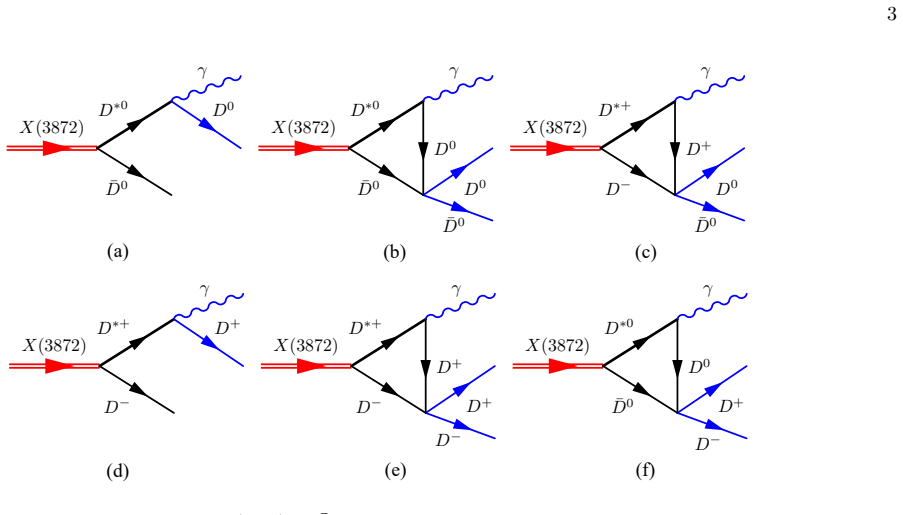
The calculation rests on XEFT, a nonrelativistic effective field theory whose degrees of freedom are D0, D*0, anti-D0, anti-D*0, and pi0 mesons. The X(3872) wave function is written as a superposition of D*0 anti-D0 and D*+ D- bound-state configurations (plus charge conjugates), with a mixing angle theta = pi/4 giving equal neutral and charged weights. Coupling constants gn and gc are extracted from residues of the D0 anti-D*0 – D+ D*- coupled-channel scattering T-matrix at the X(3872) pole. The D anti-D rescattering is incorporated by replacing the isoscalar contact interaction C0D with the D anti-D scattering amplitude T_DD = 2*pi/mu_DD / (1/a + i*p), parameterized by a scattering length a
What would settle it
If future experiments measure the ratio of neutral-to-charged radiative decay widths and find it is not large (i.e., not roughly 10:1 or larger), or if either channel's absolute width significantly exceeds the predicted values (about 11 keV for neutral, below 1 keV for charged), the pure molecular picture with equal mixing would be challenged. Conversely, observing the predicted hierarchy would support the molecular interpretation.
Extended reading notes
Core claim
The paper's key finding is that if X(3872) is a D anti-D* molecular state with equal neutral and charged components, its radiative decay into the neutral D meson pair plus a photon is more than ten times wider than the corresponding charged-channel decay. The neutral partial width is approximately 11 keV versus less than 1 keV for the charged channel, and the D anti-D rescattering correction pushes these in opposite directions — a modest 6% enhancement for the neutral channel but a substantial 38% suppression for the charged channel. This hierarchy is a direct, testable consequence of the molecular picture and the very different magnetic transition moments of the neutral and charged D* meson
Load-bearing premise
The entire calculation assumes X(3872) is a pure S-wave D anti-D* molecular bound state with exactly equal neutral and charged components (mixing angle theta = pi/4), with no admixture of tetraquark or charmonium structure, and that isospin-breaking effects in the final-state interactions can be neglected.
Signed reviews
Editorial analysis
A structured set of objections, weighed in public.
Referee Report
Summary. This manuscript calculates the radiative decay widths of X(3872) to D Dbar gamma within the XEFT framework, treating X(3872) as a pure S-wave D* Dbar molecular state with equal neutral and charged components (theta = pi/4). The calculation includes tree-level diagrams and D Dbar final-state rescattering contributions. The authors find a strong hierarchy between the neutral and charged channels: the tree-level partial width for X -> D0 Dbar0 gamma is approximately 11 keV (with a 6% enhancement from rescattering), while the charged channel X -> D+ D- gamma is below 1 keV (with a 38% suppression from rescattering). The loop integrals are ultraviolet convergent, and the theoretical framework follows standard nonrelativistic EFT methods.
Significance. The predicted hierarchy between neutral and charged radiative decay channels provides a falsifiable signature of the molecular picture of X(3872), testable at future experiments. The calculation is grounded in a well-established EFT framework (XEFT) with ultraviolet-convergent loop integrals. The dependence on the binding energy E_n is explored systematically (Figs. 2-3). The work contributes to the broader program of using radiative decays to discriminate between molecular and alternative structural interpretations of X(3872).
major comments (2)
- The headline 38% suppression of the charged channel is driven by the interference between tree-level amplitudes (Eqs. 7, 10, independent of C0_D) and rescattering amplitudes (Eqs. 8-9, 11-12, linear in C0_D). From Table I: Gamma_Tree = 0.41 keV, Gamma_Res = 0.02 keV, Gamma_Total = 0.26 keV, so the cross-term contributes approximately -0.17 keV. This interference is directly proportional to C0_D, which the paper itself states is 'not well constrained' (text following Eq. 5). The adopted value C0_D = -1 fm^2 is taken from Refs. [36, 59] without independent justification for this decay channel. The paper varies E_n (Figs. 2-3) but never varies C0_D, leaving the sensitivity of the headline 38% figure untested. A sensitivity analysis varying C0_D (or equivalently the scattering length a) is needed to establish the robustness of the charged-channel result. Without it, the 38% suppression could
- range from mild enhancement to strong suppression depending on the sign and magnitude of C0_D, making the quantitative claim in the abstract and conclusion not yet reliably established.
minor comments (6)
- The experimental upper limits in Table I are cited as '<83.30 [9]' and '<47.60 [9]', but the text in the introduction (citing Ref. [60], BESIII) gives branching ratio upper limits relative to X -> pi+ pi- J/psi. The table appears to list absolute width upper limits in keV, but the conversion from branching ratio to width is not explained. Please clarify how these numbers were obtained.
- In the text following Eq. (5), the scattering length is given as a = -1/262 MeV^{-1}. This should be -1/262 MeV^{-1} or equivalently a ~ -0.76 fm. Please verify the units and sign convention are stated consistently.
- Figures 2 and 3: the axis labels and legends are small and difficult to read. The legend entries 'Total', 'Tree', 'Rescattering' could be made clearer with more descriptive labels or a caption explaining the line styles.
- The phrase 'banding energy' appears in the description of Fig. 2 (Section III); this should be 'binding energy'.
- The abstract states the charged-channel width is 'less than 1.0 keV' while Table I gives 0.26 keV. Consider stating the actual value in the abstract for precision.
- Eq. (1) and surrounding text: the assumption theta = pi/4 is justified by a footnote stating that isospin-breaking effects in final-state interactions are not considered. This is a reasonable simplification, but the sensitivity of the results to theta is not discussed. A brief comment on how the hierarchy would change for theta != pi/4 would strengthen the paper.
Simulated Author's Rebuttal
We thank the referee for a careful reading and a constructive suggestion. The referee correctly identifies that the 38% suppression in the charged channel depends on C0_D, which we acknowledge is not well constrained. We agree to add a sensitivity analysis varying C0_D in the revised manuscript. We emphasize, however, that the primary neutral/charged hierarchy is driven by the magnetic moment difference and is robust.
read point-by-point responses
-
Referee: The headline 38% suppression of the charged channel is driven by interference between tree-level and rescattering amplitudes, directly proportional to C0_D, which the paper states is 'not well constrained.' The adopted value C0_D = -1 fm^2 is taken from Refs. [36, 59] without independent justification. The paper varies E_n but never varies C0_D, leaving the sensitivity of the 38% figure untested. A sensitivity analysis varying C0_D is needed.
Authors: We thank the referee for this important observation, which is well taken. The referee is correct that the 38% suppression in the charged channel arises from the interference between tree-level and rescattering amplitudes, and that this interference is linear in C0_D. We also agree that C0_D is not well constrained and that the paper does not currently test the sensitivity of our results to its value. We will add a sensitivity analysis varying C0_D (or equivalently the D Dbar scattering length a) in the revised manuscript, including a new figure showing the charged- and neutral-channel widths as functions of C0_D over a physically reasonable range. This will allow readers to assess the robustness of the 38% figure directly. We will also add an explicit caveat in the abstract and conclusion that the quantitative suppression factor in the charged channel carries a systematic uncertainty associated with C0_D. We note, however, that the primary hierarchy between the neutral and charged channels — approximately 11 keV versus less than 1 keV — is driven primarily by the large difference in magnetic transition moments (mu_D0 = 0.56 GeV^{-1} versus mu_D+ = -0.15 GeV^{-1}), which enters at tree level and is independent of C0_D. The tree-level charged width is already suppressed by more than an order of magnitude relative to the neutral one. Therefore, while the referee is correct that the specific 38% figure is sensitive to C0_D and must be qualified accordingly, the qualitative prediction of a strong neutral-over-charged hierarchy is robust and does not depend on the rescattering parameter. revision: yes
-
Referee: Without [a sensitivity analysis], the 38% suppression could range from mild enhancement to strong suppression depending on the sign and magnitude of C0_D, making the quantitative claim in the abstract and conclusion not yet reliably established.
Authors: We agree with this assessment. The quantitative claim of 'roughly 38%' suppression in the abstract and conclusion should be qualified. In the revised manuscript, we will: (1) present the C0_D sensitivity analysis as described above; (2) rephrase the abstract and conclusion to state that the rescattering correction to the charged channel is sensitive to the poorly constrained C0_D parameter, and that the 38% suppression corresponds to the adopted value C0_D = -1 fm^2; and (3) emphasize that the robust, model-independent prediction is the tree-level hierarchy, which is unaffected by C0_D. We believe this addresses the referee's concern while preserving the main physics message of the paper. revision: yes
Circularity Check
No significant circularity: the decay width predictions are computed from external inputs (magnetic moments, binding energies, contact terms) without fitting to the target observables.
full rationale
The paper computes radiative decay widths Γ(X→D̄Dγ) from a standard EFT framework. The key inputs are: (1) magnetic moments μ_D0 and μ_D+ extracted from measured D*→Dγ decay widths (external experimental data, Eq. 4 and surrounding text), (2) coupling constants g_n, g_c derived from binding energies E_n, E_c and the X(3872) pole position (Eq. 3, using PDG masses), (3) the contact term C_0_D taken from Refs. [36, 59] with an explicitly stated value C_0_D = −1 fm², and (4) the mixing angle θ = π/4 adopted as a model assumption (Eq. 1). The decay amplitudes (Eqs. 7–12) are then computed from Feynman diagrams using these inputs, and the partial widths in Table I are genuine predictions — none of the input parameters were fitted to the D̄Dγ decay widths themselves. The paper compares its predictions against experimental upper limits from BESIII (Table I, last column) and notes they lie well below these limits. While the C_0_D value is acknowledged as 'not well constrained' and is taken from prior work by overlapping author groups (Refs. [36, 59]), this is a parameter sensitivity concern (correctness risk), not circularity: the cited value was derived for a different process (D⁰D̄⁰ bound state scattering length), not fitted to the present decay widths. The derivation chain is self-contained against external benchmarks, and no step reduces to its own output by construction.
Assumptions & free parameters
free parameters (3)
- E_n =
0.01-0.80 MeV (varied)
- C0_D =
-1 fm^2
- theta =
pi/4
assumptions (3)
- domain assumption X(3872) is a pure S-wave D*D-bar molecular state.
- domain assumption The isovector D D-bar final-state interaction is negligible.
- domain assumption Nonrelativistic effective field theory (XEFT) is valid for this decay process.
Cite this review
Pith. "Pith review of Radiative decays of $X(3872)$ within $D{\bar D}^*$ molecular framework." pith.science (2026). https://pith.science/paper/2B2TYVUQ
@misc{pith2026260706046,
  author       = {Pith},
  title        = {Pith review of: Radiative decays of $X(3872)$ within $D\bar D^*$ molecular framework},
  year         = {2026},
  howpublished = {\url{https://pith.science/paper/2B2TYVUQ}},
  note         = {Machine review of arXiv:2607.06046}
}
abstract
Within the framework of nonrelativistic effective field theory, we calculate the radiative decay width of the process $X(3872) \to \bar{D} D \gamma$ while taking into account the $D\bar{D}$ final-state interactions. In this work, the $X(3872)$, with the spin-parity quantum numbers $J^{PC}=1^{++}$, is treated as a $D^*\bar{D} +\rm c.c.$ bound state comprising equal proportions of neutral and charged components. Our numerical calculations predict the tree-level partial decay width of approximately $11.0$ keV for the decay process $X(3872) \to \bar{D}^0 D^0\gamma$, while the partial width for $X(3872) \to D^- D^+\gamma$ is less than $1.0$ keV. It is found that the $D\bar{D}$ rescattering effect enhances the tree-level width of $X(3872) \to \bar{D}^0 D^0\gamma$ by $6\%$. In contrast, the rescattering effect makes a suppression to the charged channel $X(3872)\to D^- D^+\gamma $ by roughly $38\%$. We expect that the present predictions based on the molecular picture of the $X(3872)$ can be tested by future experiments.
Figures


Reference graph
Works this paper leans on
-
[1]
Exotic hadrons: review and perspectives
J.-M. Richard, Exotic hadrons: review and perspectives, Few Body Syst.57, 1185 (2016), arXiv:1606.08593 [hep- ph]
work page Pith review arXiv 2016
-
[2]
Exotic Hadrons with Heavy Flavors -X, Y, Z and Related States-
A. Hosaka, T. Iijima, K. Miyabayashi, Y. Sakai, and S. Yasui, Exotic hadrons with heavy flavors: X, Y, Z, and related states, PTEP2016, 062C01 (2016), arXiv:1603.09229 [hep-ph]
work page Pith review arXiv 2016
-
[3]
F.-K. Guo, C. Hanhart, U.-G. Meißner, Q. Wang, Q. Zhao, and B.-S. Zou, Hadronic molecules, Rev. Mod. Phys.90, 015004 (2018), [Erratum: Rev.Mod.Phys. 94, 029901 (2022)], arXiv:1705.00141 [hep-ph]
work page Pith review arXiv 2018
-
[4]
A. Ali, J. S. Lange, and S. Stone, Exotics: Heavy Pen- taquarks and Tetraquarks, Prog. Part. Nucl. Phys.97, 123 (2017), arXiv:1706.00610 [hep-ph]
work page Pith review arXiv 2017
-
[5]
Pentaquark and Tetraquark states
Y.-R. Liu, H.-X. Chen, W. Chen, X. Liu, and S.-L. Zhu, Pentaquark and Tetraquark states, Prog. Part. Nucl. Phys.107, 237 (2019), arXiv:1903.11976 [hep-ph]
work page Pith review arXiv 2019
-
[6]
H.-X. Chen, W. Chen, X. Liu, Y.-R. Liu, and S.-L. Zhu, An updated review of the new hadron states, Rept. Prog. Phys.86, 026201 (2023), arXiv:2204.02649 [hep-ph]
work page Pith review arXiv 2023
- [7]
-
[8]
Determination of the X(3872) meson quantum numbers
R. Aaij et al. (LHCb), Determination of theX(3872) meson quantum numbers, Phys. Rev. Lett.110, 222001 (2013), arXiv:1302.6269 [hep-ex]
work page Pith review arXiv 2013
Show all 71 references
-
[9]
Navas et al
S. Navas et al. (Particle Data Group), Review of particle physics, Phys. Rev. D110, 030001 (2024)
2024
-
[10]
F. E. Close and P. R. Page, TheD ∗0 ¯D0 threshold resonance, Phys. Lett. B578, 119 (2004), arXiv:hep- ph/0309253
2004
-
[11]
Pakvasa and M
S. Pakvasa and M. Suzuki, On the hidden charm state at 3872 MeV, Phys. Lett. B579, 67 (2004), arXiv:hep- ph/0309294
2004
-
[12]
E. S. Swanson, Short range structure in theX(3872), Phys. Lett. B588, 189 (2004), arXiv:hep-ph/0311229
2004 arXiv
-
[13]
E. S. Swanson, Diagnostic decays of theX(3872), Phys. Lett. B598, 197 (2004), arXiv:hep-ph/0406080
2004 arXiv
-
[14]
N. A. Tornqvist, Isospin breaking of the narrow charmo- nium state of Belle at 3872 MeV as a deuson, Phys. Lett. B590, 209 (2004), arXiv:hep-ph/0402237
2004 arXiv
-
[15]
M. B. Voloshin, Interference and binding effects in decays of possible molecular component ofX(3872), Phys. Lett. B579, 316 (2004), arXiv:hep-ph/0309307
2004 arXiv
-
[16]
Wong, Molecular states of heavy quark mesons, Phys
C.-Y. Wong, Molecular states of heavy quark mesons, Phys. Rev. C69, 055202 (2004), arXiv:hep-ph/0311088
2004 arXiv
-
[17]
M. T. AlFiky, F. Gabbiani, and A. A. Petrov,X(3872): Hadronic molecules in effective field theory, Phys. Lett. 7 B640, 238 (2006), arXiv:hep-ph/0506141
2006 arXiv
-
[18]
Braaten and M
E. Braaten and M. Lu, Operator Product Expansion in the Production and Decay of theX(3872), Phys. Rev. D 74, 054020 (2006), arXiv:hep-ph/0606115
2006 arXiv
-
[19]
Fleming, M
S. Fleming, M. Kusunoki, T. Mehen, and U. van Kolck, Pion interactions in theX(3872), Phys. Rev. D76, 034006 (2007), arXiv:hep-ph/0703168
2007 arXiv
-
[20]
Ding, J.-F
G.-J. Ding, J.-F. Liu, and M.-L. Yan, Dynamics of Hadronic Molecule in One-Boson Exchange Approach and Possible Heavy Flavor Molecules, Phys. Rev. D79, 054005 (2009), arXiv:0901.0426 [hep-ph]
2009 arXiv
-
[21]
Y. Dong, A. Faessler, T. Gutsche, S. Kovalenko, and V. E. Lyubovitskij,X(3872) as a hadronic molecule and its decays to charmonium states and pions, Phys. Rev. D 79, 094013 (2009), arXiv:0903.5416 [hep-ph]
2009 arXiv
-
[22]
I. W. Lee, A. Faessler, T. Gutsche, and V. E. Lyubovit- skij,X(3872) as a molecularDD ∗ state in a potential model, Phys. Rev. D80, 094005 (2009), arXiv:0910.1009 [hep-ph]
2009 arXiv
-
[23]
Lee, Z.-G
N. Lee, Z.-G. Luo, X.-L. Chen, and S.-L. Zhu, Possible Deuteron-like Molecular States Composed of Heavy Baryons, Phys. Rev. D84, 014031 (2011), arXiv:1104.4257 [hep-ph]
2011 arXiv
-
[24]
Liu, Z.-G
X. Liu, Z.-G. Luo, Y.-R. Liu, and S.-L. Zhu,X(3872) and Other Possible Heavy Molecular States, Eur. Phys. J. C61, 411 (2009), arXiv:0808.0073 [hep-ph]
2009 arXiv
-
[25]
Zhang and M.-Q
J.-R. Zhang and M.-Q. Huang,{Q¯q}{ ¯Q ′ q}molecular states, Phys. Rev. D80, 056004 (2009), arXiv:0906.0090 [hep-ph]
2009 arXiv
-
[26]
Gamermann, J
D. Gamermann, J. Nieves, E. Oset, and E. Ruiz Arriola, Couplings in coupled channels versus wave functions: ap- plication to theX(3872) resonance, Phys. Rev. D81, 014029 (2010), arXiv:0911.4407 [hep-ph]
2010 arXiv
-
[27]
Mehen and R
T. Mehen and R. Springer, Radiative DecaysX(3872)→ ψ(2S)γandψ(4040)→X(3872)γin Effective Field The- ory, Phys. Rev. D83, 094009 (2011), arXiv:1101.5175 [hep-ph]
2011 arXiv
-
[28]
Nieves and M
J. Nieves and M. P. Valderrama, Deriving the exis- tence ofB ¯B∗ bound states from theX(3872) and Heavy Quark Symmetry, Phys. Rev. D84, 056015 (2011), arXiv:1106.0600 [hep-ph]
2011 arXiv
-
[29]
Nieves and M
J. Nieves and M. P. Valderrama, The Heavy Quark Spin Symmetry Partners of theX(3872), Phys. Rev. D86, 056004 (2012), arXiv:1204.2790 [hep-ph]
2012 arXiv
-
[30]
Li and S.-L
N. Li and S.-L. Zhu, Isospin breaking, Coupled-channel effects and Diagnosis ofX(3872), Phys. Rev. D86, 074022 (2012), arXiv:1207.3954 [hep-ph]
2012 arXiv
-
[31]
Z.-F. Sun, X. Liu, M. Nielsen, and S.-L. Zhu, Hadronic molecules with both open charm and bottom, Phys. Rev. D85, 094008 (2012), arXiv:1203.1090 [hep-ph]
2012 arXiv
-
[32]
F.-K. Guo, C. Hidalgo-Duque, J. Nieves, and M. P. Valderrama, Consequences of Heavy Quark Symmetries for Hadronic Molecules, Phys. Rev. D88, 054007 (2013), arXiv:1303.6608 [hep-ph]
2013 arXiv
-
[33]
He, Study of theB ¯B∗/D ¯D∗ bound states in a Bethe- Salpeter approach, Phys
J. He, Study of theB ¯B∗/D ¯D∗ bound states in a Bethe- Salpeter approach, Phys. Rev. D90, 076008 (2014), arXiv:1409.8506 [hep-ph]
2014 arXiv
-
[34]
L. Zhao, L. Ma, and S.-L. Zhu, Spin-orbit force, recoil corrections, and possibleB ¯B∗ andD ¯D∗ molecular states, Phys. Rev. D89, 094026 (2014), arXiv:1403.4043 [hep- ph]
2014 arXiv
-
[35]
F.-K. Guo, C. Hanhart, Y. S. Kalashnikova, U.-G. Meißner, and A. V. Nefediev, What can radiative decays of theX(3872) teach us about its nature?, Phys. Lett. B 742, 394 (2015), arXiv:1410.6712 [hep-ph]
2015 arXiv
-
[36]
F. K. Guo, C. Hidalgo-Duque, J. Nieves, A. Ozpineci, and M. P. Valderrama, Detecting the long-distance struc- ture of theX(3872), Eur. Phys. J. C74, 2885 (2014), arXiv:1404.1776 [hep-ph]
2014 arXiv
-
[37]
Braaten and M
E. Braaten and M. Kusunoki, Low-energy universality and the new charmonium resonance at 3870 MeV, Phys. Rev. D69, 074005 (2004), arXiv:hep-ph/0311147
2004 arXiv
-
[38]
Wu, D.-Y
Q. Wu, D.-Y. Chen, and T. Matsuki, A phenomenolog- ical analysis on isospin-violating decay ofX(3872), Eur. Phys. J. C81, 193 (2021), arXiv:2102.08637 [hep-ph]
2021 arXiv
-
[39]
Yamaguchi, A
Y. Yamaguchi, A. Hosaka, S. Takeuchi, and M. Takizawa, Heavy hadronic molecules with pion exchange and quark core couplings: a guide for practitioners, J. Phys. G47, 053001 (2020), arXiv:1908.08790 [hep-ph]
2020 arXiv
-
[40]
F. Wang, G. Li, S.-D. Liu, and Q. Wu, Radiative decays ofX(3872) inD ¯D∗ molecule scenario, Phys. Rev. D111, 094001 (2025), arXiv:2502.19887 [hep-ph]
2025 arXiv
-
[41]
Cai, Z.-S
H.-D. Cai, Z.-S. Jia, G. Li, and S.-D. Liu, Hidden charmed decays ofX(3872) within theD ¯D∗ molec- ular framework, Phys. Rev. D111, 114024 (2025), arXiv:2503.20183 [hep-ph]
2025 arXiv
-
[42]
Wu, Z.-Q
Q. Wu, Z.-Q. Sun, D.-Y. Chen, S.-D. Liu, and G. Li, Dipion transitions fromX(3872) toχ cJ (J= 0,1,2), Phys. Rev. D113, 014015 (2026), arXiv:2512.21161 [hep- ph]
2026
-
[43]
Z.-S. Jia, G. Li, and Z.-H. Zhang, Constrain the χcJ →D (∗) ¯D(∗) effective couplings via theX(3872)→ π0χcJ decays, Phys. Rev. D112, 074035 (2025), arXiv:2507.16618 [hep-ph]
2025
-
[44]
Y. S. Kalashnikova and A. V. Nefediev,X(3872) in the molecular model, Phys. Usp.62, 568 (2019), arXiv:1811.01324 [hep-ph]
2019 arXiv
-
[45]
Maiani, F
L. Maiani, F. Piccinini, A. D. Polosa, and V. Riquer, Diquark-antidiquarks with hidden or open charm and the nature ofX(3872), Phys. Rev. D71, 014028 (2005), arXiv:hep-ph/0412098
2005 arXiv
-
[46]
Maiani, V
L. Maiani, V. Riquer, F. Piccinini, and A. D. Polosa, Four quark interpretation ofY(4260), Phys. Rev. D72, 031502 (2005), arXiv:hep-ph/0507062
2005 arXiv
-
[47]
Maiani, A
L. Maiani, A. D. Polosa, and V. Riquer, Indications of a Four-Quark Structure for theX(3872) andX(3876) Par- ticles from Recent Belle and BABAR Data, Phys. Rev. Lett.99, 182003 (2007), arXiv:0707.3354 [hep-ph]
2007 arXiv
-
[48]
Terasaki, A New tetra-quark interpretation of X(3872), Prog
K. Terasaki, A New tetra-quark interpretation of X(3872), Prog. Theor. Phys.118, 821 (2007), arXiv:0706.3944 [hep-ph]
2007 arXiv
-
[49]
Dubniˇ cka, A
S. Dubniˇ cka, A. Z. Dubniˇ ckov´ a, M. A. Ivanov, and A. Liptaj, Dynamical Approach to Decays ofXY Z States, Symmetry12, 884 (2020)
2020
-
[50]
Wang, Decipher the width of theX(3872) via the QCD sum rules, Phys
Z.-G. Wang, Decipher the width of theX(3872) via the QCD sum rules, Phys. Rev. D109, 014017 (2024), arXiv:2310.02030 [hep-ph]
2024 arXiv
-
[51]
Wang, Analysis of the hidden-charm tetraquark mass spectrum with the QCD sum rules, Phys
Z.-G. Wang, Analysis of the hidden-charm tetraquark mass spectrum with the QCD sum rules, Phys. Rev. D 102, 014018 (2020), arXiv:1908.07914 [hep-ph]
2020 arXiv
-
[52]
Barnes and S
T. Barnes and S. Godfrey, Charmonium options for the X(3872), Phys. Rev. D69, 054008 (2004), arXiv:hep- ph/0311162
2004
-
[53]
Suzuki, TheX(3872) boson: Molecule or char- monium, Phys
M. Suzuki, TheX(3872) boson: Molecule or char- monium, Phys. Rev. D72, 114013 (2005), arXiv:hep- ph/0508258. 8
2005
-
[54]
Y. Dong, A. Faessler, T. Gutsche, and V. E. Lyubovitskij, J/ψγandψ(2S)γdecay modes of theX(3872), J. Phys. G38, 015001 (2011), arXiv:0909.0380 [hep-ph]
2011 arXiv
-
[55]
Braaten, H
E. Braaten, H. W. Hammer, and T. Mehen, Scattering of an Ultrasoft Pion and theX(3872), Phys. Rev. D82, 034018 (2010), arXiv:1005.1688 [hep-ph]
2010 arXiv
-
[56]
Fleming and T
S. Fleming and T. Mehen, The decay of theX(3872) intoχ cJ and the Operator Product Expansion in XEFT, Phys. Rev. D85, 014016 (2012), arXiv:1110.0265 [hep- ph]
2012 arXiv
-
[57]
Mehen, Hadronic loops versus factorization in effective field theory calculations ofX(3872)→χ cJ π0, Phys
T. Mehen, Hadronic loops versus factorization in effective field theory calculations ofX(3872)→χ cJ π0, Phys. Rev. D92, 034019 (2015), arXiv:1503.02719 [hep-ph]
2015 arXiv
-
[58]
Braaten, Galilean-invariant effective field theory for theX(3872), Phys
E. Braaten, Galilean-invariant effective field theory for theX(3872), Phys. Rev. D91, 114007 (2015), arXiv:1503.04791 [hep-ph]
2015 arXiv
-
[59]
Dai, F.-K
L. Dai, F.-K. Guo, and T. Mehen, RevisitingX(3872)→ D0 ¯D0π0 in an effective field theory for theX(3872), Phys. Rev. D101, 054024 (2020), arXiv:1912.04317 [hep- ph]
2020 arXiv
-
[60]
Ablikim et al
M. Ablikim et al. (BESIII), Study of Open-Charm De- cays and Radiative Transitions of theX(3872), Phys. Rev. Lett.124, 242001 (2020), arXiv:2001.01156 [hep- ex]
2020
-
[61]
Y. Wang, Q. Wu, G. Li, W.-H. Qin, X.-H. Liu, C.-S. An, and J.-J. Xie, Investigations of charmless decays of X(3872) via intermediate meson loops, Phys. Rev. D 106, 074015 (2022), arXiv:2209.12206 [hep-ph]
2022 arXiv
-
[62]
Albaladejo, F
M. Albaladejo, F. K. Guo, C. Hidalgo-Duque, J. Nieves, and M. P. Valderrama, Decay widths of the spin-2 part- ners of theX(3872), Eur. Phys. J. C75, 547 (2015), arXiv:1504.00861 [hep-ph]
2015 arXiv
-
[63]
Jia, Z.-H
Z.-S. Jia, Z.-H. Zhang, G. Li, and F.-K. Guo, Radiative decays of the heavy-quark-spin molecular partner ofT + cc, Phys. Rev. D108, 094038 (2023), arXiv:2307.11047 [hep- ph]
2023 arXiv
-
[64]
Fleming, R
S. Fleming, R. Hodges, and T. Mehen,T + cc decays: Dif- ferential spectra and two-body final states, Phys. Rev. D 104, 116010 (2021), arXiv:2109.02188 [hep-ph]
2021 arXiv
-
[65]
J. F. Amundson, C. G. Boyd, E. E. Jenkins, M. E. Luke, A. V. Manohar, J. L. Rosner, M. J. Savage, and M. B. Wise, RadiativeD ∗ decay using heavy quark and chi- ral symmetry, Phys. Lett. B296, 415 (1992), arXiv:hep- ph/9209241
1992
-
[66]
I. W. Stewart, Extraction of theD ∗Dπcoupling from D∗ decays, Nucl. Phys. B529, 62 (1998), arXiv:hep- ph/9803227
1998
-
[67]
Guo, Novel Method for Precisely Measuring the X(3872) Mass, Phys
F.-K. Guo, Novel Method for Precisely Measuring the X(3872) Mass, Phys. Rev. Lett.122, 202002 (2019), arXiv:1902.11221 [hep-ph]
2019 arXiv
-
[68]
D. B. Kaplan, M. J. Savage, and M. B. Wise, Two nucleon systems from effective field theory, Nucl. Phys. B534, 329 (1998), arXiv:nucl-th/9802075
1998 arXiv
-
[69]
Shi, Z.-H
P.-P. Shi, Z.-H. Zhang, F.-K. Guo, and Z. Yang,D +D− hadronic atom and its production inppandp¯pcollisions, Phys. Rev. D105, 034024 (2022), arXiv:2111.13496 [hep- ph]
2022 arXiv
-
[70]
F.-K. Guo, C. Hanhart, G. Li, U.-G. Meißner, and Q. Zhao, Effect of charmed meson loops on charmo- nium transitions, Phys. Rev. D83, 034013 (2011), arXiv:1008.3632 [hep-ph]
2011 arXiv
-
[71]
Dong, F.-K
X.-K. Dong, F.-K. Guo, and B.-S. Zou, A survey of heavy-antiheavy hadronic molecules, Progr. Phys.41, 65 (2021), arXiv:2101.01021 [hep-ph]
2021 arXiv
Reviewed July 8, 2026 · model on record in the stance chip above.
Discussion (0). Continue with ORCID to comment.