REVIEW 4 major objections 5 minor 2 cited by
Two dense passive spheres in highly eccentric Earth orbits, tracked by laser ranging, can act as resonant detectors of microhertz gravitational waves, filling the gap between pulsar timing arrays and planned space interferometers.
Reviewed by Pith at T0; open to challenge. T0 means a machine referee read the full paper against a public rubric. the ladder, T0–T4 →
T0 review · deepseek-v4-flash
2026-08-01 15:31 UTC pith:5R2GIIZP
load-bearing objection A serious white paper for a clever microhertz GW mission, but the headline sensitivity is the authors' own 'likely overly optimistic' no-arc case, and the conservative case is orders weaker. the 4 major comments →
GUEST: Gravitational Universe Exploration with Satellite Tracking. A passive satellite laser-ranging mission for the dark gravitational Universe
The pith
A machine-rendered reading of the paper's core claim, the machinery that carries it, and where it could break.
Core claim
The paper's central claim is that a highly eccentric Earth satellite orbit is a practical resonant gravitational-wave detector. A GW with frequency close to n times the orbital frequency induces a transverse-traceless acceleration that, over many orbits, produces a quadratic drift in the orbital angle (the true anomaly) — a drift that grows with observation time and survives a simultaneous fit of all other orbital parameters. With two spheres in 33.8-hour, e≈0.75 orbits tracked at ~10 cm precision (10 normal points per orbit per satellite) for ten years, the projected reach is h0 ≲ 1e-19 for monochromatic sources and hc ≲ 1e-17 for stochastic backgrounds in the 1e-7 to 1e-4 Hz range. The pap
What carries the argument
The central object is the orbit-as-resonator: the satellite's trajectory itself accumulates the gravitational-wave signal. The key identity is the resonance condition P ≈ n/ω_gw, where the orbital period stays near an integer multiple of the GW period; the resulting quadratic growth of the orbital-angle drift is amplified by high eccentricity and by higher harmonics. The long orbital period (33.8 h) places the fundamental resonances in the microhertz band, and the high eccentricity (e≈0.75) boosts the effect and excites higher resonances that extend the sensitive band upward. Two spheres in differently oriented planes (inclinations 75° and 50°, differing ascending nodes) decorrelate systemat
Load-bearing premise
The detection requires that the satellite's orbit remain near a fixed resonance with the gravitational-wave frequency long enough for the quadratic drift to accumulate over years, and that all systematic non-gravitational accelerations can be modelled well enough to separate them from the signal; the paper states that its 7-day-arc analysis destroys long-term signals and that the 10-year-arc analysis is 'likely overly optimistic'.
What would settle it
A concrete test: run a full precise-orbit-determination simulation of the two GUEST orbits — including lunisolar perturbations, the Earth's gravity field, solar radiation pressure, albedo, thermal re-radiation, and measurement noise — and inject a monochromatic GW of h0 = 1e-19 at 1e-5 Hz. If the recovered signal is absorbed by the fitted orbital parameters, or if the quadratic drift only appears in the unrealistic 10-year-arc analysis and not in any arc-based analysis, the central sensitivity claim fails; conversely, successful recovery would validate the concept.
If this is right
- GUEST would deliver the first coherent search for supermassive black-hole binaries in the microhertz band, with sensitivity to individual chirping mergers up to roughly a billion solar masses at redshifts near 1, and to intermediate-mass black-hole binaries in nearby globular clusters.
- It would probe stochastic backgrounds from primordial sources such as first-order phase transitions and cosmic strings, at energy scales inaccessible to terrestrial colliders, complementing pulsar-timing and millihertz interferometer observations.
- It would extend direct searches for ultra-light dark matter (masses around 1e-22 to 1e-19 eV/c^2) into a parameter region untouched by other experiments, and would look for gravitational waves from superradiant boson clouds around nearby supermassive black holes.
- It would improve bounds on Yukawa fifth forces and quadratic scalar couplings by roughly an order of magnitude at ranges from about a thousand to ten billion kilometres, and test the relativistic precession of the orbit's closest-approach point at the few-percent level.
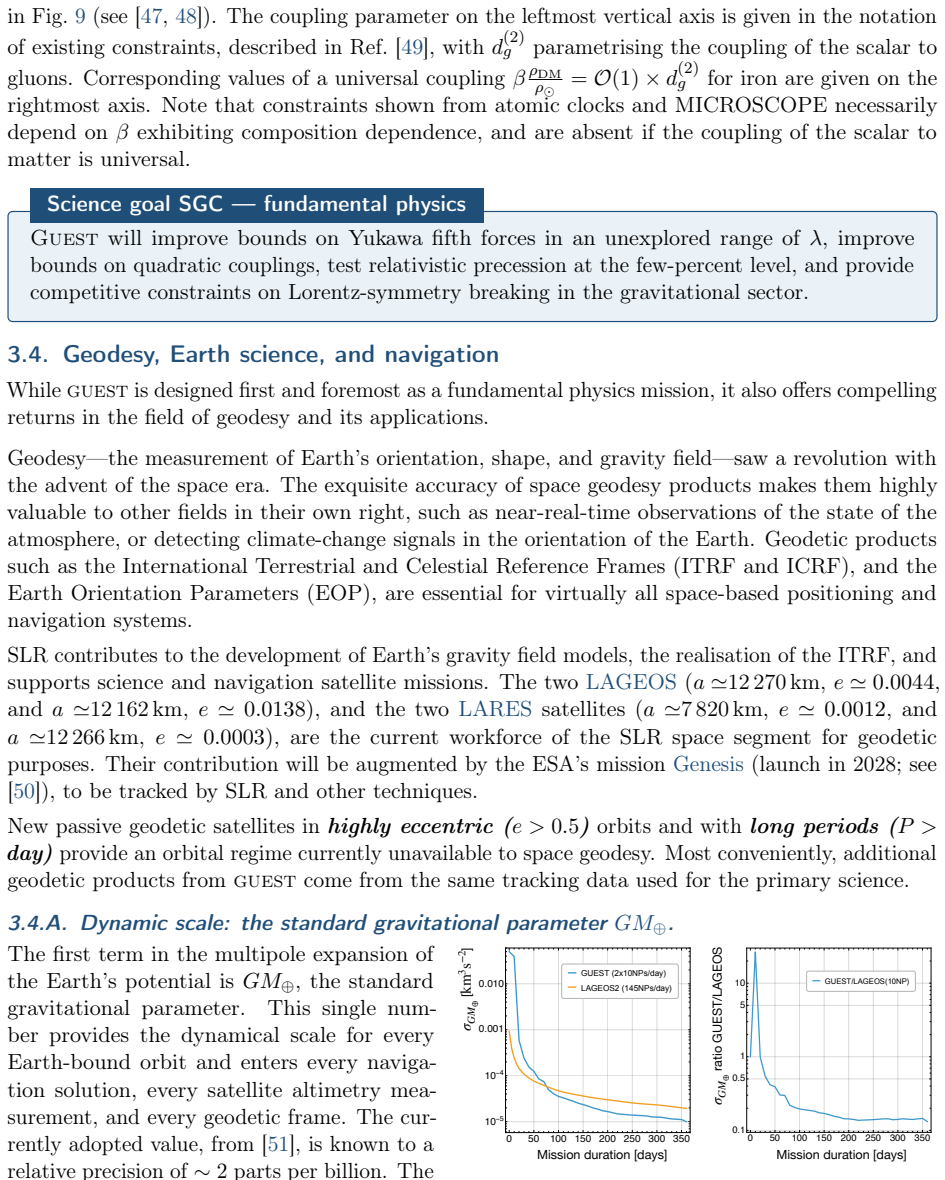
- The high-eccentricity, long-period orbits would break the correlation between range biases, station positions, and GM⊕, yielding an absolute determination of Earth's gravitational parameter approaching the 1-mm geodetic goals.
Where Pith is reading between the lines
- The paper leaves implicit that the resonant response could also act as a monitor of local transient perturbations — for example, a planetary-mass primordial black hole passing through the inner Solar System might produce a detectable non-resonant disturbance; this is a natural extension worth quantifying.
- Because the sensitivity curves are bracketed by two extremes (7-day arc breaks that erase long signals, and a 10-year arc the paper calls 'likely overly optimistic'), the real sensitivity will probably fall between them; a practical data-analysis scheme that keeps some arc structure while retaining long-period signal would sharpen the forecast.
- A testable near-term extension is to apply the same resonant-drift formalism to existing long-arc objects that are already laser-tracked, such as the Moon, to search for an injected known monochromatic signal; success would validate the detection pipeline before launch.
- The proposed scientific overlap with the planned millihertz interferometer turns GUEST into a possible pre-alert system: a source identified in the microhertz band can be followed into the higher band years later, improving sky localization and enabling archival searches — a multi-band synergy the paper mentions but does not fully develop.
Editorial analysis
A structured set of objections, weighed in public.
Referee Report
Summary. The paper proposes GUEST, a mission concept consisting of two dense, passive, retroreflector-covered spheres in highly eccentric Earth orbits (e~0.75, P~33.8 h), tracked by the ILRS satellite laser ranging network. The central claim is that the orbits act as resonant GW detectors, accumulating a quadratic drift in orbital elements when a GW frequency matches a harmonic of the orbital motion. The authors claim sensitivity to monochromatic strains h0≲1e-19 and stochastic backgrounds hc≲1e-17 in the microhertz band, and from these derive a broad science programme: SMBHB searches, primordial GW backgrounds, ultralight dark matter, superradiant boson clouds, fifth forces, and improved GM⊕ determination. The paper is a white paper presenting the motivation, orbit choices, sensitivity curves, science goals, and mission implementation, but it does not provide the underlying simulation code, covariance matrices, or a detailed error budget.
Significance. If the central sensitivity claim is correct, GUEST would open a genuinely unexplored frequency window between PTAs and LISA, with impact on GW astronomy, cosmology, particle physics, and geodesy. The concept is attractively simple and builds on mature SLR technology, and the two-satellite configuration for sky coverage and systematic decorrelation is thoughtful. The paper also contains useful concrete engineering work, including the dual-CCR optical cross-section design and the re-entry analysis. However, the quantitative forecasts are not yet demonstrated: the headline sensitivity relies on an admittedly optimistic data-analysis scenario, and the realistic 'with arcs' scenario is admitted to destroy the long-term coherent signal that is the basis of the detection concept. The scientific payoff therefore rests on an unquantified ability to perform decade-long precise orbit determination, which is the manuscript's principal weakness.
major comments (4)
- [Sec. 2.2, Fig. 2, Abstract and Sec. 3.5] The abstract and Sec. 3.5 state that GUEST will be sensitive to h0≲1e-19 and hc≲1e-17, but Fig. 2 shows that the h0≲1e-19 curve is the 'no arc' case, i.e. a single 10-year arc. The text immediately before Fig. 2 calls this scenario 'likely overly optimistic'. The 'with arcs' case (7-day POD arcs) is described as the realistic conservative scenario, and the paper admits that arcs are 'highly unfavorable for long-term signals'. No quantitative argument is given for how unmodeled non-gravitational accelerations (solar radiation pressure, Earth albedo, thermal/Yarkovsky effects, geopotential harmonics, station range biases) would be mitigated to allow a 10-year global arc. Thus the headline sensitivity is not supported as stated; the paper must either adopt the with-arcs sensitivity as the headline or provide an error budget demonstrating that decade-long arcs are feasible.
- [Sec. 2.1 and Sec. 2.2] The paper claims that 'we fit the GW signal simultaneously with all other parameters considered in standard POD', but no covariance matrix, simulation setup, or analysis software is provided, and no end-to-end simulation results are shown. The only quantitative basis for the sensitivity curves is therefore opaque. To make the central claim reproducible and checkable, the authors need to release at least the relevant covariance analysis, or describe the simulation in enough detail for an independent group to reproduce the curves. This is not a mere documentation issue: the feasibility of the whole mission depends on whether systematics can be separated from the GW signal over the relevant timescales.
- [Fig. 4 and Sec. 2.1] The sensitivity curves in Fig. 2 appear to assume fixed orbital elements, but Fig. 4 shows large Lidov-Kozai-driven variations in eccentricity, inclination, and argument of perigee over the 30-year mission. These variations change the resonance condition, the orbital harmonics, and the accumulated phase drift. The paper does not convolve the time-dependent orbital elements with the sensitivity calculation. Even the 'no arc' curve is therefore a best-case snapshot, not a mission-integrated sensitivity. The authors should show the sensitivity obtained by propagating the actual time-dependent orbits, or justify why the static approximation is adequate.
- [Sec. 3.1.A and Fig. 5] The reach claims for individual SMBHB mergers and IMBH systems in Fig. 5 are based on 'dedicated waveforms' and 'estimates for individual sources' that 'will appear in future work'. Since these figures are used to support science goals SGA1 and SGA2, the analysis should be described at least in outline here, or the figures should be clearly labelled as preliminary and not used as quantitative mission statements. The same applies to the GM⊕ forecast in Fig. 10, whose caption notes that additional parameters are not included.
minor comments (5)
- [Title] The title contains a typo: 'T racking' should be 'Tracking'.
- [Throughout] The acronym 'GUEST' is written as 'Guest' in several places (e.g., first sentence of the abstract and in Sec. 2.2). Please use one consistent capitalization.
- [Sec. 4.4 and Sec. 2.2] The data cadence is given as '10 NPs per orbit' in Sec. 2.2, but Sec. 4.4 says '20 NPs observations per orbit (10 per satellite)', and Fig. 10 refers to '2x10NPs/day'. Please clarify the intended number per satellite and per day, and ensure the sensitivity calculations use a consistent value.
- [Fig. 2] The left-panel x-axis is labelled 'f [Hz]' but the tick values run from 0 to 140; presumably the intended unit is microhertz or the axis should be scaled. Please correct the axis label and ticks.
- [Fig. 8] The axes are labelled only '[m]' and '[-]'; the meaning (λ and α) should be included in the axis labels.
Circularity Check
No significant circularity: sensitivity forecasts follow from standard, independently checkable orbital-resonance physics; the optimistic no-arc case is explicitly labeled as optimistic, not disguised as a fitted prediction.
full rationale
The paper's central derivation is not circular. Its detection concept relies on the standard transverse-traceless acceleration formula (Eq. 2) and the published result that a resonantly-driven eccentric orbit accumulates a quadratic drift in true anomaly; the ensemble of Refs. [14-18] provides the underlying physics, but that physics is external to the mission claim and is checkable from general-relativistic perturbation theory rather than being defined by GUEST's sensitivity. The mission parameters (e~0.75, P~33.8 h, 10 NPs/orbit, 10 cm precision, 10 years) are chosen design inputs, not fit parameters tuned to reproduce a target signal, and the sensitivity curves are explicitly presented as SNR=1 forecasts under two data-analysis scenarios. The paper is transparent that the 'no arc' curve is 'likely overly optimistic' while the 'with arcs' curve is 'overly pessimistic', so quoting the no-arc headline is a best-case caveat, not a constructed equivalence. The overlap of some authors with Refs. [14-18] and [31] is real, but those works are published, parameter-free derivations of the resonant response, not unverified claims whose sole support is the present collaboration. Any weaknesses — arc length, non-gravitational accelerations, Lidov-Kozai secular evolution, or the deferred source-specific waveform details — are feasibility and modelling limitations, openly acknowledged in the text, and do not reduce the forecast to its own inputs. No fitted parameter is renamed as a prediction, and no self-citation chain is invoked to forbid alternatives, so no circular step can be exhibited.
Axiom & Free-Parameter Ledger
free parameters (5)
- Normal-point precision =
10 cm (baseline); cm-level stated as possible
- Data cadence =
10 NPs per orbit per satellite
- Observation duration =
10 years nominal, 30 years extended
- Arc length in POD =
7-day arcs (conservative) or 10-year single arc (optimistic)
- Orbital elements =
e=0.75, P=33.8h, i=75/50 deg, RAAN=0/220 deg
axioms (4)
- standard math Linearized TT-gauge equation δ¨r_i = 1/2 h¨_ij^TT r_j (Eq. 2)
- domain assumption Resonance condition P ≈ n/ω_gw produces a quadratic drift of the true anomaly (Refs. [14-18])
- domain assumption The local DM density ρ⊙ = 0.4 GeV/cm^3
- domain assumption SMBHB stochastic background extends from the PTA band into the μHz band (Sec. 3.1.A, Fig. 2 right)
read the original abstract
GUEST is a space mission concept whose central objective is the detection of gravitational waves (GWs) in the microhertz band -- a physics-rich frequency window that no other present or planned detector can reach at a significant level. The concept is simple: two dense, passive spheres, covered with cube-corner retroreflectors, deployed in {highly eccentric} Earth orbits ($e \gtrsim 0.7$, period $P \gtrsim 33$ h), tracked continuously by the global network of satellite laser-ranging stations over a minimum observation time of 10 years, with an expected total duration of 30 years. The orbits themselves act as resonant detectors of the oscillating gravitational perturbations, with the microhertz sensitivity emerging from the selected orbital parameters. From the same data stream, GUEST delivers a programme of fundamental and applied science that cuts across particle physics, gravitational-wave astronomy, cosmology, astrophysics, and geodesy: the first coherent search for GWs from supermassive black-hole binaries in the $\mu$Hz band, the exploration of primordial GW backgrounds in the unexplored energy-scale gap between pulsar-timing arrays and LISA, a dedicated probe of ultra-light dark matter in a parameter region untouched by any other experiment, a new way to search for ultra-light bosons, order-of-magnitude-improved tests of new gravitational interactions at astronomical ranges, and a step change in the absolute determination of $GM_\oplus$ that underpins the Global Geodetic Observing System and future navigation and Earth-observation missions. This white paper presents the motivation, scientific reach, and mission concept of GUEST.
Figures




Forward citations
Cited by 2 Pith papers
-
Gravitational waves decay in vacuum
Coherent graviton states that make up classical gravitational waves decay into photon pairs at a rate enhanced by N squared, a purely quantum effect that yields tiny rates for binaries and first photon-injection bound...
-
Gravitational waves decay in vacuum
Coherent gravitational waves decay into photon pairs in vacuum with a rate ∝ G^2 N^2 ω^3 σ^2, and the paper estimates binary, stochastic-background, and ultralight-dark-matter consequences.
Reference graph
Works this paper leans on
-
[1]
B. P. Abbottet al.(LIGO Scientific, Virgo), Phys. Rev. Lett.116, 061102 (2016), arXiv:1602.03837 [gr-qc]
Pith/arXiv arXiv 2016
-
[2]
Antoniadiset al.(EPTA, InPTA), Astron
J. Antoniadiset al.(EPTA, InPTA), Astron. Astrophys.678, A50 (2023), arXiv:2306.16214 [astro-ph.HE]
Pith/arXiv arXiv 2023
-
[3]
D. J. Reardonet al., Astrophys. J. Lett.951, L6 (2023), arXiv:2306.16215 [astro-ph.HE]
Pith/arXiv arXiv 2023
-
[4]
Agazieet al.(NANOGrav), Astrophys
G. Agazieet al.(NANOGrav), Astrophys. J. Lett.951, L8 (2023), arXiv:2306.16213 [astro- ph.HE]
Pith/arXiv arXiv 2023
-
[5]
H. Xuet al., Res. Astron. Astrophys.23, 075024 (2023), arXiv:2306.16216 [astro-ph.HE]
Pith/arXiv arXiv 2023
-
[6]
ESAVoyage2050, ESA Voyage 2050,https://www.cosmos.esa.int/web/voyage-2050
2050
-
[7]
LISA collaboration, arXiv (2024), arXiv:2402.07571 [astro-ph.CO]
Pith/arXiv arXiv 2024
-
[8]
A. Abdallaet al., EPJ Quant. Technol.12, 42 (2025), arXiv:2412.14960 [hep-ex]
Pith/arXiv arXiv 2025
-
[9]
Kawamuraet al., Class
S. Kawamuraet al., Class. Quant. Grav.28, 094011 (2011)
2011
-
[10]
Amaralet al., arXiv:2603.24645 [astro-ph.IM] (2026)
D. Amaralet al., arXiv:2603.24645 [astro-ph.IM] (2026)
arXiv 2026
-
[11]
N. Aggarwalet al., Living Rev. Rel.28, 10 (2025), arXiv:2501.11723 [gr-qc]
arXiv 2025
-
[12]
Sesanaet al., Exper
A. Sesanaet al., Exper. Astron.51, 1333 (2021)
2021
- [13]
-
[14]
Huiet al., Phys
L. Huiet al., Phys. Rev. D87, 084009 (2013)
2013
-
[15]
Blas and A
D. Blas and A. C. Jenkins, Phys. Rev. D105, 064021 (2022)
2022
-
[16]
Blas and A
D. Blas and A. C. Jenkins, Phys. Rev. Lett.128, 101103 (2022)
2022
-
[17]
J. W. Fosteret al., submitted to Phys. Rev. D (2025), arXiv:2504.16988 [gr-qc]
Pith/arXiv arXiv 2025
-
[18]
J. W. Fosteret al., submitted to Phys. Rev. Letters (2025), arXiv:2504.15334 [astro-ph.CO]
Pith/arXiv arXiv 2025
-
[19]
C. W. Misner, K. S. Thorne, and J. A. Wheeler,San Francisco: W.H. Freeman and Co., 1973, edited by Misner, C. W., Thorne K. S. & Wheeler J. A., Physics Series (W. H. Freeman, 1973)
1973
-
[20]
E. Thrane and J. D. Romano, Phys. Rev. D88, 124032 (2013), arXiv:1310.5300 [astro-ph.IM]
Pith/arXiv arXiv 2013
-
[21]
J. Ellis, M. Fairbairn, G. Hütsi, M. Raidal, J. Urrutia, V. Vaskonen, and H. Veermäe, Astron. Astrophys.676, A38 (2023), arXiv:2301.13854 [astro-ph.CO]
Pith/arXiv arXiv 2023
-
[22]
Capriniet al., JCAP04, 001, arXiv:1512.06239 [astro-ph.CO]
C. Capriniet al., JCAP04, 001, arXiv:1512.06239 [astro-ph.CO]
-
[23]
Auclairet al., JCAP04, 034, arXiv:1909.00819 [astro-ph.CO]
P. Auclairet al., JCAP04, 034, arXiv:1909.00819 [astro-ph.CO]
Pith/arXiv arXiv 1909
-
[24]
Strugarek, K
D. Strugarek, K. Sośnica, D. Arnold, A. Jäggi, R. Zajdel, and G. Bury, Earth, Planets and Space73, 87 (2021)
2021
-
[25]
Gourgoulhon, A
E. Gourgoulhon, A. Le Tiec, F. H. Vincent, and N. Warburton, A&A627, A92 (2019)
2019
-
[26]
Caprini and D
C. Caprini and D. G. Figueroa, Class. Quant. Grav.35, 163001 (2018)
2018
-
[27]
Afzalet al.(NANOGrav), Astrophys
A. Afzalet al.(NANOGrav), Astrophys. J. Lett.951, L11 (2023), [Erratum: Astrophys.J.Lett. 971, L27 (2024), Erratum: Astrophys.J. 971, L27 (2024)], arXiv:2306.16219 [astro-ph.HE] . GUEST Community White Paper22
Pith/arXiv arXiv 2023
-
[28]
EuropeanStrategy, European Strategy for Particle Physics , https://europeanstrategy. cern/
-
[29]
APPECRoadmap, European Astroparticle Physics Strategy Surveys,https://www.appec.org/ roadmap/
-
[30]
R. Brito, V. Cardoso, and P. Pani, Lect. Notes Phys.906, pp.1 (2015), arXiv:1501.06570 [gr-qc]
Pith/arXiv arXiv 2015
-
[31]
D. Blas, J. W. Foster, Y. Gouttenoire, A. J. Iovino, I. Musco, S. Trifinopoulos, and M. Van- vlasselaer, Phys. Lett. B879, 140635 (2026), arXiv:2602.12252 [astro-ph.CO]
arXiv 2026
-
[32]
B. Carr, A. J. Iovino, G. Perna, V. Vaskonen, and H. Veermäe, Riv. Nuovo Cim.49, 225 (2026), arXiv:2601.06024 [astro-ph.CO]
arXiv 2026
-
[33]
H. Niikura, M. Takada, S. Yokoyama, T. Sumi, and S. Masaki, Phys. Rev. D99, 083503 (2019), arXiv:1901.07120 [astro-ph.CO]
Pith/arXiv arXiv 2019
-
[34]
S. Sugiyama, M. Takada, N. Yasuda, and N. Tominaga, arXiv (2026), arXiv:2602.05840 [astro-ph.CO]
arXiv 2026
-
[35]
J. E. Moody and F. Wilczek, Phys. Rev. D30, 130 (1984)
1984
-
[36]
Fischbach and C
E. Fischbach and C. L. Talmadge,The Search for Non-Newtonian Gravity, edited by Fischbach, E. & Talmadge, C. L., Aip-Press Series (Springer, 1999)
1999
-
[37]
D. M. Lucchesi and R. Peron, Phys. Rev. Lett.105, 231103 (2010), arXiv:1106.2905 [gr-qc]
Pith/arXiv arXiv 2010
-
[38]
D. M. Lucchesi and R. Peron, Phys. Rev. D89, 082002 (2014)
2014
-
[39]
Q. G. Bailey and V. A. Kostelecký, Phys. Rev. D74, 045001 (2006)
2006
-
[40]
Lucchesi, M
D. Lucchesi, M. Visco, R. Peron, J. C. Rodriguez, G. Pucacco, L. Anselmo, M. Bassan, G. Appleby, M. Cinelli, A. D. Marco, M. Lucente, C. Magnafico, C. Pardini, and F. Sapio, Phys. Rev. D , (2026)
2026
-
[41]
D. M. Lucchesi, L. Anselmo, M. Bassan, C. Magnafico, C. Pardini, R. Peron, G. Pucacco, and M. Visco, Universe6, 139 (2020)
2020
-
[42]
M. Bauer and G. Rostagni, Phys. Rev. Lett.132, 101802 (2024), arXiv:2307.09516 [hep-ph]
Pith/arXiv arXiv 2024
- [43]
-
[44]
D. O’Connell, M. J. Ramsey-Musolf, and M. B. Wise, Phys. Rev. D75, 037701 (2007), arXiv:hep-ph/0611014
Pith/arXiv arXiv 2007
- [45]
-
[46]
C. Burrage, A. Macdonald, M. P. Ross, G. Rybka, and E. Todarello, Phys. Rev. D113, 063505 (2026), arXiv:2507.16526 [hep-ph]
arXiv 2026
-
[47]
C. Burrage, A. Macdonald, and E. Todarello, Using the Pericentre Precession of LAGEOS II to Constrain Quadratically Coupled Ultralight Dark Matter (2026), arXiv:2605.28248 [hep-ph]
Pith/arXiv arXiv 2026
-
[48]
A. Hees, O. Minazzoli, E. Savalle, Y. V. Stadnik, and P. Wolf, Phys. Rev. D98, 064051 (2018), arXiv:1807.04512 [gr-qc]
Pith/arXiv arXiv 2018
-
[49]
T. Damour and J. F. Donoghue, Phys. Rev. D82, 084033 (2010), arXiv:1007.2792 [gr-qc]
Pith/arXiv arXiv 2010
-
[50]
Delva, Z
P. Delva, Z. Altamimi, A. Blazquez, M. Blossfeld, J. Böhm, P. Bonnefond, J.-P. Boy,et al., Earth Planets Space75, 5 (2023)
2023
-
[51]
J. C. Ries, R. J. Eanes, C. K. Shum, and M. M. Watkins, Geophysical Research Letters19, 529 (1992)
1992
-
[52]
Plag and M
H.-P. Plag and M. Pearlman, eds.,Global Geodetic Observing System: Meeting the Requirements of a Global Society on a Changing Planet in 2020(Springer, Berlin, Heidelberg, 2009) p. 332
2020
-
[53]
Visco and D
M. Visco and D. M. Lucchesi, Advances in Space Research57, 1928 (2016)
1928
-
[54]
Visco and D
M. Visco and D. M. Lucchesi, Phys. Rev. D98, 044034 (2018)
2018
-
[55]
Geisser,Generation and Analysis of Satellite Laser Ranging Normal Points for Geodetic Parameter Estimation, Ph.D
L. Geisser,Generation and Analysis of Satellite Laser Ranging Normal Points for Geodetic Parameter Estimation, Ph.D. thesis, Universität Bern (2023)
2023
-
[56]
Sośnica, F
K. Sośnica, F. Gałdyn, R. Zajdel, D. Strugarek, J. Najder, A. Nowak, M. Mikoś, T. Kur, J. Bosy, and G. Bury, Journal of Geodesy99, 1 (2025). GUEST Community White Paper23
2025
discussion (0)
Sign in with ORCID, Apple, or X to comment. Anyone can read and Pith papers without signing in.