Matter And Gravitation In Collisions of heavy ions and neutron stars: equation of state
Pith reviewed 2026-05-24 22:13 UTC · model grok-4.3
The pith
Gravitational wave signals from neutron star mergers can be combined with heavy ion collision data to determine the equation of state of dense QCD matter.
A machine-rendered reading of the paper's core claim, the machinery that carries it, and where it could break.
Core claim
The gravitational waves emitted from a binary neutron star merger are sensitive to the appearance of quark matter and the stiffness of the equation of state of QCD matter. These astrophysical extremes match to within 20 percent the densities and temperatures reached in relativistic hydrodynamics of heavy ion collisions. One unified equation of state can therefore be constructed and used for both neutron star physics and hot QCD matter created at laboratory facilities, allowing gravitational wave signals to be combined with heavy ion data to pin down the equation of state and phase structure of dense matter.
What carries the argument
A single unified equation of state for QCD matter that simultaneously describes the inner cores of neutron stars and the matter produced in heavy ion collisions.
If this is right
- Gravitational wave signals will directly probe the stiffness of the equation of state and the possible appearance of quark matter.
- High-multiplicity fluctuations and flow measurements in heavy ion detectors will supply independent constraints on the same equation of state.
- The phase structure of dense QCD matter becomes accessible through two orthogonal experimental routes.
- Future advanced LIGO and Virgo events can be interpreted with laboratory data already in hand.
Where Pith is reading between the lines
- Discrepancies between the two data sets could indicate that the 20 percent matching window is not sufficient for a single equation of state.
- The method opens the possibility of using one domain to calibrate uncertainties in the other before new observations arrive.
- Detector design for both gravitational wave observatories and heavy ion experiments could be guided by the need for matching thermodynamic coverage.
Load-bearing premise
The underlying QCD physics remains similar enough in the two systems that one equation of state applies to both.
What would settle it
A gravitational wave signal from a neutron star merger whose extracted equation of state at a given density is incompatible with the equation of state obtained from heavy ion collision observables at the same density.
Figures




read the original abstract
The gravitational waves emitted from a binary neutron star merger, as predicted from general relativistic magneto-hydrodynamics calculations, are sensitive to the appearance of quark matter and the stiffness of the equation of state of QCD matter present in the inner cores of the stars. This is a new messenger observable from outer space, which does provide direct signals for the phase structure of strongly interacting QCD matter at high baryon density and high temperature. These astrophysically created extremes of thermodynamics do match, to within 20\%, the values of densities and temperatures which we find in relativistic hydrodynamics and transport theory of heavy ion collisions at the existing laboratories, if though at quite different rapidity windows, impact parameters and bombarding energies of the heavy nuclear systems. We demonstrate how one unified equation of state can be constructed and used for both neutron star physics and hot QCD matter excited at laboratory facilities. The similarity in underlying QCD physics allows the gravitational wave signals from future advanced LIGO and Virgo events to be combined with the analysis of high multiplicity fluctuations and flow measurements in heavy ion detectors in the lab to pin down the EoS and the phase structure of dense matter.
Editorial analysis
A structured set of objections, weighed in public.
Referee Report
Summary. The manuscript argues that densities and temperatures in binary neutron star mergers and relativistic heavy-ion collisions match to within 20%, permitting construction of a single unified QCD equation of state applicable to both systems; gravitational-wave signals from LIGO/Virgo can then be combined with heavy-ion flow and fluctuation data to constrain the EoS and phase structure.
Significance. If the unification and cross-system applicability were demonstrated, the approach would offer a concrete route to jointly constrain the high-density QCD EoS using complementary observables, which is of clear interest for mapping the phase diagram of dense matter.
major comments (1)
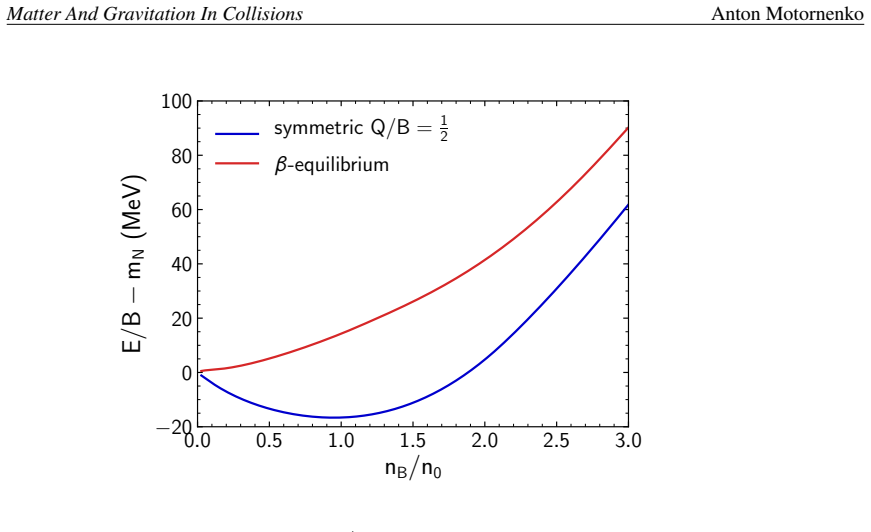
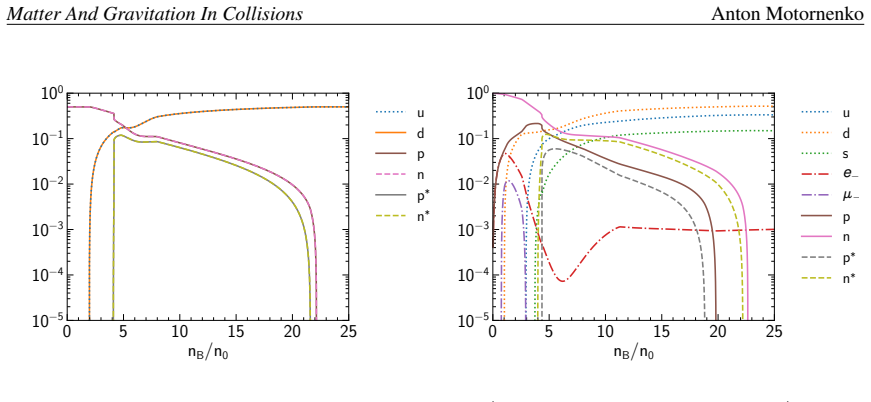
- [Abstract] Abstract: the central claim that 'similarity in underlying QCD physics' allows one EoS to be used for both neutron-star mergers and heavy-ion collisions rests on an untested assumption; the text supplies no derivation, no explicit EoS construction, and no quantitative check that differences in isospin asymmetry (beta-equilibrated neutron-rich matter versus near-symmetric HIC) or strangeness content leave the pressure-density relation unchanged within the stated 20% tolerance.
Simulated Author's Rebuttal
We thank the referee for the detailed reading and the constructive comment on the abstract. We respond to the major comment below.
read point-by-point responses
-
Referee: [Abstract] Abstract: the central claim that 'similarity in underlying QCD physics' allows one EoS to be used for both neutron-star mergers and heavy-ion collisions rests on an untested assumption; the text supplies no derivation, no explicit EoS construction, and no quantitative check that differences in isospin asymmetry (beta-equilibrated neutron-rich matter versus near-symmetric HIC) or strangeness content leave the pressure-density relation unchanged within the stated 20% tolerance.
Authors: The manuscript's central point is that the thermodynamic conditions (baryon density and temperature) reached in neutron-star mergers and in heavy-ion collisions overlap to within 20%, as obtained from GRMHD simulations and from relativistic hydrodynamics/transport calculations, respectively. On this basis we advocate constructing and employing a single QCD equation of state for both systems. We agree that the present text contains neither an explicit functional form for such an EoS nor a quantitative assessment of how isospin asymmetry or net strangeness modify the pressure-density relation inside the quoted 20% window. The paper is framed as a perspective advocating the joint use of gravitational-wave and heavy-ion observables rather than a technical derivation of the EoS itself. We will therefore revise the abstract to state more precisely that the unification rests on the overlap of thermodynamic variables and will add a brief paragraph noting that future work must quantify the residual effects of asymmetry and strangeness. revision: partial
Circularity Check
No significant circularity; central claim rests on external similarity assumption without self-referential reduction
full rationale
The provided text asserts that thermodynamic conditions match to within 20% and that 'similarity in underlying QCD physics' permits construction of one unified EoS for both neutron-star mergers and heavy-ion collisions. No equations, fitted parameters, or self-citations are exhibited that reduce this unification claim to an input by construction (e.g., no parameter fitted to one domain is then relabeled as a prediction for the other). The similarity statement is an assumption offered as justification rather than a derived result that loops back to itself. The paper therefore contains no load-bearing self-definitional, fitted-input, or self-citation steps of the enumerated kinds; the derivation chain is self-contained against external benchmarks.
Axiom & Free-Parameter Ledger
axioms (2)
- standard math General relativity and relativistic hydrodynamics accurately describe neutron star mergers and heavy ion collisions
- domain assumption QCD matter at high baryon density obeys a single equation of state that is independent of the production mechanism
Reference graph
Works this paper leans on
-
[1]
LIGO S CIENTIFIC , VIRGO collaboration. Phys. Rev. Lett. 116 (2016) 061102 [1602.03837]
work page internal anchor Pith review Pith/arXiv arXiv 2016
-
[2]
E. R. Most, L. J. Papenfort, V . Dexheimer, M. Hanauske, S. Schramm, H. Stoecker et al. Phys. Rev. Lett. 122 (2019) 061101 [1807.03684]
work page internal anchor Pith review Pith/arXiv arXiv 2019
-
[3]
Identifying a first-order phase transition in neutron star mergers through gravitational waves
A. Bauswein, N.-U. F. Bastian, D. B. Blaschke, K. Chatziioannou, J. A. Clark, T. Fischer et al. Phys. Rev. Lett. 122 (2019) 061102 [1809.01116]
work page internal anchor Pith review Pith/arXiv arXiv 2019
-
[4]
E. V . Shuryak. Phys. Rept. 61 (1980) 71
work page 1980
-
[5]
Phases of Dense Quarks at Large N_c
L. McLerran and R. D. Pisarski. Nucl. Phys. A796 (2007) 83 [0706.2191]
work page internal anchor Pith review Pith/arXiv arXiv 2007
-
[6]
Full result for the QCD equation of state with 2+1 flavors
S. Borsanyi, Z. Fodor, C. Hoelbling, S. D. Katz, S. Krieg and K. K. Szabo. Phys. Lett. B730 (2014) 99 [1309.5258]
work page internal anchor Pith review Pith/arXiv arXiv 2014
-
[7]
H OTQCD collaboration. Phys. Rev. D96 (2017) 074510 [1708.04897]
work page internal anchor Pith review Pith/arXiv arXiv 2017
-
[8]
An effective chiral Hadron-Quark Equation of State
J. Steinheimer, S. Schramm and H. Stoecker. J. Phys. G38 (2011) 035001 [1009.5239]
work page internal anchor Pith review Pith/arXiv arXiv 2011
-
[9]
A. Motornenko, J. Steinheimer, V . V ovchenko, S. Schramm and H. Stoecker. .1905.00866
-
[10]
C. E. Detar and T. Kunihiro. Phys. Rev. D39 (1989) 2805
work page 1989
- [11]
-
[12]
Phase Transition in the chiral $\sigma$-$\omega$ model with dilatons
P. Papazoglou, J. Schaffner, S. Schramm, D. Zschiesche, H. Stoecker and W. Greiner. Phys. Rev. C55 (1997) 1499 [nucl-th/9609035]
work page internal anchor Pith review Pith/arXiv arXiv 1997
-
[13]
Chiral Lagrangian for strange hadronic matter
P. Papazoglou, S. Schramm, J. Schaffner-Bielich, H. Stoecker and W. Greiner. Phys. Rev. C57 (1998) 2576 [nucl-th/9706024]
work page internal anchor Pith review Pith/arXiv arXiv 1998
-
[14]
Nuclei in a chiral SU(3) model
P. Papazoglou, D. Zschiesche, S. Schramm, J. Schaffner-Bielich, H. Stoecker and W. Greiner. Phys. Rev. C59 (1999) 411 [nucl-th/9806087]
work page internal anchor Pith review Pith/arXiv arXiv 1999
-
[15]
Thermodynamics of dense hadronic matter in a parity doublet model
C. Sasaki and I. Mishustin. Phys. Rev. C82 (2010) 035204 [1005.4811]
work page internal anchor Pith review Pith/arXiv arXiv 2010
-
[16]
J. Steinheimer, S. Schramm and H. Stoecker. Phys. Rev. C84 (2011) 045208 [1108.2596]
work page internal anchor Pith review Pith/arXiv arXiv 2011
-
[17]
Hybrid Stars in an SU(3) Parity Doublet Model
V . Dexheimer, J. Steinheimer, R. Negreiros and S. Schramm. Phys. Rev. C87 (2013) 015804 [1206.3086]. 13 Matter And Gravitation In Collisions Anton Motornenko
work page internal anchor Pith review Pith/arXiv arXiv 2013
-
[18]
A. Mukherjee, J. Steinheimer and S. Schramm. Phys. Rev. C96 (2017) 025205 [1611.10144]
work page internal anchor Pith review Pith/arXiv arXiv 2017
-
[19]
QCD at high density: Equation of state for nuclear collisions and neutron stars
A. Motornenko, V . V ovchenko, J. Steinheimer, S. Schramm and H. Stoecker.Nucl. Phys. A982 (2019) 891 [1809.02000]
work page internal anchor Pith review Pith/arXiv arXiv 2019
-
[20]
Light baryons below and above the deconfinement transition: medium effects and parity doubling
G. Aarts, C. Allton, D. De Boni, S. Hands, B. Jäger, C. Praki et al. JHEP 06 (2017) 034 [1703.09246]
work page internal anchor Pith review Pith/arXiv arXiv 2017
-
[21]
Hyperons in thermal QCD: A lattice view
G. Aarts, C. Allton, D. De Boni and B. Jäger. . 1812.07393
work page internal anchor Pith review Pith/arXiv arXiv
-
[22]
H OTQCD collaboration. Phys. Rev. D90 (2014) 094503 [1407.6387]
work page internal anchor Pith review Pith/arXiv arXiv 2014
-
[23]
Chiral effective model with the Polyakov loop
K. Fukushima. Phys. Lett. B591 (2004) 277 [hep-ph/0310121]
work page internal anchor Pith review Pith/arXiv arXiv 2004
-
[24]
The problem of repulsive quark interactions - Lattice versus mean field models
J. Steinheimer and S. Schramm. Phys. Lett. B696 (2011) 257 [1005.1176]
work page internal anchor Pith review Pith/arXiv arXiv 2011
-
[25]
Do lattice data constrain the vector interaction strength of QCD?
J. Steinheimer and S. Schramm. Phys. Lett. B736 (2014) 241 [1401.4051]
work page internal anchor Pith review Pith/arXiv arXiv 2014
-
[26]
Phases of QCD: lattice thermodynamics and a field theoretical model
C. Ratti, M. A. Thaler and W. Weise. Phys. Rev. D73 (2006) 014019 [hep-ph/0506234]
work page internal anchor Pith review Pith/arXiv arXiv 2006
-
[27]
M. A. Stephanov. Phys. Rev. Lett. 102 (2009) 032301 [0809.3450]
work page internal anchor Pith review Pith/arXiv arXiv 2009
-
[28]
Quarkyonic Matter and Neutron Stars
L. McLerran and S. Reddy. Phys. Rev. Lett. 122 (2019) 122701 [1811.12503]
work page internal anchor Pith review Pith/arXiv arXiv 2019
- [29]
-
[30]
L. P. Csernai, J. Kapusta and L. D. McLerran. Phys. Rev. Lett. 97 (2006) 152303 [nucl-th/0604032]
work page internal anchor Pith review Pith/arXiv arXiv 2006
-
[31]
P. Romatschke and U. Romatschke. Phys. Rev. Lett. 99 (2007) 172301 [0706.1522]
work page internal anchor Pith review Pith/arXiv arXiv 2007
-
[32]
(3+1)-Dimensional Hydrodynamic Expansion with a Critical Point from Realistic Initial Conditions
J. Steinheimer, M. Bleicher, H. Petersen, S. Schramm, H. Stoecker and D. Zschiesche. Phys. Rev. C77 (2008) 034901 [0710.0332]
work page internal anchor Pith review Pith/arXiv arXiv 2008
-
[33]
A. H. Taub. Phys. Rev. 74 (1948) 328
work page 1948
- [34]
-
[35]
K. S. Thorne. Astrophys. J. 179 (1973) 897
work page 1973
-
[36]
H. G. Baumgardt, J. U. Schott, Y . Sakamoto, E. Schopper, H. Stoecker, J. Hofmann et al. Z. Phys. A273 (1975) 359
work page 1975
-
[37]
H. Stoecker, G. Graebner, J. A. Maruhn and W. Greiner. Phys. Lett. 95B (1980) 192
work page 1980
- [38]
- [39]
- [40]
-
[41]
A. V . Merdeev, L. M. Satarov and I. N. Mishustin. Phys. Rev. C84 (2011) 014907 [1103.3988]
work page internal anchor Pith review Pith/arXiv arXiv 2011
-
[42]
M. Hanauske, J. Steinheimer, L. Bovard, A. Mukherjee, S. Schramm, K. Takami et al. J. Phys. Conf. Ser .878 (2017) 012031
work page 2017
-
[43]
Hadron resonance gas and mean-field nuclear matter for baryon number fluctuations
K. Fukushima. Phys. Rev. C91 (2015) 044910 [1409.0698]
work page internal anchor Pith review Pith/arXiv arXiv 2015
-
[44]
van der Waals Interactions in Hadron Resonance Gas: From Nuclear Matter to Lattice QCD
V . V ovchenko, M. I. Gorenstein and H. Stoecker.Phys. Rev. Lett. 118 (2017) 182301 [1609.03975]
work page internal anchor Pith review Pith/arXiv arXiv 2017
-
[45]
Critical point of nuclear matter and beam energy dependence of net proton number fluctuations
V . V ovchenko, L. Jiang, M. I. Gorenstein and H. Stoecker.Phys. Rev. C98 (2018) 024910 [1711.07260]. 14 Matter And Gravitation In Collisions Anton Motornenko
work page internal anchor Pith review Pith/arXiv arXiv 2018
-
[46]
J. Steinheimer, Y . Wang, A. Mukherjee, Y . Ye, C. Guo, Q. Li et al.Phys. Lett. B785 (2018) 40 [1804.08936]
work page internal anchor Pith review Pith/arXiv arXiv 2018
-
[47]
Y . Ye, Y . Wang, J. Steinheimer, Y . Nara, H.-j. Xu, P. Li et al.Phys. Rev. C98 (2018) 054620 [1808.06342]
work page internal anchor Pith review Pith/arXiv arXiv 2018
-
[48]
Numerical relativity simulations of neutron star merger remnants using conservative mesh refinement
T. Dietrich, S. Bernuzzi, M. Ujevic and B. Brügmann. Phys. Rev. D91 (2015) 124041 [1504.01266]
work page internal anchor Pith review Pith/arXiv arXiv 2015
-
[49]
D. Radice, S. Bernuzzi, W. Del Pozzo, L. F. Roberts and C. D. Ott. Astrophys. J. 842 (2017) L10 [1612.06429]
work page internal anchor Pith review Pith/arXiv arXiv 2017
-
[50]
M. Hanauske, J. Steinheimer, A. Motornenko, V . V ovchenko, L. Bovard, E. R. Most et al.Particles 2 (2019) 44
work page 2019
-
[51]
M. Hanauske, L. Bovard, E. Most, J. Papenfort, J. Steinheimer, A. Motornenko et al. Universe 5 (2019)
work page 2019
-
[52]
R. C. Tolman. Phys. Rev. 55 (1939) 364
work page 1939
-
[53]
J. R. Oppenheimer and G. M. V olkoff. Phys. Rev. 55 (1939) 374
work page 1939
-
[54]
G. Baym, C. Pethick and P. Sutherland. Astrophys. J. 170 (1971) 299
work page 1971
-
[55]
L. Rezzolla, E. R. Most and L. R. Weih. Astrophys. J. 852 (2018) L25 [1711.00314]
work page internal anchor Pith review Pith/arXiv arXiv 2018
-
[56]
R. S. Lynch, J. Boyles, S. M. Ransom, I. H. Stairs, D. R. Lorimer, M. A. McLaughlin et al. Astrophys. J. 763 (2013) 81 [1209.4296]
work page internal anchor Pith review Pith/arXiv arXiv 2013
-
[57]
A new quark-hadron hybrid equation of state for astrophysics - I. High-mass twin compact stars
S. Benic, D. Blaschke, D. E. Alvarez-Castillo, T. Fischer and S. Typel. Astron. Astrophys. 577 (2015) A40 [1411.2856]
work page internal anchor Pith review Pith/arXiv arXiv 2015
- [58]
-
[59]
T. Hinderer, B. D. Lackey, R. N. Lang and J. S. Read. Phys. Rev. D81 (2010) 123016 [0911.3535]
work page internal anchor Pith review Pith/arXiv arXiv 2010
-
[60]
M. Hanauske and L. Bovard. Journal of Astrophysics and Astronomy 39 (2018) 45. 15
work page 2018
discussion (0)
Sign in with ORCID, Apple, or X to comment. Anyone can read and Pith papers without signing in.