Strangeness neutrality and the QCD phase diagram
Pith reviewed 2026-05-24 19:41 UTC · model grok-4.3
The pith
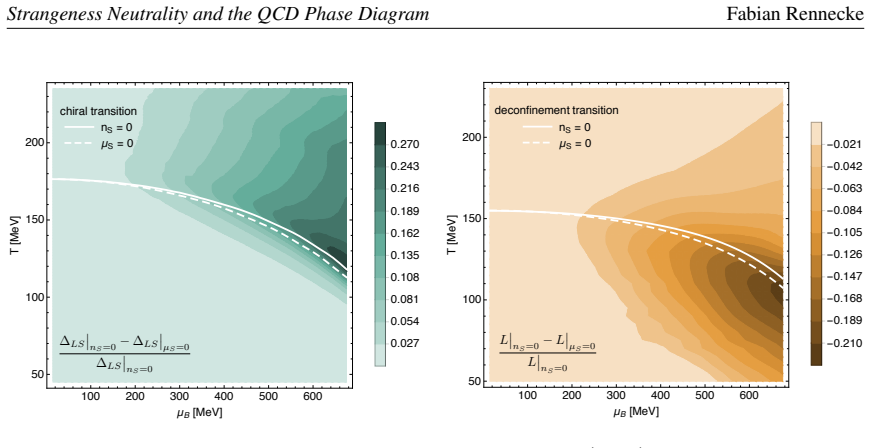
Strangeness neutrality required in heavy-ion collisions is intimately linked to baryon-strangeness correlations through quark number conservation.
A machine-rendered reading of the paper's core claim, the machinery that carries it, and where it could break.
Core claim
There is an intimate relation between strangeness neutrality and baryon-strangeness correlations. In the context of heavy-ion collisions the former is a consequence of quark number conservation of the strong interactions while the latter are sensitive probes of the character of QCD matter. The authors investigate the sensitivity of baryon-strangeness correlations on the freeze-out conditions by studying their dependence on temperature, baryon- and strangeness chemical potential and discuss the impact of strangeness neutrality on the QCD equation of state at finite chemical potentials.
What carries the argument
Polyakov-loop enhanced quark-meson model with 2+1 dynamical flavors treated with the functional renormalization group, which incorporates non-perturbative quantum fluctuations of hadrons.
If this is right
- Baryon-strangeness correlations depend on temperature, baryon chemical potential and strangeness chemical potential.
- Strangeness neutrality modifies the QCD equation of state at finite chemical potentials.
- These correlations can serve as diagnostics of freeze-out conditions in heavy-ion collisions.
- The relation between neutrality and correlations holds because both originate in quark number conservation.
Where Pith is reading between the lines
- Enforcing strangeness neutrality may shift the apparent location of phase boundaries when mapping heavy-ion data onto the QCD phase diagram.
- The same conservation argument could be applied to other conserved charges such as electric charge to derive additional correlation constraints.
- If the model holds, it suggests that ignoring neutrality in thermodynamic calculations at finite density would produce inconsistent predictions for fluctuation observables.
Load-bearing premise
The Polyakov-loop enhanced quark-meson model with functional renormalization group supplies a sufficiently accurate description of low-energy QCD at finite baryon and strangeness chemical potentials.
What would settle it
A lattice QCD or heavy-ion collision measurement in which baryon-strangeness correlations remain unchanged when the strangeness chemical potential is adjusted to enforce neutrality would contradict the claimed intimate relation.
Figures



read the original abstract
Since the incident nuclei in heavy-ion collisions do not carry strangeness, the global net strangeness of the detected hadrons has to vanish. We show that there is an intimate relation between strangeness neutrality and baryon-strangeness correlations. In the context of heavy-ion collisions, the former is a consequence of quark number conservation of the strong interactions while the latter are sensitive probes of the character of QCD matter. We investigate the sensitivity of baryon-strangeness correlations on the freeze-out conditions of heavy-ion collisions by studying their dependence on temperature, baryon- and strangeness chemical potential. The impact of strangeness neutrality on the QCD equation of state at finite chemical potentials will also be discussed. We model the low-energy sector of QCD by an effective Polyakov loop enhanced quark-meson model with 2+1 dynamical quark flavors and use the functional renormalization group to account for the non-perturbative quantum fluctuations of hadrons.
Editorial analysis
A structured set of objections, weighed in public.
Referee Report
Summary. The paper claims an intimate relation between strangeness neutrality (net S=0, enforced by quark-number conservation in heavy-ion collisions) and baryon-strangeness correlations χ_BS, which are presented as sensitive probes of the character of QCD matter. Within a Polyakov-loop enhanced quark-meson model with 2+1 dynamical flavors treated by the functional renormalization group, the authors study the dependence of these correlations on temperature and chemical potentials, their sensitivity to freeze-out conditions, and the impact of the neutrality constraint on the equation of state.
Significance. If the effective-model results map reliably to real QCD, the work would supply a concrete link between a conservation-law constraint and thermodynamic correlators that could aid interpretation of heavy-ion data. The FRG treatment of fluctuations within the model is a methodological strength. The significance remains conditional on the untested accuracy of the PQM+FRG truncation at finite μ_B and μ_S.
major comments (2)
- [Abstract] Abstract and final paragraph: the assertion that χ_BS correlations are 'sensitive probes of the character of QCD matter' is load-bearing for the paper's interpretive claim, yet rests on an effective Lagrangian whose parameters are fixed exclusively to vacuum observables and on an FRG truncation whose systematic errors are not quantified or benchmarked against lattice QCD at finite baryon or strangeness density.
- [Results] Results section (dependence on T, μ_B, μ_S): the reported correlation between the neutrality constraint and χ_BS is obtained by solving the model flow equations under net S=0; while this is not a tautology, the quantitative sensitivity statements and EoS impact cannot be assessed for robustness without estimates of truncation or parameter variation effects.
minor comments (2)
- [Notation] Notation for the susceptibilities χ_BS and related derivatives should be defined explicitly with the relevant thermodynamic potential or pressure derivatives in an early section.
- [Figures] Figure captions should state the precise values of μ_B and μ_S (or the neutrality condition) used in each panel to improve readability.
Simulated Author's Rebuttal
We thank the referee for the careful reading and constructive comments. We address the major comments point by point below, indicating where revisions will be incorporated.
read point-by-point responses
-
Referee: [Abstract] Abstract and final paragraph: the assertion that χ_BS correlations are 'sensitive probes of the character of QCD matter' is load-bearing for the paper's interpretive claim, yet rests on an effective Lagrangian whose parameters are fixed exclusively to vacuum observables and on an FRG truncation whose systematic errors are not quantified or benchmarked against lattice QCD at finite baryon or strangeness density.
Authors: We agree that the interpretive claim requires qualification. The model parameters are fixed exclusively to vacuum observables and no direct lattice benchmarks exist at finite μ_B or μ_S owing to the sign problem. The demonstrated relation between strangeness neutrality and χ_BS follows directly from enforcing net S=0 together with the model's quark content and conservation laws. We will revise the abstract and final paragraph to state that the sensitivity is observed within the PQM+FRG framework and add an explicit discussion of these limitations. revision: yes
-
Referee: [Results] Results section (dependence on T, μ_B, μ_S): the reported correlation between the neutrality constraint and χ_BS is obtained by solving the model flow equations under net S=0; while this is not a tautology, the quantitative sensitivity statements and EoS impact cannot be assessed for robustness without estimates of truncation or parameter variation effects.
Authors: We concur that quantitative robustness statements would be strengthened by such estimates. Full truncation-error quantification is not feasible within the present FRG setup without further approximations. We will add a paragraph examining the dependence on a subset of model parameters (meson masses and Yukawa couplings) and confirm that the qualitative correlation between neutrality and χ_BS persists under these variations, thereby providing a partial robustness check. revision: partial
- Full systematic error quantification and benchmarking of the PQM+FRG truncation against lattice QCD at finite baryon and strangeness chemical potentials.
Circularity Check
No significant circularity: relation derived from model dynamics under conservation constraint
full rationale
The paper enforces net strangeness neutrality (S=0) as a direct consequence of quark-number conservation in the 2+1 flavor PQM model and then computes baryon-strangeness correlations χ_BS by solving the FRG flow equations. Model parameters are fixed upstream to vacuum observables, so the exhibited relation is an output of the model's dynamics rather than a fit or redefinition of the input. No self-definitional steps, fitted inputs renamed as predictions, or load-bearing self-citations appear in the derivation chain. The central claim remains independent of the target observables.
Axiom & Free-Parameter Ledger
free parameters (2)
- quark-meson model couplings and masses
- Polyakov loop potential parameters
axioms (2)
- domain assumption The functional renormalization group flow equations with the chosen truncation capture the dominant non-perturbative fluctuations of the model at finite chemical potentials.
- domain assumption The 2+1 flavor Polyakov-quark-meson model is an adequate effective description of the low-energy sector of QCD.
Lean theorems connected to this paper
-
IndisputableMonolith/Foundation/RealityFromDistinction.leanreality_from_one_distinction unclear?
unclearRelation between the paper passage and the cited Recognition theorem.
strangeness neutrality condition ⟨S⟩=0 ... χ_S1(T,μ_B,μ_S0)=0 ... ∂μ_S0/∂μ_B = (1/3) C_BS
What do these tags mean?
- matches
- The paper's claim is directly supported by a theorem in the formal canon.
- supports
- The theorem supports part of the paper's argument, but the paper may add assumptions or extra steps.
- extends
- The paper goes beyond the formal theorem; the theorem is a base layer rather than the whole result.
- uses
- The paper appears to rely on the theorem as machinery.
- contradicts
- The paper's claim conflicts with a theorem or certificate in the canon.
- unclear
- Pith found a possible connection, but the passage is too broad, indirect, or ambiguous to say the theorem truly supports the claim.
Reference graph
Works this paper leans on
-
[1]
NA49 collaboration, Study of hadron production in hadron-nucleus and nucleus-nucleus collisions at the cern sps, Tech. Rep. SPSC-P-330. CERN-SPSC-2006-034, CERN, Geneva, Nov, 2006
work page 2006
-
[2]
STAR collaboration Star Note 598: Studying the Phase Diagram of QCD Matter at RHIC (2014)
work page 2014
- [3]
-
[4]
V . D. Kekelidze, R. Lednicky, V . A. Matveev, I. N. Meshkov, A. S. Sorin and G. V . Trubnikov,Three stages of the NICA accelerator complex, Eur. Phys. J. A52 (2016) 211
work page 2016
-
[5]
Galatyuk, Hades overview, Nuclear Physics A 931 (2014) 41
T. Galatyuk, Hades overview, Nuclear Physics A 931 (2014) 41
work page 2014
-
[6]
Sako et al., Towards the heavy-ion program at J-PARC, Nucl
H. Sako et al., Towards the heavy-ion program at J-PARC, Nucl. Phys. A931 (2014) 1158
work page 2014
-
[7]
Y . Aoki, G. Endrodi, Z. Fodor, S. D. Katz and K. K. Szabo,The order of the quantum chromodynamics transition predicted by the standard model of particle physics, Nature 443 (2006) 675 [hep-lat/0611014]
work page internal anchor Pith review Pith/arXiv arXiv 2006
-
[8]
The QCD phase diagram from analytic continuation
R. Bellwied, S. Borsanyi, Z. Fodor, J. Günther, S. D. Katz, C. Ratti et al., The QCD phase diagram from analytic continuation, Phys. Lett. B751 (2015) 559 [1507.07510]
work page internal anchor Pith review Pith/arXiv arXiv 2015
-
[9]
Bazavov et al., Chiral crossover in QCD at zero and non-zero chemical potentials, 1812.08235
A. Bazavov et al., Chiral crossover in QCD at zero and non-zero chemical potentials, 1812.08235
-
[10]
M. A. Stephanov, QCD phase diagram: An Overview, PoS LA T2006(2006) 024 [hep-lat/0701002]
work page internal anchor Pith review Pith/arXiv arXiv 2006
-
[11]
M. A. Stephanov, K. Rajagopal and E. V . Shuryak,Event-by-event fluctuations in heavy ion collisions and the QCD critical point, Phys. Rev. D60 (1999) 114028 [hep-ph/9903292]
work page internal anchor Pith review Pith/arXiv arXiv 1999
-
[12]
M. A. Stephanov, Non-Gaussian fluctuations near the QCD critical point, Phys. Rev. Lett. 102 (2009) 032301 [0809.3450]
work page internal anchor Pith review Pith/arXiv arXiv 2009
-
[13]
Particle Production in Heavy Ion Collisions
P. Braun-Munzinger, K. Redlich and J. Stachel, Particle production in heavy ion collisions, nucl-th/0304013
work page internal anchor Pith review Pith/arXiv arXiv
-
[14]
STAR collaboration, Bulk Properties of the Medium Produced in Relativistic Heavy-Ion Collisions from the Beam Energy Scan Program, Phys. Rev. C96 (2017) 044904 [1701.07065]
work page internal anchor Pith review Pith/arXiv arXiv 2017
-
[15]
Freeze-out Conditions in Heavy Ion Collisions from QCD Thermodynamics
A. Bazavov et al., Freeze-out Conditions in Heavy Ion Collisions from QCD Thermodynamics, Phys. Rev. Lett. 109 (2012) 192302 [1208.1220]
work page internal anchor Pith review Pith/arXiv arXiv 2012
- [16]
- [17]
-
[18]
V . Koch, A. Majumder and J. Randrup, Baryon-strangeness correlations: A Diagnostic of strongly interacting matter, Phys. Rev. Lett. 95 (2005) 182301 [nucl-th/0505052]. 13 Strangeness Neutrality and the QCD Phase Diagram Fabian Rennecke
work page internal anchor Pith review Pith/arXiv arXiv 2005
-
[19]
Freeze-out parameters: lattice meets experiment
S. Borsanyi, Z. Fodor, S. D. Katz, S. Krieg, C. Ratti and K. K. Szabo, Freeze-out parameters: lattice meets experiment, Phys. Rev. Lett. 111 (2013) 062005 [1305.5161]
work page internal anchor Pith review Pith/arXiv arXiv 2013
-
[20]
H OTQCD collaboration, Skewness and kurtosis of net baryon-number distributions at small values of the baryon chemical potential, Phys. Rev. D96 (2017) 074510 [1708.04897]
work page internal anchor Pith review Pith/arXiv arXiv 2017
-
[21]
Fluctuation-induced modifications of the phase structure in (2+1)-flavor QCD
F. Rennecke and B.-J. Schaefer, Fluctuation-induced modifications of the phase structure in (2+1)-flavor QCD, Phys. Rev. D96 (2017) 016009 [1610.08748]
work page internal anchor Pith review Pith/arXiv arXiv 2017
-
[22]
J. B. Kogut and D. Toublan, QCD at small nonzero quark chemical potentials, Phys. Rev. D64 (2001) 034007 [hep-ph/0103271]
work page internal anchor Pith review Pith/arXiv arXiv 2001
-
[23]
’t Hooft, Symmetry breaking through bell-jackiw anomalies, Phys
G. ’t Hooft, Symmetry breaking through bell-jackiw anomalies, Phys. Rev. Lett. 37 (1976) 8
work page 1976
-
[24]
’t Hooft, Computation of the quantum effects due to a four-dimensional pseudoparticle, Phys
G. ’t Hooft, Computation of the quantum effects due to a four-dimensional pseudoparticle, Phys. Rev. D14 (1976) 3432
work page 1976
-
[25]
Polyakov loop modeling for hot QCD
K. Fukushima and V . Skokov,Polyakov loop modeling for hot QCD, Prog. Part. Nucl. Phys.96 (2017) 154 [1705.00718]
work page internal anchor Pith review Pith/arXiv arXiv 2017
-
[26]
P. M. Lo, B. Friman, O. Kaczmarek, K. Redlich and C. Sasaki, Polyakov loop fluctuations in SU(3) lattice gauge theory and an effective gluon potential, Phys. Rev. D88 (2013) 074502 [1307.5958]
work page internal anchor Pith review Pith/arXiv arXiv 2013
-
[27]
W.-j. Fu, J. M. Pawlowski, F. Rennecke and B.-J. Schaefer, Baryon number fluctuations at finite temperature and density, Phys. Rev. D94 (2016) 116020 [1608.04302]
work page internal anchor Pith review Pith/arXiv arXiv 2016
-
[28]
On the relevance of matter and glue dynamics for baryon number fluctuations
W.-j. Fu and J. M. Pawlowski, Relevance of matter and glue dynamics for baryon number fluctuations, Phys. Rev. D92 (2015) 116006 [1508.06504]
work page internal anchor Pith review Pith/arXiv arXiv 2015
-
[29]
Wetterich, Exact evolution equation for the effective potential, Phys.Lett
C. Wetterich, Exact evolution equation for the effective potential, Phys.Lett. B301 (1993) 90
work page 1993
-
[30]
Non-Perturbative Renormalization Flow in Quantum Field Theory and Statistical Physics
J. Berges, N. Tetradis and C. Wetterich, Non-perturbative renormalization flow in quantum field theory and statistical physics, Phys. Rept. 363 (2002) 223 [hep-ph/0005122]
work page internal anchor Pith review Pith/arXiv arXiv 2002
-
[31]
J. M. Pawlowski, Aspects of the functional renormalisation group, Annals Phys. 322 (2007) 2831 [hep-th/0512261]
work page internal anchor Pith review Pith/arXiv arXiv 2007
-
[32]
Introduction to the functional RG and applications to gauge theories
H. Gies, Introduction to the functional rg and applications to gauge theories, Lect.Notes Phys. 852 (2012) 287 [hep-ph/0611146]
work page internal anchor Pith review Pith/arXiv arXiv 2012
-
[33]
Fermion Interactions and Universal Behavior in Strongly Interacting Theories
J. Braun, Fermion interactions and universal behavior in strongly interacting theories, J.Phys. G39 (2012) 033001 [1108.4449]
work page internal anchor Pith review Pith/arXiv arXiv 2012
-
[34]
H OTQCD collaboration, Fluctuations and Correlations of net baryon number, electric charge, and strangeness: A comparison of lattice QCD results with the hadron resonance gas model, Phys. Rev. D86 (2012) 034509 [1203.0784]
work page internal anchor Pith review Pith/arXiv arXiv 2012
-
[35]
Isentropic thermodynamics in the PNJL model
K. Fukushima, Isentropic thermodynamics in the PNJL model, Phys. Rev. D79 (2009) 074015 [0901.0783]
work page internal anchor Pith review Pith/arXiv arXiv 2009
-
[36]
J. M. Pawlowski and F. Rennecke, Higher order quark-mesonic scattering processes and the phase structure of QCD, Phys. Rev. D90 (2014) 076002 [1403.1179]
work page internal anchor Pith review Pith/arXiv arXiv 2014
-
[37]
C. Gale, S. Jeon and B. Schenke, Hydrodynamic Modeling of Heavy-Ion Collisions, Int. J. Mod. Phys. A28 (2013) 1340011 [1301.5893]
work page internal anchor Pith review Pith/arXiv arXiv 2013
-
[38]
V . Skokov, B. Friman and K. Redlich,Quark number fluctuations in the polyakov loop-extended quark-meson model at finite baryon density, Phys.Rev. C83 (2011) 054904 [1008.4570]
work page internal anchor Pith review Pith/arXiv arXiv 2011
-
[39]
T. D. Cohen, Functional integrals for qcd at nonzero chemical potential and zero density, Phys.Rev.Lett. 91 (2003) 222001 [hep-ph/0307089]. 14
work page internal anchor Pith review Pith/arXiv arXiv 2003
discussion (0)
Sign in with ORCID, Apple, or X to comment. Anyone can read and Pith papers without signing in.