REVIEW 3 major objections 3 minor 63 references
Divining the Shape of Nascent Polymer Crystal Nuclei
T0 review · 3 major / 3 minor · reviewed 2026-08-14 · deepseek-v4-flash
Pith's one-line read Polymer crystal nuclei are anisotropic blobs, not spheres or cylinders, and high-symmetry shapes are thermodynamically unfavorable.
desk verdict Large, careful MD study that probably establishes anisotropic polymer nuclei, but the central free-energy claim depends on analysis details in the missing SI and an untested quasi-equilibrium assumption. read the letter →
The pith
A machine-rendered reading of the paper's core claim, the machinery that carries it, and where it could break.
The reading
What carries the argument
The central object is the radius of gyration tensor of each extracted crystalline cluster, whose eigenvalues give squared semi-axis lengths and whose eigenvectors give the principal axes. From this come three dimensionless shape metrics: relative asphericity $b_{\rm rel}$ (zero for spheres), relative acylindricity $c_{\rm rel}$ (zero for cylinders), and relative shape anisotropy $\kappa^2$ (zero for spheres, one for a perfectly aligned rod). These metrics are computed for clusters of every size and converted into relative free energies $G = -k_B T \ln P$, making shape preferences quantitative. Cluster identity itself comes from a local chain-segment alignment criterion followed by cluster analysis, applied to ten about four-microsecond simulations of an entangled polyethylene melt with a coarse-grained model; over four million clusters are used in the statistics.
What would settle it
Check the shape statistics under a different but equally plausible crystallinity detector, such as local bond-orientational order parameters or a substantially different alignment cutoff; if the major/median/minor eigenvalue ratios and the free-energy minima in $\kappa^2$, $b_{\rm rel}$, and $c_{\rm rel}$ shift to spherical or cylindrical values, the central claim would be disproved. A second check is to compute the same metrics on equilibrated liquid clusters of the same size; if those show identical anisotropy, the signal is not specific to crystalline nuclei.
Extended reading notes
Core claim
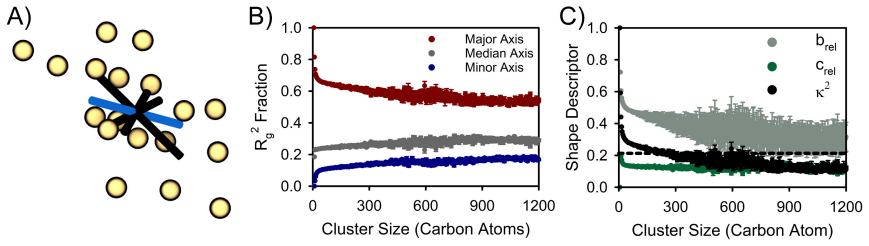
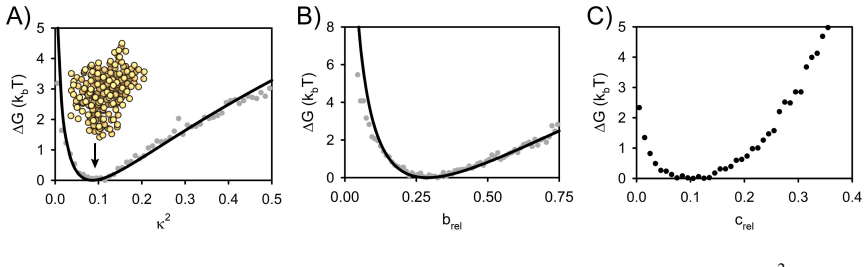
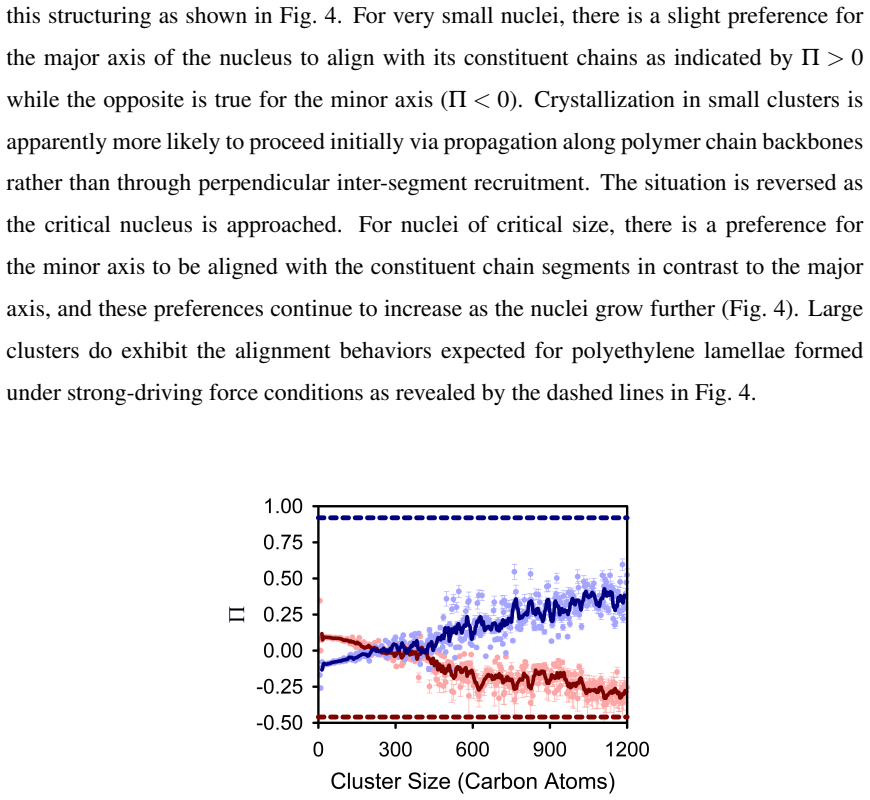
The paper's central claim is that the shape of a nascent polymer crystal nucleus is an anisotropic blob. In the vicinity of the critical nucleus (about 600 carbon atoms for the conditions studied), the three principal axes of the radius of gyration tensor make distinct contributions, so spherical and cylindrical geometries are excluded. Free-energy profiles in the shape parameters $\kappa^2$, $b_{\rm rel}$, and $c_{\rm rel}$ show that spherical ($b_{\rm rel}=0$), cylindrical ($c_{\rm rel}=0$), and other high-symmetry configurations are thermodynamically unfavorable, not metastable. Nuclei are also rough, with fractal dimension $D_f = 2.60 \pm 0.13$ at the critical size. The paper further shows that the direction of the nucleus's minor axis aligns with the constituent chain stems only as clusters approach and exceed the critical size, and that early nuclei have very few folds; fold surfaces and lamellar structure develop after the critical stage.
Load-bearing premise
The whole shape analysis rests on the cluster-detection rule: crystalline clusters are defined by a local chain-segment alignment threshold followed by cluster analysis, and if that rule preferentially carves out elongated or compact clusters, the measured anisotropy is an artifact of the definition rather than a property of the nuclei.
Editorial extensions
If this is right
- Treating near-critical nuclei as spheres understates the nucleus surface area by about 6% (and by more than 10% for smaller precritical clusters), which overstates the crystal-liquid interfacial free energy by a similar amount and, through the $\gamma^3$ dependence in classical nucleation theory, raises the nucleation barrier by roughly 20-33%.
- Nucleation-rate predictions based on spherical or cylindrical embryos can be off by orders of magnitude, so quantitative polymer crystallization models should use shape-dependent surface energies.
- Lamellar morphology is not a scaled-up version of the nucleus: fold surfaces and stem-aligned axes appear only after clusters pass the critical size, so growth-stage interfacial data should not be projected onto nucleation.
- Because shape preference is thermodynamic, additives or flow that alter interfacial anisotropy should change nucleus shape before the critical size, offering a lever on nucleation kinetics.
Reading between the lines
- A natural extension would be to test whether the same anisotropic-blob statistics emerge from atomistic models or from coarse-grained models with different chain stiffness; if the shape is robust across models, it points to a generic interfacial free-energy anisotropy rather than a quirk of the particular force field.
- The finding that shape preference is thermodynamic suggests a testable design rule for nucleating agents: additives that bind preferentially to one type of nucleus surface should bias the nucleus aspect ratio before the critical size, which could be detected in simulations by comparing shape distributions with and without the additive.
- If the post-critical transition to lamellae is a genuine restructuring, then the effective nucleation rate is not set solely by the critical cluster but by the competition between cluster growth and shape relaxation; a kinetic theory of nucleation may need an additional shape coordinate.
Signed reviews
Editorial analysis
A structured set of objections, weighed in public.
Referee Report
Summary. The manuscript reports molecular dynamics simulations of entangled polyethylene melts quenched to 285 K, from which over four million crystalline clusters were extracted. Using radius-of-gyration tensors and shape metrics (relative asphericity, relative acylindricity, and relative shape anisotropy), the authors find that nascent polymer nuclei are anisotropic blobs, neither spherical nor cylindrical, and that spherical, cylindrical, and higher-symmetry shapes are thermodynamically unfavorable according to free-energy profiles constructed from cluster populations. The paper also reports that nuclei are rough with fractal character, exhibit few folds, and that the alignment of principal axes with chain stems changes with cluster size. The authors conclude that lamellar structure develops only post-critically and that current nucleation models assuming spherical or cylindrical nuclei may incur order-of-magnitude errors in nucleation rates.
Significance. If the central claim holds, it directly challenges widespread assumptions in polymer nucleation theory (cylindrical or spherical nuclei) and has practical implications for estimating interfacial free energies and nucleation rates. A strength of the paper is its very large dataset (over four million clusters) and the use of standard, well-defined shape metrics. The analysis is a direct measurement rather than a parameterized model, which makes the conclusions transparent and falsifiable. However, the entire result rests on the crystalline-cluster detection algorithm, which is only described in a supplementary section that was not available for review, and on the interpretation of cluster-population histograms as free-energy profiles. These issues are central to the paper's load-bearing claims.
major comments (3)
- [Results and Discussion, SI Subsection B] The cluster detection algorithm is not described in the main text and the SI was not included with the manuscript. The shape statistics in Figure 2 and the free-energy profiles in Figure 3 are properties of clusters defined by 'assessing the local alignment between polymer chain segments, and then performing cluster analysis.' If the alignment criterion and clustering rule inherently favor chain-like or elongated aggregates (e.g., if a bead must be aligned with at least one neighbor to be counted, then any connected cluster of aligned beads will tend to be extended along the chain direction), the reported anisotropy and the minima in the free-energy profiles could be artifacts of the cluster definition. The authors should provide the full algorithm and demonstrate robustness of the shape results to reasonable variations of the alignment threshold and clustering parameters. Without this, the central claim is not independently checkable.
- [Figure 3 and surrounding text] The free-energy profiles are constructed from cluster-population histograms via G = -kT ln P(x). This assumes the observed clusters represent an equilibrium distribution. However, the system is at 285 K, well below the melting point, and the authors state that crystallization is an activated, stochastic process that did not occur in all simulations. Under strong driving force, the populations of transient, growing or shrinking clusters may reflect kinetic pathway sampling rather than a thermodynamic free-energy surface. The authors should justify the quasi-equilibrium assumption, for example by checking time-independence of the profiles or by comparing with umbrella-sampling or committor-based free-energy calculations. This is load-bearing because the abstract's claim that spherical, cylindrical, and high-symmetry geometries are 'thermodynamically unfavorable' rests on these profiles.
- [Figure 3 caption] The probability distributions used to construct the free-energy profiles pool clusters of sizes ranging from 300 to 900 carbon atoms. Since the shape metrics vary systematically with cluster size (Figure 2C), this pooling mixes size-dependent shape preferences with the shape preference at a given size. The authors should verify that the free-energy minima and barrier heights are unchanged when a narrower size window around the critical nucleus (e.g., 500-700 carbon atoms) is used. If the profiles shift substantially, the conclusion that high-symmetry shapes are unfavorable 'in the vicinity of the critical nucleus' needs qualification.
minor comments (3)
- [Figure 2C text] The text contains a typographical error: 'anistropy' should be 'anisotropy' in the sentence 'clusters exhibit decreasing anistropy as nucleation proceeds.'
- [References] Reference 2 begins with 'Ref. 1. presents compiled data...' which is an unusual formatting choice; the reference should be formatted consistently with the other entries.
- [Introduction, Figure 1] The text refers to 'Fig. 1A-B' but the caption describes panels A, B, and C; please clarify which panels are being referenced.
Circularity Check
No circularity: the shape and free-energy results are direct measurements from MD simulations, not predictions derived from fitted inputs or self-citation.
full rationale
The paper's central claim—that nascent polymer nuclei are anisotropic blobs and that spherical, cylindrical, and other high-symmetry geometries are thermodynamically unfavorable—is presented as a direct statistical characterization of over four million clusters extracted from MD simulations, not as a derived prediction from fitted parameters. Crystalline clusters are identified by local segment alignment and cluster analysis (SI Subsection B), and the shape metrics b_rel, c_rel, and κ² are computed from the radius-of-gyration tensors of those clusters (SI Subsection D). The ΔG profiles are obtained by Boltzmann inversion of the observed cluster populations via G = −k_B T ln P(x), which is standard histogram reweighting of simulation data rather than a parameter fit. The concern that the alignment-based cluster definition may bias the measured shapes is a validity or order-parameter question, not a circularity: the paper does not define 'anisotropic' as equivalent to its cluster-detection criterion, and it does not fit a shape parameter to one subset and then predict a closely related quantity from that same fit. Citations to the authors' prior SDK-model work (refs 6 and 46) support the force field and melting-point calibration, but the shape and free-energy conclusions do not reduce to those citations; the central result is computed directly in this paper from simulation trajectories. The comparison of fractal dimension with an experimental value is explicitly qualitative and conditional, and is not used as a load-bearing derivation. Therefore, no self-definitional, fitted-input, self-citation, or ansatz-smuggling circularity is present.
Assumptions & free parameters
assumptions (4)
- domain assumption The SDK coarse-grained model of polyethylene faithfully captures the thermodynamics and kinetics of crystallization, including nucleation.
- domain assumption The crystalline cluster detection algorithm (SI Subsection B) correctly isolates nascent crystal nuclei.
- domain assumption Cluster populations near the critical size are sampled at quasi-equilibrium so that -k_B T ln(P(x)) yields the free energy landscape.
- standard math The shape invariants (asphericity, acylindricity, shape anisotropy) derived from the radius of gyration tensor are sufficient order parameters for nucleus shape.
Cite this review
Pith. "Pith review of Divining the Shape of Nascent Polymer Crystal Nuclei." pith.science (2026). https://pith.science/paper/62IFVQRU
@misc{pith2026190801735,
  author       = {Pith},
  title        = {Pith review of: Divining the Shape of Nascent Polymer Crystal Nuclei},
  year         = {2026},
  howpublished = {\url{https://pith.science/paper/62IFVQRU}},
  note         = {Machine review of arXiv:1908.01735}
}
read the original abstract
We demonstrate that nascent polymer crystals (i.e., nuclei) are anisotropic entities, with neither spherical nor cylindrical geometry, in contrast to previous assumptions. In fact, cylindrical, spherical, and other high symmetry geometries are thermodynamically unfavorable. Moreover, post-critical transitions are necessary to achieve the lamellae that ultimately arise during the crystallization of semicrystalline polymers. We also highlight how inaccurate treatments of polymer nucleation can lead to substantial errors (e.g., orders of magnitude discrepancies in predicted nucleation rates). These insights are based on quantitative analysis of over four million crystal clusters from the crystallization of prototypical entangled polyethylene melts. New comprehensive bottom-up models are needed to capture polymer nucleation.
Figures

Figures from the paper (2 more)

Reference graph
Works this paper leans on
-
[1]
author author R. Geyer , author J. R. \ Jambeck , \ and\ author K. L. \ Law ,\ @noop journal journal Science Advances \ volume 3 ,\ pages e1700782 ( year 2017 ) NoStop
work page 2017
-
[2]
note Ref. Geyer2017 . presents compiled data on the production and utilization of plastics. Important plastics that correspond to semicrystalline polymers include polyethylene, polyethylene terepthalate, polypropylene, and many polyamides. Not all plastics are necessarily semicrystalline polymers NoStop
-
[3]
author author A. Keller ,\ @noop journal journal The Philosophical Magazine: A Journal of Theoretical Experimental and Applied Physics \ volume 2 ,\ pages 1171 ( year 1957 ) NoStop
work page 1957
-
[4]
author author A. Keller \ and\ author A. O ' Connor ,\ @noop journal journal Discuss. Faraday Soc. \ volume 25 ,\ pages 114 ( year 1958 ) NoStop
work page 1958
-
[5]
Yamamoto ,\ @noop journal journal Macromolecules \ volume 52 ,\ pages 1695 ( year 2019 ) NoStop
author author T. Yamamoto ,\ @noop journal journal Macromolecules \ volume 52 ,\ pages 1695 ( year 2019 ) NoStop
work page 2019
-
[6]
author author K. W. \ Hall , author S. Percec , \ and\ author M. L. \ Klein ,\ @noop journal journal J. Chem. Phys. \ volume 150 ,\ pages 114901 ( year 2019 ) NoStop
work page 2019
-
[7]
author author K. Iyer \ and\ author M. Muthukumar ,\ @noop journal journal J. Chem. Phys. \ volume 148 ,\ pages 244904 ( year 2018 ) NoStop
work page 2018
-
[8]
author author K. Cui , author Z. Ma , author N. Tian , author F. Su , author D. Liu , \ and\ author L. Li ,\ @noop journal journal Chemical Reviews \ volume 118 ,\ pages 1840 ( year 2018 ) NoStop
work page 2018
Show all 63 references
-
[9]
Xiao , author C
author author H. Xiao , author C. Luo , author D. Yan , \ and\ author J.-U. \ Sommer ,\ @noop journal journal Macromolecules \ volume 50 ,\ pages 9796 ( year 2017 ) NoStop
2017
-
[10]
Luo , author M
author author C. Luo , author M. Kröger , \ and\ author J.-U. \ Sommer ,\ @noop journal journal Macromolecules \ volume 49 ,\ pages 9017 ( year 2016 ) NoStop
2016
-
[11]
Kimata , author T
author author S. Kimata , author T. Sakurai , author Y. Nozue , author T. Kasahara , author N. Yamaguchi , author T. Karino , author M. Shibayama , \ and\ author J. A. \ Kornfield ,\ @noop journal journal Science \ volume 316 ,\ pages 1014 ( year 2007 ) NoStop
2007
-
[12]
Luo \ and\ author J.-U
author author C. Luo \ and\ author J.-U. \ Sommer ,\ @noop journal journal Phys. Rev. Lett. \ volume 112 ,\ pages 195702 ( year 2014 a ) NoStop
2014
-
[13]
Yi , author C
author author P. Yi , author C. R. \ Locker , \ and\ author G. C. \ Rutledge ,\ @noop journal journal Macromolecules \ volume 46 ,\ pages 4723 ( year 2013 ) NoStop
2013
-
[14]
Muthukumar \ and\ author P
author author M. Muthukumar \ and\ author P. Welch ,\ @noop journal journal Polymer \ volume 41 ,\ pages 8833 ( year 2000 ) NoStop
2000
-
[15]
author author J. P. K. \ Doye \ and\ author D. Frenkel ,\ @noop journal journal J. Chem. Phys. \ volume 110 ,\ pages 2692 ( year 1999 ) NoStop
1999
-
[16]
author author J. P. K. \ Doye \ and\ author D. Frenkel ,\ @noop journal journal J. Chem. Phys. \ volume 109 ,\ pages 10033 ( year 1998 ) NoStop
1998
-
[17]
Liu \ and\ author M
author author C. Liu \ and\ author M. Muthukumar ,\ @noop journal journal J. Chem. Phys. \ volume 109 ,\ pages 2536 ( year 1998 ) NoStop
1998
-
[18]
author author J. D. \ Hoffman \ and\ author R. L. \ Miller ,\ @noop journal journal Polymer \ volume 38 ,\ pages 3151 ( year 1997 ) NoStop
1997
-
[19]
author author D. M. \ Sadler \ and\ author G. H. \ Gilmer ,\ @noop journal journal Nature \ volume 326 ,\ pages 174 ( year 1987 ) NoStop
1987
-
[20]
author author D. M. \ Sadler \ and\ author G. H. \ Gilmer ,\ @noop journal journal Phys. Rev. Lett. \ volume 56 ,\ pages 2708 ( year 1986 ) NoStop
1986
-
[21]
author author P. J. \ Barham , author R. A. \ Chivers , author A. Keller , author J. Martinez-Salazar , \ and\ author S. J. \ Organ ,\ @noop journal journal Journal of Materials Science \ volume 20 ,\ pages 1625 ( year 1985 ) NoStop
1985
-
[22]
author author J. I. \ Lauritzen Jr. \ and\ author J. D. \ J. D. Hoffman ,\ @noop journal journal J. Res. Natl. Bur. Stand., Sect. A \ volume 64A ,\ pages 73 ( year 1960 ) NoStop
1960
-
[23]
author author K. N. \ Okada \ and\ author M. Hikosaka ,\ title Polymer nucleation , \ in\ @noop booktitle Handbook of Polymer Crystallization \ ( publisher John Wiley & Sons, Ltd ,\ year 2013 )\ Chap. chapter 4 , pp.\ pages 125--164 NoStop
2013
-
[24]
Okada , author K
author author K. Okada , author K. Watanabe , author I. Wataoka , author A. Toda , author S. Sasaki , author K. Inoue , \ and\ author M. Hikosaka ,\ @noop journal journal Polymer \ volume 48 ,\ pages 382 ( year 2007 ) NoStop
2007
-
[25]
Muthukumar ,\ title Nucleation in polymer crystallization , \ in\ @noop booktitle Advances in Chemical Physics \ ( publisher John Wiley & Sons, Ltd ,\ year 2004 )\ Chap
author author M. Muthukumar ,\ title Nucleation in polymer crystallization , \ in\ @noop booktitle Advances in Chemical Physics \ ( publisher John Wiley & Sons, Ltd ,\ year 2004 )\ Chap. chapter 1 , pp.\ pages 1--63 NoStop
2004
-
[26]
Muthukumar ,\ @noop journal journal Philosophical Transactions of the Royal Society of London
author author M. Muthukumar ,\ @noop journal journal Philosophical Transactions of the Royal Society of London. Series A: Mathematical, Physical and Engineering Sciences \ volume 361 ,\ pages 539 ( year 2003 ) NoStop
2003
-
[27]
Kundagrami \ and\ author M
author author A. Kundagrami \ and\ author M. Muthukumar ,\ @noop journal journal J. Chem. Phys. \ volume 126 ,\ pages 144901 ( year 2007 ) NoStop
2007
-
[28]
author author P. M. \ Welch ,\ @noop journal journal J. Chem. Phys. \ volume 146 ,\ pages 044901 ( year 2017 ) NoStop
2017
-
[29]
\ Sommer \ and\ author C
author author J.-U. \ Sommer \ and\ author C. Luo ,\ @noop journal journal Journal of Polymer Science Part B: Polymer Physics \ volume 48 ,\ pages 2222 ( year 2010 ) NoStop
2010
-
[30]
Yamamoto ,\ @noop journal journal J
author author T. Yamamoto ,\ @noop journal journal J. Chem. Phys. \ volume 129 ,\ pages 184903 ( year 2008 ) NoStop
2008
-
[31]
Yamamoto ,\ @noop journal journal J
author author T. Yamamoto ,\ @noop journal journal J. Chem. Phys. \ volume 133 ,\ pages 034904 ( year 2010 ) NoStop
2010
-
[32]
Yamamoto ,\ @noop journal journal J
author author T. Yamamoto ,\ @noop journal journal J. Chem. Phys. \ volume 139 ,\ pages 054903 ( year 2013 ) NoStop
2013
-
[33]
Luo , author M
author author C. Luo , author M. Kröger , \ and\ author J.-U. \ Sommer ,\ @noop journal journal Polymer \ volume 109 ,\ pages 71 ( year 2017 ) NoStop
2017
-
[34]
Luo \ and\ author J.-U
author author C. Luo \ and\ author J.-U. \ Sommer ,\ @noop journal journal Phys. Rev. Lett. \ volume 112 ,\ pages 195702 ( year 2014 b ) NoStop
2014
-
[35]
Koyama , author T
author author A. Koyama , author T. Yamamoto , author K. Fukao , \ and\ author Y. Miyamoto ,\ @noop journal journal Journal of Macromolecular Science, Part B \ volume 42 ,\ pages 821 ( year 2003 ) NoStop
2003
-
[36]
Yamamoto ,\ @noop journal journal J
author author T. Yamamoto ,\ @noop journal journal J. Chem. Phys. \ volume 115 ,\ pages 8675 ( year 2001 ) NoStop
2001
-
[37]
Welch \ and\ author M
author author P. Welch \ and\ author M. Muthukumar ,\ @noop journal journal Phys. Rev. Lett. \ volume 87 ,\ pages 218302 ( year 2001 ) NoStop
2001
-
[38]
Yamamoto ,\ @noop journal journal J
author author T. Yamamoto ,\ @noop journal journal J. Chem. Phys. \ volume 109 ,\ pages 4638 ( year 1998 ) NoStop
1998
-
[39]
Yamamoto ,\ @noop journal journal J
author author T. Yamamoto ,\ @noop journal journal J. Chem. Phys. \ volume 107 ,\ pages 2653 ( year 1997 ) NoStop
1997
-
[40]
author author M. J. \ Ko , author N. Waheed , author M. S. \ Lavine , \ and\ author G. C. \ Rutledge ,\ @noop journal journal J. Chem. Phys. \ volume 121 ,\ pages 2823 ( year 2004 ) NoStop
2004
-
[41]
author author M. S. \ Lavine , author N. Waheed , \ and\ author G. C. \ Rutledge ,\ @noop journal journal Polymer \ volume 44 ,\ pages 1771 ( year 2003 ) NoStop
2003
-
[42]
Anwar \ and\ author R
author author M. Anwar \ and\ author R. S. \ Graham ,\ @noop journal journal J. Chem. Phys. \ volume 150 ,\ pages 084905 ( year 2019 ) NoStop
2019
-
[43]
author author Y. R. \ Sliozberg , author I.-C. \ Yeh , author M. Kröger , author K. A. \ Masser , author J. L. \ Lenhart , \ and\ author J. W. \ Andzelm ,\ @noop journal journal Macromolecules \ volume 51 ,\ pages 9635 ( year 2018 ) NoStop
2018
-
[44]
Muthukumar ,\ title Shifting paradigms in polymer crystallization , \ in\ @noop booktitle Progress in Understanding of Polymer Crystallization ,\ editor edited by\ editor G
author author M. Muthukumar ,\ title Shifting paradigms in polymer crystallization , \ in\ @noop booktitle Progress in Understanding of Polymer Crystallization ,\ editor edited by\ editor G. Reiter \ and\ editor G. R. \ Strobl \ ( publisher Springer Berlin Heidelberg ,\ addres...
2007
-
[45]
Shinoda , author R
author author W. Shinoda , author R. DeVane , \ and\ author M. L. \ Klein ,\ @noop journal journal Molecular Simulation \ volume 33 ,\ pages 27 ( year 2007 ) NoStop
2007
-
[46]
author author K. W. \ Hall , author T. W. \ Sirk , author M. L. \ Klein , \ and\ author W. Shinoda ,\ @noop journal journal J. Chem. Phys. \ volume 150 ,\ pages 244901 ( year 2019 ) NoStop
2019
-
[47]
Leyva-Porras , author M
author author C. Leyva-Porras , author M. A. \ Esneider-Alcalá , author A. Toxqui-Terán , author A. Márquez-Lucero , \ and\ author J. A. \ Aguilar-Martínez ,\ @noop journal journal Industrial & Engineering Chemistry Research \ volume 52 ,\ pages 5666 ( year 2013 ) NoStop
2013
-
[48]
author author D. N. \ Theodorou \ and\ author U. W. \ Suter ,\ @noop journal journal Macromolecules \ volume 18 ,\ pages 1206 ( year 1985 ) NoStop
1985
-
[49]
Haji-Akbari \ and\ author P
author author A. Haji-Akbari \ and\ author P. G. \ Debenedetti ,\ @noop journal journal Proceedings of the National Academy of Sciences \ volume 112 ,\ pages 10582 ( year 2015 ) NoStop
2015
-
[50]
author author A. J. \ Bourque \ and\ author G. C. \ Rutledge ,\ @noop journal journal European Polymer Journal \ volume 104 ,\ pages 64 ( year 2018 ) NoStop
2018
-
[51]
author author A. J. \ Bourque , author C. R. \ Locker , \ and\ author G. C. \ Rutledge ,\ @noop journal journal The Journal of Physical Chemistry B \ volume 121 ,\ pages 904 ( year 2017 ) NoStop
2017
-
[52]
Zhou , author Y
author author J. Zhou , author Y. Yang , author Y. Yang , author D. S. \ Kim , author A. Yuan , author X. Tian , author C. Ophus , author F. Sun , author A. K. \ Schmid , author M. Nathanson , author H. Heinz , author Q. An , author H. Zeng , author P. Ercius , \ and\ author J...
2019
-
[53]
Gasser , author E
author author U. Gasser , author E. R. \ Weeks , author A. Schofield , author P. N. \ Pusey , \ and\ author D. A. \ Weitz ,\ @noop journal journal Science \ volume 292 ,\ pages 258 ( year 2001 ) NoStop
2001
-
[54]
Moroni , author P
author author D. Moroni , author P. R. \ ten Wolde , \ and\ author P. G. \ Bolhuis ,\ @noop journal journal Phys. Rev. Lett. \ volume 94 ,\ pages 235703 ( year 2005 ) NoStop
2005
-
[55]
Trudu , author D
author author F. Trudu , author D. Donadio , \ and\ author M. Parrinello ,\ @noop journal journal Phys. Rev. Lett. \ volume 97 ,\ pages 105701 ( year 2006 ) NoStop
2006
-
[56]
Wang , author H
author author H. Wang , author H. Gould , \ and\ author W. Klein ,\ @noop journal journal Phys. Rev. E \ volume 76 ,\ pages 031604 ( year 2007 ) NoStop
2007
-
[57]
Schroeder ,\ @noop title Fractals, Chaos, Power Laws: Minutes from an Infinite Paradise \ ( publisher W
author author M. Schroeder ,\ @noop title Fractals, Chaos, Power Laws: Minutes from an Infinite Paradise \ ( publisher W. H. Freeman ,\ address New York ,\ year 1991 )\ p. pages 10 NoStop
1991
-
[58]
Wang ,\ @noop journal journal Polymer \ volume 47 ,\ pages 4897 ( year 2006 ) NoStop
author author H. Wang ,\ @noop journal journal Polymer \ volume 47 ,\ pages 4897 ( year 2006 ) NoStop
2006
-
[59]
author author D. A. \ Nicholson \ and\ author G. C. \ Rutledge ,\ @noop journal journal J. Chem. Phys. \ volume 145 ,\ pages 244903 ( year 2016 ) NoStop
2016
-
[60]
author author M. B. \ Enright \ and\ author D. M. \ Leitner ,\ @noop journal journal Phys. Rev. E \ volume 71 ,\ pages 011912 ( year 2005 ) NoStop
2005
-
[61]
author author D. S. M. \ de Silva , author X.-b. \ Zeng , author G. Ungar , \ and\ author S. J. \ Spells ,\ @noop journal journal Macromolecules \ volume 35 ,\ pages 7730 ( year 2002 ) NoStop
2002
-
[62]
author author D. S. M. \ de Silva , author X. bing Zeng , author G. Ungar , \ and\ author S. J. \ Spells ,\ @noop journal journal Journal of Macromolecular Science, Part B \ volume 42 ,\ pages 915 ( year 2003 ) NoStop
2003
-
[63]
Eppenga \ and\ author D
author author R. Eppenga \ and\ author D. Frenkel ,\ @noop journal journal Molecular Physics \ volume 52 ,\ pages 1303 ( year 1984 ) NoStop
1984
Reviewed August 14, 2026 · model on record in the stance chip above.
Discussion (0). Continue with ORCID to comment.