REVIEW 2 major objections 4 minor 1 cited by
Nanoscale imaging of equilibrium quantum Hall edge currents and of the magnetic monopole response in graphene
T0 review · 2 major / 4 minor · reviewed 2026-08-14 · deepseek-v4-flash
Pith's one-line read Quantum Hall edge states in graphene carry a pair of counterpropagating equilibrium currents, not a single chiral current, and the pure magnetic-monopole response exists only at isolated tuning points.
desk verdict First imaging of equilibrium QH edge currents is real science; add a null test and calibration before publishing. read the letter →
The pith
A machine-rendered reading of the paper's core claim, the machinery that carries it, and where it could break.
The reading
What carries the argument
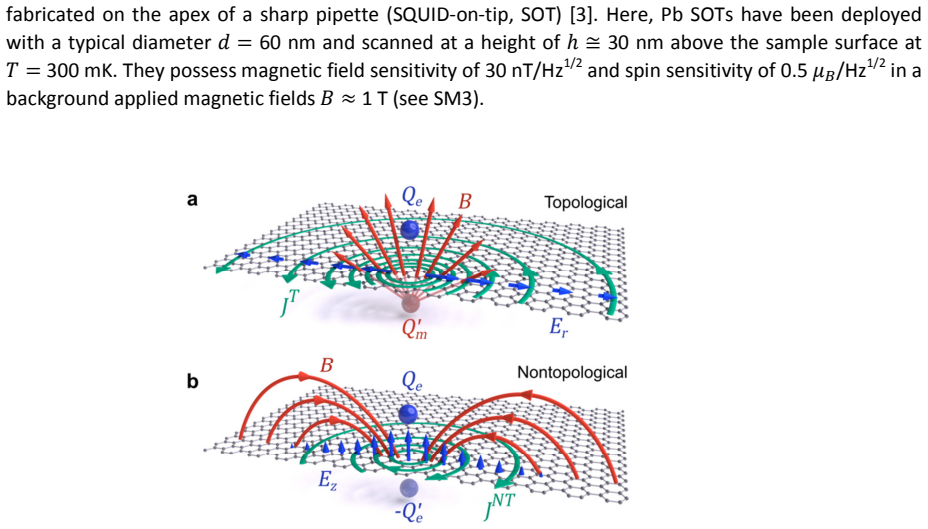
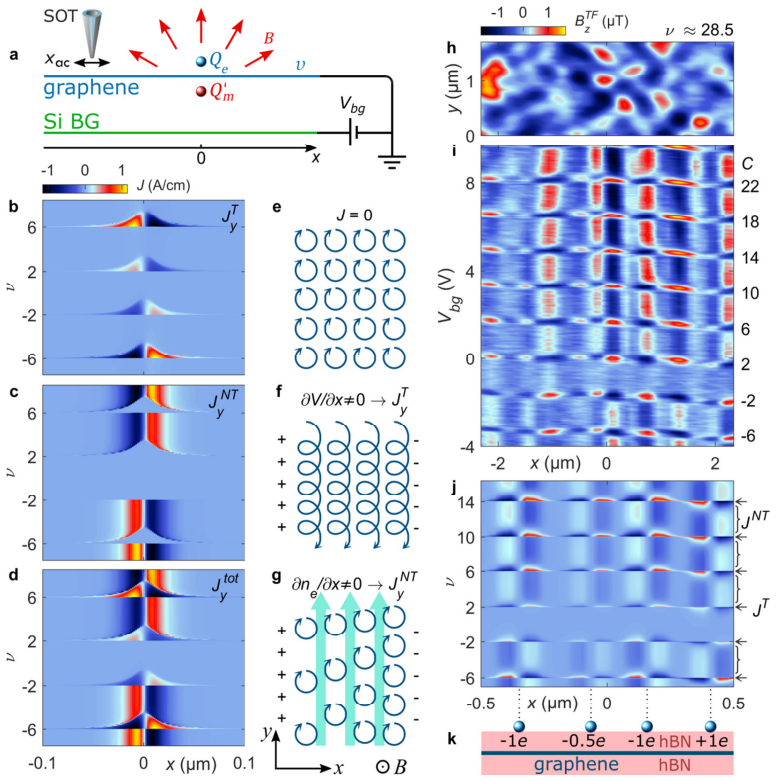
The load-bearing instrument is a SQUID-on-tip: a nanoscale superconducting quantum interference device on a pipette apex, used both as a tunable electric gate and as a magnetometer with roughly 30 nT/Hz$^{1/2}$ sensitivity. A quartz tuning fork oscillates the SQUID-on-tip parallel to the surface with amplitude $x_0$, and the lock-in signal $B_z'(x)=x_0\,dB_z/dx$ becomes, by the Biot-Savart law for a thin current strip, a peaked function whose height is proportional to the strip's total current, directly mapping $j_y(x)$. The theoretical decomposition is $\mathbf{j}_{\mathrm{t}}=\sigma_{xy}\mathbf{E}$ in incompressible regions and $\mathbf{j}_{\mathrm{nt}}=\nabla\times\mathbf{M}$ with $\mathbf{M}=n\boldsymbol{\mu}$ in compressible regions; both currents are computed self-consistently through electrostatic simulations of potential and density, and quantum-mechanical Dirac-equation simulations reproduce the semiclassical current patterns smeared over a magnetic length.
What would settle it
Scan the same electrostatically defined edge at several scan heights (for example 25, 40, and 60 nm) and deconvolve the measured $B_z'(x)$ with the known SQUID-on-tip sensing area: if the inferred $j_y(x)$ reproduces the same strip positions, widths, and currents up to the height-dependent point-spread function, the counterpropagating-current interpretation survives, whereas if the reconstructed pattern changes sign, shifts, or splits with height, the mapping from field derivative to current density is not unique; a second check is the predicted zero of the upstream current at the graphene $n=0$ Landau level in the same junction.
Extended reading notes
Core claim
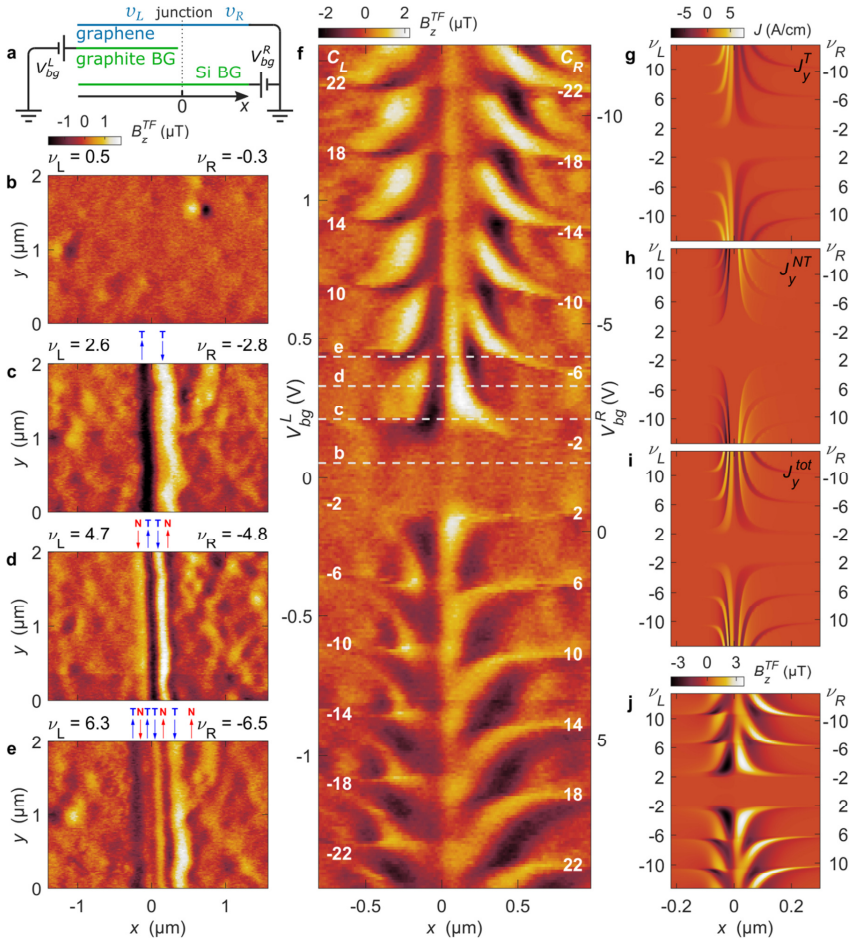
The paper's central discovery is that the equilibrium quantum Hall edge state is not a single chiral channel but a current pair. In the incompressible region, where the filling factor is pinned at an integer, the in-plane electric field drives a topological current $\mathbf{j}_{\mathrm{t}} = \sigma_{xy}\mathbf{E}$ flowing downstream along the edge chirality. In the adjacent compressible region, screening produces a density gradient, and the resulting gradient of the local magnetization $\mathbf{M} = n\boldsymbol{\mu}$ generates a nontopological current $\mathbf{j}_{\mathrm{nt}} = \nabla\times\mathbf{M}$ flowing upstream; for graphene Landau levels with $|n|\ge 1$ this upstream current has magnitude comparable to the downstream one, while for the $n=0$ Landau level it vanishes. The measured images show these pairs directly, and show that the total equilibrium edge current does not grow with added Landau levels but oscillates as pairs of $j_{\mathrm{t}}$ and $j_{\mathrm{nt}}$ strips advance toward the edge. The same measurement of the magnetoelectric response to a tip charge yields a diamond-tiled phase diagram of the mixed magnetoelectric effect, with the pure monopole response confined to the vertices.
Load-bearing premise
The argument assumes that the measured $B_z'(x)=x_0\,dB_z/dx$ is a faithful local image of the current density $j_y(x)$: that the Biot-Savart forward model, the known sensing area and scan height, and the thin-strip current geometry uniquely convert each peak into one current strip with current proportional to peak height, so that if tip-induced gating, topographic crosstalk, or a non-striplike current distribution corrupts that conversion, the inferred counterpropagating pair could be a deconvolution artifact.
Editorial extensions
If this is right
- Each equilibrium quantum Hall edge state contains a downstream $j_{\mathrm{t}}$ strip and an upstream $j_{\mathrm{nt}}$ strip of comparable magnitude, so the net equilibrium edge current is close to zero and oscillates with filling rather than growing with Landau-level index.
- Under an external bias the net downstream current becomes finite while the net upstream current stays zero, but locally both distributions change, offering a route to image nonequilibrium edge reconstruction and energy equilibration.
- The pure mirror-magnetic-monopole response occurs only at the vertices of the diamond phase diagram near zero tip potential; elsewhere the response is a mixed magnetoelectric effect classified by two Landau-level quantum numbers.
- A single electron charge on the tip, or very weak disorder in magnetically doped topological insulators, is enough to destroy the global incompressible state, making the monopole response extremely fragile.
- The $n=0$ Landau level of graphene carries topological current but no nontopological current, in contrast to higher Landau levels, providing a clear internal control for the counterpropagating-current picture.
Reading between the lines
- The local balance between $j_{\mathrm{t}}$ and $j_{\mathrm{nt}}$ is set by the local electrochemical potential and Landau-level occupation, so the same imaging technique could serve as a noninvasive nanoscale potentiometer or thermometer on quantum Hall edges under bias.
- The predicted vanishing of $j_{\mathrm{nt}}$ at the graphene $n=0$ Landau level is a sharp internal test: if an upstream current is observed there, the magnetization-current mechanism would need revision.
- Because the upstream current is invisible to transport and to potential-sensing probes, similar counterpropagating equilibrium currents may be present but unnoticed in other topological systems, including quantum anomalous Hall and fractional quantum Hall edges.
- The diamond phase diagram suggests the magnetic monopole is a fine-tuned limit; a natural extension is to map the same diagram in fractional quantum Hall states, where the quantized Hall conductance would change the monopole charge unit.
Signed reviews
Editorial analysis
A structured set of objections, weighed in public.
Referee Report
Summary. The paper reports scanning SQUID-on-tip experiments on hBN-encapsulated graphene in the quantum Hall regime, using the same tip as a tunable local electrostatic gate and as a nanoscale magnetometer, with a tuning-fork-induced vibration to record the spatial derivative of the out-of-plane magnetic field, Bz'_ac, interpreted as a local image of the current density j_y. The central claims are: (i) equilibrium quantum Hall edge states carry a pair of counterpropagating currents, a topological downstream current in the incompressible strip and a nontopological upstream current in the adjacent compressible strip, of comparable magnitude; and (ii) the topological mirror-magnetic-monopole response exists only at singular points of the phase diagram, with a nonlinear mixed magnetoelectric effect dominating elsewhere. The evidence combines two independent simulation approaches, semiclassical COMSOL electrostatics with Biot-Savart forward modeling and microscopic tight-binding calculations, together with spatial maps and gate-sweep line cuts across p-n junctions and electrostatically defined edges. The paper also argues that the monopole response is extremely fragile, requiring the entire sample to remain incompressible, and that a single electron charge is sufficient to destroy it in graphene as well as in magnetic topological insulators.
Significance. If established, the results would constitute a substantial advance: the first nanoscale imaging of equilibrium quantum Hall edge currents, the direct observation of the long-predicted nontopological upstream current, and the first phase diagram of the mixed magnetoelectric effect, including the demonstration that the pure mirror-monopole response is confined to isolated singular points. The paper is commendable for combining two independent simulation methods, for explicitly reporting all measurement and simulation parameters in SM14, and for making falsifiable predictions, most notably the absence of the nontopological current for the n=0 Landau level and its presence for higher Landau levels. The monopole-fragility argument for magnetic topological insulators is also a significant and testable conclusion. However, the central edge-current claim currently rests on a forward-model interpretation of Bz'_ac line profiles that has not been tested against the null hypothesis of a single downstream current strip; this is a load-bearing gap that must be closed before the counterpropagating-current claim is fully established.
major comments (2)
- [SM5, Fig. 3f, Fig. S3] The central inference that opposite-signed Bz'_ac peaks correspond to two counterpropagating current strips is not tested against the null hypothesis of a single downstream strip. For a line current, dBz/dx is proportional to (x^2 - h^2)/(x^2 + h^2)^2, which has a central peak and opposite-sign sidelobes at |x| approximately sqrt(3)h with about one-eighth of the main amplitude. With h approximately 25-35 nm and vibration amplitude x0 = 35 nm rms in Fig. 3f (SM14), those sidelobes occur at 43-60 nm from the main peak, which is within the range of the reported red-blue pairs. The simulations in Figs. 3g-j already include both I_top and I_non, and Fig. S3 demonstrates resolution only for a prescribed three-strip input; no I_non = 0 forward model is shown. I request a quantitative residual comparison of the Fig. 3f line cuts and the Fig. S7f edge-state scans against a single-strip model, using the exact finite-vibration lock-in response rather than the small-x0 derivative approximation.
- [SM14, Figs. 3f-j and 4i] The quantitative claim that the topological and nontopological currents have 'comparable magnitude' is not supported by an absolute calibration of Bz'_ac to current density; the agreement between data and simulation is described qualitatively as 'in agreement' without residual statistics. Moreover, the p-n junction simulation parameters (top hBN thickness 2 nm, SOT height 32 nm above graphene) differ from the experimental device (Device B, top hBN approximately 11.5 nm, scan height 25 nm above the surface, i.e. approximately 36 nm above graphene), and the electrostatic screening and Biot-Savart kernel both depend on these distances. The paper should provide a calibration chain, a quantitative residual, and a sensitivity analysis over the device parameters and the Landau-level broadening used in the smoothed occupation function before the 'comparable magnitude' assertion is treated as demonstrated.
minor comments (4)
- [SM5] The expression Bz'_ac = x0 dBz/dx is an approximation valid for small vibration amplitude; since x0 is comparable to the scan height in several datasets, the paper should state this approximation explicitly and quantify its validity for each measurement.
- [Fig. 3f and Fig. S7f] The color scales of the line-cut panels are not shown, which makes it difficult to assess quantitatively the statement that the n=0 Landau level shows 'essentially no' nontopological current; a noise floor or color-bar scale should be provided.
- [Abstract and main text] The phrase 'directly image' the equilibrium currents should be qualified as 'image under a forward Biot-Savart model,' since the measured quantity is the field derivative, not the current distribution itself.
- [SM6] The derivation of the orbital magnetic moment for Dirac fermions would benefit from an explicit statement of the factor-of-two difference from the parabolic two-dimensional electron gas case and its sign convention, as this ratio is central to the predicted near-cancellation of I_top and I_non shown in Fig. S5.
Circularity Check
No circularity found: raw imaging data plus external QH theory and parameter-free simulations carry the central claim; self-citations concern instrumentation only.
full rationale
The derivation chain is not circular. The central observation is the directly measured derivative signal Bz'_probe = x0 * dBz/dx obtained by vibrating the SQUID-on-tip; its sign changes with filling factor are raw data (Figs. 2i and 3f). The mapping from Bz' to current density j_y is a Biot-Savart forward calculation (SM5, Fig. S3) with independently stated geometry parameters (SM14), not a fit to the images. The decomposition into topological I_top = sigma_xy E and nontopological I_non = mu_LL curl M is taken from external prior work (Geller-Vignale, Ref. [4]), not from the authors' own papers, and the paper identifies clear falsifiable consequences, such as vanishing I_non for the graphene n=0 Landau level, opposite signs of I_top and I_non, and comparable magnitudes from Fig. S5. The simulations in Figs. 2j, 3g-j, and 4b-c are self-consistent electrostatic calculations whose inputs are device geometry, gate voltages, and the measured Landau-level density of states; no parameter of the current model is fitted to the measured Bz' images. A skeptical concern that the forward-model inversion was not tested against a no-upstream null model is a question of model validation and experimental systematics, not a reduction of the prediction to its inputs. The paper's self-citations are to the SQUID-on-tip instrumentation (Refs. 3, 37-40, 53) and to one prior quantum-simulation method paper (Ref. 31) with overlapping authorship; these are not load-bearing for the central counterpropagating-current claim, which rests on the raw sign patterns, the external Geller-Vignale theory, and parameter-free simulations.
Assumptions & free parameters
free parameters (1)
- Landau level broadening (Gamma) =
about 2 meV
assumptions (5)
- domain assumption The current density in compressible quantum Hall regions is j_nt = curl(M), with M the local orbital magnetization (Geller-Vignale).
- standard math The incompressible-region current is the topological Hall current j_t = sigma_xy E with quantized sigma_xy = nu e^2/h.
- standard math The Landau level dispersion in monolayer graphene is E_n = sign(n) v_F sqrt(2 hbar e B |n|).
- domain assumption The measured Bz'(x) equals the convolution of the true dBz/dx with the SOT sensing area, and Bz from the currents is computed via Biot-Savart.
- domain assumption Graphene charge density and potential are related by a self-consistent local approximation with a smoothed LL occupation function nu(V).
Cite this review
Pith. "Pith review of Nanoscale imaging of equilibrium quantum Hall edge currents and of the magnetic monopole response in graphene." pith.science (2026). https://pith.science/paper/QAT4FVYU
@misc{pith2026190802466,
  author       = {Pith},
  title        = {Pith review of: Nanoscale imaging of equilibrium quantum Hall edge currents and of the magnetic monopole response in graphene},
  year         = {2026},
  howpublished = {\url{https://pith.science/paper/QAT4FVYU}},
  note         = {Machine review of arXiv:1908.02466}
}
read the original abstract
The recently predicted topological magnetoelectric effect and the response to an electric charge that mimics an induced mirror magnetic monopole are fundamental attributes of topological states of matter with broken time reversal symmetry. Using a SQUID-on-tip, acting simultaneously as a tunable scanning electric charge and as ultrasensitive nanoscale magnetometer, we induce and directly image the microscopic currents generating the magnetic monopole response in a graphene quantum Hall electron system. We find a rich and complex nonlinear behavior governed by coexistence of topological and nontopological equilibrium currents that is not captured by the monopole models. Furthermore, by utilizing a tuning fork that induces nanoscale vibrations of the SQUID-on-tip, we directly image the equilibrium currents of individual quantum Hall edge states for the first time. We reveal that the edge states that are commonly assumed to carry only a chiral downstream current, in fact carry a pair of counterpropagating currents, in which the topological downstream current in the incompressible region is always counterbalanced by heretofore unobserved nontopological upstream current flowing in the adjacent compressible region. The intricate patterns of the counterpropagating equilibrium-state orbital currents provide new insights into the microscopic origins of the topological and nontopological charge and energy flow in quantum Hall systems.
Figures
Forward citations
Cited by 1 Pith paper
-
Mapping the twist angle and unconventional Landau levels in magic angle graphene
Local twist-angle maps in magic-angle twisted bilayer graphene reveal 0.1-degree variations and gradients that generate unscreened electric fields and bulk quantum Hall edge states.
Reference graph
Works this paper leans on
-
[1]
X.-L. Qi, T. L. Hughes, and S.-C. Zhang, ''Topol ogical field theory of time-reversal invariant insulators'', Phys. Rev. B 78 , 195424 (2008)
work page 2008
-
[2]
X.-L. Qi, R. Li, J. Zang, and S.-C. Zhang, ''Ind ucing a Magnetic Monopole with Topological Surface States'', Science 323 , 1184 (2009)
work page 2009
-
[3]
D. Vasyukov, Y. Anahory, L. Embon, D. Halbertal, J. Cuppens, L. Neeman, A. Finkler, Y. Segev, Y. Myasoedov, M. L. Rappaport, M. E. Huber, and E. Zeldov, ''A scanning superconducting quantum interference device with single electron spin sensitivity'', Nat. Nanotechnol. 8, 639 (2013)
work page 2013
-
[4]
M. R. Geller and G. Vignale, ''Currents in the c ompressible and incompressible regions of the two- dimensional electron gas'', Phys. Rev. B 50 , 11714 (1994)
work page 1994
-
[5]
S. T. Bramwell, S. R. Giblin, S. Calder, R. Aldu s, D. Prabhakaran, and T. Fennell, ''Measurement of the charge and current of magnetic monopoles in spin ice'', Nature 461 , 956 (2009)
work page 2009
-
[6]
D. J. P. Morris, D. A. Tennant, S. A. Grigera, B . Klemke, C. Castelnovo, R. Moessner, C. Czternasty, M. Meissner, K. C. Rule, J.-U. Hoffmann, K. Kiefer, S. Gerischer, D. Slobinsky, and R. S. Perry, ''Dirac Strings and Magnetic Monopoles in the Spin Ice Dy2Ti2O7'', Science 326 , 411 (2009)
work page 2009
-
[7]
A. M. Essin, J. E. Moore, and D. Vanderbilt, ''M agnetoelectric Polarizability and Axion Electrodynamics in Crystalline Insulators'', Phys. Rev. Lett. 102 , 146805 (2009)
work page 2009
-
[8]
K. Nomura and N. Nagaosa, ''Surface-Quantized An omalous Hall Current and the Magnetoelectric Effect in Magnetically Disordered Topological Insulators'', Phys. Rev. Lett. 106 , 166802 (2011)
work page 2011
Show all 53 references
-
[9]
L. D. Landau and E. M. Lifshitz, Electrodynamics of Continuous Media . Pergamon, Oxford, 1984
1984
-
[10]
Fusil, V
S. Fusil, V. Garcia, A. Barthélémy, and M. Bibe s, ''Magnetoelectric Devices for Spintronics'', Annu. Rev. Mater. Res. 44 , 91 (2014)
2014
-
[11]
Dziom, A
V. Dziom, A. Shuvaev, A. Pimenov, G. V. Astakho v, C. Ames, K. Bendias, J. Böttcher, G. Tkachov, E. M. Hankiewicz, C. Brüne, H. Buhmann, and L. W. Molenkamp, ''Observation of the universal 12 magnetoelectric effect in a 3D topological insulator'', Nat. Commun. 8, 15197 (2017)
2017
-
[12]
D. A. Pesin and A. H. MacDonald, ''Topological Magnetoelectric Effect Decay'', Phys. Rev. Lett. 111 , 016801 (2013)
2013
-
[13]
Q. N. Meier, M. Fechner, T. Nozaki, M. Sahashi, Z. Salman, T. Prokscha, A. Suter, P. Schoenherr, M. Lilienblum, P. Borisov, I. E. Dzyaloshinskii, M. Fiebig, H. Luetkens, and N. A. Spaldin, ''Search for the Magnetic Monopole at a Magnetoelectric Surface'', Phys. Rev. X 9, 011011 (2019)
2019
-
[14]
Xi and W
W. Xi and W. Ku, ''Hunting Down Magnetic Monopo les in 2D Topological Insulators'', arXiv:1802.05624 (2018)
2018 arXiv
-
[15]
C. R. Dean, A. F. Young, I. Meric, C. Lee, L. W ang, S. Sorgenfrei, K. Watanabe, T. Taniguchi, P. Kim, K. L. Shepard, and J. Hone, ''Boron nitride substrates for high-quality graphene electronics'', Nat. Nanotechnol. 5, 722 (2010)
2010
-
[16]
A. S. Mayorov, R. V Gorbachev, S. V Morozov, L. Britnell, R. Jalil, L. A. Ponomarenko, P. Blake, K. S. Novoselov, K. Watanabe, T. Taniguchi, and A. K. Geim, ''Micrometer-Scale Ballistic Transport in Encapsulated Graphene at Room Temperature'', Nano Lett. 11 , 2396 (2011)
2011
-
[17]
J. R. Williams, L. DiCarlo, and C. M. Marcus, ' 'Quantum Hall Effect in a Gate-Controlled p-n Junction of Graphene'', Science 317 , 638 (2007)
2007
-
[18]
Özyilmaz, P
B. Özyilmaz, P. Jarillo-Herrero, D. Efetov, D. A. Abanin, L. S. Levitov, and P. Kim, ''Electronic Transport and Quantum Hall Effect in Bipolar Graphene p-n-p Junctions'', Phys. Rev. Lett. 99 , 166804 (2007)
2007
-
[19]
Chang, J
C.-Z. Chang, J. Zhang, X. Feng, J. Shen, Z. Zha ng, M. Guo, K. Li, Y. Ou, P. Wei, L.-L. Wang, Z.-Q. Ji, Y. Feng, S. Ji, X. Chen, J. Jia, X. Dai, Z. Fang, S.-C. Zhang, K. He, Y. Wang, L. Lu, X.-C. Ma, and Q.-K. Xue, ''Experimental Observation of the Quantum Anomalous Hall Effec...
2013
-
[20]
M. Mogi, M. Kawamura, R. Yoshimi, A. Tsukazaki, Y. Kozuka, N. Shirakawa, K. S. Takahashi, M. Kawasaki, and Y. Tokura, ''A magnetic heterostructure of topological insulators as a candidate for an axion insulator'', Nat. Mater. 16 , 516 (2017)
2017
-
[21]
N. R. Cooper, B. I. Halperin, and I. M. Ruzin, ''Thermoelectric response of an interacting two- dimensional electron gas in a quantizing magnetic field'', Phys. Rev. B 55 , 2344 (1997)
1997
-
[22]
Weis and K
J. Weis and K. von Klitzing, ''Metrology and mi croscopic picture of the integer quantum Hall effect'', Philos. Trans. R. Soc. A Math. Phys. Eng. Sci. 369 , 3954 (2011)
2011
-
[23]
B. E. Feldman, B. Krauss, J. H. Smet, and A. Ya coby, ''Unconventional Sequence of Fractional Quantum Hall States in Suspended Graphene'', Science 337 , 1196 (2012)
2012
-
[24]
M. E. Suddards, A. Baumgartner, M. Henini, and C. J. Mellor, ''Scanning capacitance imaging of compressible and incompressible quantum Hall effect edge strips'', New J. Phys. 14 , 083015 (2012)
2012
-
[25]
Kim, ''Graphene and Relativistic Quantum Phy sics'', in Duplantier B., Rivasseau V., Fuchs JN
P. Kim, ''Graphene and Relativistic Quantum Phy sics'', in Duplantier B., Rivasseau V., Fuchs JN. (eds) Dirac Matter. Progress in Mathematical Physics, vol 71. Birkhäuser, Cham , 2017, 1
2017
-
[26]
D. B. Chklovskii, B. I. Shklovskii, and L. I. G lazman, ''Electrostatics of edge channels'', Phys. Rev. B 46 , 4026 (1992)
1992
-
[27]
Y.-T. Cui, B. Wen, E. Y. Ma, G. Diankov, Z. Han , F. Amet, T. Taniguchi, K. Watanabe, D. Goldhaber- Gordon, C. R. Dean, and Z.-X. Shen, ''Unconventional Correlation between Quantum Hall Transport Quantization and Bulk State Filling in Gated Graphene Devices'', Phys. Rev. Lett....
2016
-
[28]
K. Lai, W. Kundhikanjana, M. A. Kelly, Z.-X. Sh en, J. Shabani, and M. Shayegan, ''Imaging of Coulomb-Driven Quantum Hall Edge States'', Phys. Rev. Lett. 107 , 176809 (2011)
2011
-
[29]
N. M. Freitag, L. A. Chizhova, P. Nemes-Incze, C. R. Woods, R. V Gorbachev, Y. Cao, A. K. Geim, K. S. Novoselov, J. Burgdörfer, F. Libisch, and M. Morgenstern, ''Electrostatically Confined Monolayer Graphene Quantum Dots with Orbital and Valley Splittings'', Nano Lett. 16 , 57...
2016
-
[30]
Ghahari, D
F. Ghahari, D. Walkup, C. Gutiérrez, J. F. Rodr iguez-Nieva, Y. Zhao, J. Wyrick, F. D. Natterer, W. G. Cullen, K. Watanabe, T. Taniguchi, L. S. Levitov, N. B. Zhitenev, and J. A. Stroscio, ''An on/off Berry phase switch in circular graphene resonators'', Science 356 , 845 (2017)
2017
-
[31]
Gutiérrez, D
C. Gutiérrez, D. Walkup, F. Ghahari, C. Lewando wski, J. F. Rodriguez-Nieva, K. Watanabe, T. Taniguchi, L. S. Levitov, N. B. Zhitenev, and J. A. Stroscio, ''Interaction-driven quantum Hall wedding cake–like structures in graphene quantum dots'', Science 361 , 789 (2018)
2018
-
[32]
Y. Kim, A. C. Balram, T. Taniguchi, K. Watanabe , J. K. Jain, and J. H. Smet, ''Evidence for a new even-denominator fractional quantum Hall state in graphene'', arXiv:1807.08375 (2018)
2018 arXiv
-
[33]
Masubuchi, M
S. Masubuchi, M. Morimoto, S. Morikawa, M. Onod era, Y. Asakawa, K. Watanabe, T. Taniguchi, and T. Machida, ''Autonomous robotic searching and assembly of two-dimensional crystals to build van der Waals superlattices'', Nat. Commun. 9, 1413 (2018)
2018
-
[34]
Y. Kim, P. Herlinger, P. Moon, M. Koshino, T. T aniguchi, K. Watanabe, and J. H. Smet, ''Charge Inversion and Topological Phase Transition at a Twist Angle Induced van Hove Singularity of Bilayer Graphene'', Nano Lett. 16 , 5053 (2016)
2016
-
[35]
A. M. Goossens, V. E. Calado, A. Barreiro, K. W atanabe, T. Taniguchi, and L. M. K. Vandersypen, ''Mechanical cleaning of graphene'', Appl. Phys. Lett. 100 , 073110 (2012)
2012
-
[36]
Lindvall, A
N. Lindvall, A. Kalabukhov, and A. Yurgens, ''C leaning graphene using atomic force microscope'', J. Appl. Phys. 111 , 064904 (2012)
2012
-
[37]
Halbertal, J
D. Halbertal, J. Cuppens, M. Ben Shalom, L. Emb on, N. Shadmi, Y. Anahory, H. R. Naren, J. Sarkar, A. Uri, Y. Ronen, Y. Myasoedov, L. S. Levitov, E. Joselevich, A. K. Geim, and E. Zeldov, ''Nanoscale thermal imaging of dissipation in quantum systems'', Nature 539 , 407 (2016)
2016
-
[38]
Halbertal, M
D. Halbertal, M. Ben Shalom, A. Uri, K. Bagani, A. Y. Meltzer, I. Marcus, Y. Myasoedov, J. Birkbeck, L. S. Levitov, A. K. Geim, and E. Zeldov, ''Imaging resonant dissipation from individual atomic defects in graphene'', Science 358 , 1303 (2017)
2017
-
[39]
Finkler, D
A. Finkler, D. Vasyukov, Y. Segev, L. Ne’eman, E. O. Lachman, M. L. Rappaport, Y. Myasoedov, E. Zeldov, and M. E. Huber, ''Scanning superconducting quantum interference device on a tip for magnetic imaging of nanoscale phenomena'', Rev. Sci. Instrum. 83 , 073702 (2012)
2012
-
[40]
E. O. Lachman, A. F. Young, A. Richardella, J. Cuppens, H. R. Naren, Y. Anahory, A. Y. Meltzer, A. Kandala, S. Kempinger, Y. Myasoedov, M. E. Huber, N. Samarth, and E. Zeldov, ''Visualization of superparamagnetic dynamics in magnetic topological insulators'', Sci. Adv. 1, e150...
2015
-
[41]
Kleinbaum and G
E. Kleinbaum and G. A. Csáthy, ''Note: A transi mpedance amplifier for remotely located quartz tuning forks'', Rev. Sci. Instrum. 83 , 126101 (2012)
2012
-
[42]
P. G. Silvestrov and K. B. Efetov, ''Charge acc umulation at the boundaries of a graphene strip induced by a gate voltage: Electrostatic approach'', Phys. Rev. B 77 , 155436 (2008)
2008
-
[43]
Hettmansperger, F
H. Hettmansperger, F. Duerr, J. B. Oostinga, C. Gould, B. Trauzettel, and L. W. Molenkamp, ''Quantum Hall effect in narrow graphene ribbons'', Phys. Rev. B 86 , 195417 (2012)
2012
-
[44]
J. Chae, S. Jung, S. Woo, H. Baek, J. Ha, Y. J. Song, Y.-W. Son, N. B. Zhitenev, J. A. Stroscio, and Y. Kuk, ''Enhanced Carrier Transport along Edges of Graphene Devices'', Nano Lett. 12 , 1839 (2012)
2012
-
[45]
Barraud, T
C. Barraud, T. Choi, P. Butti, I. Shorubalko, T . Taniguchi, K. Watanabe, T. Ihn, and K. Ensslin, ''Field effect in the quantum Hall regime of a high mobility graphene wire'', J. Appl. Phys. 116 , 073705 (2014)
2014
-
[46]
S. Chen, R. Ribeiro-Palau, K. Yang, K. Watanabe , T. Taniguchi, J. Hone, M. O. Goerbig, and C. R. Dean, ''Competing Fractional Quantum Hall and Electron Solid Phases in Graphene'', Phys. Rev. Lett. 122 , 026802 (2019)
2019
-
[47]
K. Itoh, R. Nakazawa, T. Ota, M. Hashisaka, K. Muraki, and T. Fujisawa, ''Signatures of a Nonthermal Metastable State in Copropagating Quantum Hall Edge Channels'', Phys. Rev. Lett. 120 , 197701 (2018)
2018
-
[48]
Venkatachalam, S
V. Venkatachalam, S. Hart, L. Pfeiffer, K. West , and A. Yacoby, ''Local thermometry of neutral modes on the quantum Hall edge'', Nat. Phys. 8, 676 (2012). 14
2012
-
[49]
Altimiras, H
C. Altimiras, H. le Sueur, U. Gennser, A. Cavan na, D. Mailly, and F. Pierre, ''Tuning Energy Relaxation along Quantum Hall Channels'', Phys. Rev. Lett. 105 , 226804 (2010)
2010
-
[50]
Chang, W
C.-Z. Chang, W. Zhao, D. Y. Kim, P. Wei, J. K. Jain, C. Liu, M. H. W. Chan, and J. S. Moodera, ''Zero- Field Dissipationless Chiral Edge Transport and the Nature of Dissipation in the Quantum Anomalous Hall State'', Phys. Rev. Lett. 115 , 057206 (2015)
2015
-
[51]
M. Liu, W. Wang, A. R. Richardella, A. Kandala, J. Li, A. Yazdani, N. Samarth, and N. P. Ong, ''Large discrete jumps observed in the transition between Chern states in a ferromagnetic topological insulator'', Sci. Adv. 2, e1600167 (2016)
2016
-
[52]
E. J. Fox, I. T. Rosen, Y. Yang, G. R. Jones, R . E. Elmquist, X. Kou, L. Pan, K. L. Wang, and D. Goldhaber-Gordon, ''Part-per-million quantization and current-induced breakdown of the quantum anomalous Hall effect'', Phys. Rev. B 98 , 075145 (2018)
2018
-
[53]
weddin g cake
E. O. Lachman, M. Mogi, J. Sarkar, A. Uri, K. B agani, Y. Anahory, Y. Myasoedov, M. E. Huber, A. Tsukazaki, M. Kawasaki, Y. Tokura, and E. Zeldov, ''Observation of superparamagnetism in coexistence with quantum anomalous Hall C = ±1 and C = 0 Chern states'', npj Quantum Mater....
2017
Reviewed August 14, 2026 · model on record in the stance chip above.
Discussion (0). Continue with ORCID to comment.