REVIEW 3 major objections 5 minor 27 references
Learning Vision-based Flight in Drone Swarms by Imitation
T0 review · 3 major / 5 minor · reviewed 2026-08-14 · deepseek-v4-flash
Pith's one-line read A convolutional network can replace shared positions and markers in drone swarms.
desk verdict A solid imitation-learning integration with an overstated 'fully decentralized' claim; real evidence is narrow but the method is worth a look. read the letter →
The pith
A machine-rendered reading of the paper's core claim, the machinery that carries it, and where it could break.
The reading
What carries the argument
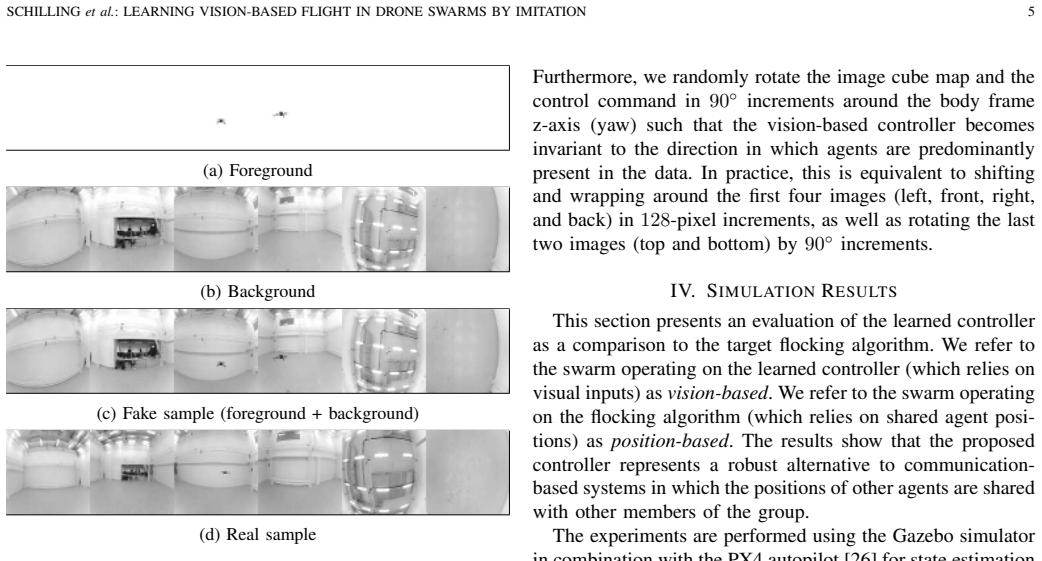
The load-bearing object is the visual policy: a small convolutional regression network that maps a grayscale 128 by 768 image, built by concatenating six 128 by 128 cameras arranged as a cube map, to a three-dimensional velocity command in the drone's body frame. The training procedure is iterative on-policy imitation: the current policy flies the swarm in simulation, the position-based flocking expert labels each image with its velocity command, and the policy is retrained on the growing dataset. The sim-to-real bridge is a task-specific domain adaptation in which simulated drones rendered on a blank background are composited onto 20,000 unlabeled background images recorded in the destination flight hall, with simulation labels left unchanged. A low-level autopilot converts the predicted velocity setpoints into motor commands, so the learned network functions as the coordination layer of the control stack.
What would settle it
Run a three-or-more-drone outdoor experiment with no inter-agent communication and no visual markers, using only the learned vision policy for coordination and onboard state estimation for self-position; a collision or a permanent breakup of the group beyond the perception radius would falsify the central claim. A cheaper check is to measure the network's velocity predictions against the expert flocking command on real drone images taken in lighting and backgrounds never seen in training.
Extended reading notes
Core claim
The central claim is that the visual coordination problem, where the other drones are and what velocity to command, can be solved end-to-end by regression from raw omnidirectional images to velocity commands, rather than by explicit detection, tracking, and position sharing. The expert providing the training signal is Reynolds flocking restricted to separation and cohesion terms, optionally plus a migration goal; the network must recover the relative-position information contained in the images. The paper reports that the vision-based nine-drone swarm in simulation closely tracks the position-based swarm's minimum and maximum inter-agent distances, both with a common migration goal and with two subsets pulling in opposite directions. In the real world, a follower drone running the network onboard keeps a stable distance to a leader in a circle, a tilted carousel trajectory, and a head-on push-pull maneuver. An attribution study shows the network concentrates its influence on the visible other drone, which the authors read as evidence that the controller has learned implicit relative localization.
Load-bearing premise
The simulated drone foregrounds composited onto real background images must be a faithful enough stand-in for real images of drones that a policy trained on these composites, with labels computed in simulation, transfers to physical drones without further adaptation.
Editorial extensions
If this is right
- Swarms could coordinate in environments where GNSS is unreliable and wireless links are congested, because inter-agent information is carried by pixels rather than radio messages.
- The recipe of picking a position-based expert, imitating it from omnidirectional images, and adapting the simulator to the target background can be reused to produce controllers for other collective behaviors by changing the expert's target commands.
- Because the network outputs velocity setpoints and runs onboard in real time, it can replace the coordination layer of an existing drone autopilot without altering low-level flight control.
Reading between the lines
- A natural stress test the paper leaves implicit is appearance generalization: if the attribution map reflects learned visual features of the simulated drone model, a differently shaped or colored drone could break cohesion; this can be tested by rendering unseen drone geometries during evaluation.
- Because the expert omits the velocity-matching term of Reynolds flocking, the learned swarm may lack alignment and can oscillate, as the push-pull experiment hints; extending the expert with velocity matching and giving the network a short stack of frames is a direct next step.
- The domain-adaptation trick could also be tested outdoors by collecting background images from the target field and using RTK self-positioning instead of motion capture; the paper names outdoor transfer as future work but does not demonstrate it.
- The paper's real-world validation is two drones with ground-truth self-pose; a decisive extension would be three or more real drones with no inter-agent communication and no markers, which the paper's training recipe supports but does not execute.
Signed reviews
Editorial analysis
A structured set of objections, weighed in public.
Referee Report
Summary. The paper proposes a learning-based method for markerless, vision-based coordination of drone swarms. Each agent is controlled by a small convolutional network that takes a concatenation of six omnidirectional camera images and regresses 3D velocity commands imitating a Reynolds flocking algorithm (separation, cohesion, and migration). Training is performed with DAGGER in simulation, followed by an unsupervised domain-adaptation step that composites simulated drone foregrounds onto real background images, and then further real-world DAGGER training. The authors report a nine-agent Gazebo simulation study with common and opposing migration goals, and real-world two-drone experiments (circle, carousel, push-pull) showing that a follower drone can maintain cohesion and avoid collision from visual input alone. An attribution study (Grad-CAM) indicates that the network localizes the other agent in the visual field.
Significance. If validated, this work is a meaningful step toward scalable swarm coordination that does not rely on sharing positions or on visual markers, both of which are current practical limitations. The expert policy is an external Reynolds-based benchmark, so the imitation-learning setup is not circular, and the authors provide real-hardware demonstrations with two drones, which is commendable. The paper is clearly written and the proposed domain-adaptation idea is practically appealing. However, the evidence for the headline claims of full decentralization and communication-free operation is incomplete, and the quantitative evaluation lacks statistical rigor.
major comments (3)
- [Sec. V (first paragraph), Abstract, Sec. I] The real-world system relies on an external motion capture system: "Each drone receives its ground truth pose via Wi-Fi at a frequency of 100 Hz" (Sec. V). The predicted velocity commands from the network are transformed to the world frame using this externally provided pose, and the low-level controller uses it for state feedback. The abstract claims a "fully decentralized, vision-based swarm without the need for communication or visual markers," and the contribution list in Sec. I states that "state estimation" is an onboard computation. These claims are not demonstrated by the experiments, since the implementation uses communication (Wi-Fi pose) and a central motion capture infrastructure. Please temper the claims to "first step" (as the abstract later does) and explicitly state the current dependence on external localization, or provide an experiment with onboard state estimation.
- [Sec. IV, Fig. 4] The simulation evaluation appears to be based on single runs; no repeated trials, error bars, or statistical measures are reported. The conclusion that the vision-based swarm "matches the position-based one very well" rests on a qualitative inspection of the minimum and maximum inter-agent distance plots. Please provide multiple independent runs with mean and variance, and report a quantitative error metric (e.g., RMSE between the vision-based and position-based inter-agent distance time series, or a collision rate). This is necessary to support the robustness claim in the abstract and Sec. IV.
- [Sec. III-D and Sec. V] The domain-adaptation approach is a stated contribution, but its effectiveness is not quantitatively assessed. No ablation compares the final policy with one trained without the real-background compositing, and no metric characterizes how closely the composite images approximate real drone images. Since the real-world policy is further trained with DAGGER in the motion capture hall (Sec. III-C), the relative contribution of the unsupervised adaptation versus the real data is unclear. Please add a quantitative analysis or a clear statement of the role and limitations of the domain-adaptation step, given that the central transfer claim rests on it.
minor comments (5)
- [Sec. IV-A and Sec. V-C] Sec. IV-A states that the velocity commands predicted by the neural network are sent to the agents "in their raw form without any further processing," but the push-pull experiment in Sec. V-C sets the x and z components of the command to zero. Please clarify this inconsistency.
- [Sec. V-A, Fig. 5] The text describes a "representative 6 min flight," while Fig. 5 shows a time axis of 250 seconds (approximately 4.2 minutes). Please correct the reported flight duration.
- [Fig. 4 caption] The caption says "The mean minimum distance between any pair of agents is denoted by a solid line, whereas mean maximum distances are shown as a dashed line," but the legend entries "Position (min)" and "Vision (min)" appear duplicated. Please clarify the exact statistics and make the legend consistent with the caption.
- [Sec. III-E] The description of yaw augmentation is clear, but it would be helpful to state explicitly that the same rotation is applied to the target velocity commands in addition to the images; this is implied but not stated in the same sentence.
- [Sec. I, conclusion] The claim that "all computations (policy evaluation, state estimation, and control) can be run entirely onboard in real-time" is plausible but not supported by the reported experiments, since the real-world pose is externally provided. Please provide evidence or rephrase the claim to reflect what was actually demonstrated.
Circularity Check
No circularity: the network is trained against an external position-based Reynolds expert and evaluated on held-out and real flights; self-citations are not load-bearing.
full rationale
The paper's central derivation is a supervised imitation-learning pipeline in which the expert policy is Reynolds flocking computed from known relative positions, an external benchmark independent of the learned network's visual predictions. The neural network is trained to regress the expert's velocity commands from omnidirectional images, and the evaluation compares the learned vision-based controller against the position-based expert in simulation and in real two-drone flights. This is a genuine empirical reduction: the image inputs do not contain explicit relative positions, so the network's ability to produce collision-avoiding and cohesive commands is not guaranteed by construction and could fail, as acknowledged by the paper's use of DAGGER and its iterative data collection. The domain-adaptation step composites simulated drone foregrounds onto real background images while keeping simulation labels, which is a practical approximation rather than a circularity; no fitted constant is relabeled as a prediction. The paper does cite prior work by the same group, notably the hardware design in [12] and the influence of limited visual sensing in [22], but these citations are contextual or supportive and do not supply the load-bearing claim that vision can replace shared positions. The real-world system's dependence on a motion-capture pose stream delivered over Wi-Fi is a legitimate external-validity concern about the strength of the 'fully decentralized' claim, but it is not a circularity: the pose serves state estimation and low-level control, while the learned coordination policy still maps raw images to velocity commands and is compared against an external expert. No equation is defined in terms of its own output, no fitted parameter is presented as a prediction, and no self-citation is invoked to forbid alternative explanations. Therefore the derivation chain is self-contained with respect to circularity.
Assumptions & free parameters
free parameters (10)
- k_sep (separation gain) =
7
- k_coh (cohesion gain) =
1
- k_mig (migration gain) =
1
- v_max (maximum speed) =
2 m/s
- r_max (perception radius) =
7 m
- collision threshold =
1 m
- dispersion threshold =
7 m
- initial random placement cube =
4 m side, 1.5 m minimum separation
- background image dataset size =
20k samples
- network training hyperparameters =
lr 1e-3, weight decay 5e-4, dropout 0.5, batch size 128
assumptions (5)
- domain assumption Reynolds separation and cohesion rules, with the chosen gains, form a valid expert policy for collision-free cohesive swarming.
- domain assumption A 10 Hz, 128x128 grayscale six-camera image is informationally sufficient for reactive collision avoidance and cohesion.
- ad hoc to paper Compositing simulated drone foregrounds onto real background images is an adequate proxy for real deployment images.
- domain assumption Gazebo/PX4 simulation dynamics are close enough to the physical quadrotors that a policy trained in simulation transfers to the flight hall.
- standard math DAgger's no-regret properties apply to this interactive learning problem.
Cite this review
Pith. "Pith review of Learning Vision-based Flight in Drone Swarms by Imitation." pith.science (2026). https://pith.science/paper/M5EW6UE6
@misc{pith2026190802999,
  author       = {Pith},
  title        = {Pith review of: Learning Vision-based Flight in Drone Swarms by Imitation},
  year         = {2026},
  howpublished = {\url{https://pith.science/paper/M5EW6UE6}},
  note         = {Machine review of arXiv:1908.02999}
}
read the original abstract
Decentralized drone swarms deployed today either rely on sharing of positions among agents or detecting swarm members with the help of visual markers. This work proposes an entirely visual approach to coordinate markerless drone swarms based on imitation learning. Each agent is controlled by a small and efficient convolutional neural network that takes raw omnidirectional images as inputs and predicts 3D velocity commands that match those computed by a flocking algorithm. We start training in simulation and propose a simple yet effective unsupervised domain adaptation approach to transfer the learned controller to the real world. We further train the controller with data collected in our motion capture hall. We show that the convolutional neural network trained on the visual inputs of the drone can learn not only robust inter-agent collision avoidance but also cohesion of the swarm in a sample-efficient manner. The neural controller effectively learns to localize other agents in the visual input, which we show by visualizing the regions with the most influence on the motion of an agent. We remove the dependence on sharing positions among swarm members by taking only local visual information into account for control. Our work can therefore be seen as the first step towards a fully decentralized, vision-based swarm without the need for communication or visual markers.
Figures


Figures from the paper (4 more)


Reference graph
Works this paper leans on
-
[1]
Science, technology and the future of small autonomous drones,
D. Floreano and R. J. Wood, “Science, technology and the future of small autonomous drones,” Nature, vol. 521, no. 7553, pp. 460–466, 2015
2015
-
[2]
J.-C. Zufferey, Hauert, Sabine, Stirling, Timothy, Leven, Severin, Roberts, James, and Floreano, Dario, “Aerial Collective Systems,” in Handbook of Collective Robotics, S. Kernbach, Ed. Pan Stanford, 2011, pp. 609–660
work page 2011
-
[3]
Towards a swarm of agile micro quadrotors,
A. Kushleyev, D. Mellinger, C. Powers, and V . Kumar, “Towards a swarm of agile micro quadrotors,” Auton Robots , vol. 35, no. 4, pp. 287–300, 2013
work page 2013
-
[4]
Crazyswarm: A large nano-quadcopter swarm,
J. A. Preiss, W. Honig, G. S. Sukhatme, and N. Ayanian, “Crazyswarm: A large nano-quadcopter swarm,” in Int Conf Rob Autom (ICRA) , 2017, pp. 3299–3304
work page 2017
-
[5]
Visual Inertial Odometry Swarm: An Autonomous Swarm of Vision-Based Quadro- tors,
A. Weinstein, A. Cho, G. Loianno, and V . Kumar, “Visual Inertial Odometry Swarm: An Autonomous Swarm of Vision-Based Quadro- tors,” IEEE Robot Autom Lett (RA-L) , vol. 3, no. 3, pp. 1801–1807, 2018
work page 2018
-
[6]
Outdoor flocking and formation flight with autonomous aerial robots,
G. V ´as´arhelyi, C. Vir´agh, G. Somorjai, N. Tarcai, T. Sz¨or´enyi, T. Nepusz, and T. Vicsek, “Outdoor flocking and formation flight with autonomous aerial robots,” in Int Conf Intel Rob Sys (IROS) . IEEE/RSJ, 2014, pp. 3866–3873
work page 2014
-
[7]
Flocking algorithm for autonomous flying robots,
C. Vir ´agh, G. V´as´arhelyi, N. Tarcai, T. Sz¨or´enyi, G. Somorjai, T. Nepusz, and T. Vicsek, “Flocking algorithm for autonomous flying robots,” Bioinspir Biomim, vol. 9, no. 2, p. 025012, 2014
work page 2014
-
[8]
Optimized flocking of autonomous drones in confined environments,
G. V ´as´arhelyi, C. Vir ´agh, G. Somorjai, T. Nepusz, A. E. Eiben, and T. Vicsek, “Optimized flocking of autonomous drones in confined environments,” Science Robot, vol. 3, no. 20, p. eaat3536, 2018
work page 2018
Show all 27 references
-
[9]
Deep learning,
Y . LeCun, Y . Bengio, and G. Hinton, “Deep learning,”Nature, vol. 521, no. 7553, pp. 436–444, 2015
2015
-
[10]
Reynolds flocking in reality with fixed-wing robots: Communication range vs. maximum turning rate,
S. Hauert, S. Leven, M. Varga, F. Ruini, A. Cangelosi, J.-C. Zufferey, and D. Floreano, “Reynolds flocking in reality with fixed-wing robots: Communication range vs. maximum turning rate,” in Int Conf Intel Rob Sys (IROS). IEEE/RSJ, 2011, pp. 5015–5020
2011
-
[11]
Flocks, Herds and Schools: A Distributed Behavioral Model,
C. W. Reynolds, “Flocks, Herds and Schools: A Distributed Behavioral Model,” in Annual Conf Comp Graph Interactive Technol (SIGGRAPH), vol. 14, 1987, pp. 25–34
1987
-
[12]
Human-Comfortable Collision-Free Navigation for Personal Aerial Vehicles,
N. Dousse, G. Heitz, F. Schill, and D. Floreano, “Human-Comfortable Collision-Free Navigation for Personal Aerial Vehicles,” IEEE Robot Autom Lett (RA-L) , vol. 2, no. 1, pp. 358–365, 2017
2017
-
[13]
Learning Monocular Reactive UA V Control in Cluttered Natural Environments,
S. Ross, N. Melik-Barkhudarov, K. S. Shankar, A. Wendel, D. Dey, J. A. Bagnell, and M. Hebert, “Learning Monocular Reactive UA V Control in Cluttered Natural Environments,” in Int Conf Rob Autom (ICRA) , 2013, pp. 1765–1772
2013
-
[14]
DroNet: Learning to Fly by Driving,
A. Loquercio, A. I. Maqueda, C. R. del Blanco, and D. Scaramuzza, “DroNet: Learning to Fly by Driving,” IEEE Robot Autom Lett (RA-L) , vol. 3, no. 2, pp. 1088–1095, 2018
2018
-
[15]
CAD2RL: Real Single-Image Flight without a Single Real Image,
F. Sadeghi and S. Levine, “CAD2RL: Real Single-Image Flight without a Single Real Image,” in Rob: Sci Sys (RSS) , vol. 13, 2017
2017
-
[16]
A Machine Learning Approach to Visual Perception of Forest Trails for Mobile Robots,
A. Giusti, J. Guzzi, D. C. Cires ¸an, F. L. He, J. P. Rodr´ıguez, F. Fontana, M. Faessler, C. Forster, J. Schmidhuber, G. D. Caro, D. Scaramuzza, and L. M. Gambardella, “A Machine Learning Approach to Visual Perception of Forest Trails for Mobile Robots,” IEEE Robot Autom Lett...
2016
-
[17]
Toward Low- Flying Autonomous MA V Trail Navigation using Deep Neural Networks for Environmental Awareness,
N. Smolyanskiy, A. Kamenev, J. Smith, and S. Birchfield, “Toward Low- Flying Autonomous MA V Trail Navigation using Deep Neural Networks for Environmental Awareness,” in Int Conf Intel Rob Sys (IROS) , 2017, pp. 4241–4247
2017
-
[18]
System for deployment of groups of unmanned micro aerial vehicles in GPS-denied environments using onboard visual relative localization,
M. Saska, T. Baca, J. Thomas, J. Chudoba, L. Preucil, T. Krajnik, J. Faigl, G. Loianno, and V . Kumar, “System for deployment of groups of unmanned micro aerial vehicles in GPS-denied environments using onboard visual relative localization,” Auton Robots, vol. 41, no. 4, pp. 9...
2017
-
[19]
A Practical Multirobot Localization System,
T. Krajn ´ık, M. Nitsche, J. Faigl, P. Van ˇek, M. Saska, L. P ˇreuˇcil, T. Duckett, and M. Mejail, “A Practical Multirobot Localization System,” J Intell Robotic Syst , vol. 76, no. 3-4, pp. 539–562, 2014
2014
-
[20]
UVDAR System for Visual Relative Localization with application to Leader-Follower Formations of Multirotor UA Vs,
V . Walter, N. Staub, A. Franchi, and M. Saska, “UVDAR System for Visual Relative Localization with application to Leader-Follower Formations of Multirotor UA Vs,” IEEE Robot Autom Lett (RA-L) , pp. 1–1, 2019
2019
-
[21]
Swarms of micro aerial vehicles stabilized under a visual relative localization,
M. Saska, J. Vakula, and L. P ˇreu´cil, “Swarms of micro aerial vehicles stabilized under a visual relative localization,” in Int Conf Rob Autom (ICRA), 2014, pp. 3570–3575
2014
-
[22]
The Influence of Limited Visual Sensing on the Reynolds Flocking Algorithm,
E. Soria, F. Schiano, and D. Floreano, “The Influence of Limited Visual Sensing on the Reynolds Flocking Algorithm,” in Int Conf Rob Comp (IRC), 2019, pp. 138–145
2019
-
[23]
A Reduction of Imitation Learning and Structured Prediction to No-Regret Online Learning,
S. Ross, G. Gordon, and D. Bagnell, “A Reduction of Imitation Learning and Structured Prediction to No-Regret Online Learning,” in Int Conf Artif Intel Stat (AISTATS) , vol. 14. JMLR.org, 2011, pp. 627–635
2011
-
[24]
Delving Deep into Rectifiers: Surpassing Human-Level Performance on ImageNet Classification,
K. He, X. Zhang, S. Ren, and J. Sun, “Delving Deep into Rectifiers: Surpassing Human-Level Performance on ImageNet Classification,” in Int Conf Comp Vis (ICCV) , 2015, pp. 1026–1034
2015
-
[25]
Adam: A Method for Stochastic Optimization,
D. P. Kingma and J. Ba, “Adam: A Method for Stochastic Optimization,” in Int Conf Learn Repr (ICLR) , 2014
2014
-
[26]
PX4: A node-based mul- tithreaded open source robotics framework for deeply embedded plat- forms,
L. Meier, D. Honegger, and M. Pollefeys, “PX4: A node-based mul- tithreaded open source robotics framework for deeply embedded plat- forms,” in Int Conf Rob Autom (ICRA) , 2015, pp. 6235–6240
2015
-
[27]
Grad-CAM: Visual Explanations from Deep Networks via Gradient-Based Localization,
R. R. Selvaraju, M. Cogswell, A. Das, R. Vedantam, D. Parikh, and D. Batra, “Grad-CAM: Visual Explanations from Deep Networks via Gradient-Based Localization,” in Int Conf Comp Vis (ICCV) , 2017, pp. 618–626
2017
Reviewed August 14, 2026 · model on record in the stance chip above.
Discussion (0). Continue with ORCID to comment.