REVIEW 3 major objections 6 minor 3 cited by
Charged particle tracking with quantum annealing-inspired optimization
T0 review · 3 major / 6 minor · reviewed 2026-08-14 · deepseek-v4-flash
Pith's one-line read Charged particle tracking can be reformulated as a QUBO optimization problem whose lowest-energy solution selects the true tracks, and both simulated and quantum annealing solve it on TrackML data with stable purity and efficiency as…
desk verdict A genuine proof-of-concept for QUBO-based tracking on real annealing hardware, but the evaluation baseline does not yet separate the solver from the KDE prior. read the letter →
The pith
A machine-rendered reading of the paper's core claim, the machinery that carries it, and where it could break.
The reading
What carries the argument
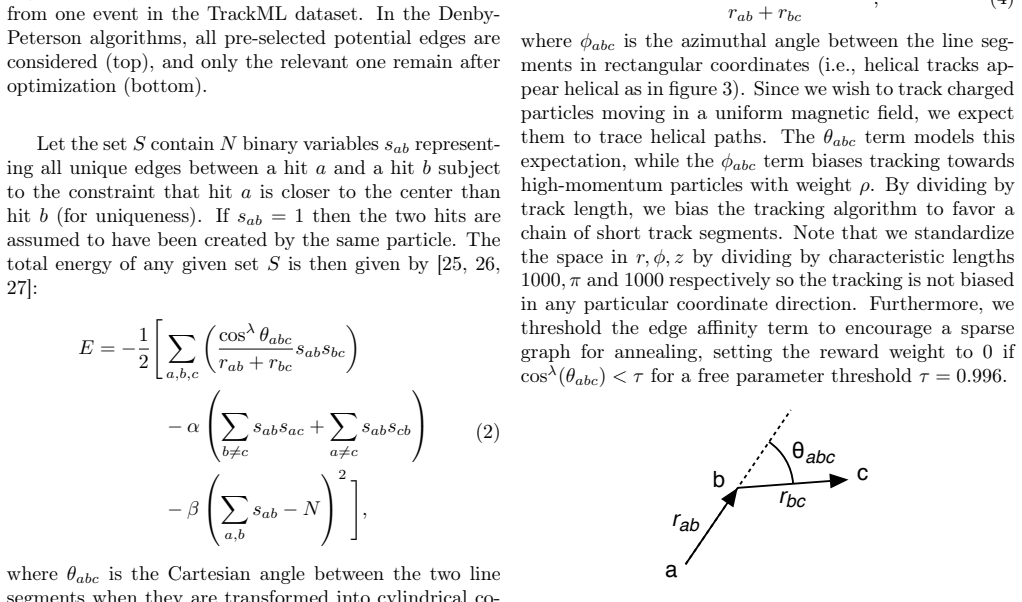
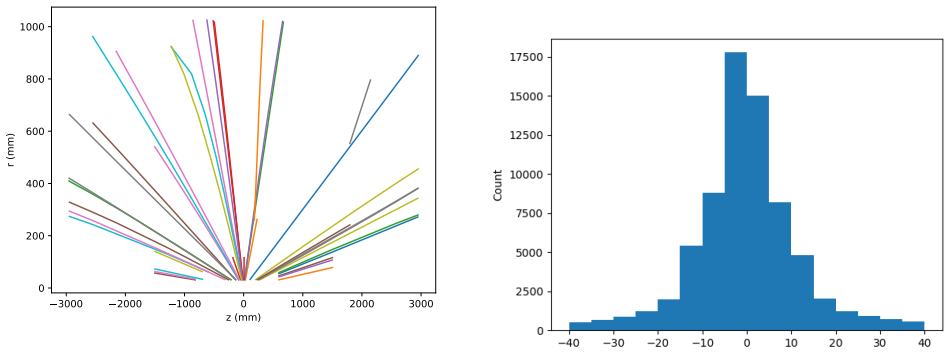
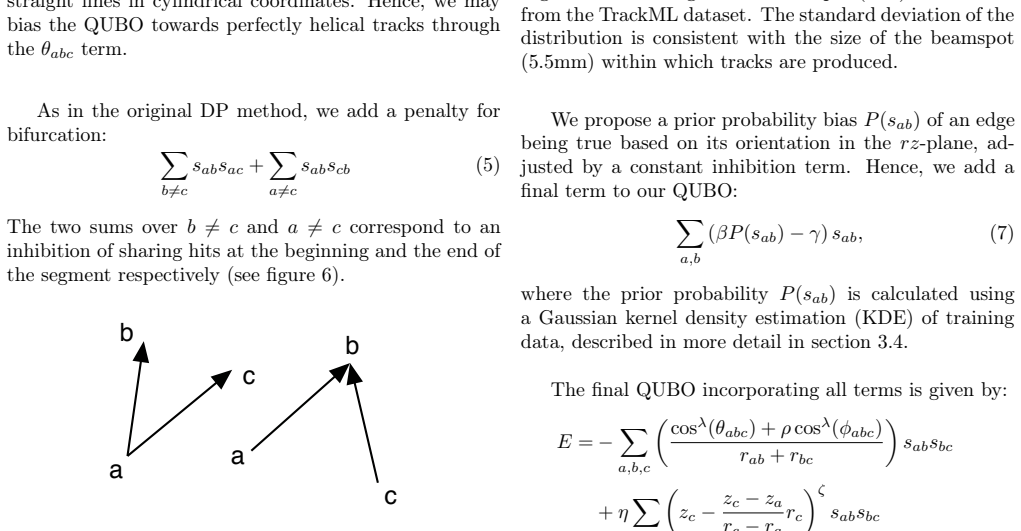
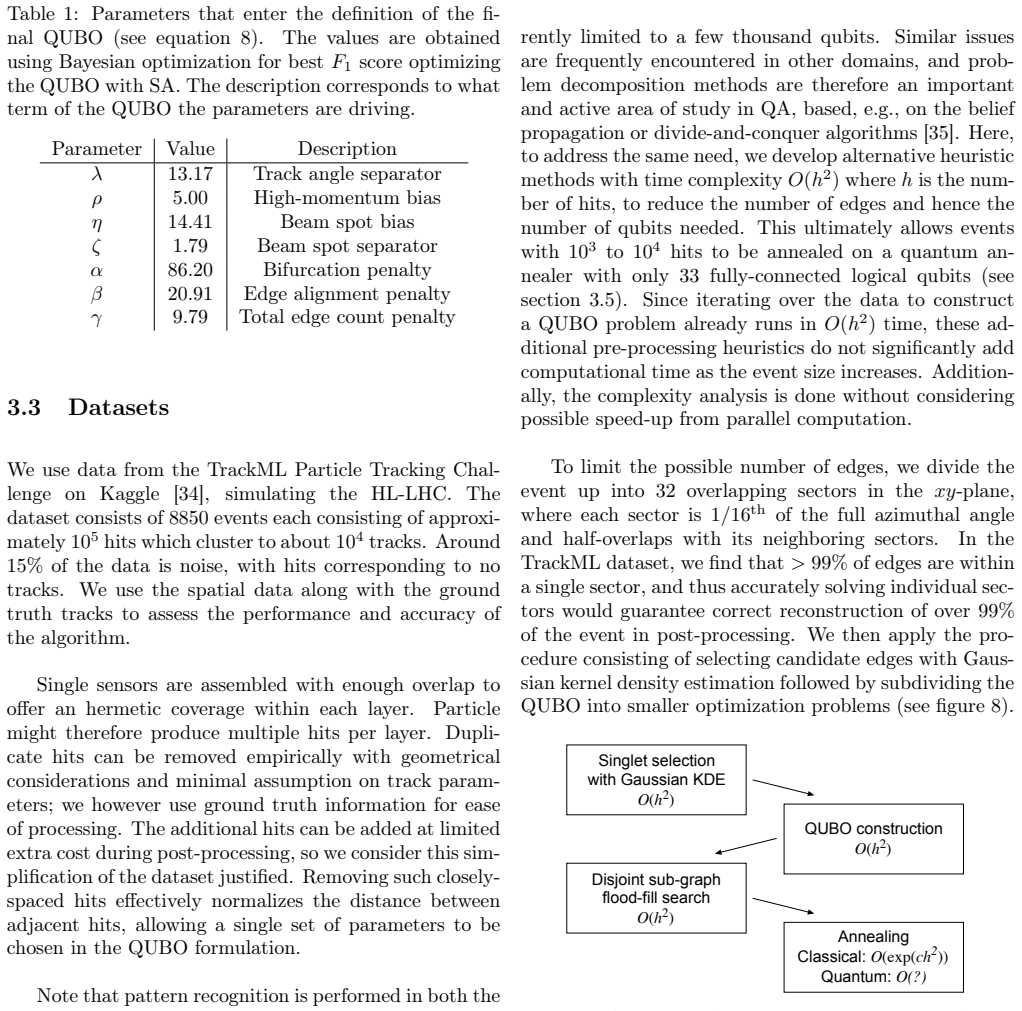
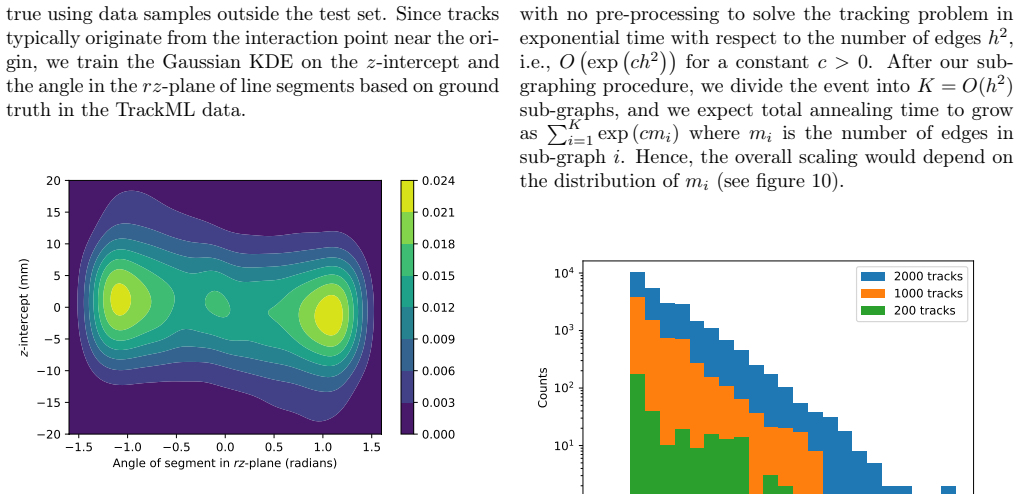
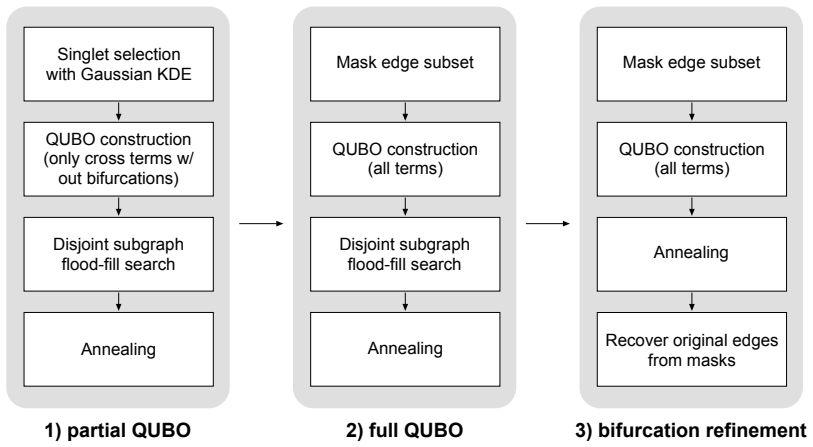
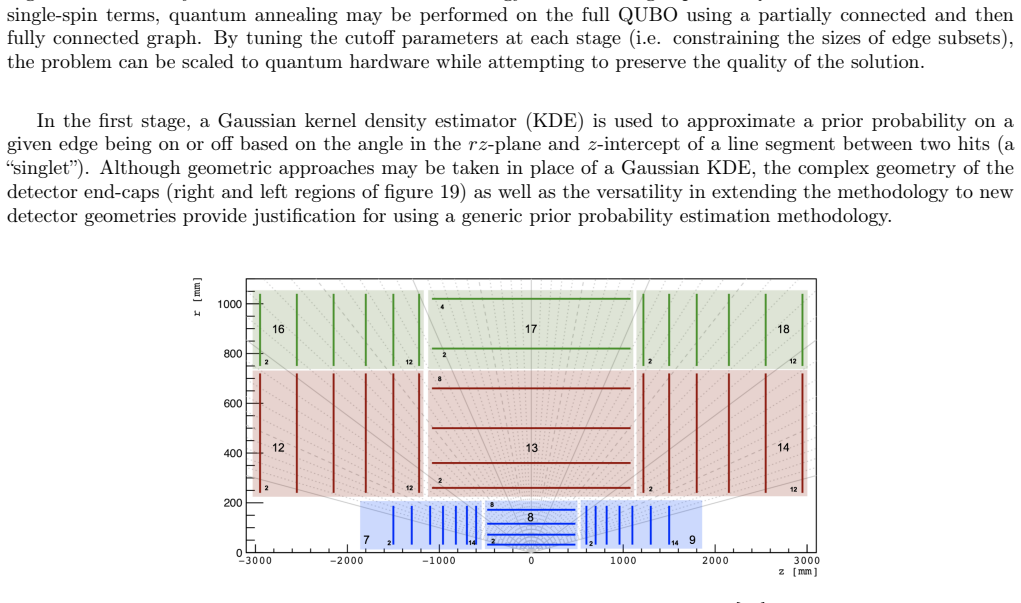
The central object is the modified geometric-network QUBO energy (equation (8)). Its variables are candidate hit-to-hit edges $s_{ab}$; the energy combines a helical-geometry reward $(\cos^\lambda\theta_{abc} + \rho\cos^\lambda\varphi_{abc})/(r_{ab}+r_{bc})$ for two consecutive segments, a beam-spot $z$-intercept penalty, a bifurcation penalty that penalizes a hit from being shared by two segments, and a prior-probability bias learned by Gaussian kernel density estimation. Around this energy the paper builds $O(h^2)$ classical pre-processing: 32 overlapping azimuthal sectors, Gaussian-KDE edge selection, flood-fill sub-graphing that keeps at most five edges per node, and a multi-stage sparse-QUBO construction. The energy landscape is the mechanism: its low-energy states coincide with true tracks, and the annealing procedures are what navigate it.
What would settle it
Run the identical QUBO pipeline on TrackML events without ground-truth duplicate removal, replacing it with a geometric duplicate-cleaning step; if purity or efficiency drops substantially as pileup increases toward 200, the claim that this annealing-based method reconstructs HL-LHC tracks is refuted. A complementary check is whether random edge selection after pre-processing matches the QUBO's performance on these harder events, which would show the solver itself is not doing the reconstruction.
Extended reading notes
Core claim
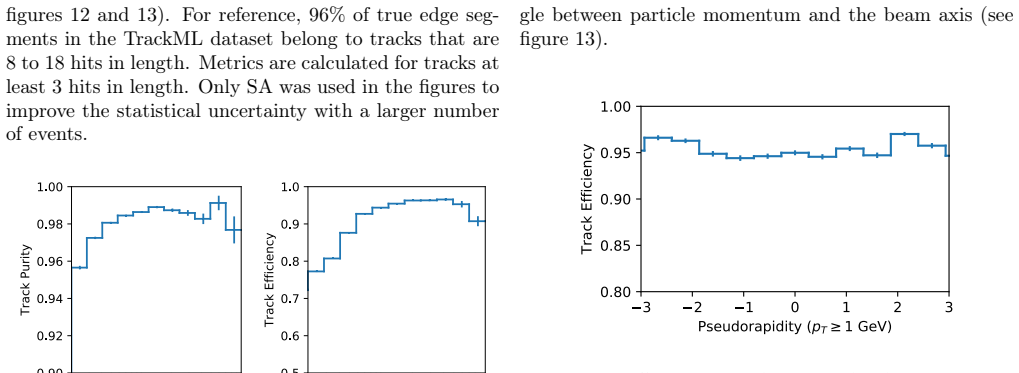
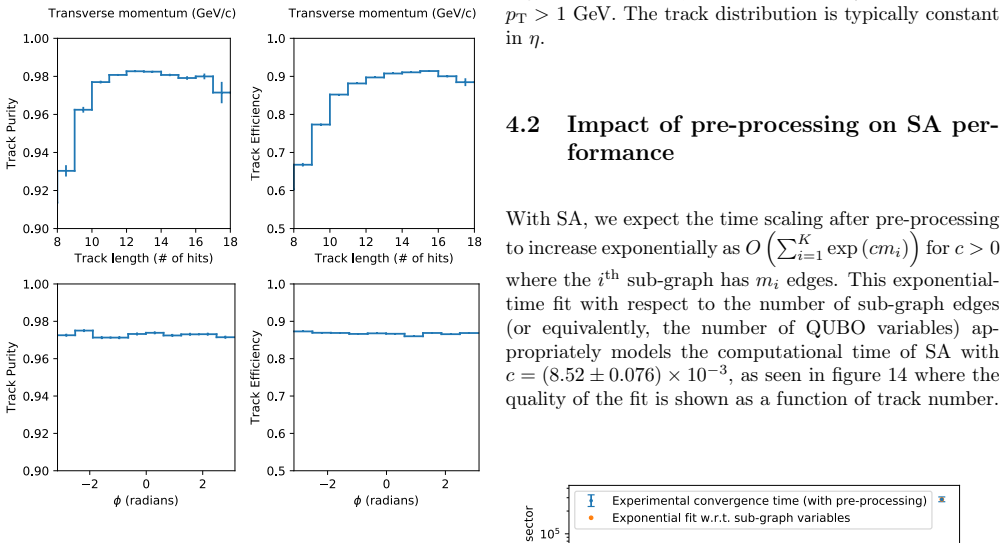
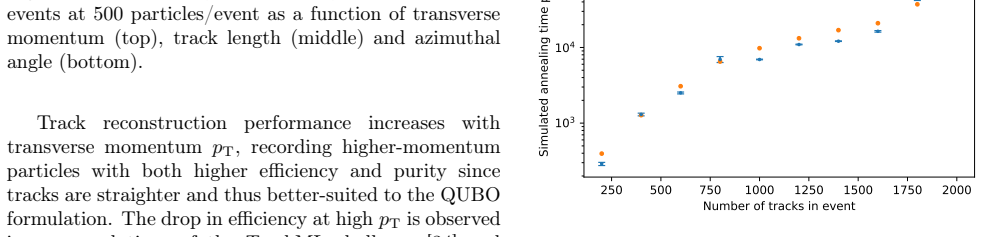
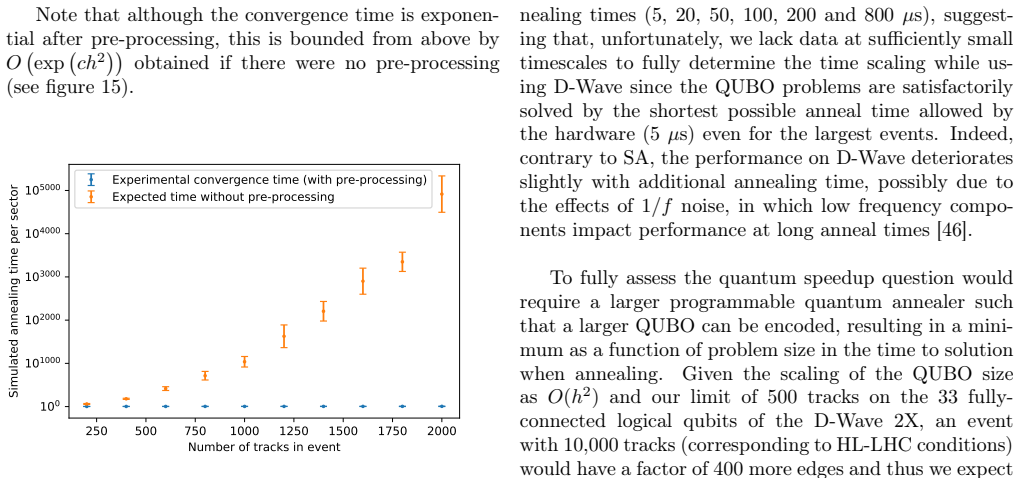
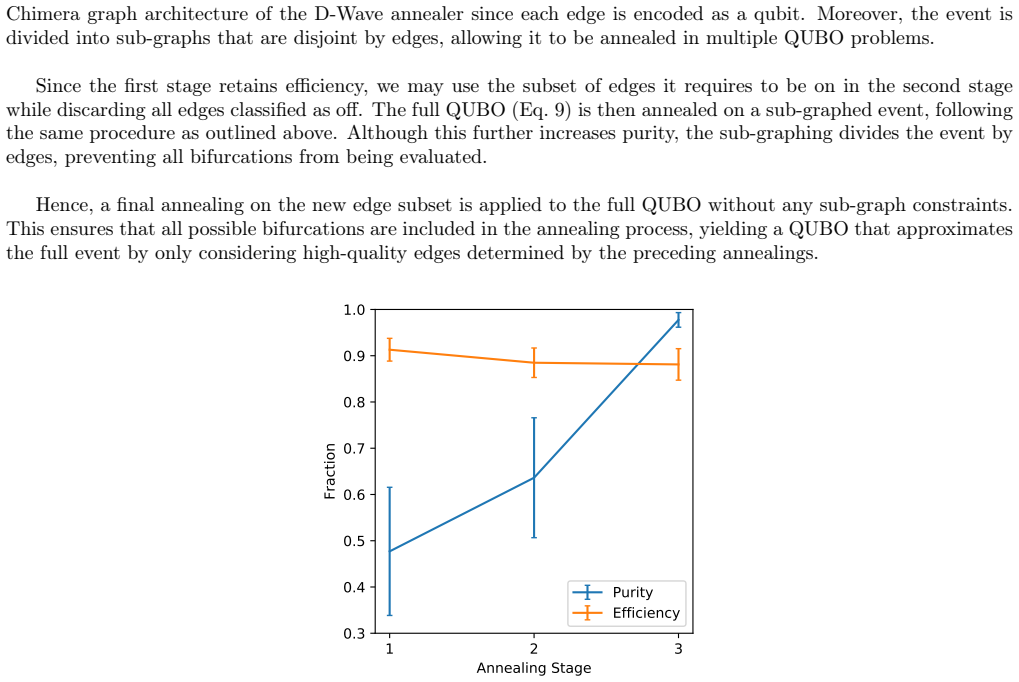
The central claim is that charged particle tracking is a segment-classification problem with a QUBO objective. For every candidate pair of hits $(a,b)$, a binary variable $s_{ab}$ marks whether both hits belong to the same particle's trajectory, and the energy of equation (8) rewards chains of short, collinear segments in cylindrical coordinates, biases toward high-momentum and origin-pointing tracks, and penalizes shared-hit bifurcations. Minimizing this energy with simulated annealing, and with a programmable quantum annealer after minor-embedding onto 33 fully connected logical qubits, reconstructs tracks from TrackML events with roughly constant purity and efficiency up to the tested multiplicities, whereas random edge selection after the same pre-processing fails. Quantum annealing matches simulated annealing on events up to 500 tracks but does not outperform it, so no speedup is claimed. The paper therefore argues that the QUBO solver, not the polynomial $O(h^2)$ pre-processing heuristics, is responsible for the track-finding performance, and that the post-preprocessing annealing time grows exponentially with sub-graph size with a fitted exponent $c = (8.52 \pm 0.076)\times 10^{-3}$.
Load-bearing premise
The load-bearing premise is that deleting duplicate hits with ground-truth information, rather than by a geometric algorithm, does not change the difficulty of track finding; if that premise is wrong, the reported purity and efficiency numbers do not transfer to realistic HL-LHC events.
Editorial extensions
If this is right
- The same QUBO can be re-tuned for high efficiency or high purity, allowing it to act as a first-stage track filter before Kalman-style fitting or as a trigger-level preselection.
- Because the formulation is hardware-agnostic, it can run on FPGA simulated-annealing chips and fully connected classical Ising machines with more spins than the annealer used here, which could make trigger-level tracking practical.
- Scaling to full HL-LHC conditions would require an annealer with roughly 10,000 fully connected qubits after sub-graphing, about twice the capacity of next-generation annealer topologies, so current hardware is limited to smaller events.
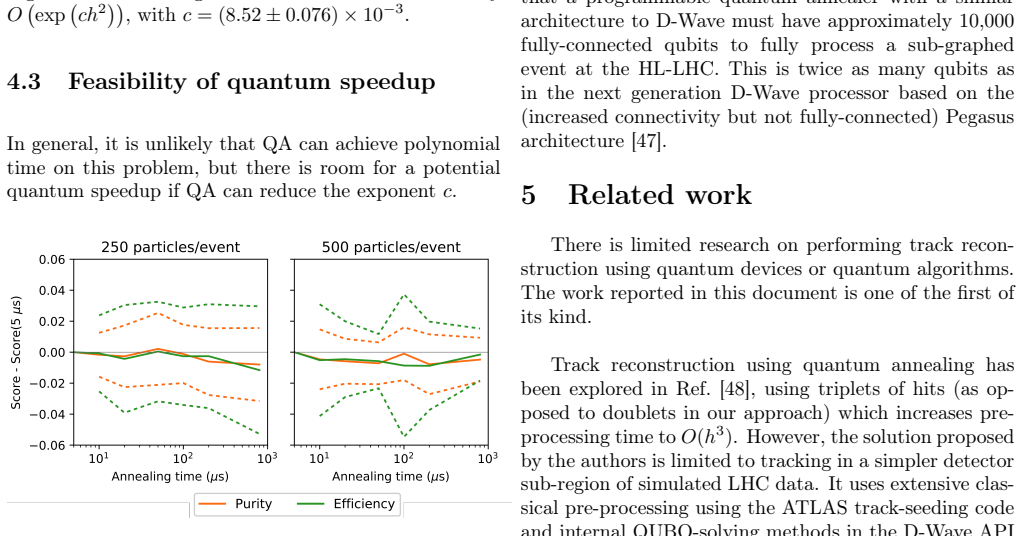
- Quantum annealing at the shortest tested time (5 microseconds) already solves the sub-QUBOs as well as longer anneals, so the speedup question cannot be settled until larger problems can be embedded.
- The exponential growth of simulated-annealing time with sub-graph size means the practical bottleneck is the size distribution of sub-graphs, not the raw number of hits in the event.
Reading between the lines
- Removing duplicate hits with ground truth (as done in Section 3.3) is the assumption most likely to change the difficulty of the problem; a direct test would rerun the pipeline with geometric duplicate removal and compare at 200 pileup.
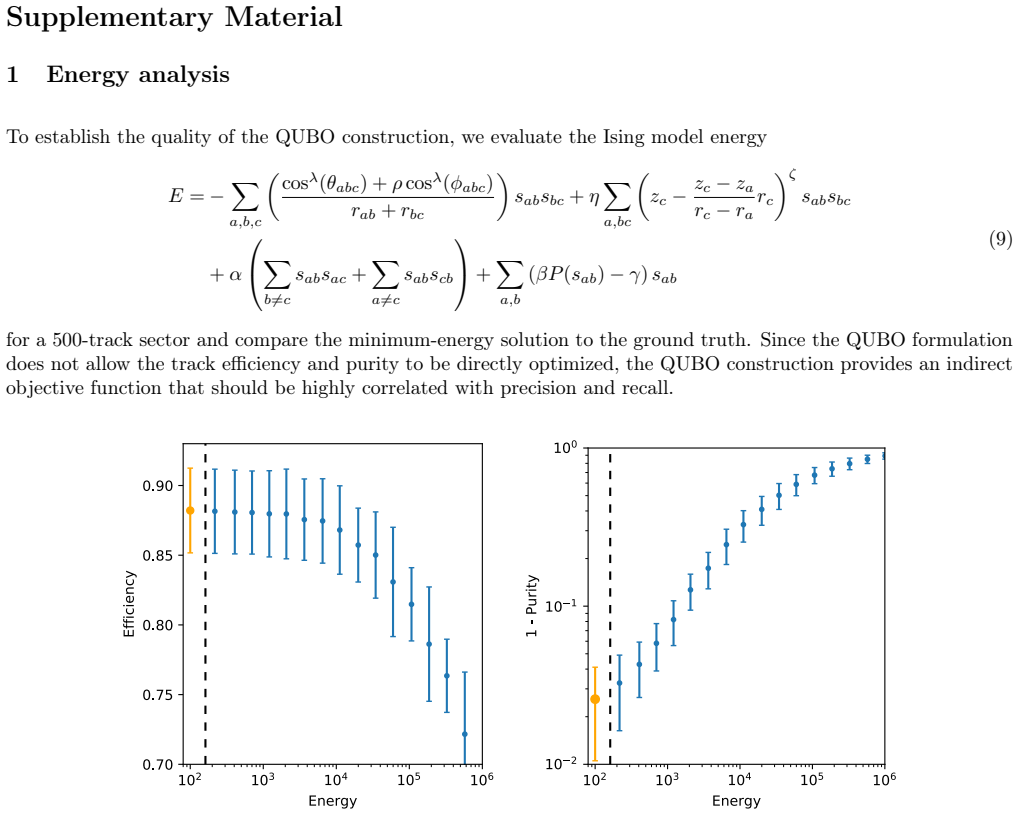
- The energy function's visible correlation with track efficiency and purity suggests the same QUBO could serve as a differentiable loss or regularizer for learned track-finding networks, although the paper does not explore this.
- Because the 5 microsecond anneal already saturates performance on these small sub-QUBOs, any quantum speedup, if it exists, would appear only when sub-QUBOs grow beyond what today's annealers can embed; that is a hardware test the paper cannot yet perform.
Signed reviews
Editorial analysis
A structured set of objections, weighed in public.
Referee Report
Summary. The paper presents a QUBO-based track reconstruction method for charged particles, adapting the Denby-Peterson Hopfield-network formulation to an Ising/QUBO objective with additional terms for helical geometry, beamspot constraints, and a KDE-based edge prior. The authors preprocess TrackML data by sectoring, KDE-based edge selection, and sub-graphing, then solve the resulting QUBOs with simulated annealing and on the D-Wave 2X. They report purity and efficiency that remain roughly stable with track multiplicity, and they attribute the reconstruction quality primarily to the QUBO solver rather than to the preprocessing heuristics. They also analyze the scaling of simulated annealing and explicitly leave the quantum speedup question open.
Significance. If the central claim were fully supported, this would be a useful proof-of-concept for applying quantum and quantum-inspired optimization to HL-LHC track reconstruction, with a clear mapping of a realistic physics problem to QUBO and a concrete hardware demonstration. The paper is careful to state caveats: it does not claim a quantum speedup, it notes that duplicate hits are removed using ground truth, and it reports limited qubit scalability. The explicit formulation of the track segment classification problem and the complexity analysis of preprocessing are valuable. However, the reported performance numbers are currently not fully convincing because the evaluation uses ground truth in preprocessing and lacks a held-out validation, and the baseline used to attribute the tracking to the QUBO solver is too weak.
major comments (3)
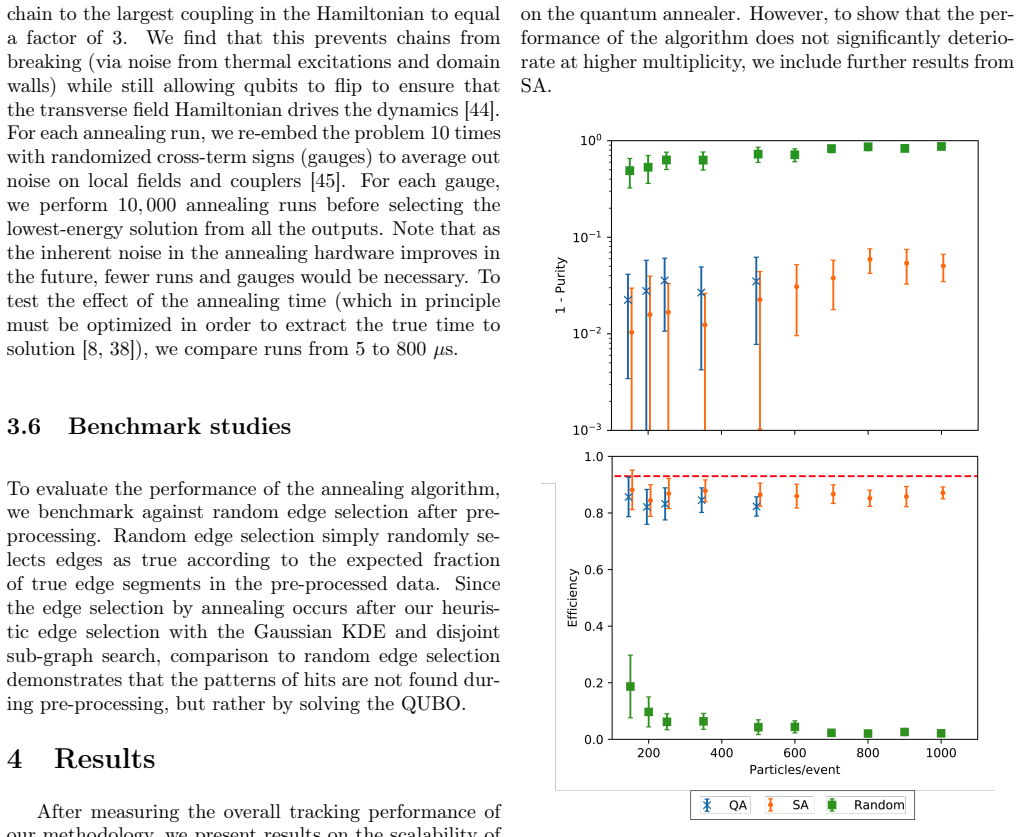
- [Section 3.6, Eq. (8)] The comparison to random edge selection cannot support the inference that "the patterns of hits are not found during pre-processing, but rather by solving the QUBO." The Gaussian KDE prior P(sab) enters the QUBO as the linear coefficient (βP(sab)-γ); random selection discards this information, so it is not a meaningful control. Add a greedy baseline that orders candidate edges by P(sab) and rejects edges sharing a hit, and compare its purity and efficiency to the SA and QA results. Without this control, the attribution of the reconstruction quality to the combinatorial optimization is unestablished.
- [Section 3.3] The decision to "use ground truth information for ease of processing" to remove duplicate hits changes the problem instance. Duplicate hits are part of the HL-LHC hit combinatorics, and removing them using ground truth means the reported efficiencies and purities are not measured on the actual challenge. Please provide an ablation that includes duplicate hits, or an explicit estimate of the effect, or clearly restrict the claims to the duplicate-free simplified problem. As written, this simplification affects the central feasibility claim for HL-LHC conditions.
- [Section 3.2 and Section 3.4.1, Table 1] The QUBO parameters are optimized by Bayesian optimization on 500-particle TrackML events to maximize F1, and the KDE prior is trained on ground-truth edges from the same dataset; no held-out validation is described. The performance reported in Section 4 may therefore reflect tuning to the test data. Please report results on an explicitly held-out validation set (e.g., different events or a k-fold split), and state whether the parameters are re-tuned per event or fixed.
minor comments (6)
- [Section 3.2, Eq. (8)] The sum over "a,bc" in the beamspot term should be "a,b,c" to match Eq. (6).
- [Figure 11 caption] The caption refers to "random annealing" while the text describes "random edge selection"; please make the terms consistent.
- [Introduction, last paragraph] The phrase "We provide a concluding analysis of potential real-world applications in section 5. section 5." contains a duplicated "section 5."; remove the repetition.
- [Section 4.1] Purity and Efficiency are defined at the track level, but the paper does not specify how a "reconstructed track" is obtained from the selected edge variables (e.g., connected components or a maximum-segment criterion); please clarify so the metrics are reproducible.
- [Section 3.4] The notation "1010" and "103" should be rendered with superscripts to avoid ambiguity.
- [Supplementary Material, Section 3] The statement that the convergence analysis seeks a lower bound on runtime should be reconciled with the fitted exponential constant, since the epsilon-close criterion for the 2000-track point may make the lower bound non-uniform across multiplicities; suggest adding a sentence in the main text.
Circularity Check
The central attribution claim is partially circular: the trained KDE prior and F1-tuned parameters are embedded in the QUBO, yet the random baseline used to attribute 'the majority of tracking' to the solver discards that prior information.
-
fitted input called prediction
[Section 3.4.1 (Gaussian kernel density estimation), Eq. (7)-(8), Section 3.6 (Benchmark studies)]
"Random edge selection simply randomly selects edges as true according to the expected fraction of true edge segments in the pre-processed data. Since the edge selection by annealing occurs after our heuristic edge selection with the Gaussian KDE and disjoint sub-graph search, comparison to random edge selection demonstrates that the patterns of hits are not found during pre-processing, but rather by solving the QUBO."
The QUBO's linear term in Eq. (8) is -sum(βP(sab)-γ)sab, where P(sab) is the Gaussian KDE prior trained on ground-truth edges from TrackML data. The random baseline discards P(sab), so it is a degenerate control: any sensible use of the KDE scores, such as greedy acceptance by descending P(sab) with a bifurcation constraint, would outperform random selection. Therefore the comparison cannot show that 'patterns of hits' are found by the solver rather than by the trained prior. The attribution of reconstruction quality to 'solving the QUBO' double-counts the fitted prior that was inserted into the QUBO as an input.
-
fitted input called prediction
[Section 3.2 (Modified QUBO for HL-LHC) and Section 4.1 (Tracking efficiency and purity)]
"The parameters are optimized by Bayesian optimization, sampling regions of the parameter space that are expected to provide the largest improvement in the objective function according to Bayesian inference. ... a total of 100 parameter sets were sampled on TrackML events with 500 particles/event to maximize the F1 score (the harmonic mean between purity and efficiency) using SA."
The headline SA purity/efficiency results include the 500-particle/event configuration, which is exactly the configuration on which the QUBO parameters were selected to maximize F1. The 500-track benchmark is therefore an in-sample optimized quantity, not an independent prediction. Combined with the ground-truth-trained KDE prior, the reported performance at 500 tracks is substantially a report of fitted inputs; the remaining extrapolative content is the scaling to 1000 and 2000 tracks, but the central attribution of 'the majority of tracking' to the solver is not independently supported.
full rationale
The paper is not a pure renaming of a known result, and no load-bearing self-citation chain is used: Refs. [8] and [45] support general annealing methodology and gauge averaging, not the tracking claim. However, the central derivation is not fully self-contained. The Gaussian KDE prior P(sab) is trained on ground-truth segments from TrackML data and then inserted into the QUBO via Eq. (7)-(8); the QUBO parameters are selected by Bayesian optimization on TrackML 500-particle events to maximize F1. The reported 500-track purities/efficiencies are therefore in-sample optimized quantities. More importantly, Section 3.6's random-selection baseline cannot establish that the solver, rather than the KDE prior, is responsible for reconstruction quality, because random selection discards the very edge-score information that the QUBO receives. A greedy KDE-only baseline is needed before the attribution claim is supported. The ground-truth-based removal of duplicate hits (Section 3.3) is a stated simplification and a correctness risk, but it is not itself a circular step. Because some extrapolative content remains (fixed parameters at higher multiplicities, geometric pair/triplet terms, and comparison between SA and QA), the circularity is partial rather than total.
Assumptions & free parameters
free parameters (11)
- lambda =
13.17
- rho =
5.00
- eta =
14.41
- zeta =
1.79
- alpha =
86.20
- beta =
20.91
- gamma =
9.79
- tau =
0.996
- KDE cutoff threshold =
not specified
- KDE bandwidth =
not specified
- characteristic lengths for scaling =
(1000, pi, 1000)
assumptions (5)
- domain assumption Charged particle tracks in the LHC tracker are well approximated by helices in a uniform axial magnetic field.
- domain assumption The beam spot is small (about 5.5 mm in z), so true tracks should extrapolate back near the origin in the rz-plane.
- domain assumption The TrackML simulated dataset is representative of HL-LHC conditions with up to about 200 pileup.
- domain assumption The Gaussian KDE prior trained on ground-truth edges from TrackML generalizes to the events used for evaluation.
- domain assumption The sub-graphing step that keeps only the 5 highest-bias edges per node preserves enough true edges for reconstruction.
Cite this review
Pith. "Pith review of Charged particle tracking with quantum annealing-inspired optimization." pith.science (2026). https://pith.science/paper/OMMZDSUM
@misc{pith2026190804475,
  author       = {Pith},
  title        = {Pith review of: Charged particle tracking with quantum annealing-inspired optimization},
  year         = {2026},
  howpublished = {\url{https://pith.science/paper/OMMZDSUM}},
  note         = {Machine review of arXiv:1908.04475}
}
read the original abstract
At the High Luminosity Large Hadron Collider (HL-LHC), traditional track reconstruction techniques that are critical for analysis are expected to face challenges due to scaling with track density. Quantum annealing has shown promise in its ability to solve combinatorial optimization problems amidst an ongoing effort to establish evidence of a quantum speedup. As a step towards exploiting such potential speedup, we investigate a track reconstruction approach by adapting the existing geometric Denby-Peterson (Hopfield) network method to the quantum annealing framework and to HL-LHC conditions. Furthermore, we develop additional techniques to embed the problem onto existing and near-term quantum annealing hardware. Results using simulated annealing and quantum annealing with the D-Wave 2X system on the TrackML dataset are presented, demonstrating the successful application of a quantum annealing-inspired algorithm to the track reconstruction challenge. We find that combinatorial optimization problems can effectively reconstruct tracks, suggesting possible applications for fast hardware-specific implementations at the LHC while leaving open the possibility of a quantum speedup for tracking.
Figures
Figures from the paper (17 more)

Forward citations
Cited by 3 Pith papers
-
Quantum Algorithms for Jet Clustering
Thrust can be computed in O(N^2) time with a Grover-based quantum algorithm under a sequential data-loading model, and in O(N^2 log N) time classically with sorting, but the quantum advantage is only formal for very r...
-
Efficient Quantum Simulation of QCD Jets on the Light Front
A direct second-quantized qubit encoding of the light-front QCD Hamiltonian is used to classically emulate in-medium jet evolution with up to three-particle Fock states.
-
Quantum adiabatic machine learning with zooming
QAML-Z, an iterative zooming and classifier-augmentation upgrade to QAML, improves Higgs classification AUROC over QAML and matches a deep neural network at small training set sizes, but a classical simulated-annealin...
Reference graph
Works this paper leans on
-
[1]
A Roadmap for HEP Software and Computing R&D for the 2020s
The HEP Software Foundation et al. “A Roadmap for HEP Software and Computing R&D for the 2020s”. In:Computing and Software for Big Science 3.1 (2019), p. 7. issn: 2510-2044. doi: 10 . 1007 / s41781-018-0018-8 . url: https://doi.org/10. 1007/s41781-018-0018-8
work page 2019
-
[2]
High-Luminosity Large HadronCollider(HL-LHC)
G. Apollinari et al. “High-Luminosity Large HadronCollider(HL-LHC)”.In: CERN Yellow Rep. Monogr.4 (2017), pp. 1–516.doi: 10.23731/CYRM- 2017-004
doi:10.23731/cyrm- 2017
-
[3]
Parallelized Kalman-Filter-Based Reconstruction of Particle Tracks on Many-Core Architectures
G Cerati et al. “Parallelized Kalman-Filter-Based Reconstruction of Particle Tracks on Many-Core Architectures”. In:Journal of Physics: Conference Series 1085 (2018), p. 042016.doi: 10.1088/1742- 6596/1085/4/042016. url: https://doi.org/10. 1088%2F1742-6596%2F1085%2F4%2F042016. 11
doi:10.1088/1742- 2018
-
[4]
Parallel track reconstruction in CMS using the cellular automaton approach
Daniel Funke et al. “Parallel track reconstruction in CMS using the cellular automaton approach”. In: J. Phys. Conf. Ser.513 (2014), p. 052010.doi: 10.1088/1742-6596/513/5/052010
-
[5]
Novel deep learning meth- ods for track reconstruction
Steven Farrell et al. “Novel deep learning meth- ods for track reconstruction”. In:4th International Workshop Connecting The Dots 2018 (CTD2018) Seattle, Washington, USA, March 20-22, 2018
work page 2018
-
[6]
Quantum annealing in the transverse Ising model
Tadashi Kadowaki and Hidetoshi Nishimori. “Quantum annealing in the transverse Ising model”. In: Phys. Rev. E58 (5 1998), pp. 5355–5363.doi: 10.1103/PhysRevE.58.5355. url: https://link. aps.org/doi/10.1103/PhysRevE.58.5355
-
[7]
Quantum adiabatic evolution algorithms versus simulated annealing
Edward Farhi, Jeffrey Goldstone, and Sam Gut- mann. “Quantum adiabatic evolution algorithms versus simulated annealing”. In: arXiv preprint quant-ph/0201031 (2002)
arXiv 2002
-
[8]
Demonstra- tion of a Scaling Advantage for a Quantum An- nealer over Simulated Annealing
Tameem Albash and Daniel A. Lidar. “Demonstra- tion of a Scaling Advantage for a Quantum An- nealer over Simulated Annealing”. In:Phys. Rev. X 8 (3 2018), p. 031016.doi: 10.1103/PhysRevX. 8.031016. url: https://link.aps.org/doi/10. 1103/PhysRevX.8.031016
doi:10.1103/physrevx 2018
Show all 60 references
-
[9]
SolvingaHiggsoptimizationprob- lem with quantum annealing for machine learning
AlexMottetal.“SolvingaHiggsoptimizationprob- lem with quantum annealing for machine learning”. In: Nature 550 (Oct. 2017), 375 EP –.url: http: //dx.doi.org/10.1038/nature24047
2017 doi
-
[10]
Quantum annealing versus classical machine learning applied to a simplified computational biology problem
Richard Y. Li et al. “Quantum annealing versus classical machine learning applied to a simplified computational biology problem”. In:npj Quantum Information 4.1 (2018), p. 14. doi: 10 . 1038 / s41534 - 018 - 0060 - 8. url: https : / / doi . org / 10.1038/s41534-018-0060-8
2018 doi
-
[11]
Description and perfor- mance of track and primary-vertex reconstruction with the CMS tracker
The CMS Collaboration. “Description and perfor- mance of track and primary-vertex reconstruction with the CMS tracker”. In:Journal of Instrumen- tation 9.10 (2014), P10009–P10009.doi: 10.1088/ 1748 - 0221 / 9 / 10 / p10009. url: https : / / doi . org/10.1088%2F1748-0221%2F9%2F...
2014
-
[12]
Identification of b-Quark Jets with the CMS Experiment
Serguei Chatrchyan et al. “Identification of b-Quark Jets with the CMS Experiment”. In: JINST 8 (2013), P04013. doi: 10.1088/1748- 0221/8/04/ P04013. arXiv: 1211.4462 [hep-ex]
2013 arXiv
-
[13]
Identification of heavy- flavour jets with the CMS detector in pp collisions at 13 TeV
A. M. Sirunyan et al. “Identification of heavy- flavour jets with the CMS detector in pp collisions at 13 TeV”. In:JINST 13.05 (2018), P05011. doi: 10.1088/1748-0221/13/05/P05011. arXiv: 1712. 07158 [physics.ins-det]
2018 doi
-
[14]
Performance ofb-Jet Identifica- tion in the ATLAS Experiment
Georges Aad et al. “Performance ofb-Jet Identifica- tion in the ATLAS Experiment”. In:JINST 11.04 (2016), P04008. doi: 10.1088/1748-0221/11/04/ P04008. arXiv: 1512.01094 [hep-ex]
2016 arXiv
-
[15]
Measurements of b-jet tag- ging efficiency with the ATLAS detector usingtt events at √s = 13 TeV
Morad Aaboud et al. “Measurements of b-jet tag- ging efficiency with the ATLAS detector usingtt events at √s = 13 TeV”. In:JHEP 08 (2018), p. 089. doi: 10 . 1007 / JHEP08(2018 ) 089. arXiv: 1805.01845 [hep-ex]
2018 arXiv
-
[16]
Pileup Removal Algorithms. Tech. rep. CMS-PAS- JME-14-001. Geneva: CERN, 2014.url: http:// cds.cern.ch/record/1751454
2014
-
[17]
Performance of the CMS missing transverse momentum reconstruction in pp data at√s = 8 TeV
Vardan Khachatryan et al. “Performance of the CMS missing transverse momentum reconstruction in pp data at√s = 8 TeV”. In:JINST 10.02 (2015), P02006. doi: 10.1088/1748-0221/10/02/P02006. arXiv: 1411.0511 [physics.ins-det]
2015 arXiv
-
[18]
Performance of miss- ing transverse momentum reconstruction in proton- proton collisions at√s = 13 TeV using the CMS detector
Albert M Sirunyan et al. “Performance of miss- ing transverse momentum reconstruction in proton- proton collisions at√s = 13 TeV using the CMS detector”. In:JINST 14.07 (2019), P07004. doi: 10.1088/1748-0221/14/07/P07004. arXiv: 1903. 06078 [hep-ex]
2019 doi
-
[19]
Particle-flow reconstruction and global event description with the CMS detec- tor
A. M. Sirunyan et al. “Particle-flow reconstruction and global event description with the CMS detec- tor”. In:JINST 12.10 (2017), P10003. doi: 10 . 1088 / 1748 - 0221 / 12 / 10 / P10003. arXiv: 1706 . 04965 [physics.ins-det]
2017
-
[20]
The CMS trigger sys- tem
V. Khachatryan et al. “The CMS trigger sys- tem”. In:Journal of Instrumentation12.01 (2017), P01020–P01020.doi: 10.1088/1748-0221/12/01/ p01020. url: https://doi.org/10.1088%2F1748- 0221%2F12%2F01%2Fp01020
2017 doi
-
[21]
Track and vertex reconstruction: From classical to adaptive methods
Are Strandlie and Rudolf Fruhwirth. “Track and vertex reconstruction: From classical to adaptive methods”. In:Rev. Mod. Phys.82 (2010), pp. 1419–
2010
-
[22]
Track fitting with multiple scatter- ing: A new method
Pierre Billoir. “Track fitting with multiple scatter- ing: A new method”. In:Nuclear Instruments and Methods in Physics Research225.2 (1984), pp. 352 –366.issn: 0167-5087. doi: https : / / doi . org / 10 . 1016 / 0167 - 5087(84 ) 90274 - 6. url: http : / / www . sciencedirect ....
1984
-
[23]
Machine Analysis of Bubble ChamberPictures
P. V. C. Hough. “Machine Analysis of Bubble ChamberPictures”.In:Conf. Proc.C590914(1959), pp. 554–558
1959
-
[24]
Fast Hough-transform track recon- struction for the ALICE TPC
C. Cheshkov. “Fast Hough-transform track recon- struction for the ALICE TPC”. In:Nuclear Instru- ments and Methods in Physics Research Section A: Accelerators, Spectrometers, Detectors and Associ- ated Equipment 566.1 (2006). TIME 2005, pp. 35 –39.issn: 0168-9002. doi: https :...
2006
-
[25]
Neural networks and cellular automata in experimental high energy physics
B. Denby. “Neural networks and cellular automata in experimental high energy physics”. In:Computer Physics Communications 49.3 (1988), pp. 429 –
1988
-
[26]
Track finding with neural net- works
Carsten Peterson. “Track finding with neural net- works”. In:Nuclear Instruments and Methods in Physics Research Section A: Accelerators, Spec- trometers, Detectors and Associated Equipment 279.3 (1989), pp. 537 –545.issn: 0168-9002. doi: https : / / doi . org / 10 . 1016 / 016...
1989
-
[27]
Fast track finding with neural networks
Georg Stimpfl-Abele and LluÃs Garrido. “Fast track finding with neural networks”. In:Computer Physics Communications 64.1 (1991), pp. 46 –56. issn: 0010-4655. doi: https : / / doi . org / 10 . 1016 / 0010 - 4655(91 ) 90048 - P. url: http : / / www.sciencedirect.com/science/artic...
1991
-
[28]
CMS Tracking POG Performance Plots For 2017 with PhaseI pixel detector. 2017. url: https : / / twiki . cern . ch / twiki / bin / view / CMSPublic / TrackingPOGPerformance2017MC#Timing
2017
-
[29]
Quantum Computation by Adiabatic Evolution
Edward Farhi et al. “Quantum Computation by Adiabatic Evolution”. In:arXiv:quant-ph/0001106 (Jan. 2000). url: http://arxiv.org/abs/quant- ph/0001106 (visited on 03/24/2015)
2000 arXiv
-
[30]
Ising formulations of many NP prob- lems
A. Lucas. “Ising formulations of many NP prob- lems”. In:Front. Phys.2 (2014), p. 5.doi: 10.3389/ fphy.2014.00005
2014
-
[31]
Tracking by a modified rotor model of neural network
S. Baginyan et al. “Tracking by a modified rotor model of neural network”. In:Computer Physics Communications 79.2 (1994), pp. 165 –178.issn: 0010-4655. doi: https : / / doi . org / 10 . 1016 / 0010 - 4655(94 ) 90065 - 5 . url: http : / / www . sciencedirect . com / science / a...
1994
-
[32]
Neural tracking in the ALICE Inner Tracking System
A. Pulvirenti et al. “Neural tracking in the ALICE Inner Tracking System”. In:Nuclear Instruments and Methods in Physics Research Section A: Ac- celerators, Spectrometers, Detectors and Associated Equipment 533.3 (2004), pp. 543 –559.issn: 0168-
2004
-
[33]
A recurrent neural network for track reconstruction in the LHCb Muon System
G. Passaleva. “A recurrent neural network for track reconstruction in the LHCb Muon System”. In: 2008 IEEE Nuclear Science Symposium Conference Record. 2008, pp. 867–872.doi: 10.1109/NSSMIC. 2008.4774532
2008
-
[34]
TrackML: A High Energy Physics Particle Tracking Challenge
Polo Calafiura et al. “TrackML: A High Energy Physics Particle Tracking Challenge”. In:Proceed- ings, 14th International Conference on e-Science: Amsterdam, Netherlands, October 29-November 1,
-
[35]
Mapping Constrained Opti- mizationProblemstoQuantumAnnealingwithAp- plication to Fault Diagnosis
Zhengbing Bian et al. “Mapping Constrained Opti- mizationProblemstoQuantumAnnealingwithAp- plication to Fault Diagnosis”. In:Frontiers in ICT3 (2016), p. 14.issn: 2297-198X.doi: 10.3389/fict. 2016 . 00014. url: https : / / www . frontiersin . org/article/10.3389/fict.2016.00014
2016
-
[36]
Applied computer science
Shane Torbert. Applied computer science. Springer, 2016
2016
-
[37]
Evidence for quantum annealing with more than one hundred qubits
S. Boixo et al. “Evidence for quantum annealing with more than one hundred qubits”. In:Nature Physics 10 (Mar. 2014), pp. 218–224. doi: 10 . 1038/nphys2900. arXiv: 1304.4595 [quant-ph]
2014 arXiv
-
[38]
Defining and detecting quantum speedup
Troels F. Rønnow et al. “Defining and detecting quantum speedup”. In:Science 345.6195 (2014), pp. 420–424. issn: 0036-8075. doi: 10 . 1126 / science . 1252319. eprint: https : / / science . sciencemag.org/content/345/6195/420.full. pdf. url: https : / / science . sciencemag . o...
2014
- [39]
-
[40]
Minor-embedding in adiabatic quan- tum computation: I. The parameter setting prob- lem
Vicky Choi. “Minor-embedding in adiabatic quan- tum computation: I. The parameter setting prob- lem”. In: Quantum Information Processing 7.5 (2008), pp. 193–209. issn: 1573-1332. doi: 10 . 1007/s11128- 008- 0082- 9 . url: https://doi. org/10.1007/s11128-008-0082-9
2008 doi
-
[41]
Minor-embedding in adiabatic quan- tum computation: II. Minor-universal graph de- sign
Vicky Choi. “Minor-embedding in adiabatic quan- tum computation: II. Minor-universal graph de- sign”. In:Quantum Information Processing 10.3 (2011), pp. 343–353. issn: 1573-1332. doi: 10 . 1007/s11128- 010- 0200- 3 . url: https://doi. org/10.1007/s11128-010-0200-3
2011 doi
-
[42]
Adiabatic quantum programming: minor embedding with hard faults
Christine Klymko, Blair D. Sullivan, and Travis S. Humble. “Adiabatic quantum programming: minor embedding with hard faults”. In:Quant. Inf. Proc. 13.3 (2014), pp. 709–729.doi: 10.1007/s11128- 013-0683-9. url: http://dx.doi.org/10.1007/ s11128-013-0683-9
2014 doi
-
[43]
A practical heuristic for finding graph minors
Jun Cai, William G. Macready, and Aidan Roy. “A practical heuristic for finding graph minors”. In: arXiv:1406.2741 (2014). url: http://arXiv.org/ abs/1406.2741. 13
2014 arXiv
-
[44]
Architectural Considerations in the Design of a Superconducting Quantum Anneal- ing Processor
P. I. Bunyk et al. “Architectural Considerations in the Design of a Superconducting Quantum Anneal- ing Processor”. In:IEEE Transactions on Applied Superconductivity24.4 (2014), pp. 1–10.issn: 1051-
2014
-
[45]
Test-driving 1000 qubits
Joshua Job and Daniel Lidar. “Test-driving 1000 qubits”. In:Quantum Science and Technology3.3 (2018), p. 030501. doi: 10 . 1088 / 2058 - 9565 / aabd9b. url: https://doi.org/10.1088%2F2058- 9565%2Faabd9b
2018
-
[46]
D-Wave White Paper: Improved coherence leads to gains in quantum annealing performance. 2019. url: https : / / www . dwavesys . com / sites / default / files / 14 - 1037A - A _ Improved _ coherence _ leads _ to _ gains _ QA _ performance . pdf
2019
-
[47]
Next-Generation Topology of D-Wave Quantum Processors
Kelly Boothby et al. Next-Generation Topology of D-Wave Quantum Processors. Tech. rep. D-Wave Systems Inc., 2019.url: https://www.dwavesys. com / sites / default / files / 14 - 1026A - C _ Next - Generation - Topology - of - DW - Quantum - Processors.pdf
2019
-
[48]
A pattern recognition algo- rithm for quantum annealers
Frederic Bapst et al. “A pattern recognition algo- rithm for quantum annealers”. In:arXiv preprint arXiv:1902.08324 (2019). url: https : / / arxiv . org/abs/1902.08324
2019 arXiv
-
[49]
Quantum As- sociative Memory in HEP Track Pattern Recogni- tion
Illya Shapoval and Paolo Calafiura. “Quantum As- sociative Memory in HEP Track Pattern Recogni- tion”. In:arXiv preprint arXiv:1902.00498 (2019). url: https://arxiv.org/abs/1902.00498
2019 arXiv
-
[50]
Quantum Optimization of Fully Connected Spin Glasses
Davide Venturelli et al. “Quantum Optimization of Fully Connected Spin Glasses”. In:Phys. Rev. X5 (3 2015), p. 031040. doi: 10.1103/PhysRevX.5. 031040. url: https : / / link . aps . org / doi / 10 . 1103/PhysRevX.5.031040
2015 doi
-
[51]
An accelerator architec- ture for combinatorial optimization problems
Sanroku Tsukamoto et al. “An accelerator architec- ture for combinatorial optimization problems”. In: Fujitsu Scientific & Technical Journal53.5 (2017), pp. 8–13
2017
-
[52]
A coherent Ising ma- chine for 2000-node optimization problems
Takahiro Inagaki et al. “A coherent Ising ma- chine for 2000-node optimization problems”. In:Sci- ence 354.6312 (2016), pp. 603–606.issn: 0036-8075. doi: 10 . 1126 / science . aah4243. eprint: https : / / science . sciencemag . org / content / 354 / 6312 / 603 . full . pdf. ur...
2016
-
[53]
Optimization by Simulated Annealing
S. Kirkpatrick, C. D. Gelatt, and M. P. Vecchi. “Optimization by Simulated Annealing”. In:Sci- ence 220.4598 (1983), pp. 671–680.issn: 0036-8075. doi: 10 . 1126 / science . 220 . 4598 . 671. eprint: https : / / science . sciencemag . org / content / 220/4598/671.full.pdf. url:...
1983
-
[56]
Track clustering with a quantum annealer for primary vertex reconstruc- tion at hadron colliders
Souvik Das et al. “Track clustering with a quantum annealer for primary vertex reconstruc- tion at hadron colliders”. In: arXiv preprint arXiv:1903.08879 (2019). url: https : / / arxiv . org/abs/1903.08879
2019 arXiv
-
[60]
partial QUBO 3) bifurcation refinement2) full QUBO QUBO construction (only cross terms w/ out bifurcations) Disjoint subgraph flood-fill search Singlet selection with Gaussian KDE Annealing Mask edge subset QUBO construction (all terms) Disjoint subgraph flood-fill search Anne...
2000
-
[448]
doi: https : / / doi
issn: 0010-4655. doi: https : / / doi . org / 10 . 1016 / 0010 - 4655(88 ) 90004 - 5. url: http : / / www . sciencedirect . com / science / article / pii/0010465588900045
-
[1458]
doi: 10.1103/RevModPhys.82.1419
-
[2018]
06111 [hep-ex]
arXiv: 1810 . 06111 [hep-ex]. url: http : //lss.fnal.gov/archive/2018/conf/fermilab- conf-18-598-cd.pdf
2018
-
[8223]
doi: 10.1109/TASC.2014.2318294
2014
-
[9002]
2004.06.176
doi: https://doi.org/10.1016/j.nima. 2004.06.176. url: http://www.sciencedirect. com/science/article/pii/S0168900204016754
2004 doi
Reviewed August 14, 2026 · model on record in the stance chip above.
Discussion (0). Continue with ORCID to comment.