REVIEW 3 major objections 4 minor 24 references
A stochastic MPC scheme for distributed systems with multiplicative uncertainty
T0 review · 3 major / 4 minor · reviewed 2026-08-14 · deepseek-v4-flash
Pith's one-line read A feasible start guarantees recursive feasibility, mean-square convergence, and chance constraint satisfaction in distributed stochastic MPC.
desk verdict A promising distributed stochastic MPC scheme whose main theorem does not cover the actual preferred feedback branch (S1), leaving the convergence guarantee unproven for the implemented algorithm. read the letter →
The pith
A machine-rendered reading of the paper's core claim, the machinery that carries it, and where it could break.
The reading
What carries the argument
The central machinery is a distributed terminal design: a block-diagonal terminal cost $V_{f,i}(z_i)=z_i^\top P_i z_i$, a structured local terminal controller $K_{N_i}$, time-varying local terminal sets $Z_{f,i}(\alpha_i(k))$ whose sizes are updated by relaxation functions $\Gamma_{N_i}$, and a block-diagonal terminal covariance bound $\hat{\Sigma}_{f,i}$. These are computed by solving distributed LMIs and a distributed linear program, and they make the terminal region invariant while satisfying tightened mean and covariance constraints. Online, the global optimization problem is rewritten in consensus form and solved in parallel by ADMM; each subsystem optimizes over its own and its neighbors' predicted trajectories and exchanges copies to reach agreement. Chance constraints are converted into deterministic constraints on means, inputs, and covariances via Cantelli's inequality, $f(p)=\sqrt{p/(1-p)}$, and then linearized with a parameter $\epsilon$ that trades conservatism against feasibility.
What would settle it
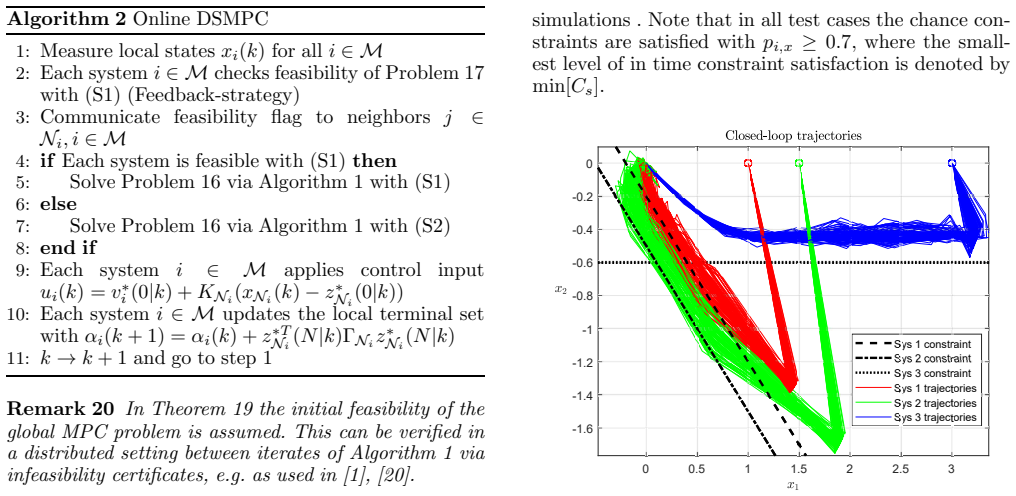
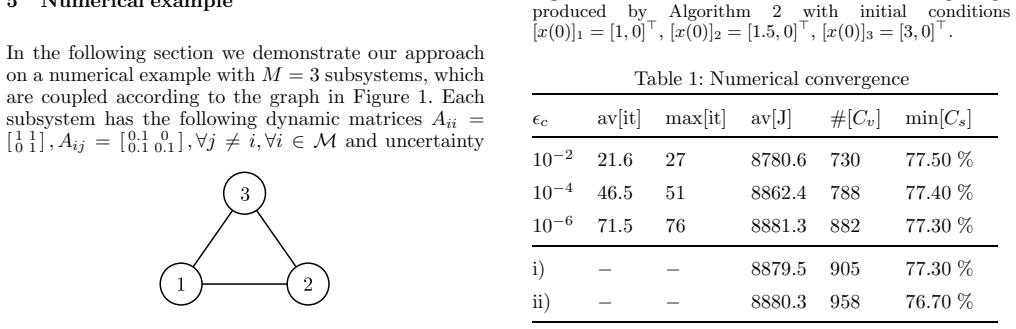
A decisive test is to run the Section 5 example with a boundary-feasible initial condition and decreasing stopping tolerances $\epsilon_c=10^{-2},10^{-4},10^{-6}$; if any closed-loop trajectory under finite $\epsilon_c$ becomes infeasible at the next step, or violates the chance constraint at the required $p_{i,x} \ge 0.7$, then the theorem's guarantees do not extend to the implemented algorithm.
Extended reading notes
Core claim
The paper establishes that every stabilizing ingredient of stochastic MPC—terminal cost, terminal controller, terminal set scaling, and covariance bound—can be synthesized distributedly for multiplicative uncertainties, and the online distributed problem then inherits the recursive feasibility, mean-square stability, and chance constraint satisfaction of the centralized design. Specifically, Theorem 19 states: if Problem 16 is feasible at $k=0$ and Algorithm 1 converges exactly (Assumption 18), then the closed loop is recursively feasible, $\mathbb{E}(\|x(k)\|_Q^2) \to 0$ as $k \to \infty$, and the chance constraints (2) are satisfied for all $k \ge 0$. This extends centralized stochastic MPC for multiplicative unbounded uncertainty to networks and removes the need for a central node in both offline design and online operation.
Load-bearing premise
The proof assumes the distributed optimization problem is solved exactly at every step, while the implemented algorithm stops at a finite tolerance, and the paper gives no bound on how this gap affects recursive feasibility, mean-square convergence, or chance constraint satisfaction.
Editorial extensions
If this is right
- Under the theorem's conditions, closed-loop trajectories of every subsystem satisfy their chance constraints at all times $k \ge 0$, even though the multiplicative noise has unbounded support.
- The terminal ingredients can be computed without a central node, so the method scales to larger networks where centralized synthesis or centralized initialization is intractable.
- With exact ADMM convergence, the closed loop is mean-square stable: $\mathbb{E}(\|x(k)\|_Q^2) \to 0$ as $k \to \infty$.
- The linearization parameter $\epsilon \in (0,1]$ gives the designer a dial for trading conservatism of the approximated chance constraints against feasibility and closed-loop cost.
- The two initialization strategies (feedback and prediction) let the controller maintain recursive feasibility even when resetting the mean and covariance to the measured state would be infeasible.
Reading between the lines
- Because Theorem 19 assumes exact convergence of the ADMM solver ($\epsilon_c=0$) whereas Algorithm 2 stops at a finite tolerance, the guarantees for the implemented controller are unquantified; a natural extension is to derive a bound on how suboptimality degrades recursive feasibility, mean-square convergence, and chance constraint satisfaction.
- The numerical table suggests a trade-off: looser ADMM tolerances act as extra constraint tightening and reduce observed violations, while tighter tolerances operate closer to the probabilistic limit and show more violations; using the tolerance as an intentional tuning knob is a testable idea the paper leaves open.
- As the paper notes in Remark 5, replacing the distribution-free Cantelli bound with the exact quantile of the disturbance should reduce conservatism; a quantitative comparison of feasible volume and closed-loop cost is a straightforward extension.
- The block-diagonal upper bound on each neighbor covariance is a deliberate source of conservatism; relaxing it would be a step toward the coupling chance constraints the conclusion names as future work.
Signed reviews
Editorial analysis
A structured set of objections, weighed in public.
Referee Report
Summary. The paper proposes a distributed stochastic model predictive control (DSMPC) scheme for networks of linear systems with multiplicative, unbounded zero-mean noise and local chance constraints. Chance constraints are converted, via Cantelli's inequality and a linearization, into constraints on the predicted mean and an upper bound on the predicted covariance. The terminal ingredients, including a structured terminal controller, terminal cost, relaxation functions, and terminal covariance bound, are synthesized through distributed LMIs and a distributed LP. The online algorithm solves the global MPC problem with consensus ADMM, using two initialization strategies: S1, which initializes the mean at the measured state and the covariance at zero, and S2, which uses the shifted optimal prediction from the previous step. The main result, Theorem 19, claims recursive feasibility, mean-square convergence of the state to zero, and satisfaction of the chance constraints at all times, assuming exact solution of the distributed optimization. A three-subsystem numerical example illustrates the closed-loop behavior and compares the distributed design with a centralized one.
Significance. If Theorem 19 were fully established, the paper would make a useful contribution: it provides a fully distributed, scalable stochastic MPC formulation for multiplicative uncertainty, avoiding a central node in both design and online computation. The chance-constraint bounds are derived from a distribution-independent inequality rather than tuned to the example, and the terminal design is genuinely distributed. The numerical study gives evidence of practical behavior over many Monte-Carlo runs. However, the theoretical guarantees as stated are not proven for the algorithm actually implemented: the proof covers only the shifted S2 branch, and the exact-ADMM assumption is not satisfied by the finite-tolerance stopping rule. These gaps are load-bearing for the central claims.
major comments (3)
- [Theorem 19, Algorithm 2, Appendix C] The proof of Theorem 19 constructs the feasible candidate at time k+1 by shifting the previous optimal solution, i.e. by setting the initial mean and covariance to (z*(1|k), Σ*(1|k)). This is exactly strategy S2 in constraint (23). However, Algorithm 2 (lines 4-8) solves Problem 16 with strategy S1, i.e. with (z0,Σ0)=(x(k+1),0), whenever the S1 feasibility check succeeds. The shifted candidate is not generally feasible for the S1 problem because it requires z0=z*(1|k) and Σ0=Σ*(1|k), not (x(k+1),0). No alternative feasible candidate is supplied for the S1 branch, so the cost-decrease inequality J*(k+1) ≤ J_m(1|k)+J_v(1|k) is not established for the branch that Algorithm 2 prefers. Consequently, the mean-square convergence argument applies only to a hypothetical run that always uses S2. This gap is independent of the ADMM tolerance issue.
- [Assumption 18, Algorithm 1] Theorem 19 assumes that Problem 16 is solved exactly, i.e. that Algorithm 1 converges with ε_c=0. The implemented Algorithm 2 uses the finite stopping criterion ||E_i ξ − y_i||_∞ ≤ ε_c, and ADMM convergence is asymptotic, so ε_c=0 is not reached in finitely many iterations. The manuscript does not quantify how a nonzero ADMM residue affects recursive feasibility, mean-square convergence, or chance constraint satisfaction. The theorem therefore guarantees properties of a limit that the online algorithm never attains. Please either state Theorem 19 explicitly for the idealized exact solver and treat the numerical scheme as an approximation, or provide a suboptimality bound that preserves the closed-loop properties.
- [Problem 16, Eq. (7)] The covariance propagation via (8)-(9) is valid only if Σ̂_{N_i}(t|k) is an upper bound on the true covariance Σ_{N_i}(t|k), as stated in (7). However, Problem 16 lists only (4a), (6), and (9) as constraints and does not include (7). If Σ̂ is a decision variable without the explicit constraint Σ̂_{N_i}(t|k) ⬣ Σ_{N_i}(t|k), the solver could choose Σ̂ too small, making the predicted covariance Σ_i(t+1|k) an underestimate of the true covariance and invalidating the chance constraint guarantee. Please add (7) to the problem statement, specify whether Σ̂ is a decision variable or a precomputed bound, and show that the constraint is preserved in the ADMM local problems.
minor comments (4)
- [Eqs. (5b), (6b)] In (5b) and (6b) the subscript r should be s, consistent with the input constraint index in (2b).
- [Section 3.3] The text says the synthesis is presented 'such that Assumption 4 is satisfied', but the relevant condition is Assumption 9 (the LMI (10)); please correct the cross-reference.
- [Appendix C] The claim that recursive feasibility and constraint satisfaction follow directly from [8, Lem. 8] and [8, Lem. 9] should be expanded, because [8] is a deterministic setting and the terminal covariance condition (17) has no counterpart there; a short argument showing that the stochastic terminal constraints are invariant under the α_i update would make the proof self-contained.
- [Algorithm 2, numerical example] The simulations do not report how often the S1 branch versus the S2 branch is selected, nor do they test the Lyapunov decrease on S1 steps; such a report would help assess whether the missing S1 analysis is a purely theoretical artifact or a practical issue.
Circularity Check
No load-bearing circularity: the central derivation rests on external invariance lemmas and Cantelli bounds, not on fitted quantities; the only self-citation is contextual.
full rationale
The derivation chain does not reduce to its own inputs. The chance-constraint tightening comes from Cantelli's inequality (Eq. (5)) plus a standard linearization with the explicit design parameter epsilon, not from fitted data. The terminal-cost and terminal-set synthesis in Problems (20)-(21) is an offline design: feasibility of (21) defines alpha, and Lemma 15 proves equivalence with Definition 11 rather than assuming the desired conclusion. The proof of Theorem 19 in Appendix C builds shifted candidates from the previous optimal solution and invokes the external distributed-invariance results [8, Lem. 8] and [8, Lem. 9]; those results are not authored by the present authors and are not stated in terms of Theorem 19's conclusion. The reliance on [10], [12], and [8] is normal prior work, and no 'uniqueness theorem' by the present authors is invoked to force a choice. The only self-citation, [17] in Section 1.1, is a contextual reference to the authors' earlier non-iterative DSMPC concept and is never used as a premise for the main theorem. The reviewer-identified weaknesses -- Assumption 18 requiring exact ADMM convergence while Algorithm 2 uses a finite stopping tolerance, and Appendix C providing a feasible candidate only for the S2 branch while Algorithm 2 may select S1 -- are genuine rigor gaps, but they are not circularity: Theorem 19 does not assume its conclusion under Algorithm 2; it gives an incomplete proof of that implication. A proof covering only one branch is a non-circular failure of implication, not an equivalence of output to input.
Assumptions & free parameters
free parameters (3)
- epsilon (ǫ) =
0.5 in the numerical example
- rho (ρ) =
10 in the numerical example
- epsilon_c (ǫc) =
10^-2, 10^-4, 10^-6 in simulations
assumptions (7)
- domain assumption Assumption 1: disturbances w_l and w_p are uncorrelated for l != p, zero mean, unit variance, unbounded support.
- domain assumption Assumption 3: the coupling graph is undirected.
- domain assumption Assumption 4: (A,B) is stabilizable with a structured linear feedback K(x) = col(K_Ni x_Ni).
- ad hoc to paper Assumption 9: there exist block-diagonal P and structured K such that the LMI (10) holds.
- ad hoc to paper Assumption 18: the distributed ADMM (Algorithm 1) converges exactly to the global optimum (ǫc = 0).
- standard math The Cantelli inequality and the linearization (6) are used without proof, citing [10].
- domain assumption The block-diagonal upper bound Sigma_Ni <= Sigma_hat_Ni in (7) is introduced to enable distributed optimization.
Cite this review
Pith. "Pith review of A stochastic MPC scheme for distributed systems with multiplicative uncertainty." pith.science (2026). https://pith.science/paper/VOTOLMHQ
@misc{pith2026190809337,
  author       = {Pith},
  title        = {Pith review of: A stochastic MPC scheme for distributed systems with multiplicative uncertainty},
  year         = {2026},
  howpublished = {\url{https://pith.science/paper/VOTOLMHQ}},
  note         = {Machine review of arXiv:1908.09337}
}
read the original abstract
This paper presents a Distributed Stochastic Model Predictive Control algorithm for networks of linear systems with multiplicative uncertainties and local chance constraints on the states and control inputs. The chance constraints are approximated via Cantelli's inequality by means of expected value and covariance. The cooperative control algorithm is based on the distributed Alternating Direction Method of Multipliers, which renders the controller fully distributedly implementable, recursively feasible and ensures point-wise convergence of the states. The aforementioned properties are guaranteed through a properly selected distributed invariant set and distributed terminal constraints for the mean and covariance. The paper closes with an example highlighting the chance constraint satisfaction, numerical properties and scalability of our approach.
Figures
Reference graph
Works this paper leans on
-
[9]
Distributed stochastic mpc of linear systems with paramete r uncertainty and disturbances
Li Dai, Yuanqing Xia, Yulong Gao, and Mark Cannon. Distributed stochastic mpc of linear systems with paramete r uncertainty and disturbances. In Proc. 2016 35th Chinese Control Conference (CCC) , pages 4312–4317. IEEE, 2016
work page 2016
-
[1]
Infeasibility detection in the alternating direction method of multipliers for convex optimization
Goran Banjac, Paul Goulart, Bartolomeo Stellato, and Stephen Boyd. Infeasibility detection in the alternating direction method of multipliers for convex optimization. In Proc. 2018 UKACC 12th International Conference on Control (CONTROL) , pages 340–340. IEEE, 2018
work page 2018
-
[2]
Scenario-bas ed model predictive control of stochastic constrained linear systems
Daniele Bernardini and Alberto Bemporad. Scenario-bas ed model predictive control of stochastic constrained linear systems. In Proc. 48h IEEE Conference on Decision and Control (CDC) held jointly with 2009 28th Chinese Control Conference, pages 6333–6338. IEEE, 2009
work page 2009
-
[3]
A probabilistic particle-control approximation of chance-constrained stochastic predicti ve control
Lars Blackmore, Masahiro Ono, Askar Bektassov, and Brian C Williams. A probabilistic particle-control approximation of chance-constrained stochastic predicti ve control. IEEE transactions on Robotics, 26(3):502–517, 2010
work page 2010
-
[4]
Linear matrix inequalities in system and control theory , volume 15
Stephen Boyd, Laurent El Ghaoui, Eric Feron, and Venkataramanan Balakrishnan. Linear matrix inequalities in system and control theory , volume 15. Siam, 1994
work page 1994
-
[5]
Stephen Boyd, Neal Parikh, Eric Chu, Borja Peleato, Jonathan Eckstein, et al. Distributed optimization and statistical learning via the alternating direction method of multipliers. Foundations and Trends® in Machine learning , 3(1):1–122, 2011
work page 2011
-
[6]
Stochastic tubes in model predictive control with probabilistic constraints
Mark Cannon, Basil Kouvaritakis, Saˇ sa V Rakovic, and Qifeng Cheng. Stochastic tubes in model predictive control with probabilistic constraints. IEEE Transactions on Automatic Control, 56(1):194–200, 2010
work page 2010
-
[7]
Distributed model predictive control: A tutorial review and future research directions
Panagiotis D Christofides, Riccardo Scattolini, David M unoz de la Pena, and Jinfeng Liu. Distributed model predictive control: A tutorial review and future research directions. Computers & Chemical Engineering , 51:21–41, 2013
work page 2013
Show all 24 references
-
[8]
Distributed synthesis and stability o f cooperative distributed model predictive control for line ar systems
Christian Conte, Colin N Jones, Manfred Morari, and Melanie N Zeilinger. Distributed synthesis and stability o f cooperative distributed model predictive control for line ar systems. Automatica, 69:117–125, 2016
2016
-
[10]
A probabilistic approach to model predictive control
Marcello Farina, Luca Giulioni, Lalo Magni, and Riccar do Scattolini. A probabilistic approach to model predictive control. In Proc. 52nd IEEE Conference on Decision and Control (CDC) , pages 7734–7739. IEEE, 2013
2013
-
[11]
Distributed predictive control of stochastic linear syste ms with chance constraints
Marcello Farina, Luca Giulioni, and Riccardo Scattoli ni. Distributed predictive control of stochastic linear syste ms with chance constraints. In Proc. 2016 American Control Conference (ACC), pages 20–25. IEEE, 2016
2016
-
[12]
Model predic tive control of linear systems with multiplicative unbounded uncertainty and chance constraints
Marcello Farina and Riccardo Scattolini. Model predic tive control of linear systems with multiplicative unbounded uncertainty and chance constraints. Automatica, 70:258–265, 2016
2016
-
[13]
Stochastic model predictive control for linear systems using probabilistic reachable sets
Lukas Hewing and Melanie N Zeilinger. Stochastic model predictive control for linear systems using probabilistic reachable sets. In Proc. 2018 IEEE Conference on Decision and Control (CDC) , pages 5182–5188. IEEE, 2018
2018
-
[14]
Distributed model predictive controlrecursive feasibili ty under inexact dual optimization
Johannes K¨ ohler, Matthias A M¨ uller, and Frank Allg¨ ower. Distributed model predictive controlrecursive feasibili ty under inexact dual optimization. Automatica, 102:1–9, 2019
2019
-
[15]
Model predictive control
Basil Kouvaritakis and Mark Cannon. Model predictive control. Switzerland: Springer International Publishing , 2016
2016
-
[16]
Constraint-tightening and stability in stochastic model predictive control
Matthias Lorenzen, Fabrizio Dabbene, Roberto Tempo, a nd Frank Allg¨ ower. Constraint-tightening and stability in stochastic model predictive control. IEEE Transactions on Automatic Control, 62(7):3165–3177, 2016
2016
-
[17]
Distributed stochastic model predictive control for dynamically coupled linear systems using probabilistic reachable sets
Christoph Mark and Steven Liu. Distributed stochastic model predictive control for dynamically coupled linear systems using probabilistic reachable sets. In Proc. 2019 18th European Control Conference (ECC) , pages 1362–1367. IEEE, 2019
2019
-
[18]
Stochastic model predictive control: An ov erview and perspectives for future research
Ali Mesbah. Stochastic model predictive control: An ov erview and perspectives for future research. IEEE Control Systems Magazine, 36(6):30–44, 2016
2016
-
[19]
Stochastic receding horizon control of constrained linear systems with state and control multiplicative noise
James A Primbs and Chang Hwan Sung. Stochastic receding horizon control of constrained linear systems with state and control multiplicative noise. IEEE Transactions on Automatic Control, 54(2):221–230, 2009
2009
-
[20]
Admm for convex quadratic programs: Q-linear convergence and infeasibility detection
Arvind U Raghunathan and Stefano Di Cairano. Admm for convex quadratic programs: Q-linear convergence and infeasibility detection. arXiv preprint arXiv:1411.7288, 2014
2014 arXiv
-
[21]
Model predictive control: Theory and design
James Blake Rawlings and David Q Mayne. Model predictive control: Theory and design . Nob Hill Pub. Madison, Wisconsin, 2009
2009
-
[22]
Admm-based distributed model predictive control: Primal and dual approaches
Ramin Rostami, Giuliano Costantini, and Daniel G¨ orge s. Admm-based distributed model predictive control: Primal and dual approaches. In Proc. 2017 IEEE 56th Annual Conference on Decision and Control (CDC) , pages 6598–
2017
-
[24]
✷ C Proof of Theorem 19 PROOF
After application of the Schur complement, (19b) fol- lows. ✷ C Proof of Theorem 19 PROOF. Let Assumption 18 hold and assume that at timek a feasible solution to Problem 16 exists. Recursive feasibility and chance constraint satisfaction At time step k + 1, we show that a feas...
-
[6603]
A Proof of Lemma 8 PROOF
IEEE, 2017. A Proof of Lemma 8 PROOF. We show the equivalence of the inequality version of (8) and (9). For the sake of readability we neglect the time indices. From positive definiteness of ˆΣ Ni, the substitution KNi =UNi ˆΣ −1 Ni can be plugged in (8). This yields (ANi +BiUN...
2017
Reviewed August 14, 2026 · model on record in the stance chip above.
Discussion (0). Continue with ORCID to comment.