REVIEW 3 major objections 4 minor 39 references
Entanglement Wedges from Information Metric in Conformal Field Theories
T0 review · 3 major / 4 minor · reviewed 2026-08-14 · deepseek-v4-flash
Pith's one-line read The Bures metric of reduced density matrices in a holographic CFT reproduces the AdS entanglement wedge geometry from boundary data alone.
desk verdict The wedge-from-I result is real and worth a look, but the advertised Bures metric derivation has a k=1 collapse and needs repair. read the letter →
The pith
A machine-rendered reading of the paper's core claim, the machinery that carries it, and where it could break.
The reading
What carries the argument
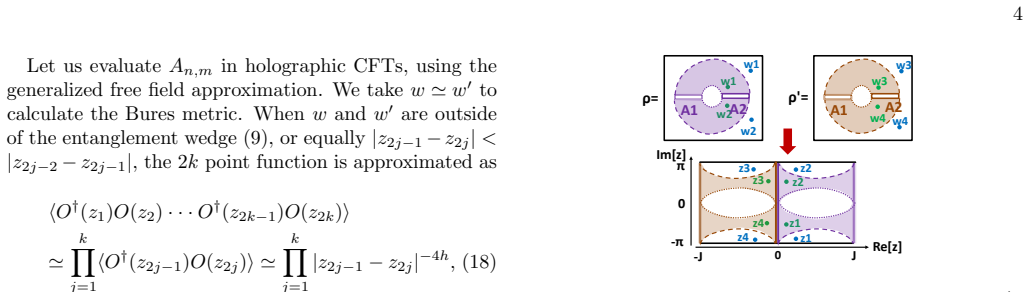
The load-bearing object is the Bures distance $D_B(\rho,\rho')^2=2(1-\operatorname{Tr}[\sqrt{\sqrt{\rho}\,\rho'\sqrt{\rho}}])$ and its replica evaluation through $A_{n,m}=\operatorname{Tr}[(\rho^m\rho'\rho^m)^n]$, analytically continued to $n=m=1/2$. In holographic CFTs the multi-point functions are evaluated by generalized free-field Wick contractions: the trivial contraction makes the two reduced states indistinguishable, while the nontrivial contraction dominates precisely inside the entanglement wedge and reproduces the pure-state metric. Conformal maps---$z^2=w/(w-L)$ for the single interval, and an elliptic map onto a torus for two intervals---convert the two density matrices into a single correlation function whose dominant contraction selects the wedge boundary. The sharpness of the boundary comes from the $h\gg1$ limit, and the free scalar CFT fails because its correlation functions lack this dominance structure.
What would settle it
Compute $A_{n,m}$ for a concrete large-central-charge CFT beyond the Wick contraction, including subleading conformal blocks or the first $1/c$ corrections, and continue to $n=m=1/2$; the central claim collapses if $dD_B^2$ fails to vanish identically outside the wedge or fails to equal $\frac{h}{\tau^2}(dx^2+d\tau^2)$ inside it.
Extended reading notes
Core claim
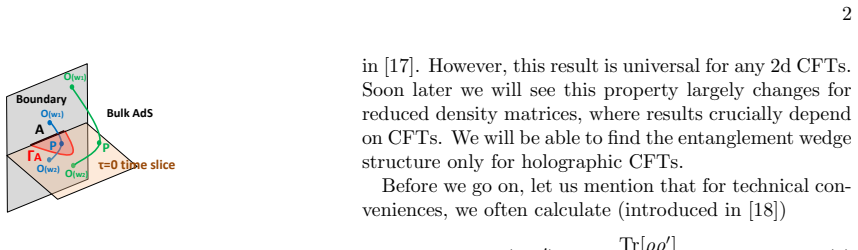
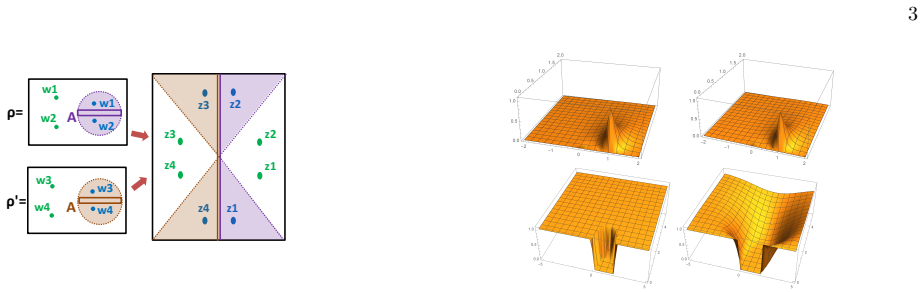
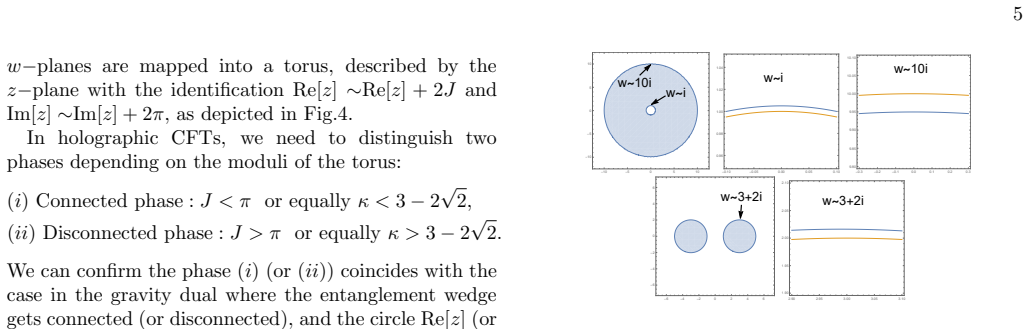
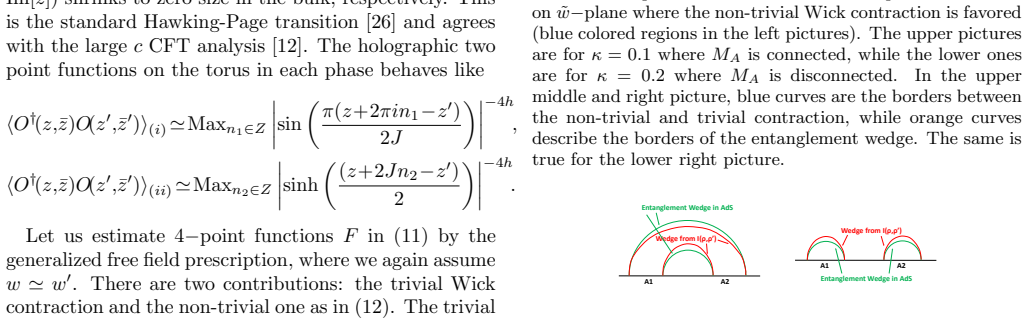
The central claim is that state distinguishability inside the boundary theory encodes the shape of the bulk. In a two-dimensional holographic CFT, the Bures metric $dD_B^2$ computed from the reduced density matrix $\rho_A(w,\bar w)$ of a locally excited primary operator equals $\frac{h}{\tau^2}(dx^2+d\tau^2)$ when the excitation lies inside the entanglement wedge, and vanishes when it lies outside; the paper obtains the same structure for the circle and finite-temperature backgrounds, with the metric factors $1/\sinh^2\tau$ and $\sin^{-2}(2\pi T\tau)$ respectively. For two disjoint intervals, the region favored by the nontrivial Wick contraction in a four-point function approximates the true entanglement wedge to within a few percent, and switches from connected to disconnected at the expected phase-transition point. The paper also shows that a free scalar CFT does not produce any sharp wedge, indicating that the derivation relies on the holographic, large-central-charge character of the CFT.
Load-bearing premise
The load-bearing premise is that in a large-central-charge holographic CFT, multi-point correlation functions are accurately captured by generalized free-field Wick contractions, and that the replica expression $A_{n,m}$ can be analytically continued to $n=m=1/2$; if either fails, the sharp wedge boundary and the vanishing of the Bures metric outside the wedge would be disturbed.
Editorial extensions
If this is right
- If the derivation survives, the entanglement wedge geometry can be obtained from boundary correlation functions alone, without assuming the bulk metric.
- The wedge boundary becomes a sharp transition in state distinguishability: inside the wedge the Bures metric equals the pure-state metric, outside it vanishes.
- The method extends to circle and finite-temperature backgrounds, recovering the corresponding time-slice metrics of the dual spacetime.
- In the two-interval case the connected/disconnected phase transition is captured by the torus calculation, with only a few-percent discrepancy relative to the true wedge.
- Free scalar CFTs show no sharp wedge, so a sharp wedge in this construction is a diagnostic of holographic dynamics.
Reading between the lines
- A consequence the authors leave implicit: the Bures metric gives an operational, measurement-based definition of bulk locality --- points in the boundary parameter space are geometrically separated exactly to the extent that their reduced states can be distinguished.
- One testable extension is to track the first $1/c$ correction: if it moves the wedge boundary or produces a nonvanishing metric outside the wedge, the present sharp wedge picture is only approximate, and the exact wedge boundary would be defined by the genuine Bures metric rather than by $I(\rho,\rho')$.
- The few-percent discrepancy in the two-interval case suggests a precise computation of the genuine Bures metric there, which the paper hints should yield the pure-state metric; if confirmed, the discrepancy quantifies how far $I(\rho,\rho')$ is from the true fidelity.
Editorial analysis
A structured set of objections, weighed in public.
Referee Report
Summary. The manuscript proposes that, in two-dimensional holographic CFTs, the Bures metric of the reduced density matrix of a locally excited state, viewed as a function of the excitation point, reproduces the AdS time-slice metric inside the entanglement wedge and vanishes outside it. The single-interval case is treated in Sec. 3 by a replica calculation with analytic continuation to n=m=1/2, leading to the claimed result dD_B^2 = (h/τ^2)(dx^2+dτ^2) inside the wedge. The two-interval case is analyzed in Sec. 4 using the surrogate quantity I(ρ,ρ') = Tr[ρρ']/sqrt(Tr[ρ^2]Tr[ρ'^2]) instead of the genuine Bures metric; the region where a nontrivial Wick contraction dominates is compared with the holographic entanglement wedge, including the connected/disconnected transition. A free scalar CFT is analyzed as a contrast and is argued to show no sharp wedge structure. The broad conceptual claim is that entanglement-wedge geometry can be derived from CFT distinguishability data alone, without assuming the bulk metric.
Significance. If the derivation were made rigorous, the paper would offer a genuinely new route to the emergence of entanglement-wedge geometry from CFT data, and it would provide a sharp, falsifiable criterion distinguishing holographic CFTs from free CFTs. The comparison with free scalars is instructive, and the paper is honest that the double-interval computation uses an alternative to the Bures metric. However, the load-bearing fidelity calculation in Sec. 3 has a serious gap that must be repaired before the central claim is established; as it stands, the main result is not derived by the equations shown.
major comments (3)
- [Sec. 3, Eqs. (16)-(19)] At the claimed analytic-continuation point n=m=1/2, the replica parameter is k=(2m+1)n=1. Substituting k=1 into Eq. (17) makes the conformal prefactors cancel the two-point function, giving A_{1/2,1/2}=1 identically, with no dependence on w'. The displayed expression A_{1/2,1/2}=|w-\bar w|^{2h}|w'-\bar w'|^{2h}|w'-\bar w|^{-4h} therefore does not follow from Eq. (17). Moreover, the two Wick contractions compared in Eq. (18) coincide when k=1, so the distinction between the 'inside-wedge' and 'outside-wedge' regimes is not defined in this formula. Consequently Eq. (19) and the central claim that the Bures metric equals (h/τ^2)(dx^2+dτ^2) inside the wedge are not derived as written. Please specify a well-defined analytic continuation that keeps the w'-dependent insertions, or provide a direct computation of the fidelity at n=m=1/2.
- [Sec. 3, definitions after Eq. (17)] The insertion points assigned in Eq. (17), namely z_{2s+1}=e^{2πi s/k}z_1 and z_{2s+2}=e^{2πi s/k}z_2, are all expressed in terms of the unprimed coordinate w only; the points belonging to ρ' (which should depend on w') are never written down. Even for k=2 this would give z_3=-z_1, whereas the Section 2 calculation of Tr[ρρ'] has z_3=-z' with z' depending on w'. Without an explicit assignment of the w'-dependent points, the replica representation cannot encode the distinguishability between ρ_A(w) and ρ_A(w'), which is the very object needed for the Bures metric.
- [Secs. 2 and 3, Eqs. (12) and (18)] The approximation of all multi-point correlators by generalized free field Wick contractions is load-bearing for both the I(ρ,ρ') wedge boundary and the claimed Bures metric. The citation to Ref. [22] supports generalized free fields in a large-c limit, but the regime used here involves arbitrary excitation positions and operator weight h with 1≪h≪c; the paper does not analyze competing conformal blocks or 1/c corrections in this kinematics. If subleading contributions are not negligible, the sharp wedge boundary and the vanishing of the metric outside the wedge would be modified. This may be a standard approximation in the holographic CFT literature, but its validity for the specific 2k-point functions and kinematics used here should be justified.
minor comments (4)
- [Sec. 4, final paragraph] The closing paragraph of Sec. 4 states that computing the genuine Bures metric for the double-interval case is 'very complicated' and that obtaining the expected metric (7) 'might not be surprising'; this is an admission that the double-interval Bures claim is not established and should be labeled as a conjecture rather than presented as a consequence.
- [Abstract and Sec. 4] The abstract's phrase 'up to a very small error' for the double-interval wedge is not quantified; the deviation in Fig. 5 should be defined precisely, for example through a distance between the two boundary curves, so that the claimed few-percent accuracy can be checked.
- [Sec. 3, Eq. (22)] The free-scalar Bures metric in Eq. (22) is presented without derivation; since this is the only case where the Bures metric is computed without the problematic replica collapse, a derivation or a precise reference for the direct fidelity calculation would substantially help the reader.
- [General] There are typographical errors, including 'furture' in Sec. 5 and 'intstructive' in Sec. 3; these should be corrected in revision.
Circularity Check
No significant circularity: the wedge region is an output of the Wick-contraction comparison, not a fitted input; the self-citations are minor and non-load-bearing.
full rationale
The central derivation chain is self-contained: Eqs. (11)-(12) define I(rho,rho') from a four-point function and identify the wedge as the region where the nontrivial Wick contraction dominates, with the known RT wedge (9) used only as a comparison benchmark. The Bures metric in Section 3 is then computed from the same correlation-function approximation via A_{n,m}, with the inside/outside selection expressed as an inequality between contraction distances; no parameter is fitted to the target wedge, and the prefactor h is the input conformal dimension, not an adjustable constant. The self-citations that occur ([14], [17], [20], [21], [28], [29], [32], [35]) are contextual: they cover the locally-excited-state construction, the pure-state Bures coincidence (which is re-derived in Eq. (7)), conformal-mapping techniques, and future directions, and none carries the load of the derivation. The generalized free-field approximation is cited to external work [22]. The analytic-continuation difficulty at k=1 noted for Eqs. (16)-(19) is a mathematical gap or correctness risk, not a reduction of the claimed result to its input by construction, so it does not constitute circularity. The double-interval analysis similarly validates the I(rho,rho') wedge against the independently computed entanglement wedge and reports small deviations, which is comparison rather than circular reasoning. Overall, the central claim has independent content and is not forced by self-citation or by definition.
Assumptions & free parameters
assumptions (5)
- domain assumption Holographic CFTs at large central charge can be approximated by generalized free fields, so multipoint functions factorize into Wick contractions.
- domain assumption The probe primary operator has 1 << h << c, so backreaction on the dual geometry is negligible and the geodesic approximation for two-point functions applies.
- domain assumption The replica-trick quantity A_{n,m} can be analytically continued to n = m = 1/2 to give the fidelity Tr[sqrt(sqrt(rho) rho' sqrt(rho))].
- domain assumption Holographic two-point functions on a torus are given by the maximum over images of the appropriate holomorphic function.
- domain assumption The reduced density matrix rho_A(w,bar w) is dual to an excitation at a bulk point P determined by projecting the boundary insertion along the geodesic to the time slice.
Cite this review
Pith. "Pith review of Entanglement Wedges from Information Metric in Conformal Field Theories." pith.science (2026). https://pith.science/paper/KT7U6PNS
@misc{pith2026190809939,
  author       = {Pith},
  title        = {Pith review of: Entanglement Wedges from Information Metric in Conformal Field Theories},
  year         = {2026},
  howpublished = {\url{https://pith.science/paper/KT7U6PNS}},
  note         = {Machine review of arXiv:1908.09939}
}
read the original abstract
We present a new method of deriving the geometry of entanglement wedges in holography directly from conformal field theories (CFTs). We analyze an information metric called the Bures metric of reduced density matrices for locally excited states. This measures distinguishability of states with different points excited. For a subsystem given by an interval, we precisely reproduce the expected entanglement wedge for two dimensional holographic CFTs from the Bures metric, which turns out to be proportional to the AdS metric on a time slice. On the other hand, for free scalar CFTs, we do not find any sharp structures like entanglement wedges. When a subsystem consists of disconnected two intervals we manage to reproduce the expected entanglement wedge from holographic CFTs with correct phase transitions, up to a very small error, from a quantity alternative to the Bures metric.
Figures
Figures from the paper (2 more)
Reference graph
Works this paper leans on
-
[22]
M. Miyaji, T. Numasawa, N. Shiba, T. Takayanagi and K. Watanabe, “Continuous Multiscale Entanglement Renormalization Ansatz as Holographic Surface- State Correspondence,” Phys. Rev. Lett. 115 (2015) no.17, 171602 doi:10.1103/PhysRevLett.115.171602 [arXiv:1506.01353 [hep-th]]
arXiv 2015
-
[1]
Entanglement Wedges from Information Metric in Conformal Field Theories
Introduction An important and fundamental question in the anti- de Sitter space/conformal field theory (AdS/CFT) cor- respondence [1] is “Which region in AdS corresponds to a given subregion A in a CFT ?”. The answer to this question has been argued to be the entanglement wedge MA [2–4], i.e. the region surrounded by the subsystem A and the extremal surfac...
work page Pith review arXiv 1908
-
[2]
The surface Γ A in the bulk AdS is given by the semi circle (x−L/2)2 +η2 =L2/4
Single Interval Case We choose the subsystemA to be an interval 0≤x≤L at τ = 0. The surface Γ A in the bulk AdS is given by the semi circle (x−L/2)2 +η2 =L2/4. Therefore if the entanglement reconstruction is correct, the information metric should vanish if the intersection P is outside of the entanglement wedge given by |w−L/2| =L/2. (9) In this example, ...
-
[3]
We evaluate Tr[√√ρρ′√ρ] from An,m = Tr[(ρmρ′ρm)n]
Bures Metric Now let us calculate the genuine Bures metric when A is a single interval. We evaluate Tr[√√ρρ′√ρ] from An,m = Tr[(ρmρ′ρm)n]. (14) via the analytical continuation n =m = 1/2. We apply the conformal transformation (we set k = (2m + 1)n) zk = w w−L, (15) so that the path-integrals for 2 mn ρs and n ρ′s are mapped into that on a single plane. Th...
-
[4]
We conformally map the w-plane with two slits alongA1 andA2 into az−cylinder via (see e.g
Double Interval Case Finally, we take the subsystem A to be a union of two disconnected intervals A1 and A2, which are parameter- ized as A1 = [0,s ] and A2 = [l +s,l + 2s], without losing generality. We conformally map the w-plane with two slits alongA1 andA2 into az−cylinder via (see e.g. [25]) z =f(w) = J(κ2) 2 − J(κ2) 2K(κ2)sn−1( ˜w,κ 2), (23) where w...
-
[5]
Discussions In this article, we presented a general mechanism how entanglement wedges emerge from holographic CFTs and gave several successful examples. One important furture problem is to repeat the same procedure by using the genuine localized operator in the bulk [7] or the state [17], which may give us more refined results. Another interesting directio...
-
[6]
J. M. Maldacena, Adv. Theor. Math. Phys. 2 (1998) 231 [Int. J. Theor. Phys. 38 (1999) 1113] [arXiv:hep- th/9711200]
arXiv 1998
-
[7]
The Gravity Dual of a Density Matrix,
B. Czech, J. L. Karczmarek, F. Nogueira and M. Van Raamsdonk, “The Gravity Dual of a Density Matrix,” Class. Quant. Grav. 29 (2012) 155009 doi:10.1088/0264- 9381/29/15/155009 [arXiv:1204.1330 [hep-th]]
arXiv 2012
Show all 39 references
-
[8]
Maximin Surfaces, and the Strong Sub- additivity of the Covariant Holographic Entanglement Entropy,
A. C. Wall, “Maximin Surfaces, and the Strong Sub- additivity of the Covariant Holographic Entanglement Entropy,” Class. Quant. Grav. 31 (2014) no.22, 225007 doi:10.1088/0264-9381/31/22/225007 [arXiv:1211.3494 [hep-th]]
2014 arXiv
-
[9]
Causality and holographic en- tanglement entropy,
M. Headrick, V. E. Hubeny, A. Lawrence and M. Rangamani, “Causality and holographic en- tanglement entropy,” JHEP 1412 (2014) 162 doi:10.1007/JHEP12(2014)162 [arXiv:1408.6300 [hep- th]]
2014 arXiv
-
[10]
Holographic derivation of entanglement entropy from AdS/CFT,
S. Ryu and T. Takayanagi, “Holographic derivation of entanglement entropy from AdS/CFT,” Phys. Rev. Lett. 96 (2006) 181602; “Aspects of holographic entanglement entropy,” JHEP 0608 (2006) 045
2006
-
[11]
A Covariant holographic entanglement entropy proposal,
V. E. Hubeny, M. Rangamani and T. Takayanagi, “A Covariant holographic entanglement entropy proposal,” JHEP 0707 (2007) 062 [arXiv:0705.0016 [hep-th]]
2007 arXiv
-
[12]
Holographic representation of local bulk operators,
A. Hamilton, D. N. Kabat, G. Lifschytz and D. A. Lowe, “Holographic representation of local bulk operators,” Phys. Rev. D 74 (2006) 066009 doi:10.1103/PhysRevD.74.066009 [hep-th/0606141]
2006 arXiv
-
[13]
Quan- tum corrections to holographic entanglement entropy,
T. Faulkner, A. Lewkowycz and J. Maldacena, “Quan- tum corrections to holographic entanglement entropy,” JHEP 1311 (2013) 074 doi:10.1007/JHEP11(2013)074 [arXiv:1307.2892 [hep-th]]
2013 arXiv
-
[14]
Relative entropy equals bulk relative entropy,
D. L. Jafferis, A. Lewkowycz, J. Maldacena and S. J. Suh, “Relative entropy equals bulk relative entropy,” JHEP 1606 (2016) 004 doi:10.1007/JHEP06(2016)004 [arXiv:1512.06431 [hep-th]]
2016 arXiv
-
[15]
Bulk Lo- cality and Quantum Error Correction in AdS/CFT,
A. Almheiri, X. Dong and D. Harlow, “Bulk Lo- cality and Quantum Error Correction in AdS/CFT,” JHEP 1504 (2015) 163 doi:10.1007/JHEP04(2015)163 [arXiv:1411.7041 [hep-th]]; D. Harlow, “The Ryu- Takayanagi Formula from Quantum Error Correction,” arXiv:1607.03901 [hep-th]
2015 arXiv
-
[16]
Reconstruction of Bulk Operators within the Entanglement Wedge in Gauge-Gravity Duality,
X. Dong, D. Harlow and A. C. Wall, “Reconstruction of Bulk Operators within the Entanglement Wedge in Gauge-Gravity Duality,” Phys. Rev. Lett. 117 (2016) no.2, 021601 doi:10.1103/PhysRevLett.117.021601 [arXiv:1601.05416 [hep-th]]
2016 arXiv
-
[17]
Entanglement Renyi entropies in holo- graphic theories,
M. Headrick, “Entanglement Renyi entropies in holo- graphic theories,” Phys. Rev. D 82 (2010) 126010 doi:10.1103/PhysRevD.82.126010 [arXiv:1006.0047 [hep- th]]
2010 arXiv
-
[18]
Universal Spec- trum of 2d Conformal Field Theory in the Large c Limit,
T. Hartman, C. A. Keller and B. Stoica, “Universal Spec- trum of 2d Conformal Field Theory in the Large c Limit,” JHEP 1409 (2014) 118 doi:10.1007/JHEP09(2014)118 [arXiv:1405.5137 [hep-th]]
2014 arXiv
-
[20]
Quantum Information Theory
M. Hayashi, “Quantum Information Theory”, Graduate Texts in Physics, Springer
-
[21]
C. W. Helstrom, Minimum mean-square error estimation in quantum statistics, ” Phys. Lett. 25A, 101-102 (1976)
1976
-
[23]
Thermalization and Revivals after a Quantum Quench in Conformal Field Theory,
J. Cardy, “Thermalization and Revivals after a Quantum Quench in Conformal Field Theory,” Phys. Rev. Lett. 112 (2014) 220401 doi:10.1103/PhysRevLett.112.220401 [arXiv:1403.3040 [cond-mat.stat-mech]]
2014 arXiv
-
[24]
Causal Holo- graphic Information,
V. E. Hubeny and M. Rangamani, “Causal Holo- graphic Information,” JHEP 1206 (2012) 114 doi:10.1007/JHEP06(2012)114 [arXiv:1204.1698 [hep- th]]
2012 arXiv
-
[25]
Quan- tum Entanglement of Local Operators in Conformal Field Theories,
M. Nozaki, T. Numasawa and T. Takayanagi, “Quan- tum Entanglement of Local Operators in Conformal Field Theories,” Phys. Rev. Lett. 112 (2014) 111602 doi:10.1103/PhysRevLett.112.111602 [arXiv:1401.0539 [hep-th]]; M. Nozaki, “Notes on Quantum Entan- glement of Local Operators,”...
2014 arXiv
-
[26]
Quantum dimension as entanglement entropy in two dimensional conformal field theories,
S. He, T. Numasawa, T. Takayanagi and K. Watan- abe, “Quantum dimension as entanglement entropy in two dimensional conformal field theories,” Phys. Rev. D 90 (2014) no.4, 041701 doi:10.1103/PhysRevD.90.041701 [arXiv:1403.0702 [hep-th]]
2014 arXiv
-
[27]
Emergent Space- time and Holographic CFTs,
S. El-Showk and K. Papadodimas, “Emergent Space- time and Holographic CFTs,” JHEP 1210 (2012) 106 doi:10.1007/JHEP10(2012)106 [arXiv:1101.4163 [hep- th]]
2012 arXiv
-
[28]
Relative Entropies in Conformal Field Theory,
N. Lashkari, “Relative Entropies in Conformal Field Theory,” Phys. Rev. Lett. 113 (2014) 051602 doi:10.1103/PhysRevLett.113.051602 [arXiv:1404.3216 [hep-th]]; “Modular Hamiltonian for Excited States in Conformal Field Theory,” Phys. Rev. Lett. 117 (2016) no.4, 041601 doi:10.11...
2014 arXiv
-
[29]
Relative entropy of excited states in two dimensional conformal field theories,
G. Srosi and T. Ugajin, “Relative entropy of excited states in two dimensional conformal field theories,” JHEP 1607 (2016) 114 doi:10.1007/JHEP07(2016)114 [arXiv:1603.03057 [hep-th]]
2016 arXiv
-
[30]
Post measurement bipartite entan- 7 glement entropy in conformal field theories,
M. A. Rajabpour, “Post measurement bipartite entan- 7 glement entropy in conformal field theories,” Phys. Rev. B 92 (2015) 7, 075108 doi:10.1103/PhysRevB.92.075108 [arXiv:1501.07831 [cond-mat.stat-mech]]; “Fate of the area-law after partial measurement in quantum field theories,...
2015 arXiv
-
[31]
Thermodynamics of Black Holes in anti-De Sitter Space,
S. W. Hawking and D. N. Page, “Thermodynamics of Black Holes in anti-De Sitter Space,” Commun. Math. Phys. 87 (1983) 577. doi:10.1007/BF01208266
1983 doi
-
[32]
Sub- system Trace Distance in Quantum Field The- ory,
J. Zhang, P. Ruggiero and P. Calabrese, “Sub- system Trace Distance in Quantum Field The- ory,” Phys. Rev. Lett. 122 (2019) no.14, 141602 doi:10.1103/PhysRevLett.122.141602 [arXiv:1901.10993 [hep-th]]; “Subsystem trace distance in low-lying states of conformal field theories,” ...
2019 arXiv
-
[33]
Anti-de Sitter Space from Optimization of Path Integrals in Conformal Field Theories,
P. Caputa, N. Kundu, M. Miyaji, T. Takayanagi and K. Watanabe, “Anti-de Sitter Space from Optimization of Path Integrals in Conformal Field Theories,” Phys. Rev. Lett. 119, no. 7, 071602 (2017), [arXiv:1703.00456 [hep-th]]; “Liouville Action as Path-Integral Complexity: From C...
2017 arXiv
-
[34]
Entanglement of pu- rification through holographic duality,
K. Umemoto and T. Takayanagi, “Entanglement of pu- rification through holographic duality,” Nature Phys. 14 (2018) no.6, 573 doi:10.1038/s41567-018-0075-2 [arXiv:1708.09393 [hep-th]]
2018 arXiv
-
[35]
Entanglement of purification: from spin chains to holography,
P. Nguyen, T. Devakul, M. G. Halbasch, M. P. Zale- tel and B. Swingle, “Entanglement of purification: from spin chains to holography,” JHEP 1801 (2018) 098 doi:10.1007/JHEP01(2018)098 [arXiv:1709.07424 [hep- th]]
2018 arXiv
-
[36]
Entanglement negativity and minimal entanglement wedge cross sections in holo- graphic theories,
J. Kudler-Flam and S. Ryu, “Entanglement negativity and minimal entanglement wedge cross sections in holo- graphic theories,” arXiv:1808.00446 [hep-th]
-
[37]
Holographic Entanglement of Purification from Con- formal Field Theories,
P. Caputa, M. Miyaji, T. Takayanagi and K. Umemoto, “Holographic Entanglement of Purification from Con- formal Field Theories,” Phys. Rev. Lett. 122 (2019) no.11, 111601 doi:10.1103/PhysRevLett.122.111601 [arXiv:1812.05268 [hep-th]]
2019 arXiv
-
[38]
Entanglement Wedge Cross Section from the Dual Density Matrix,
K. Tamaoka, “Entanglement Wedge Cross Section from the Dual Density Matrix,” arXiv:1809.09109 [hep-th]
-
[39]
A canonical purification for the entanglement wedge cross-section,
S. Dutta and T. Faulkner, “A canonical purification for the entanglement wedge cross-section,” arXiv:1905.00577 [hep-th]
1905 arXiv
-
[40]
Suzuki, T
Y. Suzuki, T. Takayanagi and K. Umemoto, work in progress
Reviewed August 14, 2026 · model on record in the stance chip above.
Discussion (0). Continue with ORCID to comment.