REVIEW 3 major objections 6 minor 162 references
Self-Parametrizing System-Focused Atomistic Models
T0 review · 3 major / 6 minor · reviewed 2026-08-14 · deepseek-v4-flash
Pith's one-line read Atomistic models for arbitrary nanoscale systems can be assembled automatically from one quantum-chemical structure and its Hessian, then refined on the fly by machine learning with uncertainty estimates.
desk verdict A credible proof-of-principle for an integrated SFAM workflow, but the headline accuracy numbers rest on self-sampled configurations and need an external validation before the strong claims hold. read the letter →
The pith
A machine-rendered reading of the paper's core claim, the machinery that carries it, and where it could break.
The reading
What carries the argument
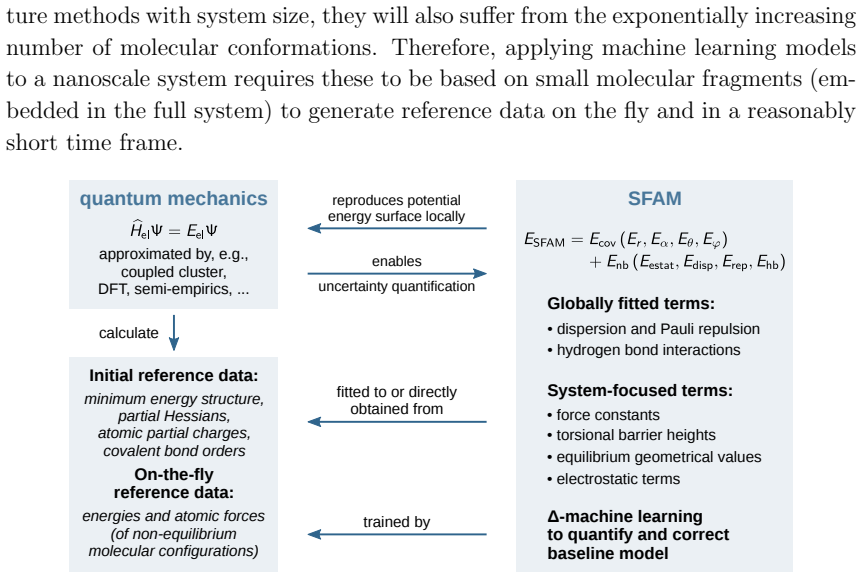
The engine of the workflow is the partial Hessian fitting procedure: each force-constant parameter is obtained by minimizing the Frobenius norm of the difference between the quantum-chemical Hessian submatrix for an atom pair and the corresponding MM Hessian submatrix, with the atom-pair set chosen in each step so that the parameter being fit is the only unknown. The sequential order (dihedral half-barriers first, then angles, then bonds, then impropers) keeps each fit clean of coupling to unoptimized parameters. The other load-bearing object is the Δ-machine-learning correction using a kernel (linear, polynomial, Gaussian, or Laplacian) trained on energies and on atom-centered internal-coordinate forces from the SFAM trajectory; the authors emphasize that the flexibility of the kernel should be matched to the amount of training data.
What would settle it
Run the workflow on a molecule whose SFAM trajectory stays near one conformational basin, then evaluate the hybrid model on configurations from an independent enhanced-sampling simulation that visits other basins, comparing predicted energies and forces to the quantum reference; large errors in those unseen basins would show the refinement loop missed relevant parts of the surface.
Extended reading notes
Core claim
The central claim is that a "self-parametrizing system-focused atomistic model" (SFAM) can be generated from parameter-free quantum-chemical reference data: equilibrium geometry, Hessian matrix, partial charges, and covalent bond orders. The Hessian is fit in blocks by the partial Hessian method, so each covalent force constant is optimized against only the Hessian submatrices that depend on it; non-covalent terms reuse a dispersion model and a hydrogen-bonding correction with a small set of globally fitted parameters. Large systems are handled by spherical fragments around each atom, whose individual Hessians are assembled into a sparse approximate full Hessian. The resulting MM model is used to run molecular dynamics, and the sampled configurations are sent back for quantum-mechanical reference energies and forces; a kernel ridge regression Δ-machine-learning model then predicts the correction from the MM baseline to the reference, with the standard deviation of 5-fold cross validation used as uncertainty. The paper reports that this hybrid reaches chemical accuracy on energies and forces for butane with far fewer reference calculations than an ML-only model, and that the base MM model alone matches or beats standard force fields on relative energies sampled from an SFAM trajectory.
Load-bearing premise
The accuracy evidence assumes that the configurations visited by the model's own simulation are representative of the configurations that matter; if the potential energy surface is wrong in regions the model never visits, the reported errors and uncertainty estimates are overoptimistic.
Editorial extensions
If this is right
- Any molecule whose structure and Hessian can be computed can receive a working MM model with no atom-type library and no manual parameter tuning.
- The same model is the trajectory generator, so early inexpensive MD can be used to choose where to spend QM reference calculations, and the model improves as more data arrive.
- The system-specific uncertainty from cross validation can be used to decide when new reference data are needed, enabling rolling refinement during a simulation.
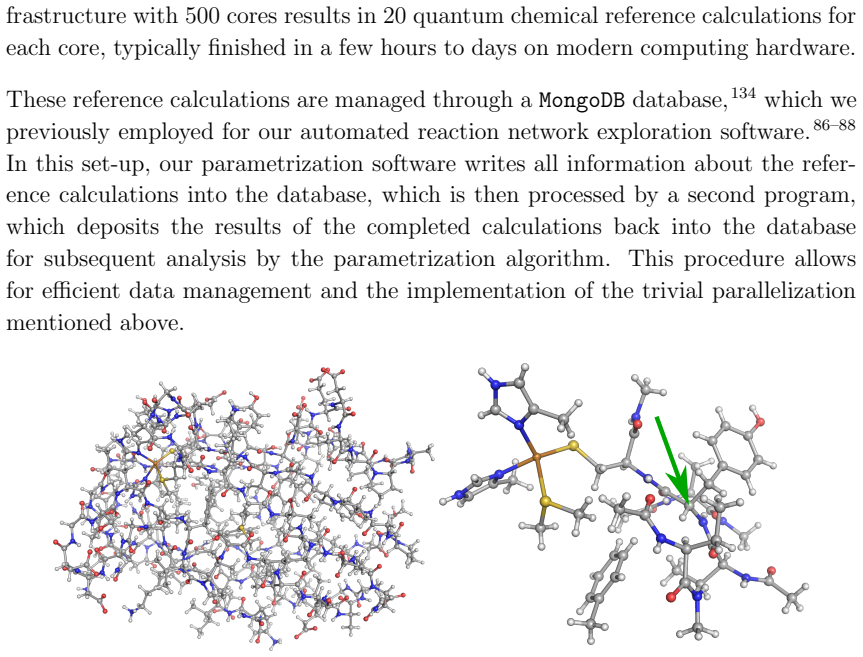
- The fragmentation parametrization was demonstrated on a 1412-atom protein with 284 fitted force constants, so the scheme is not limited to small molecules; the authors claim it extends to arbitrary nanoscale structures.
- The method can be used to build electrostatic MM embedding environments for QM/MM models of reactions, linking the base model to quantum chemistry for bond breaking.
Reading between the lines
- A decisive test the paper does not report would be to sample configurations from an independent, more exploratory ensemble (for example, high-temperature or enhanced-sampling MD) and check whether the uncertainty estimates and errors remain as small as reported; the paper's own comparison is acknowledged to be biased toward SFAM because its test structures came from an SFAM trajectory.
- The same self-parametrizing loop could in principle be run with a higher-level reference method on later iterations, yielding a converged hierarchy from cheap semiempirical to coupled-cluster quality PES without changing the MM architecture.
- If the base MM model is accurate near equilibrium and the ML correction is localized, then the model's transferability to a new chemical environment should be measurable directly from the growth of the cross-validation uncertainty, giving an operational definition of when reparametrization is needed.
- The fragmentation-based redundancy (multiple fragments provide the same atom-pair Hessian blocks) could be exploited not only for missing-data compensation but as a real uncertainty estimate of the force constants themselves, which the paper only suggests.
Signed reviews
Editorial analysis
A structured set of objections, weighed in public.
Referee Report
Summary. The manuscript presents SFAM, a workflow that automatically parametrizes a classical molecular mechanics potential from a single quantum-chemical minimum-energy structure and its Hessian via partial Hessian fitting, and then improves the model by training a Δ-machine-learning correction on energies and forces of configurations sampled from the SFAM potential. A fragmentation protocol is proposed to scale the parametrization to large systems such as plastocyanin, and the method is demonstrated on small molecules, with vibrational frequencies, relative energies along MD trajectories, and dihedral scans compared against a DFT reference. The central claim is that this combination of an automatically generated physical baseline and an on-the-fly ML correction with uncertainty quantification yields accurate, self-parametrizing atomistic models for arbitrary nanoscale systems.
Significance. If the central claim were fully demonstrated, this would be a valuable step toward removing manual force-field parametrization as a bottleneck in multiscale modeling: the Hessian-based parametrization is well grounded in earlier partial-Hessian fitting work, the fragmentation idea is practical, the integration with Δ-ML and uncertainty estimation is timely, and the authors are transparent about several limitations (e.g., the acknowledged bias of the SFAM-sampled test set). The proof-of-principle on butane and the plastocyanin fragmentation example show that the components work in isolation. However, the validation of the headline accuracy numbers relies on configurations generated by the model being tested, so the current evidence does not establish that the method is accurate on the configuration distribution relevant to a target application, nor does it demonstrate the claimed rolling on-the-fly refinement. The significance is therefore moderate and conditional on additional independent validation.
major comments (3)
- [III.3 / Fig. 10 (and II.5 / Fig. 7)] The central accuracy evidence is based on configurations sampled from the SFAM potential itself. In II.5 the authors state that the force-field comparison 'is biased towards SFAM since the structures were sampled from a SFAM trajectory,' and the same bias applies to the Δ-ML results in III.3, where both training and test structures come from a SFAM MD trajectory. Consequently, the reported mean absolute errors below 0.4 kcal/mol and the cross-validation uncertainty bands describe interpolation among configurations that the base model already samples; they do not measure error on the true (DFT) Boltzmann ensemble or on any independent target distribution. Because the paper's central claim is that SFAM provides reliable, uncertainty-quantified models for arbitrary systems, this is a load-bearing issue. I request an additional validation in which the base and Δ-ML models are evaluated on structures generated independently, e.g., from a DFT-based MD trajectory or from a trajectory reweighted to the QM ensemble as the authors themselves suggest.
- [III.1 / III.3] The claimed uncertainty quantification is not calibrated. The 5-fold cross-validation standard deviation reported in Fig. 10 and Section III.3 is a measure of model variance on the SFAM-generated training distribution; it is not a prediction interval for the error relative to the reference PES on unseen regions. Section IV states that SFAM provides 'uncertainty quantification that measures the reliability of the model,' but no evidence is shown that the error bars are meaningful, e.g., that the fraction of true errors falling within one or two standard deviations matches the nominal coverage on an independent test set. A calibration study on a held-out independent ensemble is needed to support the uncertainty-quantification component of the central claim.
- [III.3 / IV] The rolling, on-the-fly refinement that distinguishes this approach from a one-shot ML fit is not actually demonstrated. In the butane study, a fixed MD trajectory is generated with the base SFAM model, reference data are computed for those configurations, and a single Δ-ML model is trained and evaluated; there is no iteration in which the corrected model generates new configurations, new reference data are added, and the model is improved. The conclusion nevertheless claims that the model 'can be improved in a rolling fashion' and that the approach enables 'on-the-fly' correction. Since this iterative refinement is a central part of the proposed workflow, the manuscript should either include a demonstration of at least one refinement cycle or explicitly restrict the claims to what is shown.
minor comments (6)
- [III.1, Eq. (20)] The KRR prediction formula as written, y = (X^T X + λI)^{-1} X^T \tilde{y} x, is dimensionally inconsistent; it should be written with the test vector on the left and the training targets on the right, e.g., y = x_*^T (X^T X + λI)^{-1} X^T \tilde{y}.
- [II.4] The plastocyanin example required manual input: the Cu–S bond was added manually because the Mayer bond order was below threshold, and the local charge/spin states were provided manually. The text acknowledges this, but the conclusion's statement that parametrization occurs 'without human interference' is stronger than the demonstrated result; please qualify the claim.
- [I / II.1] The phrase 'parameter-free quantum chemical calculations' in the introduction is imprecise, since the reference DFT method and the globally fitted SFAM non-covalent parameters (a1, a2, s8, β, khb) involve fitted or functional parameters. Consider rewording to 'parameters not tailored to the target system' or similar.
- [II.2, Eq. (14)] The periodicity rule for dihedral angles is a minor notational issue: the expression (N−1)(M−1)/gcd(N−1, M−1) is the least common multiple of N−1 and M−1; stating this explicitly would aid readability.
- [II.5, Fig. 7] The comparison with GAFF, MMFF94, and UFF uses Open Babel implementations of relatively generic force fields; as the authors note, these may not represent the best available specialized force fields. This is acceptable for a proof of principle, but the manuscript should make even clearer that the quantitative comparison is not a benchmark against state-of-the-art specialized parameters.
- [III.3] The figure captions for Figs. 10 and 11 state that shaded areas represent confidence intervals, but the text describes them as standard deviations from 5-fold cross-validation. These are not confidence intervals in the statistical sense; please use consistent terminology.
Circularity Check
No constructional circularity; the only self-referential element is the SFAM-sampled validation ensemble, explicitly acknowledged by the authors and not a reduction of any derived quantity to fitted inputs.
full rationale
The derivation chain is not circular. The base MM model's force constants are fitted to an independently calculated quantum-chemical Hessian, and equilibrium values, charges, and bond orders are obtained from first-principles reference calculations, not from the properties later 'predicted.' The global van der Waals and hydrogen-bond parameters are fitted to dimer data and then reused, but the target molecules and their relative energies are not fitted inputs, so those predictions are not forced. The delta-machine-learning corrections target DFT energies and forces, with training and test structures separated by 5-fold cross-validation; the labels are external reference data rather than model outputs. The acknowledged limitation in Section II.5, 'this test is biased towards SFAM since the structures were sampled from a SFAM trajectory,' applies to the force-field comparison and conceptually to the ML validation in Section III.3: the configuration distribution is generated by the SFAM base model, so the reported errors and uncertainty estimates quantify interpolation on the SFAM-sampled ensemble rather than guaranteed accuracy on the full QM equilibrium ensemble. This is a genuine validation weakness and should temper claims of reliability for arbitrary nanoscale targets, but it is not a circular derivation: no equation reduces to its own input, no fitted parameter is renamed as a prediction, and no load-bearing claim rests solely on self-citation. The citations to the authors' prior work on uncertainty quantification (Refs. 55 and 63) are contextual and not used to force the model choice or to forbid alternatives.
Assumptions & free parameters
free parameters (5)
- Global dispersion and repulsion parameters a1, a2, s8, beta =
a1 = 0.1, a2 = 7.1 bohr, s8 = 4.6, beta = 7.4
- Hydrogen-bond element strengths khb =
khb(N) = 0.6 a.u., khb(O) = 0.7 a.u., khb(F) = 3.2 a.u., khb(Cl) = 4.2 a.u.
- Per-atom-type covalent force constants =
284 parameters for plastocyanin; values not tabulated in main text
- KRR hyperparameters =
Not reported; chosen by 5-fold cross-validation
- Fragment and atom-type thresholds =
fragment radius 5.5 angstrom, minimum fragment size 20 atoms, planarity threshold 20 degrees, Mayer bond-order cutoff…
assumptions (6)
- domain assumption The classical MM functional forms in Eqs. (3)-(13) are a sufficient base approximation to the potential energy surface.
- domain assumption Local partial Hessian blocks contain enough information to determine force constants without fitting to non-equilibrium data.
- domain assumption D3 atom-pair coefficients and QMDFF effective charges and constants transfer to the SFAM force field.
- domain assumption Hydrogen-capped fragment Hessians approximate the partial Hessian blocks of the full nanoscale system.
- domain assumption PBE-D3/def2-SVP provides sufficiently accurate reference energies and forces for the target applications.
- domain assumption Configurations sampled from a base-SFAM MD trajectory cover the configuration space relevant for the target simulation.
Cite this review
Pith. "Pith review of Self-Parametrizing System-Focused Atomistic Models." pith.science (2026). https://pith.science/paper/3M3YPIZM
@misc{pith2026190810492,
  author       = {Pith},
  title        = {Pith review of: Self-Parametrizing System-Focused Atomistic Models},
  year         = {2026},
  howpublished = {\url{https://pith.science/paper/3M3YPIZM}},
  note         = {Machine review of arXiv:1908.10492}
}
abstract
Computational studies of chemical reactions in complex environments such as proteins, nanostructures, or on surfaces require accurate and efficient atomistic models applicable to the nanometer scale. In general, an accurate parametrization of the atomistic entities will not be available for arbitrary system classes, but demands a fast automated system-focused parametrization procedure to be quickly applicable, reliable, flexible, and reproducible. Here, we develop and combine an automatically parametrizable quantum chemically derived molecular mechanics model with machine-learned corrections under autonomous uncertainty quantification and refinement. Our approach first generates an accurate, physically motivated model from a minimum energy structure and its corresponding Hessian matrix by a partial Hessian fitting procedure of the force constants. This model is then the starting point to generate a large number of configurations for which additional off-minimum reference data can be evaluated on the fly. A $\Delta$-machine learning model is trained on these data to provide a correction to energies and forces including uncertainty estimates. During the procedure, the flexibility of the machine learning model is tailored to the amount of available training data. The parametrization of large systems is enabled by a fragmentation approach. Due to their modular nature, all model construction steps allow for model improvement in a rolling fashion. Our approach may also be employed for the generation of system-focused electrostatic molecular mechanics embedding environments in a quantum-mechanical/molecular-mechanical hybrid model for arbitrary atomistic structures at the nanoscale.
Figures


Figures from the paper (9 more)



Reference graph
Works this paper leans on
-
[1]
Metal-Organic Frameworks: Applications from Catalysis to Gas Storage; John Wiley & Sons, 2011
Farrusseng, D. Metal-Organic Frameworks: Applications from Catalysis to Gas Storage; John Wiley & Sons, 2011
2011
-
[2]
C.; Koetzle, T
Bernstein, F. C.; Koetzle, T. F.; Williams, G. J.; Meyer Jr, E. F.; Brice, M. D.; Rodgers, J. R.; Kennard, O.; Shimanouchi, T.; Tasumi, M. The Protein Data Bank: a computer-based archival file for macromolecular structures. J. Mol. Biol. 1977, 112, 535–542
1977
-
[3]
VMD – Visual Molecular Dynamics
Humphrey, W.; Dalke, A.; Schulten, K. VMD – Visual Molecular Dynamics. J. Mol. Graphics 1996, 14, 33–38
1996
-
[4]
M.; Lovell, S
Word, J. M.; Lovell, S. C.; Richardson, J. S.; Richardson, D. C. Asparagine and glutamine: using hydrogen atom contacts in the choice of side-chain amide orientation. J. Mol. Biol. 1999, 285, 1735–1747
1999
-
[5]
M.; Thiel, W
Senn, H. M.; Thiel, W. QM/MM Methods for Biological Systems. Top. Curr. Chem. 2006, 268, 173–290
2006
-
[6]
Biomolecular Simulations ; Methods in Molecular Biology; Hu- mana Press, Totowa, NJ, 2013; pp 43–66
Groenhof, G. Biomolecular Simulations ; Methods in Molecular Biology; Hu- mana Press, Totowa, NJ, 2013; pp 43–66
2013
-
[7]
Theoretical studies of enzymic reactions: Dielectric, electrostatic and steric stabilization of the carbonium ion in the reaction of lysozyme
Warshel, A.; Levitt, M. Theoretical studies of enzymic reactions: Dielectric, electrostatic and steric stabilization of the carbonium ion in the reaction of lysozyme. J. Mol. Biol. 1976, 103, 227–249
1976
-
[8]
Nobel 2013 Chemistry: Methods for computational chemistry
Thiel, W.; Hummer, G. Nobel 2013 Chemistry: Methods for computational chemistry. Nature 2013, 504, 96
2013
Show all 162 references
-
[9]
J.; Zhang, J.; Klinman, J
Kulik, H. J.; Zhang, J.; Klinman, J. P.; Martinez, T. J. How large should the QM region be in QM/MM calculations? The case of catechol O- methyltransferase. J. Phys. Chem. B 2016, 120, 11381–11394. 39
2016
-
[10]
Influence of coupling and embedding schemes on QM size convergence in QM/MM approaches for the example of a proton transfer in DNA
Roßbach, S.; Ochsenfeld, C. Influence of coupling and embedding schemes on QM size convergence in QM/MM approaches for the example of a proton transfer in DNA. J. Chem. Theory Comput. 2017, 13, 1102–1107
2017
-
[11]
Heyden, A.; Lin, H.; Truhlar, D. G. Adaptive partitioning in combined quan- tum mechanical and molecular mechanical calculations of potential energy functions for multiscale simulations. J. Phys. Chem. B 2007, 111, 2231–2241
2007
-
[12]
E.; Ensing, B.; Sikkema, J.; Visscher, L
Bulo, R. E.; Ensing, B.; Sikkema, J.; Visscher, L. Toward a practical method for adaptive QM/MM simulations. J. Chem. Theory Comput. 2009, 5, 2212– 2221
2009
-
[13]
W.; Laino, T.; Walker, R
Mones, L.; Jones, A.; G¨ otz, A. W.; Laino, T.; Walker, R. C.; Leimkuhler, B.; Cs´ anyi, G.; Bernstein, N. The adaptive buffered force QM/MM method in the CP2K and AMBER software packages. J. Comput. Chem. 2015, 36, 633–648
2015
-
[14]
Zheng, M.; Waller, M. P. Adaptive quantum mechanics/molecular mechanics methods. WIREs Comput. Mol. Sci. 2016, 6, 369–385
2016
-
[15]
W.; Wang, C.-H.; Garza, C
Duster, A. W.; Wang, C.-H.; Garza, C. M.; Miller, D. E.; Lin, H. Adaptive quantum/molecular mechanics: What have we learned, where are we, and where do we go from here? WIREs Comput. Mol. Sci. 2017, 7, e1310
2017
-
[16]
P.; Warshel, A
Muller, R. P.; Warshel, A. Ab initio calculations of free energy barriers for chemical reactions in solution. J. Phys. Chem. 1995, 99, 17516–17524
1995
-
[17]
Convergence of QM/MM free-energy perturbations based on molecular-mechanics or semiempirical simulations
Heimdal, J.; Ryde, U. Convergence of QM/MM free-energy perturbations based on molecular-mechanics or semiempirical simulations. Phys. Chem. Chem. Phys. 2012, 14, 12592–12604
2012
-
[18]
J.; Pittock, C.; Tautermann, C
Fox, S. J.; Pittock, C.; Tautermann, C. S.; Fox, T.; Christ, C.; Malcolm, N.; Essex, J. W.; Skylaris, C.-K. Free energies of binding from large-scale first- principles quantum mechanical calculations: application to ligand hydration energies. J. Phys. Chem. B 2013, 117, 9478–9485
2013
-
[19]
Cave-Ayland, C.; Skylaris, C.-K.; Essex, J. W. Direct validation of the single step classical to quantum free energy perturbation. J. Phys. Chem. B 2014, 119, 1017–1025
2014
-
[20]
A.; S¨ oderhjelm, P.; Ryde, U
Mikulskis, P.; Cioloboc, D.; Andreji´ c, M.; Khare, S.; Brorsson, J.; Gen- heden, S.; Mata, R. A.; S¨ oderhjelm, P.; Ryde, U. Free-energy perturbation and quantum mechanical study of SAMPL4 octa-acid host–guest binding en- ergies. J. Comput.-Aided Mol. Des. 2014, 28, 375–400. 40
2014
-
[21]
S.; Woodcock, H
Hudson, P. S.; Woodcock, H. L.; Boresch, S. Use of nonequilibrium work methods to compute free energy differences between molecular mechanical and quantum mechanical representations of molecular systems. J. Phys. Chem. Lett. 2015, 6, 4850–4856
2015
-
[22]
Binding affinities by alchemical per- turbation using QM/MM with a large QM system and polarizable MM model
Genheden, S.; Ryde, U.; S¨ oderhjelm, P. Binding affinities by alchemical per- turbation using QM/MM with a large QM system and polarizable MM model. J. Comput. Chem. 2015, 36, 2114–2124
2015
-
[23]
S.; Woods, C.; Skylaris, C.-K
Sampson, C.; Fox, T.; Tautermann, C. S.; Woods, C.; Skylaris, C.-K. A step- ping stone approach for obtaining quantum free energies of hydration.J. Phys. Chem. B 2015, 119, 7030–7040
2015
-
[24]
How many conformations need to be sampled to obtain converged QM/MM energies? The curse of exponential averaging
Ryde, U. How many conformations need to be sampled to obtain converged QM/MM energies? The curse of exponential averaging. J. Chem. Theory Comput. 2017, 13, 5745–5752
2017
-
[25]
L.; Hudson, P
Kearns, F. L.; Hudson, P. S.; Woodcock, H. L.; Boresch, S. Computing con- verged free energy differences between levels of theory via nonequilibrium work methods: Challenges and opportunities. J. Comput. Chem. 2017, 38, 1376– 1388
2017
-
[26]
A.; Ryde, U
Olsson, M. A.; Ryde, U. Comparison of QM/MM methods to obtain ligand- binding free energies. J. Chem. Theory Comput. 2017, 13, 2245–2253
2017
-
[27]
Boresch, S.; Woodcock, H. L. Convergence of single-step free energy pertur- bation. Mol. Phys. 2017, 115, 1200–1213
2017
-
[28]
A.; Ignjatovi´ c, M
Caldararu, O.; Olsson, M. A.; Ignjatovi´ c, M. M.; Wang, M.; Ryde, U. Binding free energies in the SAMPL6 octa-acid host–guest challenge calculated with MM and QM methods. J. Comput.-Aided Mol. Des. 2018, 32, 1027–1046
2018
-
[29]
S.; Boresch, S.; Rogers, D
Hudson, P. S.; Boresch, S.; Rogers, D. M.; Woodcock, H. L. Accelerat- ing QM/MM free energy computations via intramolecular force matching. J. Chem. Theory Comput. 2018, 14, 6327–6335
2018
-
[30]
R.; Thiel, W.; York, D
K¨ onig, G.; Brooks, B. R.; Thiel, W.; York, D. M. On the convergence of multi-scale free energy simulations. Mol. Simul. 2018, 44, 1062–1081
2018
-
[31]
D.; Brooks, B.; York, D
K¨ onig, G.; Pickard, F.; Huang, J.; Thiel, W.; MacKerell Jr, A. D.; Brooks, B.; York, D. A comparison of QM/MM simulations with and without the Drude oscillator model based on hydration free energies of simple solutes. Molecules 2018, 23, 2695. 41
2018
-
[32]
Host–Guest Relative Binding Affinities at Density-Functional Theory Level from Semiempirical Molecular Dynamics Simulations
Wang, M.; Mei, Y.; Ryde, U. Host–Guest Relative Binding Affinities at Density-Functional Theory Level from Semiempirical Molecular Dynamics Simulations. J. Chem. Theory Comput. 2019, 15, 2659–2671
2019
-
[33]
Mackerell, A. D. Empirical force fields for biological macromolecules: Overview and issues. J. Comput. Chem. 2004, 25, 1584–1604
2004
-
[34]
W.; Case, D
Ponder, J. W.; Case, D. A. Advances in Protein Chemistry ; Protein Simula- tions; Academic Press, 2003; Vol. 66; pp 27–85
2003
-
[35]
Scott, W. R. P.; H¨ unenberger, P. H.; Tironi, I. G.; Mark, A. E.; Billeter, S. R.; Fennen, J.; Torda, A. E.; Huber, T.; Kr¨ uger, P.; van Gunsteren, W. F. The GROMOS Biomolecular Simulation Program Package. J. Phys. Chem. A 1999, 103, 3596–3607
1999
-
[36]
D.; Daura, X.; Van Gunsteren, W
Schuler, L. D.; Daura, X.; Van Gunsteren, W. F. An improved GROMOS96 force field for aliphatic hydrocarbons in the condensed phase. J. Comput. Chem. 2001, 22, 1205–1218
2001
-
[37]
E.; Van Gunsteren, W
Oostenbrink, C.; Villa, A.; Mark, A. E.; Van Gunsteren, W. F. A biomolecular force field based on the free enthalpy of hydration and solvation: the GROMOS force-field parameter sets 53A5 and 53A6. J. Comput. Chem. 2004, 25, 1656– 1676
2004
-
[38]
P.; Choutko, A.; Riniker, S.; Winger, M.; Mark, A
Schmid, N.; Eichenberger, A. P.; Choutko, A.; Riniker, S.; Winger, M.; Mark, A. E.; van Gunsteren, W. F. Definition and testing of the GROMOS force-field versions 54A7 and 54B7. Eur. Biophys. J. 2011, 40, 843
2011
-
[39]
D.; Cieplak, P.; Bayly, C
Cornell, W. D.; Cieplak, P.; Bayly, C. I.; Gould, I. R.; Merz, K. M.; Fergu- son, D. M.; Spellmeyer, D. C.; Fox, T.; Caldwell, J. W.; Kollman, P. A. A second generation force field for the simulation of proteins, nucleic acids, and organic molecules. J. Am. Chem. Soc. 1995, 117...
1995
-
[40]
M.; Caldwell, J
Wang, J.; Wolf, R. M.; Caldwell, J. W.; Kollman, P. A.; Case, D. A. Develop- ment and testing of a general amber force field. J. Comput. Chem. 2004, 25, 1157–1174
2004
-
[41]
R.; Bruccoleri, R
Brooks, B. R.; Bruccoleri, R. E.; Olafson, B. D.; States, D. J.; Swami- nathan, S.; Karplus, M. CHARMM: A program for macromolecular energy, minimization, and dynamics calculations. J. Comput. Chem. 1983, 4, 187– 217
1983
-
[42]
D.; Bashford, D.; Bellott, M.; Dunbrack, R
MacKerell, A. D.; Bashford, D.; Bellott, M.; Dunbrack, R. L.; Evanseck, J. D.; Field, M. J.; Fischer, S.; Gao, J.; Guo, H.; Ha, S.; Joseph-McCarthy, D.; Kuchnir, L.; Kuczera, K.; Lau, F. T. K.; Mattos, C.; Michnick, S.; Ngo, T.; 42 Nguyen, D. T.; Prodhom, B.; Reiher, W. E.; Ro...
1998
-
[43]
Vanommeslaeghe, K.; Hatcher, E.; Acharya, C.; Kundu, S.; Zhong, S.; Shim, J.; Darian, E.; Guvench, O.; Lopes, P.; Vorobyov, I.; MacKerell, A. D. CHARMM general force field: A force field for drug-like molecules compati- ble with the CHARMM all-atom additive biological force field...
2010
-
[44]
W.; MacKerell Jr, A
Pastor, R. W.; MacKerell Jr, A. D. Development of the CHARMM force field for lipids. J. Phys. Chem. Lett. 2011, 2, 1526–1532
2011
-
[45]
Huang, J.; MacKerell Jr, A. D. CHARMM36 all-atom additive protein force field: Validation based on comparison to NMR data. J. Comput. Chem. 2013, 34, 2135–2145
2013
-
[46]
L.; Tirado-Rives, J
Jorgensen, W. L.; Tirado-Rives, J. The OPLS potential functions for proteins, energy minimizations for crystals of cyclic peptides and crambin.J. Am. Chem. Soc. 1988, 110, 1657–1666
1988
-
[47]
Halgren, T. A. Merck molecular force field. I. Basis, form, scope, parameteri- zation, and performance of MMFF94. J. Comput. Chem. 1996, 17, 490–519
1996
-
[48]
Mapping the genome of meta-generalized gradient approximation density functionals: The search for B97M-V
Mardirossian, N.; Head-Gordon, M. Mapping the genome of meta-generalized gradient approximation density functionals: The search for B97M-V. J. Chem. Phys. 2015, 142, 074111
2015
-
[49]
Thirty years of density functional theory in computational chemistry: an overview and extensive assessment of 200 density functionals
Mardirossian, N.; Head-Gordon, M. Thirty years of density functional theory in computational chemistry: an overview and extensive assessment of 200 density functionals. Mol. Phys. 2017, 115, 2315–2372
2017
-
[50]
J.; Kaasbjerg, K.; Frederiksen, S
Mortensen, J. J.; Kaasbjerg, K.; Frederiksen, S. L.; Nørskov, J. K.; Sethna, J. P.; Jacobsen, K. W. Bayesian error estimation in density-functional theory. Phys. Rev. Lett. 2005, 95, 216401
2005
-
[51]
T.; Møgelhøj, A.; Petzold, V.; Landis, D
Wellendorff, J.; Lundgaard, K. T.; Møgelhøj, A.; Petzold, V.; Landis, D. D.; Nørskov, J. K.; Bligaard, T.; Jacobsen, K. W. Density functionals for surface science: Exchange-correlation model development with Bayesian error estima- tion. Phys. Rev. B 2012, 85, 235149
2012
-
[52]
T.; Jacobsen, K
Wellendorff, J.; Lundgaard, K. T.; Jacobsen, K. W.; Bligaard, T. mBEEF: An accurate semi-local Bayesian error estimation density functional. J. Chem. Phys. 2014, 140, 144107. 43
2014
-
[53]
Prediction uncertainty of density functional approximations for properties of crystals with cubic symmetry
Pernot, P.; Civalleri, B.; Presti, D.; Savin, A. Prediction uncertainty of density functional approximations for properties of crystals with cubic symmetry. J. Phys. Chem. C 2015, 119, 5288–5304
2015
-
[54]
N.; Reiher, M
Simm, G. N.; Reiher, M. Systematic error estimation for chemical reaction energies. J. Chem. Theory Comput. 2016, 12, 2762–2773
2016
-
[55]
N.; Reiher, M
Simm, G. N.; Reiher, M. Error-Controlled Exploration of Chemical Reaction Networks with Gaussian Processes. J. Chem. Theory Comput. 2018, 14, 5238– 5248
2018
-
[56]
Probabilistic performance estimators for computational chemistry methods: The empirical cumulative distribution function of absolute errors
Pernot, P.; Savin, A. Probabilistic performance estimators for computational chemistry methods: The empirical cumulative distribution function of absolute errors. J. Chem. Phys. 2018, 148, 241707
2018
-
[57]
Grimme, S.; Bannwarth, C.; Shushkov, P. A robust and accurate tight-binding quantum chemical method for structures, vibrational frequencies, and nonco- valent interactions of large molecular systems parametrized for all spd-block elements (Z= 1–86). J. Chem. Theory Comput. 201...
2017
-
[58]
A Robust Non-Self- Consistent Tight-Binding Quantum Chemistry Method for large Molecules
Pracht, P.; Caldeweyher, E.; Ehlert, S.; Grimme, S. A Robust Non-Self- Consistent Tight-Binding Quantum Chemistry Method for large Molecules. 2019, ChemRxiv, DOI: 10.26434/chemrxiv.8326202.v1
2019 doi
-
[59]
Calculations of molecules, clusters, and solids with a simplified LCAO-DFT-LDA scheme
Seifert, G.; Porezag, D.; Frauenheim, T. Calculations of molecules, clusters, and solids with a simplified LCAO-DFT-LDA scheme. Int. J. Quantum Chem. 1996, 58, 185–192
1996
-
[60]
N.; Proppe, J.; Reiher, M
Simm, G. N.; Proppe, J.; Reiher, M. Error assessment of computational models in chemistry. Chimia 2017, 71, 202–208
2017
-
[61]
Reliable Estimation of Prediction Uncertainty for Physicochemical Property Models
Proppe, J.; Reiher, M. Reliable Estimation of Prediction Uncertainty for Physicochemical Property Models. J. Chem. Theory Comput. 2017, 13, 3297– 3317
2017
-
[62]
Statistical Analysis of Semiclassical Dispersion Corrections
Weymuth, T.; Proppe, J.; Reiher, M. Statistical Analysis of Semiclassical Dispersion Corrections. J. Chem. Theory Comput. 2018, 14, 2480–2494
2018
-
[63]
Gaussian Process-Based Refinement of Dis- persion Corrections
Proppe, J.; Gugler, S.; Reiher, M. Gaussian Process-Based Refinement of Dis- persion Corrections. J. Chem. Theory Comput. 2019, 15, 6046–6060
2019
-
[64]
A General Quantum Mechanically Derived Force Field (QMDFF) for Molecules and Condensed Phase Simulations
Grimme, S. A General Quantum Mechanically Derived Force Field (QMDFF) for Molecules and Condensed Phase Simulations. J. Chem. Theory Comput. 2014, 10, 4497–4514. 44
2014
-
[65]
Reactive force fields made simple
Hartke, B.; Grimme, S. Reactive force fields made simple. Phys. Chem. Chem. Phys. 2015, 17, 16715–16718
2015
-
[66]
QuickFF: A program for a quick and easy derivation of force fields for metal-organic frameworks from ab initio input
Vanduyfhuys, L.; Vandenbrande, S.; Verstraelen, T.; Schmid, R.; Waro- quier, M.; Van Speybroeck, V. QuickFF: A program for a quick and easy derivation of force fields for metal-organic frameworks from ab initio input. J. Comput. Chem. 2015, 36, 1015–1027
2015
-
[67]
R.; Welsh, I
Allison, J. R.; Welsh, I. D. CherryPicker: An Algorithm for the Automated Pa- rameterisation of Large Biomolecules for Molecular Simulation. Front. Chem. 2019, 7, 400
2019
-
[68]
Comprehensive analysis of the neglect of diatomic differ- ential overlap approximation
Husch, T.; Reiher, M. Comprehensive analysis of the neglect of diatomic differ- ential overlap approximation. J. Chem. Theory Comput. 2018, 14, 5169–5179
2018
-
[69]
Machine learning force fields: Construction, validation, and outlook
Botu, V.; Batra, R.; Chapman, J.; Ramprasad, R. Machine learning force fields: Construction, validation, and outlook. J. Phys. Chem. C 2016, 121, 511–522
2016
-
[70]
C.; Narayanan, B.; Sen, F
Li, Y.; Li, H.; Pickard IV, F. C.; Narayanan, B.; Sen, F. G.; Chan, M. K.; Sankaranarayanan, S. K.; Brooks, B. R.; Roux, B. Machine learning force field parameters from ab initio data. J. Chem. Theory Comput. 2017, 13, 4492– 4503
2017
-
[71]
Machine learning in materials informatics: recent applications and prospects
Ramprasad, R.; Batra, R.; Pilania, G.; Mannodi-Kanakkithodi, A.; Kim, C. Machine learning in materials informatics: recent applications and prospects. npj Comput. Mater. 2017, 3, 54
2017
-
[72]
Data driven inference for the repulsive exponent of the Lennard-Jones potential in molecular dynamics simulations
Kulakova, L.; Arampatzis, G.; Angelikopoulos, P.; Hadjidoukas, P.; Papadim- itriou, C.; Koumoutsakos, P. Data driven inference for the repulsive exponent of the Lennard-Jones potential in molecular dynamics simulations. Sci. Rep. 2017, 7, 16576
2017
-
[73]
P.; De, S.; Poelking, C.; Bernstein, N.; Kermode, J
Bart´ ok, A. P.; De, S.; Poelking, C.; Bernstein, N.; Kermode, J. R.; Cs´ anyi, G.; Ceriotti, M. Machine learning unifies the modeling of materials and molecules. Sci. Adv. 2017, 3, e1701816
2017
-
[74]
L.; Cs´ anyi, G
Deringer, V. L.; Cs´ anyi, G. Machine learning based interatomic potential for amorphous carbon. Phys. Rev. B 2017, 95, 094203
2017
-
[75]
P.; Kermode, J.; Bernstein, N.; Cs´ anyi, G
Bart´ ok, A. P.; Kermode, J.; Bernstein, N.; Cs´ anyi, G. Machine learning a general-purpose interatomic potential for silicon. Phys. Rev. X 2018, 8, 041048. 45
2018
-
[76]
Nature 2019, 566, 195
Reichstein, M.; Camps-Valls, G.; Stevens, B.; Jung, M.; Denzler, J.; Carval- hais, N.; Prabhat, Deep learning and process understanding for data-driven Earth system science. Nature 2019, 566, 195
2019
-
[77]
A.; Bennie, S
Amabilino, S.; Bratholm, L. A.; Bennie, S. J.; Vaucher, A. C.; Reiher, M.; Glowacki, D. R. Training neural nets to learn reactive potential energy surfaces using interactive quantum chemistry in virtual reality.J. Phys. Chem. A 2019, 123, 4486–4499
2019
-
[78]
O.; Rupp, M.; von Lilienfeld, O
Ramakrishnan, R.; Dral, P. O.; Rupp, M.; von Lilienfeld, O. A. Big data meets quantum chemistry approximations: The ∆-machine learning approach. J. Chem. Theory Comput. 2015, 11, 2087–2096
2015
-
[79]
C.; Reiher, M
Husch, T.; Vaucher, A. C.; Reiher, M. Semiempirical molecular orbital models based on the neglect of diatomic differential overlap approximation. Int. J. Quantum Chem. 2018, 118, e25799
2018
-
[80]
Explicitly correlated local coupled-cluster methods us- ing pair natural orbitals
Ma, Q.; Werner, H.-J. Explicitly correlated local coupled-cluster methods us- ing pair natural orbitals. WIREs Comput. Mol. Sci. 2018, 8, e1371
2018
-
[81]
The Density Matrix Renormalization Group in chem- istry and molecular physics: recent developments and new challenges
Baiardi, A.; Reiher, M. The Density Matrix Renormalization Group in chem- istry and molecular physics: recent developments and new challenges. 2019, arXiv preprint arXiv:1910.00137
2019 arXiv
-
[82]
E.; Poltavsky, I.; Sch¨ utt, K
Chmiela, S.; Tkatchenko, A.; Sauceda, H. E.; Poltavsky, I.; Sch¨ utt, K. T.; M¨ uller, K.-R. Machine learning of accurate energy-conserving molecular force fields. Sci. Adv. 2017, 3, e1603015
2017
-
[83]
E.; M¨ uller, K.-R.; Tkatchenko, A
Chmiela, S.; Sauceda, H. E.; M¨ uller, K.-R.; Tkatchenko, A. Towards exact molecular dynamics simulations with machine-learned force fields. Nat. Com- mun. 2018, 9, 3887
2018
-
[84]
http://www.rdkit.org/, visited on 2019-05-05
Gregory Landrum, RDKit 2019.03.1. http://www.rdkit.org/, visited on 2019-05-05
2019
-
[85]
Riniker, S.; Landrum, G. A. Better informed distance geometry: using what we know to improve conformation generation. J. Chem. Inf. Model. 2015, 55, 2562–2574
2015
-
[86]
N.; Reiher, M
Simm, G. N.; Reiher, M. Context-Driven Exploration of Complex Chemical Reaction Networks. J. Chem. Theory Comput. 2017, 13, 6108–6119
2017
-
[87]
N.; Vaucher, A
Simm, G. N.; Vaucher, A. C.; Reiher, M. Exploration of Reaction Pathways and Chemical Transformation Networks. J. Phys. Chem. A 2018, 123, 385– 399. 46
2018
-
[88]
P.; Reiher, M
Unsleber, J. P.; Reiher, M. The Exploration of Chemical Reaction Networks. 2019, arXiv preprint arXiv:1906.10223
2019 arXiv
-
[89]
Learn on the fly: a hybrid classical and quantum-mechanical molecular dynamics simulation
Cs´ anyi, G.; Albaret, T.; Payne, M.; De Vita, A. Learn on the fly: a hybrid classical and quantum-mechanical molecular dynamics simulation. Phys. Rev. Lett. 2004, 93, 175503
2004
-
[90]
Harmonic Force Constants for Molecular Me- chanics Force Fields via Hessian Matrix Projection
Allen, A.; Payne, M.; Cole, D. Harmonic Force Constants for Molecular Me- chanics Force Fields via Hessian Matrix Projection. J. Chem. Theory Comput. 2018, 14, 274–281
2018
-
[91]
Quantum Derivative Fitting and Biomolecular Force Fields: Func- tional Form, Coupling Terms, Charge Flux, Nonbond Anharmonicity, and Individual Dihedral Potentials
Hagler, A. Quantum Derivative Fitting and Biomolecular Force Fields: Func- tional Form, Coupling Terms, Charge Flux, Nonbond Anharmonicity, and Individual Dihedral Potentials. J. Chem. Theory Comput. 2015, 11, 5555– 5572
2015
-
[92]
Fixed-charge atomistic force fields for molecular dynamics simula- tions in the condensed phase: An overview
Riniker, S. Fixed-charge atomistic force fields for molecular dynamics simula- tions in the condensed phase: An overview. J. Chem. Inf. Model. 2018, 58, 565–578
2018
-
[93]
Charge, bond order and valence in the AB initio SCF theory
Mayer, I. Charge, bond order and valence in the AB initio SCF theory. Chem. Phys. Lett. 1983, 97, 270–274
1983
-
[94]
On bond orders and valences in the ab initio quantum chemical theory
Mayer, I. On bond orders and valences in the ab initio quantum chemical theory. Int. J. Quantum Chem. 1986, 29, 73–84
1986
-
[95]
C.; Dasgupta, S.; Lorant, F.; Goddard, W
Van Duin, A. C.; Dasgupta, S.; Lorant, F.; Goddard, W. A. ReaxFF: a reactive force field for hydrocarbons. J. Phys. Chem. A 2001, 105, 9396–9409
2001
-
[96]
P.; Hong, S.; Islam, M
Senftle, T. P.; Hong, S.; Islam, M. M.; Kylasa, S. B.; Zheng, Y.; Shin, Y. K.; Junkermeier, C.; Engel-Herbert, R.; Janik, M. J.; Aktulga, H. M.; Verstrae- len, T.; Grama, A.; van Duin, A. C. T. The ReaxFF reactive force-field: de- velopment, applications and future directions. ...
2016
-
[97]
D.; Feig, M.; Brooks III, C
MacKerell Jr, A. D.; Feig, M.; Brooks III, C. L. Extending the treatment of backbone energetics in protein force fields: limitations of gas-phase quantum mechanics in reproducing protein conformational distributions in molecular dynamics simulations. J. Comput. Chem. 2004, 25, ...
2004
-
[98]
D.; Ren, P.; Ponder, J
Rasmussen, T. D.; Ren, P.; Ponder, J. W.; Jensen, F. Force field modeling of conformational energies: importance of multipole moments and intramolecular polarization. Int. J. Quantum Chem. 2007, 107, 1390–1395. 47
2007
-
[99]
W.; Ren, P
Shi, Y.; Xia, Z.; Zhang, J.; Best, R.; Wu, C.; Ponder, J. W.; Ren, P. Polarizable atomic multipole-based AMOEBA force field for proteins. J. Chem. Theory Comput. 2013, 9, 4046–4063
2013
-
[100]
R.; Mackie, I
Johnson, E. R.; Mackie, I. D.; DiLabio, G. A. Dispersion interactions in density-functional theory. J. Phys. Org. Chem. 2009, 22, 1127–1135
2009
-
[101]
Density functional theory with London dispersion corrections
Grimme, S. Density functional theory with London dispersion corrections. WIREs Comput. Mol. Sci. 2011, 1, 211–228
2011
-
[102]
A Feynman dispersion correction: a proof of principle for MNDO
Kriebel, M.; Weber, K.; Clark, T. A Feynman dispersion correction: a proof of principle for MNDO. J. Mol. Model. 2018, 24, 338
2018
-
[103]
The general theory of molecular forces
London, F. The general theory of molecular forces. Trans. Faraday Soc. 1937, 33, 8b–26
1937
-
[104]
A consistent and accurate ab initio parametrization of density functional dispersion correction (DFT-D) for the 94 elements H-Pu
Grimme, S.; Antony, J.; Ehrlich, S.; Krieg, H. A consistent and accurate ab initio parametrization of density functional dispersion correction (DFT-D) for the 94 elements H-Pu. J. Chem. Phys. 2010, 132, 154104
2010
-
[105]
A thorough benchmark of density functional methods for general main group thermochemistry, kinetics, and noncovalent interac- tions
Goerigk, L.; Grimme, S. A thorough benchmark of density functional methods for general main group thermochemistry, kinetics, and noncovalent interac- tions. Phys. Chem. Chem. Phys. 2011, 13, 6670–6688
2011
-
[106]
Benchmarking density functional meth- ods against the S66 and S66x8 datasets for non-covalent interactions
Goerigk, L.; Kruse, H.; Grimme, S. Benchmarking density functional meth- ods against the S66 and S66x8 datasets for non-covalent interactions. ChemPhysChem 2011, 12, 3421–3433
2011
-
[107]
Benchmarking of London dispersion-accounting den- sity functional theory methods on very large molecular complexes
Risthaus, T.; Grimme, S. Benchmarking of London dispersion-accounting den- sity functional theory methods on very large molecular complexes. J. Chem. Theory Comput. 2013, 9, 1580–1591
2013
-
[108]
Effect of the damping function in disper- sion corrected density functional theory
Grimme, S.; Ehrlich, S.; Goerigk, L. Effect of the damping function in disper- sion corrected density functional theory. J. Comput. Chem. 2011, 32, 1456– 1465
2011
-
[109]
K.; Casewit, C
Rappe, A. K.; Casewit, C. J.; Colwell, K. S.; Goddard, W. A.; Skiff, W. M. UFF, a full periodic table force field for molecular mechanics and molecular dynamics simulations. J. Am. Chem. Soc. 1992, 114, 10024–10035
1992
-
[110]
Accurate interatomic force fields via machine learning with covariant kernels
Glielmo, A.; Sollich, P.; De Vita, A. Accurate interatomic force fields via machine learning with covariant kernels. Phys. Rev. B 2017, 95, 214302
2017
-
[111]
Assessment of atomic charge models for gas-phase computa- tions on polypeptides
Verstraelen, T.; Pauwels, E.; De Proft, F.; Van Speybroeck, V.; Geerlings, P.; Waroquier, M. Assessment of atomic charge models for gas-phase computa- tions on polypeptides. J. Chem. Theory Comput. 2012, 8, 661–676. 48
2012
-
[112]
Z.; Tirado-Rives, J.; Jorgensen, W
Vilseck, J. Z.; Tirado-Rives, J.; Jorgensen, W. L. Evaluation of CM5 charges for condensed-phase modeling. J. Chem. Theory Comput. 2014, 10, 2802– 2812
2014
-
[113]
Hirshfeld, F. L. Bonded-atom fragments for describing molecular charge den- sities. Theor. Chim. Acta 1977, 44, 129–138
1977
-
[114]
W.; Carb´ o-Dorca, R
Bultinck, P.; Van Alsenoy, C.; Ayers, P. W.; Carb´ o-Dorca, R. Critical analysis and extension of the Hirshfeld atoms in molecules. J. Chem. Phys. 2007, 126, 144111
2007
-
[115]
V.; Jerome, S
Marenich, A. V.; Jerome, S. V.; Cramer, C. J.; Truhlar, D. G. Charge Model 5: An Extension of Hirshfeld Population Analysis for the Accurate Description of Molecular Interactions in Gaseous and Condensed Phases. J. Chem. Theory Comput. 2012, 8, 527–541
2012
-
[116]
J.; Trucks, G
Frisch, M. J.; Trucks, G. W.; Schlegel, H. B.; Scuseria, G. E.; Robb, M. A.; Cheeseman, J. R.; Scalmani, G.; Barone, V.; Petersson, G. A.; Nakatsuji, H.; Li, X.; Caricato, M.; Marenich, A. V.; Bloino, J.; Janesko, B. G.; Gom- perts, R.; Mennucci, B.; Hratchian, H. P.; Ortiz, J...
2009
-
[117]
C.; Pickard IV, F
Mei, Y.; Simmonett, A. C.; Pickard IV, F. C.; DiStasio Jr, R. A.; Brooks, B. R.; Shao, Y. Numerical study on the partitioning of the molecular polarizabil- ity into fluctuating charge and induced atomic dipole contributions. J. Phys. Chem. A 2015, 119, 5865–5882
2015
-
[118]
L.; Verstraelen, T.; Matamala, A
Riquelme, M.; Lara, A.; Mobley, D. L.; Verstraelen, T.; Matamala, A. R.; Vohringer-Martinez, E. Hydration Free Energies in the FreeSolv Database Cal- culated with Polarized Iterative Hirshfeld Charges.J. Chem. Inf. Model. 2018, 58, 1779–1797
2018
-
[119]
N.; T¨ urtscher, P
Simm, G. N.; T¨ urtscher, P. L.; Reiher, M. Systematic Microsolvation Approach 49 with a Cluster-Continuum Scheme and Conformational Sampling.2019, arXiv preprint arXiv:1909.06664
2019 arXiv
-
[120]
Partial hessian fitting for determining force constant parameters in molecular mechanics
Wang, R.; Ozhgibesov, M.; Hirao, H. Partial hessian fitting for determining force constant parameters in molecular mechanics. J. Comput. Chem. 2016, 37, 2349–2359
2016
-
[121]
Analytical hessian fitting schemes for efficient determination of force-constant parameters in molecular mechanics
Wang, R.; Ozhgibesov, M.; Hirao, H. Analytical hessian fitting schemes for efficient determination of force-constant parameters in molecular mechanics. J. Comput. Chem. 2018, 39, 307–318
2018
-
[122]
A method for the solution of certain non-linear problems in least squares
Levenberg, K. A method for the solution of certain non-linear problems in least squares. Q. Appl. Math. 1944, 2, 164–168
1944
-
[123]
Marquardt, D. W. An algorithm for least-squares estimation of nonlinear pa- rameters. J. Soc. Ind. Appl. Math. 1963, 11, 431–441
1963
-
[124]
K¨ onig, G.; Brooks, B. R. Correcting for the free energy costs of bond or angle constraints in molecular dynamics simulations. Biochim. Biophys. Acta Gen. Subj. 2015, 1850, 932–943
2015
-
[125]
S.; Woodcock, H
Hudson, P. S.; Woodcock, H. L.; Boresch, S. On the use of interaction energies in QM/MM free energy simulations. J. Chem. Theory Comput. 2019, 15, 4632–4645
2019
-
[126]
R.; Stella, M.; Goodpaster, J
Manby, F. R.; Stella, M.; Goodpaster, J. D.; Miller III, T. F. A simple, exact density-functional-theory embedding scheme.J. Chem. Theory Comput. 2012, 8, 2564–2568
2012
-
[127]
E.; Lee, J.; Miyamoto, K.; Manby, F
Fornace, M. E.; Lee, J.; Miyamoto, K.; Manby, F. R.; Miller III, T. F. Em- bedded mean-field theory. J. Chem. Theory Comput. 2015, 11, 568–580
2015
-
[128]
H.; Reiher, M
M¨ uhlbach, A. H.; Reiher, M. Quantum system partitioning at the single- particle level. J. Chem. Phys. 2018, 149, 184104
2018
-
[129]
J.; Welborn, M.; Manby, F
Lee, S. J.; Welborn, M.; Manby, F. R.; Miller III, T. F. Projection-Based Wavefunction-in-DFT Embedding. Acc. Chem. Res. 2019, 52, 1359–1368
2019
-
[130]
R.; Yeates, T
Redinbo, M. R.; Yeates, T. O.; Merchant, S. Plastocyanin: structural and functional analysis. J. Bioenerg. Biomembr. 1994, 26, 49–66
1994
-
[131]
W.; Zhang, J
Zhang, D. W.; Zhang, J. Molecular fractionation with conjugate caps for full quantum mechanical calculation of protein–molecule interaction energy. J. Chem. Phys. 2003, 119, 3599–3605. 50
2003
-
[132]
He, X.; Zhang, J. Z. The generalized molecular fractionation with conjugate caps/molecular mechanics method for direct calculation of protein energy. J. Chem. Phys. 2006, 124, 184703
2006
-
[133]
Z.; He, X
Wang, X.; Liu, J.; Zhang, J. Z.; He, X. Electrostatically embedded generalized molecular fractionation with conjugate caps method for full quantum mechan- ical calculation of protein energy. J. Phys. Chem. A 2013, 117, 7149–7161
2013
-
[134]
www.mongodb.com, visited on 2019-12-12
MongoDB Inc., MongoDB 3.2. www.mongodb.com, visited on 2019-12-12
2019
-
[135]
Whitten, J. L. Coulombic potential energy integrals and approximations. J. Chem. Phys. 1973, 58, 4496–4501
1973
-
[136]
I.; Connolly, J.; Sabin, J
Dunlap, B. I.; Connolly, J.; Sabin, J. On some approximations in applications of X α theory. J. Chem. Phys. 1979, 71, 3396–3402
1979
-
[137]
Integral approximations for LCAO-SCF calculations
Vahtras, O.; Alml¨ of, J.; Feyereisen, M. Integral approximations for LCAO-SCF calculations. Chem. Phys. Lett. 1993, 213, 514–518
1993
-
[138]
P.; Burke, K.; Ernzerhof, M
Perdew, J. P.; Burke, K.; Ernzerhof, M. Generalized Gradient Approximation Made Simple. Phys. Rev. Lett. 1996, 77, 3865–3868
1996
-
[139]
Balanced basis sets of split valence, triple zeta va- lence and quadruple zeta valence quality for H to Rn: Design and assessment of accuracy
Weigend, F.; Ahlrichs, R. Balanced basis sets of split valence, triple zeta va- lence and quadruple zeta valence quality for H to Rn: Design and assessment of accuracy. Phys. Chem. Chem. Phys. 2005, 7, 3297–3305
2005
-
[140]
The ORCA program system
Neese, F. The ORCA program system. WIREs Comput. Mol. Sci. 2012, 2, 73–78
2012
-
[141]
Software update: the ORCA program system, version 4.0
Neese, F. Software update: the ORCA program system, version 4.0. WIREs Comput. Mol. Sci. 2018, 8, e1327
2018
-
[142]
D.; Landis, C
Glendening, E. D.; Landis, C. R.; Weinhold, F. Natural bond orbital methods. WIREs Comput. Mol. Sci. 2012, 2, 1–42
2012
-
[143]
Intrinsic atomic orbitals: An unbiased bridge between quantum theory and chemical concepts
Knizia, G. Intrinsic atomic orbitals: An unbiased bridge between quantum theory and chemical concepts. J. Chem. Theory Comput. 2013, 9, 4834–4843
2013
-
[144]
Manz, T. A. Introducing DDEC6 atomic population analysis: part 3. Com- prehensive method to compute bond orders. RSC Adv. 2017, 7, 45552–45581
2017
-
[145]
Berendsen, H. J. C.; Postma, J. P. M.; van Gunsteren, W. F.; DiNola, A.; Haak, J. R. Molecular dynamics with coupling to an external bath. J. Chem. Phys. 1984, 81, 3684–3690. 51
1984
-
[146]
M.; Banck, M.; James, C
O’Boyle, N. M.; Banck, M.; James, C. A.; Morley, C.; Vandermeersch, T.; Hutchison, G. R. Open Babel: An open chemical toolbox. J. Cheminf. 2011, 3, 33
2011
-
[147]
Hands-on machine learning with Scikit-Learn and TensorFlow ; O’Reilly Media, Inc., 2017
G´ eron, A. Hands-on machine learning with Scikit-Learn and TensorFlow ; O’Reilly Media, Inc., 2017
2017
-
[148]
J.; Bach, F
Sch¨ olkopf, B.; Smola, A. J.; Bach, F. Learning with kernels: support vector machines, regularization, optimization, and beyond ; MIT press, 2002
2002
-
[149]
Rupp, M.; Tkatchenko, A.; M¨ uller, K.-R.; von Lilienfeld, O. A. Fast and Accurate Modeling of Molecular Atomization Energies with Machine Learning. Phys. Rev. Lett. 2012, 108, 058301
2012
-
[150]
Machine learning for quantum mechanics in a nutshell
Rupp, M. Machine learning for quantum mechanics in a nutshell. Int. J. Quan- tum Chem. 2015, 115, 1058–1073
2015
-
[151]
A.; Tkatchenko, A.; Muller, K.-R
Hansen, K.; Montavon, G.; Biegler, F.; Fazli, S.; Rupp, M.; Scheffler, M.; Von Lilienfeld, O. A.; Tkatchenko, A.; Muller, K.-R. Assessment and validation of machine learning methods for predicting molecular atomization energies. J. Chem. Theory Comput. 2013, 9, 3404–3419
2013
-
[152]
Learning scheme to predict atomic forces and accel- erate materials simulations
Botu, V.; Ramprasad, R. Learning scheme to predict atomic forces and accel- erate materials simulations. Phys. Rev. B 2015, 92, 094306
2015
-
[153]
Adaptive machine learning framework to accelerate ab initio molecular dynamics
Botu, V.; Ramprasad, R. Adaptive machine learning framework to accelerate ab initio molecular dynamics. Int. J. Quantum Chem. 2015, 115, 1074–1083
2015
-
[154]
R.; De Vita, A
Li, Z.; Kermode, J. R.; De Vita, A. Molecular dynamics with on-the-fly ma- chine learning of quantum-mechanical forces. Phys. Rev. Lett. 2015, 114, 096405
2015
-
[155]
Machine learning for atomic forces in a crystalline solid: Transferability to various temperatures
Suzuki, T.; Tamura, R.; Miyazaki, T. Machine learning for atomic forces in a crystalline solid: Transferability to various temperatures. Int. J. Quantum Chem. 2017, 117, 33–39
2017
-
[156]
Rupp, M.; Ramakrishnan, R.; von Lilienfeld, O. A. Machine learning for quan- tum mechanical properties of atoms in molecules. J. Phys. Chem. Lett. 2015, 6, 3309–3313
2015
-
[157]
Regularised Atomic Body-Ordered Permutation-Invariant Polynomials for the Construction of In- teratomic Potentials
van der Oord, C.; Dusson, G.; Csanyi, G.; Ortner, C. Regularised Atomic Body-Ordered Permutation-Invariant Polynomials for the Construction of In- teratomic Potentials. 2019, arXiv preprint arXiv:1910.06010
2019 arXiv
-
[158]
Monte Carlo and molecular dynamics simulations in polymer sci- ence; Oxford University Press, 1995
Binder, K. Monte Carlo and molecular dynamics simulations in polymer sci- ence; Oxford University Press, 1995. 52
1995
-
[159]
Understanding molecular simulation: from algorithms to applications; Elsevier, 2001; Vol
Frenkel, D.; Smit, B. Understanding molecular simulation: from algorithms to applications; Elsevier, 2001; Vol. 1
2001
-
[160]
http://scine.ethz
SCINE − Software for Chemical Interaction Networks. http://scine.ethz. ch/, visited on 2019-06-17
2019
-
[161]
https://qcarchive.molssi.org/, visited on 2019-07-11
The QCArchive developers, QCArchive − The MolSSI Quantum Chemistry Archive. https://qcarchive.molssi.org/, visited on 2019-07-11
2019
-
[162]
Wilkins-Diehr, N.; Crawford, T. D. NSFs inaugural software institutes: The science gateways community institute and the molecular sciences software in- stitute. Comput. Sci. Eng. 2018, 20, 26–38. 53
2018
Reviewed August 14, 2026 · model on record in the stance chip above.
Discussion (0). Continue with ORCID to comment.