REVIEW 4 major objections 4 minor 1 cited by
A Continuous Effective Model of the Protein Dynamics
T0 review · 4 major / 4 minor · reviewed 2026-08-14 · deepseek-v4-flash
Pith's one-line read The paper predicts that beta strands have a universal length of about 12 Å, produced by a two-minimum field theory of protein geometry.
desk verdict An interesting effective-field-theory sketch with a circular quantitative centerpiece: the 12 Å beta-strand 'prediction' comes from parameters fitted to the same data it claims to describe. read the letter →
The pith
A machine-rendered reading of the paper's core claim, the machinery that carries it, and where it could break.
The reading
What carries the argument
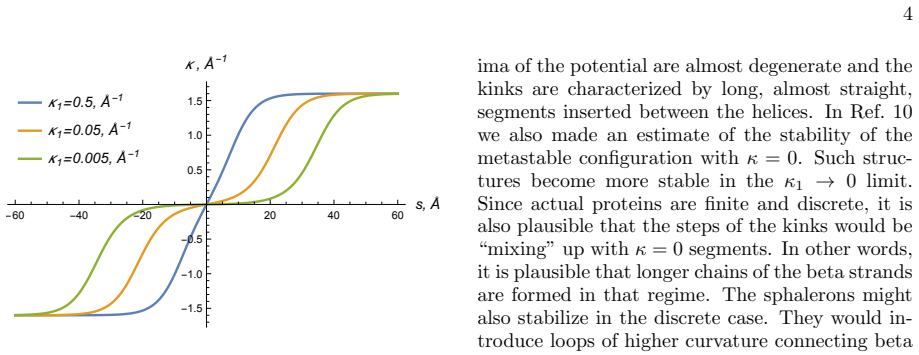
The load-bearing object is the one-dimensional Abelian Higgs model with a Chern-Simons term and a Proca mass term, Eq. (1), written for a complex curvature field $\hat\kappa = \kappa e^{i\eta}$ and a torsion field $\hat\tau$. Gauge invariance removes $\eta$ by shifting the torsion, giving the effective potential $V(\kappa) = \lambda(\kappa^2-\kappa_0^2)^2(\kappa^2+\kappa_1^2)/(2(\kappa^2+\epsilon^2))$ with two minima. The special relation $\tau = F^2\kappa/(\kappa^2+\epsilon^2)$ emerges from integrating out torsion and is the empirical tie to real proteins. Static solutions of this potential, namely constant-curvature helices, zero-curvature strands, kinks as loops, and sphalerons as hairpins, carry the paper's interpretations, and the size of the flat step inside the kink gives the universal strand length.
What would settle it
Take a large, structurally diverse set of high-resolution protein structures and measure, for every $\beta$ strand, the ribbon torsion and the local curvature of the fitted continuous curve. If the $(\kappa,\tau)$ pairs do not follow $\tau = F^2\kappa/(\kappa^2+\epsilon^2)$ with the published values of $F$ and $\epsilon$, or if the typical isolated strand length is not near 12 Å, the model's central prediction is falsified.
Extended reading notes
Core claim
The paper's central claim is that a continuous Abelian Higgs model with a two-minimum potential captures universal geometric features of protein secondary structure. In the model, a complex curvature field has a symmetry-broken ground state with constant curvature and torsion, meaning a helix, while zero-curvature configurations correspond to $\beta$ strands. Integrating out the torsion field produces an effective potential for curvature whose minima and kink solutions reproduce helices, loops, strands, and hairpin-like sphalerons. Fitting the curvature-torsion relation to real structures gives $F = 0.70\ \text{\AA}^{-1}$ and $\epsilon = 1.5\ \text{\AA}^{-1}$; with the helix parameters $\kappa_0 \simeq 1.6\ \text{\AA}^{-1}$ and $\tau_0 \simeq 0.15\ \text{\AA}^{-1}$, the model predicts a universal $\beta$-strand length $R_\beta \simeq 12\ \text{\AA}$. The paper further claims that $\beta$-strand abundance is controlled by the parameter $\kappa_1$, which can either suppress strands completely or make them abundant.
Load-bearing premise
The load-bearing premise is that a beta strand is correctly represented by the model's nearly straight, twisted-ribbon solution, with the ribbon's torsion, not the backbone's torsion, used as the measured quantity; if this identification fails, the fitted parameters and the 12 Å prediction lose their empirical support.
Editorial extensions
If this is right
- Helices are the generic ground state of the model, while beta strands appear only when the chemical-potential parameter $\kappa_1$ permits them, making strand abundance a tunable rather than fixed property.
- The predicted beta-strand length $R_\beta \approx 12\ \text{\AA}$ is parameter-independent in the model, so it should appear as a universal scale across unrelated proteins.
- Long loops interpolating between helices are kink solutions whose size grows logarithmically as $\kappa_1 \to 0$, matching the expectation that low-$\kappa_1$ proteins have extended near-straight segments.
- Sphaleron solutions give a natural field-theoretic counterpart of beta hairpins, predicting higher-curvature loop regions connecting beta strands.
- The model's few parameters define a universality class; discrete and inhomogeneous generalizations should preserve the geometric relations rather than reproduce exact atomic coordinates.
Reading between the lines
- If the 12 Å prediction is correct, beta-strand length distributions in structural databases should show a floor near this value across fold families; this could be checked directly without any new model assumptions.
- The chemical-potential interpretation of $\kappa_1$ suggests a concrete test: protein families in different cellular environments or with different amino-acid compositions should differ statistically in beta-strand abundance in the direction the parameter prescribes.
- The model's curvature-torsion relation implies an anticorrelation between ribbon curvature and torsion along strands; re-measuring this relation on a large independent structure set would be a sharper test than the single fitted figure.
- Extending the model to position-dependent parameters would turn it into a generative model for secondary-structure patterns, allowing comparison of predicted loop-size distributions with observed ones.
Signed reviews
Editorial analysis
A structured set of objections, weighed in public.
Referee Report
Summary. The paper proposes a continuous one-dimensional Abelian Higgs model with a Chern-Simons term and a Proca mass term as an effective field theory for protein backbone geometry. After integrating out the torsion, it claims a reduced energy functional whose derivative-free part can be rewritten as a two-minimum potential (4), with helices as the ground state, beta strands as metastable zero-curvature configurations, and loops as kinks interpolating between helical minima. The authors fit the model parameters to curvature-torsion data for helices and beta strands, and from the fitted parameters they derive a universal beta-strand length R_beta ≈ 12 Å, stated as a prediction of the model. They further argue that a single parameter kappa1 controls the abundance of beta strands, acting like a chemical potential.
Significance. If the central derivation were supplied and the 12 Å prediction independently tested, the paper would offer a genuinely attractive statement: a two-minimum effective potential with a single controlling parameter that unifies helices, beta strands, and loops in one universality class. The qualitative mapping of kinks, sphalerons, and zero-curvature segments to secondary-structure motifs is concrete and pedagogically useful, and the claimed R_beta ≈ 12 Å is a crisp, falsifiable quantitative prediction. However, in its current form the letter does not establish the derivation of the effective potential, and the empirical validation is not independent of the fitted parameters. The paper therefore cannot yet support its main quantitative claim.
major comments (4)
- [Eqs. (1)–(3)] The reduction from the gauge-invariant energy (1) to the algebraic relation (2) and the reduced functional (3) is not shown and does not follow from Eq. (1) as written. The torsion-dependent part of Eq. (1) is -∫ F τ̂ ds + (1/2ε²)∫(τ̂ - η')² ds. Varying with respect to the physical torsion τ = τ̂ - η' gives τ = F ε², a κ-independent constant, rather than the κ-dependent relation τ = F/(κ² + ε²) needed to produce the F²/(κ² + ε²) term in Eq. (3). Either Eq. (1) is missing a κ-dependent torsion mass or kinetic term, or Eq. (2) is simply asserted. Since Eq. (3) and all subsequent analysis use Eq. (2), this is a load-bearing gap.
- [Eq. (4)] The paper states that Eq. (4) is a rewrite of the derivative-free part of Eq. (3), but this is not algebraically correct as printed. Multiplying the potential in Eq. (3), U(κ) = ½(-m²κ² + λκ⁴) - F²/[2(κ² + ε²)], by 2(κ² + ε²) and comparing with Eq. (4) forces the constant-term condition -F² = λ κ₀⁴ κ₁², which is incompatible with real parameters and with the stated assumption 0 ≤ κ₁² ≤ ε². An unstated additive constant and additional parameter relations would be required to make the two potentials coincide. The 'two different parameterizations' relation between λ and F invoked in Eq. (7) is also deferred to the companion Ref. 10, which the footnote reports is not available on arXiv. Because Eq. (4) is the basis of the kink solutions, Fig. 3, and Eq. (7), the central derivation is not checkable in this letter.
- [Eqs. (6)–(7) and Fig. 2] The R_β ≈ 12 Å result is not an independent prediction. The values F = 0.70 Å⁻¹ and ε = 1.5 Å⁻¹ in Eq. (6) are obtained by fitting relation (2) to the helix and beta-strand points in Fig. 2, the same data whose compatibility with Eq. (2) is presented as validation. Equation (7) then evaluates R_β from these fitted values together with κ₀ from Eq. (5), but no measured distribution of beta-strand lengths is shown and no error bars or sensitivity analysis are given for R_β ≈ 12 Å. As a result, the paper does not demonstrate that this is a falsifiable prediction or that it agrees with protein phenomenology beyond the data already used to fix the parameters.
- [Identification of β strands and Fig. 2] The empirical support for Eq. (2) is weakened by the use of a different geometric observable for beta strands. The fields κ and τ in Eqs. (1)–(3) are properties of the backbone curve, and Eq. (2) is a relation between backbone curvature and backbone torsion. For beta strands the authors state that they measured 'the torsion of the ribbon, rather than that of the backbone chain.' At κ → 0 the Frenet torsion of a nearly straight backbone is not a well-defined continuous quantity, whereas the ribbon torsion is a different quantity; no justification is given for using ribbon torsion to test a relation derived for the backbone. Consequently, the fitted parameters in Eq. (6) and the compatibility claim for Fig. 2 are not established as tests of the model.
minor comments (4)
- [Reference 10] The companion paper is explicitly reported to be 'still on hold by the arXiv moderators' as of the submission date; the authors should either make the derivation available as supplementary material or state clearly which results in the letter depend on it.
- [Eq. (7)] The displayed formula for R_β is garbled in the typesetting; it should be clarified whether the integrand is 1/[√λ κ₀ ε √(k² + κ₁²)] and how the final rational expression in F, ε, and κ₀ is obtained.
- [Fig. 2] The figure caption and text do not specify how the beta-strand points were obtained from protein structures, which proteins were used, or how the ribbon torsion was computed; these details are needed for reproducibility.
- [General] The term 'universality class' is used without a precise definition; the authors should specify what can and cannot vary within the class and what observables are universal.
Circularity Check
Rβ ≈ 12 Å prediction is not self-contained: it uses a same-author companion paper for the λ–F relation and parameters fitted to the same beta-strand data, with no independent length comparison.
-
self citation load bearing
[Eq. (7), final paragraph of the kink-solution section]
"where we assumed the relation between parameters λ and F following from two different parameterizations of the potential. 10 Note, that this value does not depend on κ1. The estimate gives the numerical value Rβ ≃ 12 ˚A, which is a prediction of the universal size of the length of the beta strand in the model."
The numerical prediction Rβ is evaluated only after importing from Ref. 10, a companion paper by the same authors that the footnote reports as 'still on hold' on arXiv, the relation between λ and F. That relation is the load-bearing bridge between the fitted F, ε, κ0 and the integral in Eq. (7); the letter itself neither states nor derives it. Moreover, F and ε were obtained by fitting Eq. (2) to the Fig. 2 scatter of helix and beta-strand points, and Rβ is a direct algebraic function of those fitted parameters. The 'universal' beta-strand length is therefore not an independent prediction: it is a rearranged combination of parameters fitted to the very structural class whose length is claimed to be predicted, together with an unverifiable same-author relation.
full rationale
The model construction itself is not circular: Eqs. (1)-(4) explicitly define an effective energy functional, the torsion is integrated out to give relation (2), and the potential (4) is presented as a reparameterization of the derivative-free part of Eq. (3). Fitting κ0, τ0, F, and ε to data is ordinary model calibration, and the functional form of the model has independent quantitative content. The central difficulty is the claimed prediction Rβ ≈ 12 Å. It is not an independent test of the model because (i) F and ε are fitted to the Fig. 2 curvature-torsion distribution that includes beta-strand points, (ii) Rβ is computed from those same fitted parameters through Eq. (7), and (iii) the λ-F relation needed to evaluate the integral is imported from Ref. 10, a same-author companion paper that was not available on arXiv at submission. No measured distribution of beta-strand lengths is shown for comparison, so the empirical support is partly in-sample. This warrants a moderate circularity score rather than a high one: the prediction is not literally identical to a fitted value, and the model could have produced a different length, but the derivation chain for the headline number reduces at a load-bearing step to an unavailable self-citation.
Assumptions & free parameters
free parameters (6)
- κ0 =
1.6 Å⁻¹
- τ0 =
0.15 Å⁻¹
- F =
0.70 Å⁻¹
- ϵ =
1.5 Å⁻¹
- κ1
- λ
assumptions (4)
- domain assumption The one-dimensional Abelian Higgs energy functional (1) is the correct effective action for protein backbone conformations.
- domain assumption The continuum limit is valid, treating proteins as long continuous curves.
- ad hoc to paper The potential (4) is the correct reduction of the energy functional with a specific mapping of parameters.
- domain assumption Beta strands correspond to κ=0 configurations, and the torsion of the ribbon is the appropriate observable.
Cite this review
Pith. "Pith review of A Continuous Effective Model of the Protein Dynamics." pith.science (2026). https://pith.science/paper/HYJIIAUG
@misc{pith2026190811739,
  author       = {Pith},
  title        = {Pith review of: A Continuous Effective Model of the Protein Dynamics},
  year         = {2026},
  howpublished = {\url{https://pith.science/paper/HYJIIAUG}},
  note         = {Machine review of arXiv:1908.11739}
}
read the original abstract
The theory of elastic rods can be used to describe certain geometric and topological properties of the DNA molecules. A similar effective field theory approach was previously suggested to describe the conformations and dynamics of proteins. In this letter we report a detailed study of the basic features of a version of the proposed model, which assumes proteins to be very long continuous curves. In the most appealing case, the model is based on a potential with a pair of minima corresponding to helical and strand-like configurations of the curves. It allows to derive several predictions about the geometric features of the molecules, and we show that the predictions are compatible with the phenomenology. While the helices represent the ground state configurations, the abundance of beta strands is controlled by a parameter, which can either completely suppress their presence in a molecule, or make them abundant. The few-parameter model investigated in the letter rather represents a universality class of protein molecules. Generalizations accounting for the discrete nature and inhomogeneity of the molecules presumably allow to model realistic cases.
Figures


Forward citations
Cited by 1 Pith paper
-
Chern-Simons-Higgs Model as a Theory of Protein Molecules
A four-parameter Chern-Simons-Higgs model fits the curvature-torsion relation of protein secondary structure, with one remaining parameter controlling loop length and strand abundance.
Reference graph
Works this paper leans on
-
[1]
U. H. Danielsson, M. Lundgren and A. J. Niemi, Phys.\ Rev.\ E 82 (2010) 021910 [arXiv:0902.2920 [cond-mat.stat-mech]]
work page Pith review arXiv 2010
-
[2]
Topological Solitons and Folded Proteins
M. Chernodub, S. Hu and A. J. Niemi, Phys.\ Rev.\ E 82 (2010) 011916 [arXiv:1003.4481 [bio-ph]]
work page Pith review arXiv 2010
-
[3]
N. Molkenthin, S. Hu and A.J. Niemi, Phys.\ Rev.\ Lett.\ 106 (2011) 78102
work page 2011
-
[4]
S. Hu, A. Krokhotin, A. J. Niemi, and X. Peng Phys.\ Rev.\ E 83 (2011) 041907
work page 2011
-
[5]
S. Hu, M. Lundgren and A. J. Niemi, Phys.\ Rev.\ A 83 (2011) 061908 [arXiv:1102.5658 [q-bio.BM]]
work page Pith review arXiv 2011
- [6]
-
[7]
X. Peng, A. Chenani, S. Hu, Y. Zhou, A. J. Niemi, BMC\ Struct.\ Biol.\ 14 (2014) 27
work page 2014
-
[8]
A. J. Niemi, Theoret.\ Math.\ Phys.\ 181 (1) (2014) 1235
work page 2014
Show all 21 references
-
[9]
Molochkov, A
A. Molochkov, A. Begun and A. Niemi, EPJ Web Conf.\ 137 (2017) 04004 [arXiv:1703.04263 [q-bio.BM]]
2017 arXiv
-
[10]
Melnikov and A
D. Melnikov and A. B. F. Neves, ``Chern-Simons-Higgs Model as a Theory of Protein Molecules''. This paper was submitted to arXiv on August 9, 2019. As of August 30, it is still on hold by the arXiv moderators
2019
-
[11]
S. Hu, Y. Jiang and A. J. Niemi, Phys.\ Rev.\ D 87 (2013) 105011
2013
-
[12]
Gordeli, D
I. Gordeli, D. Melnikov, A. Niemi and A. Sedrakyan, Phys.\ Rev.\ D 94 (2016) no.2, 021701 [arXiv:1508.03268 [hep-th]]
2016 arXiv
-
[13]
F. R. Klinkhamer and N. S. Manton, Phys.\ Rev.\ D 30 (1984) 2212
1984
-
[14]
V. A. Rubakov, ``Classical Theory of Gauge Fields,'' Princeton University Press, 2002
2002
-
[15]
The PyMOL Molecular Graphics System, Version 2.0 Schr\"odinger, LLC
-
[16]
G. N. Ramachandran, C. Ramakrishnan and V. Sasisekharan, Journal of Molecular Biology, 7 (1) (1963) 95
1963
-
[17]
Ramakrishnan and G
C. Ramakrishnan and G. N. Ramachandran Biophys.\ J.\ 5 (1965) 909
1965
-
[18]
Lovell, I
S C. Lovell, I. W. Davis, W. B. Arendall, P. I. de Bakker, J. M. Word, M. G. Prisant,J. S. Richardson and D. C. Richardson, Proteins 50 (2003) 437
2003
-
[19]
N. H. Christ and T. D. Lee, Phys.\ Rev.\ D 12 (1975) 1606
1975
- [20]
- [21]
Reviewed August 14, 2026 · model on record in the stance chip above.
Discussion (0). Continue with ORCID to comment.