REVIEW 3 major objections 3 minor 104 references
RPN 2: On Interdependence Function Learning Towards Unifying and Advancing CNN, RNN, GNN, and Transformer
T0 review · 3 major / 3 minor · reviewed 2026-08-12 · deepseek-v4-flash
Pith's one-line read The paper claims that CNN, RNN, GNN, and Transformer architectures differ only in their interdependence functions within one shared RPN 2 model.
desk verdict A real framework paper with a public toolkit, but the Transformer-unification claim is asserted rather than proven, and the empirical summary overreaches; worth refereeing with the equivalence proofs demanded. read the letter →
The pith
A machine-rendered reading of the paper's core claim, the machinery that carries it, and where it could break.
The reading
What carries the argument
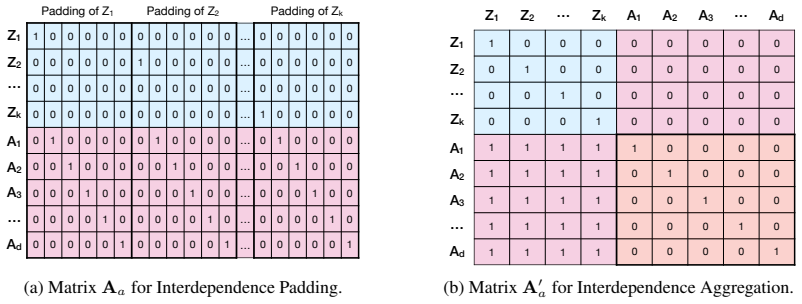
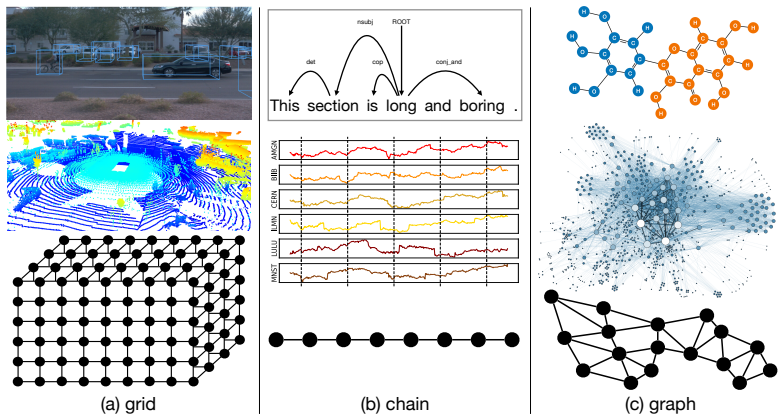
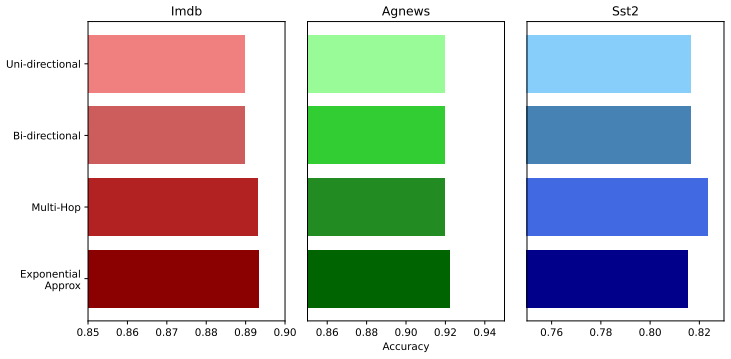
The carrying object is the interdependence matrix: a typically sparse matrix $\mathbf{A}$ computed from the input batch and optional structure, applied to the data before or after transformation as $\mathbf{X}\mathbf{A}_{\xi_a}$ and $\mathbf{A}_{\xi_i}^{\top}(\cdot)$. The paper defines a library of interdependence functions—constant and identity, statistical and numerical kernels, parameterized bilinear forms, geometric grid patches (cuboid, cylinder, sphere) with packing schemes, chain-based unidirectional, bidirectional, and multi-hop functions, graph adjacency and PageRank functions, and hybrid fusions—and claims that these functions supply the locality, sequential, structural, and attention mechanisms that distinguish existing backbones. Everything else in the architecture, including data expansion and compression, parameter reconciliation, remainder, and fusion, is shared across families.
What would settle it
Take a standard transformer block with softmax attention, layer normalization, and a residual connection, and transcribe its forward pass using only functions in the paper's catalogue. If any operation requires a function outside that catalogue, or if the residual-plus-normalization interaction cannot be represented through the interdependence matrices, then the claimed unification is approximate rather than exact.
Extended reading notes
Core claim
RPN 2 retains the original RPN decomposition $g(\mathbf{x}|w) = \langle \kappa_\xi(\mathbf{x}), \psi(w)\rangle + \pi(\mathbf{x})$, but replaces the plain data expansion with a data interdependent transformation $\kappa_\xi(\mathbf{X}) = \mathbf{A}_{\xi_i}^{\top}\kappa(\mathbf{X}\mathbf{A}_{\xi_a})$, where $\mathbf{A}_{\xi_a}$ and $\mathbf{A}_{\xi_i}$ are attribute and instance interdependence matrices returned by new interdependence functions. The paper's discovery claim is that every major backbone can be written in this form, and that the distinctions among CNN, RNN, GNN, and Transformer are explained by which interdependence function is used rather than by any deeper architectural difference. It substantiates this with explicit reconstruction recipes in Section 8 for each family, a catalogue of interdependence functions including grid patches, chains with multi-hop powers and matrix inverses or exponentials, graph adjacency and PageRank, and parameterized bilinear forms, plus a hybrid construction that reproduces attention-like behavior.
Load-bearing premise
The load-bearing premise is that every layer of a real CNN, RNN, GNN, or Transformer, including nonlinearities, normalization, and skip connections, can be absorbed exactly into the RPN 2 composition with only the interdependence matrix varying.
Editorial extensions
If this is right
- Choosing the identity interdependence function for both instances and attributes recovers the original RPN and, with it, the models already unified by RPN, including probabilistic graphical models, kernel SVMs, MLPs, and KANs.
- Using grid-patch interdependence reproduces CNN-style local receptive fields; varying patch shape and packing density gives a family of convolutional variants.
- Using chain interdependence functions reproduces RNN-style sequential processing, with multi-hop powers and $(I-A)^{-1}$ or $\exp(A)$ as computationally cheaper ways to propagate information along long sequences.
- Using graph adjacency, PageRank, or hybrid bilinear-plus-graph interdependence yields GNN, GAT-like, and Transformer-like behavior, so attention can be understood as one interdependence function choice.
- New backbones can be designed by selecting or fusing interdependence functions, and the reported experiments show such RPN 2 variants matching or outperforming standard backbones on image, language, time-series, and graph tasks.
Reading between the lines
- Beyond what the paper shows, the unification claim implies a concrete architecture-search agenda: treat the interdependence function class as the search space, with shared transformation and reconciliation components fixed, and measure whether such search finds backbones that beat hand-designed CNN and Transformer baselines.
- The chain and graph functions that sum powers of an adjacency-like matrix connect RPN 2 to graph-diffusion and PageRank ideas; learning the hop weights instead of fixing them would be a natural next step the paper motivates but does not implement.
- A shared RPN 2 model with per-modality interdependence functions could serve as a multimodal backbone without modality-specific heads; the paper discusses multimodal data but evaluates datasets one modality at a time.
- The paper's exact-equality claim should be tested by reimplementing a standard transformer as RPN 2 and checking forward-pass equality up to floating-point precision; until that check is run, the statement that these backbones differ only in interdependence function is a representation claim rather than a verified equivalence.
Editorial analysis
A structured set of objections, weighed in public.
Referee Report
Summary. This paper introduces RPN 2, an extension of the Reconciled Polynomial Network. The model represents a function as g(x|w) = ⟨κξ(x), ψ(w)⟩ + π(x), where κξ composes a data transformation κ with new attribute- and instance-level interdependence functions ξ that produce interdependence matrices applied to the input batch. The paper claims that this canonical form unifies CNN, RNN, GNN, and Transformer backbones and that the differences among these backbones primarily stem from how interdependence functions are defined. It also contributes a large catalog of interdependence functions, data compression and fusion functions, complexity estimates, a software toolkit update, and experiments on image, language, time-series, and graph benchmarks.
Significance. If the exact unification claim held, this would be a valuable conceptual contribution with practical implications for architecture design, and the open-source TINY BIG v0.2.0 toolkit is a concrete asset. The taxonomy of interdependence functions and the constructive matrix mappings for grid, chain, and graph structures are presented in a clear and useful way. However, the Transformer equivalence is asserted rather than demonstrated in the reviewed text, and the empirical evidence needed to support the performance claims is not present in the material provided. The central advertised novelty is therefore not yet established.
major comments (3)
- [Section 8.4, Eq. (28)] The unification of Transformers is asserted but not demonstrated. A standard Transformer encoder combines multi-head scaled dot-product softmax attention, per-head value and output projections, residual connections, and layer normalization. The RPN 2 form in Eq. (28) contains an interdependence matrix ξ, a transformation κ, a parameter reconciliation ψ, and a remainder π, but no exact derivation is given that rewrites the full Transformer forward pass in this form without placing the softmax nonlinearity and row normalization inside an opaque ξ and without changing κ and π per backbone. If softmax is absorbed into ξ, then ξ is no longer merely an interdependence matrix, and the claim that backbones differ primarily in their interdependence functions needs a precise and formal statement. Section 8.4 must provide explicit equivalence statements for all components of the Transformer encoder, or the central claim must be weakened.
- [Section 8, Eq. (24)] The claim that 'the fundamental distinctions among these backbone models primarily stem from their diverse approaches to defining the interdependence functions' requires that the other components of the canonical form be held fixed or shown to be common. The paper does not establish this. The constructive mappings for CNN, RNN, and GNN use backbone-specific ingredients beyond ξ: patch geometry and compression for CNNs, temporal sharing and remainder terms for RNNs, and graph adjacency plus normalization for GNNs. If κ, ψ, or π vary between backbones, the distinctions are not primarily due to interdependence functions alone. A formal statement of what is fixed across backbones and what is allowed to vary is needed before the advertised conceptual conclusion is supported.
- [Section 9 and Abstract] The empirical claims in the abstract and introduction cannot be verified from the reviewed text. The abstract says RPN 2 'significantly outperforms' the previous RPN and that RPN 2-based models 'enhance existing backbones,' while Section 1 says RPN 2 'achieves performance comparable to leading models like CNNs, RNNs, and GCNs.' The reviewed portions do not include the experimental setup, result tables, baselines, standard deviations, or ablations needed to assess either claim. These materials must be included, and the apparent inconsistency between 'significantly outperforms' and 'comparable' should be resolved.
minor comments (3)
- [Section 4.2] There is a grammatical error near the end of the section: 'the codomain dimensions m′ and b′ must are explicitly specified' should read 'must be explicitly specified.'
- [Figure 19] Entries 7 and 8 in the data expansion list are both labeled 'Lucas Expansion'; one of them appears to be mislabeled and should be corrected.
- [Eq. (30)] The notation in Eq. (30) for the multi-head and multi-channel fusion is difficult to parse because the head and channel indices H, C are introduced without a fully explicit indexing convention; a cleaner definition of the fusion argument would improve readability.
Circularity Check
Central unification claim is partly self-definitional: RPN 2 is defined with a free interdependence function xi, and backbones are instantiated by choosing xi, so the 'finding' that backbones differ in xi is to some extent built into the template; Transformer/GAT equivalences are announced with 'akin to' rather than proven, and the empirical benchmarking is independent.
-
self definitional
[Abstract; Section 4.2, Eq. (26)-(27)]
"Our analysis reveals that the fundamental distinctions among these backbone models primarily stem from their diverse approaches to defining the interdependence functions. ... kappa_xi(X) = A_xi_i^top kappa(X A_xi_a) in R^{b' x D} ... A_xi_a = xi_a(X) in R^{m x m'}, and A_xi_i = xi_i(X) in R^{b x b'}."
The canonical RPN 2 form is a template in which the interdependence function xi is free to absorb all inter-instance/attribute structure. Each backbone is 'unified' by selecting a different xi (grid, chain, graph, bilinear/attention matrix). Therefore the conclusion that backbones differ primarily in xi is entailed by the way the representation was filled in: any operation expressible as X times a matrix produced from X can be put into xi. The paper does not derive from independent definitions of CNN/RNN/GNN/Transformer that their differences must reduce to xi; it assigns each a xi and then reads the distinction back out.
-
renaming known result
[Section 5.1.7 and Section 5.3.2; announced Section 8.4]
"To illustrate, we present the bilinear interdependence function with low-rank parameter reconciliation, which will also be used to construct the Transformer model with the RPN 2 model architecture. ... this hybrid interdependence function endows the RPN 2 model with capabilities akin to those of the Graph Attention Network (GAT) [76], which uses a linear attention mechanism, and Graph-BERT [91], which utilizes a transformer-based attention mechanism."
Self-attention and graph attention are re-expressed as a 'parameterized bilinear' or 'hybrid graph' interdependence matrix. The 'unification' then consists of renaming the attention-score matrix as an interdependence function and placing it in xi. The paper itself says 'akin to', not 'equal to', so the exact reduction of Transformer/GAT to the canonical form is not demonstrated; the claimed insight is carried by the naming/placement of xi rather than by a derivation from the backbones' own definitions.
full rationale
The paper is not a pure exercise in circularity: RPN 2's architecture, the new interdependence functions, and the benchmark experiments stand on their own, and the identity-interdependence reduction to RPN is a genuine containment result. The circular flavor is concentrated in the advertised unification claim. Because RPN 2's definition (Eq. 24-28) gives xi the role of the variable that changes across instantiations, saying that CNN/RNN/GNN/Transformer 'primarily differ in their interdependence functions' is largely a restatement of how the author chose to instantiate the template, especially when the Transformer/attention mappings are sketched ('will be used to construct', 'akin to') rather than proved as exact equivalences. This is a partial, construction-level circularity affecting the paper's headline conceptual contribution, but it does not invalidate the empirical comparisons, which are external benchmarks with fitted models. Hence score 4 rather than 8-10.
Assumptions & free parameters
free parameters (4)
- Patch packing hyperparameters (ph, pw, pd, dh, dw, dd)
- Low-rank rank r for bilinear interdependence
- PageRank damping factor alpha =
0.15 (default)
- Kernel bandwidth sigma for RBF and Laplacian kernels
assumptions (4)
- standard math Taylor's theorem justifies decomposing any sufficiently smooth function into an expansion and a remainder.
- domain assumption Data interdependence can be fully captured by multiplying the data batch by pairwise interdependence matrices.
- domain assumption Standard CNN, RNN, GNN, and Transformer operations can be represented exactly as a composition of an interdependence function, a transformation, and a remainder in RPN 2.
- ad hoc to paper The primary distinction between backbones is their interdependence function.
invented entities (2)
-
Data interdependence function (xi)
-
Interdependence matrix
Cite this review
Pith. "Pith review of RPN 2: On Interdependence Function Learning Towards Unifying and Advancing CNN, RNN, GNN, and Transformer." pith.science (2026). https://pith.science/paper/MJMSGUIW
@misc{pith2026241111162,
  author       = {Pith},
  title        = {Pith review of: RPN 2: On Interdependence Function Learning Towards Unifying and Advancing CNN, RNN, GNN, and Transformer},
  year         = {2026},
  howpublished = {\url{https://pith.science/paper/MJMSGUIW}},
  note         = {Machine review of arXiv:2411.11162}
}
read the original abstract
This paper builds upon our previous work on the Reconciled Polynomial Network (RPN). The original RPN model was designed under the assumption of input data independence, presuming the independence among both individual instances within data batches and attributes in each data instance. However, this assumption often proves invalid for function learning tasks involving complex, interdependent data such as language, images, time series, and graphs. Ignoring such data interdependence may inevitably lead to significant performance degradation. To overcome these limitations, we introduce the new Reconciled Polynomial Network (version 2), namely RPN 2, in this paper. By incorporating data and structural interdependence functions, RPN 2 explicitly models data interdependence via new component functions in its architecture. This enhancement not only significantly improves RPN 2's learning performance but also substantially expands its unifying potential, enabling it to encompass a broader range of contemporary dominant backbone models within its canonical representation. These backbones include, but are not limited to, convolutional neural networks (CNNs), recurrent neural networks (RNNs), graph neural networks (GNNs), and Transformers. Our analysis reveals that the fundamental distinctions among these backbone models primarily stem from their diverse approaches to defining the interdependence functions. Furthermore, this unified representation opens up new opportunities for designing innovative architectures with the potential to surpass the performance of these dominant backbones.
Figures


Figures from the paper (34 more)








Reference graph
Works this paper leans on
-
[1]
Vatt: Transformers for multimodal self-supervised learning from raw video, audio and text
Hassan Akbari, Linagzhe Yuan, Rui Qian, Wei-Hong Chuang, Shih-Fu Chang, Yin Cui, and Boqing Gong. Vatt: Transformers for multimodal self-supervised learning from raw video, audio and text. ArXiv, abs/2104.11178, 2021
arXiv 2021
-
[2]
Understanding of a convolutional neural network
Saad Albawi, Tareq Abed Mohammed, and Saad Al-Zawi. Understanding of a convolutional neural network. In 2017 International Conference on Engineering and Technology (ICET), pages 1–6, 2017
2017
-
[3]
Neural machine translation by jointly learning to align and translate
Dzmitry Bahdanau, Kyunghyun Cho, and Yoshua Bengio. Neural machine translation by jointly learning to align and translate. CoRR, abs/1409.0473, 2014
arXiv 2014
-
[4]
Bartlett and Shahar Mendelson
Peter L. Bartlett and Shahar Mendelson. Rademacher and gaussian complexities: risk bounds and structural results. J. Mach. Learn. Res., 3(null):463–482, March 2003
2003
-
[5]
Irwan Bello, Barret Zoph, Ashish Vaswani, Jonathon Shlens, and Quoc V . Le. Attention augmented convolutional networks. 2019 IEEE/CVF International Conference on Computer Vision (ICCV), pages 3285–3294, 2019
2019
-
[6]
Blattmann, Tim Dockhorn, Sumith Kulal, Daniel Mendelevitch, Maciej Kilian, and Do- minik Lorenz
A. Blattmann, Tim Dockhorn, Sumith Kulal, Daniel Mendelevitch, Maciej Kilian, and Do- minik Lorenz. Stable video diffusion: Scaling latent video diffusion models to large datasets. ArXiv, abs/2311.15127, 2023
arXiv 2023
-
[7]
Blattmann, Robin Rombach, Huan Ling, Tim Dockhorn, Seung Wook Kim, Sanja Fidler, and Karsten Kreis
A. Blattmann, Robin Rombach, Huan Ling, Tim Dockhorn, Seung Wook Kim, Sanja Fidler, and Karsten Kreis. Align your latents: High-resolution video synthesis with latent diffusion models. 2023 IEEE/CVF Conference on Computer Vision and Pattern Recognition (CVPR), pages 22563–22575, 2023
2023
-
[8]
Ehrenfeucht, David Haussler, and Manfred K
Anselm Blumer, A. Ehrenfeucht, David Haussler, and Manfred K. Warmuth. Learnability and the vapnik-chervonenkis dimension. J. ACM, 36(4):929–965, oct 1989
1989
Show all 104 references
-
[9]
STEPHEN G. BRUSH. History of the lenz-ising model. Rev. Mod. Phys., 39:883–893, Oct 1967
1967
-
[10]
Purushotham, Kyunghyun Cho, David A
Zhengping Che, S. Purushotham, Kyunghyun Cho, David A. Sontag, and Yan Liu. Recurrent neural networks for multivariate time series with missing values. Scientific Reports, 8, 2016
2016
-
[11]
Fleet, and Geoffrey E
Ting Chen, Saurabh Saxena, Lala Li, David J. Fleet, and Geoffrey E. Hinton. Pix2seq: A language modeling framework for object detection. ArXiv, abs/2109.10852, 2021
2021 arXiv
-
[12]
Learning phrase representations using rnn en- coder–decoder for statistical machine translation
Kyunghyun Cho, Bart van Merrienboer, C ¸ aglar G¨ulc ¸ehre, Dzmitry Bahdanau, Fethi Bougares, Holger Schwenk, and Yoshua Bengio. Learning phrase representations using rnn en- coder–decoder for statistical machine translation. In Conference on Empirical Methods in Natural Langu...
2014
-
[13]
Transformers are ssms: Generalized models and efficient algorithms through structured state space duality
Tri Dao and Albert Gu. Transformers are ssms: Generalized models and efficient algorithms through structured state space duality. ArXiv, abs/2405.21060, 2024
2024 arXiv
-
[14]
Convolutional neural networks on graphs with fast localized spectral filtering
Micha ¨el Defferrard, Xavier Bresson, and Pierre Vandergheynst. Convolutional neural networks on graphs with fast localized spectral filtering. In Neural Information Processing Systems, 2016
2016
-
[15]
Bert: Pre-training of deep bidirectional transformers for language understanding
Jacob Devlin, Ming-Wei Chang, Kenton Lee, and Kristina Toutanova. Bert: Pre-training of deep bidirectional transformers for language understanding. In North American Chapter of the Association for Computational Linguistics, 2019
2019
-
[16]
An image is worth 16x16 words: Transformers for image recognition at scale
Alexey Dosovitskiy, Lucas Beyer, Alexander Kolesnikov, Dirk Weissenborn, Xiaohua Zhai, Thomas Unterthiner, Mostafa Dehghani, Matthias Minderer, Georg Heigold, Sylvain Gelly, Jakob Uszkoreit, and Neil Houlsby. An image is worth 16x16 words: Transformers for image recognition at...
2010 arXiv
-
[17]
Transductive rademacher complexity and its applications
Ran El-Yaniv and Dmitry Pechyony. Transductive rademacher complexity and its applications. In Annual Conference Computational Learning Theory, 2007
2007
-
[18]
Jeffrey L. Elman. Finding structure in time. Cognitive Science, 14(2):179–211, 1990
1990
-
[19]
Learning the- ory can (sometimes) explain generalisation in graph neural networks
Pascal Mattia Esser, Leena Chennuru Vankadara, and Debarghya Ghoshdastidar. Learning the- ory can (sometimes) explain generalisation in graph neural networks. ArXiv, abs/2112.03968, 2021
2021 arXiv
-
[20]
Patrick Esser, Sumith Kulal, A. Blattmann, Rahim Entezari, Jonas Muller, Harry Saini, Yam Levi, Dominik Lorenz, Axel Sauer, Frederic Boesel, Dustin Podell, Tim Dockhorn, Zion En- glish, Kyle Lacey, Alex Goodwin, Yannik Marek, and Robin Rombach. Scaling rectified flow transform...
2024 arXiv
-
[21]
Th´eorie analytique de la chaleur
Joseph Fourier. Th´eorie analytique de la chaleur. F. Didot, Paris, 1822. English translation: The Analytical Theory of Heat
-
[22]
Garg, Stefanie Jegelka, and T
Vikas K. Garg, Stefanie Jegelka, and T. Jaakkola. Generalization and representational limits of graph neural networks. In International Conference on Machine Learning, 2020
2020
-
[23]
Roy J. Glauber. Time-Dependent Statistics of the Ising Model. Journal of Mathematical Physics, 4(2):294–307, 02 1963
1963
-
[24]
node2vec: Scalable feature learning for networks
Aditya Grover and Jure Leskovec. node2vec: Scalable feature learning for networks. In Proceedings of the 22nd ACM SIGKDD International Conference on Knowledge Discovery and Data Mining, KDD ’16, page 855–864, New York, NY , USA, 2016. Association for Com- puting Machinery
2016
-
[25]
Mamba: Linear-time sequence modeling with selective state spaces
Albert Gu and Tri Dao. Mamba: Linear-time sequence modeling with selective state spaces. ArXiv, abs/2312.00752, 2023
2023 arXiv
-
[26]
Zhang, Shaoqing Ren, and Jian Sun
Kaiming He, X. Zhang, Shaoqing Ren, and Jian Sun. Deep residual learning for image recog- nition. 2016 IEEE Conference on Computer Vision and Pattern Recognition (CVPR), pages 770–778, 2015
2016
-
[27]
Jonathan Ho, Ajay Jain, and P. Abbeel. Denoising diffusion probabilistic models. ArXiv, abs/2006.11239, 2020
2006 arXiv
-
[28]
Jonathan Ho, Tim Salimans, Alexey Gritsenko, William Chan, Mohammad Norouzi, and David J. Fleet. Video diffusion models. ArXiv, abs/2204.03458, 2022
2022 arXiv
-
[29]
Long short-term memory
Sepp Hochreiter and J ¨urgen Schmidhuber. Long short-term memory. Neural Comput., 9(8):1735–1780, November 1997
1997
-
[30]
J. J. Hopfield. Neural networks and physical systems with emergent collective computational abilities. Proceedings of the National Academy of Sciences of the United States of America, 79(8):2554–2558, 1982
1982
-
[31]
J. J. Hopfield. Neurons with graded response have collective computational properties like those of two-state neurons. Proceedings of the National Academy of Sciences of the United States of America, 81(10):3088–3092, 1984
1984
-
[32]
Gpt-gnn: Gen- erative pre-training of graph neural networks
Ziniu Hu, Yuxiao Dong, Kuansan Wang, Kai-Wei Chang, and Yizhou Sun. Gpt-gnn: Gen- erative pre-training of graph neural networks. Proceedings of the 26th ACM SIGKDD International Conference on Knowledge Discovery & Data Mining, 2020
2020
-
[33]
Le, Yun- Hsuan Sung, Zhen Li, and Tom Duerig
Chao Jia, Yinfei Yang, Ye Xia, Yi-Ting Chen, Zarana Parekh, Hieu Pham, Quoc V . Le, Yun- Hsuan Sung, Zhen Li, and Tom Duerig. Scaling up visual and vision-language representation learning with noisy text supervision. In International Conference on Machine Learning, 2021. 94
2021
-
[34]
Johnson and Joram Lindenstrauss
William B. Johnson and Joram Lindenstrauss. Extensions of lipschitz mappings into hilbert space. Contemporary mathematics, 26:189–206, 1984
1984
-
[35]
Michael I. Jordan. Chapter 25 - serial order: A parallel distributed processing approach. In John W. Donahoe and Vivian Packard Dorsel, editors, Neural-Network Models of Cognition, volume 121 of Advances in Psychology, pages 471–495. North-Holland, 1997
1997
-
[36]
Convolutional neural networks for sentence classification
Yoon Kim. Convolutional neural networks for sentence classification. In Conference on Empirical Methods in Natural Language Processing, 2014
2014
-
[37]
Semi-supervised classification with graph convolutional net- works
Thomas Kipf and Max Welling. Semi-supervised classification with graph convolutional net- works. ArXiv, abs/1609.02907, 2016
2016 arXiv
-
[38]
D. Kondratyuk, Lijun Yu, Xiuye Gu, Jos´e Lezama, Jonathan Huang, Rachel Hornung, Hartwig Adam, Hassan Akbari, Yair Alon, Vighnesh Birodkar, Yong Cheng, Ming-Chang Chiu, Josh Dillon, Irfan Essa, Agrim Gupta, Meera Hahn, Anja Hauth, David Hendon, Alonso Martinez, David C. Minnen...
2023 arXiv
-
[39]
Vera: Vector-based ran- dom matrix adaptation
Dawid Jan Kopiczko, Tijmen Blankevoort, and Yuki Markus Asano. Vera: Vector-based ran- dom matrix adaptation. ArXiv, abs/2310.11454, 2023
2023 arXiv
-
[40]
Imagenet classification with deep convolutional neural networks
Alex Krizhevsky, Ilya Sutskever, and Geoffrey E Hinton. Imagenet classification with deep convolutional neural networks. In F. Pereira, C.J. Burges, L. Bottou, and K.Q. Weinberger, editors, Advances in Neural Information Processing Systems, volume 25. Curran Associates, Inc., 2012
2012
-
[41]
Hopfield
Dmitry Krotov and John J. Hopfield. Dense associative memory for pattern recognition.ArXiv, abs/1606.01164, 2016
2016 arXiv
-
[42]
Hopfield
Dmitry Krotov and John J. Hopfield. Large associative memory problem in neurobiology and machine learning. ArXiv, abs/2008.06996, 2020
2008 arXiv
-
[43]
Lecun, L
Y . Lecun, L. Bottou, Y . Bengio, and P. Haffner. Gradient-based learning applied to document recognition. Proceedings of the IEEE, 86(11):2278–2324, 1998
1998
-
[44]
Convolutional networks for images, speech, and time series, page 255–258
Yann LeCun and Yoshua Bengio. Convolutional networks for images, speech, and time series, page 255–258. MIT Press, Cambridge, MA, USA, 1998
1998
-
[45]
Bart: Denoising sequence-to-sequence pre-training for natural language generation, translation, and comprehension
Mike Lewis, Yinhan Liu, Naman Goyal, Marjan Ghazvininejad, Abdel rahman Mohamed, Omer Levy, Veselin Stoyanov, and Luke Zettlemoyer. Bart: Denoising sequence-to-sequence pre-training for natural language generation, translation, and comprehension. In Annual Meeting of the Assoc...
2019
-
[46]
Unicoder-vl: A universal encoder for vision and language by cross-modal pre-training
Gen Li, Nan Duan, Yuejian Fang, Daxin Jiang, and Ming Zhou. Unicoder-vl: A universal encoder for vision and language by cross-modal pre-training. ArXiv, abs/1908.06066, 2019
1908 arXiv
-
[47]
Visualbert: A simple and performant baseline for vision and language
Liunian Harold Li, Mark Yatskar, Da Yin, Cho-Jui Hsieh, and Kai-Wei Chang. Visualbert: A simple and performant baseline for vision and language. ArXiv, abs/1908.03557, 2019
1908 arXiv
-
[48]
Deeper insights into graph convolutional net- works for semi-supervised learning
Qimai Li, Zhichao Han, and Xiao-Ming Wu. Deeper insights into graph convolutional net- works for semi-supervised learning. In AAAI Conference on Artificial Intelligence, 2018
2018
-
[49]
Oscar: Object-semantics aligned pre-training for vision-language tasks
Xiujun Li, Xi Yin, Chunyuan Li, Xiaowei Hu, Pengchuan Zhang, Lei Zhang, Lijuan Wang, Houdong Hu, Li Dong, Furu Wei, Yejin Choi, and Jianfeng Gao. Oscar: Object-semantics aligned pre-training for vision-language tasks. ArXiv, abs/2004.06165, 2020. 95
2004 arXiv
-
[50]
Vilbert: Pretraining task-agnostic vi- siolinguistic representations for vision-and-language tasks
Jiasen Lu, Dhruv Batra, Devi Parikh, and Stefan Lee. Vilbert: Pretraining task-agnostic vi- siolinguistic representations for vision-and-language tasks. In Neural Information Processing Systems, 2019
2019
-
[51]
Unified-io: A unified model for vision, language, and multi-modal tasks
Jiasen Lu, Christopher Clark, Rowan Zellers, Roozbeh Mottaghi, and Aniruddha Kemb- havi. Unified-io: A unified model for vision, language, and multi-modal tasks. ArXiv, abs/2206.08916, 2022
2022 arXiv
-
[52]
Recur- rent models of visual attention
V olodymyr Mnih, Nicolas Manfred Otto Heess, Alex Graves, and Koray Kavukcuoglu. Recur- rent models of visual attention. In Neural Information Processing Systems, 2014
2014
-
[53]
Dreamix: Video diffusion models are general video editors
Eyal Molad, Eliahu Horwitz, Dani Valevski, Alex Rav Acha, Yossi Matias, Yael Pritch, Yaniv Leviathan, and Yedid Hoshen. Dreamix: Video diffusion models are general video editors. ArXiv, abs/2302.01329, 2023
2023 arXiv
-
[54]
Glide: Towards photorealistic image generation and editing with text-guided diffusion models
Alex Nichol, Prafulla Dhariwal, Aditya Ramesh, Pranav Shyam, Pamela Mishkin, Bob Mc- Grew, Ilya Sutskever, and Mark Chen. Glide: Towards photorealistic image generation and editing with text-guided diffusion models. In International Conference on Machine Learning, 2021
2021
-
[55]
An introduction to convolutional neural networks
Keiron O’Shea and Ryan Nash. An introduction to convolutional neural networks. ArXiv, abs/1511.08458, 2015
2015 arXiv
-
[56]
Peebles and Saining Xie
William S. Peebles and Saining Xie. Scalable diffusion models with transformers. 2023 IEEE/CVF International Conference on Computer Vision (ICCV), pages 4172–4182, 2022
2023
-
[57]
Bryan Perozzi, Rami Al-Rfou, and Steven S. Skiena. Deepwalk: online learning of social rep- resentations. Proceedings of the 20th ACM SIGKDD international conference on Knowledge discovery and data mining, 2014
2014
-
[58]
Qi, Hao Su, Kaichun Mo, and Leonidas J
C. Qi, Hao Su, Kaichun Mo, and Leonidas J. Guibas. Pointnet: Deep learning on point sets for 3d classification and segmentation. 2017 IEEE Conference on Computer Vision and Pattern Recognition (CVPR), pages 77–85, 2016
2017
-
[59]
Learning transferable visual models from natural language supervision
Alec Radford, Jong Wook Kim, Chris Hallacy, Aditya Ramesh, Gabriel Goh, Sandhini Agar- wal, Girish Sastry, Amanda Askell, Pamela Mishkin, Jack Clark, Gretchen Krueger, and Ilya Sutskever. Learning transferable visual models from natural language supervision. In International C...
2021
-
[60]
Improving language understanding by generative pre- training
Alec Radford and Karthik Narasimhan. Improving language understanding by generative pre- training. 2018
2018
-
[61]
Zero-shot text-to-image generation
Aditya Ramesh, Mikhail Pavlov, Gabriel Goh, Scott Gray, Chelsea V oss, Alec Radford, Mark Chen, and Ilya Sutskever. Zero-shot text-to-image generation. ArXiv, abs/2102.12092, 2021
2021 arXiv
-
[62]
Kreil, Michael Kopp, G¨unter Klambauer, Johannes Brandstetter, and Sepp Hochreiter
Hubert Ramsauer, Bernhard Schafl, Johannes Lehner, Philipp Seidl, Michael Widrich, Lukas Gruber, Markus Holzleitner, Milena Pavlovi’c, Geir Kjetil Ferkingstad Sandve, Victor Greiff, David P. Kreil, Michael Kopp, G¨unter Klambauer, Johannes Brandstetter, and Sepp Hochreiter. Ho...
2008 arXiv
-
[63]
Blattmann, Dominik Lorenz, Patrick Esser, and Bj ¨orn Ommer
Robin Rombach, A. Blattmann, Dominik Lorenz, Patrick Esser, and Bj ¨orn Ommer. High- resolution image synthesis with latent diffusion models. 2022 IEEE/CVF Conference on Computer Vision and Pattern Recognition (CVPR), pages 10674–10685, 2021
2022
-
[64]
Dropedge: Towards deep graph convolutional networks on node classification
Yu Rong, Wenbing Huang, Tingyang Xu, and Junzhou Huang. Dropedge: Towards deep graph convolutional networks on node classification. In International Conference on Learning Representations, 2019. 96
2019
-
[65]
Perceptual generalization over transformation groups
Frank Rosenblatt. Perceptual generalization over transformation groups. In Marshall C. Yovitz and Scott Cameron, editors, Self-organizing Systems: Proceedings of an Inter-disciplinary Conference, 5 and 6 May, 1959, pages 63–100. Pergamon Press, London, New York, 1960. ix, 322 p
1959
-
[66]
Ross, Jongwoo Lim, Ruei-Sung Lin, and Ming-Hsuan Yang
David A. Ross, Jongwoo Lim, Ruei-Sung Lin, and Ming-Hsuan Yang. Incremental learning for robust visual tracking. International Journal of Computer Vision, 77:125–141, 2008
2008
-
[67]
Denton, Seyed Kamyar Seyed Ghasemipour, Burcu Karagol Ayan, Seyedeh Sara Mahdavi, Raphael Gontijo Lopes, Tim Salimans, Jonathan Ho, David J
Chitwan Saharia, William Chan, Saurabh Saxena, Lala Li, Jay Whang, Emily L. Denton, Seyed Kamyar Seyed Ghasemipour, Burcu Karagol Ayan, Seyedeh Sara Mahdavi, Raphael Gontijo Lopes, Tim Salimans, Jonathan Ho, David J. Fleet, and Mohammad Norouzi. Photorealistic text-to-image di...
2022 arXiv
-
[68]
Schuster and K.K
M. Schuster and K.K. Paliwal. Bidirectional recurrent neural networks. IEEE Transactions on Signal Processing, 45(11):2673–2681, 1997
1997
-
[69]
Very deep convolutional networks for large-scale image recognition
Karen Simonyan and Andrew Zisserman. Very deep convolutional networks for large-scale image recognition. CoRR, abs/1409.1556, 2014
2014 arXiv
-
[70]
Make-a-video: Text-to-video generation without text-video data
Uriel Singer, Adam Polyak, Thomas Hayes, Xiaoyue Yin, Jie An, Songyang Zhang, Qiyuan Hu, Harry Yang, Oron Ashual, Oran Gafni, Devi Parikh, Sonal Gupta, and Yaniv Taigman. Make-a-video: Text-to-video generation without text-video data. ArXiv, abs/2209.14792, 2022
2022 arXiv
-
[71]
Flava: A foundational language and vision alignment model
Amanpreet Singh, Ronghang Hu, Vedanuj Goswami, Guillaume Couairon, Wojciech Galuba, Marcus Rohrbach, and Douwe Kiela. Flava: A foundational language and vision alignment model. 2022 IEEE/CVF Conference on Computer Vision and Pattern Recognition (CVPR), pages 15617–15629, 2021
2022
-
[72]
Yu, and Tianyi Wu
Yizhou Sun, Jiawei Han, Xifeng Yan, Philip S. Yu, and Tianyi Wu. Pathsim: meta path- based top-k similarity search in heterogeneous information networks. Proc. VLDB Endow., 4(11):992–1003, August 2011
2011
-
[73]
Lxmert: Learning cross-modality encoder representations from transformers
Hao Hao Tan and Mohit Bansal. Lxmert: Learning cross-modality encoder representations from transformers. In Conference on Empirical Methods in Natural Language Processing, 2019
2019
-
[74]
V . N. Vapnik and A. Ya. Chervonenkis. On the uniform convergence of relative frequencies of events to their probabilities. Theory of Probability & Its Applications, 16(2):264–280, 1971
1971
-
[75]
Shazeer, Niki Parmar, Jakob Uszkoreit, Llion Jones, Aidan N
Ashish Vaswani, Noam M. Shazeer, Niki Parmar, Jakob Uszkoreit, Llion Jones, Aidan N. Gomez, Lukasz Kaiser, and Illia Polosukhin. Attention is all you need. In Neural Information Processing Systems, 2017
2017
-
[76]
Graph attention networks
Petar Velickovic, Guillem Cucurull, Arantxa Casanova, Adriana Romero, Pietro Lio’, and Yoshua Bengio. Graph attention networks. ArXiv, abs/1710.10903, 2017
2017 arXiv
-
[77]
Mooney, Trevor Dar- rell, and Kate Saenko
Subhashini Venugopalan, Marcus Rohrbach, Jeff Donahue, Raymond J. Mooney, Trevor Dar- rell, and Kate Saenko. Sequence to sequence – video to text. 2015 IEEE International Conference on Computer Vision (ICCV), pages 4534–4542, 2015
2015
-
[78]
V oleti, Chun-Han Yao, Mark Boss, Adam Letts, David Pankratz, Dmitry Tochilkin, Christian Laforte, Robin Rombach, and Varun Jampani
Vikram S. V oleti, Chun-Han Yao, Mark Boss, Adam Letts, David Pankratz, Dmitry Tochilkin, Christian Laforte, Robin Rombach, and Varun Jampani. Sv3d: Novel multi-view synthesis and 3d generation from a single image using latent video diffusion. ArXiv, abs/2403.12008, 2024
2024 arXiv
-
[79]
Residual attention network for image classification
Fei Wang, Mengqing Jiang, Chen Qian, Shuo Yang, Cheng Li, Honggang Zhang, Xiaogang Wang, and Xiaoou Tang. Residual attention network for image classification. 2017 IEEE Conference on Computer Vision and Pattern Recognition (CVPR), pages 6450–6458, 2017. 97
2017
-
[80]
Image as a foreign language: Beit pretraining for all vision and vision-language tasks
Wenhui Wang, Hangbo Bao, Li Dong, Johan Bjorck, Zhiliang Peng, Qiang Liu, Kriti Ag- garwal, Owais Khan Mohammed, Saksham Singhal, Subhojit Som, and Furu Wei. Image as a foreign language: Beit pretraining for all vision and vision-language tasks. ArXiv, abs/2208.10442, 2022
2022 arXiv
-
[81]
Zettlemoyer, and Christoph Feichtenhofer
Hu Xu, Saining Xie, Xiaoqing Ellen Tan, Po-Yao (Bernie) Huang, Russell Howes, Vasu Sharma, Shang-Wen Li, Gargi Ghosh, Luke S. Zettlemoyer, and Christoph Feichtenhofer. De- mystifying clip data. ArXiv, abs/2309.16671, 2023
2023 arXiv
-
[82]
Courville, Ruslan Salakhutdinov, Richard S
Ke Xu, Jimmy Ba, Ryan Kiros, Kyunghyun Cho, Aaron C. Courville, Ruslan Salakhutdinov, Richard S. Zemel, and Yoshua Bengio. Show, attend and tell: Neural image caption generation with visual attention. In International Conference on Machine Learning, 2015
2015
-
[83]
Convolutional neural networks: an overview and application in radiology
Rikiya Yamashita, Mizuho Nishio, Richard Kinh Gian Do, and Kaori Togashi. Convolutional neural networks: an overview and application in radiology. Insights into Imaging, 9(4):611– 629, 2018
2018
-
[84]
gspan: graph-based substructure pattern mining
Xifeng Yan and Jiawei Han. gspan: graph-based substructure pattern mining. In 2002 IEEE International Conference on Data Mining, 2002. Proceedings., pages 721–724, 2002
2002
-
[85]
Hier- archical attention networks for document classification
Zichao Yang, Diyi Yang, Chris Dyer, Xiaodong He, Alex Smola, and Eduard Hovy. Hier- archical attention networks for document classification. In Kevin Knight, Ani Nenkova, and Owen Rambow, editors,Proceedings of the 2016 Conference of the North American Chapter of the Associati...
2016
-
[86]
Hauptmann, Ming-Hsuan Yang, Yuan Hao, Irfan Essa, and Lu Jiang
Lijun Yu, Yong Cheng, Kihyuk Sohn, Jos ´e Lezama, Han Zhang, Huiwen Chang, Alexan- der G. Hauptmann, Ming-Hsuan Yang, Yuan Hao, Irfan Essa, and Lu Jiang. Magvit: Masked generative video transformer. 2023 IEEE/CVF Conference on Computer Vision and Pattern Recognition (CVPR), pa...
2023
-
[87]
Seongjun Yun, Minbyul Jeong, Raehyun Kim, Jaewoo Kang, and Hyunwoo J. Kim. Graph transformer networks. In Neural Information Processing Systems, 2019
2019
-
[88]
Recurrent neural network regularization
Wojciech Zaremba, Ilya Sutskever, and Oriol Vinyals. Recurrent neural network regularization. ArXiv, abs/1409.2329, 2014
2014 arXiv
-
[89]
Rpn: Reconciled polynomial network towards unifying pgms, kernel svms, mlp and kan
Jiawei Zhang. Rpn: Reconciled polynomial network towards unifying pgms, kernel svms, mlp and kan. ArXiv, abs/2407.04819, 2024
2024 arXiv
-
[90]
Gresnet: Graph residual network for reviving deep gnns from suspended animation
Jiawei Zhang and Lin Meng. Gresnet: Graph residual network for reviving deep gnns from suspended animation. ArXiv, abs/1909.05729, 2019
1909 arXiv
-
[91]
Graph-bert: Only attention is needed for learning graph representations
Jiawei Zhang, Haopeng Zhang, Li Sun, and Congying Xia. Graph-bert: Only attention is needed for learning graph representations. ArXiv, abs/2001.05140, 2020
2001 arXiv
-
[92]
Confirmation
Hengshuang Zhao, Li Jiang, Jiaya Jia, Philip H. S. Torr, and Vladlen Koltun. Point transformer. 2021 IEEE/CVF International Conference on Computer Vision (ICCV), pages 16239–16248, 2020. 98 A Appendix A.1 Licensing Rights of Using BioRender Created Contents in This Paper Descr...
2024
-
[95]
Created in BioRender. Zhang, J. (2024) BioRender.com/f39x623
All Completed Graphics to be published in any publication (journals, textbooks, websites, etc.) must be accompanied by the following citation either as a caption, footnote or reference for each figure that includes a Completed Graphic: "Created in BioRender. Zhang, J. (2024) B...
2024
-
[100]
Confirmation
Re-Use/Publish with Modifications: For any re-use and re-publication of a Completed Graphic with a modification(s) made by the Reader, the Reader may do so by becoming a BioRender user themselves under either an Academic or Industry Plan, citing the original author using the c...
2024
-
[103]
Created in BioRender. Zhang, J. (2024) BioRender.com/j80y259
All Completed Graphics to be published in any publication (journals, textbooks, websites, etc.) must be accompanied by the following citation either as a caption, footnote or reference for each figure that includes a Completed Graphic: "Created in BioRender. Zhang, J. (2024) B...
2024
-
[108]
Confirmation
Re-Use/Publish with Modifications: For any re-use and re-publication of a Completed Graphic with a modification(s) made by the Reader, the Reader may do so by becoming a BioRender user themselves under either an Academic or Industry Plan, citing the original author using the c...
2024
-
[109]
publish their Completed Graphics created in the BioRender Services containing both User Content and BioRender Content (as both are defined in the License Terms) in publications (journals, textbooks, websites, etc.); and
-
[110]
open access
sublicense such Completed Graphics under “open access” publication sublicensing models such as CC-BY 4.0 and more restrictive models, so long as the conditions set forth herein are fully met. Requirements of User:
-
[111]
Created in BioRender. Zhang, J. (2024) BioRender.com/v74r180
All Completed Graphics to be published in any publication (journals, textbooks, websites, etc.) must be accompanied by the following citation either as a caption, footnote or reference for each figure that includes a Completed Graphic: "Created in BioRender. Zhang, J. (2024) B...
2024
-
[112]
All terms of the License Terms including all Prohibited Uses are fully complied with. E.g. For Academic License Users, no commercial uses (beyond publication in journals, textbooks or websites) are permitted without obtaining or switching to a BioRender Industry Plan
-
[113]
It is up to the User to determine what level of access to grant
A Reader (defined below) may request that the User allow their figure to be a public template for Readers to view, copy, and modify the figure. It is up to the User to determine what level of access to grant. Open-Access Journal Readers: Open-Access journal readers (“Reader”) ...
-
[114]
By becoming a BioRender Free Plan user, the Reader may view, modify and re-use the Completed Graphic as permitted under BioRender’s Basic License Terms (e.g
View-Only/Free Plan Use: A Reader who wishes to only view the Completed Graphic may do so in the BioRender Services as either a BioRender Free Plan user or simply as a viewer. By becoming a BioRender Free Plan user, the Reader may view, modify and re-use the Completed Graphic ...
-
[115]
The Reader must also comply with the underlying License Terms which apply to the Completed Graphic as noted above (e.g
Re-Use/Publish with No Modifications: For any re-use and re-publication of a Completed Graphic with no modification(s) to the Completed Graphic made by the Reader, a Reader may do so by citing the original author using the citation noted above with the Completed Graphic. The R...
-
[116]
Re-Use/Publish with Modifications: For any re-use and re-publication of a Completed Graphic with a modification(s) made by the Reader, the Reader may do so by becoming a BioRender user themselves under either an Academic or Industry Plan, citing the original author using the c...
Reviewed August 12, 2026 · model on record in the stance chip above.
Discussion (0). Continue with ORCID to comment.