REVIEW 4 major objections 6 minor 102 references
Late Time Phenomena in $f(T,\mathcal{T})$ Gravity Framework: Role of $H_0$ Priors
T0 review · 4 major / 6 minor · reviewed 2026-08-12 · deepseek-v4-flash
Pith's one-line read The paper argues that a trace-coupled torsion gravity model can produce Hubble-constant estimates on both sides of the cosmic tension while predicting slower matter growth, potentially easing both the H0 and σ8 tensions.
desk verdict A routine MCMC scan of a known f(T,T) model whose H0 result follows the priors, and whose sigma8-easing claim rests on an underived growth equation; fixable, but not ready as is. read the letter →
The pith
A machine-rendered reading of the paper's core claim, the machinery that carries it, and where it could break.
The reading
What carries the argument
The load-bearing objects are the model Lagrangian $f(T,\mathcal{T})=\alpha T^n\mathcal{T}+\Lambda$, the implicit dimensionless Hubble equation $E^2(z)=(1+z)^3\Omega_{m0}-\frac16+(1-\Omega_{m0}+\frac16)(1+z)^3E^{2n}(z)$, and the effective gravitational coupling $P(a)=G_{\rm eff}/G=(1+f_{\mathcal{T}}/2)/(1+f_{\mathcal{T}})$ that enters the linear growth equation $\delta_m''+(2+H'/H)\delta_m'-(3/2)(G_{\rm eff}/G)\Omega_m\delta_m=0$. The trace-derivative $f_{\mathcal{T}}$ is what carries the modification: it shifts the inferred expansion rate when different data sets are combined and simultaneously suppresses the growth of matter overdensities relative to $\Lambda$CDM. The numerical evolution of $\delta_m$ and the resulting weighted growth rate $f\sigma_8(z)=f_\delta(a)\sigma(a)$ converts these couplings into the paper's headline predictions.
What would settle it
A concrete decisive check would be to derive the full linear scalar perturbation equations for the action and see whether they reduce to the assumed sub-horizon growth equation with the simple effective coupling; if extra pressure or scale dependence appears, recomputing $f\sigma_8$ with the correct coupling would show whether the predicted 9–11 percent deficit survives. A second, simpler check is a single joint MCMC fit to all datasets simultaneously: if no parameter choice yields an $H_0$ consistent with both the local and early-universe measurements, the claimed easing of the Hubble tension is not a simultaneous resolution.
Extended reading notes
Core claim
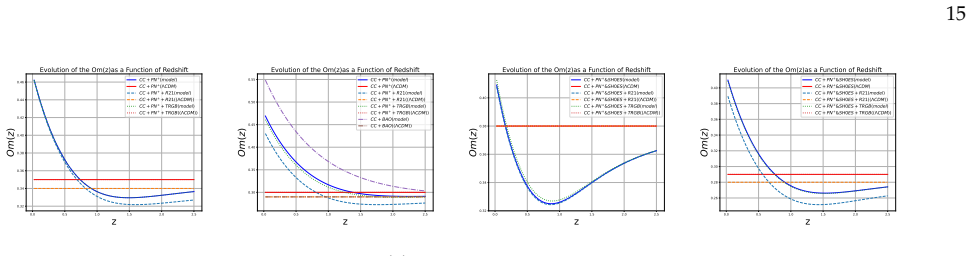
The central claim is that in $f(T,\mathcal{T})$ gravity with $f(T,\mathcal{T})=\alpha T^n\mathcal{T}+\Lambda$, different data combinations tune the model's parameters so that the inferred Hubble constant interpolates between early-Universe and late-Universe values: with the 1701-point supernova sample plus cosmic chronometers the best fit is about 66.4 km/s/Mpc, adding the local distance-ladder calibration raises it to about 72.5–72.7 km/s/Mpc, and adding BAO lowers it to 64.7–70.3 km/s/Mpc depending on priors. The paper also claims that the same model, through the effective Newton constant $P(a)=G_{\rm eff}/G=(1+f_{\mathcal{T}}/2)/(1+f_{\mathcal{T}})$ entering the sub-horizon growth equation, yields a weighted growth rate $f\sigma_8(0)$ about 9–11 percent lower than $\Lambda$CDM for the parameter sets that include BAO, and it reproduces late-time background diagnostics (deceleration parameter, quintessence equation of state, matter-to-dark-energy transition, and the $Om(z)$ diagnostic) broadly consistent with observation. Because the model has no $\Lambda$CDM limit, these results are presented as genuine modified-gravity alternatives rather than small perturbations of the standard model.
Load-bearing premise
The load-bearing premise is that the linear growth of matter clustering in this trace-coupled gravity is captured by the standard sub-horizon equation with a simple effective Newton constant; the paper does not derive the perturbation equations for the theory, so if pressure or scale-dependent corrections appear in a full derivation, the predicted drop in growth is unsupported.
Editorial extensions
If this is right
- If the central claim holds, $f(T,\mathcal{T})$ gravity with this functional form is a viable late-time alternative to $\Lambda$CDM that reproduces the accelerated expansion and passes AIC/BIC comparison for the supernova-plus-chronometer combinations.
- The model's ability to return $H_0$ near 73 with local calibrations and near 67–69 with BAO means that future joint analyses simultaneously using all probes could either resolve or sharpen the Hubble tension depending on whether one global fit can match all data.
- The predicted $f\sigma_8$ deficit of roughly 9–11 percent relative to $\Lambda$CDM at $z=0$, if confirmed by full perturbation theory, would bring the model in line with large-scale structure measurements that see weaker clustering than the early-Universe extrapolation.
- Because the model has no $\Lambda$CDM limit, improved distance-ladder and BAO measurements will eventually distinguish it from $\Lambda$CDM through the shape of $H(z)$ and the growth rate, not just through overall $\chi^2$.
- The background diagnostics indicate quintessence-like evolution, so the model predicts specific redshift-dependent dark-energy behavior that future surveys can test.
Reading between the lines
- Going beyond the paper, a full derivation of the linear perturbation equations for this $f(T,\mathcal{T})$ action is the natural decisive test; the coupling to the matter trace can introduce pressure and scale-dependent terms that the assumed quasi-static equation omits.
- Going beyond the paper, the spread in $H_0$ across separate fits is evidence of parameter flexibility, not yet proof of a single model that fits all data simultaneously; a joint fit with all datasets and their covariances would be the sharper test of tension reduction.
- Going beyond the paper, the model's growth prediction could be tested directly against the full redshift-space-distortion catalogue at multiple redshifts, since the two parameter sets that give the 9–11 percent deficit also carry a spread in $\sigma_8$ (0.76–0.85) that affects the comparison.
- Going beyond the paper, the same effective gravitational coupling could be probed in the nonlinear regime with N-body simulations, whose cluster-count and weak-lensing predictions would distinguish this model from $\Lambda$CDM independently of linear growth.
Editorial analysis
A structured set of objections, weighed in public.
Referee Report
Summary. The paper studies late-time cosmology in f(T,T) gravity with the specific form f(T,T)=αT^n+Λ, using MCMC likelihood analyses of cosmic chronometer, Pantheon+ (with and without SH0ES), and BAO data, with R21 and TRGB H0 priors. It reports constraints on H0, Ωm0, n, and the nuisance parameter M for thirteen dataset combinations, computes χ²_min, AIC, and BIC relative to ΛCDM, and solves numerically the linear matter-growth equation to produce fσ8(z) curves. The central claims are that the dataset combinations yield a range of H0 values that could help with the Hubble tension, and that the model predicts fσ8 about 9–11% below ΛCDM, potentially easing the σ8 tension.
Significance. If the growth calculation is correct, the paper provides a useful set of late-time constraints for a specific f(T,T) model and a candidate mechanism for lowering fσ8 without invoking new matter physics. The MCMC analysis covers a wide range of data combinations with full CC and BAO covariance matrices, and the AIC/BIC comparison with ΛCDM is a useful consistency test. The model predicts a quintessence-like equation of state and a deceleration-to-acceleration transition consistent with observations. However, the two headline results are currently not established: the H0 range is mostly a reflection of the input priors, and the fσ8 reduction rests on an effective Newton constant that is asserted rather than derived from the theory's perturbation equations. These issues, together with internal errors in the model-comparison tables, limit the paper's impact until corrected.
major comments (4)
- [Sec. V, Eqs. (34)–(35), Fig. 3b] The σ8-alleviation claim rests entirely on the adopted growth equation with P(a)=(1+f_T/2)/(1+f_T). The paper states that this "can be demonstrated" and cites Refs. [46,49], but it does not derive the quasi-static sub-horizon perturbation system from action (6) and field equations (7). Because f(T,T) couples to the matter trace, the perturbed equations generically contain δT, pressure, and scale-dependent gradient terms; their cancellation or suppression in the quasi-static limit must be shown explicitly. Without this, the reported 9% and 11% reductions of fσ8 are an assumption, not a derived prediction.
- [Sec. V.A, Fig. 3b and Sec. VII] The caption states that the complete RSD fσ8 dataset of Ref. [93] is used, but the figure only superposes model and ΛCDM curves; no RSD likelihood, residuals, or χ² are reported. The claims in Sec. VII that the model "could provide a better fit to large-scale structure observations" and that the curves are "approximately 9%" and "11% below ΛCDM" are comparisons with ΛCDM only, not with the data. A quantitative fit to the RSD points is required to support the σ8-tension claim.
- [Table II] The information criteria in Table II are internally inconsistent. For CC+PN++BAO+R21, AIC−χ²_min = 308, which would require k=154 parameters if AIC=χ²_min+2k, whereas all other rows in the same table give k=4; the value χ²_min=1524.96 is likely a typo for 1824.96. For CC+PN++R21, AIC=1798.52 with χ²_min=1780.52 gives k=9, while the model has four free parameters and the AIC should be 1788.52. These errors propagate into ΔAIC and ΔBIC and undermine the statistical comparison in Sec. IV.
- [Abstract and Sec. IV/VII] The "primary finding" that different dataset combinations yield a range of H0 values, and that this "could contribute to reducing the cosmic tension," is a restatement of the input priors rather than a model prediction. Adding the R21 prior or SH0ES points shifts H0 toward 73 km/s/Mpc by construction, and the normalization Λ=H0² after Eq. (33) makes H0 an input to the Lagrangian. To claim that the model reduces the H0 tension, the paper must demonstrate that the model, without such priors, produces a high H0 or reconciles early- and late-universe calibrations through an internal mechanism.
minor comments (6)
- [Sec. VII] The conclusion contains "CC+PAN+" in place of "CC+PN+" in three places; this typo should be corrected.
- [Sec. III and Table I] The R21 prior is quoted as H0=73.04±1.04 and attributed to Ref. [12], whose central value is 73.30±1.04; the label and value should be made consistent (R21 versus R22).
- [Sec. III] The MCMC analysis does not report chain lengths, burn-in, acceptance rates, or prior ranges; without these the numerical constraints in Tables I and III cannot be reproduced.
- [Eq. (24)] The sound-horizon calculation uses Ωb,0=0.02242 without specifying h; since this is Ωb h², the calculation needs the assumed h or a separate Ωb input to be unambiguous.
- [Eq. (33) and Sec. IV] Equation (33) is an implicit equation for E(z), but the numerical root-finding method and branch selection used to solve it are not described.
- [Sec. V.A, Fig. 3a] The text states σ(a)∼δm(a) with δm(a)≈a; this approximation should be justified in the context of Eq. (36), since the growth equation is being integrated numerically.
Circularity Check
No significant circularity: the H0 constraints are transparent fits with stated priors, and the sigma8 result, while relying on an underived imported growth equation, is not equivalent to the paper's own fitted inputs.
full rationale
Walking the derivation chain, the background analysis is self-contained: the chosen f(T,T) form (30) is substituted into the Friedmann equations, alpha is fixed at z=0 by Eq. (31), and the normalized E(z) in Eq. (33) is solved numerically and fitted to external CC, Pantheon+, BAO data with explicitly stated H0 priors. The reported H0 values in Tables I and III are labelled as constrained parameters; the shift seen when R21 or SH0ES is included is a prior/likelihood propagation effect, not a claim that the f(T,T) dynamics predicts H0, so it does not qualify as a fitted input renamed as a prediction. The sigma8-alleviation claim is carried by the growth equation (34) and the effective Newton constant P(a) in Eq. (35), which the paper imports from refs. [46,49] with the phrase 'It can be demonstrated with relative ease' and does not derive from the field equations; this is a genuine omitted-proof and correctness risk, but it is not a circular reduction because the imported formula is not identical to the paper's fitted H0, Omega_m0, or n outputs. The self-citation [51] appears only in a list of f(T,T) literature and is not load-bearing. No step of the claimed derivation is equivalent by construction to its inputs.
Assumptions & free parameters
free parameters (6)
- H0 =
66.4 to 72.7 km/s/Mpc depending on dataset
- Ωm0 =
0.280 to 0.381 depending on dataset
- n =
-2.31 to -1.25
- M =
-19.43 to -19.24
- Λ =
≡ H0²
- σ8 =
0.76, 0.81, 0.85, 0.76 (four dataset combinations)
assumptions (5)
- standard math Flat FLRW background metric (Eq 8) with Weitzenböck connection and teleparallel torsion scalar T=-6H².
- domain assumption Matter is a pressureless perfect fluid (pm=0) for background and growth calculations.
- domain assumption The quasi-static sub-horizon linear growth equation (34) with G_eff/G from Eq (35) applies to f(T,T) gravity.
- ad hoc to paper The normalization Λ = H0² (set after Eq 32) is a valid way to fix the Lagrangian constant.
- domain assumption BAO sound-horizon inputs from Planck (Ωb,0=0.02242, T0=2.7255 K, rs,fid=147.78 Mpc) are used to build the BAO likelihood.
Cite this review
Pith. "Pith review of Late Time Phenomena in $f(T,\mathcal{T})$ Gravity Framework: Role of $H_0$ Priors." pith.science (2026). https://pith.science/paper/GWWLTPW2
@misc{pith2026241111923,
  author       = {Pith},
  title        = {Pith review of: Late Time Phenomena in $f(T,\mathcalT)$ Gravity Framework: Role of $H_0$ Priors},
  year         = {2026},
  howpublished = {\url{https://pith.science/paper/GWWLTPW2}},
  note         = {Machine review of arXiv:2411.11923}
}
abstract
This study explored the behavior of the $f(T, \mathcal{T})$ cosmological model with the use of various data set combinations. We also compared the results for this model between the Pantheon+ (without SH0ES) and the Pantheon+\&SH0ES (with SH0ES) data sets. Additionally, we incorporated data from BAO along with $H_0$ priors. We observed that integrating SH0ES data points leads to a higher estimation of $H_0$ than Pantheon+ (without SH0ES). We perform an extensive MCMC analysis for each combination of data sets, providing constraints on the model parameters. We also computed the $\chi^2_{min}$ value for each combination of data sets to evaluate the chosen model against the standard $\Lambda$CDM model. Our primary finding is that the various dataset combinations in the $f(T, \mathcal{T})$ model we examined relate to a range of Hubble constants, which could contribute to reducing the cosmic tension associated with this parameter. Additionally, we investigate the evolution of matter fluctuations by solving the density contrast evolution equation numerically. We calculate numerical solutions for the weighted growth rate $f\sigma_8$ using these findings. We plotted the cosmological background parameters to check the behavior of the $f(T, \mathcal{T})$ model in late-time. Based on the behavior of these background cosmological parameters, we conclude that our selected models reflect the late-time cosmic dynamics of the Universe.
Figures


Figures from the paper (11 more)




Reference graph
Works this paper leans on
-
[51]
Growth factor in $f(T,\mathcal{T})$ gravity
G. Farrugia and J. L. Said, “Growth factor in f (T, T ) gravity,” Phys. Rev. D 94 (2016) 124004, arXiv:1612.00974 [gr-qc]
work page Pith review arXiv 2016
-
[57]
E. Abdalla et al., “Cosmology intertwined: A review of the particle physics, astrophysics, and cosmology associated with the cosmological tensions and anomalies,” Journal of High Energy Astrophysics 34 (2022) 49–211, arXiv:2203.06142 [astro-ph.CO]. 22
arXiv 2022
-
[93]
Growth of matter overdensities in non-minimal torsion-matter coupling theories,
M. Gonzalez-Espinoza, G. Otalora, J. Saavedra, and N. Videla, “Growth of matter overdensities in non-minimal torsion-matter coupling theories,” Eur. Phys. J. C 78 (2018) no. 10, 799, arXiv:1808.01941 [gr-qc]
arXiv 2018
-
[1]
(32) becomes, E2(z) = (1 + z)3Ωm0 − 1 6 + 1 − Ωm0 + 1 6 (1 + z)3E2n(z)
Now, Eq. (32) becomes, E2(z) = (1 + z)3Ωm0 − 1 6 + 1 − Ωm0 + 1 6 (1 + z)3E2n(z) . (33) 7 Eq. (33) is an implicit formulation for E(z). Considering that analytical solutions for Eq. (33) are impractical, we have adhered to the numerical methods to compute the parameters. The methodology used as described in Sec.-III and the results obtained are described b...
-
[2]
Measurements of Ω and Λ from 42 high redshift supernovae,
Supernova Cosmology Project Collaboration, S. Perlmutter et al., “Measurements of Ω and Λ from 42 high redshift supernovae,” Astrophys. J. 517 (1999) 565–586, arXiv:astro-ph/9812133
arXiv 1999
-
[3]
A comprehensive summary of the current values of the total EoS parameter is provided in Table V. In Figs. 10, we present the evolution of the density para- 0.0 0.5 1.0 1.5 2.0 2.5 z 0.0 0.2 0.4 0.6 0.8 1.0 Density parameter as a Function of Redshift CC + PN+( m) CC + PN+( de) CC + PN+ + R21( m) CC + PN+ + R21( de) CC + PN+ + TRGB( m) CC + PN+ + TRGB( de) ...
-
[4]
Observational evidence from supernovae for an accelerating universe and a cosmological constant,
Supernova Search T eamCollaboration, A. G. Riess et al., “Observational evidence from supernovae for an accelerating universe and a cosmological constant,” Astron. J. 116 (1998) 1009–1038, arXiv:astro-ph/9805201. 20
arXiv 1998
-
[5]
S. Alam et al., “The clustering of galaxies in the completed SDSS-III Baryon Oscillation Spectroscopic Survey: cosmological analysis of the DR12 galaxy sample,” Monthly Notices of the Royal Astronomical Society 470 (2017) no. 3, 2617–2652, arXiv:1607.03155 [astro-ph.CO]
arXiv 2017
Show all 102 references
-
[6]
First-Year Wilkinson Microwave Anisotropy Probe (WMAP)* Observations: Preliminary Maps and Basic Results,
C. L. Bennett et al., “First-Year Wilkinson Microwave Anisotropy Probe (WMAP)* Observations: Preliminary Maps and Basic Results,” The Astrophysical Journal Supplement Series 148 (2003) no. 1, 1, arXiv:astro-ph/0302207
2003 arXiv
-
[7]
Cosmological parameters from SDSS and WMAP,
M. Tegmark et al., “Cosmological parameters from SDSS and WMAP,” Physical Review D 69 (2004) no. 10, , arXiv:astro-ph/0310723
2004 arXiv
-
[8]
Testing late-time cosmic acceleration with uncorrelated baryon acoustic oscillation dataset,
D. Benisty and D. Staicova, “Testing late-time cosmic acceleration with uncorrelated baryon acoustic oscillation dataset,” Astronomy & Astrophysics 647 (2021) A38, arXiv:2009.10701 [astro-ph.CO]
2021 arXiv
-
[9]
The Complete Light-curve Sample of Spectroscopically Confirmed SNe Ia from Pan-STARRS1 and Cosmological Constraints from the Combined Pantheon Sample,
D. M. Scolnic et al., “The Complete Light-curve Sample of Spectroscopically Confirmed SNe Ia from Pan-STARRS1 and Cosmological Constraints from the Combined Pantheon Sample,” The Astrophysical Journal 859 (2018) no. 2, 101, arXiv:1710.00845 [astro-ph.CO]
2018 arXiv
-
[10]
Large Magellanic Cloud Cepheid Standards Provide a 1% Foundation for the Determination of the Hubble Constant and Stronger Evidence for Physics beyond ΛCDM,
A. G. Riess et al., “Large Magellanic Cloud Cepheid Standards Provide a 1% Foundation for the Determination of the Hubble Constant and Stronger Evidence for Physics beyond ΛCDM,” Astrophys. J. 876 (2019) no. 1, 85, arXiv:1903.07603 [astro-ph.CO]
2019 arXiv
-
[11]
Planck2013 results. XVI. Cosmological parameters,
Planck Collaboration Collaboration, “Planck2013 results. XVI. Cosmological parameters,” Astronomy & Astrophysics 571 (2014) A16, arXiv:1303.5076 [astro-ph.CO]
2014 arXiv
-
[12]
Dark Energy Survey Year 3 results: calibration of lens sample redshift distributions using clustering redshifts with BOSS/eBOSS,
DES Collaboration Collaboration, “Dark Energy Survey Year 3 results: calibration of lens sample redshift distributions using clustering redshifts with BOSS/eBOSS,” Monthly Notices of the Royal Astronomical Society 513 (2022) no. 4, 5517–5539, arXiv:2012.12826 [astro-ph.CO] . h...
2022 arXiv
-
[13]
JWST early Universe observations andΛCDM cosmology,
R. P . Gupta, “JWST early Universe observations andΛCDM cosmology,” Monthly Notices of the Royal Astronomical Society 524 (2023) no. 3, 3385–3395, arXiv:2309.13100 [astro-ph.CO]
2023 arXiv
-
[14]
The Carnegie-Chicago Hubble Program. VIII. An Independent Determination of the Hubble Constant Based on the Tip of the Red Giant Branch*,
W. L. Freedman et al., “The Carnegie-Chicago Hubble Program. VIII. An Independent Determination of the Hubble Constant Based on the Tip of the Red Giant Branch*,” The Astrophysical Journal 882 (2019) no. 1, 34, arXiv:1907.05922 [astro-ph.CO]
2019 arXiv
-
[15]
A Comprehensive Measurement of the Local Value of the Hubble Constant with 1 km s−1 Mpc−1 Uncertainty from the Hubble Space Telescope and the SH0ES Team,
A. G. Riess et al., “A Comprehensive Measurement of the Local Value of the Hubble Constant with 1 km s−1 Mpc−1 Uncertainty from the Hubble Space Telescope and the SH0ES Team,”The Astrophysical Journal Letters 934 (2022) no. 1, L7, arXiv:2112.04510 [astro-ph.CO]
2022 arXiv
-
[16]
The H0 findings for PN + and PN +& SH0ES in our study resemble those obtained by Brout et al [56]
present a value of 67.2 +1.2 −1.0km s−1Mpc−1. The H0 findings for PN + and PN +& SH0ES in our study resemble those obtained by Brout et al [56]. Our analysis of linear matter perturbations in f (T, T ) gravity demonstrates that the growth rate of matter over- density is influe...
2023
-
[17]
H0LiCOW XIII. A 2.4 % measurement of H0 from lensed quasars: 5.3σ tension between early and late-Universe probes,
Wang et al., “H0LiCOW XIII. A 2.4 % measurement of H0 from lensed quasars: 5.3σ tension between early and late-Universe probes,” Monthly Notices of the Royal Astronomical Society 498 (2019) no. 1, 1420–1439, arXiv:1907.04869 [astro-ph.CO]
2019 arXiv
-
[18]
Planck 2018 results. VI. Cosmological parameters,
Planck Collaboration, N. Aghanim et al., “Planck 2018 results. VI. Cosmological parameters,” Astron. Astrophys. 641 (2020) A6, arXiv:1807.06209 [astro-ph.CO] . [Erratum: Astron.Astrophys. 652, C4 (2021)]
2020 arXiv
-
[19]
Dark Energy Survey Year 1 Results: A Precise H0 Estimate from DES Y1, BAO, and D/H Data,
DES Collaboration Collaboration, “Dark Energy Survey Year 1 Results: A Precise H0 Estimate from DES Y1, BAO, and D/H Data,” Monthly Notices of the Royal Astronomical Society 480 (2018) no. 3, 3879–3888, arXiv:1711.00403 [astro-ph.CO]
2018 arXiv
-
[20]
Can interacting dark energy solve the H0 tension?,
E. Di Valentino, A. Melchiorri, and O. Mena, “Can interacting dark energy solve the H0 tension?,” Physical Review D 96 (2017) no. 4, , arXiv:1704.08342 [astro-ph.CO]
2017 arXiv
-
[21]
In the realm of the Hubble tension - a review of solutions,
E. Di Valentino et al., “In the realm of the Hubble tension - a review of solutions,” Classical and Quantum Gravity 38 (2021) no. 15, 153001, arXiv:2103.01183 [astro-ph.CO]
2021 arXiv
-
[22]
The clustering of the SDSS-IV extended Baryon Oscillation Spectroscopic Survey DR14 quasar sample: first measurement of baryon acoustic oscillations between redshift 0.8 and 2.2,
M. Ata et al., “The clustering of the SDSS-IV extended Baryon Oscillation Spectroscopic Survey DR14 quasar sample: first measurement of baryon acoustic oscillations between redshift 0.8 and 2.2,” Mon. Not. Roy. Astron. Soc. 473 (2017) no. 4, 4773–4794, arXiv:1705.06373 [astro-ph.CO]
2017 arXiv
-
[23]
KiDS-1000 cosmology: Cosmic shear constraints and comparison between two point statistics,
M. Asgari et al., “KiDS-1000 cosmology: Cosmic shear constraints and comparison between two point statistics,” Astronomy & Astrophysics 645 (2021) A104, arXiv:2007.15633 [astro-ph.CO]
2021 arXiv
-
[24]
Geometry versus growth: Internal consistency of the flat ΛCDM model with KiDS-1000,
J. Ruiz-Zapatero et al., “Geometry versus growth: Internal consistency of the flat ΛCDM model with KiDS-1000,” Astronomy & Astrophysics 655 (2021) A11, arXiv:2105.09545 [astro-ph.CO]
2021 arXiv
-
[25]
The SRG/eROSITA all-sky survey: Cosmology constraints from cluster abundances in the western Galactic hemisphere,
V . Ghirardiniet al., “The SRG/eROSITA all-sky survey: Cosmology constraints from cluster abundances in the western Galactic hemisphere,” Astronomy & Astrophysics 689 (2024) A298, arXiv:2402.08458 [astro-ph.CO]
2024 arXiv
-
[26]
Modified f (R) gravity consistent with realistic cosmology: From a matter dominated epoch to a dark energy universe,
S. Nojiri and S. D. Odintsov, “Modified f (R) gravity consistent with realistic cosmology: From a matter dominated epoch to a dark energy universe,” Phys. Rev. D 74 (2006) 086005, arXiv:hep-th/0608008
2006 arXiv
-
[27]
Unifying inflation with ΛCDM epoch in modified f(R) gravity consistent with Solar System Test,
S. Nojiri and S. D. Odintsov, “Unifying inflation with ΛCDM epoch in modified f(R) gravity consistent with Solar System Test,” Physics Letters B 657 (2007) no. 4, 238–245, arXiv:0707.1941 [hep-th]
2007 arXiv
-
[28]
f (R) Theories Of Gravity,
T. P . Sotiriou and V . Faraoni, “f (R) Theories Of Gravity,” Rev. Mod. Phys. 82 (2010) 451–497, arXiv:0805.1726 [gr-qc] . 21
2010 arXiv
-
[29]
Extended Theories of Gravity,
S. Capozziello and M. De Laurentis, “Extended Theories of Gravity,” Phys. Rept. 509 (2011) 167–321, arXiv:1108.6266 [gr-qc]
2011 arXiv
-
[30]
Hamiltonian formulation of the teleparallel description of general relativity,
J. W. Maluf, “Hamiltonian formulation of the teleparallel description of general relativity,” J. Math. Phys. 35 (1994) 335–343, arXiv:gr-qc/0002059
1994 arXiv
-
[31]
Aldrovandi and J
R. Aldrovandi and J. G. Pereira, Teleparallel Gravity: An Introduction. Springer, 2013
2013
-
[32]
Weitzenb ¨oock, ‘Invariantentheorie’
R. Weitzenb ¨oock, ‘Invariantentheorie’. Noordhoff, Gronningen, 1923
1923
-
[33]
Dark torsion as the cosmic speed-up,
G. R. Bengochea and R. Ferraro, “Dark torsion as the cosmic speed-up,” Phys. Rev. D 79 (2009) 124019, arXiv:0812.1205 [astro-ph]
2009 arXiv
-
[34]
On Born-Infeld Gravity in Weitzenbock spacetime,
R. Ferraro and F. Fiorini, “On Born-Infeld Gravity in Weitzenbock spacetime,” Phys. Rev. D 78 (2008) 124019, arXiv:0812.1981 [gr-qc]
2008 arXiv
-
[35]
Einstein’s Other Gravity and the Acceleration of the Universe,
E. V . Linder, “Einstein’s Other Gravity and the Acceleration of the Universe,”Phys. Rev. D 81 (2010) 127301, arXiv:1005.3039 [astro-ph.CO] . [Erratum: Phys.Rev.D 82, 109902 (2010)]
2010 arXiv
-
[36]
Cosmological perturbations in f (T) gravity,
S.-H. Chen et al., “Cosmological perturbations in f (T) gravity,” Phys. Rev. D 83 (2011) 023508, arXiv:1008.1250 [astro-ph.CO]
2011 arXiv
-
[37]
f (T) teleparallel gravity and cosmology,
Y.-F. Cai et al., “ f (T) teleparallel gravity and cosmology,” Reports on Progress in Physics 79 (2016) no. 10, 106901
2016
-
[38]
Dynamical stability analysis of accelerating f(T) gravity models,
L. K. Duchaniya et al., “Dynamical stability analysis of accelerating f(T) gravity models,” Eur. Phys. J. C 82 (2022) no. 5, 448, arXiv:2202.08150 [gr-qc]
2022 arXiv
-
[39]
Growth of structures using redshift space distortion in f (T) cosmology,
R. Briffa et al., “Growth of structures using redshift space distortion in f (T) cosmology,” Monthly Notices of the Royal Astronomical Society 528 (2024) no. 2, 2711–2727, arXiv:2310.09159 [gr-qc]
2024 arXiv
-
[40]
Attractor behavior of f (T) modified gravity and the cosmic acceleration,
L. K. Duchaniya, K. Gandhi, and B. Mishra, “Attractor behavior of f (T) modified gravity and the cosmic acceleration,” Physics of the Dark Universe 44 (2024) 101461, arXiv:2303.09076 [gr-qc]
2024 arXiv
-
[41]
Teleparallel equivalent of Gauss-Bonnet gravity and its modifications,
G. Kofinas and E. N. Saridakis, “Teleparallel equivalent of Gauss-Bonnet gravity and its modifications,” Phys. Rev. D 90 (2014) 084044, arXiv:1404.2249 [gr-qc]
2014 arXiv
-
[42]
Cosmological applications of F(T, TG) gravity,
G. Kofinas and E. N. Saridakis, “Cosmological applications of F(T, TG) gravity,” Phys. Rev. D 90 (2014) 084045, arXiv:1408.0107 [gr-qc]
2014 arXiv
-
[43]
Cosmological viable models in f (T, B) theory as solutions to the H0 tension,
C. Escamilla-Rivera and J. Levi Said, “Cosmological viable models in f (T, B) theory as solutions to the H0 tension,” Class. Quant. Grav. 37 (2020) no. 16, 165002, arXiv:1909.10328 [gr-qc]
2020 arXiv
-
[44]
Dynamical system analysis in teleparallel gravity with boundary term,
S. A. Kadam, N. P . Thakkar, and B. Mishra, “Dynamical system analysis in teleparallel gravity with boundary term,”The European Physical Journal C 83 (2023) no. 9, , arXiv:2306.06677 [gr-qc]
2023 arXiv
-
[45]
Cosmological dynamics of dark energy in scalar-torsion f (T, ϕ) gravity,
M. Gonzalez-Espinoza and G. Otalora, “Cosmological dynamics of dark energy in scalar-torsion f (T, ϕ) gravity,” Eur. Phys. J. C 81 (2021) no. 5, 480, arXiv:2011.08377 [gr-qc]
2021 arXiv
-
[46]
Stability of scalar perturbations in scalar-torsion f(T, ϕ) gravity theories in the presence of a matter fluid,
M. Gonzalez-Espinoza, G. Otalora, and J. Saavedra, “Stability of scalar perturbations in scalar-torsion f(T, ϕ) gravity theories in the presence of a matter fluid,” JCAP 10 (2021) 007, arXiv:2101.09123 [gr-qc]
2021 arXiv
-
[47]
Noether symmetry approach in scalar-torsion f (T, ϕ) gravity,
L. K. Duchaniya, B. Mishra, and J. L. Said, “Noether symmetry approach in scalar-torsion f (T, ϕ) gravity,” The European Physical Journal C 83 (2023) no. 7, , arXiv:2210.11944 [gr-qc]
2023 arXiv
-
[48]
Dynamical systems analysis in f (T, ϕ) gravity,
L. K. Duchaniya et al., “Dynamical systems analysis in f (T, ϕ) gravity,” The European Physical Journal C 83 (2023) no. 1, , arXiv:2209.03414 [gr-qc]
2023 arXiv
-
[49]
f (T, T ) gravity and cosmology,
T. Harko et al., “ f (T, T ) gravity and cosmology,” Journal of Cosmology and Astroparticle Physics 2014 (2014) no. 12, 021, arXiv:1405.0519 [gr-qc]
2014 arXiv
-
[50]
Cosmological reconstruction of f (T, T ) gravity,
D. Momeni and R. Myrzakulov, “Cosmological reconstruction of f (T, T ) gravity,” International Journal of Geometric Methods in Modern Physics 11 (2014) no. 08, 1450077, arXiv:1405.5863 [gr-qc]
2014 arXiv
-
[52]
Reconstruction, thermodynamics and stability of the ΛCDM model in f (T, T ) gravity,
E. L. B. Junior et al., “Reconstruction, thermodynamics and stability of the ΛCDM model in f (T, T ) gravity,” Classical and Quantum Gravity 33 (2016) no. 12, 125006, arXiv:1501.00621 [gr-qc]
2016 arXiv
-
[53]
Quark Stars in f (T, T )-Gravity,
M. Pace and J. L. Said, “Quark Stars in f (T, T )-Gravity,” The European Physical Journal C 77 (2017) no. 2, , arXiv:1701.04761 [gr-qc]
2017 arXiv
-
[54]
Cosmological models in f (T, T ) gravity and the dynamical system analysis,
L. K. Duchaniya, S. V . Lohakare, and B. Mishra, “Cosmological models in f (T, T ) gravity and the dynamical system analysis,” Physics of the Dark Universe 43 (2024) 101402, arXiv:2302.07132 [gr-qc]
2024 arXiv
-
[55]
New physics in light of the H0 tension: An alternative view,
S. Vagnozzi, “New physics in light of the H0 tension: An alternative view,” Physical Review D 102 (2020) no. 2, 023518, arXiv:1907.07569 [astro-ph.CO]
2020 arXiv
-
[56]
Measurements of the hubble constant: Tensions in perspective,
W. L. Freedman, “Measurements of the hubble constant: Tensions in perspective,” The Astrophysical Journal 919 (2021) no. 1, 16, arXiv:2106.15656 [astro-ph] . http://dx.doi.org/10.3847/1538-4357/ac0e95
2021 arXiv
-
[58]
Unveiling the universe with emerging cosmological probes,
M. Moresco et al., “Unveiling the universe with emerging cosmological probes,” Living Reviews in Relativity 25 (2022) no. 1, , arXiv:2201.07241 [astro-ph.CO]
2022 arXiv
-
[59]
The Pantheon+ Analysis: Cosmological Constraints,
D. Brout et al., “The Pantheon+ Analysis: Cosmological Constraints,” The Astrophysical Journal 938 (2022) no. 2, 110, arXiv:2202.04077 [astro-ph.CO]
2022 arXiv
-
[60]
Impact of H0 priors on f (T) late time cosmology,
R. Briffa et al., “Impact of H0 priors on f (T) late time cosmology,” The European Physical Journal Plus 137 (2022) no. 5, , arXiv:2108.03853 [astro-ph.CO]
2022 arXiv
-
[61]
Seven Hints That Early-Time New Physics Alone Is Not Sufficient to Solve the Hubble Tension,
S. Vagnozzi, “Seven Hints That Early-Time New Physics Alone Is Not Sufficient to Solve the Hubble Tension,” Universe 9 (2023) no. 9, 393, arXiv:2308.16628 [astro-ph.CO]
2023 arXiv
-
[62]
Constraints on f (T) cosmology with Pantheon+,
R. Briffa et al., “Constraints on f (T) cosmology with Pantheon+,” Monthly Notices of the Royal Astronomical Society 522 (2023) no. 4, 6024–6034, arXiv:2303.13840 [gr-qc]
2023 arXiv
-
[63]
A Critical Discussion on the H0 Tension,
S. Capozziello, G. Sarracino, and G. De Somma, “A Critical Discussion on the H0 Tension,” Universe 10 (2024) no. 3, 140, arXiv:2403.12796 [gr-qc]
2024 arXiv
-
[64]
The CosmoVerse White Paper: Addressing observational tensions in cosmology with systematics and fundamental physics,
E. D. Valentino et al., “The CosmoVerse White Paper: Addressing observational tensions in cosmology with systematics and fundamental physics,” arXiv:2504.01669 [astro-ph.CO]
-
[65]
Misner, K
C. Misner, K. Thorne, and J. Wheeler, Gravitation. No. pt. 3 in Gravitation. W. H. Freeman, 1973. https://books.google.com.mt/books?id=w4Gigq3tY1kC
1973
-
[66]
emcee: The mcmc hammer,
D. Foreman-Mackey et al., “emcee: The mcmc hammer,” Publications of the Astronomical Society of the Pacific 125 (2013) no. 925, 306–312, arXiv:1202.3665 [astro-ph.CO]
2013 arXiv
-
[67]
Constraining cosmological parameters based on relative galaxy ages,
R. Jimenez and A. Loeb, “Constraining cosmological parameters based on relative galaxy ages,” The Astrophysical Journal 573 (2002) no. 1, 37–42, arXiv:astro-ph/0106145 [astro-ph.CO]
2002 arXiv
-
[68]
Four new observational H(z) data from luminous red galaxies in the Sloan Digital Sky Survey data release seven,
Z. Cong et al., “Four new observational H(z) data from luminous red galaxies in the Sloan Digital Sky Survey data release seven,” Research in Astronomy and Astrophysics 14 (2014) no. 10, 1221, arXiv:1207.4541 [astro-ph.CO] . https://dx.doi.org/10.1088/1674-4527/14/10/002
2014 arXiv
-
[69]
Constraints on the Equation of State of Dark Energy and the Hubble Constant from Stellar Ages and the Cosmic Microwave Background,
R. Jimenez et al., “Constraints on the Equation of State of Dark Energy and the Hubble Constant from Stellar Ages and the Cosmic Microwave Background,” The Astrophysical Journal 593 (2003) no. 2, 622–629, arXiv:astro-ph/0302560 [astro-ph.CO]
2003 arXiv
-
[70]
A 6% measurement of the Hubble parameter at z ∼ 0.45: direct evidence of the epoch of cosmic re-acceleration,
M. Moresco et al., “A 6% measurement of the Hubble parameter at z ∼ 0.45: direct evidence of the epoch of cosmic re-acceleration,” Journal of Cosmology and Astroparticle Physics 2016 (2016) no. 05, 014–014, arXiv:1601.01701 [astro-ph.CO]
2016 arXiv
-
[71]
Constraints on the redshift dependence of the dark energy potential,
J. Simon, L. Verde, and R. Jimenez, “Constraints on the redshift dependence of the dark energy potential,” Physical Review D 71 (2005) no. 12, , arXiv:astro-ph/0412269 [astro-ph.CO]
2005 arXiv
-
[72]
Improved constraints on the expansion rate of the Universe up to z∼1.1 from the spectroscopic evolution of cosmic chronometers,
M. Moresco et al., “Improved constraints on the expansion rate of the Universe up to z∼1.1 from the spectroscopic evolution of cosmic chronometers,” Journal of Cosmology and Astroparticle Physics 2012 (2012) no. 08, 006–006, arXiv:1201.3609 [astro-ph.CO]
2012 arXiv
-
[73]
Cosmic chronometers: constraining the equation of state of dark energy. I: H(z) measurements,
D. Stern et al., “Cosmic chronometers: constraining the equation of state of dark energy. I: H(z) measurements,” Journal of Cosmology and Astroparticle Physics 2010 (2010) no. 02, 008–008, arXiv:0907.3149 [astro-ph.CO]
2010 arXiv
-
[74]
Raising the bar: new constraints on the Hubble parameter with cosmic chronometers at z ∼2,
M. Moresco, “Raising the bar: new constraints on the Hubble parameter with cosmic chronometers at z ∼2,” Monthly Notices of the Royal Astronomical Society 450 (2015) no. 1, 16–20, arXiv:1503.01116 [astro-ph.CO]
2015 arXiv
-
[75]
Setting the stage for cosmic chronometers. ii. impact of stellar population synthesis models systematics and full covariance matrix,
M. Moresco et al., “Setting the stage for cosmic chronometers. ii. impact of stellar population synthesis models systematics and full covariance matrix,” The Astrophysical Journal 898 (2020) no. 1, 82, arXiv:2003.07362 [astro-ph.CO]
2020 arXiv
-
[76]
The Pantheon+ Analysis: SuperCal-fragilistic Cross Calibration, Retrained SALT2 Light-curve Model, and Calibration Systematic Uncertainty,
D. Brout et al., “The Pantheon+ Analysis: SuperCal-fragilistic Cross Calibration, Retrained SALT2 Light-curve Model, and Calibration Systematic Uncertainty,” The Astrophysical Journal 938 (2022) no. 2, 111, arXiv:2112.03864 [astro-ph.CO]
2022 arXiv
-
[77]
The Pantheon+ Analysis: The Full Data Set and Light-curve Release,
D. Scolnic et al., “The Pantheon+ Analysis: The Full Data Set and Light-curve Release,” The Astrophysical Journal 938 (2022) no. 2, 113, arXiv:2112.03863 [astro-ph.CO]
2022 arXiv
-
[78]
Supernova constraints and systematic uncertainties from the first three years of the supernova legacy survey,
A. Conley et al., “Supernova constraints and systematic uncertainties from the first three years of the supernova legacy survey,” The Astrophysical Journal Supplement Series 192 (2010) no. 1, 1, arXiv:1104.1443 [astro-ph.CO]
2010 arXiv
-
[79]
The 6dF Galaxy Survey: baryon acoustic oscillations and the local Hubble constant: 6dFGS: BAOs and the local Hubble constant,
F. Beutler et al., “The 6dF Galaxy Survey: baryon acoustic oscillations and the local Hubble constant: 6dFGS: BAOs and the local Hubble constant,” Monthly Notices of the Royal Astronomical Society 416 (2011) no. 4, 3017–3032, arXiv:1106.3366 [astro-ph.CO]
2011 arXiv
-
[80]
Baryon acoustic oscillations from the complete SDSS-III Lyα-quasar cross-correlation function at z = 2.4,
H. du Mas des Bourboux et al., “Baryon acoustic oscillations from the complete SDSS-III Lyα-quasar cross-correlation function at z = 2.4,” Astronomy &; Astrophysics 608 (2017) A130, arXiv:1708.02225 [astro-ph.CO]
2017 arXiv
-
[81]
The clustering of the SDSS DR7 main Galaxy sample I. A 4 per cent distance measure at z=0.15,
A. J. Ross et al., “The clustering of the SDSS DR7 main Galaxy sample I. A 4 per cent distance measure at z=0.15,” Monthly Notices of the Royal Astronomical Society 449 (2015) no. 1, 835–847, arXiv:1409.3242 [astro-ph.CO]
2015 arXiv
-
[82]
G.-B. Zhao et al., “The clustering of the sdss-iv extended baryon oscillation spectroscopic survey dr14 quasar sample: a tomographic measurement of cosmic structure growth and expansion rate based on optimal redshift weights,” Monthly Notices of the Royal Astronomical Society ...
2018 arXiv
-
[83]
The temperature of the cosmic microwave background,
D. J. Fixsen, “The temperature of the cosmic microwave background,” The Astrophysical Journal 707 (2009) no. 2, 916–920, arXiv:0911.1955 [astro-ph.CO]
2009 arXiv
-
[84]
Probing Newton’s constant on vast scales: Dvali-Gabadadze-Porrati gravity, cosmic acceleration, and large scale structure,
A. Lue, R. Scoccimarro, and G. D. Starkman, “Probing Newton’s constant on vast scales: Dvali-Gabadadze-Porrati gravity, cosmic acceleration, and large scale structure,” Physical Review D 69 (2004) no. 12, , arXiv:astro-ph/0401515 [astro-ph.CO]
2004 arXiv
-
[85]
Cosmic growth history and expansion history,
E. V . Linder, “Cosmic growth history and expansion history,”Physical Review D 72 (2005) no. 4, , arXiv:astro-ph/0507263 [astro-ph.CO]
2005 arXiv
-
[86]
The acceleration of the universe and the physics behind it,
J.-P . Uzan, “The acceleration of the universe and the physics behind it,”General Relativity and Gravitation 39 (2007) no. 3, 307–342, arXiv:astro-ph/0605313 [astro-ph.CO]
2007 arXiv
-
[87]
The growth of matter perturbations in f (R) models,
R. Gannouji, B. Moraes, and D. Polarski, “The growth of matter perturbations in f (R) models,” Journal of Cosmology and Astroparticle Physics 2009 (2009) no. 02, 034–034, arXiv:0809.3374 [astro-ph.CO]
2009 arXiv
-
[88]
Density perturbations in f (R) gravity theories in metric and Palatini formalisms,
S. Tsujikawa, K. Uddin, and R. Tavakol, “Density perturbations in f (R) gravity theories in metric and Palatini formalisms,” Physical Review D 77 (2008) no. 4, , arXiv:0712.0082 [astro-ph.CO]
2008 arXiv
-
[89]
Observational constraints on viable f (r) parametrizations with geometrical and dynamical probes,
S. Basilakos, S. Nesseris, and L. Perivolaropoulos, “Observational constraints on viable f (r) parametrizations with geometrical and dynamical probes,” Physical Review D 87 (2013) no. 12, , arXiv:1302.6051 [astro-ph.CO]
2013 arXiv
-
[90]
Bayesian analysis of f (T) gravity using f σ8 data ,
F. K. Anagnostopoulos, S. Basilakos, and E. N. Saridakis, “Bayesian analysis of f (T) gravity using f σ8 data ,” Physical Review D 100 (2019) no. 8, , arXiv:1907.07533 [astro-ph.CO]
2019 arXiv
-
[91]
P . J. E. Peebles,Principles of Physical Cosmology, Princeton University Press, Princeton New Jersey. 1993
1993
-
[92]
The H0 tension in light of vacuum dynamics in the Universe,
J. Sol `a, A. G´omez-Valent, and J. de Cruz P´erez, “The H0 tension in light of vacuum dynamics in the Universe,” Phys. Lett. B 774 (2017) 317–324, arXiv:1705.06723 [astro-ph.CO]
2017 arXiv
-
[94]
Density perturbations for running vacuum: a successful approach to structure formation and to the σ8-tension,
A. G ´omez-Valent and J. Sol`a Peracaula, “Density perturbations for running vacuum: a successful approach to structure formation and to the σ8-tension,” Mon. Not. Roy. Astron. Soc. 478 (2018) no. 1, 126–145, arXiv:1801.08501 [astro-ph.CO]
2018 arXiv
-
[95]
f(R) theories,
A. De Felice and S. Tsujikawa, “f(R) theories,” Living Rev. Rel. 13 (2010) 3, arXiv:1002.4928 [gr-qc]
2010 arXiv
-
[96]
Evolution of the f σ8 tension with the Planck15/ΛCDM determination and implications for modified gravity theories,
L. Kazantzidis and L. Perivolaropoulos, “Evolution of the f σ8 tension with the Planck15/ΛCDM determination and implications for modified gravity theories,” Phys. Rev. D 97 (2018) no. 10, 103503, arXiv:1803.01337 [astro-ph.CO]
2018 arXiv
-
[97]
Reducing the H0 and σ8 tensions with dark matter-neutrino interactions,
Di Valentino, Eleonora and others, “Reducing the H0 and σ8 tensions with dark matter-neutrino interactions,” Physical Review D 97 (2018) no. 4, , arXiv:1710.02559 [astro-ph.CO]
2018 arXiv
-
[98]
Sigma-8 tension is a drag,
V . Poulin, J. L. Bernal, E. D. Kovetz, and M. Kamionkowski, “Sigma-8 tension is a drag,”Physical Review D 107 (2023) no. 12, , arXiv:2209.06217 [astro-ph.CO]
2023 arXiv
-
[99]
Cosmographic bounds on the cosmological deceleration-acceleration transition redshift in f (R) gravity,
S. Capozziello et al., “Cosmographic bounds on the cosmological deceleration-acceleration transition redshift in f (R) gravity,” Phys. Rev. D 90 (2014) 044016, arXiv:1403.1421 [gr-qc]
2014 arXiv
-
[100]
Local determination of the hubble constant and the deceleration parameter,
D. Camarena and V . Marra, “Local determination of the hubble constant and the deceleration parameter,”Phys. Rev. Res. 2 (2020) 013028, arXiv:1906.11814 [astro-ph.CO]
2020 arXiv
-
[101]
Two new diagnostics of dark energy,
V . Sahni, A. Shafieloo, and A. A. Starobinsky, “Two new diagnostics of dark energy,”Phys. Rev. D 78 (2008) 103502, arXiv:0807.3548 [astro-ph.CO]
2008 arXiv
-
[102]
Statefinder-a new geometrical diagnostic of dark energy,
V . Sahniet al., “Statefinder-a new geometrical diagnostic of dark energy,”Journal of Experimental and Theoretical Physics Letters 77 (2003) no. 5, 201–206, arXiv:astro-ph/0201498 [astro-ph.CO]
2003 arXiv
Reviewed August 12, 2026 · model on record in the stance chip above.
Discussion (0). Continue with ORCID to comment.