REVIEW 4 major objections 5 minor 4 cited by
Prepare inflationary universe via the Euclidean charged wormhole
T0 review · 4 major / 5 minor · reviewed 2026-08-12 · deepseek-v4-flash
Pith's one-line read A Euclidean charged wormhole can make long inflation the likely initial state of the universe.
desk verdict A real calculation of the charged wineglass wormhole action, but the physical claim is conditional and the paper itself admits the no-boundary state dominates. read the letter →
The pith
A machine-rendered reading of the paper's core claim, the machinery that carries it, and where it could break.
The reading
What carries the argument
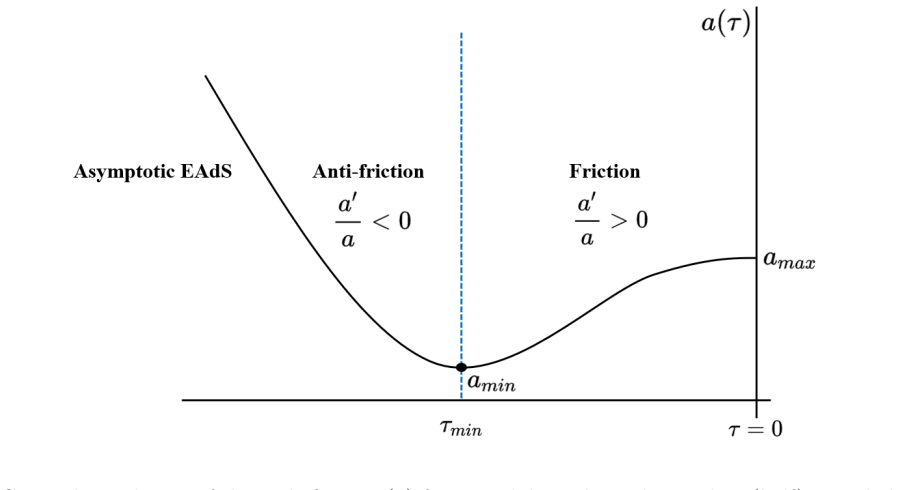
The load-bearing object is the Euclidean charged wineglass (half-)wormhole: a spherically symmetric solution $ds^2=d\tau^2+a^2(\tau)d\Omega_3^2$ whose scale factor $a(\tau)$ grows toward an asymptotic Euclidean AdS boundary, shrinks to a minimum $a_{\min}$, and peaks at $a_{\max}=a(0)$ with $a'(0)=0$ and $a''(0)<0$, the condition that hands off to an expanding Lorentzian universe. The electric charge enters the action as a $Q^2/a^4$ term in addition to the scalar potential; the probability weight of the resulting state is set by the on-shell Euclidean action $S_E$, with $P\simeq e^{-S_E}$. What makes the argument work is the $a_{\min}\approx a_{\max}$ regime, where the action integral is evaluated by replacing $a$ with the constant $\bar a=r/\sqrt{\tilde V_0}$ and by using the constant $C$ of the scalar first integral to close the integral over $\tilde\phi$. The resulting closed-form action (Eq. 38), with its maximum at a threshold $\tilde V_*$, is the mechanism that converts a large $V_0$ into a high creation probability; the same closed form is then compared between charged and axion wormholes at matched dimensionless charge.
What would settle it
Compute the exact on-shell action by numerically solving the Einstein, scalar, and Maxwell equations (17)--(19) for the potential of Fig. 3 without the $\bar a=r/\sqrt{\tilde V_0}$ and $C\simeq\tilde V_0$ approximations, and evaluate $\partial S_E/\partial\tilde V_0$ across the discriminant-allowed interval; if the derivative fails to be negative near $\tilde V_0\to 1/(4\tilde Q^2)$, the claimed high probability for long inflation collapses.
Extended reading notes
Core claim
On the paper's own terms, the central discovery is a probability inversion for the creation of a long-inflation universe. A Euclidean charged wineglass (half-)wormhole with asymptotic Euclidean AdS boundary and a scalar potential of the special shape sketched in Fig. 3 has an on-shell Euclidean action that, in the $a_{\min}\approx a_{\max}$ regime, peaks as a function of the initial potential $V_0$. Because the creation weight is $P(\tilde V_0)=|\Psi|^2\simeq e^{-S_E}$, placing the slow-roll sector's metastable minimum $\tilde V_{\rm ms}$ above that peak makes larger $V_0$ cheaper and hence more probable, which is exactly the opposite of the no-boundary preference. The derivation uses a constant scale factor $\bar a=r/\sqrt{\tilde V_0}$ over the thick-wall region and the first integral $\frac{1}{6}\tilde\phi'^2=\tilde V(\tilde\phi)-C$ of the scalar equation to turn the action into the closed form (Eq. 38); taking $\tilde V_0\to 1/(4\tilde Q^2)$ makes the derivative $\partial S_E/\partial\tilde V_0$ negative. Matching the dimensionless charge of the axion wormhole then gives $\Delta S_E=S_E^{(1)}-S_E^{(2)}>0$ throughout the allowed region, so the charged wormhole always wins that comparison.
Load-bearing premise
The favorable probability result assumes a finely tuned scalar potential with near-zero value at the AdS boundary, a positive maximum, and a positive metastable minimum above the threshold $\tilde V_*$, and it also assumes that the integration constant $C$ is close to $\tilde V_0$; if the potential is not so tuned, or if $C$ departs from $\tilde V_0$, the preference for long inflation need not hold.
Editorial extensions
If this is right
- A long inflationary phase becomes the high-probability outcome whenever the slow-roll vacuum lies above the threshold $\tilde V_*$ set by the action's maximum.
- For equal dimensionless charge and equal initial field value, the charged wineglass wormhole replaces the axion wormhole as the dominant Euclidean pre-inflationary configuration.
- The no-boundary Euclidean evolution still gives the largest creation weight, so making this wormhole the actual origin of the universe requires a mechanism that suppresses or disfavors the no-boundary instanton.
- The slow-roll part of the potential can be chosen to deliver roughly 60 e-folds, so the proposal is compatible with a nearly scale-invariant spectrum of primordial perturbations.
- Other charged Euclidean configurations considered in the appendices—$Q^2/a^8$, $Q^2/a^2$, and a pure electromagnetic wormhole—either produce a collapsing universe or reduce to the no-boundary case, and so do not solve the long-inflation problem.
Reading between the lines
- The $C\simeq\tilde V_0$ identification is an approximation that can be checked independently; integrating the scalar equation exactly for the Fig. 3 potential would show whether the conclusion survives outside the heuristic limit.
- If the dominance holds for three independent Maxwell fields (the $SO(4)$-symmetric choice in Appendix C), the result extends to any charge content, suggesting a selection rule in favour of the most highly charged Euclidean entrance.
- The same action-comparison machinery could be applied to wormholes with other boundary topologies or higher-form gauge fields, and might map which configurations can ever exceed the no-boundary weight.
- A testable extension is to make $C$ a dynamical output rather than an input; small corrections to $C$ are exactly the kind of effect that could flip the sign of $\Delta S_E$.
Editorial analysis
A structured set of objections, weighed in public.
Referee Report
Summary. The paper proposes that the initial state of an inflationary universe can be semiclassically described by a Euclidean charged 'wineglass' half-wormhole with an asymptotically Euclidean AdS boundary. The authors compute the on-shell Euclidean action, show that in the regime where the maximum and minimum scale factors are nearly equal (amin ≃ amax) the action can decrease with the initial potential value V0, and interpret this as a higher probability weight for a long period of inflation. They compare the charged wormhole action with that of the axion wormhole of Ref. [35] and claim that, for equal dimensionless charges, the charged wormhole always dominates. Appendices analyze alternative Euclidean actions with Q2/a8 and Q2/a2 terms and a pure Maxwell field with EAdS boundary, finding that these do not produce a suitable inflationary initial state.
Significance. If the central claim holds, the paper offers a genuine alternative to the Hartle-Hawking no-boundary proposal as a mechanism for selecting initial conditions that favor a sufficiently long inflationary phase, and it identifies a concrete class of Euclidean configurations that dominate over the axion wormhole. The analytic derivation in Section II C 1 is internally consistent and correctly reproduces the no-boundary action in the limit Q → 0 (Eq. (32)). The authors are also transparent about limitations, explicitly acknowledging in the Conclusion that the no-boundary state always has a larger probability weight (Eq. (54)). However, the main probability and dominance claims rest on an uncontrolled approximation (C ≃ V0) and on a finely tuned scalar potential that is sketched but not explicitly constructed, so the significance is conditional on resolving these issues.
major comments (4)
- [Section II C 2, Eqs. (39)-(40)] The central sign analysis that leads to the claimed high probability for long inflation replaces V0 by C in the numerator of Eq. (39) to obtain Eq. (40), whose sign is then controlled by r^4 - 1/4. The only information given about C is Vmin < C < Vτ (text below Eq. (36)), and the approximation C ≃ V0 is asserted heuristically after Eq. (39). Since the numerator of Eq. (39) contains the combination (2C + V0) and the denominator contains sqrt(V0 - C), a modest deviation such as C = 0.8 V0 can change the sign of ∂S_E/∂V0. The conclusion that 'within the range allowed by the discriminant, this situation does not exhibit the problem present in section II C 1' is therefore not established. The authors should either provide an explicit potential and demonstrate C ≈ V0 by solving the equations of motion, or derive a rigorous bound on V0 - C that guarantees the sign of Eq. (40).
- [Section III B, Fig. 4 and Eq. (52)] The claim that the charged wormhole 'always dominates' the axion wormhole is extracted from Fig. 4, which is plotted with the specific choice C = 0.99 V0 (caption of Fig. 4). The action difference ΔS_E in Eq. (52) inherits the same uncontrolled C-dependence through both S_E^(1) and S_E^(2), and the additional assumption C^(1) ≃ C^(2) = C in Eq. (51) is an input rather than a derived result. The authors should show that the dominance conclusion is robust to the allowed range of C and to the identification of charges in Eq. (53). Without such a check, the 'always dominates' statement is a statement about a particular curve, not about the model.
- [Section II C 3 and Eq. (38)] The entire amin ≃ amax analysis assumes that the scale factor is nearly constant (a ≃ a-bar = r/sqrt(V0)) over the thick-wall region while the scalar field changes from ϕ_tmin to ϕ0. This requires a specific shape of the potential (near-zero at the EAdS boundary, a maximum, a metastable minimum, and a slow-roll sector, as sketched in Fig. 3) and a specific dynamics of the scalar field. The paper does not provide an explicit potential function or a numerical solution demonstrating that such a configuration exists with C ≈ V0 and with the claimed relation a ≃ a-bar. Without this, Eq. (38) is a plausible but unverified approximation. A concrete potential and a numerical integration of Eqs. (17)-(19) would be needed to make the result load-bearing.
- [Section IV and Eq. (54)] The authors explicitly state in Eq. (54) and in the Conclusion that the no-boundary state always has a larger probability weight than the charged wormhole. This means the proposal does not solve the original problem posed in the Introduction (the incompatibility of the Hartle-Hawking proposal with long inflation) in an absolute sense; the 'higher probability for long inflation' is only relative within the class of charged wormhole configurations. The paper should clearly state this limitation in the Introduction and Abstract so that readers do not infer that the charged wormhole outperforms the standard no-boundary wavefunction.
minor comments (5)
- [Abstract and Introduction] The phrase 'a wavefunction of the universe, which correspond to an Euclidean charged wineglass (half)-wormholes' should be rewritten for grammatical agreement; also 'an Euclidean' should be 'a Euclidean'.
- [Eq. (30)] The bracket structure in the integrand of Eq. (30) appears to have a mismatched parenthesis; please check the mathematical typesetting.
- [Section II C 2, text below Eq. (39)] The claim 'Since the Euclidean action depends on V0 through its dependence on ϕ0 and ϕ is very close to ϕ0 at the end of the thick-wall integral, we can approximate C ≃ V0' is a heuristic statement; even if accepted, the margin of error of this approximation should be quantified or bounded.
- [Section III B, Eq. (53)] The dimensionless charge identification between the axion and Maxwell charges is a nontrivial convention. Please clarify whether the 'always dominates' conclusion depends on this specific choice of nondimensionalization.
- [Fig. 4] The caption of Fig. 4 should state that the black line represents the relation (53), and it would be helpful to indicate the region of parameter space where each wormhole dominates; the current text explains this in the body but the caption is incomplete.
Circularity Check
No significant circularity: the central probability and dominance claims follow from explicit on-shell action calculations with stated assumptions, not from fitted parameters or self-citation chains.
full rationale
The paper's main derivation is a direct semiclassical evaluation of the Euclidean on-shell action: the probability weight is P(V0) = |Psi|^2 ~ exp(-S_E), and the sign of dS_E/dV0 in Situation 2 is controlled by the physical discriminant constraint r < 1/sqrt(2) (Eqs. 39-40). The approximation C ~ V0 is load-bearing and heuristic, as the skeptic notes, but it is an assumption about the scalar-field dynamics and the range of the constant C, not a quantity defined in terms of the conclusion; a failure of that approximation would be a correctness risk, not a circular step. The charged-versus-axion dominance claim is obtained by substituting explicit parameter relations (Eqs. 41, 50, 53) and plotting the resulting Delta S_E at stated values (kappa V0 = 0.58, C = 0.99 V0); no parameter is fitted to force the advertised outcome. Self-citations appear only in peripheral cosmological contexts and in the list of slow-roll models, not as load-bearing support for the wormhole action calculation or for any uniqueness claim. The paper also explicitly concedes that the no-boundary state still dominates in all cases considered (Sec. IV), which is an honest limitation rather than a circularity. Overall, the derivation is self-contained against the stated model assumptions, with no step reducing by construction to its own inputs.
Assumptions & free parameters
free parameters (4)
- Fine-tuned scalar potential parameters (Vmax, Vms, V0 range) =
unspecified, constrained by Vms > V* and 0 < Vms <= V0 < Vmax
- epsilon_tildeV (slow-roll parameter in the expansion tildeV = tildeV0(1 - epsilon_tildeV phi)) =
chosen 0.1 in the numerical comparison of Fig. 4
- C (negative of the total work done by the friction term) =
approximated as C = 0.99 tildeV0 in Fig. 4
- r (constant in abar = r/sqrt(tildeV0)) =
asymptotically 1/sqrt(2) from below
assumptions (5)
- domain assumption The wavefunction of the universe satisfies the Wheeler-DeWitt equation and the probability weight of creating a universe is P = |Psi|^2 approximately e^{-S_E} for a semiclassical saddle.
- domain assumption The semiclassical saddle-point approximation: the Euclidean path integral is dominated by on-shell wormhole solutions, and boundary terms and counterterms render the action finite.
- ad hoc to paper The scalar potential V(phi) is fine-tuned to the shape in Fig. 3, with V(0) near zero at the EAdS boundary, a positive maximum, a positive metastable minimum Vms, and a slow-roll inflationary sector.
- domain assumption The analytic continuation from Euclidean time tau = 0 to Lorentzian time with a'(0) = 0 and a''(0) < 0 produces an inflationary universe.
- ad hoc to paper The identification of dimensionless charges between axion and Maxwell wormholes, Eq. (53): tildeQ^2_(1)/kappa^2 = tildeQ^2_(2)/kappa.
Cite this review
Pith. "Pith review of Prepare inflationary universe via the Euclidean charged wormhole." pith.science (2026). https://pith.science/paper/UF3C3D6A
@misc{pith2026241113844,
  author       = {Pith},
  title        = {Pith review of: Prepare inflationary universe via the Euclidean charged wormhole},
  year         = {2026},
  howpublished = {\url{https://pith.science/paper/UF3C3D6A}},
  note         = {Machine review of arXiv:2411.13844}
}
read the original abstract
In this paper, we present a wavefunction of the universe, which correspond to an Euclidean charged wineglass (half)-wormholes semiclassically, as a possible creation for our inflationary universe. We calculate the Euclidean action of the charged wormhole, and find that the initial state of universe brought by such an Euclidean charged wormhole can exhibit a high probability weight for a long period of inflation. We compare our result with that of axion wormholes, and evaluate the potential of other corresponding Euclidean configurations as the pre-inflationary initial states.
Figures


Figures from the paper (1 more)

Forward citations
Cited by 4 Pith papers
-
A Small-Throat Boundary Condition for the Tunneling Wave Function of the Universe
Tunneling wave function of a closed universe is recovered as the ε o0 limit of a Neumann-plus-small-domain path integral with radiation-induced throat, excluding the unsuppressed outer saddle.
-
Birth of Inflationary Universes via Wineglass Wormholes and their No-Boundary Relatives
Wineglass wormholes with a local maximum in the scale factor mediate the birth of inflationary spacetimes and split into background plus no-boundary geometries at small axionic or magnetic charge.
-
A Menagerie of Wormholes and Cosmologies in the Gravitational Path Integral
The paper identifies a variety of Euclidean saddle solutions including wormholes and oscillatory configurations in Einstein-Scalar-Maxwell models, demonstrates how oscillations are controlled by lifting flat potential...
-
Magnetic Anti-de Sitter Wormholes as seeds for Higgs Inflation
Magnetic AdS wormholes, combined with a metastable Higgs potential, can seed hilltop Higgs inflation consistent with observed CMB parameters.
Reference graph
Works this paper leans on
- [35]
-
[1]
Situation 1: amin ≪ amax 8
-
[2]
Situation 2: amin ≃ amax 10
-
[3]
Compared with Euclidean axion wineglass wormhole 14 A
Supplementary discussion on the effective potential 13 III. Compared with Euclidean axion wineglass wormhole 14 A. Wineglass wormhole 15 B. Compare with our charged actions 16 IV. Conclusion and outlook 18 Acknowledgments 19 A. Euclidean action includes the term Q2/a8 19 B. Euclidean action includes the term Q2/a2 20 C. Charged Euclidean wormhole with EAd...
-
[4]
The choose of charged Euclidean wormhole action 21
-
[5]
particle
Wormhole 22 References 23 I. INTRODUCTION The creation of the universe has been still a crucial issue in cosmology and quantum gravity research in recent decades. Inflation [1–4], solving the issues of big-bang model, is the popular paradigm of very early universe, and explains the existence of the primordial perturbations in the early universe [5–9]. 2 H...
-
[6]
1, there is only a small region ∆ τ where a′ ≃ 0, which we refer to as the ”thin-wall” 4
Situation 1: amin ≪ amax In this situation, near τmin in Fig. 1, there is only a small region ∆ τ where a′ ≃ 0, which we refer to as the ”thin-wall” 4. In this thin-wall region, we assume that the scalar field rapidly grows from ϕτ minto near ϕ0, and the scale factor a(τ ) is approximately a constant close to amin. The action for the thin-wall region is S...
-
[7]
Situation 2: amin ≃ amax In this situation, the region where a′ = 0 is quite broad, and in this thick-wall region, a can be considered a constant. We can replace a with ¯a = r√ ˜V0 , (r ∼ O(1)). At this point, the region where a′ ̸= 0 is very narrow, corresponding to a thin-wall region. Since the potential is approximately constant, as in section II C 1 ,...
Show all 86 references
-
[8]
scalar particle
Supplementary discussion on the effective potential The scalar potential we choose is shown in Fig. 3. Before ϕ0, it describes the Euclidean charged wineglass wormhole. The Euclidean evolution, τ ∈ (−∞, 0), prepares the initial state of the universe at ϕ0, where it converts in...
-
[9]
This part primarily refers the discussion in Ref
The choose of charged Euclidean wormhole action This subsection provides an explanation for the choice of the electromagnetic vector potential. This part primarily refers the discussion in Ref. [50]. The Euclidean action considered is SE = − Z M d4x√gE 1 2κ R + 6 L2 − 3X I=1 F...
-
[10]
W ormhole In this subsection, we consider the Euclidean action with only gravitational and electro- magnetic field terms, with an EAdS boundary. The form of the action is 9 SE = Z d4x√gE(− 1 2κ R + 6 L2 + FµνF µν) (C8) 9 In the case of the charged wormhole discussed earlier, t...
-
[11]
A. H. Guth, Phys. Rev. D 23 (1981), 347-356 doi:10.1103/PhysRevD.23.347
1981 doi
-
[12]
A. D. Linde, Phys. Lett. B 108 (1982), 389-393 doi:10.1016/0370-2693(82)91219-9
1982 doi
-
[13]
Albrecht and P
A. Albrecht and P. J. Steinhardt, Phys. Rev. Lett. 48 (1982), 1220-1223 doi:10.1103/PhysRevLett.48.1220
1982 doi
-
[14]
A. A. Starobinsky, Phys. Lett. B 91 (1980), 99-102 doi:10.1016/0370-2693(80)90670-X
1980 doi
-
[15]
V. F. Mukhanov and G. V. Chibisov, JETP Lett. 33 (1981), 532-535
1981
-
[16]
A. A. Starobinsky, Phys. Lett. B 117, 175-178 (1982) doi:10.1016/0370-2693(82)90541-X
1982 doi
-
[17]
A. H. Guth and S. Y. Pi, Phys. Rev. Lett. 49, 1110-1113 (1982) doi:10.1103/PhysRevLett.49.1110
1982 doi
-
[18]
J. M. Bardeen, P. J. Steinhardt and M. S. Turner, Phys. Rev. D 28, 679 (1983) doi:10.1103/PhysRevD.28.679 23
1983 doi
-
[19]
S. W. Hawking, Phys. Lett. B 115, 295 (1982) doi:10.1016/0370-2693(82)90373-2
1982 doi
-
[20]
B. S. DeWitt, Phys. Rev. 160, 1113-1148 (1967) doi:10.1103/PhysRev.160.1113
1967 doi
-
[21]
J. J. Halliwell and J. Louko, Phys. Rev. D 39, 2206 (1989) doi:10.1103/PhysRevD.39.2206
1989 doi
-
[22]
J. J. Blanco-Pillado, H. S. Ramadhan and B. Shlaer, JCAP 01, 045 (2012) doi:10.1088/1475- 7516/2012/01/045 [arXiv:1104.5229 [gr-qc]]
2012 arXiv
-
[23]
J. B. Hartle and S. W. Hawking, Phys. Rev. D 28, 2960-2975 (1983) doi:10.1103/PhysRevD.28.2960
1983 doi
-
[24]
J. B. Hartle, S. W. Hawking and T. Hertog, Phys. Rev. Lett. 100, 201301 (2008) doi:10.1103/PhysRevLett.100.201301 [arXiv:0711.4630 [hep-th]]
2008 arXiv
- [25]
-
[26]
J. L. Lehners, Phys. Rept. 1022, 1-82 (2023) doi:10.1016/j.physrep.2023.06.002 [arXiv:2303.08802 [hep-th]]
2023 arXiv
-
[27]
Akrami et al
Y. Akrami et al. [Planck], Astron. Astrophys. 641 (2020), A10 doi:10.1051/0004- 6361/201833887 [arXiv:1807.06211 [astro-ph.CO]]
2020 arXiv
-
[28]
Ye and Y
G. Ye and Y. S. Piao, Phys. Rev. D 101, no.8, 083507 (2020) doi:10.1103/PhysRevD.101.083507 [arXiv:2001.02451 [astro-ph.CO]]
2020 arXiv
-
[29]
G. Ye, B. Hu and Y. S. Piao, Phys. Rev. D 104 (2021) no.6, 063510 doi:10.1103/PhysRevD.104.063510 [arXiv:2103.09729 [astro-ph.CO]]
2021 arXiv
-
[30]
J. Q. Jiang and Y. S. Piao, Phys. Rev. D 105 (2022) no.10, 103514 doi:10.1103/PhysRevD.105.103514 [arXiv:2202.13379 [astro-ph.CO]]
2022 arXiv
-
[31]
J. Q. Jiang, G. Ye and Y. S. Piao, Mon. Not. Roy. Astron. Soc. 527 (2023) no.1, L54-L59 doi:10.1093/mnrasl/slad137 [arXiv:2210.06125 [astro-ph.CO]]
2023 arXiv
-
[32]
G. Ye, J. Q. Jiang and Y. S. Piao, Phys. Rev. D 106 (2022) no.10, 103528 doi:10.1103/PhysRevD.106.103528 [arXiv:2205.02478 [astro-ph.CO]]
2022 arXiv
-
[33]
J. Q. Jiang, G. Ye and Y. S. Piao, Phys. Lett. B 851 (2024), 138588 doi:10.1016/j.physletb.2024.138588 [arXiv:2303.12345 [astro-ph.CO]]
2024
-
[34]
Z. Y. Peng and Y. S. Piao, Phys. Rev. D 109 (2024) no.2, 023519 doi:10.1103/PhysRevD.109.023519 [arXiv:2308.01012 [astro-ph.CO]]
2024 arXiv
-
[36]
H. Wang, G. Ye, J. Q. Jiang and Y. S. Piao, [arXiv:2409.17879 [astro-ph.CO]]
-
[37]
J. A. Wheeler, Annals Phys. 2, 604-614 (1957) doi:10.1016/0003-4916(57)90050-7 24
1957 doi
-
[38]
Carlip, Rept
S. Carlip, Rept. Prog. Phys. 86, no.6, 066001 (2023) doi:10.1088/1361-6633/acceb4 [arXiv:2209.14282 [gr-qc]]
2023 arXiv
-
[39]
S. W. Hawking, Phys. Lett. B 195, 337 (1987) doi:10.1016/0370-2693(87)90028-1
1987 doi
-
[40]
S. W. Hawking, Phys. Rev. D 37, 904-910 (1988) doi:10.1103/PhysRevD.37.904
1988 doi
-
[41]
S. R. Coleman, Nucl. Phys. B 307, 867-882 (1988) doi:10.1016/0550-3213(88)90110-1
1988 doi
-
[44]
S. B. Giddings and A. Strominger, Nucl. Phys. B 306, 890-907 (1988) doi:10.1016/0550- 3213(88)90446-4
1988 doi
-
[45]
Betzios and O
P. Betzios and O. Papadoulaki, Phys. Rev. Lett. 133, no.2, 021501 (2024) doi:10.1103/PhysRevLett.133.021501 [arXiv:2403.17046 [hep-th]]
2024 arXiv
-
[46]
Jonas, G
C. Jonas, G. Lavrelashvili and J. L. Lehners, Phys. Rev. D 108, no.6, 066012 (2023) doi:10.1103/PhysRevD.108.066012 [arXiv:2306.11129 [hep-th]]
2023 arXiv
-
[47]
Hebecker, T
A. Hebecker, T. Mikhail and P. Soler, Front. Astron. Space Sci. 5, 35 (2018) doi:10.3389/fspas.2018.00035 [arXiv:1807.00824 [hep-th]]
2018
-
[48]
Hebecker, P
A. Hebecker, P. Mangat, S. Theisen and L. T. Witkowski, JHEP 02, 097 (2017) doi:10.1007/JHEP02(2017)097 [arXiv:1607.06814 [hep-th]]
2017 arXiv
-
[49]
S. E. Aguilar-Gutierrez, T. Hertog, R. Tielemans, J. P. van der Schaar and T. Van Riet, JHEP 11, 225 (2023) doi:10.1007/JHEP11(2023)225 [arXiv:2306.13951 [hep-th]]
2023 arXiv
-
[50]
G. V. Lavrelashvili, V. A. Rubakov and P. G. Tinyakov, Mod. Phys. Lett. A 3, 1231-1242 (1988) doi:10.1142/S0217732388001483
1988 doi
-
[51]
V. A. Rubakov and P. G. Tinyakov, Phys. Lett. B 214, 334-338 (1988) doi:10.1016/0370- 2693(88)91373-1
1988 doi
-
[52]
Andriolo, G
S. Andriolo, G. Shiu, P. Soler and T. Van Riet, Class. Quant. Grav. 39, no.21, 215014 (2022) doi:10.1088/1361-6382/ac8fdc [arXiv:2205.01119 [hep-th]]
2022 arXiv
-
[53]
Gutperle and W
M. Gutperle and W. Sabra, Nucl. Phys. B 647, 344-356 (2002) doi:10.1016/S0550- 3213(02)00942-2 [arXiv:hep-th/0206153 [hep-th]]
2002 arXiv
-
[54]
Hertog, M
T. Hertog, M. Trigiante and T. Van Riet, JHEP 06, 067 (2017) doi:10.1007/JHEP06(2017)067 [arXiv:1702.04622 [hep-th]]. 25
2017 arXiv
-
[55]
J. M. Maldacena and L. Maoz, JHEP 02, 053 (2004) doi:10.1088/1126-6708/2004/02/053 [arXiv:hep-th/0401024 [hep-th]]
2004 arXiv
-
[56]
Betzios, E
P. Betzios, E. Kiritsis and O. Papadoulaki, JHEP 06, 042 (2019) doi:10.1007/JHEP06(2019)042 [arXiv:1903.05658 [hep-th]]
2019 arXiv
-
[57]
Betzios, E
P. Betzios, E. Kiritsis and O. Papadoulaki, JHEP 02, 126 (2022) doi:10.1007/JHEP02(2022)126 [arXiv:2110.14655 [hep-th]]
2022 arXiv
-
[58]
Antonini, P
S. Antonini, P. Simidzija, B. Swingle and M. Van Raamsdonk, Class. Quant. Grav. 41, no.4, 045008 (2024) doi:10.1088/1361-6382/ad1d46 [arXiv:2203.11220 [hep-th]]
2024 arXiv
-
[59]
Antonini, P
S. Antonini, P. Simidzija, B. Swingle and M. Van Raamsdonk, Phys. Rev. Lett. 130, no.22, 221601 (2023) doi:10.1103/PhysRevLett.130.221601 [arXiv:2206.14821 [hep-th]]
2023 arXiv
-
[60]
Marolf and J
D. Marolf and J. E. Santos, Class. Quant. Grav. 38, no.22, 224002 (2021) doi:10.1088/1361- 6382/ac2cb7 [arXiv:2101.08875 [hep-th]]
2021 arXiv
-
[61]
Panyasiripan, F
P. Panyasiripan, F. Felegary and P. Channuie, Nucl. Phys. B 1007, 116681 (2024) doi:10.1016/j.nuclphysb.2024.116681 [arXiv:2406.17362 [gr-qc]]
2024
-
[62]
S. W. Hawking and S. F. Ross, Phys. Rev. D 52, 5865-5876 (1995) doi:10.1103/PhysRevD.52.5865 [arXiv:hep-th/9504019 [hep-th]]
1995 arXiv
-
[63]
H. F. Dowker, Nucl. Phys. B 331, 194-212 (1990) doi:10.1016/0550-3213(90)90023-7
1990 doi
-
[64]
S. W. Kim and H. Lee, Phys. Rev. D 63, 064014 (2001) doi:10.1103/PhysRevD.63.064014 [arXiv:gr-qc/0102077 [gr-qc]]
2001 arXiv
-
[65]
D. L. Jafferis, I. R. Klebanov, S. S. Pufu and B. R. Safdi, JHEP 06, 102 (2011) doi:10.1007/JHEP06(2011)102 [arXiv:1103.1181 [hep-th]]
2011 arXiv
- [66]
-
[67]
J. K. Ghosh, E. Kiritsis, F. Nitti and L. T. Witkowski, JHEP 02, 055 (2019) doi:10.1007/JHEP02(2019)055 [arXiv:1810.12318 [hep-th]]
2019 arXiv
-
[68]
S. R. Coleman and F. De Luccia, Phys. Rev. D 21, 3305 (1980) doi:10.1103/PhysRevD.21.3305
1980 doi
-
[69]
Boubekeur and D
L. Boubekeur and D. H. Lyth, JCAP 07, 010 (2005) doi:10.1088/1475-7516/2005/07/010 [arXiv:hep-ph/0502047 [hep-ph]]
2005 arXiv
-
[70]
Baumann and L
D. Baumann and L. McAllister, Cambridge University Press, 2015, ISBN 978-1-107-08969-3, 978-1-316-23718-2 doi:10.1017/CBO9781316105733 [arXiv:1404.2601 [hep-th]]
2015 arXiv
-
[71]
Friedrich and A
B. Friedrich and A. Hebecker, Phys. Lett. B 856, 138946 (2024) doi:10.1016/j.physletb.2024.138946 [arXiv:2403.18892 [hep-th]]. 26
2024
-
[72]
S. Li, Y. Liu and Y. S. Piao, Phys. Rev. D 80, 123535 (2009) doi:10.1103/PhysRevD.80.123535 [arXiv:0906.3608 [hep-th]]
2009 arXiv
-
[73]
H. L. Huang, Y. Cai, J. Q. Jiang, J. Zhang and Y. S. Piao, Res. Astron. Astrophys. 24 (2024) no.9, 091001 doi:10.1088/1674-4527/ad683d [arXiv:2306.17577 [gr-qc]]
2024 arXiv
-
[74]
H. L. Huang and Y. S. Piao, Phys. Rev. D 110 (2024) no.2, 023501 doi:10.1103/PhysRevD.110.023501 [arXiv:2312.11982 [astro-ph.CO]]
2024 arXiv
-
[75]
H. L. Huang, J. Q. Jiang and Y. S. Piao, [arXiv:2407.15781 [astro-ph.CO]]
-
[76]
H. L. Huang, Y. T. Wang and Y. S. Piao, [arXiv:2410.05891 [astro-ph.GA]]
-
[77]
H. L. Huang, J. Q. Jiang, J. He, Y. T. Wang and Y. S. Piao, [arXiv:2410.20663 [astro-ph.GA]]
-
[78]
Y. S. Piao, Phys. Rev. D 74 (2006), 047302 doi:10.1103/PhysRevD.74.047302 [arXiv:gr- qc/0606034 [gr-qc]]
2006
-
[79]
J. M. Maldacena, Adv. Theor. Math. Phys. 2, 231-252 (1998) doi:10.4310/ATMP.1998.v2.n2.a1 [arXiv:hep-th/9711200 [hep-th]]
1998 arXiv
-
[80]
Witten, Adv
E. Witten, Adv. Theor. Math. Phys. 2, 253-291 (1998) doi:10.4310/ATMP.1998.v2.n2.a2 [arXiv:hep-th/9802150 [hep-th]]
1998 arXiv
-
[81]
Hertog and J
T. Hertog and J. Hartle, JHEP 05, 095 (2012) doi:10.1007/JHEP05(2012)095 [arXiv:1111.6090 [hep-th]]
2012 arXiv
-
[82]
J. B. Hartle, S. W. Hawking and T. Hertog, JCAP 01, 015 (2014) doi:10.1088/1475- 7516/2014/01/015 [arXiv:1207.6653 [hep-th]]
2014 arXiv
- [83]
-
[84]
Y. Chen, V. Gorbenko and J. Maldacena, JHEP 02, 009 (2021) doi:10.1007/JHEP02(2021)009 [arXiv:2007.16091 [hep-th]]
2021 arXiv
- [85]
-
[86]
Y. S. Piao, Phys. Rev. D 107, no.12, 123509 (2023) doi:10.1103/PhysRevD.107.123509 [arXiv:2301.07403 [hep-th]]
2023 arXiv
-
[87]
W. H. Jiang and Y. S. Piao, [arXiv:2403.18420 [hep-th]]
-
[88]
J. C. Chang, S. He, Y. X. Liu and L. Zhao, JHEP 11, 006 (2023) doi:10.1007/JHEP11(2023)006 [arXiv:2308.03645 [hep-th]]. 27
2023 arXiv
Reviewed August 12, 2026 · model on record in the stance chip above.
Discussion (0). Continue with ORCID to comment.