REVIEW 3 major objections 5 minor 2 cited by
ComfyGI: Automatic Improvement of Image Generation Workflows
T0 review · 3 major / 5 minor · reviewed 2026-08-12 · deepseek-v4-flash
Pith's one-line read ComfyGI shows that an automated hill-climbing search over the JSON of a ComfyUI workflow can improve text-to-image quality without human involvement, with median ImageReward scores rising by about 50% and human raters preferring the…
desk verdict A solid applied GI-for-image-workflows paper with a strong human eval, but the headline gains are mostly checkpoint selection against a random baseline; needs baseline comparisons before the search itself gets credit. read the letter →
The pith
A machine-rendered reading of the paper's core claim, the machinery that carries it, and where it could break.
The reading
What carries the argument
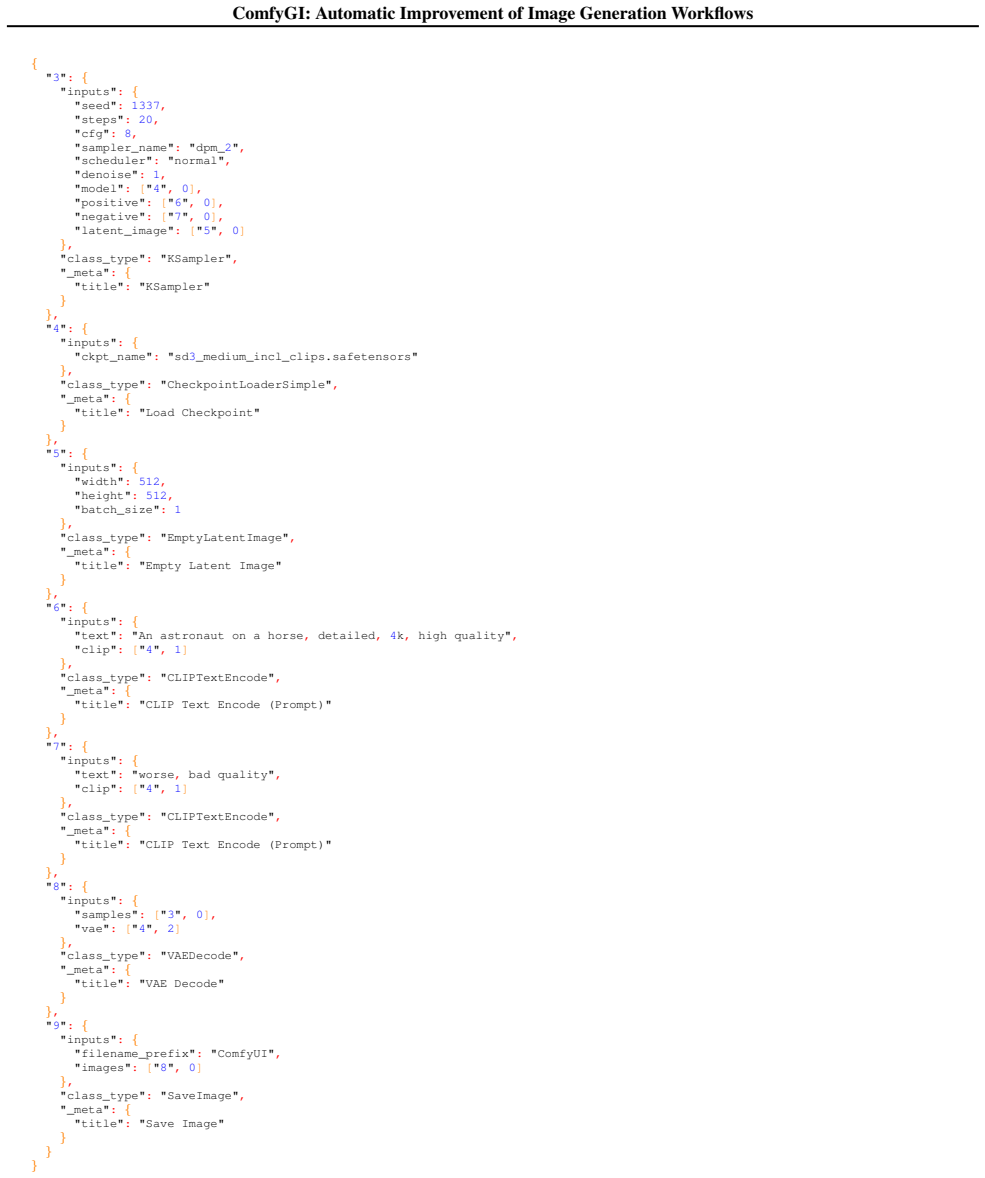
The central mechanism is the hill-climbing patch search over the workflow's JSON representation. Each mutation operator targets one module: checkpoint (replacing the diffusion model), ksampler (changing seed, steps, CFG, sampler, scheduler, denoise), prompt word and prompt statement (editing prompt text with copy, switch, remove, add, replace operations), and prompt llm (rewriting the prompt with a randomly chosen LLM). The ImageReward model is the objective function that scores every generated image; the search accepts a mutation only if it raises the best score, and terminates when no further improvement is found. The resulting patch is applied to the original workflow to generate the final image.
What would settle it
A direct test would compare ComfyGI's optimized images against images produced by the same workflow after a human expert tunes it, using the same human evaluation protocol; if the ComfyGI images do not win at a significantly higher rate, the claim that the hill-climbing search is an effective automatic improvement method fails.
Extended reading notes
Core claim
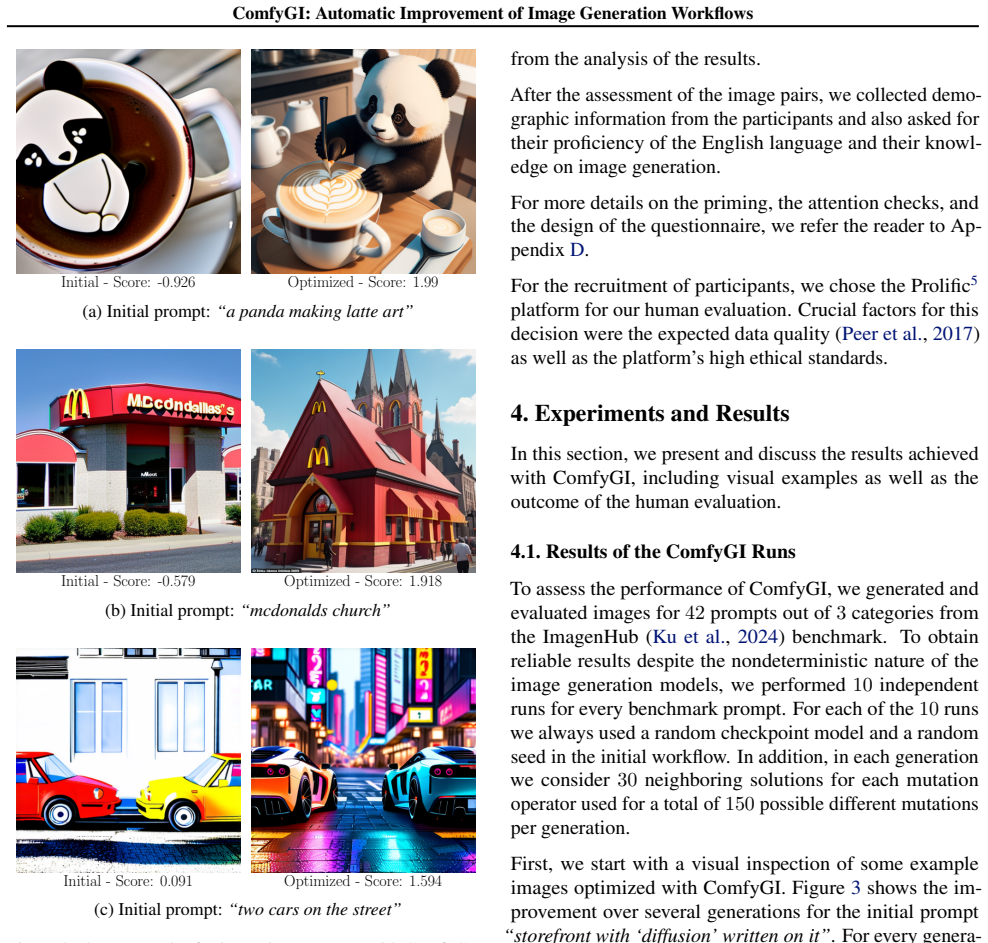
ComfyGI's central discovery is that a hill-climbing genetic-improvement search over the JSON of a ComfyUI text-to-image workflow can substantially improve output quality. Starting from a workflow with a randomly selected checkpoint and seed, the method repeatedly mutates the checkpoint, sampler settings, and prompt (using word-level edits and LLM rewrites), generates an image for each mutant, and accepts the single best mutation per generation as part of a patch. The patch is applied to the workflow to produce the final image. Across 42 prompts from 14 categories and 10 runs per prompt, the median ImageReward score improves by about 50% relative to the initial image, and all prompt categories improve. A human study with 100 annotators confirms the direction: the optimized image is preferred in about 90% of pairwise comparisons, with high inter-rater reliability (Gwet's AC1 = 0.6346).
Load-bearing premise
The search is guided entirely by ImageReward's score, so the method assumes that ImageReward is a valid and smooth proxy for the human preferences the paper claims to improve: prompt alignment and aesthetics. If ImageReward misranks images, the hill climber optimizes the wrong objective.
Editorial extensions
If this is right
- Practitioners can improve their ComfyUI workflows automatically without manual prompt engineering or parameter tuning.
- The improvement appears across all 14 prompt categories tested, including misspellings, rare words, counting, and text rendering, suggesting the method is not limited to easy prompts.
- Changing the checkpoint model produces the largest early gains, indicating that automated model selection is a key lever for generation quality.
- Most runs converge within three generations, so the search is fast enough for routine use on a single prompt.
- Because workflows are stored as JSON patches, the same search mechanism can be applied to any ComfyUI workflow with additional modules.
Reading between the lines
- Because the search optimizes ImageReward, the resulting images will reflect that model's notion of quality; swapping in a different reward model would steer the search toward different properties, such as photorealism or safety.
- The 90% human-preference figure was obtained against randomly initialized workflows; on an already well-tuned workflow the expected gain is smaller, so the method is best seen as an automated tuner rather than a universal quality booster.
- The category-dependent checkpoint choices suggest that a learned model-routing rule could pick the diffusion model before the search even starts, saving computation.
- Extending the mutation set to newer modules such as ControlNet, LoRA, or IP-Adapter would likely open further improvements, but each requires a bespoke mutation operator.
Editorial analysis
A structured set of objections, weighed in public.
Referee Report
Summary. The paper introduces ComfyGI, a method that automatically improves ComfyUI text-to-image generation workflows by applying genetic-improvement style hill climbing to the workflow's JSON representation. Mutations change the checkpoint model, KSampler settings, and prompts (via word-level operations or LLM-based rewriting), with each candidate workflow scored by the ImageReward model. In experiments on 42 ImagenHub prompts with 10 runs each, the median ImageReward score of optimized workflows is reported to improve by about 50% over the initial workflow, and a human study with 100 annotators shows the optimized images are preferred in roughly 90% of pairwise comparisons (Wilcoxon p<0.0001, Gwet's AC1=0.6346). The paper also analyzes per-mutation contributions and convergence behavior.
Significance. If the results hold, ComfyGI provides a practical, fully automatic workflow optimizer for text-to-image generation, building on genetic improvement and LLM-based mutation operators. The human evaluation is a notable strength: it uses a sizable annotator pool, attention checks, and inter-rater reliability reporting, giving independent evidence that the optimized images are indeed preferred. The method is simple, extensible, and the authors have released the project code. However, the scientific significance is currently limited by the absence of control experiments that isolate the contribution of the hill-climbing search from other factors, and by the reliance on ImageReward as both the fitness function and the headline evaluation metric.
major comments (3)
- [Section 4.1 / Appendix A] The causal attribution of the reported gains to the hill-climbing search is not established. The experiments initialize each of the 10 runs with a random checkpoint model and a random seed (Appendix A, Figure 13), and Section 4.3 and Figure 10 show that the checkpoint mutation alone produces an average improvement of over 1.75 points in the first generation. A large part of the ~50% median ImageReward improvement may therefore simply reflect replacing an unlucky random checkpoint with a model that is better suited to the prompt, rather than the iterative patch construction that is the paper's central claim. To support the claim that ComfyGI's search is effective, the authors should compare against control conditions: (a) a random-search baseline that applies the same mutation operators with the same mutation budget but without greedy selection; (b) a checkpoint-only baseline that, for each prompt, selects the best checkpoint by evaluating all available models while keeping the remaining settings fixed; and (c) runs starting from a fixed, sensible default workflow (e.g., Stable Diffusion 1.5 with default KSampler settings) rather than a random draw. These controls would separate the effect of the search mechanism from the effect of chance checkpoint initialization.
- [Section 3.1 / Section 4.1] The headline 50% ImageReward improvement is not independent evidence of quality improvement because ImageReward is exactly the objective being optimized by the search. The human evaluation is a genuinely independent check, but it only compares the random-initial workflow with the fully optimized workflow, and thus inherits the same baseline-attribution problem. The paper should report quantitative agreement between ImageReward scores and human preferences (e.g., correlation or accuracy on the pairwise comparisons) to validate the proxy in this setting, and should discuss the selection-artifact issue explicitly. Without such evidence, a reader cannot tell whether the ImageReward gain is a meaningful reflection of the qualities the authors claim to optimize or merely an artifact of hill climbing on a smooth score.
- [Section 4.2 / Section 4.3] The human evaluation does not distinguish between the contribution of the hill-climbing search and the contribution of simply choosing a better checkpoint from the predefined set. The paper should add a human-evaluation condition comparing the fully optimized workflow against a strong fixed baseline, such as the best single checkpoint selected per prompt on a separate validation run, or against the output of the random-search control suggested above. This would show whether the human-preference advantage is due to the search process or due to model selection alone. Without this comparison, the claim that ComfyGI's 'genetic improvement' techniques are responsible for the ~90% win rate is not fully supported.
minor comments (5)
- [Section 4.2] The statistical test is reported only as 'Wilcoxon signed-rank test with p<0.0001'; the authors should specify the unit of analysis (e.g., per-prompt median win rate, per-participant preference counts, or per-image-pair choices), whether the test is two-sided, and how tied responses were handled.
- [Figure 6 and Section 4.1] The y-axis in Figure 6 is labeled 'Average improvement' but the precise definition (average over what? improvement over the initial score?) is not given in the main text. Please define the quantity and report confidence intervals for the improvement curves.
- [Section 3.1 / Table 1] The KSampler mutation ranges (steps, CFG, denoise, seed range) are only listed in Appendix A. Since the mutation operators are central to the method, these settings should be stated in the main text or the reader should be directed to Table 1 at first mention.
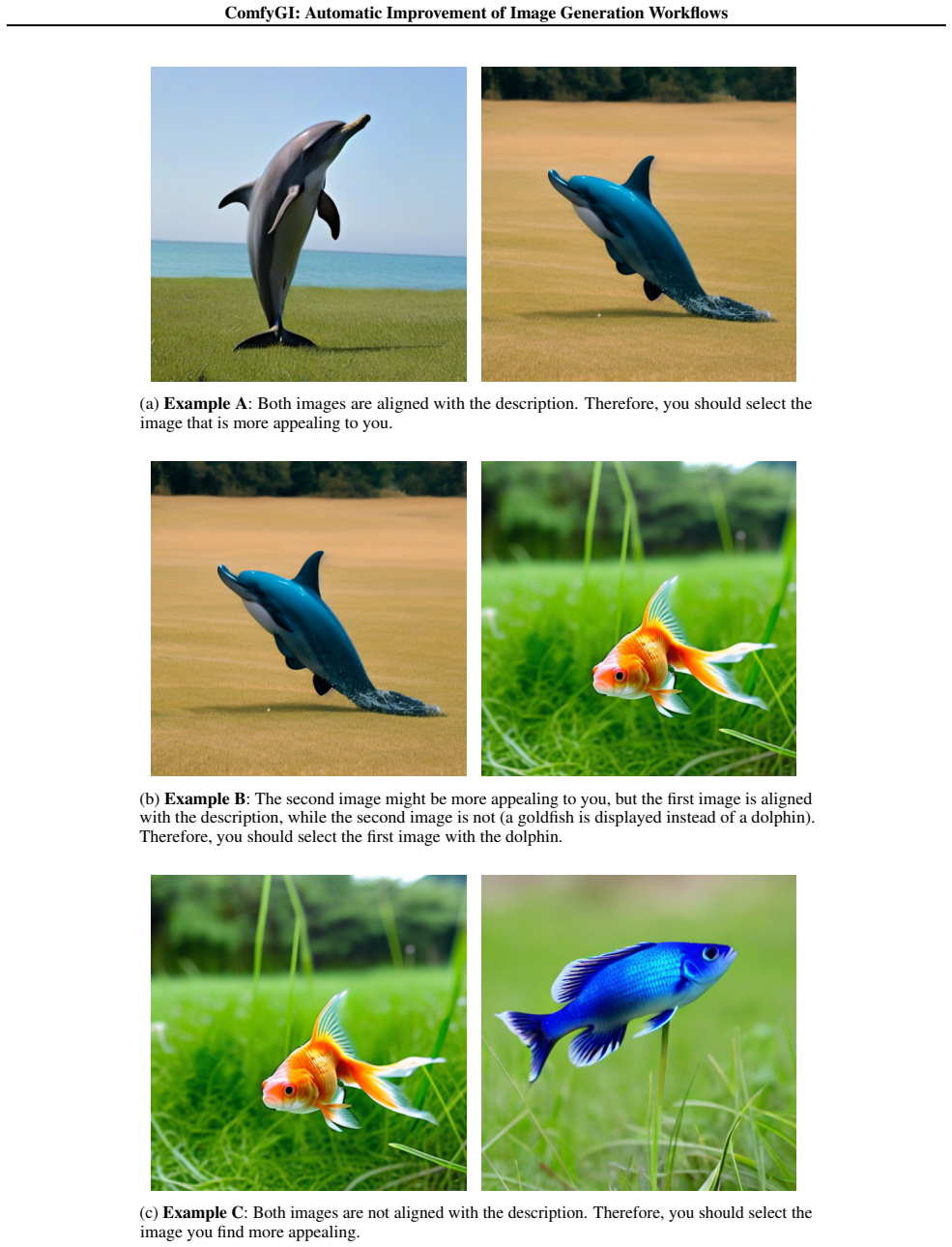
- [Appendix D] The priming tells participants to prefer the prompt-aligned image even if it is less aesthetically pleasing; this could introduce a bias toward alignment over aesthetics, which is a stated goal but should be acknowledged as a potential limitation of the human study.
- [Section 5 / Impact Statement] The impact statement is only two sentences. Given the potential for misuse of automated image generation (e.g., deepfakes, deceptive content), a fuller discussion of risks and mitigations would strengthen the paper.
Circularity Check
The 50% median ImageReward gain is a selection artifact of the search objective, but the human evaluation provides independent support for the quality claim.
-
fitted input called prediction
[Section 3.1 (Search Method, steps 1/4/5) versus Section 4.1 and Abstract]
"First, we take the input workflow in JSON format, use it to generate the initial image, and assign a score to this image with the ImageReward model (step 1). ... evaluate all generated images with the ImageReward model and compare the score of all images (step 4). If the score of the best image in the current generation is better than the best score recorded so far, we add the mutation that led to this successful improvement to the patch (step 5). ... We see that the median ImageReward score could be significantly improved by about 50% compared to the initial images."
The headline performance number is measured with the same ImageReward model that serves as the hill climber's acceptance criterion. Since only mutations that improve the best ImageReward score are added to the patch, the final workflow's ImageReward score is, by construction, the best score found during search, and the reported 50% median improvement is a selection artifact rather than an independent evaluation of image quality. The paper does not present this as a parameter fitted to data, but the logical structure is the same: the objective used to guide search is reused as the headline outcome, so the improvement is statistically forced by the selection rule.
full rationale
The paper's central qualitative claim, that ComfyGI produces images humans prefer, is independently tested: 100 annotators with attention checks preferred the optimized images in about 90% of pairwise comparisons (Wilcoxon p < 0.0001, Gwet's AC1 = 0.6346). That human evaluation uses the same random-initialization baseline as the automatic runs, so it inherits the baseline-attribution weakness, but it is not circular: the annotators' judgments are external to the ImageReward objective. The only identified circular step is the reuse of ImageReward as both the search objective and the headline evaluation metric, which makes the 50% median gain a by-construction consequence of the acceptance rule. No load-bearing self-citations appear; the Brownlee et al. citations involving an author of this paper are background for LLM-based mutation operators and are not used to justify the quality claim. The random checkpoint and seed in the initial workflow weaken causal attribution to hill-climbing search, and the Section 4.3 finding that checkpoint mutation alone contributes over 1.75 points in the first generation suggests much of the gain comes from selecting a better pretrained model; however, this is a correctness and generalization concern, not circularity. Overall, the paper is partially circular in its headline metric but has independent human evidence for its main claim.
Assumptions & free parameters
free parameters (5)
- KSampler mutation ranges =
steps [1,200), cfg [0.0,25.0), denoise [0.00,1.00], seed [0,100000], pre-defined sampler/scheduler lists
- Neighborhood size per generation =
30 neighboring solutions per mutation operator, 150 total mutations
- Prompt enrichment lists =
250 common positive prompt statements from Santana (2022) and negative prompt statements from Yip (2023)
- Checkpoint model set =
9 models (SD 1.5, SD 2, SD3 Medium, SDXL Turbo/Base, Realistic Vision 6.0, ReV Animated 1.2.2, Dreamlike Photoreal…
- LLM set and temperature/seed =
llama3.1:8b, mistral-nemo:12b, gemma2:9b with random seed and temperature
assumptions (5)
- domain assumption ImageReward is a valid proxy for human aesthetic quality and prompt alignment.
- domain assumption Small mutations to the workflow JSON produce a sufficiently smooth fitness landscape for hill climbing to find improvements.
- domain assumption The 42 randomly sampled ImagenHub prompts represent typical text-to-image use cases.
- domain assumption A randomly chosen checkpoint and seed is a fair baseline for an 'initial workflow'.
- ad hoc to paper The LLM prompt templates produce useful prompt rewrites for diffusion models.
Cite this review
Pith. "Pith review of ComfyGI: Automatic Improvement of Image Generation Workflows." pith.science (2026). https://pith.science/paper/5WRQU6FC
@misc{pith2026241114193,
  author       = {Pith},
  title        = {Pith review of: ComfyGI: Automatic Improvement of Image Generation Workflows},
  year         = {2026},
  howpublished = {\url{https://pith.science/paper/5WRQU6FC}},
  note         = {Machine review of arXiv:2411.14193}
}
read the original abstract
Automatic image generation is no longer just of interest to researchers, but also to practitioners. However, current models are sensitive to the settings used and automatic optimization methods often require human involvement. To bridge this gap, we introduce ComfyGI, a novel approach to automatically improve workflows for image generation without the need for human intervention driven by techniques from genetic improvement. This enables image generation with significantly higher quality in terms of the alignment with the given description and the perceived aesthetics. On the performance side, we find that overall, the images generated with an optimized workflow are about 50% better compared to the initial workflow in terms of the median ImageReward score. These already good results are even surpassed in our human evaluation, as the participants preferred the images improved by ComfyGI in around 90% of the cases.
Figures


Figures from the paper (17 more)




Forward citations
Cited by 2 Pith papers
-
Knowledge-Centric Agents for Workflow Generation in ComfyUI
A knowledge-centric pipeline distills strategies and pseudo-codes from real workflows, fine-tunes a language model on those levels, and reconstructs executable ComfyUI graphs from task descriptions.
-
ComfyUI-Copilot: An Intelligent Assistant for Automated Workflow Development
An LLM-powered multi-agent Copilot retrieves and constructs ComfyUI workflows, reporting at least 88.5% recall on its own test set and 85.9% online acceptance of proposed workflows.
Reference graph
Works this paper leans on
-
[1]
Comparing line and ast granularity level for program repair using pyggi
An, G., Kim, J., and Yoo, S. Comparing line and ast granularity level for program repair using pyggi. In Proceedings of the 4th International Workshop on Genetic Improvement Workshop, pp.\ 19--26, 2018
work page 2018
-
[2]
Stableyolo: Optimizing image generation for large language models
Berger, H., Dakhama, A., Ding, Z., Even-Mendoza, K., Kelly, D., Menendez, H., Moussa, R., and Sarro, F. Stableyolo: Optimizing image generation for large language models. In International Symposium on Search Based Software Engineering, pp.\ 133--139. Springer, 2023
work page 2023
-
[3]
E., Callan, J., Even-Mendoza, K., Geiger, A., Hanna, C., Petke, J., Sarro, F., and Sobania, D
Brownlee, A. E., Callan, J., Even-Mendoza, K., Geiger, A., Hanna, C., Petke, J., Sarro, F., and Sobania, D. Enhancing genetic improvement mutations using large language models. In International Symposium on Search Based Software Engineering, pp.\ 153--159. Springer, 2023
work page 2023
-
[4]
Brownlee, A. E. I., Callan, J., Even-Mendoza, K., Geiger, A., Hanna, C., Petke, J., Sarro, F., and Sobania, D. Large language model based mutations in genetic improvement. 2024
work page 2024
-
[5]
Bruce, B. R., Petke, J., and Harman, M. Reducing energy consumption using genetic improvement. In Proceedings of the 2015 Annual Conference on Genetic and Evolutionary Computation, pp.\ 1327--1334, 2015
work page 2015
-
[6]
Callan, J. and Petke, J. Multi-objective genetic improvement: A case study with evosuite. In International Symposium on Search Based Software Engineering, pp.\ 111--117. Springer, 2022
work page 2022
-
[7]
Cicchetti, D. V. and Feinstein, A. R. High agreement but low kappa: Ii. resolving the paradoxes. Journal of clinical epidemiology, 43 0 (6): 0 551--558, 1990
work page 1990
-
[8]
and Nichol, A
Dhariwal, P. and Nichol, A. Diffusion models beat gans on image synthesis. Advances in neural information processing systems, 34: 0 8780--8794, 2021
2021
Show all 45 references
-
[9]
Cogview: Mastering text-to-image generation via transformers
Ding, M., Yang, Z., Hong, W., Zheng, W., Zhou, C., Yin, D., Lin, J., Zou, X., Shao, Z., Yang, H., et al. Cogview: Mastering text-to-image generation via transformers. Advances in neural information processing systems, 34: 0 19822--19835, 2021
2021
-
[10]
Raft: Reward ranked finetuning for generative foundation model alignment
Dong, H., Xiong, W., Goyal, D., Zhang, Y., Chow, W., Pan, R., Diao, S., Zhang, J., Shum, K., and Zhang, T. Raft: Reward ranked finetuning for generative foundation model alignment. arXiv preprint arXiv:2304.06767, 2023
2023 arXiv
-
[11]
M., Bobeldyk, D., and Moore, J
Fredericks, E. M., Bobeldyk, D., and Moore, J. M. Crafting generative art through genetic improvement: Managing creative outputs in diverse fitness landscapes. arXiv preprint arXiv:2407.20095, 2024 a
2024 arXiv
-
[12]
M., Moore, J
Fredericks, E. M., Moore, J. M., and Diller, A. C. Generativegi: creating generative art with genetic improvement. Automated Software Engineering, 31 0 (1): 0 23, 2024 b
2024
-
[13]
Generative adversarial networks
Goodfellow, I., Pouget-Abadie, J., Mirza, M., Xu, B., Warde-Farley, D., Ozair, S., Courville, A., and Bengio, Y. Generative adversarial networks. Communications of the ACM, 63 0 (11): 0 139--144, 2020
2020
-
[14]
Gwet, K. L. Computing inter-rater reliability and its variance in the presence of high agreement. British Journal of Mathematical and Statistical Psychology, 61 0 (1): 0 29--48, 2008
2008
-
[15]
Gwet, K. L. Handbook of inter-rater reliability: The definitive guide to measuring the extent of agreement among raters. Advanced Analytics, LLC, 2014
2014
-
[16]
and Yaman, A
Hall, O. and Yaman, A. Collaborative interactive evolution of art in the latent space of deep generative models. In International Conference on Computational Intelligence in Music, Sound, Art and Design (Part of EvoStar), pp.\ 194--210. Springer, 2024
-
[17]
Optimizing prompts for text-to-image generation
Hao, Y., Chi, Z., Dong, L., and Wei, F. Optimizing prompts for text-to-image generation. Advances in Neural Information Processing Systems, 36, 2024
2024
-
[18]
O., Woodward, J
Haraldsson, S. O., Woodward, J. R., Brownlee, A. E., and Siggeirsdottir, K. Fixing bugs in your sleep: How genetic improvement became an overnight success. In Proceedings of the Genetic and Evolutionary Computation Conference Companion, pp.\ 1513--1520, 2017
2017
-
[19]
Denoising diffusion probabilistic models
Ho, J., Jain, A., and Abbeel, P. Denoising diffusion probabilistic models. Advances in neural information processing systems, 33: 0 6840--6851, 2020
2020
-
[20]
Draw your art dream: Diverse digital art synthesis with multimodal guided diffusion
Huang, N., Tang, F., Dong, W., and Xu, C. Draw your art dream: Diverse digital art synthesis with multimodal guided diffusion. In Proceedings of the 30th ACM International Conference on Multimedia, pp.\ 1085--1094, 2022
2022
-
[21]
Imagenhub: Standardizing the evaluation of conditional image generation models
Ku, M., Li, T., Zhang, K., Lu, Y., Fu, X., Zhuang, W., and Chen, W. Imagenhub: Standardizing the evaluation of conditional image generation models. In The Twelfth International Conference on Learning Representations, 2024
2024
-
[22]
Langdon, W. B. and Harman, M. Optimizing existing software with genetic programming. IEEE Transactions on Evolutionary Computation, 19 0 (1): 0 118--135, 2014
2014
-
[23]
B., Lam, B
Langdon, W. B., Lam, B. Y. H., Petke, J., and Harman, M. Improving cuda dna analysis software with genetic programming. In Proceedings of the 2015 Annual Conference on Genetic and Evolutionary Computation, pp.\ 1063--1070, 2015
2015
-
[24]
Lee, K., Liu, H., Ryu, M., Watkins, O., Du, Y., Boutilier, C., Abbeel, P., Ghavamzadeh, M., and Gu, S. S. Aligning text-to-image models using human feedback. arXiv preprint arXiv:2302.12192, 2023
2023 arXiv
-
[25]
and Chilton, L
Liu, V. and Chilton, L. B. Design guidelines for prompt engineering text-to-image generative models. In Proceedings of the 2022 CHI conference on human factors in computing systems, pp.\ 1--23, 2022
2022
-
[26]
M., Correia, J., and Machado, P
Martins, T., Cunha, J. M., Correia, J., and Machado, P. Towards the evolution of prompts with metaprompter. In International Conference on Computational Intelligence in Music, Sound, Art and Design (Part of EvoStar), pp.\ 180--195. Springer, 2023
2023
-
[27]
Beyond the turk: Alternative platforms for crowdsourcing behavioral research
Peer, E., Brandimarte, L., Samat, S., and Acquisti, A. Beyond the turk: Alternative platforms for crowdsourcing behavioral research. Journal of experimental social psychology, 70: 0 153--163, 2017
2017
-
[28]
O., Harman, M., Langdon, W
Petke, J., Haraldsson, S. O., Harman, M., Langdon, W. B., White, D. R., and Woodward, J. R. Genetic improvement of software: a comprehensive survey. IEEE Transactions on Evolutionary Computation, 22 0 (3): 0 415--432, 2017
2017
-
[29]
Zero-shot text-to-image generation
Ramesh, A., Pavlov, M., Goh, G., Gray, S., Voss, C., Radford, A., Chen, M., and Sutskever, I. Zero-shot text-to-image generation. In International conference on machine learning, pp.\ 8821--8831. Pmlr, 2021
2021
-
[30]
You only look once: Unified, real-time object detection
Redmon, J. You only look once: Unified, real-time object detection. In Proceedings of the IEEE conference on computer vision and pattern recognition, 2016
2016
-
[31]
Generative adversarial text to image synthesis
Reed, S., Akata, Z., Yan, X., Logeswaran, L., Schiele, B., and Lee, H. Generative adversarial text to image synthesis. In International conference on machine learning, pp.\ 1060--1069. PMLR, 2016
2016
-
[32]
High-resolution image synthesis with latent diffusion models
Rombach, R., Blattmann, A., Lorenz, D., Esser, P., and Ommer, B. High-resolution image synthesis with latent diffusion models. In Proceedings of the IEEE/CVF conference on computer vision and pattern recognition, pp.\ 10684--10695, 2022
2022
-
[33]
L., Ghasemipour, K., Gontijo Lopes, R., Karagol Ayan, B., Salimans, T., et al
Saharia, C., Chan, W., Saxena, S., Li, L., Whang, J., Denton, E. L., Ghasemipour, K., Gontijo Lopes, R., Karagol Ayan, B., Salimans, T., et al. Photorealistic text-to-image diffusion models with deep language understanding. Advances in neural information processing systems, 35...
2022
-
[34]
Stable-diffusion-prompts
Santana, G. Stable-diffusion-prompts. https://huggingface.co/datasets/Gustavosta/Stable-Diffusion-Prompts/blob/main/data/train.parquet, 2022. Accessed: November 10, 2024
2022
-
[35]
Df-gan: A simple and effective baseline for text-to-image synthesis
Tao, M., Tang, H., Wu, F., Jing, X.-Y., Bao, B.-K., and Xu, C. Df-gan: A simple and effective baseline for text-to-image synthesis. In Proceedings of the IEEE/CVF conference on computer vision and pattern recognition, pp.\ 16515--16525, 2022
2022
-
[36]
On discrete prompt optimization for diffusion models
Wang, R., Liu, T., Hsieh, C.-J., and Gong, B. On discrete prompt optimization for diffusion models. arXiv preprint arXiv:2407.01606, 2024
2024 arXiv
-
[37]
J., Montoya, E., Munechika, D., Yang, H., Hoover, B., and Chau, D
Wang, Z. J., Montoya, E., Munechika, D., Yang, H., Hoover, B., and Chau, D. H. Diffusiondb: A large-scale prompt gallery dataset for text-to-image generative models. arXiv preprint arXiv:2210.14896, 2022
2022 arXiv
-
[38]
Individual comparisons by ranking methods
Wilcoxon, F. Individual comparisons by ranking methods. In Breakthroughs in statistics: Methodology and distribution, pp.\ 196--202. Springer, 1992
1992
-
[39]
Human preference score: Better aligning text-to-image models with human preference
Wu, X., Sun, K., Zhu, F., Zhao, R., and Li, H. Human preference score: Better aligning text-to-image models with human preference. In Proceedings of the IEEE/CVF International Conference on Computer Vision, pp.\ 2096--2105, 2023
2023
-
[40]
Imagereward: Learning and evaluating human preferences for text-to-image generation
Xu, J., Liu, X., Wu, Y., Tong, Y., Li, Q., Ding, M., Tang, J., and Dong, Y. Imagereward: Learning and evaluating human preferences for text-to-image generation. Advances in Neural Information Processing Systems, 36, 2024
2024
-
[41]
IP - A dapter: Text compatible image prompt adapter for text-to-image diffusion models
Ye, H., Zhang, J., Liu, S., Han, X., and Yang, W. IP - A dapter: Text compatible image prompt adapter for text-to-image diffusion models. arXiv preprint arXiv:2308.06721, 2023
2023 arXiv
-
[42]
100+ negative prompts everyone are using
Yip, E. 100+ negative prompts everyone are using. https://medium.com/stablediffusion/100-negative-prompts-everyone-are-using-c71d0ba33980, 2023. Accessed: November 10, 2024
2023
-
[43]
and Banzhaf, W
Yuan, Y. and Banzhaf, W. Toward better evolutionary program repair: An integrated approach. ACM Transactions on Software Engineering and Methodology (TOSEM), 29 0 (1): 0 1--53, 2020
2020
-
[44]
Adding conditional control to text-to-image diffusion models
Zhang, L., Rao, A., and Agrawala, M. Adding conditional control to text-to-image diffusion models. In Proceedings of the IEEE/CVF International Conference on Computer Vision, pp.\ 3836--3847, 2023
2023
-
[45]
write newline
" write newline "" before.all 'output.state := FUNCTION n.dashify 't := "" t empty not t #1 #1 substring "-" = t #1 #2 substring "--" = not "--" * t #2 global.max substring 't := t #1 #1 substring "-" = "-" * t #2 global.max substring 't := while if t #1 #1 substring * t #2 gl...
Reviewed August 12, 2026 · model on record in the stance chip above.
Discussion (0). Continue with ORCID to comment.