REVIEW 3 major objections 6 minor 1 cited by
DROID-Splat: Combining end-to-end SLAM with 3D Gaussian Splatting
T0 review · 3 major / 6 minor · reviewed 2026-08-12 · deepseek-v4-flash
Pith's one-line read DROID-Splat combines an end-to-end optical-flow tracker with 3D Gaussian Splatting and reports state-of-the-art tracking and rendering on common SLAM benchmarks.
desk verdict Solid hybrid SLAM integration with an honest ablation study; the SotA claim only holds in P-RGBD mode with an external depth prior. read the letter →
The pith
A machine-rendered reading of the paper's core claim, the machinery that carries it, and where it could break.
The reading
What carries the argument
The machinery is a covisibility graph over keyframes: the end-to-end tracker maintains per-frame depth maps and poses, and a recurrent network plus differentiable bundle adjustment refines them by minimizing reprojection error against learned optical-flow residuals. After a covisibility and confidence filter, the depth map is triangulated and downsampled to seed 3D Gaussian hyperprimitives, each carrying position, rotation, scale, opacity, and spherical-harmonic color. Those primitives are optimized with a rendering loss that combines RGB, SSIM, and rendered depth against the tracking map or a metric depth prior, using MCMC-guided densification to add or remove Gaussians; loop closure is detected with learned place-recognition features and adds long-range edges to the backend graph. The same bundle-adjustment objective can also optimize camera intrinsics and the scale and shift of a monocular depth prior, which is how the system handles unknown-calibration video.
What would settle it
Run DROID-Splat on a monocular video of a low-texture, reflective scene with strong lighting changes, using a depth prior known to be unreliable there, and compare its trajectory error and held-out-view rendering quality against the tracker alone and a monocular baseline; if the renderer cannot prevent drift and novel-view quality collapses, the claim of simultaneous state-of-the-art tracking and rendering fails for exactly the conditions the paper names as its limits.
Extended reading notes
Core claim
The central discovery, on the paper's own terms, is that dense tracking and dense rendering reinforce each other rather than being competing objectives. The tracker's dense depth-from-motion map, produced by differentiable bundle adjustment over a covisibility graph, is filtered for covisible, high-confidence points, downsampled, and used to initialize 3D Gaussian hyperprimitives; the renderer then optimizes appearance and depth together with a mixed RGB, SSIM, and depth loss. Because both modules are differentiable and run in parallel, the system reports state-of-the-art tracking and rendering metrics on TUM-RGBD and Replica. The ablations locate the value in specific components: scale-optimized monocular priors and conservative graph building matter most for tracking, MCMC-guided densification is the main rendering improvement, and feeding rendering gradients back into the tracker helps only when perfect groundtruth depth is available, not on real monocular data.
Load-bearing premise
The system depends on the pretrained tracker's depth estimates, optionally corrected by a monocular depth model, being accurate enough to seed and supervise the 3D scene; if those estimates are unreliable, the rendering step cannot fix the geometry.
Editorial extensions
If this is right
- Photorealistic mapping no longer has to be a post-processing stage: the paper's parallel frontend, backend, renderer, and loop detector run on a single consumer GPU at near real-time rates.
- Monocular video with unknown camera intrinsics is reconstructable when a temporally consistent metric depth prior is available, because intrinsics and prior scale and shift are absorbed into bundle adjustment.
- Rendering-to-tracking feedback is not a free lunch: gradients through the rendering loss improved pose estimates only under perfect depth supervision and hurt on noisier monocular data.
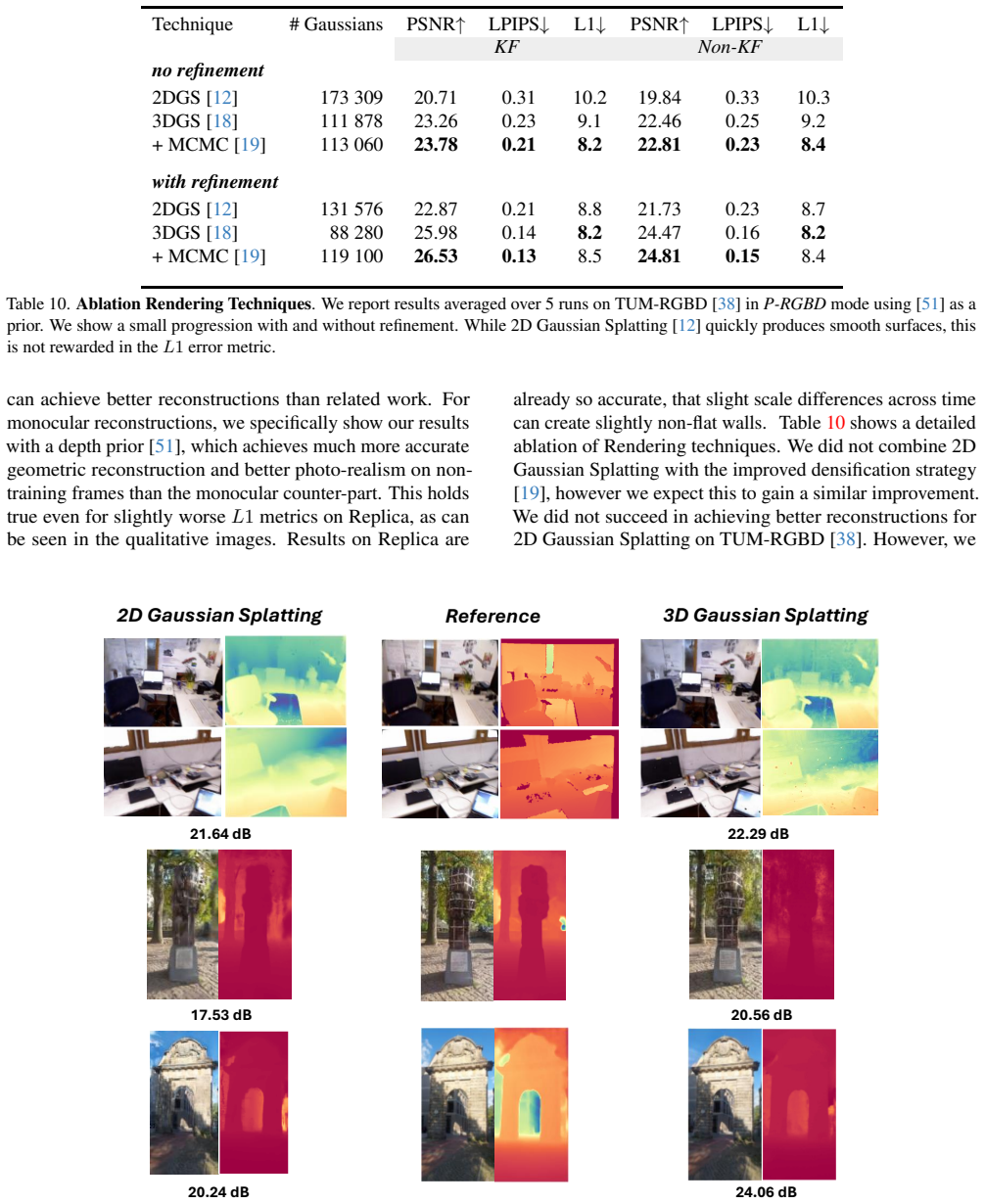
- For rendering, the densification strategy matters more than covisibility pruning; MCMC-guided densification consistently outperforms the original gradient-based density control at matched Gaussian counts.
- Dense tracking maps generalize to non-training frames, so the system's rendering advantage shows most on held-out views rather than on the keyframes used for optimization.
Reading between the lines
- Beyond the paper, the prior ablation implies that improving temporal consistency of monocular depth models would give larger SLAM gains than improving single-image depth accuracy.
- Beyond the paper, a testable extension is to route tracker uncertainty into Gaussian densification so that unreliable depth regions are not treated as ground truth.
- Beyond the paper, the pose-feedback result suggests that RGB rendering losses are too noisy for odometry; backpropagating only depth or feature-metric residuals might stabilize renderer-to-tracker feedback.
Editorial analysis
A structured set of objections, weighed in public.
Referee Report
Summary. The paper introduces DROID-Splat, a dense SLAM system that couples the end-to-end DROID-SLAM tracker with a 3D Gaussian Splatting renderer. The system processes monocular, RGB-D, and a "Pseudo-RGBD" mode in which monocular depth priors (Metric3D) are integrated through per-frame scale/shift optimization. The authors run frontend, backend, loop closure, and renderer in parallel on a single consumer GPU, and they report ablations of tracking components (Table 1), rendering techniques (Table 2), and a feedback experiment in which renderer poses/disparity are fed back into the tracker (Table 7). Evaluations on TUM-RGBD and Replica claim state-of-the-art tracking and rendering, with additional qualitative in-the-wild reconstructions.
Significance. The paper is a solid systems contribution: it combines two mature components in a flexible, parallelized framework, provides detailed ablations averaged over five runs, reports failure cases and a 'what did not work' section, and promises open-source code. The honest reporting of the unsuccessful feedback experiment (Table 7) is a strength. If the state-of-the-art claims were accurately qualified, the work would be a useful reference for practitioners building dense SLAM systems. The main weakness is that the headline claim is overstated relative to the paper's own tables: the tracking SotA only holds in P-RGBD mode with an external Metric3D prior, and rendering SotA does not hold on Replica for monocular or RGB-D input.
major comments (3)
- [Abstract; Section 4.1, Tables 3 and 4] The abstract's unqualified claim that DroidSplat 'achieves both SotA tracking and rendering results on common SLAM benchmarks' is contradicted by the paper's own data. In Table 3, Ours Mono averages 3.5 cm ATE on TUM-RGBD, behind GlORIE-SLAM (2.1 cm) and GO-SLAM (2.3 cm); only Ours P-RGBD (1.8 cm) achieves the best average. On Replica rendering, Table 4 shows NeRF-SLAM's PSNR of 41.40 dB above Ours Mono's 39.47 dB, and Table 5 shows Gaussian-SLAM's PSNR of 42.08 dB above Ours RGBD's 39.66 dB. The state-of-the-art claim should be restricted to the specific modes and datasets for which it actually holds, and the abstract and contributions should be revised accordingly.
- [Section 4, Table 1; Section 4.1, Table 3] The tracking improvement is largely inherited from the monocular depth prior rather than from the combination of the end-to-end tracker with 3D Gaussian Splatting. Table 1 shows that adding scale optimization to the P-RGBD mode reduces TUM-RGBD ATE from 4.88 cm to 1.92 cm, and Table 3 shows that P-RGBD mode (which injects Metric3D priors and optimizes per-frame scale/shift via Eq. 5) is what yields the best tracking numbers. The paper should clearly state that the SotA tracking result depends on an external depth prior, and that the contribution of the tracker-renderer combination to tracking is limited. This is a load-bearing qualification for the central claim.
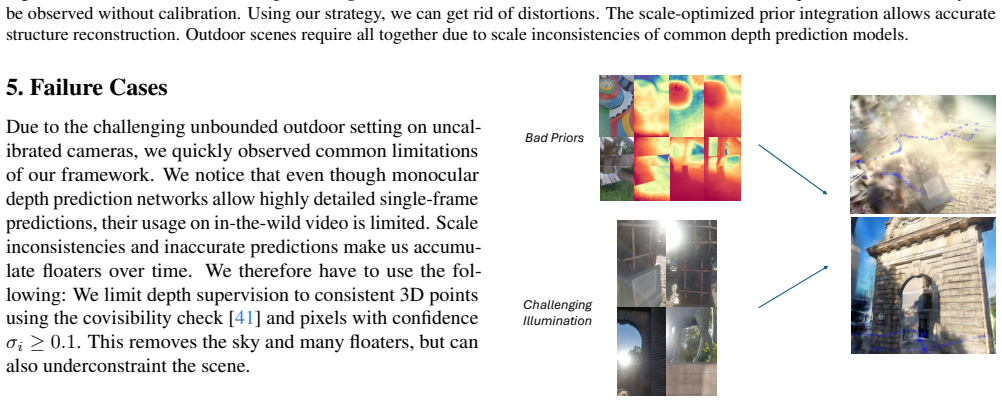
- [Section 4, Failure Cases; Section 3.3, Eq. (7)] The paper's own limitation statement — 'we perform much worse in sparser scenarios or when our priors are unreliable' — directly affects the generality of the reported results. Since Gaussians are initialized from the tracking map (Section 3.3) and trained with depth supervision (Eq. 7), an unreliable prior or sparse scene degrades both tracking and rendering, and the rendering objective cannot repair the geometry. The in-the-wild evaluation is only qualitative, so the benchmark numbers should not be presented as evidence for robust in-the-wild performance. The authors should either provide quantitative in-the-wild evaluation or explicitly scope the performance claims to scenarios with reliable depth priors.
minor comments (6)
- [Section 4, Runtime analysis] The term 'near real-time' is never quantified in the text. Please report concrete frame rates (e.g., from Figure 4) or a small table with per-mode timings, including the depth-prior bottleneck.
- [Table 2] In the row 'MCMC + Covis. Pruning', the L1 value of '0.82' for the KF column appears to be a typo; it should likely be 0.082 to be consistent with the surrounding values (0.0843 and 0.0841).
- [Section 1, Introduction] There is a typo: 'it's parent system' should be 'its parent system'.
- [Section 3.3] The sentence 'Each Gaussian possesses a rotation r ∈ SO(3), scaling s ∈ R3, density σ ∈ R1...' uses set membership notation correctly, but 'a set of points P ∈ R3' on line 2 should be 'a set of points P ⊂ R3'.
- [Table 3 caption] The caption says 'We achieve SotA tracking with our framework,' but the Mono row is not state-of-the-art. Please clarify that this refers to the P-RGBD mode.
- [Section 4, Tracking Ablation] The statement 'we achieve SotA results by simply utilizing a more conservative graph building strategy' is vague; please specify the exact graph-building parameters and how they differ from the default DROID-SLAM settings.
Circularity Check
DROID-Splat builds on external pretrained components and external benchmarks; no derivation is equivalent to its own inputs, so there is no circularity.
full rationale
The paper's contribution is an engineering combination: a pretrained end-to-end tracker (DROID-SLAM, [41]), an optional external monocular depth prior (Metric3D, [51]) with scale/shift alignment (Eq. 5), and a 3D Gaussian Splatting renderer initialized from the tracking map and supervised by the mixed rendering loss (Eq. 7). None of these components is defined in terms of the benchmark outcomes that the paper reports. Tracking accuracy is measured by ATE RMSE against ground-truth trajectories on TUM-RGBD and Replica, rendering quality by PSNR/SSIM/LPIPS and depth L1 against ground-truth images and sensor depth, and the ablations compare alternative published techniques (3DGS, MCMC, 2DGS, covisibility pruning) against one another. The Gaussians are initialized from the tracker's disparity map and depth-supervised by it, but this is an architectural design choice, not a statistical shortcut: the rendering evaluation is against external ground truth, and the tracking evaluation does not use the renderer's output as its criterion. The optional Metric3D prior is a fitted external model, but the paper does not claim to derive it or to predict its output; it explicitly attributes it to prior work and even abates different priors in the supplementary (Table 11). The main paper also candidly states limitations: 'we perform much worse in sparser scenarios or when our priors are unreliable' and, in Table 7, that render-to-tracker feedback does not improve results. The 'SotA tracking' claim is qualified by input mode, and the pure-mono numbers in Table 3 trail GlORIE-SLAM and GO-SLAM; this is a correctness/scope concern about overclaiming, not a circularity concern. No self-citations are used as load-bearing evidence, no uniqueness theorems are imported from the authors' own prior work, and no known result is renamed as a new derivation. The performance claims are supported by external benchmarks and code-release promises, not by construction from the inputs. Therefore the circularity score is 0.
Assumptions & free parameters
free parameters (13)
- lambda1 appearance-geometry weight =
0.9 TUM-RGBD, 0.8 Replica
- lambda2 SSIM weight =
0.2
- Keyframe insertion motion threshold =
3.0
- Frontend max keyframe age =
30, versus DROID-SLAM default 25
- Frame distance weight beta =
0.5 TUM-RGBD, 0.7 Replica
- Backend run frequency =
every 8 frontend passes
- Backend graph window and edge count =
150 frames, up to 1500 edges
- Loop closure thresholds tau_f, tau_t, tau_r =
0.5, 10 frames, 15 degrees
- Renderer schedule =
every 20 frontend calls, 100 iterations, 5 frame delay
- Gaussian map downsample factor =
64 Replica, 16 TUM-RGBD
- MCMC densification noise level lrnoise =
1e4
- Intrinsics heuristic initialization =
fx=fy=(H+W)/2, cx=W/2, cy=H/2
- Feedback consistency gate =
absolute relative disparity error at most 0.2, at least 50 percent of pixels
assumptions (7)
- domain assumption The pretrained DROID-SLAM tracker generalizes to the evaluation datasets and produces reliable dense optical flow, disparity, and pose updates.
- domain assumption The pretrained Metric3D monocular depth prior supplies metric depth of sufficient temporal consistency for Pseudo-RGBD mode.
- domain assumption The scenes are static and approximately Lambertian for the rendering objective.
- domain assumption The pinhole camera model with the heuristic initialization is a sufficient camera model for the demonstrated reconstructions.
- standard math Iterative differentiable bundle adjustment converges to a usable local optimum for the graph structures used.
- domain assumption EigenPlaces descriptors are sufficient to detect loop closures in the indoor benchmark scenes.
- standard math Benchmark ground-truth poses and depths are accurate enough for the reported ATE, PSNR, and L1 metrics.
Cite this review
Pith. "Pith review of DROID-Splat: Combining end-to-end SLAM with 3D Gaussian Splatting." pith.science (2026). https://pith.science/paper/H47AGKRM
@misc{pith2026241117660,
  author       = {Pith},
  title        = {Pith review of: DROID-Splat: Combining end-to-end SLAM with 3D Gaussian Splatting},
  year         = {2026},
  howpublished = {\url{https://pith.science/paper/H47AGKRM}},
  note         = {Machine review of arXiv:2411.17660}
}
read the original abstract
Recent progress in scene synthesis makes standalone SLAM systems purely based on optimizing hyperprimitives with a Rendering objective possible. However, the tracking performance still lacks behind traditional and end-to-end SLAM systems. An optimal trade-off between robustness, speed and accuracy has not yet been reached, especially for monocular video. In this paper, we introduce a SLAM system based on an end-to-end Tracker and extend it with a Renderer based on recent 3D Gaussian Splatting techniques. Our framework \textbf{DroidSplat} achieves both SotA tracking and rendering results on common SLAM benchmarks. We implemented multiple building blocks of modern SLAM systems to run in parallel, allowing for fast inference on common consumer GPU's. Recent progress in monocular depth prediction and camera calibration allows our system to achieve strong results even on in-the-wild data without known camera intrinsics. Code will be available at \url{https://github.com/ChenHoy/DROID-Splat}.
Figures


Figures from the paper (7 more)




Forward citations
Cited by 1 Pith paper
-
GeoGS-SLAM: Online Monocular Reconstruction Using Gaussian Splatting with Geometric Priors
An online monocular SLAM system that samples 3D Gaussians from RGB plus VGGT geometric priors and jointly optimizes poses and map with photometric and geometric losses plus loop closure, beating prior monocular 3DGS a...
Reference graph
Works this paper leans on
-
[1]
Eigenplaces: Training viewpoint robust models for visual place recognition
Gabriele Berton, Gabriele Trivigno, Barbara Caputo, and Carlo Masone. Eigenplaces: Training viewpoint robust models for visual place recognition. In Proceedings of the IEEE/CVF International Conference on Computer Vision , pages 11080–11090, 2023. 4, 12
work page 2023
-
[2]
Zoedepth: Zero-shot trans- fer by combining relative and metric depth
Shariq Farooq Bhat, Reiner Birkl, Diana Wofk, Peter Wonka, and Matthias Müller. Zoedepth: Zero-shot trans- fer by combining relative and metric depth. arXiv preprint arXiv:2302.12288, 2023. 2, 3, 5, 17, 18
arXiv 2023
-
[3]
Angela Dai, Matthias Nießner, Michael Zollhöfer, Shahram Izadi, and Christian Theobalt. Bundlefusion: Real-time glob- ally consistent 3d reconstruction using on-the-fly surface rein- tegration. ACM Transactions on Graphics (ToG), 36(4):1,
-
[4]
Matthijs Douze, Alexandr Guzhva, Chengqi Deng, Jeff John- son, Gergely Szilvasy, Pierre-Emmanuel Mazaré, Maria Lomeli, Lucas Hosseini, and Hervé Jégou. The faiss library. arXiv preprint arXiv:2401.08281, 2024. 4
arXiv 2024
-
[5]
Mvgs: Multi-view- regulated gaussian splatting for novel view synthesis, 2024
Xiaobiao Du, Yida Wang, and Xin Yu. Mvgs: Multi-view- regulated gaussian splatting for novel view synthesis, 2024. 19
work page 2024
-
[6]
Mvgs: Multi-view- regulated gaussian splatting for novel view synthesis, 2024
Xiaobiao Du, Yida Wang, and Xin Yu. Mvgs: Multi-view- regulated gaussian splatting for novel view synthesis, 2024. 2
work page 2024
-
[7]
Lsd-slam: Large-scale direct monocular slam
Jakob Engel, Thomas Schöps, and Daniel Cremers. Lsd-slam: Large-scale direct monocular slam. In European conference on computer vision, pages 834–849. Springer, 2014. 2, 3
work page 2014
-
[8]
Direct sparse odometry
Jakob Engel, Vladlen Koltun, and Daniel Cremers. Direct sparse odometry. IEEE transactions on pattern analysis and machine intelligence, 40(3):611–625, 2017. 2
2017
Show all 73 references
-
[9]
Are we ready for autonomous driving? the kitti vision benchmark suite
Andreas Geiger, Philip Lenz, and Raquel Urtasun. Are we ready for autonomous driving? the kitti vision benchmark suite. In 2012 IEEE conference on computer vision and pattern recognition, pages 3354–3361. IEEE, 2012. 17
2012
-
[10]
Deep geometry-aware camera self-calibration from video
Annika Hagemann, Moritz Knorr, and Christoph Stiller. Deep geometry-aware camera self-calibration from video. In Pro- ceedings of the IEEE/CVF International Conference on Com- puter Vision, pages 3438–3448, 2023. 2, 3, 18
2023
-
[11]
Lotus: Diffusion-based visual foundation model for high-quality dense prediction
Jing He, Haodong Li, Wei Yin, Yixun Liang, Leheng Li, Kaiqiang Zhou, Hongbo Zhang, Bingbing Liu, and Ying- Cong Chen. Lotus: Diffusion-based visual foundation model for high-quality dense prediction. arXiv preprint arXiv:2409.18124, 2024. 17, 18
2024 arXiv
-
[12]
2d gaussian splatting for geometrically accu- rate radiance fields
Binbin Huang, Zehao Yu, Anpei Chen, Andreas Geiger, and Shenghua Gao. 2d gaussian splatting for geometrically accu- rate radiance fields. In ACM SIGGRAPH 2024 Conference Papers, pages 1–11, 2024. 2, 4, 5, 8, 12, 16
2024
-
[13]
Photo-slam: Real-time simultaneous localization and photo- realistic mapping for monocular stereo and rgb-d cameras
Huajian Huang, Longwei Li, Hui Cheng, and Sai-Kit Yeung. Photo-slam: Real-time simultaneous localization and photo- realistic mapping for monocular stereo and rgb-d cameras. In Proceedings of the IEEE/CVF Conference on Computer Vision and Pattern Recognition, pages 21584–21593...
2024
-
[14]
Olaf Kähler, Victor Adrian Prisacariu, Carl Yuheng Ren, Xin Sun, Philip H. S. Torr, and David William Murray. Very high frame rate volumetric integration of depth images on mobile devices. IEEE Trans. Vis. Comput. Graph., 21(11): 1241–1250, 2015. 2
2015
-
[15]
Repurpos- ing diffusion-based image generators for monocular depth estimation
Bingxin Ke, Anton Obukhov, Shengyu Huang, Nando Met- zger, Rodrigo Caye Daudt, and Konrad Schindler. Repurpos- ing diffusion-based image generators for monocular depth estimation. In Proceedings of the IEEE/CVF Conference on Computer Vision and Pattern Recognition, pages 9492–9502,
-
[16]
Splatam: Splat track & map 3d gaussians for dense rgb-d slam
Nikhil Keetha, Jay Karhade, Krishna Murthy Jatavallabhula, Gengshan Yang, Sebastian Scherer, Deva Ramanan, and Jonathon Luiten. Splatam: Splat track & map 3d gaussians for dense rgb-d slam. In Proceedings of the IEEE/CVF Con- ference on Computer Vision and Pattern Recognition,...
2024
-
[17]
Real-time 3d recon- struction in dynamic scenes using point-based fusion
Maik Keller, Damien Lefloch, Martin Lambers, Shahram Izadi, Tim Weyrich, and Andreas Kolb. Real-time 3d recon- struction in dynamic scenes using point-based fusion. In 2013 International Conference on 3D Vision-3DV 2013, pages 1–8. IEEE, 2013. 2
2013
-
[18]
3d gaussian splatting for real-time radiance field rendering
Bernhard Kerbl, Georgios Kopanas, Thomas Leimkühler, and George Drettakis. 3d gaussian splatting for real-time radiance field rendering. ACM Trans. Graph., 42(4):139–1, 2023. 1, 2, 4, 5, 8, 12, 13, 16, 18, 19
2023
-
[19]
3d gaussian splatting as markov chain monte carlo, 2024
Shakiba Kheradmand, Daniel Rebain, Gopal Sharma, Wei- wei Sun, Jeff Tseng, Hossam Isack, Abhishek Kar, Andrea Tagliasacchi, and Kwang Moo Yi. 3d gaussian splatting as markov chain monte carlo, 2024. 2, 4, 5, 12, 13, 16
2024
-
[20]
g 2 o: A general framework for graph optimization
Rainer Kümmerle, Giorgio Grisetti, Hauke Strasdat, Kurt Konolige, and Wolfram Burgard. g 2 o: A general framework for graph optimization. In 2011 IEEE international confer- ence on robotics and automation, pages 3607–3613. IEEE,
2011
-
[21]
Deep patch visual slam
Lahav Lipson, Zachary Teed, and Jia Deng. Deep patch visual slam. arXiv preprint arXiv:2408.01654, 2024. 1, 2, 4, 5
2024 arXiv
-
[22]
Loopy-slam: Dense neural slam with loop closures
Lorenzo Liso, Erik Sandström, Vladimir Yugay, Luc Van Gool, and Martin R Oswald. Loopy-slam: Dense neural slam with loop closures. In Proceedings of the IEEE/CVF Conference on Computer Vision and Pattern Recognition , pages 20363–20373, 2024. 2, 4
2024
-
[23]
Robust dynamic radiance fields
Yu-Lun Liu, Chen Gao, Andreas Meuleman, Hung-Yu Tseng, Ayush Saraf, Changil Kim, Yung-Yu Chuang, Johannes Kopf, and Jia-Bin Huang. Robust dynamic radiance fields. In Pro- ceedings of the IEEE/CVF Conference on Computer Vision and Pattern Recognition, pages 13–23, 2023. 3
2023
-
[24]
Gaussian splatting slam
Hidenobu Matsuki, Riku Murai, Paul HJ Kelly, and An- drew J Davison. Gaussian splatting slam. In Proceedings of the IEEE/CVF Conference on Computer Vision and Pattern Recognition, pages 18039–18048, 2024. 1, 2, 4, 5, 6, 7, 12, 14
2024
-
[25]
Srinivasan, Matthew Tancik, Jonathan T
Ben Mildenhall, Pratul P. Srinivasan, Matthew Tancik, Jonathan T. Barron, Ravi Ramamoorthi, and Ren Ng. Nerf: 9 Representing scenes as neural radiance fields for view synthe- sis, 2020. 2
2020
-
[26]
Instant neural graphics primitives with a multires- olution hash encoding
Thomas Müller, Alex Evans, Christoph Schied, and Alexan- der Keller. Instant neural graphics primitives with a multires- olution hash encoding. ACM transactions on graphics (TOG), 41(4):1–15, 2022. 2
2022
-
[27]
Orb-slam: a versatile and accurate monocular slam system
Raul Mur-Artal, Jose Maria Martinez Montiel, and Juan D Tardos. Orb-slam: a versatile and accurate monocular slam system. IEEE transactions on robotics , 31(5):1147–1163,
-
[28]
Real-time 3d reconstruction at scale using voxel hashing
Matthias Nießner, Michael Zollhöfer, Shahram Izadi, and Marc Stamminger. Real-time 3d reconstruction at scale using voxel hashing. ACM Transactions on Graphics (TOG), 32,
-
[29]
Q-slam: Quadric representations for monocular slam
Chensheng Peng, Chenfeng Xu, Yue Wang, Mingyu Ding, Heng Yang, Masayoshi Tomizuka, Kurt Keutzer, Marco Pavone, and Wei Zhan. Q-slam: Quadric representations for monocular slam. arXiv preprint arXiv:2403.08125, 2024. 5, 6, 7
2024 arXiv
-
[30]
Nerf- slam: Real-time dense monocular slam with neural radiance fields
Antoni Rosinol, John J Leonard, and Luca Carlone. Nerf- slam: Real-time dense monocular slam with neural radiance fields. In 2023 IEEE/RSJ International Conference on Intel- ligent Robots and Systems (IROS), pages 3437–3444. IEEE,
2023
-
[31]
Orb: An efficient alternative to sift or surf
Ethan Rublee, Vincent Rabaud, Kurt Konolige, and Gary Bradski. Orb: An efficient alternative to sift or surf. In 2011 International conference on computer vision , pages 2564–
2011
-
[32]
Point-slam: Dense neural point cloud-based slam
Erik Sandström, Yue Li, Luc Van Gool, and Martin R Os- wald. Point-slam: Dense neural point cloud-based slam. In Proceedings of the IEEE/CVF International Conference on Computer Vision, pages 18433–18444, 2023. 6
2023
-
[33]
Splat-slam: Globally optimized rgb-only slam with 3d gaussians
Erik Sandström, Keisuke Tateno, Michael Oechsle, Michael Niemeyer, Luc Van Gool, Martin R Oswald, and Federico Tombari. Splat-slam: Globally optimized rgb-only slam with 3d gaussians. arXiv preprint arXiv:2405.16544, 2024. 2, 3, 4, 5, 6, 7, 13
2024 arXiv
-
[34]
R3d3: Dense 3d reconstruction of dy- namic scenes from multiple cameras
Aron Schmied, Tobias Fischer, Martin Danelljan, Marc Polle- feys, and Fisher Yu. R3d3: Dense 3d reconstruction of dy- namic scenes from multiple cameras. In Proceedings of the IEEE/CVF International Conference on Computer Vision , pages 3216–3226, 2023. 1
2023
-
[35]
Bad slam: Bundle adjusted direct rgb-d slam
Thomas Schops, Torsten Sattler, and Marc Pollefeys. Bad slam: Bundle adjusted direct rgb-d slam. In Proceedings of the IEEE/CVF Conference on Computer Vision and Pattern Recognition, pages 134–144, 2019. 2
2019
-
[36]
Indoor segmentation and support inference from rgbd images
Nathan Silberman, Derek Hoiem, Pushmeet Kohli, and Rob Fergus. Indoor segmentation and support inference from rgbd images. In Computer Vision–ECCV 2012: 12th European Conference on Computer Vision, Florence, Italy, October 7- 13, 2012, Proceedings, Part V 12, pages 746–760. Springer,
2012
-
[37]
The replica dataset: A digital replica of indoor spaces
Julian Straub, Thomas Whelan, Lingni Ma, Yufan Chen, Erik Wijmans, Simon Green, Jakob J Engel, Raul Mur-Artal, Carl Ren, Shobhit Verma, et al. The replica dataset: A digital replica of indoor spaces. arXiv preprint arXiv:1906.05797,
1906 arXiv
-
[38]
A benchmark for the evalua- tion of rgb-d slam systems
Jürgen Sturm, Nikolas Engelhard, Felix Endres, Wolfram Burgard, and Daniel Cremers. A benchmark for the evalua- tion of rgb-d slam systems. In 2012 IEEE/RSJ international conference on intelligent robots and systems, pages 573–580. IEEE, 2012. 4, 5, 6, 7, 8, 12, 13, 14, 16, 18
2012
-
[39]
High-fidelity slam using gaussian splatting with rendering-guided densification and regularized optimization
Shuo Sun, Malcolm Mielle, Achim J Lilienthal, and Martin Magnusson. High-fidelity slam using gaussian splatting with rendering-guided densification and regularized optimization. arXiv preprint arXiv:2403.12535, 2024. 2, 19
2024 arXiv
-
[40]
Raft: Recurrent all-pairs field transforms for optical flow
Zachary Teed and Jia Deng. Raft: Recurrent all-pairs field transforms for optical flow. In Computer Vision–ECCV 2020: 16th European Conference, Glasgow, UK, August 23–28, 2020, Proceedings, Part II 16, pages 402–419. Springer, 2020. 2
2020
-
[41]
Droid-slam: Deep visual slam for monocular, stereo, and rgb-d cameras
Zachary Teed and Jia Deng. Droid-slam: Deep visual slam for monocular, stereo, and rgb-d cameras. Advances in neural information processing systems, 34:16558–16569, 2021. 1, 2, 3, 4, 12, 19
2021
-
[42]
Deep patch visual odometry
Zachary Teed, Lahav Lipson, and Jia Deng. Deep patch visual odometry. Advances in Neural Information Processing Systems, 36, 2024. 1, 2
2024
-
[43]
How nerfs and 3d gaussian splatting are reshaping slam: a survey
Fabio Tosi, Youmin Zhang, Ziren Gong, Erik Sandström, Stefano Mattoccia, Martin R Oswald, and Matteo Poggi. How nerfs and 3d gaussian splatting are reshaping slam: a survey. arXiv preprint arXiv:2402.13255, 4, 2024. 2, 6
2024 arXiv
-
[44]
Dn-splatter: Depth and normal priors for gaussian splatting and meshing, 2024
Matias Turkulainen, Xuqian Ren, Iaroslav Melekhov, Otto Seiskari, Esa Rahtu, and Juho Kannala. Dn-splatter: Depth and normal priors for gaussian splatting and meshing, 2024. 2
2024
-
[45]
Image quality assessment: from error visibility to structural similarity
Zhou Wang, Alan C Bovik, Hamid R Sheikh, and Eero P Simoncelli. Image quality assessment: from error visibility to structural similarity. IEEE transactions on image processing, 13(4):600–612, 2004. 5, 12
2004
-
[46]
Elasticfusion: Dense slam without a pose graph
Thomas Whelan, Stefan Leutenegger, Renato F Salas- Moreno, Ben Glocker, and Andrew J Davison. Elasticfusion: Dense slam without a pose graph. In Robotics: science and systems, page 3. Rome, Italy, 2015. 2
2015
-
[47]
Sparsegs: Real-time 360° sparse view synthesis using gaussian splatting
Haolin Xiong, Sairisheek Muttukuru, Rishi Upadhyay, Pradyumna Chari, and Achuta Kadambi. Sparsegs: Real-time 360° sparse view synthesis using gaussian splatting. Arxiv,
-
[48]
Gs-slam: Dense visual slam with 3d gaussian splatting
Chi Yan, Delin Qu, Dan Xu, Bin Zhao, Zhigang Wang, Dong Wang, and Xuelong Li. Gs-slam: Dense visual slam with 3d gaussian splatting. In Proceedings of the IEEE/CVF Con- ference on Computer Vision and Pattern Recognition, pages 19595–19604, 2024. 2
2024
-
[49]
Depth anything: Unleashing the power of large-scale unlabeled data
Lihe Yang, Bingyi Kang, Zilong Huang, Xiaogang Xu, Jiashi Feng, and Hengshuang Zhao. Depth anything: Unleashing the power of large-scale unlabeled data. In Proceedings of the IEEE/CVF Conference on Computer Vision and Pattern Recognition, pages 10371–10381, 2024. 2, 3, 17, 18
2024
-
[50]
V ox-fusion: Dense tracking and mapping with voxel-based neural implicit representation
Xingrui Yang, Hai Li, Hongjia Zhai, Yuhang Ming, Yuqian Liu, and Guofeng Zhang. V ox-fusion: Dense tracking and mapping with voxel-based neural implicit representation. In 2022 IEEE International Symposium on Mixed and Aug- mented Reality (ISMAR), pages 499–507. IEEE, 2022. 6
2022
-
[51]
Metric3d: 10 Towards zero-shot metric 3d prediction from a single image
Wei Yin, Chi Zhang, Hao Chen, Zhipeng Cai, Gang Yu, Kaix- uan Wang, Xiaozhi Chen, and Chunhua Shen. Metric3d: 10 Towards zero-shot metric 3d prediction from a single image. In Proceedings of the IEEE/CVF International Conference on Computer Vision, pages 9043–9053, 2023. 2, 3,...
2023
-
[52]
Mip-splatting: Alias-free 3d gaussian splat- ting
Zehao Yu, Anpei Chen, Binbin Huang, Torsten Sattler, and Andreas Geiger. Mip-splatting: Alias-free 3d gaussian splat- ting. In Proceedings of the IEEE/CVF Conference on Com- puter Vision and Pattern Recognition, pages 19447–19456,
-
[53]
Gaussian opacity fields: Efficient adaptive surface reconstruction in unbounded scenes, 2024
Zehao Yu, Torsten Sattler, and Andreas Geiger. Gaussian opacity fields: Efficient adaptive surface reconstruction in unbounded scenes, 2024. 2
2024
-
[54]
Gaussian-slam: Photo-realistic dense slam with gaus- sian splatting
Vladimir Yugay, Yue Li, Theo Gevers, and Martin R Os- wald. Gaussian-slam: Photo-realistic dense slam with gaus- sian splatting. arXiv preprint arXiv:2312.10070, 2023. 2, 4, 5, 6, 7
2023 arXiv
-
[55]
Geolrm: Geometry-aware large re- construction model for high-quality 3d gaussian generation
Chubin Zhang, Hongliang Song, Yi Wei, Yu Chen, Jiwen Lu, and Yansong Tang. Geolrm: Geometry-aware large re- construction model for high-quality 3d gaussian generation. arXiv preprint arXiv:2406.15333, 2024. 8
2024 arXiv
-
[56]
Glorie-slam: Globally optimized rgb-only implicit encoding point cloud slam
Ganlin Zhang, Erik Sandström, Youmin Zhang, Manthan Patel, Luc Van Gool, and Martin R Oswald. Glorie-slam: Globally optimized rgb-only implicit encoding point cloud slam. arXiv preprint arXiv:2403.19549, 2024. 2, 3, 5, 6, 7, 14
2024 arXiv
-
[57]
The unreasonable effectiveness of deep features as a perceptual metric
Richard Zhang, Phillip Isola, Alexei A Efros, Eli Shechtman, and Oliver Wang. The unreasonable effectiveness of deep features as a perceptual metric. In Proceedings of the IEEE conference on computer vision and pattern recognition, pages 586–595, 2018. 5
2018
-
[58]
Hi-slam: Monocular real-time dense mapping with hybrid implicit fields
Wei Zhang, Tiecheng Sun, Sen Wang, Qing Cheng, and Nor- bert Haala. Hi-slam: Monocular real-time dense mapping with hybrid implicit fields. IEEE Robotics and Automation Letters, 2023. 2, 3, 4
2023
-
[59]
Go-slam: Global optimization for consistent 3d instant reconstruction
Youmin Zhang, Fabio Tosi, Stefano Mattoccia, and Matteo Poggi. Go-slam: Global optimization for consistent 3d instant reconstruction. In Proceedings of the IEEE/CVF International Conference on Computer Vision, pages 3727–3737, 2023. 4, 5, 6
2023
-
[60]
Pixel-gs: Density control with pixel- aware gradient for 3d gaussian splatting
Zheng Zhang, Wenbo Hu, Yixing Lao, Tong He, and Hengshuang Zhao. Pixel-gs: Density control with pixel- aware gradient for 3d gaussian splatting. arXiv preprint arXiv:2403.15530, 2024. 2
2024 arXiv
-
[61]
Mod-slam: Monocular dense mapping for unbounded 3d scene reconstruction
Heng Zhou, Zhetao Guo, Shuhong Liu, Lechen Zhang, Qihao Wang, Yuxiang Ren, and Mingrui Li. Mod-slam: Monocular dense mapping for unbounded 3d scene reconstruction. arXiv preprint arXiv:2402.03762, 2024. 5, 6, 7
2024 arXiv
-
[62]
Loopsplat: Loop closure by registering 3d gaus- sian splats
Liyuan Zhu, Yue Li, Erik Sandström, Konrad Schindler, and Iro Armeni. Loopsplat: Loop closure by registering 3d gaus- sian splats. arXiv preprint arXiv:2408.10154, 2024. 2
2024 arXiv
-
[63]
Nice-slam: Neural implicit scalable encoding for slam
Zihan Zhu, Songyou Peng, Viktor Larsson, Weiwei Xu, Hujun Bao, Zhaopeng Cui, Martin R Oswald, and Marc Pollefeys. Nice-slam: Neural implicit scalable encoding for slam. In Proceedings of the IEEE/CVF conference on computer vision and pattern recognition, pages 12786–12796, 2022. 6
2022
-
[64]
Nicer- slam: Neural implicit scene encoding for rgb slam
Zihan Zhu, Songyou Peng, Viktor Larsson, Zhaopeng Cui, Martin R Oswald, Andreas Geiger, and Marc Pollefeys. Nicer- slam: Neural implicit scene encoding for rgb slam. In 2024 International Conference on 3D Vision (3DV), pages 42–52. IEEE, 2024. 6 11 Supplementary Material In th...
2024
-
[66]
Inference settings and hyperparameters We run our system at resolution 320 × 432 on TUM- RGBD [38] and 360 × 640 on Replica [37]. 1.1. Tracking Tracking is configured by the frontend and backend parame- ters for graph building, optimization and our loop detector. Since the con...
-
[67]
The reported rendering metrics for our comparison with related work are computed on the keyframe images based on the estimated poses, as is standard
Extended Evaluation In this section, we want to provide more insights into how our system performs quantitatively and show more qualitative results. The reported rendering metrics for our comparison with related work are computed on the keyframe images based on the estimated p...
-
[68]
We show some qualitative comparisons between selected models in Figure 9
Monocular Depth Prediction Monocular depth prediction is a longstanding task with very impressive in-the-wild results of recent SotA models [2, 11, 49, 51]. We show some qualitative comparisons between selected models in Figure 9. Due to training on massive datasets, current s...
-
[69]
As stated in the main paper, we perform a two-stage reconstruction:
How important is camera calibration really? In this section we want to show some qualitative examples of in-the-wild footage with unknown intrinsics. As stated in the main paper, we perform a two-stage reconstruction:
-
[70]
Run the system without scale-optimization and optimize the camera intrinsics θ
-
[71]
(9) The benefit of camera calibration was quantitatively shown in [10]
Use the now calibrated camera to run in P-RGBD mode and additionally optimize si and oi Since we need an initial estimate of the intrinsics, we assume a heuristic where for a pinhole camera f x= f y= (H + W ) /2 cx = W/2 cy = H/2 . (9) The benefit of camera calibration was qua...
-
[72]
We notice that even though monocular depth prediction networks allow highly detailed single-frame predictions, their usage on in-the-wild video is limited
Failure Cases Due to the challenging unbounded outdoor setting on uncal- ibrated cameras, we quickly observed common limitations of our framework. We notice that even though monocular depth prediction networks allow highly detailed single-frame predictions, their usage on in-t...
-
[73]
We can then perform an intersection test to carve out a 3D volume across multiple views
What did not work? We tried the following things unsuccessfully: • Multi-View Gaussian Splatting [5] backprojects crops of 2D appearance error into 3D by using the camera ray. We can then perform an intersection test to carve out a 3D volume across multiple views. This test id...
-
[2019]
4, 6, 7, 8, 12, 13, 15, 18
Reviewed August 12, 2026 · model on record in the stance chip above.
Discussion (0). Continue with ORCID to comment.