REVIEW 3 major objections 6 minor 42 references
PyMatterSim: a Python Data Analysis Library for Computer Simulations of Materials Science, Physics, Chemistry, and Beyond
T0 review · 3 major / 6 minor · reviewed 2026-08-12 · deepseek-v4-flash
Pith's one-line read PyMatterSim is a simulator-independent Python analysis library that computes structure, dynamics, Hessian eigenmodes, and vector fields directly from atomic configurations.
desk verdict A useful but under-specified software paper: the library seems real, but the Hessian/vector modules need more explanation and the paper lacks validation. read the letter →
The pith
A machine-rendered reading of the paper's core claim, the machinery that carries it, and where it could break.
The reading
What carries the argument
The load-bearing design is a reader-neighbors-util pipeline in which a reader module ingests atomic positions from any simulator, a neighbors module builds the neighbor lists that almost every calculation needs, and utility functions provide shared mathematical operations. On top of this sits a generalized correlation engine: the pair correlation function and structure factor are defined not only for density but for any per-particle field $\\mathcal{A}$ (boolean, scalar, vector, or tensor, real or complex), so that spatial and time correlations of arbitrary order parameters reduce to one common routine. The Hessian module then provides the eigenvector fields on which the vector-analysis routines operate.
What would settle it
Take a single instantaneous configuration from an unminimized high-temperature liquid simulation, run the Hessian module on it, and count the negative eigenvalues; if the library returns such modes without any warning, the promise of analyzing general simulation trajectories for vibrational properties is unsupported.
Extended reading notes
Core claim
The paper's central claim is that PyMatterSim reduces the analysis step of computational materials science to a single, simulator-independent input: atomic configurations. From those configurations the library computes structural descriptors (pair correlations, structure factors, bond-orientational orders, pair entropy, nematic order), dynamical quantities (intermediate scattering functions, overlap functions, mean-squared displacement, four-point susceptibility, time correlations), the Hessian matrix of the potential energy with its eigenmodes and density of states, and a suite of vector-field analyses including participation ratio, divergence and curl, and transverse/longitudinal decomposition. The authors state that the package is built to industrial standards, is extendable beyond its primary simulator, and can serve as a component in future machine-learning workflows.
Load-bearing premise
The vibration and vector-analysis modules only give physically meaningful results when the input configuration has been energy-minimized to a local minimum first, a precondition the paper does not say the software checks or warns about.
Editorial extensions
If this is right
- Users can switch simulation engines without rewriting their post-processing and analysis scripts, because the library consumes only the atomic configuration data.
- The generalized correlation engine lets any user-defined per-particle order parameter be probed in real space, Fourier space, and time, making new structural or dynamical descriptors straightforward to test on the same trajectory.
- The built-in Hessian diagonalization and vector decomposition provide a direct route to studying vibrational anomalies and the boson peak in glassy systems without assembling the analysis from scratch.
- The library can act as a feature-engineering layer for supervised machine learning, since particle-level properties and their correlations can be exported as standardized data arrays.
- The package reduces duplication of analysis code across research groups, making the standard glass-physics observables easier to reproduce and compare.
Reading between the lines
- I infer that the same generalized-correlation module could accelerate the search for good structural order parameters, because testing a new candidate currently requires only a user-supplied per-particle function and no new analysis code.
- I infer that the vector-decomposition routines need not be limited to Hessian eigenvectors; applied to velocity or force fields, they could become a generic tool for analyzing collective motion in active matter and colloidal systems.
- I infer that the flexible treatment of arbitrary fields (including complex, vector, and tensor data) effectively gives users a small order-parameter engineering framework, a conclusion the paper does not explicitly draw.
Editorial analysis
A structured set of objections, weighed in public.
Referee Report
Summary. The manuscript describes PyMatterSim, a Python library for post-processing atomic configurations from computer simulations, with modules for structural analysis (pair correlations, structure factors, bond-orientational order, pair entropy, nematic order), dynamics (intermediate scattering function, overlaps, mean-squared displacement, four-point functions, order-parameter autocorrelations), Hessian matrix calculation and diagonalization, and vector-field analysis (participation ratios, divergence/curl, transverse/longitudinal decomposition, dynamical structure factors). The paper presents the relevant equations and references, states that the library is independent of the simulation software, and points to a GitHub repository and online documentation. No code, tests, benchmarks, or end-to-end examples are included in the manuscript.
Significance. If the implementation is correct, the library would be a useful, unified tool for the glass and disordered-materials community, and the breadth of coverage (structure, dynamics, Hessian, vector analysis) is commendable. The paper also compiles many standard formulas in one place, which can serve as a reference. However, the manuscript provides no validation of the implementation, so the central practical value of the software cannot currently be assessed. The claimed simulator-independent, configuration-only input model is not supported for the Hessian and vector-analysis modules, which require a potential-energy model or force evaluation. These issues are fixable with added benchmarks and clarified scope, but they are central to the paper's stated contribution.
major comments (3)
- [Sections VI and VIII] The central claim that the library 'takes the atomic configurations as the input, independent of the simulation methods and tools' (Section VIII) is not supported for the Hessian module. Equation (39) defines the Hessian in terms of the second derivative of the potential energy U, and Section VI states that analytical Hessians are available only for the Lennard-Jones, inverse-power, and harmonic/Hertz potentials (Eqs. 40-41). For 'more complicated models' the manuscript refers to a numerical finite-displacement method but does not state what input or callback this method requires. If the numerical Hessian is computed by calling back into LAMMPS, the library is not simulator-independent; if it requires a user-supplied potential or force routine, that requirement must be documented. As written, the paper does not reconcile the configuration-only input model with the model-specific energy information needed for Hessian-based analyses.
- [Entire manuscript] The paper contains no validation of the implemented software: no test cases, no comparisons with analytic results, no benchmarks against LAMMPS built-in outputs or other packages, and no example of a code invocation producing a known output. For a computational library paper, this absence is load-bearing because the reader cannot judge whether the equations in Sections IV-VII are correctly translated into working code. I would expect at least one end-to-end example (e.g., a small LJ trajectory with a known g(r) or Fs(q,t)) and some cross-checks against established implementations.
- [Sections III and VIII] The manuscript is essentially a theoretical introduction with no usage examples, API descriptions, or performance figures. Section III provides a high-level flow chart but no code snippet or reader-module example, and Section VIII only points to a repository URL. This makes it impossible to reproduce any of the described analyses from the paper itself. A software paper should demonstrate the workflow with a concrete example, including input format, function call, and output.
minor comments (6)
- [Section IV.D, Eq. (16)] Equation (16) has an unclear summation structure: the left side is q_lm(i) but the sum is written as 'N_i X_i X_ij ...', which appears to reuse i incorrectly and likely should be a sum over neighbors j (with j ≠ i). The definition of the weight matrix X_ij also needs clarification.
- [Section V.A, Eq. (37)] Equation (37) is missing the imaginary unit i in the exponential: it reads exp[q · r_j(0)] but should be exp[i q · r_j(0)] to be consistent with Eq. (31) and standard Fourier transforms.
- [Section VII.A, Eqs. (44) and (47)] The symbol Ψ is used for two different quantities: the local vector alignment order parameter in Eq. (44) and the vibrability in Eq. (47). This overloaded notation will confuse readers; one of these should be renamed.
- [Section VII.A, Eq. (44)] The quantity C_{N_i} in Eq. (44) is not defined; it should be stated explicitly (e.g., number of neighbors or a binomial coefficient).
- [Section II] The text states that simulation times 'can be extended to microseconds (ms)' - the abbreviation for microseconds is μs, not ms, which denotes milliseconds.
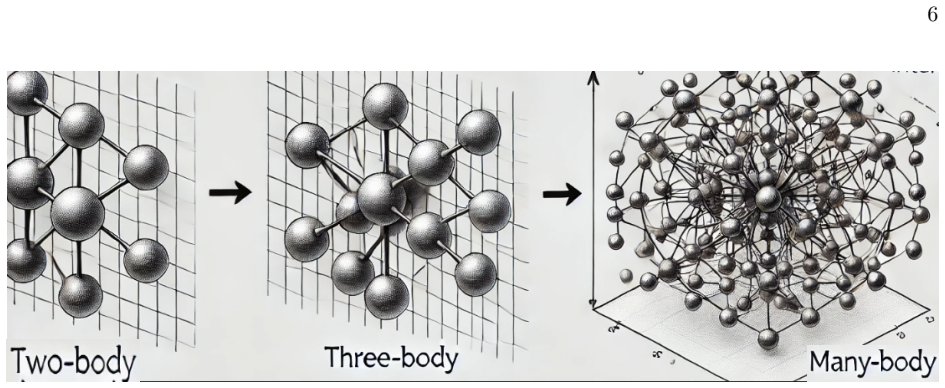
- [Figure 1 caption] The figure caption states that the figure was 'generated by the ChatGPT-4o model' and provides a URL to an OpenAI page about reasoning models; it would be more appropriate to cite the specific article or tool used, or to provide an ordinary figure with a standard credit.
Circularity Check
No load-bearing circularity: standard formulas and illustrative self-citations only.
full rationale
PyMatterSim is a software/methods paper, not a derivation of new physical results: every analysis quantity (g(r), S(q), q_lm, F_s(q,t), D_ij, PR_n, vibrability, vector decomposition) is defined directly from positions, velocities, masses, and an explicit potential or order-parameter input, using textbook or literature formulas. There are no fitted parameters that are later reported as predictions, and no uniqueness theorem is imported to force a choice. The authors cite their own prior papers (Refs. [5-10]) as case studies and examples (e.g., boson-peak and glass-forming-ability applications), but those citations are illustrative and not the justification for any formula or capability in the library. The Hessian and vector-field modules do presuppose an energy-minimized inherent structure and a potential-energy model (Eq. (39) defines D_ij as the second derivative of U, and Section VI states the system 'is usually first minimized to the local minima'), so the advertised 'atomic configurations as input, independent of simulation methods' claim is over-broad for these modules; that is a scope/input-contract concern rather than a circular reduction. The self-citations are minor and non-load-bearing, so the paper is essentially self-contained against external standards and receives a low score.
Assumptions & free parameters
assumptions (3)
- domain assumption The input atomic configurations are generated by classical molecular dynamics simulations with periodic boundary conditions and proper equilibration.
- standard math The implemented equations from the cited literature are mathematically correct and transcribed without error.
- domain assumption For Hessian and vector analysis, the configuration must be energy minimized to a local minimum (inherent structure).
Cite this review
Pith. "Pith review of PyMatterSim: a Python Data Analysis Library for Computer Simulations of Materials Science, Physics, Chemistry, and Beyond." pith.science (2026). https://pith.science/paper/TUTYURFL
@misc{pith2026241117970,
  author       = {Pith},
  title        = {Pith review of: PyMatterSim: a Python Data Analysis Library for Computer Simulations of Materials Science, Physics, Chemistry, and Beyond},
  year         = {2026},
  howpublished = {\url{https://pith.science/paper/TUTYURFL}},
  note         = {Machine review of arXiv:2411.17970}
}
read the original abstract
Computer simulation has become one of the most important tools in scientific research in many disciplines. Benefiting from the dynamical trajectories regulated by versatile interatomic interactions, various material properties can be quantitatively characterized at the atomic scale. This greatly deepens our understanding of Nature and provides incredible insights supplementing experimental observations. Hitherto, a plethora of literature discusses the computational discoveries in studying glasses in which positional disorder is inherent in their configurations. Motivated by active research and knowledge sharing, we developed a data analysis library in Python for computational materials science research. We hope to help promote scientific progress and narrow some technical gaps for the wide communities. The toolkit mainly focuses on physical analyses of glassy properties from the open-source simulator LAMMPS. Nevertheless, the code design renders high flexibility, with functionalities extendable to other computational tools. The library provides data-driven insights for different subjects and can be incorporated into advanced machine-learning workflows. The scope of the data analysis methodologies applies not only to materials science but also to physics, chemistry, and beyond.
Figures

Reference graph
Works this paper leans on
-
[1]
Ball, Made to measure: New materials for the 21st century(Princeton University Press, 1997)
P. Ball, Made to measure: New materials for the 21st century(Princeton University Press, 1997)
work page 1997
-
[2]
C. R. Harris, K. J. Millman, S. J. van der Walt, R. Gommers, P. Virtanen, D. Cournapeau, E. Wieser, J. Taylor, S. Berg, N. J. Smith, R. Kern, M. Picus, S. Hoyer, M. H. van Kerkwijk, M. Brett, A. Haldane, J. F. del R ´ ıo, M. Wiebe, P. Peterson, P. G´ erard-Marchant, K. Sheppard, T. Reddy, W. Weckesser, H. Abbasi, C. Gohlke, and T. E. Oliphant, Array progr...
work page 2020
-
[3]
The Pandas development team, pandas-dev/pandas: Pandas (2020)
work page 2020
-
[4]
Wes McKinney, Data Structures for Statistical Computing in Python, in Proceedings of the 9th Python in Science Conference, edited by St´ efan van der Walt and Jarrod Millman (2010) pp. 56 – 61
work page 2010
-
[5]
Y. Hu, F. Li, M. Li, H. Bai, and W. Wang, Five-fold symmetry as indicator of dynamic arrest in metallic glass-forming liquids, Nature Communications 6, 8310 (2015)
work page 2015
- [6]
- [7]
- [8]
Show all 42 references
-
[9]
Hu, Y.-W
Y.-C. Hu, Y.-W. Li, Y. Yang, P.-F. Guan, H.-Y. Bai, and W.-H. Wang, Configuration correlation governs slow dynamics of supercooled metallic liquids, Proceedings of the National Academy of Sciences 115, 6375 (2018)
2018
-
[10]
Hu and H
Y.-C. Hu and H. Tanaka, Universality of stringlet excitations as the origin of the boson peak of glasses with isotropic interactions, Physical Review Research 5, 023055 (2023)
2023
-
[11]
Frenkel and B
D. Frenkel and B. Smit, Understanding molecular simulation: from algorithms to applications(Elsevier, 2023)
2023
-
[12]
M. P. Allen and D. J. Tildesley, Computer simulation of liquids(Oxford university press, 2017)
2017
-
[13]
P. G. Debenedetti and F. H. Stillinger, Supercooled liquids and the glass transition, Nature 410, 259 (2001)
2001
-
[14]
Schwerdtfeger and D
P. Schwerdtfeger and D. J. Wales, 100 years of the lennard-jones potential, Journal of Chemical Theory and Computation 20, 3379 (2024)
2024
-
[15]
Hu and J
Y.-C. Hu and J. Tian, Data-driven prediction of the glass-forming ability of modeled alloys by supervised machine learning, Journal of Materials Informatics 3, 1 (2023)
2023
-
[16]
Y.-C. Hu, W. Jin, J. Schroers, M. D. Shattuck, and C. S. O’Hern, Glass-forming ability of binary lennard-jones systems, Physical Review Materials 6, 075601 (2022)
2022
-
[17]
Y.-C. Hu, K. Zhang, S. A. Kube, J. Schroers, M. D. Shattuck, and C. S. O’Hern, Glass formation in binary alloys with different atomic symmetries, Physical Review Materials 4, 105602 (2020)
2020
-
[18]
Y.-C. Hu, J. Schroers, M. D. Shattuck, and C. S. O’Hern, Tuning the glass-forming ability of metallic glasses through energetic frustration, Physical Review Materials 3, 085602 (2019)
2019
-
[19]
F. H. Stillinger and T. A. Weber, Computer simulation of local order in condensed phases of silicon, Physical review B 31, 5262 (1985)
1985
-
[20]
Molinero and E
V. Molinero and E. B. Moore, Water modeled as an intermediate element between carbon and silicon, The Journal of Physical Chemistry B 113, 4008 (2009)
2009
-
[21]
Finnis and J
M. Finnis and J. Sinclair, A simple empirical n-body potential for transition metals, Philosophical Magazine A 50, 45 (1984)
1984
-
[22]
M. S. Daw and M. I. Baskes, Embedded-atom method: Derivation and application to impurities, surfaces, and other defects in metals, Physical Review B 29, 6443 (1984)
1984
-
[23]
Laio and M
A. Laio and M. Parrinello, Escaping free-energy minima, Proceedings of the National Academy of Sciences of the United States of America 99, 12562 (2002)
2002
-
[24]
P. J. Steinhardt, D. R. Nelson, and M. Ronchetti, Bond-orientational order in liquids and glasses, Physical Review B 28, 784 (1983)
1983
-
[25]
Tanaka, T
H. Tanaka, T. Kawasaki, H. Shintani, and K. Watanabe, Critical-like behaviour of glass-forming liquids, Nature Materials 9, 324 (2010)
2010
-
[26]
Virtanen, R
P. Virtanen, R. Gommers, T. E. Oliphant, M. Haberland, T. Reddy, D. Cournapeau, E. Burovski, P. Peterson, W. Weckesser, J. Bright, S. J. van der Walt, M. Brett, J. Wilson, K. J. Millman, N. May- orov, A. R. J. Nelson, E. Jones, R. Kern, E. Larson, C. J. Carey, ˙I. Polat, Y. Fe...
2020
-
[27]
Leocmach and H
M. Leocmach and H. Tanaka, Roles of icosahedral and crystal-like order in the hard spheres glass transition, Nature communications 3, 974 (2012)
2012
-
[28]
Wehrl, General properties of entropy, Reviews of Modern Physics 50, 221 (1978)
A. Wehrl, General properties of entropy, Reviews of Modern Physics 50, 221 (1978)
1978
-
[29]
Zheng, R
Z. Zheng, R. Ni, F. Wang, M. Dijkstra, Y. Wang, and Y. Han, Structural signatures of dynamic heterogeneities in monolayers of colloidal ellipsoids, Nature Communications 5, 3829 (2014)
2014
-
[30]
T. S. Ingebrigtsen and H. Tanaka, Structural predictor for nonlinear sheared dynamics in simple glass- forming liquids, Proceedings of the National Academy of Sciences 115, 87 (2018)
2018
-
[31]
De Gennes and J
P.-G. De Gennes and J. Prost, The physics of liquid crystals, 83 (Oxford University Press, 1993)
1993
-
[32]
Berthier and G
L. Berthier and G. Biroli, Theoretical perspective on the glass transition and amorphous materials, Reviews of Modern Physics 83, 587 (2011)
2011
-
[33]
Flenner and G
E. Flenner and G. Szamel, Fundamental differences between glassy dynamics in two and three dimen- sions, Nature Communications 6, 7392 (2015)
2015
-
[34]
Shiba, Y
H. Shiba, Y. Yamada, T. Kawasaki, and K. Kim, Unveiling dimensionality dependence of glassy dy- namics: 2D infinite fluctuation eclipses inherent structural relaxation, Physical Review Letters 117, 245701 (2016)
2016
-
[35]
Illing, S
B. Illing, S. Fritschi, H. Kaiser, C. L. Klix, G. Maret, and P. Keim, Mermin–Wagner fluctuations in 2D amorphous solids, Proceedings of the National Academy of Sciences of the United States of America 114, 1856 (2017)
2017
-
[36]
Vivek, C
S. Vivek, C. P. Kelleher, P. M. Chaikin, and E. R. Weeks, Long-wavelength fluctuations and the glass transition in two dimensions and three dimensions, Proceedings of the National Academy of Sciences of the United States of America 114, 1850 (2017)
2017
-
[37]
Alvarez, A
F. Alvarez, A. Alegria, and J. Colmenero, Interconnection between frequency-domain havriliak-negami and time-domain kohlrausch-williams-watts relaxation functions, Physical Review B 47, 125 (1993)
1993
-
[38]
Laˇ cevi´ c, F
N. Laˇ cevi´ c, F. W. Starr, T. Schrøder, and S. C. Glotzer, Spatially heterogeneous dynamics investigated via a time-dependent four-point density correlation function, The Journal of Chemical Physics 119, 7372 (2003)
2003
-
[39]
Plimpton, Fast parallel algorithms for short-range molecular dynamics, Journal of Computational Physics 117, 1 (1995)
S. Plimpton, Fast parallel algorithms for short-range molecular dynamics, Journal of Computational Physics 117, 1 (1995)
1995
-
[40]
Tong and N
H. Tong and N. Xu, Order parameter for structural heterogeneity in disordered solids, Physical Review E 90, 010401 (2014)
2014
-
[41]
Beltukov, C
Y. Beltukov, C. Fusco, A. Tanguy, and D. Parshin, Transverse and longitudinal vibrations in amorphous silicon, in Journal of Physics: Conference Series, Vol. 661 (IOP Publishing, 2015) p. 012056
2015
-
[42]
Gelin, H
S. Gelin, H. Tanaka, and A. Lema ˆ ıtre, Anomalous phonon scattering and elastic correlations in amor- phous solids, Nature Materials 15, 1177 (2016)
2016
Reviewed August 12, 2026 · model on record in the stance chip above.
Discussion (0). Continue with ORCID to comment.