REVIEW 2 major objections 5 minor 2 cited by
Inertial Dynamics of Run-and-Tumble Particle
T0 review · 2 major / 5 minor · reviewed 2026-08-12 · deepseek-v4-flash
Pith's one-line read Adding inertia to a run-and-tumble particle creates four distinct motion regimes.
desk verdict Solid analytic work on the inertial RTP position distributions, but the inertia-dominated survival scaling is an unproven fitted exponent that likely conflicts with the random-acceleration limit. read the letter →
The pith
A machine-rendered reading of the paper's core claim, the machinery that carries it, and where it could break.
The reading
What carries the argument
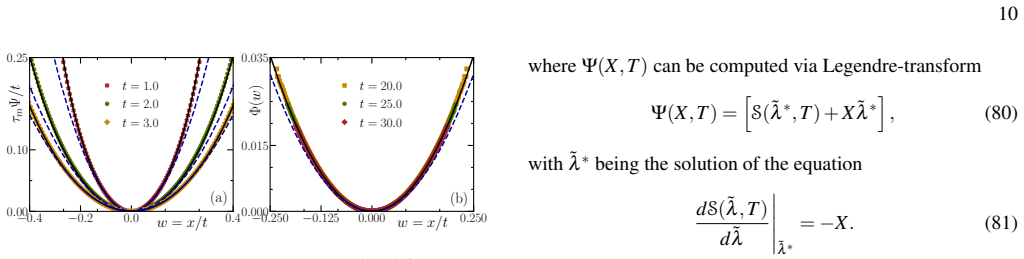
The argument is carried by three tools. First, the Fokker-Planck equations for the two noise states are recast into a recursive hierarchy for moments $M(k,n,t)=\langle x^k v^n\rangle$, whose triangular structure (each diagonal solved sequentially) yields exact lower-order correlations including the MSD. Second, a trajectory-based expansion in powers of $1/\tau_a$, counting zero, one, or more tumbling events, gives the short-time position distribution; effective mappings reduce the intermediate regimes to known exactly solvable processes (an overdamped RTP for $\tau_m\ll t\ll\tau_a$, and a dichotomous acceleration process for $\tau_a\ll t\ll\tau_m$). Third, the long-time regime is handled by coarse-graining the dichotomous noise over time windows much longer than $\tau_a$, which yields an effective noise with large deviation function $S(w)=1-\sqrt{1-w^2}$, and the position LDF follows from a saddle-point evaluation and Legendre transform. The survival-probability results rely on known persistence exponents of the random acceleration process together with a scale-invariance ansatz.
What would settle it
Simulate the inertia-dominated case with $m$, $\gamma$, and $x_0$ varied independently over at least two decades and check whether $Q(t)m^{-1/12}t^{1/4}$ is flat in the intermediate window and whether all curves collapse as $F_m(t/\tau_m)$; a systematic drift or a different best-fit exponent falsifies Eq. (88), while measuring $P(x,t)$ for several masses should confirm the $m$-independent LDF $\Phi(w)=1-\sqrt{1-w^2}$ at long times.
Extended reading notes
Core claim
On its own terms, the central discovery is that adding inertia to a run-and-tumble particle does not merely smooth the overdamped picture; it creates a qualitatively richer set of scaling laws. The MSD is computed exactly from a recursive moment hierarchy and crosses $t^4$ (short-time ballistic), then either $t^2$ (activity-dominated intermediate regime $\tau_m\ll t\ll\tau_a$) or $t^3$ (inertia-dominated intermediate regime $\tau_a\ll t\ll\tau_m$), before reaching normal diffusion $2D_{\mathrm{eff}}t$ with $D_{\mathrm{eff}}=a_0^2\tau_a/(2\gamma^2)$. The corresponding position distributions are obtained analytically by mapping regime R2 to an overdamped RTP and regime R3 to a dichotomous acceleration process; at long times the large deviation function is $\Phi(w)=1-\sqrt{1-w^2}$ for $w=\gamma x/(a_0 t)$, the same rate function as an overdamped RTP. The survival probability in the inertia-dominated case is claimed to obey $Q(t)=C[x_0\tau_a\gamma/(a_0\tau_m^2)]^{1/12}F_m(t/\tau_m)$, with a crossover from $t^{-1/4}$ to $t^{-1/2}$.
Load-bearing premise
The inertia-dominated survival probability is assumed to obey the scaling form $Q(t)=C[x_0\tau_a\gamma/(a_0\tau_m^2)]^{1/12}F_m(t/\tau_m)$ with the exponent $1/12$ taken from data collapse rather than derived from the equations; if that form does not hold beyond the simulated parameters, the claimed crossover and amplitude dependence are not established.
Editorial extensions
If this is right
- The exact MSD formulas imply a crossover sequence $t^4\to t^2\to t^3\to t$ when $\tau_m\ll\tau_a$, and $t^4\to t^3\to t^2\to t$ when $\tau_a\ll\tau_m$; which intermediate law is observed tells which time scale dominates.
- In the inertia-dominated intermediate regime the position distribution is confined to the light cone $x\in[-a_0t^2/m,a_0t^2/m]$ and follows the large deviation form of a dichotomous acceleration process, so measuring $P(x,t)$ there directly tests the effective mapping.
- At late times, typical fluctuations are Gaussian with $D_{\mathrm{eff}}$, while atypical fluctuations obey $\Phi(w)=1-\sqrt{1-w^2}$; the kurtosis decays as $1/t$, a signature visible in experiments.
- The survival probability in the inertia-dominated regime is predicted to cross from $t^{-1/4}$ to $t^{-1/2}$ with an amplitude depending on $m^{1/12}$ and $\gamma^{-1/4}$; this is a sharp, testable prediction.
Reading between the lines
- If the scaling ansatz of Eq. (88) holds beyond the simulated range, the crossover time from $t^{-1/4}$ to $t^{-1/2}$ in the inertia-dominated regime should shift with mass and damping in a way one can read off by matching the two power laws; a dedicated simulation scan over $\tau_a/\tau_m$ would make this quantitative.
- The equality of the late-time LDF with that of an overdamped RTP suggests the rate function is universal across inertia strengths once $x$ is scaled by $a_0t/\gamma$; one could test whether finite-$m$ corrections collapse onto $\Phi$ with a single correction exponent.
- A similar four-regime structure should appear in underdamped active Brownian particles, where the internal direction diffuses instead of tumbling; the same moment hierarchy could be adapted, and comparing the two would show which features are universal to inertial active motion.
Editorial analysis
A structured set of objections, weighed in public.
Referee Report
Summary. This paper analyzes a one-dimensional inertial run-and-tumble particle described by m \dot v = -\gamma v + a0 \sigma(t). Starting from the Fokker-Planck equations, the authors derive exact recursions for the moments M(k,n)=<x^k v^n> and obtain closed-form expressions for <v^2>, <xv>, and <x^2>. From these they identify four dynamical regimes R1-R4 with MSD growth t^4, t^2, t^3, and t, respectively, and a late-time effective diffusion constant D_eff = a0^2 \tau_a/(2\gamma^2). The paper then computes approximate position distributions in R1 (trajectory expansion in t/\tau_a), R2 (effective overdamped RTP with a small-mass shift), R3 (dichotomous-acceleration large deviation function), and R4 (large deviation function Phi(w)=1-sqrt(1-w^2) with finite-time corrections). Finally it studies survival probabilities, predicting t^{-1/2} decay in the activity-dominated case and a t^{-1/4} to t^{-1/2} crossover in the inertia-dominated case, with the empirical scaling form (88). All results are compared with numerical simulations.
Significance. The exact moment recursion in Eqs. (9)-(10) is a clean and useful result, and the explicit MSD formulas in Eqs. (20)-(22) reproduce the four regimes with no adjustable parameters. The R4 large deviation calculation is a nontrivial analytic derivation that matches the simulations, and the R1/R2/R3 distribution computations correctly reduce to known overdamped or force-free limits. The paper is honest about using simulations for the inertia-dominated survival scaling. However, the first-passage amplitude claim in Eqs. (88)-(91) is not a consequence of the equations of motion and is inconsistent with the random-acceleration scaling of regime R3, so the persistence section requires substantive revision before the paper can be accepted.
major comments (2)
- [Sec. VI, Eqs. (88)-(91)] The scaling form (88) is not consistent with the dynamics in regime R3. For \tau_a << t << \tau_m, Eq. (58) reduces to m x¨ ≈ a0 \sigma(t), and for t >> \tau_a the dichotomous acceleration is effectively white noise with <\xi(t)\xi(t')> = 2D\delta(t-t'), where D = a0^2 \tau_a/(2m^2). Scale invariance of this random-acceleration process forces Q(t) = F(x0/(\sqrt{D} t^{3/2})); with the known persistence exponent 1/4, this gives Q(t) ~ C x0^{1/6} D^{-1/12} t^{-1/4} ∝ m^{1/6} t^{-1/4} at fixed \gamma. This contradicts Eq. (90), which predicts Q ~ m^{1/12} t^{-1/4}; the m and x0 exponents both differ by a factor of two. In addition, Eq. (90) is unphysical in the limit m → ∞ at fixed t: A = x0\tau_a\gamma/(a0\tau_m^2) vanishes but F_m ~ (t/\tau_m)^{-1/4} ∝ m^{1/4}, so the right-hand side grows as m^{1/12} and would exceed unity, whereas the exact displacement vanishes and Q → 1. The data collapse in Fig. 12(b) spans only m = 10, 15, 20, a factor of two in m, where m^{1/12} and m^{1/6} are too close to distinguish. Since the 1/12 exponent is read off from that collapse rather than derived, the claims in Eqs. (88)-(91) are not established; the authors should derive the correct scaling from Eq. (58) or restrict the claims to the persistence exponents.
- [Sec. V D, Eqs. (63)-(84)] The coarse-graining derivation of the long-time large deviation function is performed under the explicit assumption \alpha = \tau_a/\tau_m << 1, i.e., \tau_a << \tau_m, but the claimed result (62) is stated for the full regime R4, t >> max(\tau_m, \tau_a). For the complementary ordering \tau_m << \tau_a the coarse-graining argument does not apply. The final LDF is the same as that of the overdamped RTP, so the result is plausible, but the paper should either supply the argument for the activity-dominated branch or explicitly restrict the derivation; otherwise the theoretical scope of Eq. (84) is narrower than the text claims.
minor comments (5)
- [Sec. III, after Eq. (19)] The sentence says the d=2 diagonal equations are solved starting from M(2,0,t), but the coupled structure requires solving M(0,2,t) first; please correct the displayed equation or the solution order.
- [Sec. VI] Please specify the initial velocity and initial orientation \sigma when the particle starts at x0; the scaling forms (86) and (88) and the simulations in Fig. 11 are otherwise under-specified.
- [Fig. 12] The y-axis labels in Fig. 12 are ambiguous in the current rendering; please ensure that the exponents shown (e.g., m^{1/6} versus m^{1/12} or m^{-1/12}) match the claimed collapse variables.
- [Title page] The header contains a typo: 'Run-and-T umble Particle' should read 'Run-and-Tumble Particle'.
- [Eq. (88)] The dimensionless combination A = x0\tau_a\gamma/(a0\tau_m^2) is introduced without explanation; a short scaling argument or a comment on its physical origin would help the reader understand why this particular combination is chosen.
Circularity Check
Persistence amplitude in Eq. (88) is inferred from a data collapse rather than derived, while the central MSD and large-deviation derivations are independent.
-
fitted input called prediction
[Section VI, Eqs. (88) and (90)]
"Using data from numerical simulations, we illustrate this crossover behaviour in Fig. 12(a) for fixedm and in Fig. 12(b) for fixed γ. The excellent data collapse observed in these figures for the particular choices of the scaled variables indicates the following scaling form for the survival probability in the inertia dominated case (τa ≪ τm), Q(t) = C ( x0 τa γ/(a0 τ^2_m) )^{1/12} F_m(t/τm), (88)"
The exponent 1/12 is not obtained from the equations of motion; the quoted text states that the data collapse in Fig. 12 'indicates' the scaling form. Equation (90), Q(t) ∼ m^{1/12} t^{-1/4}, is then obtained by substituting the small-u behavior F_m(u) ∼ u^{-1/4} into this empirically fitted form and is presented as the inertia-dominated persistence result. Thus the m^{1/12} amplitude is an input extracted from the simulation collapse and renamed as an output, so it cannot independently confirm the claimed crossover. The t^{-1/4} exponent itself is imported from the known random-acceleration process and is not circular; only the amplitude scaling is affected.
full rationale
The main derivations are self-contained and do not reduce to their inputs by construction. The MSD results follow from solving the exact recursive moment equations, and the short-time, activity-dominated, inertia-dominated, and long-time position distributions are obtained either from exact trajectory sums, legitimate coarse-graining, or known external results (e.g., the random-acceleration LDF from Ref. 41 and the overdamped RTP distribution from Ref. 13). Although several cited results come from papers with overlapping authorship (Refs. 13, 36, 37, 40), these are standard published exact results and are supplemented by independent references; self-citation is not load-bearing. The long-time LDF is genuinely derived by a saddle-point contraction of the coarse-grained noise, and the paper explicitly notes that the final Φ(w) equals the overdamped RTP LDF, as expected. The only significant circularity burden is in the first-passage section: the 1/12 exponent in Eq. (88) is inferred from a data collapse and then used to state Eq. (90), so the m^{1/12} amplitude is a fitted input presented as a result. This affects a secondary amplitude claim rather than the central regime classification or LDF computations, so a moderate score of 4 is appropriate.
Assumptions & free parameters
free parameters (1)
- Persistence amplitude exponent 1/12 =
1/12
assumptions (4)
- domain assumption Dichotomous noise σ(t) switches between ±1 at constant rate 1/τa, independent of x and v.
- ad hoc to paper In regime R2, terms of O(τm^2) are neglected in the effective equation for x(t), assuming x¨ is bounded.
- domain assumption In regime R4, the coarse-grained noises σ̄_i become statistically independent for α/Δs << 1, with LDF S(w)=1-sqrt(1-w^2).
- ad hoc to paper Survival probability in the inertia-dominated case obeys the scaling form Eq. (88) with exponent 1/12.
Cite this review
Pith. "Pith review of Inertial Dynamics of Run-and-Tumble Particle." pith.science (2026). https://pith.science/paper/W4E6ILHO
@misc{pith2026241119186,
  author       = {Pith},
  title        = {Pith review of: Inertial Dynamics of Run-and-Tumble Particle},
  year         = {2026},
  howpublished = {\url{https://pith.science/paper/W4E6ILHO}},
  note         = {Machine review of arXiv:2411.19186}
}
read the original abstract
We study the dynamics of a single inertial run-and-tumble particle on a straight line. The motion of this particle is characterized by two intrinsic time-scales, namely, an inertial and an active time-scale. We show that interplay of these two time-scales leads to the emergence of four distinct regimes, characterized by different dynamical behaviour of mean-squared displacement and survival probability. We analytically compute the position distributions in these regimes when the two time-scales are well separated. We show that in the large-time limit, the distribution has a large deviation form and compute the corresponding large deviation function analytically. We also find the persistence exponents in the different regimes theoretically. All our results are supported with numerical simulations.
Figures


Figures from the paper (6 more)



Forward citations
Cited by 2 Pith papers
-
Mean first-passage time at the origin of a run-and-tumble particle with periodic forces
For a run-and-tumble particle on a half-line with a periodic, subcritical force, the paper derives the exit probability and conditional mean first-passage time to the origin, with an integral criterion J(a)≤0 for almo...
-
Nonequilibrium steady state of Brownian motion in an intermittent potential
For a Brownian particle in a rapidly switching intermittent trap, the far-tail distribution is a universal exponential and periodic traps show a first-order dynamical phase transition without drift.
Reference graph
Works this paper leans on
-
[1]
merlin.mbs apsrev4-1.bst 2010-07-25 4.21a (PWD, AO, DPC) hacked
FUNCTION id.bst "merlin.mbs apsrev4-1.bst 2010-07-25 4.21a (PWD, AO, DPC) hacked" ENTRY address archive archivePrefix author bookaddress booktitle chapter collaboration doi edition editor eid eprint howpublished institution isbn issn journal key language month note number organization pages primaryClass publisher school SLACcitation series title translati...
2010
-
[2]
" * write output.state after.block = add.period write newline
ENTRY address archive author booktitle chapter collaboration edition editor eid eprint howpublished institution isbn issn journal key month note number numpages organization pages publisher school series title type url volume year issue section epilog volumetitle transjournal transsection transvolume transnumber transissue transpages transyear label FUNCT...
-
[3]
write newline
" write newline "" before.all 'output.state := FUNCTION n.dashify 't := "" t empty not t #1 #1 substring "-" = t #1 #2 substring "--" = not "--" * t #2 global.max substring 't := t #1 #1 substring "-" = "-" * t #2 global.max substring 't := while if t #1 #1 substring * t #2 global.max substring 't := if while FUNCTION word.in bbl.in " " * FUNCTION format....
-
[4]
author author O. Dauchot \ and\ author V. D\'emery ,\ 10.1103/PhysRevLett.122.068002 journal journal Phys. Rev. Lett. \ volume 122 ,\ pages 068002 ( year 2019 ) NoStop
-
[5]
author author A. Cavagna \ and\ author I. Giardina ,\ https://doi.org/10.1146/annurev-conmatphys-031113-133834 journal journal Annu. Rev. Condens. Matter Phys. \ volume 5 ,\ pages 183 ( year 2014 ) NoStop
-
[6]
author author O. Feinerman , author I. Pinkoviezky , author A. Gelblum , author E. Fonio , \ and\ author N. S. \ Gov ,\ https://doi.org/10.1038/s41567-018-0107-y journal journal Nat. Phys. \ volume 14 ,\ pages 683 ( year 2018 ) NoStop
-
[7]
author author D. S. \ Pavlov \ and\ author A. O. \ Kasumyan ,\ @noop journal journal J. Ichthyol. \ volume 40 ,\ pages S163 ( year 2000 ) NoStop
work page 2000
-
[8]
author author H. Mukundarajan , author T. C. \ Bardon , author D. H. \ Kim , \ and\ author M. Prakash ,\ 10.1242/jeb.127829 journal journal J. Exp. Biol. \ volume 219 ,\ pages 752 ( year 2016 ) NoStop
Show all 50 references
-
[9]
Jiang \ and\ editor S
editor S. Jiang \ and\ editor S. Granick ,\ eds.,\ https://doi.org/10.1039/9781849735100 title Janus Particle Synthesis, Self-assembly and Applications \ ( publisher Royal Society of Chemistry ,\ year 2012 ) NoStop
2012 doi
-
[10]
Bechinger , author R
author author C. Bechinger , author R. Di Leonardo , author H. L\"owen , author C. Reichhardt , author G. Volpe , \ and\ author G. Volpe ,\ 10.1103/RevModPhys.88.045006 journal journal Rev. Mod. Phys. \ volume 88 ,\ pages 045006 ( year 2016 ) NoStop
-
[11]
Walther \ and\ author A
author author A. Walther \ and\ author A. H. \ Muller ,\ 10.1021/cr300089t journal journal Chem. Rev. \ volume 113 ,\ pages 5194 ( year 2013 ) NoStop
2013 doi
-
[12]
author author B. J. \ Nelson , author I. K. \ Kaliakatsos , \ and\ author J. J. \ Abbott ,\ 10.1146/annurev-bioeng-010510-103409 journal journal Annu. Rev. Biomed. \ volume 12 ,\ pages 55 ( year 2010 ) NoStop
2010 doi
-
[13]
author author J. R. \ Howse , author R. A. \ Jones , author A. J. \ Ryan , author T. Gough , author R. Vafabakhsh , \ and\ author R. Golestanian ,\ https://doi.org/10.1103/PhysRevLett.99.048102 journal journal Phys. Rev. Lett. \ volume 99 ,\ pages 048102 ( year 2007 ) NoStop
-
[14]
Basu , author S
author author U. Basu , author S. N. \ Majumdar , author A. Rosso , \ and\ author G. Schehr ,\ https://doi.org/10.1103/PhysRevE.98.062121 journal journal Phys. Rev. E \ volume 98 ,\ pages 062121 ( year 2018 ) NoStop
2018 doi
-
[15]
Tailleur \ and\ author M
author author J. Tailleur \ and\ author M. E. \ Cates ,\ https://doi.org/10.1103/PhysRevLett.100.218103 journal journal Phys. Rev. Lett. \ volume 100 ,\ pages 218103 ( year 2008 ) NoStop
2008 doi
-
[16]
Malakar , author V
author author K. Malakar , author V. Jemseena , author A. Kundu , author K. V. \ Kumar , author S. Sabhapandit , author S. N. \ Majumdar , author S. Redner , \ and\ author A. Dhar ,\ 10.1088/1742-5468/aab84f journal journal J. Stat. Mech.: Theory Exp. \ volume 2018 ,\ pages 04...
-
[17]
author author L. L. \ Bonilla ,\ https://doi.org/10.1103/PhysRevE.100.022601 journal journal Phys. Rev. E \ volume 100 ,\ pages 022601 ( year 2019 ) NoStop
2019 doi
-
[18]
Martin , author J
author author D. Martin , author J. O'Byrne , author M. E. \ Cates , author \'E . Fodor , author C. Nardini , author J. Tailleur , \ and\ author F. Van Wijland ,\ https://doi.org/10.1103/PhysRevE.103.032607 journal journal Phys. Rev. E \ volume 103 ,\ pages 032607 ( year 2021 ) NoStop
-
[19]
Mandal , author B
author author S. Mandal , author B. Liebchen , \ and\ author H. L \"o wen ,\ https://doi.org/10.1103/PhysRevLett.123.228001 journal journal Phys. Rev. Lett. \ volume 123 ,\ pages 228001 ( year 2019 ) NoStop
2019 doi
-
[20]
Su , author H
author author J. Su , author H. Jiang , \ and\ author Z. Hou ,\ 10.1088/1367-2630/abd80a journal journal New J. Phys. \ volume 23 ,\ pages 013005 ( year 2021 ) NoStop
2021 doi
-
[21]
Negro , author C
author author G. Negro , author C. B. \ Caporusso , author P. Digregorio , author G. Gonnella , author A. Lamura , \ and\ author A. Suma ,\ 10.1140/epje/s10189-022-00230-1 journal journal Eur. Phys. J. E \ volume 45 ,\ pages 75 ( year 2022 ) NoStop
-
[22]
De Karmakar \ and\ author R
author author S. De Karmakar \ and\ author R. Ganesh ,\ https://doi.org/10.1103/PhysRevE.101.032121 journal journal Phys. Rev. E \ volume 101 ,\ pages 032121 ( year 2020 ) NoStop
2020 doi
-
[23]
\ Liao , author F.-j
author author J.-j. \ Liao , author F.-j. \ Lin , \ and\ author B.-q. \ Ai ,\ 10.1016/j.physa.2022.128312 journal journal Phys. A: Stat. Mech. Appl. \ volume 582 ,\ pages 126251 ( year 2021 ) NoStop
2022
-
[24]
author author U. M. B. \ Marconi , author L. Caprini , \ and\ author A. Puglisi ,\ 10.1088/1367-2630/ac2b54 journal journal New J. Phys. \ volume 23 ,\ pages 103024 ( year 2021 ) NoStop
2021 doi
-
[25]
Caprini , author C
author author L. Caprini , author C. Maggi , \ and\ author U. Marini Bettolo Marconi ,\ https://doi.org/10.1063/5.0051315 journal journal J. Chem. Phys. \ volume 154 ( year 2021 ),\ https://doi.org/10.1063/5.0051315 NoStop
2021 doi
-
[26]
Caprini \ and\ author U
author author L. Caprini \ and\ author U. M. B. \ Marconi ,\ 10.1039/D0SM02273J journal journal Soft Matter \ volume 17 ,\ pages 4109 ( year 2021 ) NoStop
2021 doi
-
[27]
author author S. S. \ Khali , author F. Peruani , \ and\ author D. Chaudhuri ,\ https://doi.org/10.1103/PhysRevE.109.024120 journal journal Phys. Rev. E \ volume 109 ,\ pages 024120 ( year 2024 ) NoStop
2024 doi
-
[28]
Patel \ and\ author D
author author M. Patel \ and\ author D. Chaudhuri ,\ 10.1088/1367-2630/ad1538 journal journal New J. Phys. \ volume 25 ,\ pages 123048 ( year 2023 ) NoStop
2023 doi
-
[29]
Patel \ and\ author D
author author M. Patel \ and\ author D. Chaudhuri ,\ 10.1088/1367-2630/ad6349 journal journal New J. Phys. \ volume 26 ,\ pages 073048 ( year 2024 ) NoStop
2024 doi
-
[30]
author author A. R. \ Sprenger , author L. Caprini , author H. L \"o wen , \ and\ author R. Wittmann ,\ 10.1088/1361-648X/accd36 journal journal J. Phys. Condens. Matter \ volume 35 ,\ pages 305101 ( year 2023 ) NoStop
2023 doi
-
[31]
Scholz , author S
author author C. Scholz , author S. Jahanshahi , author A. Ldov , \ and\ author H. L \"o wen ,\ https://doi.org/10.1038/s41467-018-07596-x journal journal Nat. Commun. \ volume 9 ,\ pages 5156 ( year 2018 ) NoStop
2018 doi
-
[32]
Breoni , author M
author author D. Breoni , author M. Schmiedeberg , \ and\ author H. L \"o wen ,\ https://doi.org/10.1103/PhysRevE.102.062604 journal journal Phys. Rev. E \ volume 102 ,\ pages 062604 ( year 2020 ) NoStop
2020 doi
-
[33]
Lisin , author O
author author E. Lisin , author O. Vaulina , author I. Lisina , \ and\ author O. Petrov ,\ https://doi.org/10.1039/D2CP01313D journal journal Phys. Chem. Chem. Phys. \ volume 24 ,\ pages 14150 ( year 2022 ) NoStop
2022 doi
-
[34]
Caprini \ and\ author U
author author L. Caprini \ and\ author U. Marini Bettolo Marconi ,\ 10.1063/5.0030940 journal journal J. Chem. Phys. \ volume 154 ( year 2021 ),\ 10.1063/5.0030940 NoStop
2021 doi
-
[35]
Muhsin \ and\ author M
author author M. Muhsin \ and\ author M. Sahoo ,\ https://doi.org/10.1103/PhysRevE.106.014605 journal journal Phys. Rev. E \ volume 106 ,\ pages 014605 ( year 2022 ) NoStop
2022 doi
-
[36]
author author A. P. \ Antonov , author L. Caprini , author C. Scholz , \ and\ author H. L \"o wen ,\ @noop journal arXiv:2404.06615 \ NoStop
-
[37]
Adersh , author M
journal author author F. Adersh , author M. Muhsin , \ and\ author M. Sahoo ,\ 10.1140/epje/s10189-024-00424-9 journal journal Eur. Phys. J. E \ volume 47 ,\ pages 33 ( year 2024 ) NoStop
2024 doi
-
[38]
Dutta , author A
author author D. Dutta , author A. Kundu , author S. Sabhapandit , \ and\ author U. Basu ,\ https://doi.org/10.1103/PhysRevE.110.044107 journal journal Phys. Rev. E \ volume 110 ,\ pages 044107 ( year 2024 ) NoStop
2024 doi
-
[39]
Santra , author D
author author I. Santra , author D. Ajgaonkar , \ and\ author U. Basu ,\ 10.1088/1742-5468/ace3b5 journal journal J. Stat. Mech.: Theory Exp. \ volume 2023 ,\ pages 083201 ( year 2023 ) NoStop
2023 doi
-
[40]
Dhar , author A
author author A. Dhar , author A. Kundu , author S. N. \ Majumdar , author S. Sabhapandit , \ and\ author G. Schehr ,\ https://doi.org/10.1103/PhysRevE.99.032132 journal journal Phys. Rev. E \ volume 99 ,\ pages 032132 ( year 2019 ) NoStop
-
[41]
Frydel ,\ https://doi.org/10.1063/5.0173374 journal journal Physics of Fluids \ volume 35 ( year 2023 ),\ https://doi.org/10.1063/5.0173374 NoStop
author author D. Frydel ,\ https://doi.org/10.1063/5.0173374 journal journal Physics of Fluids \ volume 35 ( year 2023 ),\ https://doi.org/10.1063/5.0173374 NoStop
2023 doi
-
[42]
DLMF ,\ https://dlmf.nist.gov/ title NIST Digital Library of Mathematical Functions , \ howpublished https://dlmf.nist.gov/, Release 1.2.0 of 2024-03-15 ,\ note f. W. J. Olver, A. B. Olde Daalhuis , D. W. Lozier, B. I. Schneider, R. F. Boisvert, C. W. Clark, B. R. Miller, B. V...
2024
-
[43]
Santra , author U
author author I. Santra , author U. Basu , \ and\ author S. Sabhapandit ,\ https://doi.org/10.1103/PhysRevE.104.L012601 journal journal Phys. Rev. E \ volume 104 ,\ pages L012601 ( year 2021 ) NoStop
2021 doi
-
[44]
author author D. S. \ Dean , author S. N. \ Majumdar , \ and\ author H. Schawe ,\ https://doi.org/10.1103/PhysRevE.103.012130 journal journal Phys. Rev. E \ volume 103 ,\ pages 012130 ( year 2021 ) NoStop
2021 doi
-
[45]
author author N. R. \ Smith \ and\ author O. Farago ,\ https://doi.org/10.1103/PhysRevE.106.054118 journal journal Phys. Rev. E \ volume 106 ,\ pages 054118 ( year 2022 ) NoStop
2022 doi
-
[46]
author author T. W. \ Burkhardt ,\ 10.1088/1742-5468/2007/07/P07004 journal journal J. Stat. Mech.: Theory Exp. \ volume 2007 ,\ pages P07004 ( year 2007 ) NoStop
2007 doi
-
[47]
author author S. N. \ Majumdar , author A. Rosso , \ and\ author A. Zoia ,\ @noop journal journal J. Phys. A-Math. \ volume 43 ,\ pages 115001 ( year 2010 ) NoStop
2010
-
[48]
author author T. W. \ Marshall \ and\ author E. J. \ Watson ,\ 10.1088/0305-4470/18/18/016 journal journal Journal of Physics A: Mathematical and General \ volume 18 ,\ pages 3531 ( year 1985 ) NoStop
1985 doi
-
[49]
author author T. W. \ Burkhardt ,\ in\ https://doi.org/10.1142/9789814590297_0002 booktitle First-passage phenomena and their applications \ ( publisher World Scientific ,\ year 2014 )\ pp.\ pages 21--44 NoStop
2014 doi
-
[50]
H \"a nggi \ and\ author P
author author P. H \"a nggi \ and\ author P. Jung ,\ https://doi.org/10.1002/9780470141489.ch4 journal journal Adv. Chem. Phys. \ volume 89 ,\ pages 239 ( year 1994 ) NoStop
1994 doi
Reviewed August 12, 2026 · model on record in the stance chip above.
Discussion (0). Continue with ORCID to comment.