REVIEW 5 major objections 6 minor 1 cited by
Detecting Memorization in Large Language Models
T0 review · 5 major / 6 minor · reviewed 2026-08-12 · deepseek-v4-flash
Pith's one-line read A single neuron activation in a large language model marks memorized text with 99.9% accuracy, and suppressing that same direction disables the memorization.
desk verdict Circular labeling undermines the 99.9% memorization detection claim, but the underlying single-neuron observation is worth a closer look. read the letter →
The pith
A machine-rendered reading of the paper's core claim, the machinery that carries it, and where it could break.
The reading
What carries the argument
The central object is a classification probe trained on neuron activations, together with a labeling pipeline that makes large-scale training possible. The pipeline starts with a small, balanced corpus of 100 memorized and 100 matched non-memorized samples, uses Cohen's d to rank activations, picks activation 1857 in the MLP at layer 10 as a reliable labeler, and thresholds its values over at least ten consecutive tokens to generate one million labels per class from SlimPajama. Probes are linear or two-layer ReLU classifiers over activations at each layer. For intervention, the same probe weights define a direction in activation space; subtracting $\alpha$ times the squared projection of the activation vector onto that normalized direction attenuates the mechanism, with $\alpha$ chosen per layer by a genetic algorithm.
What would settle it
Run the trained probe on a held-out set where memorized and not-memorized texts are matched for genre, length, and style and labelled by an independent method such as known contamination of the training set; if accuracy falls well below 99.9%—or if intervening on the activation also suppresses ordinary high-confidence facts, quotes, and disclaimers—the feature is encoding certainty or genre, not memorization.
Extended reading notes
Core claim
On its own terms, the paper demonstrates that the Pythia 1B model develops a dedicated internal feature for memorized text. Using 100 manually selected memorized samples and matched non-memorized samples, the author ranks neuron activations by Cohen's d and finds that activation 1857 in MLP layer 10 separates the two classes almost perfectly. That activation is then used to label one million memorized and one million non-memorized tokens from SlimPajama, and linear and two-layer probes trained on these labels reach 99.9% accuracy, including on a curated same-distribution test set. The same procedure yields near-perfect detection of repetition. Finally, subtracting a scaled squared projection of the activations onto the probe weight direction pushes the loss of memorized sequences up to the level of non-memorized ones, which the paper reads as evidence that the detected feature is causal, not merely correlational.
Load-bearing premise
The load-bearing premise is that the manually chosen memorized examples and the one-million-token labels produced by thresholding one activation genuinely capture memorization rather than confidence, genre, or the author's selection bias.
Editorial extensions
If this is right
- Memorized tokens in Pythia 1B can be identified at the token level with 99.9% accuracy before the model outputs anything, using internal activations alone.
- The same activation-based pipeline detects repetition with near-perfect accuracy, including repetition that is not word-for-word identical, such as URLs derived from titles.
- Intervening on the memorization direction raises the loss of memorized sequences to match non-memorized ones while leaving non-memorized loss essentially unchanged; repetition is weakened but not fully removed.
- The method supports labeling millions of tokens automatically, which the paper proposes as a route to better training-data selection and more reliable evaluation.
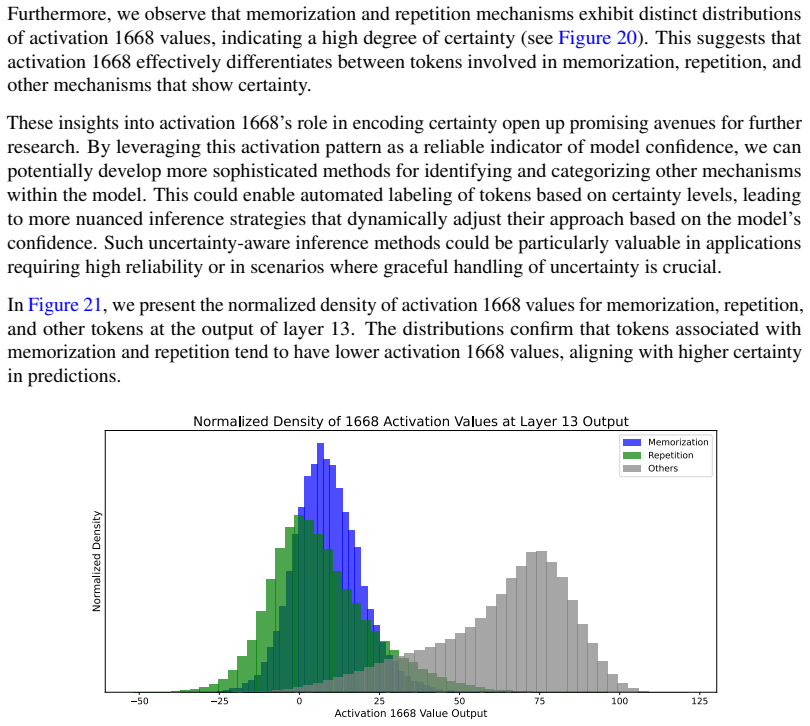
- A separate activation, 1668, encodes certainty and correlates with top-1 prediction probability, suggesting a general axis linking memorization, repetition, and confidence.
Reading between the lines
- The paper only demonstrates the direction in Pythia 1B; if the feature is architecture-specific, each new model would need its own discovery pass rather than a transferable probe.
- The 'tug-of-war' between memorization and repetition probes suggests both mechanisms compete for a shared certainty-related resource; an intervention on one may strengthen the other, which the paper observes but does not fully explain.
- Because calls to action and disclaimers are flagged as memorized and then manually set aside, a practical data-cleaning use of the probe would need a second-stage filter to avoid removing boilerplate rather than memorized content.
- A direct extension would be to test the same probe on factual-knowledge sentences: if suppressing memorization also degrades accurate fact recall, the line between memorized data and learned knowledge is not as clean as the binary labels assume.
Editorial analysis
A structured set of objections, weighed in public.
Referee Report
Summary. The paper proposes to detect memorization in LLMs by training linear and two-layer classification probes on neuron activations, after first identifying highly separable activations between manually labeled memorized and not-memorized tokens. The authors report 99.9% classification accuracy, extend the method to repetition detection, and show that intervening on probe directions can suppress memorization while leaving other behavior largely intact. The method is demonstrated on Pythia 1B, with large-scale labeling of SlimPajama tokens and a series of perturbation and interpretability analyses. The central claim is that activation 1857 in MLP layer 10, and the probes trained on it, both detect and causally control memorization.
Significance. If the central claims were valid, the paper would offer a practical and interpretable tool for detecting and intervening on memorization in LLMs, with potential applications to data curation and evaluation integrity. The idea of using activation-based separation to label large corpora is interesting and could be valuable. However, the paper does not establish that the detected signal is memorization rather than confidence, text genre, or template structure. The main accuracy number is computed against labels generated by thresholding the very activation used to train the probes, so the reported 99.9% accuracy is self-consistency rather than validation against independent ground truth. The intervention results are also measured against an objective that the genetic algorithm directly optimizes. Without independent ground-truth labels and out-of-distribution validation, the paper's contributions are not supported as stated. The paper also contains no code or data release, which limits reproducibility and further weakens the empirical claims.
major comments (5)
- [§3.1 (Part 2, step 2) and §4] The one million memorized/not-memorized labels used to train the probes are generated by thresholding activation 1857 in MLP layer 10, and the probes are then trained and evaluated on the same labeling procedure. The validation set is described as 'derived from the same dataset used for training the probe,' so the 99.9% accuracy reported in Figures 7 and 8 demonstrates only that a probe can recover the thresholding rule already present in its labels. This is a circular evaluation and does not establish detection of an independent ground truth. The authors should validate on a held-out set of tokens whose memorization status is determined by an independent criterion, such as membership in known training data or human-verified verbatim extraction.
- [§3.1 (Part 1, step 1) and §8] The initial 100 memorized samples are selected by the author's judgment that the model produces 'very high confidence' predictions on the correct token. Section 8 shows that a separate activation (1668) encodes certainty and separates memorization, repetition, and other high-confidence mechanisms. This raises the concern that the manually labeled ground truth tracks confidence, text genre, or template structure rather than memorization specifically. The authors should demonstrate that the high-confidence criterion is a valid proxy for memorization by showing, for example, that the selected samples appear verbatim in the training data and that low-confidence but memorized samples are rare or handled explicitly.
- [§7 and Figure 17] The intervention experiment optimizes, via a genetic algorithm, the objective of raising the loss of memorized sequences to match that of not-memorized sequences while keeping not-memorized loss unchanged. Figure 17 then reports that this objective is achieved. This is circular: the intervention is tuned to produce exactly the reported effect. The claim that memorization is 'completely disabled while keeping all other mechanisms intact' is not supported by loss measurements alone, and the only qualitative example is a single anecdotal case. The authors should evaluate intervention effects on independent downstream tasks, perplexity on diverse corpora, and specific memorized samples not used during optimization, and they should report variability across samples.
- [§6 and Table 1] The manual analysis of 1,000 high-loss sequences classified as memorized reports 10.6% 'Calls to action' and 7.4% 'Disclaimers' as misclassifications, plus 2.8% 'Others' where no reason could be ascertained. This directly contradicts the claim of near-perfect memorization detection, because these categories are not memorized in the traditional sense. The percentages are presented without counts, error bars, or inter-annotator agreement. The authors should either quantify the probe's precision on a balanced, independently labeled sample or revise the claim to acknowledge systematic false positives on templated language.
- [§11] The Limitations section concedes that 'the mechanisms identified by our probes might encompass more than just memorization or repetition' and that the probes may capture additional internal processes. This admission, combined with the circular labeling and the certainty mechanism documented in Section 8, means that the paper does not establish that the probes isolate memorization as opposed to a broader class of high-confidence or template-based predictions. The central conclusion should be tempered or the probes should be validated against a ground truth that distinguishes memorization from these other processes.
minor comments (6)
- [Throughout] The notation is inconsistent between 'neuron 6181' and 'activation 6181' and between 'activation 1668' and 'neuron 1668'; the authors should choose one term and use it consistently.
- [Equation (1)] The equation for Cohen's d contains a typesetting artifact ('Cohen ′s d') that should be fixed, and the pooled standard deviation formula should be checked for correctness.
- [§4 and Figure 9] The curated dataset evaluation is described as balanced and same-distribution, but no details are given about its size, composition, or how the same-distribution requirement was operationalized. This makes it difficult to interpret the near-100% accuracy claim.
- [§3.1 (Part 2, step 2)] The threshold for 'memorized' activation values is not specified; the paper should report the threshold value, the fraction of tokens that pass it, and the stability of the resulting labels to threshold choice.
- [§7] The genetic algorithm for choosing intervention scales is described only briefly; the authors should specify the objective function, the search space, the number of generations, and whether the same intervention parameters generalize to held-out sequences.
- [References] Several references are cited with incomplete bibliographic details (e.g., Carlini et al. 2020, Meng et al. 2022, Soboleva et al. 2023), and the Durmus et al. reference is not in a standard archival format; these should be completed.
Circularity Check
The 99.9% accuracy claim is self-consistency because the probe labels are thresholds on the very activation the probe learns, and the intervention optimizes the same loss gap it reports as success.
-
self definitional
[Section 3.1, Part 1, step 1 (Gathering Memorized Samples)]
"We manually tested each sample on the LLM and retained those that were memorized, indicated by a very high confidence level on the correct predictions."
The manual ground truth defines memorization by high-confidence correct predictions, i.e., by output certainty. Section 8 then reports that activation 1668 encodes certainty and that memorization and repetition tokens are concentrated in the high-certainty regime. Any activation tracking confidence therefore separates the two classes, so the 'memorized' label is not independent of the confidence mechanism the paper later identifies; the claim that a memorization-specific feature was found is not established by the labeling rule.
-
fitted input called prediction
[Section 3.1, Part 2, steps 1–2 (Choosing Activations and Labeling Tokens) with Section 4]
"We identified several activations capable of performing this task and ultimately chose the one that yielded the most reliable results, activation 1857 in the MLP at layer 10. ... We processed the samples through the model and selected memorized and not memorized tokens using the following procedure: • Window Size: We employed a window size of at least 10 tokens, where all tokens had activation values within the memorized threshold. • Selecting Not Memorized Tokens: We applied the same procedure to select not memorized tokens by inverting the threshold."
The one-million-token labels used to train the probes are produced by thresholding activation 1857 in MLP layer 10, the same activation family the probes learn from. Section 4 reports 99.9% accuracy on 'a validation set derived from the same dataset used for training the probe.' A probe can reach that accuracy by rediscovering the threshold rule already embedded in its labels; the reported accuracy is label self-consistency, not detection of an independent memorization ground truth. The smaller manual labels are themselves confidence-based (step 1), so they do not break the circular loop.
1 more flagged steps
-
fitted input called prediction
[Section 7 (Intervening) and Figure 17]
"The optimization objective was to elevate the loss of memorized sequences to match that of not memorized ones, while keeping the loss of not memorized sequences unchanged. ... By intervening in the mechanism, we were able to completely disable memorization while keeping all other mechanisms intact."
The genetic algorithm is fit to minimize exactly the gap between memorized and non-memorized cross-entropy loss, and Figure 17 reports that same gap as the evidence of success. The evaluation metric is the objective function, so 'completely disable memorization' is the optimized value of the objective rather than an independent confirmation that the threshold-defined mechanism was removed. This result inherits the circularity of the activation-threshold labels used to define the memorized group.
full rationale
The central detection claim is not self-contained. The million-token labels used to train and validate the probes are generated by thresholding activation 1857 (MLP layer 10), and the validation accuracy is measured on a set 'derived from the same dataset used for training the probe.' A probe trained on activations can therefore achieve 99.9% by recovering the thresholding rule that created its labels; this is self-consistency, not independent detection of memorization. The small manually labeled set that selects activation 1857 is built on the assumption that memorization equals 'very high confidence' predictions, and Section 8 reports a separate certainty activation (1668) that separates the same classes, so the manual ground truth is not independent of the confidence mechanism being detected. Section 7's intervention uses a genetic algorithm whose objective is the same loss gap reported as success, so the 'completely disable memorization' claim is the optimized objective rather than an out-of-sample mechanistic verification. Section 11 concedes that the probes 'might encompass more than just memorization or repetition' and may capture additional internal processes. No load-bearing self-citation chain is present; the circularity is in the labeling-and-evaluation loop. Score 7.
Assumptions & free parameters
free parameters (5)
- Intervention scale alpha =
not reported; tuned per layer and activation type by a genetic algorithm
- Cohen's d threshold of 1 =
1.0
- Activation 1857 as labeling feature =
MLP layer 10, activation index 1857
- Window size for labeling =
10 tokens
- Loss clipping threshold in softened labels =
2
assumptions (5)
- domain assumption Pythia 1B activations are a representative substrate for studying memorization in LLMs.
- ad hoc to paper The manually curated memorized/not-memorized token labels in the 10,000-token corpus are correct ground truth.
- ad hoc to paper High-confidence prediction is a valid initial screen for memorization.
- ad hoc to paper Activation 1857 thresholding faithfully labels memorization in SlimPajama at scale.
- ad hoc to paper Cross-entropy loss larger than 2 indicates a token is not memorized.
invented entities (1)
-
Certainty mechanism encoded by neuron 1668
Cite this review
Pith. "Pith review of Detecting Memorization in Large Language Models." pith.science (2026). https://pith.science/paper/MTPRZJ4G
@misc{pith2026241201014,
  author       = {Pith},
  title        = {Pith review of: Detecting Memorization in Large Language Models},
  year         = {2026},
  howpublished = {\url{https://pith.science/paper/MTPRZJ4G}},
  note         = {Machine review of arXiv:2412.01014}
}
read the original abstract
Large language models (LLMs) have achieved impressive results in natural language processing but are prone to memorizing portions of their training data, which can compromise evaluation metrics, raise privacy concerns, and limit generalization. Traditional methods for detecting memorization rely on output probabilities or loss functions, often lacking precision due to confounding factors like common language patterns. In this paper, we introduce an analytical method that precisely detects memorization by examining neuron activations within the LLM. By identifying specific activation patterns that differentiate between memorized and not memorized tokens, we train classification probes that achieve near-perfect accuracy. The approach can also be applied to other mechanisms, such as repetition, as demonstrated in this study, highlighting its versatility. Intervening on these activations allows us to suppress memorization without degrading overall performance, enhancing evaluation integrity by ensuring metrics reflect genuine generalization. Additionally, our method supports large-scale labeling of tokens and sequences, crucial for next-generation AI models, improving training efficiency and results. Our findings contribute to model interpretability and offer practical tools for analyzing and controlling internal mechanisms in LLMs.
Figures


Figures from the paper (20 more)




Forward citations
Cited by 1 Pith paper
-
Spurious Rewards Paradox: Mechanistically Understanding How RLVR Activates Memorization Shortcuts in LLMs
Spurious RLVR makes Qwen2.5-Math retrieve memorized answers via a layer 18-20 anchor and layer 21+ adapters, a shortcut that can be steered by scaling specific MLP keys.
Reference graph
Works this paper leans on
-
[1]
Emergent and Predictable Memorization in Large Language Models, 2023a
Stella Biderman, USVSN Sai Prashanth, Lintang Sutawika, Hailey Schoelkopf, Quentin Anthony, Shivanshu Purohit, and Edward Raff. Emergent and Predictable Memorization in Large Language Models, 2023a. arXiv preprint. arXiv:2304.11158. Stella Biderman, Hailey Schoelkopf, Quentin Anthony, Herbie Bradley, Kyle O’Brien, Eric Hallahan, Mohammad Aflah Khan, Shiva...
-
[4]
arXiv preprint. arXiv:2311.09060. Paul Christiano, Jan Leike, Tom B. Brown, Miljan Martic, Shane Legg, and Dario Amodei. Deep reinforcement learning from human preferences,
-
[7]
arXiv preprint. arXiv:2407.17817. Pratyush Maini, Michael C. Mozer, Hanie Sedghi, Zachary C. Lipton, J. Zico Kolter, and Chiyuan Zhang. Can Neural Network Memorization Be Localized?,
-
[8]
arXiv preprint. arXiv:2307.09542. Kevin Meng, David Bau, Alex Andonian, and Yonatan Belinkov. Locating and Editing Factual Associations in GPT,
-
[10]
arXiv preprint. arXiv:2203.02155. D. Soboleva, F. Al-Khateeb, R. Myers, J. R. Steeves, J. Hestness, and N. Dey. SlimPajama: A 627B token cleaned and deduplicated version of RedPajama
-
[11]
Accessed from Cerebras. Published 2023-06-09. Nisan Stiennon, Long Ouyang, Jeff Wu, Daniel M. Ziegler, Ryan Lowe, Chelsea V oss, Alec Radford, Dario Amodei, and Paul Christiano. Learning to summarize from human feedback,
work page 2023
-
[12]
arXiv preprint. arXiv:2009.01325. 23 Appendix A Cohen’s d Distribution Plots for Memorization 24 B Classification Accuracy Using Best Activation (Cohen’s d) for Memorization 25 26 27
arXiv 2009
-
[2017]
arXiv preprint. arXiv:1706.03741. Esin Durmus, Alex Tamkin, Jack Clark, Jerry Wei, Jonathan Marcus, Joshua Batson, Kunal Handa, Liane Lovitt, Meg Tong, Miles McCain, Oliver Rausch, Saffron Huang, Sam Bowman, Stuart Ritchie, Tom Henighan, and Deep Ganguli. Evaluating Feature Steering: A Case Study in Mitigating Social Biases,
Show all 12 references
-
[2020]
arXiv:2012.07805
arXiv preprint. arXiv:2012.07805. Nicholas Carlini, Daphne Ippolito, Matthew Jagielski, Katherine Lee, Florian Tram`er, and Chiyuan Zhang. Quantifying Memorization Across Neural Language Models,
2012 arXiv
-
[2022]
arXiv:2202.05262
arXiv preprint. arXiv:2202.05262. Long Ouyang, Jeff Wu, Xu Jiang, Diogo Almeida, Carroll L. Wainwright, Pamela Mishkin, Chong Zhang, Sandhini Agarwal, Katarina Slama, Alex Ray, John Schulman, Jacob Hilton, Fraser Kelton, Luke Miller, Maddie Simens, Amanda Askell, Peter Welinde...
-
[2023]
arXiv:2202.07646
arXiv preprint. arXiv:2202.07646. Ting-Yun Chang, Jesse Thomason, and Robin Jia. Do Localization Methods Actually Localize Memorized Data in LLMs? A Tale of Two Benchmarks,
-
[2024]
Published 2024-10-25
Accessed from Anthropic Research. Published 2024-10-25. Jing Huang, Diyi Yang, and Christopher Potts. Demystifying Verbatim Memorization in Large Language Models,
2024
Reviewed August 12, 2026 · model on record in the stance chip above.
Discussion (0). Continue with ORCID to comment.