REVIEW 5 major objections 6 minor 17 references
Enhancing CLIP Conceptual Embedding through Knowledge Distillation
T0 review · 5 major / 6 minor · reviewed 2026-08-11 · deepseek-v4-flash
Pith's one-line read This paper claims that distilling Llama 2's text embeddings into CLIP, combined with k-means concept labels and contrastive alignment, improves both the text encoder's exact-match reconstruction and the image encoder's attribute…
desk verdict The text-encoder distillation clearly helps on the reconstruction task, but the image-encoder claim is confounded by the jointly modified text encoder, and the paper doesn't supply the one control that would settle it. read the letter →
The pith
A machine-rendered reading of the paper's core claim, the machinery that carries it, and where it could break.
The reading
What carries the argument
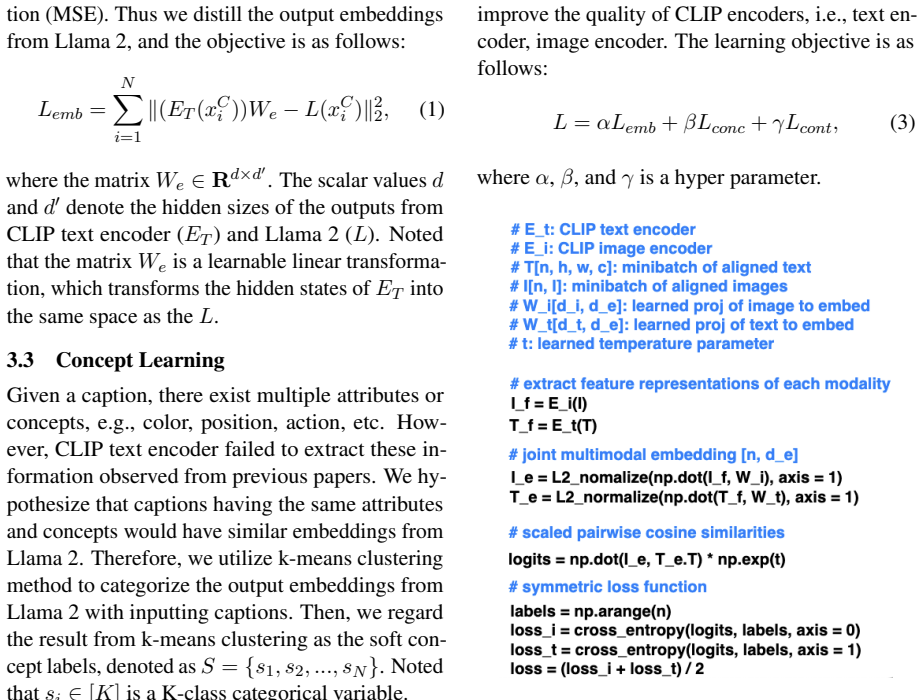
The load-bearing mechanism is the combined objective $L = \alpha L_{\text{emb}} + \beta L_{\text{conc}} + \gamma L_{\text{cont}}$. $L_{\text{emb}}$ is a mean-squared-error loss that pushes a learned linear projection of CLIP's text embedding toward Llama 2's output embedding; $L_{\text{conc}}$ is a cross-entropy loss on a frozen classifier that predicts k-means soft concept labels from the image embedding; $L_{\text{cont}}$ is CLIP's original symmetric contrastive loss. The conceptual bridge is the k-means step: clustering Llama 2 caption embeddings offline produces a discrete label for each caption-image pair, and the classifier then lets the image encoder be trained to reproduce those labels from pixels.
What would settle it
Run a random-label control: retrain Knowledge-CLIP with the same k-means concept labels randomly permuted across captions, keeping all other hyperparameters fixed. If AWA2 and CUB top-1 accuracy stay near 56.7 and 78.8, the concept-learning loss is not carrying the image-encoder gain and the central claim of transferred conceptual knowledge is falsified; if accuracy drops toward CLIP's 55.8 and 78.3 baselines, the labels are doing real work.
Extended reading notes
Core claim
Knowledge-CLIP is a fine-tuning recipe for CLIP built from three simultaneous objectives: text embedding distillation, concept learning, and contrastive learning. The distillation loss trains CLIP's text encoder, after a learnable linear projector, to match Llama 2's output embeddings with mean-squared error, transferring the LLM's more uniform and attribute-rich embedding geometry. The concept-learning loss first runs offline k-means over Llama 2 caption embeddings to produce soft concept labels for each caption-image pair, trains a classifier on those labels, then freezes it and trains the image encoder to predict the labels from images. The contrastive loss continues to align text and image embeddings. With equal weights on distillation and contrastive losses and a small weight on the concept loss, the paper reports text exact match improving from 35.8 to 44.4 on CC3M and image attribute top-1 improving from 55.8 to 56.7 on AWA2 and 78.3 to 78.8 on CUB, and concludes that both CLIP encoders are improved.
Load-bearing premise
The concept-learning branch works only if the k-means clusters of Llama 2 caption embeddings correspond to meaningful semantic attributes such as color, shape, and action; the paper's evidence is a visualization of 50 samples from a single CUB class.
Editorial extensions
If this is right
- A CLIP text encoder can be upgraded without changing its architecture by distilling an LLM embedding space through a learned linear projection.
- The offline k-means labeling makes the concept-loss branch applicable to any caption set without manual attribute annotations.
- The image encoder's attribute accuracy should improve whenever the same three-loss recipe is applied to sufficiently large paired data, with the gain concentrated on attributes the LLM embeddings already separate.
- Llama 2's more uniform embedding distribution is the property that lets the distilled text encoder represent finer sentence distinctions than CLIP's original text encoder.
Reading between the lines
- Ablating each of the three losses would reveal how much of the text gain comes from distillation versus contrastive alignment; the paper only reports the combined recipe.
- A cluster-quality measurement on all 200 CUB classes, not one class, would test whether the k-means labels encode attributes; the paper's visualization is suggestive but not quantitative.
- If the labels are valid, the same pipeline could inject LLM-derived attribute labels into other vision-language encoders or build zero-shot attribute classifiers without human annotation.
- The small image-side gains relative to the text-side gain suggest the image encoder benefits mostly indirectly, through the contrastive loss, from an improved text embedding.
Editorial analysis
A structured set of objections, weighed in public.
Referee Report
Summary. The paper proposes Knowledge-CLIP, a method to fine-tune CLIP by distilling text-embedding knowledge from Llama 2, learning soft concept labels obtained by k-means clustering of Llama 2 caption embeddings, and continuing with the CLIP contrastive objective. The training loss is a weighted sum of a text-distillation MSE term, a concept-label cross-entropy term, and a contrastive term. The authors report that the resulting text encoder improves exact-match on a CC3M reconstruction task from 35.8% (CLIP) to 44.4%, and that the image encoder improves attribute-prediction top-1 accuracy from 55.8% to 56.7% on AWA2 and from 78.3% to 78.8% on CUB, while acknowledging that the image gains are not strong.
Significance. If the central claims were established, Knowledge-CLIP would be a lightweight and practical recipe for injecting LLM-derived conceptual knowledge into CLIP without additional paired data. The method is clearly specified: the three loss terms in Eqs. (1)-(3) are simple, the experimental setup is small (500k pairs, 100 epochs), and the paper honestly reports the modest size of the image-encoder gains in Section 4.3. However, the current experimental design does not isolate the contribution of the image encoder, does not validate the k-means concept labels beyond a single qualitative figure, and does not include ablations or error bars. The central claim that both encoders are improved is therefore not yet supported by the evidence presented.
major comments (5)
- [§4.3, Table 2] The image-encoder evaluation is confounded. Knowledge-CLIP differs from CLIP in both the text encoder and the image encoder, and the AWA2/CUB prompts are encoded with the model's own text encoder. The reported +0.9 and +0.5 top-1 gains could therefore come entirely from the distilled text encoder rather than from the image encoder. A control that fixes the text encoder (for example, using the original CLIP text encoder to score both models) is required to isolate the image-encoder contribution; without it, the claim that the image encoder improves is not supported.
- [§4.2, Table 1] The text-encoder evaluation is not fully circular, but it is strongly aligned with the training objective: the reconstruction EM measures how well the student's embeddings preserve Llama-2-like information, and the student was explicitly trained to mimic Llama 2. The jump from 35.8 to 44.4 is therefore partly a fidelity check. To establish independent text-encoder quality, the paper should include a benchmark that is not defined by similarity to the teacher, such as a compositional text-retrieval or attribute-prediction task using the text encoder alone.
- [§3.3, §5.2] The concept-learning objective rests on the assumption that k-means clusters of Llama 2 caption embeddings correspond to interpretable semantic attributes such as color, shape, and action. The only support is a qualitative visualization of 50 samples from one CUB class. If the cluster labels are arbitrary, training the image encoder with Lconc cannot transfer to attribute recognition. The paper needs a quantitative cluster-attribute correspondence measure, or an ablation showing that Lconc contributes beyond Lemb and Lcont.
- [§3.5, §4.1] No ablation isolates the three loss terms, and no sensitivity analysis is reported for the hyperparameters alpha, beta, gamma, and K. Because the contrastive loss Lcont is a continuation of the original CLIP objective on a 500k subset, the small image gains could be explained by additional fine-tuning alone. The authors should report results for each loss term removed, and for reasonable variations of beta and K, to show which components drive the observed changes.
- [§4.1, §4.3] All results are reported as single numbers without variance or statistical significance. The image-encoder differences on AWA2 and CUB are within a typical range of seed-to-seed variation, and Section 4.3 itself states that the increase is 'not strong.' The paper should include repeated runs or a paired evaluation with confidence intervals before drawing conclusions about image-encoder improvements.
minor comments (6)
- [§6, Table 2, §5.2] There are several typos: 'oduces' in the conclusion, 'KKLIP' in Table 2's caption, and 'concpetual' in Section 5.2.
- [Eq. (2)] The double sum over i and j is confusingly indexed: s_i appears without a j index inside the sum over N. It should be written as s_{j,i} (or similar) with a single summation over samples.
- [§4.1] The paper should specify how the 500k training and 100k evaluation records were sampled from the 15.7M-record dataset, and whether any preprocessing or deduplication was applied.
- [Figure 4] The claimed 'more uniform' distribution of Llama 2 embeddings is supported only by a figure; a quantitative measure (for example, cluster-size entropy or a uniformity metric) would make the claim testable.
- [Figure 5] The figure caption should state what the colors represent and how the 50 samples were chosen; currently the visualization is difficult to interpret without additional annotation.
- [Eq. (1)] The paper should state explicitly that Llama 2 is frozen during training and that gradients do not flow into the teacher model.
Circularity Check
No significant circularity; the text-encoder evaluation is an external reconstruction metric and the image-encoder confound is an experimental design issue, not a circular derivation.
full rationale
Knowledge-CLIP's central derivation is a three-term loss (Eq. 3): text embedding distillation (Eq. 1) matches the CLIP text encoder to Llama 2 through a learned linear projector; concept learning (Eq. 2) attaches k-means labels of Llama 2 caption embeddings to image features through a frozen classifier; contrastive learning is standard CLIP. None of the objectives is defined in terms of the evaluation metrics. The text-encoder evaluation (Section 4.2 and Table 1) uses an external T5 reconstruction exact-match protocol from Kamath et al.; the metric is verbatim reconstruction of the input sentence, not cosine similarity to Llama 2. The result that Knowledge-CLIP (44.4) lies between CLIP (35.8) and Llama 2 (52.5) is an expected transfer outcome, not a tautology. The image-encoder evaluation (Section 4.3, Table 2) is confounded because the attribute prompts are encoded with the jointly modified text encoder, and the paper itself notes the gain is "not strong"; however, a confounded experiment is not a circular derivation. No self-citations are load-bearing, and no uniqueness theorem or ansatz is imported from the author's prior work. The k-means concept labels are an unvalidated empirical hypothesis, but the paper does not define the evaluation in terms of those labels. Therefore no circular step can be exhibited.
Assumptions & free parameters
free parameters (4)
- alpha (α) =
1
- beta (β) =
0.01
- gamma (γ) =
1
- K (number of k-means clusters) =
not stated
assumptions (4)
- domain assumption Matching hidden representations by MSE transfers semantic knowledge from a teacher to a student
- ad hoc to paper Captions sharing attributes have similar Llama 2 embeddings
- ad hoc to paper K-means clusters of Llama 2 embeddings correspond to interpretable semantic concepts
- ad hoc to paper Llama 2 text embeddings are more uniform and information-rich than CLIP's
Cite this review
Pith. "Pith review of Enhancing CLIP Conceptual Embedding through Knowledge Distillation." pith.science (2026). https://pith.science/paper/EK4QNLNQ
@misc{pith2026241203513,
  author       = {Pith},
  title        = {Pith review of: Enhancing CLIP Conceptual Embedding through Knowledge Distillation},
  year         = {2026},
  howpublished = {\url{https://pith.science/paper/EK4QNLNQ}},
  note         = {Machine review of arXiv:2412.03513}
}
read the original abstract
Recently, CLIP has become an important model for aligning images and text in multi-modal contexts. However, researchers have identified limitations in the ability of CLIP's text and image encoders to extract detailed knowledge from pairs of captions and images. In response, this paper presents Knowledge-CLIP, an innovative approach designed to improve CLIP's performance by integrating a new knowledge distillation (KD) method based on Llama 2. Our approach focuses on three key objectives: Text Embedding Distillation, Concept Learning, and Contrastive Learning. First, Text Embedding Distillation involves training the Knowledge-CLIP text encoder to mirror the teacher model, Llama 2. Next, Concept Learning assigns a soft concept label to each caption-image pair by employing offline K-means clustering on text data from Llama 2, enabling Knowledge-CLIP to learn from these soft concept labels. Lastly, Contrastive Learning aligns the text and image embeddings. Our experimental findings show that the proposed model improves the performance of both text and image encoders.
Figures


Figures from the paper (2 more)


Reference graph
Works this paper leans on
-
[1]
Gustavo Aguilar, Yuan Ling, Yu Zhang, Benjamin Yao, Xing Fan, and Chenlei Guo. 2020. http://arxiv.org/abs/1910.03723 Knowledge distillation from internal representations
arXiv 2020
-
[2]
Lei Jimmy Ba and Rich Caruana. 2014. http://arxiv.org/abs/1312.6184 Do deep nets really need to be deep?
arXiv 2014
-
[3]
Tejas Gokhale, Hamid Palangi, Besmira Nushi, Vibhav Vineet, Eric Horvitz, Ece Kamar, Chitta Baral, and Yezhou Yang. 2023. http://arxiv.org/abs/2212.10015 Benchmarking spatial relationships in text-to-image generation
arXiv 2023
-
[4]
John A Hartigan and Manchek A Wong. 1979. Algorithm as 136: A k-means clustering algorithm. Journal of the royal statistical society. series c (applied statistics), 28(1):100--108
1979
-
[5]
Xiaoqi Jiao, Yichun Yin, Lifeng Shang, Xin Jiang, Xiao Chen, Linlin Li, Fang Wang, and Qun Liu. 2019. Tinybert: Distilling bert for natural language understanding. arXiv preprint arXiv:1909.10351
arXiv 2019
-
[6]
Amita Kamath, Jack Hessel, and Kai-Wei Chang. 2023. http://arxiv.org/abs/2305.14897 Text encoders bottleneck compositionality in contrastive vision-language models
arXiv 2023
-
[7]
Taehyeon Kim, Jaehoon Oh, NakYil Kim, Sangwook Cho, and Se-Young Yun. 2021. http://arxiv.org/abs/2105.08919 Comparing kullback-leibler divergence and mean squared error loss in knowledge distillation
arXiv 2021
-
[8]
Liunian Harold Li, Pengchuan Zhang, Haotian Zhang, Jianwei Yang, Chunyuan Li, Yiwu Zhong, Lijuan Wang, Lu Yuan, Lei Zhang, Jenq-Neng Hwang, et al. 2022. Grounded language-image pre-training. In Proceedings of the IEEE/CVF Conference on Computer Vision and Pattern Recognition, pages 10965--10975
work page 2022
Show all 17 references
-
[9]
Alec Radford, Jong Wook Kim, Chris Hallacy, Aditya Ramesh, Gabriel Goh, Sandhini Agarwal, Girish Sastry, Amanda Askell, Pamela Mishkin, Jack Clark, et al. 2021. Learning transferable visual models from natural language supervision. In International conference on machine learni...
2021
-
[10]
Adriana Romero, Nicolas Ballas, Samira Ebrahimi Kahou, Antoine Chassang, Carlo Gatta, and Yoshua Bengio. 2015. http://arxiv.org/abs/1412.6550 Fitnets: Hints for thin deep nets
2015 arXiv
-
[11]
Tristan Thrush, Ryan Jiang, Max Bartolo, Amanpreet Singh, Adina Williams, Douwe Kiela, and Candace Ross. 2022. http://arxiv.org/abs/2204.03162 Winoground: Probing vision and language models for visio-linguistic compositionality
2022 arXiv
-
[12]
Hugo Touvron, Louis Martin, Kevin Stone, Peter Albert, Amjad Almahairi, Yasmine Babaei, Nikolay Bashlykov, Soumya Batra, Prajjwal Bhargava, Shruti Bhosale, et al. 2023. Llama 2: Open foundation and fine-tuned chat models. arXiv preprint arXiv:2307.09288
2023 arXiv
-
[13]
Belongie
Catherine Wah, Steve Branson, Peter Welinder, Pietro Perona, and Serge J. Belongie. 2011. https://api.semanticscholar.org/CorpusID:16119123 The caltech-ucsd birds-200-2011 dataset
2011
-
[14]
Lampert, Bernt Schiele, and Zeynep Akata
Yongqin Xian, Christoph H. Lampert, Bernt Schiele, and Zeynep Akata. 2020. http://arxiv.org/abs/1707.00600 Zero-shot learning -- a comprehensive evaluation of the good, the bad and the ugly
2020 arXiv
-
[15]
Mert Yuksekgonul, Federico Bianchi, Pratyusha Kalluri, Dan Jurafsky, and James Zou. 2023. http://arxiv.org/abs/2210.01936 When and why vision-language models behave like bags-of-words, and what to do about it?
2023 arXiv
-
[16]
URL: " 'urlintro :=
ENTRY address author booktitle chapter edition editor howpublished institution journal key month note number organization pages publisher school series title type volume year eprint doi pubmed url lastchecked label extra.label sort.label short.list INTEGERS output.state before...
-
[17]
write newline
" write newline "" before.all 'output.state := FUNCTION n.dashify 't := "" t empty not t #1 #1 substring "-" = t #1 #2 substring "--" = not "--" * t #2 global.max substring 't := t #1 #1 substring "-" = "-" * t #2 global.max substring 't := while if t #1 #1 substring * t #2 gl...
Reviewed August 11, 2026 · model on record in the stance chip above.
Discussion (0). Continue with ORCID to comment.