REVIEW 2 major objections 5 minor 26 references
M$^3$PC: Test-time Model Predictive Control for Pretrained Masked Trajectory Model
T0 review · 2 major / 5 minor · reviewed 2026-08-11 · deepseek-v4-flash
Pith's one-line read A single masked trajectory Transformer can be turned into a test-time planner by having it score its own sampled action sequences with its own predicted futures, improving offline RL returns by 6.0% on average and enabling zero-shot goal…
desk verdict Useful test-time MPC for masked trajectory models, but the 'no additional training' headline oversells the modified pretraining objective and the M3PC-Q variant. read the letter →
The pith
A machine-rendered reading of the paper's core claim, the machinery that carries it, and where it could break.
The reading
What carries the argument
The machinery is the mask ensemble of a bidirectional trajectory model plus a TD(λ) utility scoring rule. A BTM is a Transformer whose tokens are states, actions, rewards, and return-to-go, pretrained to reconstruct randomly masked trajectories; at test time M3PC composes task-specific masks: the RCBC mask (actions given states and returns) generates uncertainty-aware candidate actions, the FD mask (future states given actions) rolls candidates forward, the RP mask (rewards and returns) scores them, and the PI/ID masks in backward M3PC infer waypoint states and the actions to reach them. The TD(λ) utility $U = (1-\lambda)\sum_{n=0}^{T-t-1}\lambda^n G_{t:t+n} + \lambda^{T-t}G_{t:T}$ blends short-term predicted rewards with long-term return estimates to rank candidates, and a softmax over utilities selects the action; parallel bidirectional prediction keeps the planning cost nearly constant in the horizon.
What would settle it
Collect a suite of candidate action sequences from M3PC's uncertainty-aware policy head on a D4RL task, record the model's predicted TD(λ) utility for each, then execute each sequence in the environment and compare predicted utility to realized return; if the ranking correlation is near zero or negative on out-of-distribution candidates, the planning stage cannot be the source of the reported gains. A simpler check: run M3PC on a dataset deliberately corrupted by adding noise to rewards, and see whether the gains over the direct policy vanish.
Extended reading notes
Core claim
The central claim is that a pretrained bidirectional trajectory model (BTM) contains, in one set of weights, the components of a model-based planner: a policy head that reconstructs actions with uncertainty, a forward dynamics head that predicts future states, and heads that predict rewards and returns. By composing different mask patterns at inference time, M3PC samples action sequences from the policy head, rolls them out with the dynamics head, assigns each a TD(λ)-style utility that blends short-term rewards with long-term return estimates, and executes the best action. The paper reports that this inference-phase MPC consistently beats the same model used as a direct policy, outperforming all offline RL baselines it compares against when guided by an IQL-trained Q-value estimator, and that the same procedure serves as an efficient online finetuning strategy and a backward goal-reaching mechanism via path inference and inverse dynamics masks.
Load-bearing premise
The planner ranks sampled action sequences by the model's own predicted states, rewards, and returns, so the whole method stands or falls on whether those predictions stay accurate for action sequences that may differ from anything in the offline dataset.
Editorial extensions
If this is right
- The same pretrained BTM, without finetuning, improves its offline RL normalized return by 6.0% on average across the six D4RL tasks, and M3PC-Q (guided by an IQL value estimator) beats all compared offline RL baselines.
- With a 200K online interaction budget, M3PC's total score is 26% higher than ODT and 31% higher than IQL, and its improvement over finetuning is 123% larger than ODT's.
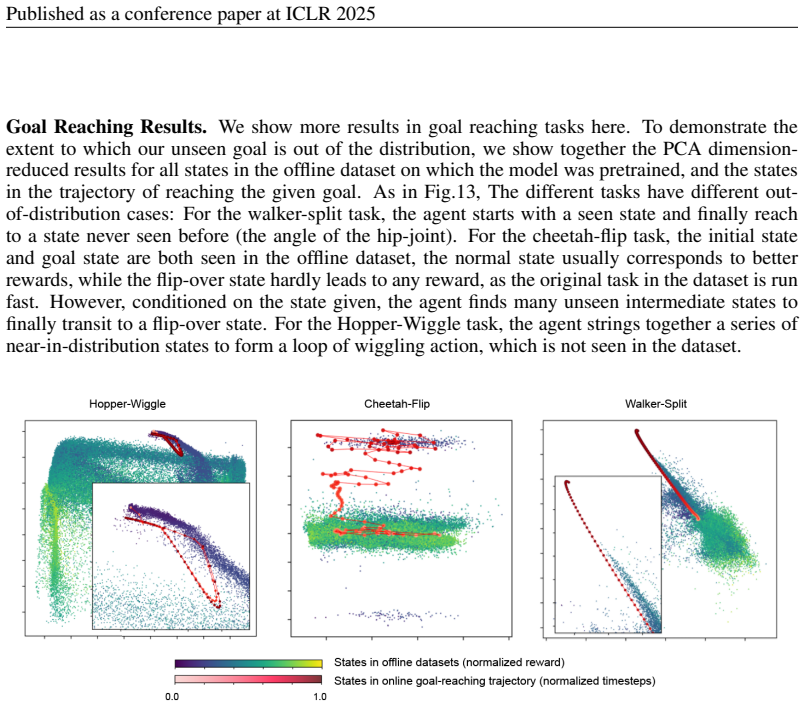
- Backward M3PC reaches goal states unseen in the offline data—split, flip, and wiggle motions—where a single goal-reaching mask fails.
- In manipulation, M3PC attains higher success rates than behavior cloning and IQL on RoboMimic tasks including a real-world can-picking task (0.70 vs 0.50 success rate for DT).
- Because candidate actions are sampled from an uncertainty-aware distribution with an entropy lower bound, the planner also serves as an exploration strategy during online finetuning, collecting higher-return trajectories while maintaining diversity.
Reading between the lines
- If the model's predicted futures remain accurate for action sequences that stray from the offline data, M3PC's gains should grow with model scale and planning horizon; the paper leaves this open and notes its experiments used only a fixed small Transformer.
- The same mask-composition recipe could be applied to other bidirectional sequence models—for example, extending M3PC to pixel observations by masking latent visual tokens rather than state vectors, a direction the paper flags as future work.
- The TD(λ) decay parameter trades dynamics error against value-estimation error, so task-specific tuning of λ (which the paper finds mildly sensitive) could yield further gains on stochastic or long-horizon environments.
- A direct test: compare M3PC's utility ranking against actual environment returns for sampled candidate actions; if the ranking correlation is low, the planning gain is coming from action resampling rather than from accurate prediction.
Editorial analysis
A structured set of objections, weighed in public.
Referee Report
Summary. This paper proposes M3PC, a test-time Model Predictive Control framework for pretrained bidirectional masked trajectory models (BTMs). The core idea is to use the same pretrained model with different mask patterns to (i) propose action sequences via an uncertainty-aware action head, (ii) predict future states, rewards, and returns via forward-dynamics and reward/return masks, and (iii) select actions by a TD(λ)-style utility over the predicted outcomes. The authors present three sets of results: offline RL on D4RL (M3PC-M improves over the same-weight BTM by about 6% average, and M3PC-Q with an IQL critic achieves higher scores), offline-to-online finetuning with a 200K step budget (outperforming ODT), and goal-reaching experiments on D4RL and RoboMimic using a backward M3PC variant with path inference and inverse dynamics masks. The paper also includes ablations on planning, uncertainty-aware action reconstruction, entropy constraint, and the decay parameter λ, along with an inference-time comparison against TT and TD-MPC.
Significance. The strongest contribution is the clean within-model comparison in Table 1: M3PC-M and the BTM baseline share identical pretrained weights, so the reported 6% average improvement is directly attributable to the test-time MPC selection loop rather than to additional training. This supports the paper's central claim that a single masked trajectory Transformer can serve as both policy and world model for test-time planning. The O2O results show substantial gains over ODT, and the goal-reaching demonstrations suggest a genuinely new capability for backward planning with masked models. The paper ships code and reports ablations for key components, which aids reproducibility. The main weaknesses are that the uncertainty-aware pretraining objective is introduced as part of the method but not ablated in the offline setting, and the 'without any additional parameter training' statement does not apply to the M3PC-Q variant used in the O2O experiments.
major comments (2)
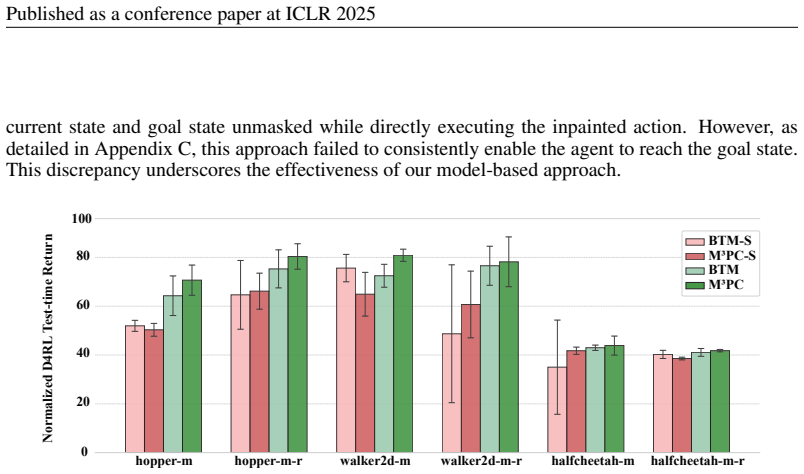
- [§4, Eq. (1)-(2); Table 1] The central comparison M3PC-M vs. BTM is internally clean because both share the same pretrained weights, but those weights come from a model trained with the modified uncertainty-aware action reconstruction objective (NLL loss plus entropy constraint, Eqs. (1)-(2)) rather than the standard masked-autoencoding MSE objective used by prior BTMs (e.g., Wu et al. 2023). The paper does not report an offline ablation that isolates the effect of the modified pretraining from the effect of test-time MPC; the only planning-vs-no-planning ablation (Figure 7) is in the online finetuning setting and uses different exploration mechanisms. As a result, the abstract's phrasing 'inference-phase MPC significantly improves the decision-making performance of a pretrained trajectory model without any additional parameter training' overstates the evidence: the 6.0% gain is demonstrated only for the authors' uncertainty-aware pretrained model, not for a standard masked trajectory model. Please either add an offline ablation (e.g., BTM trained with MSE + RCBC vs. the same model with MPC) or explicitly scope the claim to the uncertainty-aware BTM used throughout the paper.
- [§5, Table 2; §4, Eq. (9)] The offline-to-online results in Table 2 use the M3PC-Q variant, which requires training a separate IQL critic (Eq. (9)) and thus involves additional parameter training. The paper's general claim of 'without any additional parameter training' applies only to M3PC-M in the offline setting; the O2O experiments are a different regime where an extra value estimator is trained. This distinction should be stated clearly in the abstract and in the O2O section, and the table header should indicate that the reported M3PC numbers are M3PC-Q.
minor comments (5)
- [Table 1] Standard deviations are reported only for M3PC-M and M3PC-Q; the baselines (BC, TD3+BC, IQL, DT, TT, BTM) are listed without variance, which makes it difficult to assess whether the gains over BTM on datasets such as halfcheetah-m-r (41.8 vs. 41.1) are statistically meaningful.
- [Figure 7] The caption should explicitly state that the planning ablation is performed in the online finetuning phase, not in the offline setting, so that readers do not infer that the offline contribution of planning versus the modified pretraining objective has been isolated.
- [§4, Algorithm 1] The statement that 'M3PC requires only two prediction steps for planning at each timestep' should mention that each step processes N candidate sequences in parallel; otherwise the reader may underestimate the computational cost when N=625 candidates are sampled.
- [Table 2] The table header uses 'M3PC (Ours)' without specifying whether the offline and online numbers come from M3PC-M or M3PC-Q; given that the offline values match M3PC-Q in Table 1, the variant should be identified explicitly.
- [§5, Goal Reaching; Appendix A] The goal-reaching experiments rely on hand-crafted subgoal trajectories that are manually designed for each task; this dependence should be acknowledged as a limitation, since the approach may require nontrivial engineering to apply to new tasks.
Circularity Check
No significant circularity: the central improvement claim is evaluated against external environment returns using shared weights, with no fitted quantity that forces the result.
full rationale
I examined the derivation chain from the pretraining objective (Eqs. 1-8), the utility construction (Eq. 3), the proposal-selection distribution (Eq. 4), and Algorithm 1. The M3PC planning loop uses the same pretrained BTM to propose action candidates, predict future states/rewards/returns, and rank candidates, which creates a possible self-confirmation loop; however, the reported offline and online results are measured by D4RL and RoboMimic environment returns, not by the model's own predicted utilities. Hence any improvement is an external empirical fact and not equivalent to the inputs by construction. The Table 1 claim that 'M3PC-M shares the same weights as a pretrained BTM, but constantly outperforms BTM' tests two inference procedures on identical parameters; no parameter is fitted to the target scores, and the softmax over utilities does not mathematically force a higher environment return. The modified pretraining objective (NLL plus entropy constraint) is a potential confound in isolating 'test-time only' improvement, but a changed training loss is a control-variable concern, not circularity. No self-citations appear in the reference list, and no uniqueness theorem or ansatz is imported from the authors' prior work. The limitations section (state-based observations, fixed Transformer scale) does not admit or reveal any circular step. I therefore find no step that meets the quoted-reduction bar for circularity.
Assumptions & free parameters
free parameters (6)
- Decay parameter lambda =
0.6
- Candidate number N =
625
- Softmax temperature xi =
1.0
- Target entropy beta =
-3
- IQL expectile t =
0.7 (D4RL), 0.9 (RoboMimic)
- Subgoal extraction intervals =
every 5th, 30th, or every timestep depending on task
assumptions (5)
- domain assumption The environment is a Markov Decision Process with state-based observations (Section 3).
- domain assumption A single masked trajectory Transformer, trained with the two-step masking pattern, can simultaneously serve as policy, forward dynamics, reward predictor, and inverse dynamics model at test time (Section 4).
- domain assumption The uncertainty-aware action distribution with the entropy constraint is a valid policy for both offline and online action sampling (Section 4, Eq. 2).
- domain assumption The IQL critic provides reliable Q-value estimates for candidate actions in M3PC-Q (Appendix A).
- ad hoc to paper The hand-crafted subgoal trajectories in Appendix A are dynamically feasible and within the model's planning horizon (Appendix A).
Cite this review
Pith. "Pith review of M$^3$PC: Test-time Model Predictive Control for Pretrained Masked Trajectory Model." pith.science (2026). https://pith.science/paper/LQLXX7HU
@misc{pith2026241205675,
  author       = {Pith},
  title        = {Pith review of: M$^3$PC: Test-time Model Predictive Control for Pretrained Masked Trajectory Model},
  year         = {2026},
  howpublished = {\url{https://pith.science/paper/LQLXX7HU}},
  note         = {Machine review of arXiv:2412.05675}
}
read the original abstract
Recent work in Offline Reinforcement Learning (RL) has shown that a unified Transformer trained under a masked auto-encoding objective can effectively capture the relationships between different modalities (e.g., states, actions, rewards) within given trajectory datasets. However, this information has not been fully exploited during the inference phase, where the agent needs to generate an optimal policy instead of just reconstructing masked components from unmasked ones. Given that a pretrained trajectory model can act as both a Policy Model and a World Model with appropriate mask patterns, we propose using Model Predictive Control (MPC) at test time to leverage the model's own predictive capability to guide its action selection. Empirical results on D4RL and RoboMimic show that our inference-phase MPC significantly improves the decision-making performance of a pretrained trajectory model without any additional parameter training. Furthermore, our framework can be adapted to Offline to Online (O2O) RL and Goal Reaching RL, resulting in more substantial performance gains when an additional online interaction budget is provided, and better generalization capabilities when different task targets are specified. Code is available: https://github.com/wkh923/m3pc.
Figures


Figures from the paper (12 more)






Reference graph
Works this paper leans on
-
[3]
Language models are few-shot learners
Tom Brown, Benjamin Mann, Nick Ryder, Melanie Subbiah, Jared D Kaplan, Prafulla Dhariwal, Arvind Neelakantan, Pranav Shyam, Girish Sastry, Amanda Askell, et al. Language models are few-shot learners. Advances in neural information processing systems, 33:1877–1901,
1901
-
[5]
Off-policy deep reinforcement learning without exploration
Scott Fujimoto, David Meger, and Doina Precup. Off-policy deep reinforcement learning without exploration. In International conference on machine learning, pp. 2052–2062. PMLR,
-
[6]
Dream to control: Learning behaviors by latent imagination
Danijar Hafner, Timothy Lillicrap, Jimmy Ba, and Mohammad Norouzi. Dream to control: Learning behaviors by latent imagination. arXiv preprint arXiv:1912.01603,
arXiv 1912
-
[8]
The value of planning for infinite-horizon model predictive control
Nathan Hatch and Byron Boots. The value of planning for infinite-horizon model predictive control. In 2021 IEEE International Conference on Robotics and Automation (ICRA) , pp. 7372–7378. IEEE,
work page 2021
-
[9]
Masked au- toencoders are scalable vision learners
11 Published as a conference paper at ICLR 2025 Kaiming He, Xinlei Chen, Saining Xie, Yanghao Li, Piotr Doll ´ar, and Ross Girshick. Masked au- toencoders are scalable vision learners. In Proceedings of the IEEE/CVF conference on computer vision and pattern recognition, pp. 16000–16009,
work page 2025
-
[10]
Chain-of- thought predictive control
Zhiwei Jia, Vineet Thumuluri, Fangchen Liu, Linghao Chen, Zhiao Huang, and Hao Su. Chain-of- thought predictive control. arXiv preprint arXiv:2304.00776,
-
[11]
All inference times were benchmarked on a single NVIDIA RTX 3090 GPU
We additionally include two methods for references: (1) TT (Janner et al., 2021), a sequential modeling approach that employs beam search for test-time planning; (2) TD- MPC (Hansen et al., 2022), a representative model-based RL method combining MPC and temporal difference learning. All inference times were benchmarked on a single NVIDIA RTX 3090 GPU. 18 ...
work page 2021
-
[12]
Plan online, learn offline: Efficient learning and exploration via model-based control
Kendall Lowrey, Aravind Rajeswaran, Sham Kakade, Emanuel Todorov, and Igor Mordatch. Plan online, learn offline: Efficient learning and exploration via model-based control. arXiv preprint arXiv:1811.01848,
Show all 26 references
-
[13]
Awac: Accelerating online rein- forcement learning with offline datasets
Ashvin Nair, Abhishek Gupta, Murtaza Dalal, and Sergey Levine. Awac: Accelerating online rein- forcement learning with offline datasets. arXiv preprint arXiv:2006.09359,
2006 arXiv
-
[15]
A generalist agent
Scott Reed, Konrad Zolna, Emilio Parisotto, Sergio Gomez Colmenarejo, Alexander Novikov, Gabriel Barth-Maron, Mai Gimenez, Yury Sulsky, Jackie Kay, Jost Tobias Springenberg, et al. A generalist agent. arXiv preprint arXiv:2205.06175,
-
[17]
Goplan: Goal- conditioned offline reinforcement learning by planning with learned models
Mianchu Wang, Rui Yang, Xi Chen, Hao Sun, Meng Fang, and Giovanni Montana. Goplan: Goal- conditioned offline reinforcement learning by planning with learned models. arXiv preprint arXiv:2310.20025,
-
[18]
Model-based offline planning with trajectory prun- ing
Xianyuan Zhan, Xiangyu Zhu, and Haoran Xu. Model-based offline planning with trajectory prun- ing. arXiv preprint arXiv:2105.07351,
-
[19]
Policy expansion for bridging offline-to-online reinforce- ment learning
Haichao Zhang, We Xu, and Haonan Yu. Policy expansion for bridging offline-to-online reinforce- ment learning. arXiv preprint arXiv:2302.00935,
-
[20]
We consider the Lagrangian of Equation 2 given by: L(θ, σ) =J(θ) +σ(β − HT θ ), (5) where σ is a non-negative Lagrange multiplier
13 Published as a conference paper at ICLR 2025 A I MPLEMENTATION DETAILS Loss Function Construction. We consider the Lagrangian of Equation 2 given by: L(θ, σ) =J(θ) +σ(β − HT θ ), (5) where σ is a non-negative Lagrange multiplier. The training objective then become max σ≥0 m...
2025
-
[21]
algorithm to train the value estimator because its Bellman updates do not require an explicit policy function. Typically, IQL simultaneously learns a critic network Qψ and value network Vϕ with the losses defined by: JQ(ψ) =E(s,a,r,s′)∼T h (r + γVϕ(s′) − Qψ(s, a))2i , JV (ϕ) =...
2025
-
[22]
Per-task Online Training Curves for M3PC and baseline methods
BTMODTM³PC IQL Figure 9: D4RL Benchmark Comparison. Per-task Online Training Curves for M3PC and baseline methods. Mean of 5 seeds. The shaded area represents the standard deviation across seeds. We furthermore compete M 3PC with some stronger, specialized O2O baseline methods...
2022
-
[23]
The results demonstrate that M 3PC achieves performance compara- ble to SOTA specialized O2O methods such as OFF2ON and PEX. 17 Published as a conference paper at ICLR 2025 Dataset AW AC ODT OFF2ON PEX M3PC hopper-m 57.8 → 55.1 73.4 → 67.0 97.5 → 80.2 56.5 → 87.5 73.6 → 81.3 w...
2025
-
[25]
Empirical results show that entropy constraint does not have substantial influences on offline results but significantly boost the online sample efficiency. Datasets M3PC-M M3PC-Q M3PC-online w/o w w/o w w/o w hopper-m 84.3±7.3 70.7±6.2 81.6±3.5 73.6±5.6 94.9±11.7 93.9±15.8 ha...
-
[26]
The medium-replay dataset consists of recording all samples in the replay buffer observed during training until the agent reaches the ”medium” level
agent. The medium-replay dataset consists of recording all samples in the replay buffer observed during training until the agent reaches the ”medium” level. We use both these two types of datasets in offline RL and O2O RL. RoboMimic. RoboMimic includes a suite of manipulation ...
2025
-
[2010]
Bootstrapped transformer for offline reinforcement learning
12 Published as a conference paper at ICLR 2025 Kerong Wang, Hanye Zhao, Xufang Luo, Kan Ren, Weinan Zhang, and Dongsheng Li. Bootstrapped transformer for offline reinforcement learning. Advances in Neural Information Processing Sys- tems, 35:34748–34761,
2025
-
[2018]
Bert: Pre-training of deep bidirectional transformers for language understanding
Jacob Devlin, Ming-Wei Chang, Kenton Lee, and Kristina Toutanova. Bert: Pre-training of deep bidirectional transformers for language understanding. arXiv preprint arXiv:1810.04805,
-
[2019]
Temporal difference learning for model predictive control
Nicklas Hansen, Xiaolong Wang, and Hao Su. Temporal difference learning for model predictive control. arXiv preprint arXiv:2203.04955,
-
[2021]
Model-based offline planning
Arthur Argenson and Gabriel Dulac-Arnold. Model-based offline planning. arXiv preprint arXiv:2008.05556,
2008 arXiv
-
[2022]
Rt-1: Robotics transformer for real-world control at scale
Anthony Brohan, Noah Brown, Justice Carbajal, Yevgen Chebotar, Joseph Dabis, Chelsea Finn, Keerthana Gopalakrishnan, Karol Hausman, Alex Herzog, Jasmine Hsu, et al. Rt-1: Robotics transformer for real-world control at scale. arXiv preprint arXiv:2212.06817,
-
[2023]
Offline reinforcement learning with implicit q- learning
Ilya Kostrikov, Ashvin Nair, and Sergey Levine. Offline reinforcement learning with implicit q- learning. arXiv preprint arXiv:2110.06169,
-
[2024]
Temporal difference models: Model- free deep rl for model-based control
Vitchyr Pong, Shixiang Gu, Murtaza Dalal, and Sergey Levine. Temporal difference models: Model- free deep rl for model-based control. arXiv preprint arXiv:1802.09081,
Reviewed August 11, 2026 · model on record in the stance chip above.
Discussion (0). Continue with ORCID to comment.