REVIEW 3 major objections 5 minor 4 cited by
Dynamic EventNeRF: Reconstructing General Dynamic Scenes from Multi-view RGB and Event Streams
T0 review · 3 major / 5 minor · reviewed 2026-08-11 · deepseek-v4-flash
Pith's one-line read Dynamic EventNeRF is the first method that reconstructs general dynamic scenes in 4D from sparse multi-view event streams and a few RGB frames, reporting novel-view quality above RGB-based baselines in fast, dim-lit motion.
desk verdict A solid, well-engineered first for multi-view event-based dynamic reconstruction; the central claim holds, with caveats about decay bias and thin real-data evaluation. read the letter →
The pith
A machine-rendered reading of the paper's core claim, the machinery that carries it, and where it could break.
The reading
What carries the argument
The load-bearing identity is the Event-based Single Integral (ESI): the difference of log-intensities at two times equals the polarity sum of the events in between, $\log I(t_1)-\log I(t_0)=E(t_0,t_1)$. Dynamic EventNeRF converts this identity into a training signal by substituting rendered NeRF colours $\hat{C}_k(t)$ for $I(t)$, producing the event loss of Eq. 6. Around it stand four supporting pieces: (i) a sequence of cross-faded time-conditioned MLPs, $\hat{C}(t)=(1-\alpha(t))\hat{C}_i(t)+\alpha(t)\hat{C}_{i+1}(t)$ over 10%-overlap segments, so no single network must hold the whole motion; (ii) fast event accumulation with decay, $E_{x,y}(t_0,t_1)=\sum_i p_i C_{p_i} b^{i_{\mathrm{end}}-i_{\mathrm{start}}-i}$ with $b=0.93$ in Eq. 11, queried per pixel in $O(\log N)$ time via prefix arrays and binary search; (iii) an annealed sparsity loss plus a manually set cylinder outside which density is clamped to zero, the prior that makes six views converge; and (iv) $\alpha$-blending of a separately captured background image instead of learning it. The ESI identity is the hook that lets a sensor measuring change supervise a renderer predicting absolute colour.
What would settle it
Re-measure the camera response function at a different illumination level (say 50 lx instead of the recorded 7–11.5 lx) and check whether the one-time linear fit with fixed shift $3\times10^{-2}$ still maps every pixel's brightness to the observed event polarities; if the mapping drifts, the event loss of Eq. 6 is miscalibrated and the reported margin over RGB baselines should shrink or vanish, and the same experiment can be repeated with a subject moving outside the preset cylinder radius to test the general-scenes claim.
Extended reading notes
Core claim
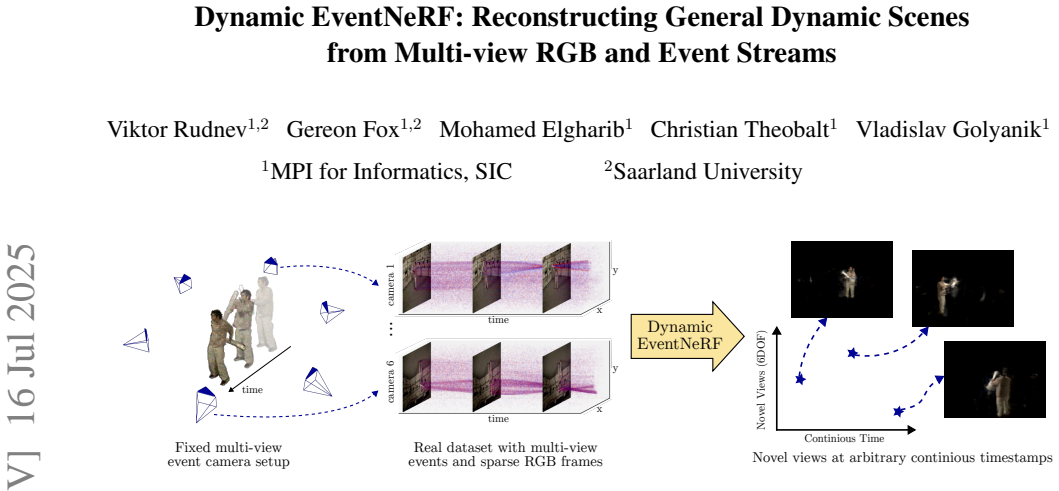
The central claim is that general dynamic scenes—arbitrary non-rigid motion, not just faces, bodies, or hands—can be reconstructed from sparse multi-view event streams plus sparse RGB frames, and that supervising a shared volume directly with events beats feeding blurry or event-reconstructed video to RGB-based dynamic NeRFs. Concretely, the paper reports an average synthetic PSNR of 26.99 against 25.80 for the strongest RGB baseline and a real-data foreground-masked PSNR of 22.51 against 19.76 for the EDI-plus-Dyn-NeRF pipeline. To get there, the sequence is split into overlapping short segments, each represented by a time-conditioned MLP radiance field; segments overlap by 10% and are cross-faded, and each one is trained by comparing rendered log-intensities with accumulated events through the Event-based Single Integral identity, anchored by deblurred reference frames through accumulation and RGB losses. An annealed sparsity term, a cylindrical clipping of the reconstruction volume, and a decayed event accumulation with $b=0.93$ (whose drift under noise is shown bounded in the appendix) complete the scheme. The paper also contributes a six-camera event-plus-RGB rig and an 18-minute benchmark of dim-lit, fast motions.
Load-bearing premise
The load-bearing premise is that the event camera's response is one fixed linear function with a constant offset—calibrated once per camera and assumed valid for every pixel and every lighting level—so that rendered log-intensities and measured event polarities live on the same scale; a second structural reliance is the hand-set cylinder, since the model fails to converge on real data without that clipping.
Editorial extensions
If this is right
- Fast, dimly lit scenes that defeat RGB-only capture become reconstructable, because events supply temporal resolution and dynamic range where long exposures blur and darken.
- Supervising a shared volume directly with events beats reconstructing video first: E2VID- and EDI-style pipelines introduce per-view inconsistencies and artefacts that lower novel-view quality.
- The RGB stream is nearly optional: cutting supporting frames from 100 FPS to 0.5 FPS costs little quality, so 4D capture driven mostly by events is feasible.
- Quality rises with the number of event views—from about 16 to 33 PSNR between 2 and 24 synthetic views—so building larger multi-view event rigs directly buys fidelity.
- Because no canonical-volume deformation is assumed, the method handles motions that deformation-based dynamic NeRFs cannot, as the failure of the NR-NeRF baseline shows.
Reading between the lines
- The bounded-drift proof for decayed accumulation suggests the same damping trick could make event supervision robust to other noise sources (hot pixels, sensor shake) without retraining—a generalisation the paper does not explore.
- The near-independence from RGB implies a cheaper capture rig: commodity low-rate cameras, or even one flash frame per segment, could replace the deblurred 5 FPS stream.
- The cross-faded segment curriculum is representation-agnostic; porting it to a faster backbone (the authors point at 3D Gaussian splatting as future work) could cut the 60 GPU-hours per sequence, provided the temporal-sharing failure of grid-based encoders is addressed.
- The hand-set cylinder is a ceiling on generality; learning the bounding volume from the event stream itself is a natural next step toward scenes of arbitrary size.
Editorial analysis
A structured set of objections, weighed in public.
Referee Report
Summary. The paper proposes Dynamic EventNeRF, a NeRF-based method for reconstructing general dynamic scenes from sparse multi-view event streams and sparse RGB frames. The method splits a recorded sequence into short overlapping temporal segments, trains a separate time-conditioned MLP NeRF per segment, and supervises each model with an event-accumulation loss, an RGB loss at sparse reference frames, an accumulation loss, a sparsity loss, and a hand-set cylindrical volume clipping. The authors contribute a synthetic benchmark and a real six-view event-RGB dataset recorded in dim lighting, and report state-of-the-art novel-view synthesis, outperforming RGB-only, E2VID/EDI-to-RGB, and deformation-based baselines on both synthetic and real sequences.
Significance. If the central claims hold, this is a meaningful step: it demonstrates that multi-view event streams can drive volumetric reconstruction of general dynamic scenes in conditions where RGB frames suffer from blur and noise, and it provides a public dataset and codebase that should facilitate follow-up work. The paper is thorough in its ablations, covering backbone choices, loss components, number of views, supporting-RGB frame rate, and design choices, and it includes a formal variance-bound argument for the decayed event accumulation in Appx. I. The main caveat is that the event-supervision loss, as defined, does not exactly enforce the physical event-accumulation constraint because of the decay factor; this issue needs to be resolved or convincingly quantified before the central quantitative claims can be taken at face value.
major comments (3)
- [Sec. 4.4, Eq. (11), and Appx. I] The event target E(t0,t1) in Eq. (11) is a decayed accumulation with b=0.93, so the event loss in Eq. (6) does not enforce the physical ESI constraint from Eq. (1); it matches a biased quantity in which old legitimate events are discounted. The paper explicitly acknowledges in Appx. I that decay "does still negatively impact the legitimate events" and relies on the MLP to compensate, but no experiment isolates this bias from noise. The "w/o decay" ablation in Table 3 is on a single real sequence, is confounded by noise, and even improves PSNR (27.119 vs 27.048). Since the central claim is that direct event supervision recovers physical intensity changes, the authors should either remove the bias from the supervised target or provide a controlled experiment, e.g., on noise-free synthetic events, that quantifies the distortion and shows it is negligible for the reported improvements.
- [Sec. 4.4, Eq. (11), and Eq. (12)] As printed, the decay exponent in Eq. (11) is iend - istart - i. For the most recent event i=iend this gives the weight b^{-istart}, which depends on the global index of the first event and can exceed one; this is inconsistent with the stated purpose that "events that are far in the past weigh less" and is not obviously compatible with the prefix-query formula in Eq. (12). The authors should correct the exponent to a relative index (presumably iend - i) and define the index origin unambiguously. They should also report the event threshold Cp used in Eq. (11), since the scale of the event loss in Eq. (6) depends on it and no value is given.
- [Sec. 4.1, Eq. (4), and Sec. 5.4] It is not specified how the background is obtained for the held-out views used in evaluation. In Eq. (4), the final image is alpha-blended with the captured background image Ak of a training view. For the real-data evaluation, the held-out view is one of the six cameras, so its background image is available; if it is used during evaluation, the full-image PSNR values in Table 1 do not test novel-view generalization for the background. For the synthetic hold-out views the situation is also unclear. The foreground ROI results mitigate this concern, but the full-image numbers and the 6-DOF novel-view claim require a precise statement of what background is used at test time.
minor comments (5)
- [Table 3] On the real "Sword" sequence, the full model is not the PSNR best: w/o decay, w/o Levent, and only Lacc all give higher PSNR than the full model (27.119, 27.620, and 27.754 vs 27.048). The text says SSIM and LPIPS favor the full model, which is true, but the PSNR discrepancy should be stated explicitly and discussed.
- [Sec. 3.2, Eq. (3)] The notation "δ^a a" in the definition of the event accumulation is malformed and should be rewritten, e.g., as a Kronecker delta with explicit arguments.
- [Table 1] The label "GT RGB [37] + Dyn-NeRF" is confusing because [37] is the EDI paper; clarify that "GT RGB" means the original non-blurry rendered frames and [37] refers to the EDI deblurring used for real data.
- [Appx. B] The CRF calibration description does not say how many pixels were used for the linear fits, whether the fits were per camera, or what the residual error of the linear approximation is; adding these numbers would make the calibration reproducible.
- [Sec. 5.2] The real benchmark evaluates only 3 of the 16 recorded sequences; the authors should state the selection criterion for these sequences and note whether the remaining sequences are excluded for motion, calibration, or other reasons.
Circularity Check
No significant circularity: the core event/RGB supervision and novel-view evaluation are self-contained, with only a minor non-load-bearing self-citation to EventNeRF.
full rationale
The paper's derivation chain is supervised learning rather than a formal derivation: Eq. 6 compares accumulated event measurements E_k(t0,t1) in Eq. 11 to the rendered log-intensity difference F(log C_hat_k(t1) - log C_hat_k(t0)), and Eqs. 7 and 8 compare rendered colors to captured RGB frames. Novel views are evaluated on held-out views and timestamps with PSNR, SSIM, and LPIPS, which are external to the training losses. No parameter is defined in terms of the target prediction: the decay b = 0.93 in Eq. 11 is an empirical hyperparameter, and the cylindrical clipping and sparsity loss are regularizers, not fitted outputs renamed as predictions. The decay analysis in Appx. I explicitly acknowledges a limitation: "decay does still negatively impact the legitimate events ... but the underlying MLP, supervised by all our losses, can compensate for that sufficiently." This is a robustness and correctness concern about the event-loss target, not a circular reduction, because the loss still compares the model to measured event streams independently of the model's own output; the 'w/o decay' ablation in Tab. 3 also shows mixed metrics (PSNR 27.119 vs. 27.048 for the full model) rather than a forced fit. The paper builds on the authors' prior EventNeRF [49] for the event-accumulation supervision scheme and codebase, but the central claim is supported by independent comparisons against RGB-only, E2VID, and EDI baselines and by ablations in Tabs. 1-4, so the self-citation is not load-bearing. No step reduces by construction to its inputs, and no uniqueness or ansatz is imported through self-citation.
Assumptions & free parameters
free parameters (5)
- event decay factor b =
0.93
- cylinder bounding radius r and vertical extent [ymin, ymax] =
scene-specific
- positional encoding frequencies =
7 temporal, 14 spatial
- CRF linear fit offset epsilon =
3e-2
- loss weights lambda_2, lambda_4 =
1e-2 for both
assumptions (5)
- domain assumption The event generation model of Eq. 1: a pixel emits an event when the log-intensity crosses a fixed threshold Cp.
- domain assumption The event camera CRF is linear with a fixed offset, after Appendix B calibration.
- ad hoc to paper The scene lies within a known cylinder; geometry outside the cylinder is background that can be alpha-blended from captured background images A_k.
- domain assumption Neural radiance field optimization with MSE losses and positional encoding annealing will converge to a plausible dynamic volume from sparse views.
- domain assumption Fast EDI-deblurred RGB frames are treated as ground-truth instantaneous frames for LRGB and Lacc.
invented entities (1)
-
No new physical entities introduced
independent evidence
Cite this review
Pith. "Pith review of Dynamic EventNeRF: Reconstructing General Dynamic Scenes from Multi-view RGB and Event Streams." pith.science (2026). https://pith.science/paper/XJNVV632
@misc{pith2026241206770,
  author       = {Pith},
  title        = {Pith review of: Dynamic EventNeRF: Reconstructing General Dynamic Scenes from Multi-view RGB and Event Streams},
  year         = {2026},
  howpublished = {\url{https://pith.science/paper/XJNVV632}},
  note         = {Machine review of arXiv:2412.06770}
}
read the original abstract
Volumetric reconstruction of dynamic scenes is an important problem in computer vision. It is especially challenging in poor lighting and with fast motion. This is partly due to limitations of RGB cameras: To capture frames under low lighting, the exposure time needs to be increased, which leads to more motion blur. In contrast, event cameras, which record changes in pixel brightness asynchronously, are much less dependent on lighting, making them more suitable for recording fast motion. We hence propose the first method to spatiotemporally reconstruct a scene from sparse multi-view event streams and sparse RGB frames. We train a sequence of cross-faded time-conditioned NeRF models, one per short recording segment. The individual segments are supervised with a set of event- and RGB-based losses and sparse-view regularisation. We assemble a real-world multi-view camera rig with six static event cameras around the object and record a benchmark multi-view event stream dataset of challenging motions. Our work outperforms RGB-based baselines, producing state-of-the-art results, and opens up the topic of multi-view event-based reconstruction as a new path for fast scene capture beyond RGB cameras. The code and the data are released at https://4dqv.mpi-inf.mpg.de/DynEventNeRF/
Figures


Figures from the paper (8 more)


Forward citations
Cited by 4 Pith papers
-
ERF-GS: Reconstructing Fast Motion from Disjoint Event-RGB Viewpoints
ERF-GS improves dynamic 3D Gaussian splatting by using simulated event streams to supervise motion and densify moving regions, yielding higher dynamic PSNR on blurred and disjoint-event versions of Neu3D and Nvidia.
-
E-4DGS: High-Fidelity Dynamic Reconstruction from the Multi-view Event Cameras
E-4DGS is a deformable 3D Gaussian Splatting method that reconstructs dynamic scenes directly from multi-view event camera streams, outperforming event-to-image baseline approaches.
-
GS2E: Gaussian Splatting is an Effective Data Generator for Event Stream Generation
A pipeline that turns sparse multi-view RGB images into a claimed 1,150-scene synthetic event dataset using 3D Gaussian Splatting rendering plus a stochastic event simulator.
-
Event Camera Guided Visual Media Restoration & 3D Reconstruction: A Survey
A structured survey of event-camera-guided video restoration and 3D reconstruction, organized by temporal, spatial, and 3D tasks.
Reference graph
Works this paper leans on
-
[1]
Evdnerf: Reconstructing event data with dynamic neural radiance fields
Anish Bhattacharya, Ratnesh Madaan, Fernando Cladera, Sai Vemprala, Rogerio Bonatti, Kostas Daniilidis, Ashish Kapoor, Vijay Kumar, Nikolai Matni, and Jayesh K Gupta. Evdnerf: Reconstructing event data with dynamic neural radiance fields. In WACV, pages 5846–5855, 2024. 2
work page 2024
-
[2]
Dhp19: Dynamic vision sensor 3d human pose dataset
Enrico Calabrese, Gemma Taverni, Christopher Awai East- hope, Sophie Skriabine, Federico Corradi, Luca Longinotti, Kynan Eng, and Tobi Delbruck. Dhp19: Dynamic vision sensor 3d human pose dataset. In CVPRW, 2019. 2
work page 2019
-
[3]
Mitigating motion blur in neural radiance fields with events and frames
Marco Cannici and Davide Scaramuzza. Mitigating motion blur in neural radiance fields with events and frames. In CVPR, 2024. 2
work page 2024
-
[4]
Hexplane: A fast representation for dynamic scenes
Ang Cao and Justin Johnson. Hexplane: A fast representation for dynamic scenes. In CVPR, pages 130–141, 2023. 2, 7, 8, 13, 14
work page 2023
-
[5]
Recent event camera innovations: A survey
Bharatesh Chakravarthi, Aayush Atul Verma, Kostas Dani- ilidis, Cornelia Ferm ¨uller, and Yezhou Yang. Recent event camera innovations: A survey. CoRR, abs/2408.13627, 2024. 1
arXiv 2024
-
[6]
Color filter array recovery using a threshold-based variable number of gradients
Edward Chang, Shiufun Cheung, and Davis Y Pan. Color filter array recovery using a threshold-based variable number of gradients. In Sensors, Cameras, and Applications for Digital Photography, pages 36–43. SPIE, 1999. 7
work page 1999
-
[7]
Tensorf: Tensorial radiance fields
Anpei Chen, Zexiang Xu, Andreas Geiger, Jingyi Yu, and Hao Su. Tensorf: Tensorial radiance fields. In ECCV, pages 333–350. Springer, 2022. 7, 8, 13, 14
work page 2022
- [8]
Show all 69 references
-
[9]
K-planes: Explicit radiance fields in space, time, and appearance
Sara Fridovich-Keil, Giacomo Meanti, Frederik Rahbæk War- burg, Benjamin Recht, and Angjoo Kanazawa. K-planes: Explicit radiance fields in space, time, and appearance. In CVPR, pages 12479–12488, 2023. 2
2023
-
[10]
Davison, J ¨org Conradt, Kostas Daniilidis, and Davide Scaramuzza
Guillermo Gallego, Tobi Delbr¨uck, Garrick Orchard, Chiara Bartolozzi, Brian Taba, Andrea Censi, Stefan Leutenegger, Andrew J. Davison, J ¨org Conradt, Kostas Daniilidis, and Davide Scaramuzza. Event-based vision: A survey. IEEE Trans. Pattern Anal. Mach. Intell., 44(1):154–18...
2022
-
[11]
Monocular dynamic view synthesis: A reality check
Hang Gao, Ruilong Li, Shubham Tulsiani, Bryan Russell, and Angjoo Kanazawa. Monocular dynamic view synthesis: A reality check. In NeurIPS, 2022. 1, 2
2022
-
[12]
Hdhumans: A hybrid approach for high-fidelity digital humans
Marc Habermann, Lingjie Liu, Weipeng Xu, Gerard Pons- Moll, Michael Zollhoefer, and Christian Theobalt. Hdhumans: A hybrid approach for high-fidelity digital humans. Proc. ACM Comput. Graph. Interact. Tech., 6(3), 2023. 2
2023
-
[13]
Ev-nerf: Event based neural radiance field
Inwoo Hwang, Junho Kim, and Young Min Kim. Ev-nerf: Event based neural radiance field. In WACV, pages 837–847,
-
[14]
DV software.https://inivation.gitlab
iniVation. DV software.https://inivation.gitlab. io/dv/dv-docs/docs/getting-started.html ,
-
[15]
Putting nerf on a diet: Semantically consistent few-shot view synthesis
Ajay Jain, Matthew Tancik, and Pieter Abbeel. Putting nerf on a diet: Semantically consistent few-shot view synthesis. In ICCV, pages 5885–5894, 2021. 2
2021
-
[16]
Complementing event streams and rgb frames for hand mesh reconstruction
Jianping Jiang, Xinyu Zhou, Bingxuan Wang, Xiaoming Deng, Chao Xu, and Boxin Shi. Complementing event streams and rgb frames for hand mesh reconstruction. CVPR,
-
[17]
3d gaussian splatting for real-time radiance field rendering
Bernhard Kerbl, Georgios Kopanas, Thomas Leimk¨uhler, and George Drettakis. 3d gaussian splatting for real-time radiance field rendering. ACM TOG, 42(4):1–14, 2023. 2, 8
2023
-
[18]
Kingma and Jimmy Ba
Diederik P. Kingma and Jimmy Ba. Adam: A method for stochastic optimization. In ICLR, 2015. 12
2015
-
[19]
E-nerf: Neural radiance fields from a moving event camera
Simon Klenk, Lukas Koestler, Davide Scaramuzza, and Daniel Cremers. E-nerf: Neural radiance fields from a moving event camera. RA-L, 8(3):1587–1594, 2023. 1, 2
2023
-
[20]
Dynibar: Neural dynamic image-based rendering
Zhengqi Li, Qianqian Wang, Forrester Cole, Richard Tucker, and Noah Snavely. Dynibar: Neural dynamic image-based rendering. In CVPR, pages 4273–4284, 2023. 2
2023
-
[21]
Fast event-based double integral for real-time robotics
Shijie Lin, Yingqiang Zhang, Dongyue Huang, Bin Zhou, Xiaowei Luo, and Jia Pan. Fast event-based double integral for real-time robotics. In ICRA, 2023. 3, 5, 7
2023
-
[22]
Neural actor: Neural free-view synthesis of human actors with pose control
Lingjie Liu, Marc Habermann, Viktor Rudnev, Kripasindhu Sarkar, Jiatao Gu, and Christian Theobalt. Neural actor: Neural free-view synthesis of human actors with pose control. ACM TOG, 2021. 2
2021
-
[23]
Neural volumes: Learning dynamic renderable volumes from images
Stephen Lombardi, Tomas Simon, Jason Saragih, Gabriel Schwartz, Andreas Lehrmann, and Yaser Sheikh. Neural volumes: Learning dynamic renderable volumes from images. ACM TOG, 38(4):65:1–65:14, 2019. 2
2019
-
[24]
Robust e-nerf: Nerf from sparse & noisy events under non-uniform motion
Weng Fei Low and Gim Hee Lee. Robust e-nerf: Nerf from sparse & noisy events under non-uniform motion. ICCV,
-
[25]
Deformable neural radiance fields using rgb and event cameras
Qi Ma, Danda Pani Paudel, Ajad Chhatkuli, and Luc Van Gool. Deformable neural radiance fields using rgb and event cameras. In ICCV, 2023. 1, 2
2023
-
[26]
Srinivasan, Rodrigo Ortiz-Cayon, Nima Khademi Kalantari, Ravi Ramamoorthi, Ren Ng, and Abhishek Kar
Ben Mildenhall, Pratul P. Srinivasan, Rodrigo Ortiz-Cayon, Nima Khademi Kalantari, Ravi Ramamoorthi, Ren Ng, and Abhishek Kar. Local light field fusion: Practical view synthe- sis with prescriptive sampling guidelines. ACM TOG, 38(4),
-
[27]
Srinivasan, Matthew Tancik, Jonathan T
Ben Mildenhall, Pratul P. Srinivasan, Matthew Tancik, Jonathan T. Barron, Ravi Ramamoorthi, and Ren Ng. Nerf: Representing scenes as neural radiance fields for view synthe- sis. In ECCV, 2020. 2, 3
2020
-
[28]
Even- tego3d: 3d human motion capture from egocentric event streams
Christen Millerdurai, Hiroyasu Akada, Jian Wang, Diogo Luvizon, Christian Theobalt, and Vladislav Golyanik. Even- tego3d: 3d human motion capture from egocentric event streams. In Computer Vision and Pattern Recognition (CVPR),
-
[29]
3d pose estimation of two interacting hands from a monocular event camera
Christen Millerdurai, Diogo Luvizon, Viktor Rudnev, Andr´e Jonas, Jiayi Wang, Christian Theobalt, and Vladislav Golyanik. 3d pose estimation of two interacting hands from a monocular event camera. In 3DV, 2024. 2
2024
-
[30]
tiny-cuda-nn, 2021
Thomas M ¨uller. tiny-cuda-nn, 2021. 13
2021
-
[31]
Instant neural graphics primitives with a multireso- lution hash encoding
Thomas M¨uller, Alex Evans, Christoph Schied, and Alexan- der Keller. Instant neural graphics primitives with a multireso- lution hash encoding. ACM TOG, 41(4):102:1–102:15, 2022. 7, 8, 13, 14
2022
-
[32]
Livehand: Real-time and photorealistic neural hand rendering
Akshay Mundra, Mallikarjun B R, Jiayi Wang, Marc Haber- mann, Christian Theobalt, and Mohamed Elgharib. Livehand: Real-time and photorealistic neural hand rendering. In ICCV,
-
[33]
Autorf: Learning 3d object radiance fields from single view observations
Norman M ¨uller, Andrea Simonelli, Lorenzo Porzi, Samuel Rota Bul`o, Matthias Nießner, and Peter Kontschieder. Autorf: Learning 3d object radiance fields from single view observations. In CVPR, 2022. 2
2022
-
[34]
Thomas Neff, Pascal Stadlbauer, Mathias Parger, Andreas Kurz, J. H. Mueller, Chakravarty R. Alla Chaitanya, Anton Kaplanyan, and Markus Steinberger. Donerf: Towards real- time rendering of compact neural radiance fields using depth oracle networks. Comput. Graph. Forum, 40(4):...
2021
-
[35]
Dif- ferentiable event stream simulator for non-rigid 3d tracking
Jalees Nehvi, Vladislav Golyanik, Franziska Mueller, Hans- Peter Seidel, Mohamed Elgharib, and Christian Theobalt. Dif- ferentiable event stream simulator for non-rigid 3d tracking. In CVPRW, 2021. 2
2021
-
[36]
Reg- nerf: Regularizing neural radiance fields for view synthesis from sparse inputs
Michael Niemeyer, Jonathan T Barron, Ben Mildenhall, Mehdi SM Sajjadi, Andreas Geiger, and Noha Radwan. Reg- nerf: Regularizing neural radiance fields for view synthesis from sparse inputs. In CVPR, pages 5480–5490, 2022. 2
2022
-
[37]
Bringing a blurry frame alive at high frame-rate with an event camera
Liyuan Pan, Cedric Scheerlinck, Xin Yu, Richard Hartley, Miaomiao Liu, and Yuchao Dai. Bringing a blurry frame alive at high frame-rate with an event camera. In CVPR, pages 6820–6829, 2019. 2, 3, 6, 7, 8
2019
-
[38]
Federico Paredes-Vall´es and Guido C. H. E. de Croon. Back to event basics: Self-supervised learning of image reconstruction for event cameras via photometric constancy. InCVPR, pages 3445–3454, 2021. 2
2021
-
[39]
Nerfies: Deformable neural radiance fields
Keunhong Park, Utkarsh Sinha, Jonathan T Barron, Sofien Bouaziz, Dan B Goldman, Steven M Seitz, and Ricardo Martin-Brualla. Nerfies: Deformable neural radiance fields. In CVPR, pages 5865–5874, 2021. 1, 5, 7
2021
-
[40]
Hypernerf: A higher- dimensional representation for topologically varying neural radiance fields
Keunhong Park, Utkarsh Sinha, Peter Hedman, Jonathan T Barron, Sofien Bouaziz, Dan B Goldman, Ricardo Martin- Brualla, and Steven M Seitz. Hypernerf: A higher- dimensional representation for topologically varying neural radiance fields. ACM TOG, 2021. 1, 2, 7
2021
-
[41]
Neural body: Implicit neural representations with structured latent codes for novel view synthesis of dynamic humans
Sida Peng, Yuanqing Zhang, Yinghao Xu, Qianqian Wang, Qing Shuai, Hujun Bao, and Xiaowei Zhou. Neural body: Implicit neural representations with structured latent codes for novel view synthesis of dynamic humans. In CVPR, pages 9054–9063, 2021. 2
2021
-
[42]
Representing volumetric videos as dynamic mlp maps
Sida Peng, Yunzhi Yan, Qing Shuai, Hujun Bao, and Xiaowei Zhou. Representing volumetric videos as dynamic mlp maps. In CVPR, pages 4252–4262, 2023. 2
2023
-
[43]
D-nerf: Neural radiance fields for dynamic scenes
Albert Pumarola, Enric Corona, Gerard Pons-Moll, and Francesc Moreno-Noguer. D-nerf: Neural radiance fields for dynamic scenes. In CVPR, pages 10318–10327, 2021. 2
2021
-
[44]
E2nerf: Event enhanced neural radiance fields from blurry images
Yunshan Qi, Lin Zhu, Yu Zhang, and Jia Li. E2nerf: Event enhanced neural radiance fields from blurry images. In ICCV, pages 13254–13264, 2023. 2
2023
-
[45]
V orf: V olumetric relightable faces
Pramod Rao, Mallikarjun B R, Gereon Fox, Tim Weyrich, Bernd Bickel, Hans-Peter Seidel, Hanspeter Pfister, Wojciech Matusik, Ayush Tewari, Christian Theobalt, and Mohamed Elgharib. V orf: V olumetric relightable faces. InBMVC, 2022. 2
2022
-
[46]
High speed and high dynamic range video with an event camera
Henri Rebecq, Ren ´e Ranftl, Vladlen Koltun, and Davide Scaramuzza. High speed and high dynamic range video with an event camera. IEEE TPAMI, 2019. 2, 6, 7, 8
2019
-
[47]
Barron, Ben Mildenhall, Pratul P
Barbara Roessle, Jonathan T. Barron, Ben Mildenhall, Pratul P. Srinivasan, and Matthias Nießner. Dense depth priors for neural radiance fields from sparse input views. In CVPR, 2022. 2
2022
-
[48]
Eventhands: Real-time neural 3d hand pose estimation from an event stream
Viktor Rudnev, Vladislav Golyanik, Jiayi Wang, Hans-Peter Seidel, Franziska Mueller, Mohamed Elgharib, and Chris- tian Theobalt. Eventhands: Real-time neural 3d hand pose estimation from an event stream. In ICCV, 2021. 1, 2
2021
-
[49]
Eventnerf: Neural radiance fields from a single colour event camera
Viktor Rudnev, Mohamed Elgharib, Christian Theobalt, and Vladislav Golyanik. Eventnerf: Neural radiance fields from a single colour event camera. In CVPR, pages 4992–5002,
-
[50]
Tensor4d: Efficient neural 4d decomposition for high-fidelity dynamic reconstruction and rendering
Ruizhi Shao, Zerong Zheng, Hanzhang Tu, Boning Liu, Hong- wen Zhang, and Yebin Liu. Tensor4d: Efficient neural 4d decomposition for high-fidelity dynamic reconstruction and rendering. In CVPR, pages 16632–16642, 2023. 2
2023
-
[51]
Scene representation networks: Continuous 3d-structure- aware neural scene representations
Vincent Sitzmann, Michael Zollh¨ofer, and Gordon Wetzstein. Scene representation networks: Continuous 3d-structure- aware neural scene representations. In NeurIPS, 2019. 2
2019
-
[52]
Non- rigid neural radiance fields: Reconstruction and novel view synthesis of a dynamic scene from monocular video
Edgar Tretschk, Ayush Tewari, Vladislav Golyanik, Michael Zollh¨ofer, Christoph Lassner, and Christian Theobalt. Non- rigid neural radiance fields: Reconstruction and novel view synthesis of a dynamic scene from monocular video. InICCV,
-
[53]
State of the art in dense monocular non-rigid 3d reconstruction
Edith Tretschk, Navami Kairanda, Mallikarjun B R, Rishabh Dabral, Adam Kortylewski, Bernhard Egger, Marc Haber- mann, Pascal Fua, Christian Theobalt, and Vladislav Golyanik. State of the art in dense monocular non-rigid 3d reconstruction. In Eurographics, 2022. 1
2022
-
[54]
Scenerflow: Time-consistent reconstruction of general dynamic scenes
Edith Tretschk, Vladislav Golyanik, Michael Zollh¨ofer, Aljaz Bozic, Christoph Lassner, and Christian Theobalt. Scenerflow: Time-consistent reconstruction of general dynamic scenes. In 3DV, 2023. 2
2023
-
[55]
TimeLens: Event-based video frame interpolation
Stepan Tulyakov, Daniel Gehrig, Stamatios Georgoulis, Julius Erbach, Mathias Gehrig, Yuanyou Li, and Davide Scaramuzza. TimeLens: Event-based video frame interpolation. CVPR,
-
[56]
Time lens++: Event-based frame interpolation with paramet- ric non-linear flow and multi-scale fusion
Stepan Tulyakov, Alfredo Bochicchio, Daniel Gehrig, Sta- matios Georgoulis, Yuanyou Li, and Davide Scaramuzza. Time lens++: Event-based frame interpolation with paramet- ric non-linear flow and multi-scale fusion. In CVPR, pages 17755–17764, 2022. 2
2022
-
[57]
Com- plete multi-view reconstruction of dynamic scenes from prob- abilistic fusion of narrow and wide baseline stereo
Tony Tung, Shohei Nobuhara, and Takashi Matsuyama. Com- plete multi-view reconstruction of dynamic scenes from prob- abilistic fusion of narrow and wide baseline stereo. ICCV,
-
[58]
Neus2: Fast learning of neural implicit surfaces for multi-view reconstruction
Yiming Wang, Qin Han, Marc Habermann, Kostas Daniilidis, Christian Theobalt, and Lingjie Liu. Neus2: Fast learning of neural implicit surfaces for multi-view reconstruction. In ICCV, 2023. 2
2023
-
[59]
Eventcap: Monocular 3d capture of high-speed human motions using an event camera
Lan Xu, Weipeng Xu, Vladislav Golyanik, Marc Habermann, Lu Fang, and Christian Theobalt. Eventcap: Monocular 3d capture of high-speed human motions using an event camera. In CVPR, 2020. 1, 2
2020
-
[60]
Event-based non-rigid reconstruction from contours
Yuxuan Xue, Haolong Li, Stefan Leutenegger, and J ¨org St¨uckler. Event-based non-rigid reconstruction from contours. BMVC, 2022. 1, 2 10
2022
-
[61]
Freenerf: Im- proving few-shot neural rendering with free frequency regu- larization
Jiawei Yang, Marco Pavone, and Yue Wang. Freenerf: Im- proving few-shot neural rendering with free frequency regu- larization. In CVPR, pages 8254–8263, 2023. 6, 7, 8
2023
-
[62]
pixelNeRF: Neural radiance fields from one or few images
Alex Yu, Vickie Ye, Matthew Tancik, and Angjoo Kanazawa. pixelNeRF: Neural radiance fields from one or few images. In CVPR, 2021. 2
2021
-
[63]
Recent Trends in 3D Reconstruction of General Non-Rigid Scenes
Raza Yunus, Jan Eric Lenssen, Michael Niemeyer, Yiyi Liao, Christian Rupprecht, Christian Theobalt, Gerard Pons-Moll, Jia-Bin Huang, Vladislav Golyanik, and Eddy Ilg. Recent Trends in 3D Reconstruction of General Non-Rigid Scenes. Comput. Graph. Forum, 2024. 1
2024
-
[64]
Deep learning for event-based vision: A comprehensive survey and benchmarks
Xu Zheng, Yexin Liu, Yunfan Lu, Tongyan Hua, Tianbo Pan, Weiming Zhang, Dacheng Tao, and Lin Wang. Deep learning for event-based vision: A comprehensive survey and benchmarks. CoRR, abs/2302.08890, 2023. 1
2023 arXiv
-
[65]
Eventhpe: Event-based 3d human pose and shape estimation
Shihao Zou, Chuan Guo, Xinxin Zuo, Sen Wang, Hu Xiaoqin, Shoushun Chen, Minglun Gong, and Li Cheng. Eventhpe: Event-based 3d human pose and shape estimation. In ICCV,
-
[68]
Spheres”, “Blender
Three new original scenes: “Spheres”, “Blender”, “Dress” (licensed CC-BY4.0), and 13 Blender Dress Spheres Method PSNR↑ SSIM↑ LPIPS↓ PSNR↑ SSIM↑ LPIPS↓ PSNR↑ SSIM↑ LPIPS↓ TensoRF-CP [7] 24.727 0.879 0.227 28.091 0.915 0.202 23.971 0.866 0.280 NGP [31] 25.687 0.888 0.184 29.131...
-
[69]
Lego”, “Static Lego
Two scenes that were based on the data provided in [26]: “Lego”, “Static Lego”. The proposed real dataset contains over 18 minof simul- taneous multi-view event and RGB frame streams, recorded on our six event-camera rig described in Sec. 5.2. We captured ten subjects. Each of...
-
[2021]
x = . . . , y=
1, 2 11 Dynamic EventNeRF: Reconstructing General Dynamic Scenes from Multi-view RGB and Event Streams Appendices Figure 7. Our portable setup in one of the recording rooms. It con- sists of six hardware-synchronised iniVation DA VIS 346C colour event cameras on tripods, conne...
-
[2023]
1, 2, 3, 4, 6, 7, 12
Reviewed August 11, 2026 · model on record in the stance chip above.
Discussion (0). Continue with ORCID to comment.